DeepSeek-V4.1-Flash Explained: Inside the Causal Encoder-Decoder Model Replacing V4-Pro

Written by
Aerin Kim
DeepSeek's V4.1-Flash started replacing V4-Pro in production today. Here is how its new causal encoder-decoder architecture, benchmarks, and peak pricing actually work.
If you called the deepseek-v4-pro endpoint on the DeepSeek API this morning, your request did not go where you think it went. Starting today, September 14, 2026, every call to deepseek-v4-pro is being transparently rerouted to a different model entirely: DeepSeek-V4.1-Flash [1] [2]. This is not a gradual deprecation notice with a distant sunset date sitting in a changelog somewhere. It is happening in production right now, and if you have not looked closely at what V4.1-Flash actually is, you are running a materially different model under your old model name without having chosen to.
That alone would be a big story for anyone with production traffic on DeepSeek's API. What makes it a genuinely unusual story, not just a routine model swap, is which direction the retirement runs. DeepSeek is not deprecating its flagship Pro-tier model in favor of a bigger, more expensive successor. It is deprecating V4-Pro in favor of a Flash-tier model, DeepSeek's designation for its faster, cheaper model class, because that cheaper model now beats the flagship on most of the tests that matter for agentic and coding work [2]. A "flash" model replacing a "pro" model, rather than sitting a tier below it as flash models normally do, is a real inversion of how model families are usually positioned, and it is worth understanding exactly why DeepSeek felt confident enough to make that call.
DeepSeek-V4.1-Flash reached general availability on September 10, 2026, four days before today's routing change [1] [2]. It ships with a genuinely new architecture family, not a fine-tune or a distillation of the existing V4 line, a 1 million token context window, a 384,000 token maximum output, and a pricing structure built around time-of-day demand that most teams evaluating it have not fully priced in yet. This post walks through the architecture, the real benchmark numbers, the peak-pricing mechanics with a worked cost example, how it stacks up against Claude Opus 5 and GPT-5.6 Sol on frontier reasoning, and what a team actually integrating deepseek-flash into production needs to get right on day one.
This is a different model from two other DeepSeek releases already covered elsewhere: the August 21, 2026 DeepSeek-V4-Flash-Vision-Exp multimodal preview, and the August 13, 2026 DeepSeek-V4-Pro-0813 hybrid-attention update. V4.1-Flash is a separate architecture family from both, released three to four weeks later, and it is the one now actively replacing production traffic, so it deserves its own treatment rather than being folded into either of those posts.
If you would rather watch the architecture than read about it, here is a short video generation prompt built around the encoder-to-decoder data flow, written for a Wan-style video model: [[PROMPT:architecture-video]]
The Causal Encoder-Decoder Architecture: What Actually Changed
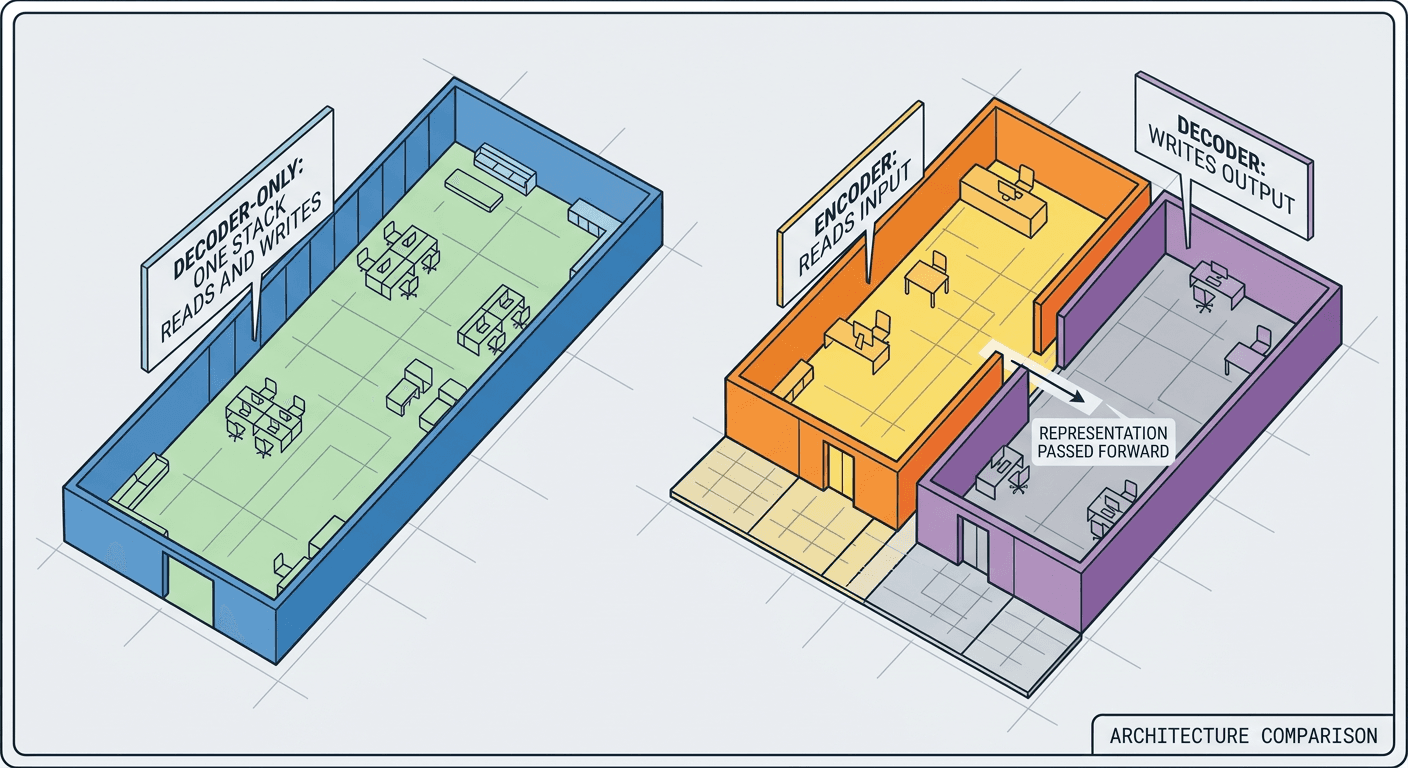
Every DeepSeek model since the original V3 line has been decoder-only, the same architectural family GPT-4, GPT-5, Claude, and Gemini all belong to: a single stack of transformer layers that reads a prompt and predicts the next token, one position at a time, using the same weights for understanding the input and generating the output. V4.1-Flash breaks from that lineage. DeepSeek is calling its new design a Causal Encoder-Decoder architecture, and both sources describing the release agree this is a genuine departure from the decoder-only pattern DeepSeek had used through V4-Pro, not a rebranding of the same mechanism [1] [2].
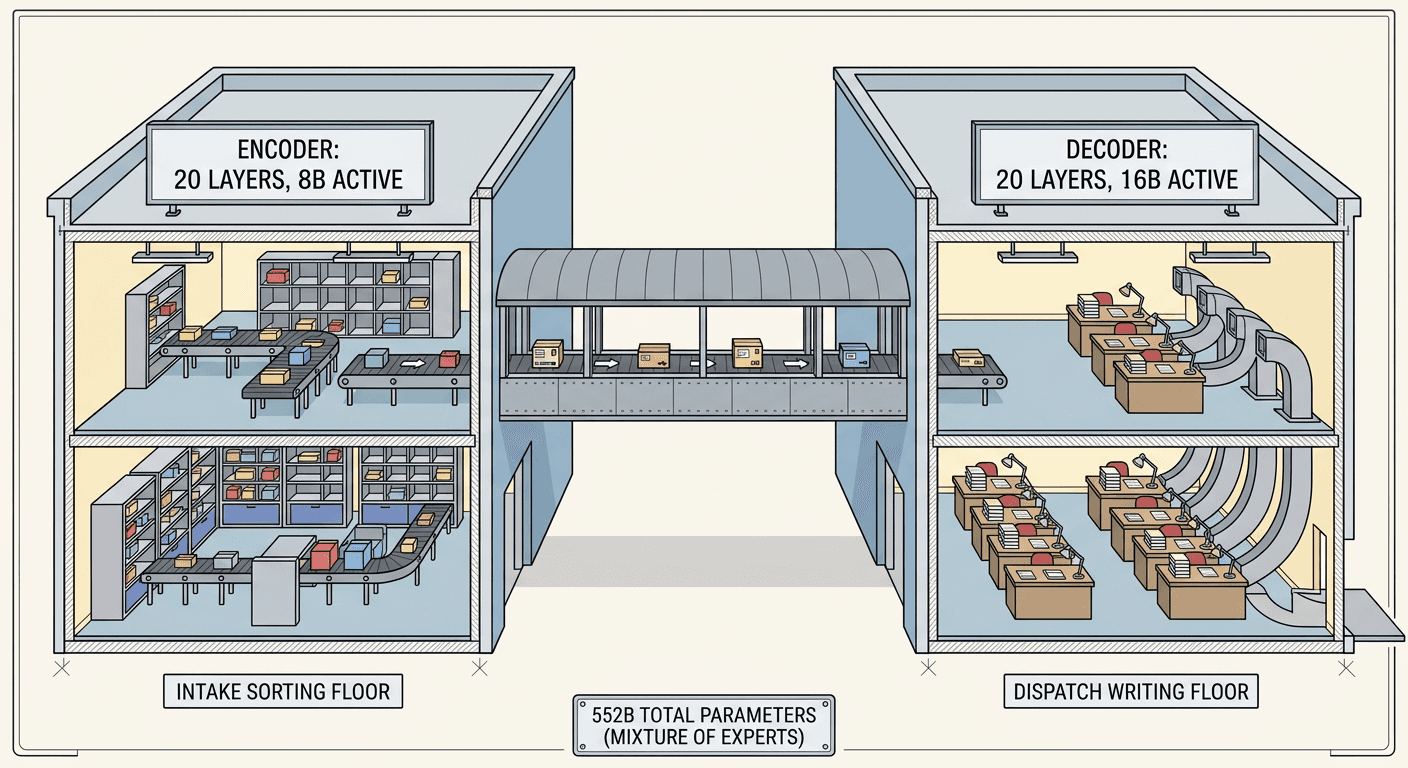
The split works like this. An encoder stack of 20 transformer layers, activating 8 billion parameters, is responsible for reading and processing the input: the prompt, the retrieved context, the conversation history, any tool outputs fed back into the model. A separate decoder stack, also 20 layers deep but activating 16 billion parameters, is responsible for generating the output token by token [1] [2]. Both stacks sit inside a much larger mixture-of-experts system, with the full model totaling 552 billion parameters, of which only a fraction activate for any given token, the same sparse-activation principle that has defined the entire DeepSeek V4 lineage and most other frontier MoE models released in 2026 [1] [2].
Why Split Input Processing From Output Generation At All
It is worth being precise about why an encoder-decoder split is a meaningfully different design choice rather than a cosmetic one, because the reasoning explains a lot about where V4.1-Flash's benchmark gains actually come from.
In a decoder-only model, the same set of weights and the same attention computation handle two jobs that have genuinely different statistical structure. Reading a long input, a codebase, a document, a multi-turn agent trace, is fundamentally a bidirectional-context problem: the meaning of a token in the middle of a function definition depends on tokens both before and after it in that function, and a model benefits from being able to attend to the entire input freely before committing to any interpretation of it. Generating output, by contrast, is a strictly causal problem: each new token can only depend on tokens already generated, because nothing after it exists yet. Decoder-only models handle both jobs with causal masking throughout, which means even while reading the input, the model is technically restricted to left-to-right attention, a real if usually tolerable compromise that has been baked into the entire GPT-style lineage since its inception.
An encoder-decoder split lets each half specialize. The encoder can process the input with attention patterns tuned for comprehension rather than generation, building a richer internal representation of what a codebase, a long document, or an agent's tool history actually contains before the decoder ever starts writing a token. The decoder then draws on that representation while generating, staying purely causal because generation genuinely is a causal problem, but doing so against an input representation that was built without the generation-side compromises decoder-only architectures inherit. This is not a new idea in absolute terms: the original Transformer paper itself was an encoder-decoder design, and the T5 line of models built an entire generation of NLP research on the same split. What is new is applying it at frontier MoE scale, with a causal formulation, to the specific problem of long-context agentic and coding work, which is exactly the category where DeepSeek reports its clearest V4.1-Flash gains [2].
The practical case for why this shows up specifically in agentic and coding benchmarks, argued from well-understood properties of the two task types rather than any DeepSeek-published mechanism paper, is that both task types spend most of their token budget on comprehension rather than generation. An agent working through a multi-step coding task reads far more than it writes: a large existing codebase, several files of context, a tool call's output, an error trace, before producing a comparatively short diff or command. A model whose encoder is purpose-built to compress and represent that large read-heavy context efficiently, separate from the generation path, is architecturally well positioned for exactly that token distribution. This reasoning is a plausible explanation for the pattern in V4.1-Flash's benchmark results, not a confirmed internal mechanism DeepSeek has published; treat it as informed technical interpretation rather than an official claim.
The Parameter Split Is Asymmetric on Purpose
One detail worth sitting with is that the decoder gets twice the active parameter budget of the encoder, 16 billion versus 8 billion, despite both stacks being the same 20 layers deep [1] [2]. That asymmetry is a real design signal. Generation is where the model has to commit to specific tokens, maintain coherence across potentially tens of thousands of output tokens given the 384,000 token maximum output ceiling, and do so while satisfying whatever task constraints the prompt implied. Comprehension, while genuinely important, is a lower-dimensional problem in the sense that the encoder's job ends once it has produced a useful representation for the decoder to consume, it does not have to independently sustain long-range coherence the way generation does. Weighting the decoder more heavily is consistent with that asymmetry, and it is a different allocation strategy than simply doubling every layer's width uniformly, which is what a less deliberate architecture search might have produced instead.
Context Window, Output Limits, and the KV Cache Story
V4.1-Flash ships a 1 million token context window with a maximum output of 384,000 tokens [1] [2]. Both numbers matter on their own, a 1M token context is enough to hold a genuinely large codebase, a lengthy legal document set, or a long multi-session agent history in a single call, and a 384K output ceiling is large enough to generate a full long-form document, a large refactor, or an extended multi-step agent transcript without truncation. But the more interesting engineering story is not the raw context size, it is what makes serving that context affordable at all: the KV cache.
Why KV Cache Size Is the Real Constraint on Long Context
Every transformer-based model, decoder-only or encoder-decoder, has to store a key-value cache for every token in its active context so it can attend back to earlier tokens without recomputing their representations from scratch on every new generated token. That cache lives in GPU high-bandwidth memory, HBM, while the model is actively serving a request, and it scales linearly with context length. A 1 million token context window is only usable in practice if the per-token KV cache cost is small enough that the total cache for a full-length request still fits in the memory budget of the hardware actually serving it, alongside the model's own weights and everything else competing for that same memory. This is the real reason so many models advertise large context windows that are technically supported but prohibitively expensive or slow to actually use at full length: the KV cache, not the attention computation itself, is usually the binding constraint.
DeepSeek's own announcement frames V4.1-Flash's KV cache efficiency as a ratio rather than a specific byte figure: the model's HBM requirement for serving a given context is one quarter of what prior DeepSeek models needed, and the SSD storage requirement for cache offloading is one eighth [1]. Both of those are meaningful, corroborated claims from the primary source, and they translate directly into practical outcomes: a given GPU fleet can serve roughly four times as many concurrent long-context requests in HBM, or offload cache to SSD at roughly one eighth the storage footprint when a request needs to persist context across a longer-running agent session than fits comfortably in memory.
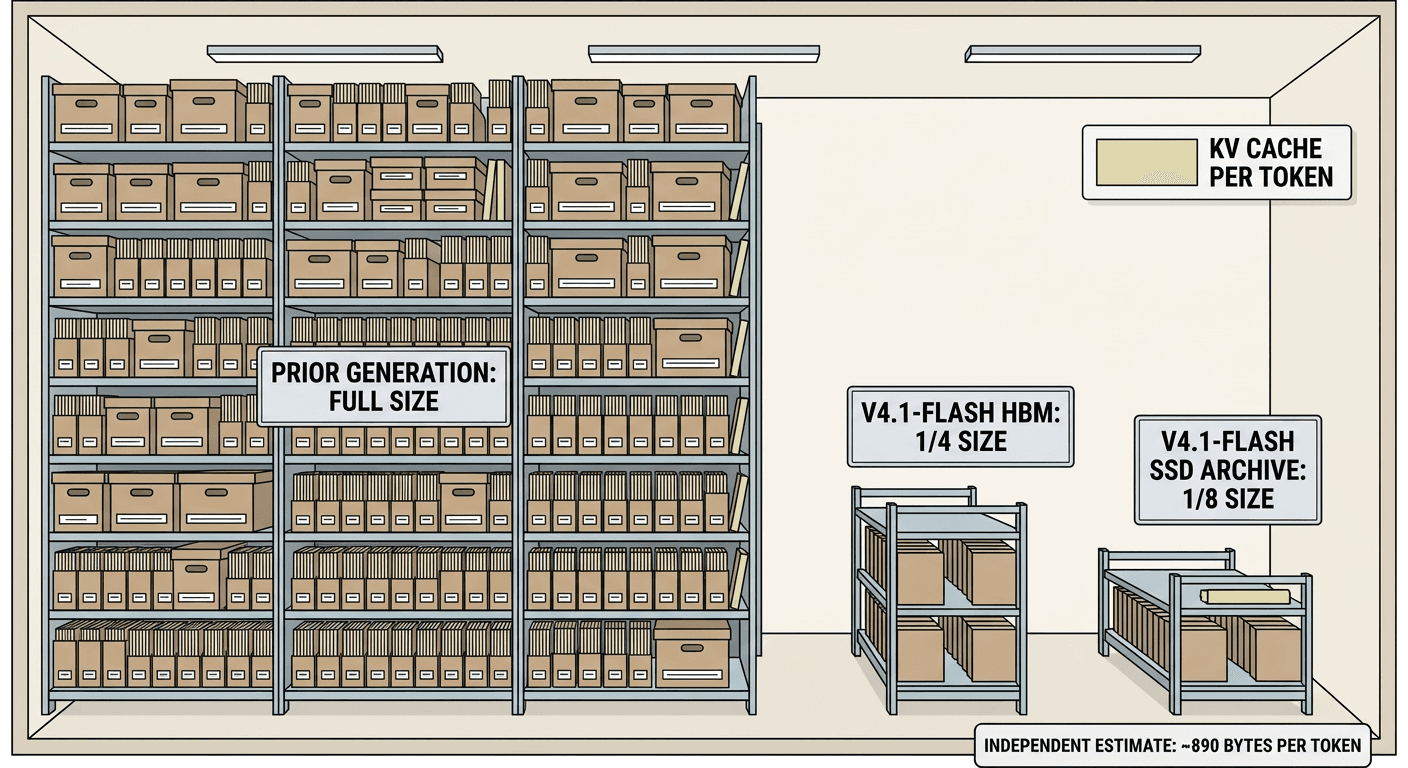
The independent technical writeup from eesel goes further and puts an actual number on it: roughly 890 bytes per token for V4.1-Flash's KV cache, compared to a much larger figure it cites for an earlier DeepSeek generation, on the order of 389,120 bytes per token [2]. That specific byte-level figure is worth treating with real caution before repeating it as an established fact. It comes from a single independent source rather than DeepSeek's own technical documentation, and the exact prior-generation baseline it is being compared against is not fully specified in a way this post can independently verify. Read it as a useful illustrative estimate of the scale of the improvement, roughly consistent in direction and rough magnitude with DeepSeek's own 4x HBM and 8x SSD ratio claims, rather than as a precise, DeepSeek-confirmed number. The ratio claim from the official announcement is the better-corroborated fact to build any capacity planning around; the raw byte figure is a helpful sanity check on scale, not a spec sheet number.
What This Means for Anyone Actually Serving Long-Context Requests
For a team evaluating V4.1-Flash specifically for long-context or long-running agentic workloads, the KV cache efficiency is arguably a bigger deal than the raw 1M token ceiling. A context window a model technically supports but cannot serve affordably at scale is a marketing number, not a usable feature. A four-times reduction in HBM requirement per token means the practical, affordable operating point for long-context requests sits meaningfully closer to that 1M ceiling than it would on a model without the same efficiency gain, which matters directly for any workload that regularly pushes into the hundreds of thousands of tokens of context, long document analysis, large-codebase agentic coding, or multi-session conversational memory carried forward across many turns.
Benchmark Analysis: Where V4.1-Flash Actually Wins and Where It Does Not
Benchmark numbers are where a lot of model launch coverage gets lazy, either repeating a vendor's own cherry-picked comparison uncritically or ignoring the numbers that do not flatter the story. The honest picture for V4.1-Flash, per the independent eesel writeup, is genuinely mixed, and that mixed picture is more useful to an engineering team than a clean sweep would be.
| Benchmark | DeepSeek-V4.1-Flash Score | What It Measures |
|---|---|---|
| Terminal-Bench 2.1 | 90.6 | Real terminal / command-line agentic tasks |
| DeepSWE (SWE-bench-style) | 74.2 | Resolving real, test-verified software engineering issues |
| Humanity's Last Exam (no tools) | 36.8 | Broad, closed-book frontier reasoning |
| Humanity's Last Exam (with tools) | 63.9 | Frontier reasoning augmented with tool access |
Terminal-Bench 2.1 measures how well a model handles real terminal and command-line agentic tasks, the kind of multi-step, tool-calling work a coding agent actually does day to day rather than a single isolated code-completion prompt. A score of 90.6 on that benchmark is a strong result for tasks that resemble actual developer tooling usage: running commands, interpreting their output, and chaining follow-up actions correctly [2]. DeepSWE, DeepSeek's own SWE-bench-style evaluation, measures the model's ability to resolve real, verifiable software engineering issues, closer to how SWE-bench itself works, where a model has to produce a patch that actually passes a held-out test suite rather than just producing plausible-looking code. A 74.2 score there is consistent with the encoder-decoder architecture's reasoning above: a model whose encoder is purpose-built for digesting a large existing codebase before the decoder starts writing a fix is architecturally suited to exactly this kind of task [2].
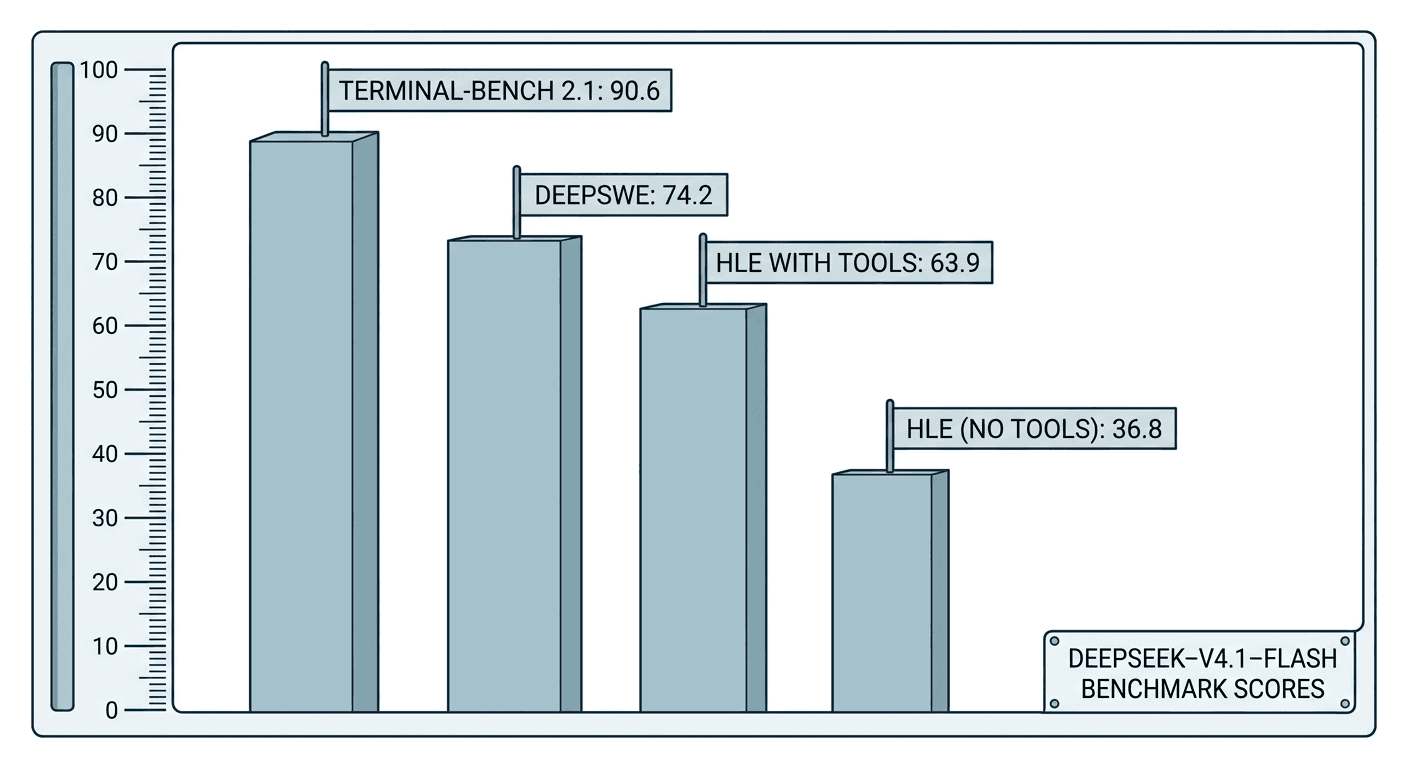
Humanity's Last Exam, HLE, is the number that tells a different story, and it is important to state it plainly rather than soften it. HLE is designed as a genuinely hard, broad reasoning benchmark, deliberately built to resist saturation by frontier models the way many earlier benchmarks had been saturated. V4.1-Flash scores 36.8 on HLE without tool access, well behind Claude Opus 5's 56.3 and GPT-5.6 Sol's 44.5 on the same benchmark [2].
| Model | Humanity's Last Exam Score (no tools) |
|---|---|
| Claude Opus 5 | 56.3 |
| GPT-5.6 Sol | 44.5 |
| DeepSeek-V4.1-Flash | 36.8 |
That gap is real and worth being direct about: V4.1-Flash is not a frontier-reasoning model in the way Opus 5 or GPT-5.6 Sol are, and nothing in DeepSeek's own architecture story changes that fact. What does change the picture somewhat is HLE with tool access, where V4.1-Flash's score rises to 63.9, a large jump from its no-tools score [2]. That gap between tools-off and tools-on performance is itself informative about what V4.1-Flash actually is: a model whose real strength is agentic execution, using tools, running code, iterating on terminal output, rather than raw unaided reasoning in a closed-book setting. A model that closes most of the distance to frontier reasoning models specifically once it is allowed to act rather than only think is a different kind of tool than a model that is simply strong at reasoning in isolation, and evaluating it against the wrong axis will produce the wrong conclusion either way.
Not a Universal Upgrade Over V4-Pro Either
It would be a mistake to read V4.1-Flash's retirement of V4-Pro as a claim that V4.1-Flash strictly dominates its predecessor on every axis. The more accurate characterization, per the independent benchmarking source, is that V4.1-Flash edges out V4-Pro on most agentic and coding tests, which is a real and meaningful result, a cheaper, faster model beating a more expensive flagship on the tasks that make up the bulk of real production traffic, but it is a "most," not an "all" [2]. DeepSeek's own decision to route V4-Pro traffic to V4.1-Flash rather than sunsetting V4-Pro outright with no replacement suggests the company judged the aggregate tradeoff worth making for its API-wide default, not that every individual workload will see an improvement. A team with a workload concentrated specifically in the areas where V4-Pro held an edge, rather than the agentic and coding tasks where V4.1-Flash wins, is exactly the kind of case worth benchmarking directly against your own evaluation set before assuming the rerouted default is strictly better for you, rather than just cheaper and faster on average.
Pricing and Cost Modeling: Peak Versus Off-Peak, With a Worked Example
V4.1-Flash's pricing is where the architecture and benchmark stories turn into a direct operational decision, because DeepSeek built time-of-day demand pricing directly into the API rather than offering a single flat rate.
| Pricing Tier | Input (per million tokens) | Cached Input (per million tokens) | Output (per million tokens) |
|---|---|---|---|
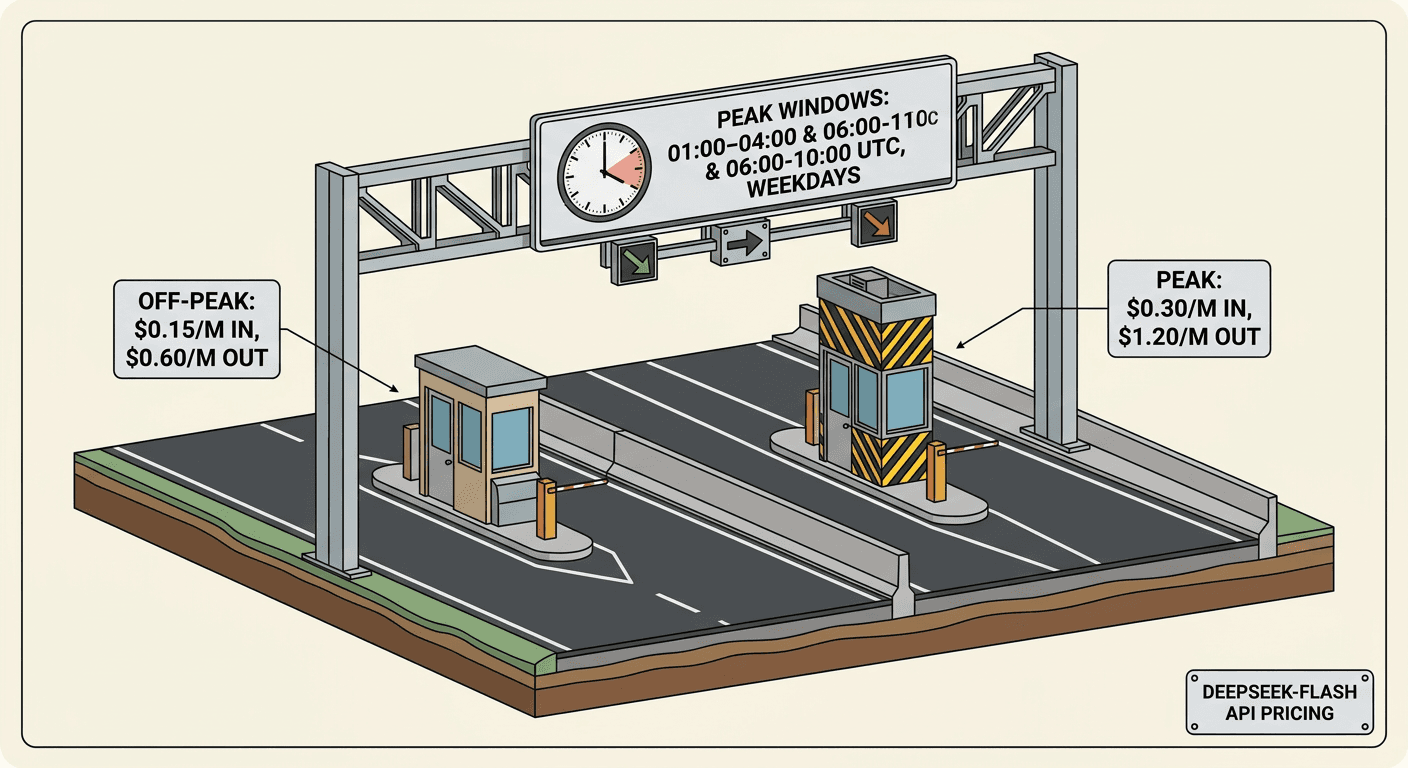
| Off-peak | $0.15 | $0.003 | $0.60 |
| Peak (01:00-04:00 & 06:00-10:00 UTC, weekdays) | $0.30 | $0.006 | $1.20 |
The off-peak rate is $0.15 per million input tokens on a cache miss, $0.003 per million on a cached input hit, and $0.60 per million output tokens. The peak rate, which applies during two windows, 01:00 to 04:00 UTC and 06:00 to 10:00 UTC, on weekdays, is exactly double every one of those figures: $0.30 per million input tokens on a cache miss, $0.006 per million on a cached hit, and $1.20 per million output tokens [2]. That clean 2x multiplier across every single pricing tier is itself worth noting, it means a team does not need to separately reason about how caching interacts with peak pricing, the discount cached input gets relative to fresh input stays proportionally identical whether you are inside or outside the peak windows.
Set against DeepSeek's own prior generation, this pricing undercuts the outgoing V4-Flash rate and runs at roughly a third of what V4-Pro previously charged, which is itself part of why the retirement makes commercial sense on top of the benchmark case: DeepSeek is not asking customers to pay more for a model that wins most of the tests that matter, it is charging meaningfully less for it [2].
Checking Which Pricing Window You Are In, In Code
The peak windows are defined in UTC, not in the calling application's local timezone, which is an easy detail to get wrong if a cost-monitoring script is written against local server time instead. A correct implementation needs to convert to UTC first, then check both windows and the weekday condition:
python/code
from datetime import datetime, timezone

def is_peak_pricing(now: datetime | None = None) -> bool:
    """Return True if the given moment (default: current UTC time) falls
    inside one of DeepSeek's two weekday peak-pricing windows:
    01:00-04:00 UTC or 06:00-10:00 UTC, Monday through Friday.

    Peak windows are defined in UTC, not local server time, so always
    convert first. A naive datetime is assumed to already be in UTC;
    pass an aware datetime if you are converting from another timezone.
    """
    if now is None:
        now = datetime.now(timezone.utc)
    elif now.tzinfo is not None:
        now = now.astimezone(timezone.utc)

    is_weekday = now.weekday() < 5  # Monday=0 ... Friday=4
    hour = now.hour

    in_first_window = 1 <= hour < 4
    in_second_window = 6 <= hour < 10

    return is_weekday and (in_first_window or in_second_window)


def current_rate_multiplier(now: datetime | None = None) -> float:
    """DeepSeek's peak pricing is a flat 2x multiplier over off-peak
    across every tier (input, cached input, and output alike)."""
    return 2.0 if is_peak_pricing(now) else 1.0


if __name__ == "__main__":
    now = datetime.now(timezone.utc)
    print(f"UTC time: {now.isoformat()}")
    print(f"Peak pricing active: {is_peak_pricing(now)}")
    print(f"Rate multiplier vs off-peak: {current_rate_multiplier(now)}x")
A Worked Example: A 50,000-Token Agentic Coding Session
To make the peak-versus-off-peak difference concrete rather than abstract, walk through a realistic agentic coding session. Assume a session where an agent reads a meaningful amount of surrounding code, test output, and prior conversation turns before producing a comparatively smaller diff or set of commands, a reasonable split for this kind of workload is roughly 40,000 input tokens against 10,000 output tokens for the session, adding up to the 50,000 total tokens in this example. These specific input and output figures are a modeling assumption for illustration, not a number published by DeepSeek, and any real team should replace them with the actual split their own agent traces show.
Run entirely at off-peak rates with no cache hits: 40,000 input tokens at $0.15 per million costs $0.006, and 10,000 output tokens at $0.60 per million costs $0.006, for a total of $0.012 per session. Run the identical session during a peak window: input costs $0.012 and output costs $0.012, for a total of $0.024 per session, exactly double, which follows directly from the flat 2x multiplier described above.
That per-session gap looks trivial in isolation, a little over a cent, but it compounds directly with volume. A team running 200 such agentic sessions a day, a realistic number for a mid-sized engineering organization with agent-assisted CI, code review, or internal tooling running continuously, spends $2.40 a day scheduled entirely off-peak versus $4.80 a day if the same volume happened to land entirely inside peak windows, a difference of $72 versus $144 over a 30-day month purely from when the requests happen to fire, with the underlying workload completely unchanged.
Caching narrows the gap further and is worth layering into the same example. Agentic coding sessions typically reuse a large, mostly unchanging block of context across many turns within the same session, a system prompt, a project's style guide, an unchanged portion of the codebase already read earlier in the session, which is exactly what a KV cache hit on repeated input is built to discount. If 30,000 of the session's 40,000 input tokens are cache hits on repeated context and only 10,000 are genuinely fresh, the off-peak cost drops to $0.0015 for fresh input, $0.00009 for cached input, and $0.006 for output, a total of about $0.0076 per session, roughly 37 percent cheaper than the uncached figure above, purely from designing prompts so that reused context lands in the cache rather than being resent as fresh input every turn.
python/code
# Cost estimator for a deepseek-flash agentic session, modeling both
# peak/off-peak pricing and cache-hit discounts. Off-peak and peak rates
# below are per DeepSeek's published deepseek-flash pricing; adjust the
# session-shape assumptions (input/output/cache split) to match your own
# actual traffic before trusting the output for budgeting.

OFF_PEAK = {
    "input": 0.15,          # $ per million tokens, cache miss
    "cached_input": 0.003,  # $ per million tokens, cache hit
    "output": 0.60,         # $ per million tokens
}
PEAK = {k: v * 2 for k, v in OFF_PEAK.items()}  # peak is a flat 2x multiplier


def session_cost(fresh_input_tokens: int, cached_input_tokens: int,
                  output_tokens: int, peak: bool = False) -> float:
    rates = PEAK if peak else OFF_PEAK
    cost = (
        fresh_input_tokens / 1_000_000 * rates["input"]
        + cached_input_tokens / 1_000_000 * rates["cached_input"]
        + output_tokens / 1_000_000 * rates["output"]
    )
    return round(cost, 6)


if __name__ == "__main__":
    # A 50,000-token agentic coding session: 40,000 input, 10,000 output.
    # Scenario A: no cache hits at all.
    uncached_off_peak = session_cost(40_000, 0, 10_000, peak=False)
    uncached_peak = session_cost(40_000, 0, 10_000, peak=True)

    # Scenario B: 30,000 of the 40,000 input tokens are cache hits on
    # reused context (system prompt, unchanged codebase sections, etc).
    cached_off_peak = session_cost(10_000, 30_000, 10_000, peak=False)

    print(f"Uncached, off-peak:  ${uncached_off_peak}")
    print(f"Uncached, peak:      ${uncached_peak}")
    print(f"Cached, off-peak:    ${cached_off_peak}")

    daily_sessions = 200
    print(f"\n{daily_sessions} sessions/day, uncached, off-peak: ${round(uncached_off_peak * daily_sessions, 2)}/day")
    print(f"{daily_sessions} sessions/day, uncached, peak:     ${round(uncached_peak * daily_sessions, 2)}/day")
    print(f"{daily_sessions} sessions/day, cached, off-peak:   ${round(cached_off_peak * daily_sessions, 2)}/day")
The broader lesson from this worked example generalizes past the specific numbers: for any team running meaningful volume against deepseek-flash, scheduling latency-tolerant, batchable workloads, nightly test-suite runs, large-scale code migrations, bulk document processing, into the off-peak windows, and structuring prompts to maximize cache hits on repeated context, are both levers with real, compounding effect on total spend, and neither requires anything more sophisticated than the small amount of scheduling and prompt-structuring logic shown above.
How V4.1-Flash Compares to Competing Approaches
Two comparisons matter here: how V4.1-Flash's actual numbers stack up against named frontier competitors, and how its structural approach, a causal encoder-decoder split, differs from the decoder-only design nearly every other frontier lab is still using.
Against Claude Opus 5 and GPT-5.6 Sol on Raw Reasoning
The HLE comparison earlier in this post is the clearest head-to-head available: Claude Opus 5 at 56.3, GPT-5.6 Sol at 44.5, and DeepSeek-V4.1-Flash at 36.8, all on the same benchmark [2]. It would be inaccurate to describe V4.1-Flash as competitive with either of those models on raw, tools-off reasoning, and this post is not going to soften that gap. What is a fairer comparison is cost and task fit. Opus 5 and GPT-5.6 Sol are both positioned, and priced, as frontier reasoning-first models, while V4.1-Flash is priced as a Flash-tier model that happens to have replaced its own lab's flagship specifically because it is strong at agentic execution rather than closed-book reasoning. Comparing V4.1-Flash to Opus 5 purely on HLE and concluding V4.1-Flash is simply a worse model misses that these three models are not really competing for the same workload in the first place. A team choosing between them for an agentic coding pipeline, where HLE-with-tools performance and cost per session matter more than closed-book HLE score, would reasonably weigh V4.1-Flash's 63.9 tools-on figure and its pricing far more heavily than its 36.8 tools-off number.
Structurally: Encoder-Decoder Versus the Decoder-Only Default
The more interesting long-term comparison is architectural rather than numerical. Every other frontier lab whose flagship models this post has covered in 2026, OpenAI's GPT line, Anthropic's Claude line, Google's Gemini line, has stayed decoder-only through its most recent releases. That is not an oversight, decoder-only architectures have a real, well-understood engineering advantage: a single stack of weights doing both comprehension and generation is simpler to train, simpler to scale, and simpler to serve, since there is only one set of layers to shard across accelerators rather than two separately sized stacks with different activation patterns to coordinate.
DeepSeek's bet with V4.1-Flash is that the specialization benefit of splitting comprehension from generation, described in the architecture section above, is worth the added system complexity for the specific class of workload it targets, agentic and coding tasks that are read-heavy relative to how much they generate. Whether other labs follow with their own encoder-decoder frontier releases is genuinely unknown, and this post is not predicting that they will. What is a fair, narrower claim is that V4.1-Flash's benchmark profile, strong on tool-heavy agentic and coding tasks, comparatively weaker on closed-book reasoning, is at least consistent with the architectural story: an encoder built to compress large input context efficiently pairs naturally with tasks that are mostly about digesting a lot of input and producing a comparatively focused output, which describes agentic coding well and describes open-ended abstract reasoning less well.
| Model | Humanity's Last Exam Score (no tools) |
|---|---|
| Claude Opus 5 | 56.3 |
| GPT-5.6 Sol | 44.5 |
| DeepSeek-V4.1-Flash | 36.8 |
Common Mistakes and Misconceptions When Adopting V4.1-Flash
A handful of assumptions come up quickly whenever a team starts evaluating a newly released model, and several of them apply to V4.1-Flash in ways that are easy to get wrong.
The first, and probably most consequential, is assuming a "flash" tier model is automatically a downgrade from a "pro" tier model because that is the usual naming convention across the industry. That assumption is exactly backwards here. DeepSeek's own routing decision, sending all deepseek-v4-pro traffic to V4.1-Flash rather than the reverse, is the company's own verdict that the naming convention does not hold in this specific case [1] [2]. A team that reflexively treats "Flash" as inferior and keeps pinning requests to a legacy alias, or manually routes around the new default expecting worse quality, is working against DeepSeek's own benchmarking rather than with it, at least for the agentic and coding workloads where V4.1-Flash's advantage is real and measured.
The second common mistake is estimating API costs using only the off-peak rate, or only the peak rate, without accounting for which windows a production workload's real traffic actually falls into. Peak pricing runs from 01:00 to 04:00 UTC and again from 06:00 to 10:00 UTC on weekdays, a schedule that does not map cleanly onto any single region's business hours, meaning a team headquartered in, say, US Pacific time might be running its heaviest daytime traffic entirely off-peak by UTC clock time without realizing it, while a team in a different timezone could be landing squarely inside both peak windows during its own normal working hours. Modeling cost from a single flat rate, in either direction, will produce a materially wrong budget forecast for any workload with real volume; the peak-window checker code earlier in this post is a minimal example of the kind of logic that needs to sit in front of any serious cost estimate.
The third mistake is assuming DeepSeek's history of shipping multimodal capability, most recently with the V4-Flash-Vision-Exp release, means V4.1-Flash carries similar multimodal or vision capability by default. Nothing in either source describing V4.1-Flash's release claims vision or multimodal benchmark results for this specific model [1] [2]. V4.1-Flash's headline capability is agentic, text-and-code reasoning with the new causal encoder-decoder architecture, not multimodal input handling, and a team that assumes otherwise because of DeepSeek's prior release under a similarly named "Flash" family risks building an image- or document-vision-dependent pipeline against a model that was never benchmarked, or necessarily built, for that use case. If a workload genuinely needs vision input, the August 21 Vision-Exp release remains the model to evaluate specifically for that, not an assumption carried over from the name alone.
A fourth, subtler mistake is treating the "edges out V4-Pro on most agentic and coding tests" result as a strict, universal upgrade rather than the qualified, aggregate result it actually is. As covered in the benchmark section above, "most" is doing real work in that sentence. A team with an unusual workload profile, one that happens to sit in the minority of tasks where V4-Pro still held an edge, should still run its own evaluation against V4.1-Flash before assuming the platform-wide default improvement applies to its specific case, rather than inheriting DeepSeek's aggregate judgment uncritically.
Production Best Practices for Integrating deepseek-flash
For a team actually wiring deepseek-flash into a production system rather than just reading benchmark numbers, a handful of concrete practices matter more than the rest.
Start with the model identifier itself. The API model id is deepseek-flash, and DeepSeek is deprecating both the outgoing V4-Flash and the V4-Flash-Vision-Exp identifiers with routing compatibility, meaning existing calls to those older model ids keep working, silently rerouted rather than hard-failing [1] [2]. That routing compatibility is convenient for avoiding a breaking change on day one, but it is not a substitute for actually updating your code to call deepseek-flash directly and pinning to it deliberately, since relying on an undocumented reroute for a model id DeepSeek has explicitly marked as being phased out is exactly the kind of technical debt that turns into an unplanned incident the day the compatibility routing itself gets removed.
Here is a minimal, realistic integration pattern using the DeepSeek API's OpenAI-compatible chat completions endpoint:
python/code
import os
from openai import OpenAI

# DeepSeek's API is OpenAI-compatible, so the standard OpenAI SDK works
# against it once the base_url and api_key are pointed at DeepSeek.
# Call the current deepseek-flash model id directly rather than relying
# on the deprecated deepseek-v4-pro / deepseek-v4-flash routing
# compatibility, which is meant as a transition aid, not a long-term
# integration target.

client = OpenAI(
    api_key=os.environ["DEEPSEEK_API_KEY"],
    base_url="https://api.deepseek.com",
)

def run_agentic_coding_turn(system_prompt: str, codebase_context: str, user_instruction: str):
    """A minimal chat completion call against deepseek-flash.

    Ordering matters for caching: keep the large, reusable
    codebase_context block in the same position and wording across
    calls within a session so DeepSeek's cache-hit pricing actually
    applies to it, rather than resending it with small formatting
    changes that would register as fresh, uncached input each time.
    """
    response = client.chat.completions.create(
        model="deepseek-flash",
        messages=[
            {"role": "system", "content": system_prompt},
            {"role": "user", "content": codebase_context},
            {"role": "user", "content": user_instruction},
        ],
        max_tokens=8000,
        temperature=0.2,
    )
    return response.choices[0].message.content


if __name__ == "__main__":
    system_prompt = (
        "You are an agentic coding assistant. Read the provided codebase "
        "context and respond only with the requested change."
    )
    codebase_context = "<large, stable codebase context reused across turns>"
    user_instruction = "Fix the failing test in checkout_test.py and explain the root cause."

    result = run_agentic_coding_turn(system_prompt, codebase_context, user_instruction)
    print(result)
Beyond the basic call pattern, three practices matter for anyone running this in production rather than a notebook. First, structure prompts so that stable, reusable context, system instructions, style guides, unchanging portions of a codebase, appears first and consistently across calls within a session, since that is what makes DeepSeek's cache-hit discount actually apply; content that shifts position or wording between calls will not register as a cache hit even if it is semantically identical. Second, build cost monitoring around the peak-window logic shown earlier rather than a single blended average rate, since a blended estimate will systematically over- or under-forecast depending on how your actual traffic distributes across the UTC day, and that error compounds at scale in exactly the way the worked example above showed. Third, given the honest benchmark picture from earlier in this post, that V4.1-Flash is strong at tool-using agentic work and comparatively weaker at closed-book reasoning, route tasks accordingly rather than sending every request type to the same model: agentic coding, terminal-driven automation, and tool-augmented workflows are squarely where this model earns its benchmark numbers, while a task that genuinely needs frontier closed-book reasoning with no tool access is better served by a model actually benchmarked for that, whether that is a different DeepSeek model or a competitor entirely.
For teams building broader AI-driven content or automation pipelines, the same inference cost and latency tradeoffs that matter for an agentic coding workload apply just as directly to a media generation pipeline. A platform like Miraflow AI, which chains script generation, scene planning, and multiple downstream generation steps together inside tools like Text2Shorts, cares about exactly this kind of model-routing and time-of-day cost decision at the infrastructure layer, even though the reader-facing product is a creative tool rather than a developer API. The underlying lesson, that a cheaper, well-matched model for a specific task category can genuinely outperform a more expensive general-purpose one on both cost and quality, generalizes well past DeepSeek's own API.
Conclusion
DeepSeek-V4.1-Flash is a genuinely new architecture family, not an incremental update dressed up with a new name, and the fact that it is replacing V4-Pro in production starting today rather than launching as a parallel option says something real about how confident DeepSeek is in the result. The causal encoder-decoder split, an 8 billion active-parameter encoder paired with a 16 billion active-parameter decoder inside a 552 billion parameter mixture-of-experts model, is a structural bet that specializing comprehension away from generation pays off specifically for agentic and coding work, and the Terminal-Bench, DeepSWE, and HLE-with-tools numbers back that bet up in the domains where it was designed to win [1] [2]. The honest counterweight is just as important to hold onto: a 36.8 on closed-book Humanity's Last Exam, well behind Claude Opus 5 and GPT-5.6 Sol, means this is not a frontier reasoning model, and DeepSeek's own retirement of V4-Pro was framed around winning most tests, not all of them.
For a team actually deciding whether to build on deepseek-flash, the practical takeaways are concrete rather than abstract: the model is well matched to agentic, tool-heavy, coding-adjacent workloads specifically, its KV cache efficiency makes its large context window genuinely usable rather than a marketing ceiling, its pricing rewards teams that schedule flexible workloads off-peak and structure prompts for cache hits, and it should not be assumed to carry vision capability, or to universally beat V4-Pro on every task, just because of its benchmark headline. A flash-tier model replacing a pro-tier flagship is a notable moment in how DeepSeek is positioning its own lineup, and it is worth watching whether other labs follow with their own encoder-decoder experiments now that a frontier-scale one has real, measured production benchmarks behind it rather than only a research paper.
Frequently Asked Questions
What is the DeepSeek API model id for V4.1-Flash? deepseek-flash. Existing calls to the outgoing deepseek-v4-flash and deepseek-v4-flash-vision-exp model ids continue to work through routing compatibility while DeepSeek phases those identifiers out, but new integrations should call deepseek-flash directly [1] [2].
Is DeepSeek-V4.1-Flash the same model as the August 21, 2026 DeepSeek-V4-Flash-Vision-Exp release? No. Vision-Exp was a multimodal preview released August 21, 2026, built on the prior V4-Flash line. V4.1-Flash is a separate, later release, reaching general availability September 10, 2026, built on an entirely new causal encoder-decoder architecture family with no published vision or multimodal benchmark results.
Why is deepseek-v4-pro being rerouted to V4.1-Flash instead of the reverse? Because independent benchmarking found V4.1-Flash edges out V4-Pro on most agentic and coding tests while running at roughly a third of V4-Pro's former price, per the eesel technical writeup on the release [2]. DeepSeek judged that aggregate result strong enough to make V4.1-Flash the new default for existing V4-Pro traffic rather than keeping V4-Pro as the flagship.
Does V4.1-Flash beat Claude Opus 5 or GPT-5.6 Sol? Not on raw closed-book reasoning. On Humanity's Last Exam without tool access, V4.1-Flash scores 36.8 against Opus 5's 56.3 and GPT-5.6 Sol's 44.5. With tool access, V4.1-Flash's HLE score rises to 63.9, reflecting its architecture's apparent strength in tool-using agentic execution rather than unaided abstract reasoning [2].
How does the peak pricing window actually work? Peak pricing applies from 01:00 to 04:00 UTC and again from 06:00 to 10:00 UTC, Monday through Friday, and is exactly double the off-peak rate across every pricing tier, input, cached input, and output alike. Outside those windows, and on weekends, off-peak pricing applies [2].
Should I assume V4.1-Flash handles images or documents well because DeepSeek shipped a vision model recently? No. Neither source describing V4.1-Flash's release reports vision or multimodal benchmark results for this model. If a workload genuinely needs vision input, evaluate the dedicated August 21 Vision-Exp release for that specific capability instead of assuming it carries over.
References and Sources
[1] DeepSeek. "DeepSeek-V4.1-Flash."
[2] eesel AI. "DeepSeek V4.1 Flash."