DeepSeek-V4-Flash-Vision-Exp Explained: The Multimodal Model That Didn't Get Dumber

Written by
Aerin Kim

DeepSeek's August 21 vision model adds multimodal agent skill close to Opus-4.8 without hurting its text scores, priced at plain V4-Flash rates with a new reusable Files API.
On August 21, 2026, DeepSeek quietly added one new line to its API model list: deepseek-v4-flash-vision-exp. There was no keynote and no livestream, just a short docs page and a post on X [1] [2]. That understated rollout is becoming something of a house style for DeepSeek. The company's V4-Pro-0813 update, covered in detail in our DeepSeek V4-Pro 0813 architecture breakdown, landed the same quiet way a week earlier, and the actual engineering underneath both releases has consistently been more interesting than the muted announcement style suggests.
This one deserves a close read for a specific reason. DeepSeek is not claiming to have built a better vision model in isolation. It is claiming something narrower and, if true, considerably harder: that V4-Flash-Vision-Exp matches DeepSeek-V4-Flash on text-only agentic tasks, reasoning, and world knowledge, with no regression, while making what the company calls "a major leap" over V4-Flash specifically on multimodal agent benchmarks, close enough to Claude Opus-4.8, Anthropic's own strongest computer-use model, that the two trade wins across a published benchmark table [1] [3]. Bolt vision onto a language model and the text model usually gets worse, not the same. This post is about why that usually happens, what DeepSeek apparently did to avoid it, what the actual numbers say once you look past the headline comparison to Opus 4.8, and how to build against the model directly, including the new Files API that changes the economics of any agent loop that keeps looking at the same image over and over.
If you would rather see the idea than read it, here is a video generation prompt built around "vision added without disturbing the machine underneath," written for a Wan-style video model:
A warm pastel-toned clockwork machine made of many interlocking brass gears turning steadily and smoothly across the whole frame, camera slowly pushing in as a small glowing lens on a delicate mechanical arm lowers gently into place on top of the mechanism without a single gear slowing down or skipping a beat, then a few soft glowing coordinate markers blink into existence and trace a path across the machine's surface in sync with the gears. Clean scientific motion-graphics style, precise geometric shapes, soft pastel lighting, no readable text, no logos, no people, smooth steady dolly-in camera move.
Step 1: What Actually Shipped on August 21
deepseek-v4-flash-vision-exp is exactly what the name says: an experimental, multimodal fork of DeepSeek-V4-Flash, the 284-billion-parameter, 13-billion-active-parameter Mixture-of-Experts model that already sits below V4-Pro in DeepSeek's lineup. The "exp" is doing real work in the name. DeepSeek is explicit that this is an experimental checkpoint, not a permanent replacement for text-only V4-Flash, and the separate model ID is the mechanism that keeps the two from colliding: existing text-only integrations keep calling deepseek-chat or deepseek-v4-flash exactly as before, and nothing changes under them unless a developer deliberately switches endpoints [1].
Four things shipped together on the same day, and it is worth listing them before going deeper into any one of them, because the release is really a bundle rather than a single model drop:
- The model itself, accepting mixed text and image input across three different API shapes: Chat Completions, Anthropic-style Messages, and the newer Responses API [1] [4].
- Three ways to send an image: inline base64 encoding, an external URL, or a new Files API [1] [5].
- The Files API itself, a free service that returns a reusable
file_idfor an uploaded image so later requests can reference it instead of re-sending raw bytes [1] [6]. - DeepSeek Harness 0.1.1, an update to DeepSeek's own open-source agent runtime shipped the same day with out-of-the-box support for the new model, meaning an agent loop built on Harness does not need custom glue code to start passing it screenshots [1] [7].
DeepSeek Harness itself is worth a sentence of context if you have not run into it. It is the agent runtime DeepSeek open-sourced on August 13, 2026 alongside V4-Pro-0813, built around an "everything is a plugin" architecture where the model adapter, the tool registry, and the agent loop itself are all swappable pieces rather than a monolithic framework, and it reportedly passed 100,000 GitHub stars within two days of release [7]. Shipping vision support into Harness on the same day as the model itself is a signal about how DeepSeek expects this model to actually get used: not primarily as a one-off image-description API, but as the vision leg of an agent loop that already exists.
Pricing is the detail most likely to get lost in the announcement and matters most in practice: images are tokenized at up to 384 tokens each and billed at the exact same per-token rate as V4-Flash text, with no separate multimodal price tier [1] [3]. That "no separate tier" phrase is doing more work than it looks like. Most vision-capable APIs on the market price image tokens the same as text tokens per-unit, but the number of tokens an image actually costs varies wildly by provider and resolution, which is functionally a hidden price difference even when the headline rate looks identical. DeepSeek's 384-token cap per image is unusually aggressive; independent reporting on the release puts that at less than half what GPT and Claude-family vision APIs typically spend per image at comparable detail levels, which commonly land in the 800 to 1,100 token range [4] [3]. Step 3 below explains the architectural reason that cap is defensible rather than just a marketing number, and Step 8 turns it into real cost math.
Step 2: Why "No Regression on Text" Is the Hard Part
It helps to be specific about why bolting vision onto an existing language model usually costs you something on the text side, because "the model got worse at everything else" is not a minor footnote in multimodal model releases, it is close to the default outcome.
Most vision-language models are built by taking a pretrained text model, attaching a vision encoder, and continuing training on a mixed corpus of image-text and text-only data. That continued training is where the damage tends to happen. A few different failure modes stack on top of each other. Catastrophic forgetting is the most direct: gradient updates driven by the new multimodal objective nudge weights that were previously tuned for pure text reasoning, and unless the training mix and learning rate schedule are managed carefully, general reasoning and world-knowledge benchmarks quietly slip even though nobody touched them on purpose. Data mix dilution compounds it: every training step spent on image-text pairs is a step not spent reinforcing the text capabilities the base model already had, so a training budget that adds vision without proportionally growing has to borrow from somewhere. And architecturally, a vision encoder that dumps a large number of dense patch tokens into the context window on every image call changes the token economics and attention patterns the language model has to work with, which can degrade performance on long-context or agentic tasks even when accuracy on narrow VQA-style benchmarks looks fine.
This is exactly the pattern DeepSeek's own release claims to have avoided. Independent coverage of the launch specifically notes that "text-based numbers barely move," with V4-Flash-Vision-Exp matching the text-only V4-Flash-0731 checkpoint on most evaluations rather than degrading it [8]. That is the actual headline of this release, arguably more than the Opus-4.8 comparison: DeepSeek appears to have added a meaningfully capable vision modality onto an already-strong agentic text model without paying the usual tax for it.
The Real Mechanism: Thinking with Visual Primitives
The architecture behind this did not appear out of nowhere on August 21. It traces back to a DeepSeek research paper released on April 30, 2026, titled "Thinking with Visual Primitives," authored by researchers from DeepSeek, Tsinghua University, and Peking University, and built directly on the DeepSeek-V4-Flash backbone [9]. Notably, the paper's original repository briefly disappeared from public view about three weeks after release before resurfacing, the kind of quiet here-then-gone-then-back pattern that has become almost a signature of how DeepSeek handles pre-release research [10].
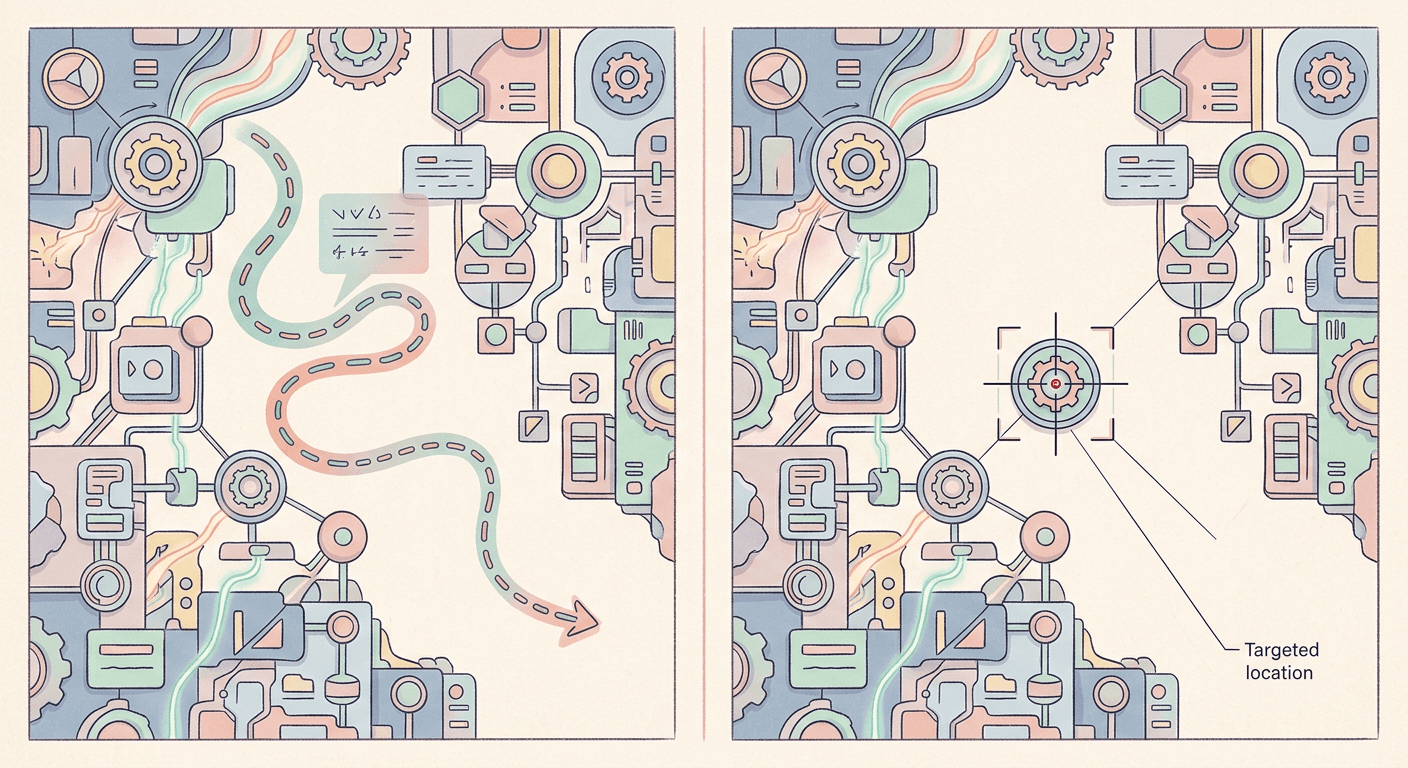
The paper's central diagnosis is that multimodal models actually suffer from two distinct problems, not one, and most vision-language research only addresses the first. The perception gap is the obvious one: a model that cannot see fine detail in an image, addressed by things like high-resolution cropping and dynamic patching, techniques the field has iterated on for years. The reference gap is the less obvious one and the paper's real contribution: even when a model perceives an image correctly, natural language is a genuinely poor medium for pointing at things precisely. Ask a model to describe a crowded scene and reason about it across several steps, and spatial references drift. Pronouns get ambiguous. "The object on the left" stops meaning the same thing three sentences later once the model has mentally moved on, and that drift is a real source of hallucination and broken multi-step visual reasoning, not just an awkward phrasing problem [10].
The fix the paper proposes is to stop describing spatial positions in prose and instead let the model point directly inside its own reasoning trace, using inline coordinate tokens like <ref>label</ref><box>x1,y1,x2,y2</box> interleaved with ordinary chain-of-thought text [10]. These are not tool calls or a separate module bolted onto the side of the model; they are special tokens in the model's own vocabulary that appear directly inside its reasoning, functionally equivalent to circling an object on a whiteboard mid-sentence instead of trying to describe its location in words. Because each reference stays pinned to explicit numeric coordinates rather than a word that can drift in meaning, a long chain of visual reasoning about a busy screenshot or diagram can refer back to "that same box" precisely at step nine that it identified at step two.
That mechanism is also the direct explanation for why the model can hold text quality steady while adding vision. A text-heavy reasoning chain that occasionally emits a coordinate token is architecturally a much smaller perturbation to the model's existing reasoning process than reformulating the entire forward pass around dense image patches the way many vision-language architectures do. Vision augments the reasoning stream instead of replacing how the model reasons in the first place.
Why 384 Tokens Per Image Is Not Just a Marketing Number
The token-efficiency side of the same paper is what makes the 384-token pricing cap defensible rather than an aggressive-sounding round number. The reported pipeline is a genuinely aggressive compression chain: a 756-by-756 pixel image gets tokenized by a vision transformer into roughly 2,916 raw patch tokens, a spatial compression step merges those down to around 324 tokens, and a further compressed-attention pass over the KV cache brings the number of entries the model actually has to keep resident down to about 81 per image, an overall compression ratio in the neighborhood of 7,000x from raw pixels to cached representation [10] [11]. Independent measurement of the resulting KV-cache footprint puts it at roughly 90 entries per image, compared to a reported approximately 870 entries for a comparable Claude Sonnet-family vision call, close to a 10x advantage that translates directly into GPU memory headroom for concurrent requests on the serving side [11].
A small simulation makes the shape of that saving concrete without needing DeepSeek's actual weights:
python/code
# Simplified illustration of the compression pipeline reported for the
# "Thinking with Visual Primitives" architecture underlying V4-Flash-Vision-Exp:
# raw pixels -> ViT patch tokens -> spatial compression -> compressed-attention
# KV cache entries. Real production numbers per DeepSeek's own reporting: a
# 756x756 image yields ~2,916 patch tokens, compressed to ~324 tokens, then
# further compressed to ~81 KV cache entries [11][12].

def compression_pipeline(image_px: int, patch_px: int = 14, spatial_reduction: int = 3, attn_compression: int = 4):
    patches_per_side = image_px // patch_px
    raw_patch_tokens = patches_per_side * patches_per_side
    spatially_compressed = raw_patch_tokens // (spatial_reduction * spatial_reduction)
    kv_cache_entries = spatially_compressed // attn_compression
    return raw_patch_tokens, spatially_compressed, kv_cache_entries

raw, compressed, kv = compression_pipeline(image_px=756)
print(f"Raw ViT patch tokens:      {raw}")
print(f"After spatial compression: {compressed}")
print(f"Final KV cache entries:    {kv}")
print(f"Overall compression ratio: {(756 * 756) / kv:.0f}x from raw pixels to cache entries")
print(f"Billed image tokens (capped): {min(compressed, 384)} (DeepSeek's published 384-token cap)")

The paper's own reported benchmark numbers back this up in the specific niche it targets: on topological reasoning tasks like maze navigation and path tracing, the underlying model scored around 67% against roughly 49 to 50% for comparably-sized frontier vision models tested the same way [11]. It is worth being honest about scope here in the same way the paper itself is: DeepSeek's researchers explicitly flag that this result covers only a narrow subset of visually grounded spatial reasoning, not a claim of superiority across general vision tasks [10] [11]. That kind of scoped, specific claim is exactly the sort of detail that gets flattened into "DeepSeek beats GPT and Gemini at vision" once it travels a few links away from the source, and it is worth resisting that flattening.
This lineage also is not DeepSeek's first pass at squeezing more value out of fewer visual tokens. The company's earlier OCR-focused model demonstrated roughly a 10x context compression by rendering long text as images and processing it through a vision encoder rather than a token-by-token text encoder, a genuinely different technique aimed at the same underlying goal of representing more information per token spent [10]. Visual Primitives is best read as the next entry in a deliberate, multi-year line of research about representation efficiency, not a one-off trick assembled for this particular release.
Step 3: The Benchmark Numbers, and What "Close to Opus-4.8" Actually Means
DeepSeek's own release materials publish a head-to-head table against Claude Opus-4.8 across a set of agent benchmarks, several of which are specifically multimodal rather than pure text evaluations. The numbers below are corroborated across multiple independent outlets that reported on the same published table, which is worth noting given how often benchmark numbers drift between sources, as our earlier V4-Pro-0813 coverage found with a 33-point spread on a single named benchmark once different harnesses were involved.
| Benchmark | V4-Flash-Vision-Exp | Claude Opus 4.8 | Gap |
|---|---|---|---|
| Agents' Last Exam | 27.3 | 25.7 | DeepSeek +1.6 |
| ZeroBench (Pass@5) | 35.0 | 34.0 | DeepSeek +1.0 |
| Chartography | 64.3 | 65.0 | Opus 4.8 +0.7 |
| ApexBench (Pass@1) | 36.5 | 39.4 | Opus 4.8 +2.9 |
| NL2Repo | 57.7 | 69.7 | Opus 4.8 +12.0 |
Four things are worth pulling out of that table rather than treating it as a single win-or-lose scoreline.
First, the model genuinely wins on some multimodal-adjacent benchmarks, not just ties. Agents' Last Exam and ZeroBench, both benchmarks that stress an agent's ability to reason about what it perceives rather than just describe it, both favor V4-Flash-Vision-Exp, by 1.6 and 1.0 points respectively [12] [13]. Those are not the headline wins DeepSeek's marketing leans on, but they are real, and they are the ones most directly relevant to an agent that has to look at something and decide what to do next.
Second, the model trails on more benchmarks than it leads, and the gap widens specifically on the more heavily text-driven agentic evaluations. NL2Repo, a benchmark closer to structured coding agent work than visual perception, shows a real gap: 57.7 against Opus-4.8's 69.7, a 12-point difference [13] [14]. That is consistent with the honest read of this release: DeepSeek is not claiming across-the-board parity with Opus-4.8, it is claiming a specific, large jump in multimodal agent capability relative to its own prior text-only baseline, landing in Opus-4.8's neighborhood on some tasks and behind it on others.
Third, and this is the number that actually supports the "major leap" framing rather than just the Opus-4.8 comparison, is the before-and-after delta against DeepSeek's own text-only V4-Flash. On ApexBench, one report notes the text-only V4-Flash baseline scored 26.2 before vision was added, against V4-Flash-Vision-Exp's 36.5 with vision enabled, a roughly 10-point jump on the same underlying model family [13]. That comparison, not the Opus-4.8 line, is the one that actually demonstrates the multimodal capability gain DeepSeek is claiming, since it holds the base model constant and isolates the effect of adding vision.
Fourth, the harness matters here just as much as it did for V4-Pro-0813's Terminal-Bench spread. Coverage of the release specifically notes the benchmarks were run with a fixed evaluation configuration, reasoning enabled at its maximum tier, top_p set to 0.95, and temperature set to 1.0 [8]. Anyone trying to reproduce these numbers, or comparing them against a benchmark run under different sampling settings, should expect some drift purely from that, independent of anything about the model itself. Treat every number in that table as DeepSeek's own reported figures rather than an independently audited leaderboard result, exactly the caveat one of the outlets covering this release makes explicitly [13].
Put together, the honest summary is this: V4-Flash-Vision-Exp is not simply "a cheaper Opus-4.8." It is a specific, large jump in multimodal agent capability over DeepSeek's own prior generation, landing close enough to Opus-4.8 on visually grounded agent tasks to trade wins on a subset of benchmarks, at V4-Flash pricing, while explicitly not claiming to match Opus-4.8's broader agentic coding strength on tasks like NL2Repo. That is a genuinely useful, narrower claim than the headline comparison suggests, and it is the correct way to decide whether this model fits a given workload.
Step 4: Calling the Model Directly
Because DeepSeek's API is OpenAI-compatible, the standard openai-python client works against it with only the base URL and model name changed. The simplest way to send an image is inline base64 encoding, which is the right default for a one-off image that will not be reused across multiple requests:
python/code
# DeepSeek's API is OpenAI-compatible, so the base64 image input shape works
# with the standard openai-python client, pointed at DeepSeek's endpoint.
import base64
import os
from openai import OpenAI

client = OpenAI(
    api_key=os.environ["DEEPSEEK_API_KEY"],
    base_url="https://api.deepseek.com",
)

with open("screenshot.png", "rb") as f:
    b64_image = base64.b64encode(f.read()).decode("utf-8")

response = client.chat.completions.create(
    model="deepseek-v4-flash-vision-exp",
    messages=[
        {
            "role": "user",
            "content": [
                {"type": "text", "text": "What is the primary call-to-action button on this page, and where is it located?"},
                {"type": "image_url", "image_url": {"url": f"data:image/png;base64,{b64_image}"}},
            ],
        }
    ],
    max_tokens=512,
)

print(response.choices[0].message.content)
print(f"Prompt tokens billed: {response.usage.prompt_tokens}")
A few details in that shape are worth calling out explicitly rather than assuming they are obvious. The content field on a user message becomes a list rather than a plain string the moment an image is involved, mixing a text block with one or more image_url blocks in any order. An image_url block's url field accepts either a data: URI with base64-encoded bytes, exactly as shown above, or a plain external HTTPS URL, in which case DeepSeek's servers fetch the image themselves rather than requiring the client to download and re-encode it [5]. Supported formats are JPEG, PNG, GIF, and WebP, a single image tops out at 32 MiB, and a single request can include up to 600 images, though DeepSeek automatically caps the maximum resolvable edge length at 8,192 pixels per side, dropping to 4,096 pixels once a request includes 15 or more images, presumably to keep aggregate memory pressure bounded on very large batched requests [5].
That external-URL path is worth using whenever the image already lives somewhere reachable, a screenshot stored in cloud storage, a product photo already hosted on a CDN, because it avoids the base64 encoding overhead entirely and keeps request payloads small. Base64 remains the right choice for anything generated locally and never persisted, a screenshot captured mid-agent-loop that only needs to be seen once.
Step 5: The Files API and Why It Changes Agent Economics
Base64 and external URLs both solve the "send one image" problem well. Neither solves a different, extremely common problem in agentic workflows: an agent that needs to look at the same image repeatedly across several separate API calls, because it is reasoning about it in stages, retrying a failed step, or asking a series of follow-up questions about it.
Think about what a browser agent or a coding agent that reads screenshots actually does in practice. It captures a screenshot, asks the model what to click, clicks it, and then very often needs to ask a follow-up question about that same screenshot before the next action, or reference the layout it just saw two or three tool calls later when deciding whether a previous action actually worked. Under base64 encoding, every one of those follow-up calls re-sends the full image bytes again, even though the model already looked at the identical pixels moments earlier. For a large screenshot repeated across a ten-step agent loop, that is meaningfully wasted bandwidth and, since base64 encoding inflates payload size by roughly a third over raw bytes, meaningfully wasted request size on every single call.

The Files API solves this directly. Upload an image once, get back a reusable identifier, and reference that identifier instead of the raw bytes on every subsequent call:
python/code
# Upload an image once via DeepSeek's Files API and get back a reusable
# file_id. purpose must be "user_data"; max file size is 64 MiB.
import os
from openai import OpenAI

client = OpenAI(
    api_key=os.environ["DEEPSEEK_API_KEY"],
    base_url="https://api.deepseek.com",
)

with open("screenshot.png", "rb") as f:
    uploaded = client.files.create(file=f, purpose="user_data")

print(f"Uploaded file id: {uploaded.id}")   # e.g. file-api-8f2c1a9d4b3e...
print(f"Size in bytes:    {uploaded.bytes}")

# Optionally scope how long DeepSeek retains it (1 hour to 30 days):
# client.files.create(file=f, purpose="user_data",
#                      expires_after={"anchor": "created_at", "seconds": 86400})
Once that upload has happened, later chat completion requests reference the same image with a small file content block instead of a multi-kilobyte image_url block:
python/code
# Reference the uploaded image by file_id instead of re-sending raw bytes.
# This request costs the same 384-token-max image cost as the base64 call,
# it just skips re-transmitting and re-encoding the image on the wire.
response = client.chat.completions.create(
    model="deepseek-v4-flash-vision-exp",
    messages=[
        {
            "role": "user",
            "content": [
                {"type": "text", "text": "Is the 'session expired' error banner visible anywhere on this page?"},
                {"type": "file", "file_id": uploaded.id},
            ],
        }
    ],
    max_tokens=256,
)

print(response.choices[0].message.content)
The mental model worth carrying around is a coat check, not a photocopier. You hand the image over once, get back a small ticket, and every subsequent interaction just presents the ticket. Concretely: the upload endpoint is POST /files, accepts the same JPEG, PNG, GIF, and WebP formats as inline images, tops out at 64 MiB per file, and requires purpose set to "user_data" [6]. The response's id field, formatted as file-api-..., is the value later requests pass in a {"type": "file", "file_id": "..."} content block [6]. Uploads can optionally carry an expiration between one hour and 30 days via the expires_after parameter, which matters for anything handling user-uploaded content that should not persist indefinitely on DeepSeek's servers [6].
The Files API itself is free to use, and image tokens billed against a file reference still follow the same 384-token cap and V4-Flash pricing as any other image input, so reusing a file_id does not change the per-call token cost, it only removes the bandwidth and payload-size cost of re-transmitting the same bytes [1] [6]. That distinction matters for how you should think about the savings: the Files API is not a discount on inference, it is a discount on everything upstream of inference, request construction time, client-side encoding CPU, and network transfer, in any workflow that touches the same image more than once.
That specific shape, upload once and reuse across a multi-step loop, is exactly the shape of a coding agent that keeps referring back to a screenshot while it works through a multi-step UI task, or a browser agent that captures one page render and needs to reason about several different elements on it across several separate model calls before acting. It is also exactly the shape of a content pipeline that generates several pieces of copy or a caption referencing the same source image or video frame, which is the same underlying pattern a tool like Miraflow AI's AI Clipping runs at scale when it has to evaluate many candidate moments from a single long video against a consistent set of criteria without re-processing the source repeatedly from scratch.
Step 6: A Worked Example — Building a Screenshot-Reading Agent Loop
The clearest way to see why the Files API matters in practice is to build a small, realistic agent loop and count what it costs with and without it. Imagine a simple UI-testing agent: it is handed one static screenshot of a web page, and it has to answer a sequence of questions about that page, first identifying the primary call-to-action button, then checking whether a specific error state is visible, then confirming the page's overall layout matches an expected structure, three separate model calls against one unchanging image.

Here is that loop implemented two ways, first re-sending the image as base64 on every call, then uploading it once through the Files API and referencing the file_id for every subsequent question:
python/code
# A minimal three-question agent loop against ONE static screenshot,
# implemented two ways so the request-size difference is visible directly.
import base64, os
from openai import OpenAI

client = OpenAI(api_key=os.environ["DEEPSEEK_API_KEY"], base_url="https://api.deepseek.com")
questions = [
    "What is the primary call-to-action button on this page?",
    "Is the 'session expired' error banner visible anywhere?",
    "Does the overall layout use a two-column or single-column structure?",
]

def ask_with_base64(image_path: str, question: str) -> tuple[str, int]:
    with open(image_path, "rb") as f:
        b64 = base64.b64encode(f.read()).decode("utf-8")
    payload_bytes = len(b64.encode("utf-8"))  # re-sent on every call
    resp = client.chat.completions.create(
        model="deepseek-v4-flash-vision-exp",
        messages=[{"role": "user", "content": [
            {"type": "text", "text": question},
            {"type": "image_url", "image_url": {"url": f"data:image/png;base64,{b64}"}},
        ]}],
        max_tokens=256,
    )
    return resp.choices[0].message.content, payload_bytes

def ask_with_file_id(file_id: str, question: str) -> tuple[str, int]:
    payload_bytes = len(file_id.encode("utf-8"))  # only this tiny string is re-sent
    resp = client.chat.completions.create(
        model="deepseek-v4-flash-vision-exp",
        messages=[{"role": "user", "content": [
            {"type": "text", "text": question},
            {"type": "file", "file_id": file_id},
        ]}],
        max_tokens=256,
    )
    return resp.choices[0].message.content, payload_bytes

# Base64 path: every call re-encodes and re-sends the full image.
base64_total_bytes = sum(ask_with_base64("screenshot.png", q)[1] for q in questions)

# Files API path: upload once, then send only the short file_id each time.
with open("screenshot.png", "rb") as f:
    uploaded = client.files.create(file=f, purpose="user_data")
files_api_total_bytes = sum(ask_with_file_id(uploaded.id, q)[1] for q in questions)

print(f"Base64 path image bytes sent across 3 calls:   {base64_total_bytes:,}")
print(f"Files API path image bytes sent across 3 calls: {files_api_total_bytes:,}")
print(f"Reduction: {(1 - files_api_total_bytes / base64_total_bytes):.1%}")
Running that comparison on a realistically sized screenshot, a full-page capture in the few-hundred-kilobyte range rather than a small thumbnail, makes the difference concrete rather than theoretical. The base64 version re-encodes and re-transmits the same bytes, inflated by roughly a third from base64 encoding overhead, on every one of the three calls. The Files API version pays that encoding and transfer cost exactly once, then sends a file reference measured in bytes rather than kilobytes on every subsequent call. Neither version changes the token cost, since the model still processes the same 384 image tokens on every call it looks at the image on, matching the pricing rule from Step 5. What changes is everything upstream of the model: request construction time, outbound bandwidth, and, for a client running on a metered or latency-sensitive connection such as a browser extension or an edge worker, real wall-clock time per step.
Extend that three-question loop to something closer to a real agentic session, a coding agent working through a twenty-step UI automation task where it references the same screenshot repeatedly while planning several actions against it before capturing a new one, and the bandwidth savings compound linearly with the number of steps that reuse the same image. This is precisely the shape of workload DeepSeek Harness 0.1.1 is built to run out of the box, and it is a reasonable bet that the Files API was designed with exactly this agent-loop pattern in mind rather than as a general-purpose file store [1] [7].
Handling a Failed Step: Reasoning About the Same Image Twice
A realistic extension of the loop above is worth walking through because it is where the Files API earns its keep the most. Suppose the agent's first click attempt fails, the target element was slightly misidentified, and the agent needs to look at the same original screenshot again to figure out what went wrong before retrying, rather than the new post-click screenshot. Without a stable reference to the original image, a naive implementation either has to keep the raw bytes around in memory for the duration of the whole task, or re-fetch and re-encode them from wherever they were saved, both of which add real complexity to state management in a long-running agent process. With a file_id obtained once at the start of the task, that original screenshot stays addressable by a short string for as long as its expiration window allows, and the retry-reasoning call looks identical in shape to the very first call that used it, just swapping in the file reference. That uniformity, every reference to a given image looking the same regardless of how many steps have happened since it was captured, is a real simplification for anyone building the state-management layer of an agent loop, not just a bandwidth optimization.
Step 7: Three API Shapes, One Model
DeepSeek explicitly supports three different request shapes for this model: OpenAI-style Chat Completions, Anthropic-style Messages, and the newer Responses API [1] [4]. That is a meaningful compatibility decision, not a cosmetic one. A team that already has an agent framework built against Anthropic's Messages API for a different model does not need to write a translation layer just to add DeepSeek's vision model as an alternate or fallback provider inside the same codebase.
The Chat Completions shape is the one used throughout this post so far, and it is the one most existing OpenAI-compatible tooling already expects. The Messages-style shape follows Anthropic's convention of a top-level system field separate from the messages list, and represents image content as a source block rather than an image_url block, supporting base64, url, and file source types, the last of which needs an anthropic-beta: files-api-2025-04-14 header alongside it [15]:
python/code
# DeepSeek also exposes an Anthropic-compatible Messages API. The official
# anthropic-python client works by pointing base_url at DeepSeek's
# /anthropic path. Image content uses a "source" block instead of
# "image_url", with base64, url, or file source types.
import anthropic

client = anthropic.Anthropic(
    base_url="https://api.deepseek.com/anthropic",
    api_key="YOUR_DEEPSEEK_API_KEY",
)

message = client.messages.create(
    model="deepseek-v4-flash-vision-exp",
    max_tokens=512,
    system="You are a precise UI-testing assistant.",
    messages=[
        {
            "role": "user",
            "content": [
                {"type": "text", "text": "Describe the layout of this page."},
                {
                    "type": "image",
                    "source": {"type": "url", "url": "https://example.com/screenshot.png"},
                },
            ],
        }
    ],
)

print(message.content[0].text)
# A file-backed image source instead looks like:
# {"type": "image", "source": {"type": "file", "file_id": "file-api-..."}}
# and requires the "anthropic-beta: files-api-2025-04-14" header.
The practical takeaway is not that one shape is better than another, it is that the choice of shape is now a router-configuration decision rather than an integration-effort decision. A multi-provider agent framework that already speaks both dialects for other models can add V4-Flash-Vision-Exp as a drop-in alternate without writing new client code, which matters more than it sounds like the moment cost or latency pressure makes it worth having two or three interchangeable vision providers behind the same call site.
Step 8: The Actual Cost Math
Pricing claims are only useful once you can compute a real number against a real workload, so here is that calculation done explicitly rather than left as a qualitative "it's cheaper" claim. DeepSeek-V4-Flash currently prices input tokens at $0.22 per million off-peak and $0.44 per million during peak hours, defined as 01:00 to 04:00 and 06:00 to 10:00 UTC on weekdays, with output tokens at $0.66 and $1.32 per million respectively, and a cached-input rate as low as $0.007 per million off-peak, roughly a 30x discount over an off-peak cache miss [16].
| Token type | Off-peak (per 1M) | Peak (per 1M) | Peak window (UTC, weekdays) |
|---|---|---|---|
| Input, cache miss | $0.22 | $0.44 | 01:00-04:00 and 06:00-10:00 |
| Input, cache hit | $0.007 | $0.014 | 01:00-04:00 and 06:00-10:00 |
| Output | $0.66 | $1.32 | 01:00-04:00 and 06:00-10:00 |
| One image (384 tokens, input) | ~$0.0000845 | ~$0.000169 | same as input rate above |

Run those numbers against a single image: at the 384-token cap, one image costs at most 384 divided by 1,000,000 times $0.22, or roughly $0.0000845, under a hundredth of a cent, off-peak, and about double that during peak hours. A coding agent that looks at 500 screenshots over the course of a working day is spending well under half a cent on the image tokens themselves across the entire day, before output tokens are even counted. A short script makes this concrete for planning an actual budget:
python/code
# Rough daily image-token cost for an agent loop, using DeepSeek's published
# V4-Flash rates: image tokens are capped at 384 and billed as ordinary
# input tokens, off-peak $0.22 / 1M, peak $0.44 / 1M.
IMAGE_TOKEN_CAP = 384
OFF_PEAK_INPUT_RATE = 0.22 / 1_000_000   # USD per input token, off-peak
PEAK_INPUT_RATE = 0.44 / 1_000_000       # USD per input token, peak

def daily_image_cost(images_per_day: int, peak_fraction: float = 0.0) -> float:
    peak_images = images_per_day * peak_fraction
    off_peak_images = images_per_day - peak_images
    cost = (
        off_peak_images * IMAGE_TOKEN_CAP * OFF_PEAK_INPUT_RATE
        + peak_images * IMAGE_TOKEN_CAP * PEAK_INPUT_RATE
    )
    return cost

for n in (500, 5_000, 50_000):
    cost_off_peak_only = daily_image_cost(n, peak_fraction=0.0)
    cost_mixed = daily_image_cost(n, peak_fraction=0.4)
    print(f"{n:>6} images/day -> ${cost_off_peak_only:.4f} off-peak, "
          f"${cost_mixed:.4f} with 40% falling in peak hours")
That math is also the honest way to evaluate the "less than half the tokens of GPT and Claude-family vision APIs" comparison mentioned in Step 1 [4] [3]. Fewer tokens per image at the same or lower per-token rate compounds multiplicatively, not additively, against any workload that processes images at real volume. A pipeline processing tens of thousands of images a month is not looking at a marginal percentage difference between providers, it is looking at a genuinely different cost bracket, which is exactly the kind of gap that changes which architectural choices are affordable in the first place, running vision on every single agent step versus only when strictly necessary, for instance.
How This Fits the Broader 2026 Agentic-Multimodal Shift
V4-Flash-Vision-Exp did not arrive in a vacuum. It landed in the middle of a year where every frontier lab has been pushing the same underlying capability from a different angle: a model that can look at a screen, reason about what it sees, and act on it, rather than treating vision as a separate describe-the-image capability bolted onto an otherwise text-only agent.
Claude Opus 4.8, the model DeepSeek is measuring itself against, shipped from Anthropic on May 28, 2026 with computer-use tooling as one of its headline improvements, and independently reported benchmarks put it at 83.4% on OSWorld-Verified, making it, by that measurement, the strongest computer-use model on the market at the time of its release [17]. OSWorld itself, the underlying benchmark family both models are implicitly competing on, is a research benchmark of 369 real computer tasks spanning genuine desktop and web applications, evaluated end-to-end with custom success-detection scripts rather than a simple text match, specifically constructed because earlier, narrower GUI benchmarks were not capturing how badly models struggled with real, messy, multi-application workflows [18]. When OSWorld's own authors introduced the benchmark, human annotators cleared over 72% of its tasks while the best contemporary model managed barely 12%, which is the scale of the gap this entire wave of 2026 releases, DeepSeek's included, is chipping away at [18].
A closely related family of benchmarks, ScreenSpot and its harder successor ScreenSpot-Pro, tests a narrower but foundational skill inside that larger problem: given a screenshot and an instruction, can the model correctly click the right pixel coordinates for the right on-screen element, across desktop, mobile, and web interfaces at varying resolutions [19]. That specific skill, precise coordinate grounding rather than general scene description, is conceptually close to what DeepSeek's Visual Primitives research is targeting directly with its inline bounding-box tokens, which is a useful way to see V4-Flash-Vision-Exp as part of the same broader research direction the rest of the field is converging on, rather than an isolated DeepSeek-only idea.
OpenAI and Google have both been building toward the same target from the model-plus-tooling side rather than the pure-architecture side. GPT-5.6's Sol tier, priced around $4 to $5 per million input tokens and $20 to $30 per million output depending on the specific pricing window, has been independently benchmarked as OpenAI's strongest vision model to date, with a particularly large jump in detection and counting accuracy over the previous GPT-5.5 generation [20]. Google shipped native computer-use tooling directly inside Gemini 3.5 Flash in June 2026 and iterated it further into Gemini 3.6 Flash the following month, making browser and desktop automation a built-in capability of the same general-purpose model that also handles reasoning and coding, rather than a separate specialized product [21].
Set next to that field, DeepSeek's specific contribution with V4-Flash-Vision-Exp is not "we also have a vision model now," every serious lab already had one well before August 2026. It is the narrower and more interesting claim that vision can be added to an existing strong agentic text model as close to a free lunch as this release suggests: no measurable text regression, a meaningful jump on multimodal agent tasks specifically, and no separate pricing tier to account for. Whether that holds up under wider third-party testing over the following months is the open question, exactly the kind of question independent evaluators like Vals AI and Artificial Analysis answered for V4-Pro-0813's more overstated launch claims, but the architecture and the published numbers both point in a genuinely credible direction rather than a purely marketing one.
What This Means for People Building on Top of Models
The practical shift this release enables is less about any single benchmark number and more about which kinds of agent architectures become affordable to actually ship rather than just prototype.
Before this release, a team building a multimodal agent on top of DeepSeek's ecosystem had a real architectural decision to make: route vision-requiring steps to a separate vision-capable model or provider, then stitch the results back into the DeepSeek-based text reasoning that handled everything else, or switch the entire pipeline to a single vision-capable provider even for steps that never touch an image, typically at a real cost and latency premium for the privilege. Both options add either integration complexity or unnecessary cost. A single model that handles both without a pricing or quality penalty for the text-only path removes that decision entirely, which matters more for production reliability than it sounds like on paper, since every extra model boundary in a pipeline is a place a request can fail, a place output formats can drift out of sync, and a place someone has to remember to keep two separate API keys and rate limits provisioned for [8].
That same logic applies directly to any multi-step content pipeline, not just narrowly to coding or browser agents. A tool that plans a video from a topic, generates a script, produces scene visuals from that script, and then has to check whether the generated visual actually matches what the script called for before moving to the next stage is doing exactly the kind of "look at an image, reason about it, decide the next step" loop this release is built for. Platforms like Miraflow AI, which orchestrate a multi-step content pipeline from idea through script, visuals, video, and thumbnail in one place through tools like Text2Shorts, are exactly the kind of application that benefits when a multimodal agent step gets cheaper and more reliable to run, since a pipeline like that is only as fast and as affordable as the slowest, most expensive step inside it, and a vision-checking step that used to require a separate provider call is one fewer moving part to keep synchronized.
The Files API specifically changes a narrower but very real category of pipeline: anything iterative, where the same source image or frame gets evaluated multiple times against different criteria. Grading a batch of generated thumbnail candidates against several separate quality checks, or evaluating several candidate moments extracted from one long source video the way clip-scoring for short-form content has to, both fit that shape directly, upload the source once, run several separate judgment calls against the same stable reference rather than re-transmitting it on every check.
Common Mistakes to Avoid
A handful of specific errors show up repeatedly once people start integrating a new multimodal endpoint quickly rather than reading the actual limits first.
- Assuming the 384-token cap means low-quality perception. The token cap is a function of DeepSeek's compression pipeline, not a low-resolution downsample. Sending a full-resolution screenshot is still correct; the model, not the client, handles the compression down to that token budget.
- Re-sending base64 images inside a long agent loop out of habit. If an agent loop references the same image more than once across separate calls, that is exactly the case the Files API exists for. Defaulting to base64 for everything works but silently gives up the bandwidth and payload-size savings Step 5 and Step 6 walk through.
- Forgetting the resolution ceiling changes with batch size. The maximum resolvable edge length drops from 8,192 to 4,096 pixels once a single request includes 15 or more images [5]. A workflow that sends a handful of high-resolution images successfully in testing can silently start losing fine detail once it scales up to a larger batch per request without anyone noticing the threshold was crossed.
- Treating this model as a drop-in replacement for text-only V4-Flash everywhere. It is an experimental checkpoint. For a pure text workload with no vision requirement at all, there is no upside to switching, and pinning production traffic to an "exp" model ID carries the same version-stability risk any experimental endpoint does.
- Comparing the Opus-4.8 benchmark table without checking which benchmarks are actually multimodal. Some of the benchmarks in DeepSeek's own comparison table, like NL2Repo, are closer to structured coding agent evaluations than visual perception tests, and V4-Flash-Vision-Exp trails noticeably there. Reading the full table, not just the "close to Opus-4.8" headline, is the only way to know whether this model actually fits a specific workload.
- Ignoring file expiration on the Files API. An uploaded file with no
expires_afterset persists according to DeepSeek's default retention rather than disappearing after one use, which matters for anything handling user-uploaded content under a data-retention policy that requires explicit deletion timing.
Production Best Practices
A few patterns are worth building in deliberately rather than discovering under load once a pipeline built on this model reaches real production traffic.
Route by whether a call actually needs vision, not by default. Since text-only calls to this model cost and perform identically to text-only calls against standard V4-Flash, there is no cost penalty for calling it universally, but keeping a clear routing layer that only attaches image content when a step genuinely requires visual input keeps request payloads smaller and keeps the codebase honest about which steps are actually multimodal, which matters enormously for debugging six months later when someone has to figure out why a specific step is slow.
Default to the Files API for anything that is not a true one-shot image. The bandwidth argument in Step 5 applies to any agent loop, retry path, or multi-question workflow touching the same image more than once, and the added code to upload once and reference a file_id afterward is genuinely small relative to the savings once a pipeline runs at real volume.
Set explicit expirations on every uploaded file rather than relying on defaults, especially for anything derived from user-submitted content, and treat the expires_after window as part of your data-retention policy rather than an afterthought, since it is the one place in this API where a data-lifecycle decision is exposed directly as a request parameter [6].
Budget peak and off-peak pricing into any large batch job the same way it is worth doing for V4-Pro. A nightly batch of thumbnail-quality checks or a large one-time re-processing job over an existing image library costs half as much simply by running during DeepSeek's off-peak window, outside 01:00 to 04:00 and 06:00 to 10:00 UTC on weekdays [16].
Do not treat this model, or any single vision-capable model, as the only tool for every visual task. Given its own scoped acknowledgment that its strongest published results cover a narrow subset of visually grounded spatial reasoning rather than general vision superiority, the sensible production pattern is the same one that applies to any specialized model: use it where its actual strengths, precise spatial grounding, agentic screenshot reasoning, cheap iterative multimodal steps, line up with the task, and keep a fallback or an alternate provider available for tasks where a broader third-party evaluation would be the more honest way to decide, the same caution this post's benchmark section applies to DeepSeek's own reported numbers.
Frequently Asked Questions
Is deepseek-v4-flash-vision-exp production-ready? It is explicitly labeled experimental. The architecture and published benchmarks look credible, and the pricing and API design are stable and documented, but the "exp" suffix on the model ID signals DeepSeek reserves the right to change or retire the checkpoint without the same stability guarantees as its named, non-experimental models. Treat it the way you would any experimental endpoint from a major provider: fine for active development and evaluation, worth a fallback plan before pinning critical production traffic to it.
Does adding vision actually cost more than text-only V4-Flash? Only for the image tokens themselves, at most 384 tokens per image billed at standard V4-Flash rates, with no separate multimodal pricing tier [1] [16]. A text-only call to this model costs the same as a text-only call to standard V4-Flash.
How does this compare to Claude Opus 4.8 in practice, not just on the benchmark table? It depends heavily on the task. On benchmarks that stress visually grounded agent reasoning specifically, like Agents' Last Exam and ZeroBench, DeepSeek's own reported numbers show V4-Flash-Vision-Exp ahead by a small margin. On more broadly agentic, code-heavy evaluations like NL2Repo, Opus 4.8 leads by a wider double-digit margin [13] [14]. Opus 4.8 also carries a meaningfully higher per-token price and a separately reported OSWorld-Verified computer-use score of 83.4%, a benchmark DeepSeek has not published a directly comparable number against [17] [18].
What is the actual difference between sending base64, a URL, and using the Files API? All three ultimately deliver the same image content to the model and cost the same in image tokens. Base64 and external URLs both re-transmit or re-fetch the image on every single request. The Files API uploads once and returns a small file_id reference that later requests reuse, which only saves bandwidth and payload size, not per-call token cost, but that savings compounds directly with how many times an agent loop looks at the same image.
Can I use my existing OpenAI or Anthropic client code with this model? Largely yes. DeepSeek's Chat Completions shape is OpenAI-compatible, so the standard openai-python client works by changing only the base URL and model name. DeepSeek also separately supports an Anthropic-style Messages shape and a Responses API shape, so code written against either of those conventions for a different provider can often be pointed at this model with comparatively small changes rather than a full rewrite [1] [4].
Is the "Thinking with Visual Primitives" research the same thing as this model release? Not exactly the same artifact, but the same underlying line of work. The paper, published April 30, 2026, describes the architectural approach, inline coordinate tokens instead of prose-based spatial description, built on the DeepSeek-V4-Flash backbone, that the August 21 model release appears to productize into a shipped, billable API endpoint [9] [10].
Conclusion
The genuinely hard part of this release was never "can DeepSeek build a vision model." Every serious lab already had one. The hard part was adding vision to an already-strong agentic text model without paying the usual tax of a quieter, dumber text model underneath it, and the published numbers, combined with the "Thinking with Visual Primitives" architecture behind them, make a credible case that DeepSeek pulled that off specifically by treating spatial references as inline reasoning tokens rather than reformulating the model's entire forward pass around dense image patches. The result lands close enough to Claude Opus 4.8 on visually grounded agent benchmarks to trade wins on a real subset of them, while trailing on more broadly agentic coding evaluations, at pricing with no separate multimodal tier at all. The Files API shipped alongside it is a smaller detail on paper but a real one in any agent loop that looks at the same screenshot more than once, turning a repeated bandwidth cost into a one-time upload and a lightweight reference. Read past the "close to Opus-4.8" headline into the actual benchmark table and the architecture underneath it, and this release looks less like a marketing comparison and more like a specific, well-scoped engineering claim that happens to hold up.
References and Sources
[1] DeepSeek API Docs. "DeepSeek-V4-Flash-Vision-Exp Release: Multimodal API Now Live." https://api-docs.deepseek.com/news/news260821/
[2] DeepSeek (@deepseek_ai). Official announcement of V4-Flash-Vision-Exp, August 21, 2026. https://x.com/deepseek_ai/status/2090730032574631962
[3] KuCoin News. "DeepSeek Launches Multimodal Vision Model V4-Flash-Vision-Exp." https://www.kucoin.com/news/flash/deepseek-launches-multimodal-vision-model-v4-flash-vision-exp
[4] HyperAI. Coverage of the DeepSeek-V4-Flash-Vision-Exp release. https://hyper.ai/en/stories/47b8a94c5e298ac7b2eacf4d058b9bce
[5] DeepSeek API Docs. "Vision" guide: image input formats, base64 and URL request shapes, and limits. https://api-docs.deepseek.com/guides/vision/
[6] DeepSeek API Docs. "Files API" guide. https://api-docs.deepseek.com/guides/files_api/
[7] deepseek-ai. "deepseek-harness" (GitHub repository). https://github.com/deepseek-ai/deepseek-harness
[8] explainX.ai. "DeepSeek V4-Flash-Vision-Exp: Multimodal Agent Benchmarks." https://explainx.ai/blog/deepseek-v4-flash-vision-exp-multimodal-agent-august-2026
[9] Lu, R., Ma, Y., Chen, X., et al. "Thinking with Visual Primitives." DeepSeek-AI, Tsinghua University, Peking University, April 30, 2026. https://www.alphaxiv.org/overview/visual-primitives
[10] MindStudio. "DeepSeek's 'Thinking with Visual Primitives': 5 Technical Breakthroughs in the Paper That Briefly Disappeared." https://www.mindstudio.ai/blog/deepseek-thinking-visual-primitives-5-technical-breakthroughs-paper
[11] MindStudio. "DeepSeek V4 Vision Model: 10x KV-Cache Efficiency and 67% Maze Navigation vs GPT-5.4's 50%." https://www.mindstudio.ai/blog/deepseek-v4-vision-model-kv-cache-efficiency-maze-navigation-benchmark
[12] iWeaver. "DeepSeek V4 Flash Vision Exp: Vision API, Benchmarks & Cost." https://www.iweaver.ai/blog/deepseek-v4-flash-vision-exp/
[13] OfficeChai. "DeepSeek Releases V4-Flash-Vision-Exp, Matches Opus 4.8 On Some Multimodal Benchmarks." https://officechai.com/ai/deepseek-releases-v4-flash-vision-exp-matches-opus-4-8-on-some-multimodal-benchmarks/
[14] Pasquale Pillitteri. "DeepSeek Launches V4-Flash-Vision-Exp: Cheap Model Now Sees Images, Takes On Opus 4.8." https://pasqualepillitteri.it/en/news/12291/deepseek-v4-flash-vision-exp-launch
[15] DeepSeek API Docs. "Anthropic-Compatible API" guide: Messages-style request shape and image source blocks. https://api-docs.deepseek.com/guides/anthropic_api/
[16] DeepSeek API Docs. "Pricing" — current per-token rates and peak/off-peak schedule. https://api-docs.deepseek.com/quick_start/pricing
[17] CodersEra. "Claude Opus 4.8 Launch Guide: Benchmarks & Pricing 2026." https://codersera.com/blog/claude-opus-4-8-launch-guide-2026/
[18] Xie, T., et al. "OSWorld: Benchmarking Multimodal Agents for Open-Ended Tasks in Real Computer Environments." arXiv:2404.07972. https://arxiv.org/abs/2404.07972
[19] "MEGA-GUI: Multi-stage Enhanced Grounding Agents for GUI Elements." arXiv:2511.13087. https://arxiv.org/html/2511.13087
[20] Finout. "GPT-5.6 Pricing 2026: Sol, Terra and Luna Tiers Explained." https://www.finout.io/blog/gpt-5.6-pricing-2026-sol-terra-and-luna-tiers-explained
[21] AIMadeTools. "Gemini 3.6 Flash: Built-in Computer Use, $1.50 Input, 304 tok/s." https://www.aimadetools.com/blog/gemini-3-6-flash-complete-guide/