AI Prompts for AI Startup Marketing: 15 Visuals That Build Trust (Copy & Paste)

Written by
Jay Kim

15 copy-paste AI prompts for AI startup marketing visuals that build trust. Covers human-AI collaboration, data precision, transparency, healthcare, security, ethics, and more.
Building trust is the hardest marketing problem in the AI industry right now. The category has a credibility crisis born of overpromising, misaligned expectations, and a cultural narrative shaped more by science fiction than by actual software. Potential customers have been burned by AI tools that claimed to revolutionize their workflow and delivered inconsistent outputs. Enterprises are cautious about data privacy, regulatory risk, and the opaque decision-making of systems they cannot fully audit. Investors and partners look for substance beneath the marketing.
Against this backdrop, the visual communication choices an AI startup makes are not aesthetic decisions. They are trust decisions. The difference between imagery that builds genuine confidence in your product and imagery that triggers the buyer's AI skepticism reflex determines whether your marketing converts serious customers or filters you into the background noise of a category full of competing claims.
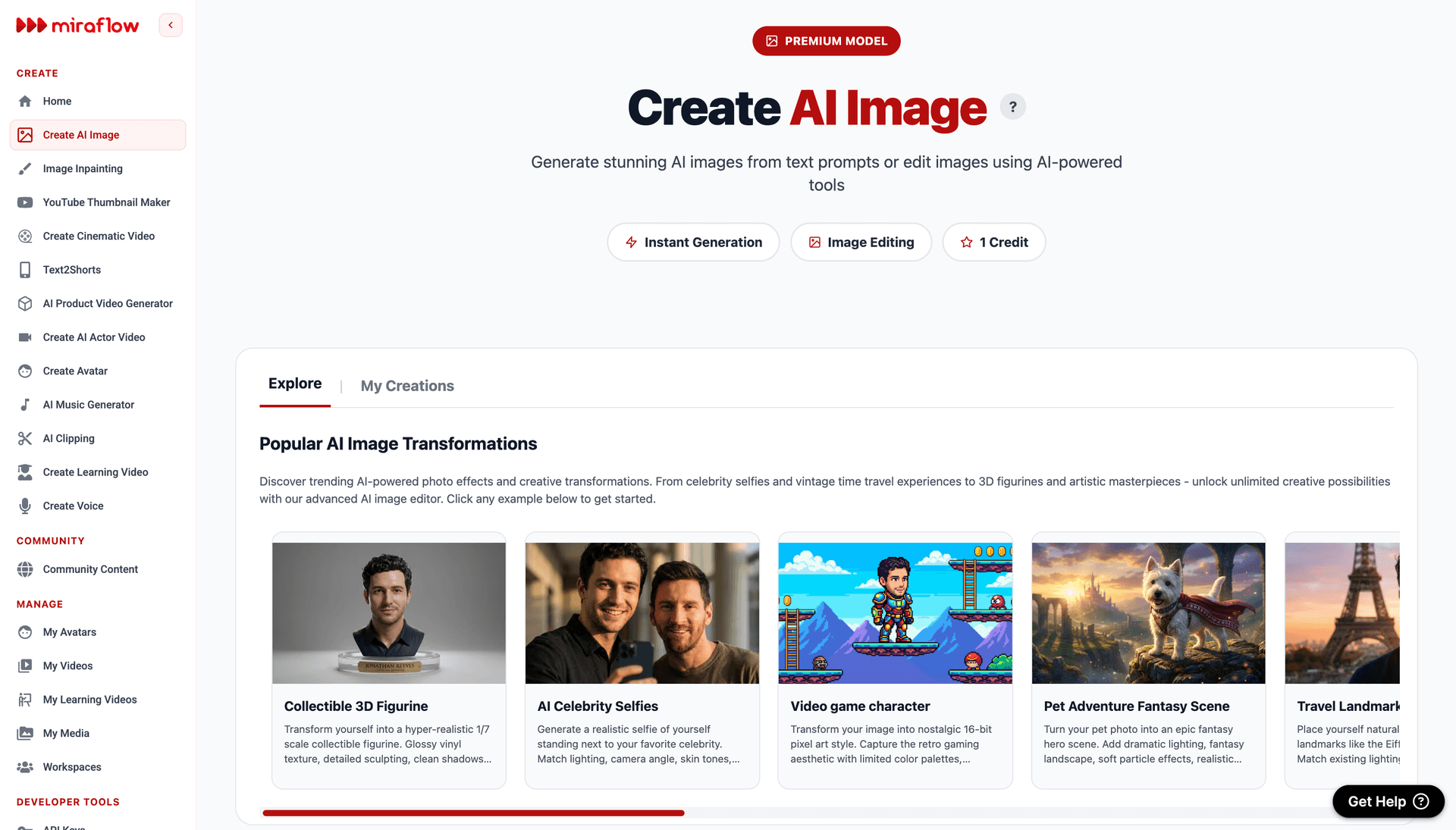
This post gives you 15 ready-to-use AI prompt templates for AI startup marketing visuals specifically designed to build trust, covering human-AI collaboration, data precision, transparency and explainability, clinical and healthcare AI, financial security, enterprise reliability, responsible AI ethics, research credibility, and customer outcome communication. Every prompt is designed to generate visuals that counter the category's trust problem rather than amplifying it. You can run all of them in the AI image generator on Miraflow AI without any setup.
Why AI Marketing Has a Trust Problem That Visuals Can Either Solve or Worsen
The trust deficit in AI marketing did not emerge from a single incident. It accumulated over years of category behavior that set expectations the technology was not yet ready to meet, created a wave of tool churn as early adopters experienced the reality gap, and left a substantial portion of the potential buyer market in a state of cautious skepticism.
The hype cycle has burned out early adopters. The category moved through its AI enthusiasm peak at tremendous speed between 2022 and 2024, and the buyers who engaged earliest are now the most sophisticated and most demanding. These buyers have direct experience with AI tools that underdelivered and have developed a specific sensitivity to marketing language and imagery that signals overstatement rather than substance.
Visual clichés have become trust killers. The neural network brain glow, the circuit board face, the robot hand shaking a human hand, the blue glowing data streams: these images have been used so relentlessly across AI marketing that they now communicate hype rather than capability. A potential customer who sees this visual vocabulary on a landing page or in a LinkedIn ad immediately categorizes the company as marketing-over-substance. The visual signals the category uses most frequently are now the signals most associated with distrust.
Enterprise buyers have a specific evidence-based trust requirement. B2B AI buyers at the enterprise tier are making decisions that involve data governance, regulatory compliance, security assessment, and internal stakeholder alignment. They are not responding to aspiration and innovation language. They need evidence: case studies, technical documentation, auditable processes, and the visual signals that communicate the company operates at a serious institutional level rather than a startup hypegrowth level.
The human oversight question is now central to AI purchase decisions. After several high-profile incidents involving AI decision-making errors, bias, and unintended consequences, potential buyers are specifically looking for evidence that humans are in control of the AI systems they are considering. Any visual communication that depicts AI operating without visible human oversight triggers a modern version of the Terminator anxiety: the feeling that buying this product means surrendering judgment to an autonomous system that cannot be corrected when it goes wrong.
Understanding these trust mechanisms changes every visual decision you make in AI marketing.
The Visual Vocabulary That Destroys Trust for AI Startups
Before getting into the prompts that build trust, it is worth naming the visual patterns that consistently undermine it. Avoiding these is as important as using the right visuals.
The glowing brain or neural network as the hero image. This was a powerful metaphor in 2018 when the general public was first encountering AI visual language. It now communicates that the company's marketing team reached for the first AI image in a stock library. It signals commodity AI positioning and a lack of creative thinking about how to communicate what makes the product specifically different.
Robots in human environments. Any humanoid robot imagery communicates replacement anxiety. The human-robot visual language, whether a robot handshake or a robot sitting at a human desk, is among the most effective ways to activate the job displacement fear that makes buyers hesitant to adopt AI tools. This imagery works against trust in almost every AI marketing context.
Pure abstract blue tech aesthetics with no human presence. A completely abstract technology visualization with no human element in the image communicates AI that operates without human involvement. This is the visual equivalent of the "black box" problem: AI that is making decisions with no accountable person visible in the process. These images feel powerful in isolation but consistently underperform trust metrics compared to images that include genuine human presence.
Over-saturated, impossibly perfect visualizations. AI marketing visuals that look too perfect, too saturated, or too rendered communicate the same thing as an overpromising headline: the gap between the visual and the reality will be large. Toning down the dramatic saturation and introducing more realistic, grounded visual quality consistently produces stronger trust performance in AI marketing content.
The Three Trust Audiences for AI Startups and What Each Needs Visually
Different stakeholders in an AI purchase decision respond to fundamentally different visual trust signals, and understanding this helps you generate the right visual for each context.
Technical evaluators including developers, data scientists, and technical leads respond to visual signals of precision, architectural clarity, and system intelligence. They are looking for evidence that the AI is built on sound technical foundations, not just smart marketing. Visualizations that communicate data precision, system architecture quality, and the specific rigor of well-engineered systems speak to this audience.
Business decision makers including executives, product leads, and operations teams respond to visual signals of business outcome, reliability, and risk reduction. They need to see evidence that the AI produces measurable results, operates predictably, and does not create new organizational risks. Human outcome imagery, reliability signals, and enterprise integration visuals speak most directly to this group.
Risk and compliance officers including legal, security, and regulatory functions respond to visual signals of protection, auditability, and responsible development. They are specifically evaluating whether the AI can be trusted with sensitive data, regulated processes, and decision-making that has legal or regulatory implications. Security, transparency, and responsible AI imagery directly addresses their concerns.
Building a visual content system that speaks to all three audiences across your marketing funnel produces dramatically stronger overall trust performance than a single visual approach optimized for one stakeholder type.
How to Use These Prompts
Every prompt in this list is specifically designed for one of the major AI startup trust categories, with visual elements that activate the appropriate trust signal for that context. Each prompt specifies the visual subject, the emotional register, the color palette, the compositional approach, and the specific trust mechanism the image is designed to communicate.
To customize any prompt for your specific AI product, replace the generic AI capability descriptions with your product's specific function, adjust the visual environment to match your target customer's industry context, and modify the color palette to align with your brand identity.
The AI image generator on Miraflow AI supports both text-to-image and image-to-image generation. Text-to-image creates fresh trust visuals from scratch. Image-to-image applies a specific trust visual treatment to existing team photos, workspace images, or product references when you want to combine authentic specificity with the visual quality these prompts produce.
Generate five to eight variations per prompt before selecting finals, since the specific human presence quality, light placement, and compositional balance vary meaningfully between generations.
15 AI Prompt Templates for AI Startup Trust Marketing Visuals
1. Human-AI Collaboration Trust Visual
The single most effective trust-building visual strategy for AI startups is showing the human-AI collaboration model clearly: AI that enhances what humans can do rather than replacing the human in the workflow. This visual communicates the product's positioning before a word of copy is read.

Prompt
Trust-building marketing visual for an AI startup showing human-AI collaboration, a warm modern professional workspace where a person is actively and confidently working at a clean desk with a laptop, soft luminous AI suggestion elements appearing naturally around the workspace as helpful information surfaces rather than overwhelming the human worker, the person is clearly the center of the composition and the primary decision-maker while the AI elements are visually supportive and secondary in scale, warm natural professional daylight filling the space from a window to the left, the human figure communicates competence and confidence rather than dependency, subtle electric blue or warm amber AI assistance element accents existing at the periphery of the human-centered composition, warm professional workspace tones, 16:9 landscape format at 1920x1080, editorial AI startup marketing visual aesthetic, the image communicates AI that amplifies human expertise rather than replacing it, this is the primary visual trust signal for the collaboration-oriented AI positioning, ultra-realistic natural workspace and light rendering, no text no logos, AI startup trust marketing visual quality
2. Data Precision and Accuracy Trust Visual
For AI products where accuracy is the primary purchase driver, including analytics, financial AI, medical AI, and data intelligence products, communicating precision visually before the performance statistics are presented creates the context that makes those statistics believable.
Prompt
Data precision and accuracy trust visual for an AI startup marketing campaign, clean abstract visualization showing raw data streams entering a precise analytical architecture and emerging as perfectly organized, clearly structured intelligence outputs, thin crisp luminous white and cool blue lines forming exactly geometric data classification structures communicating zero-tolerance error standards, the precision of the geometric organization is the primary visual trust signal, each data element appears exactly in its correct position suggesting a system that makes no categorization errors, deep near-black background with clean electric blue and bright white precision structure tones, the composition is deliberately orderly and exact with no visual noise or ambiguity, 16:9 landscape format, editorial AI data intelligence marketing visual, the image communicates measurement-grade accuracy and the specific quality of AI that can be trusted with precision-critical applications, ultra-realistic luminous data structure rendering, no text no logos, AI startup trust marketing quality
3. AI Transparency and Explainability Trust Visual
As AI explainability has become a purchase requirement in regulated industries and enterprise contexts, the ability to visually communicate that your AI can explain its reasoning is itself a competitive trust advantage.

Prompt
AI transparency and explainability trust visual for an AI startup marketing campaign, abstract visualization of an AI decision process shown as a clear organized logical flowchart architecture, the decision pathway visible as a series of clean interconnected nodes with labeled decision points and visible reasoning branches, the structure communicates that every step of the AI's reasoning is visible and auditable rather than hidden in a black box, the overall composition reads as intelligible and organized rather than complex and opaque, warm clean professional tones of cool grey and warm white with clean electric blue decision node accents, the entire visualization feels like something a human could follow and verify rather than something that requires blind trust, 16:9 landscape format, editorial AI transparency marketing visual, the image communicates that the AI operates with explainable logic rather than opaque statistical inference, ultra-realistic clean decision architecture rendering, no text no logos, AI startup trust visual quality
4. Research Team and Human Expertise Trust Visual
Showing the people behind an AI product is one of the most powerful trust signals available to early-stage AI startups, because it makes the human accountability visible and communicates that world-class expertise is governing and overseeing the AI system.
Prompt
Trust-building team and human expertise visual for an AI startup marketing campaign, warm professional editorial photograph aesthetic showing a small group of researchers, engineers, and domain specialists in a clean modern collaborative workspace, the team is engaged in genuine focused collaborative work around a shared problem, laptops, research materials, and clear whiteboard work visible in the natural workspace environment, warm natural office daylight creating a professional but approachable atmosphere, the team represents genuine technical depth and diversity of expertise, the composition communicates that serious human intelligence drives and validates the AI system, warm professional workspace tones with clean modern office environment, 16:9 landscape format, editorial human-centered AI marketing visual, the image communicates that world-class human expertise governs and oversees the AI technology, ultra-realistic workspace and natural light rendering, no text no logos, AI startup trust marketing quality
5. Healthcare and Clinical AI Trust Visual
Healthcare AI faces the highest trust bar of any AI category because the consequences of errors are direct physical harm. Visuals that communicate clinical precision, human medical oversight, and the specific rigor of medical-grade AI build the trust that healthcare buyer audiences require.

Prompt
Clinical precision trust visual for a healthcare or medical AI startup marketing campaign, clean clinical precision aesthetic showing the combination of human medical expertise and AI analytical support, a physician or clinical specialist visible in focused review of AI-generated diagnostic information presented on a clean precise clinical interface, the human medical professional is clearly in the decision role with the AI in the analytical support role, clean white and clinical blue medical environment tones communicating the specific sterility and precision standards of clinical settings, the AI information display communicates organized, accurate, clearly structured clinical intelligence rather than opaque algorithmic outputs, 16:9 landscape format, editorial healthcare AI marketing visual, the image communicates that the AI meets the precision, safety, and human oversight standards required for clinical application, ultra-realistic clinical environment and medical workspace rendering, no text no logos, healthcare AI startup trust visual quality
6. Financial Services AI Security and Compliance Trust Visual
Financial AI buyers are specifically evaluating regulatory compliance, data security, and the accuracy required for decisions with financial consequences. Visuals that communicate protection architecture and precision mathematics build the trust this category requires.
Prompt
Security and compliance trust visual for a financial services AI startup marketing campaign, clean precise financial data intelligence visualization showing organized financial data architecture with multi-layer security structure elements surrounding the data, precision mathematical quality to the data organization communicating accuracy standards required for financial decision-making, regulatory framework geometry visible as structured compliance architecture around the data core, cool professional blue and clean precise white tones on a deep navy background suggesting institutional financial quality rather than startup informality, the visualization communicates the specific trustworthiness required for AI that handles financial decisions and regulated data, 16:9 landscape format, editorial financial AI marketing visual, the image communicates security, compliance architecture, and the precision accuracy standards of enterprise financial AI, ultra-realistic financial data structure and security architecture rendering, no text no logos, financial AI startup trust visual quality
7. Enterprise Reliability and Infrastructure Trust Visual
Enterprise AI buyers place enormous weight on reliability, uptime, and the organizational confidence that the AI system will be available and performing when their critical processes depend on it. Infrastructure reliability visuals communicate this requirement before technical specifications are presented.

Prompt
Enterprise reliability and infrastructure trust visual for an AI startup marketing campaign, clean organized data infrastructure visualization showing a substantial, well-ordered technical architecture communicating the scale and redundancy of enterprise-grade AI infrastructure, multiple organized system layers with clean interconnections suggesting both processing power and resilience, the architecture has a visual quality that communicates years of engineering investment rather than a recently assembled system, cool professional precision tones of clean grey, white, and subtle blue on a deep dark background, the organization and structural integrity of the visualization is the primary trust signal communicating that the system can handle enterprise-scale volume without failure, 16:9 landscape format, editorial enterprise AI marketing visual, the image communicates the infrastructure reliability and operational resilience that enterprise buyers require before committing to an AI system for critical processes, ultra-realistic organized architecture rendering, no text no logos, enterprise AI startup trust visual quality
The AI image generator on Miraflow AI supports image-to-image generation, which is particularly useful for AI startup trust visuals when you have real team photographs, actual office environments, or real interface screenshots that can serve as reference images. Applying the trust visual treatment from these prompts to authentic reference images produces visuals that combine genuine brand specificity with professional marketing quality.
8. Customer Success Outcome Trust Visual
The most powerful proof of an AI product's trustworthiness is the genuine human outcome it enables. Visuals that show a real person experiencing a tangible positive result of using the AI communicate trust through demonstrated value rather than claimed capability.
Prompt
Customer success outcome trust visual for an AI startup marketing campaign, warm genuine human success scene showing a professional in a modern workspace experiencing the specific positive outcome that the AI product enables, whether looking confidently satisfied having completed a major task in a fraction of the expected time, reviewing results that exceed normal performance expectations, or presenting findings that reflect the enhanced analytical capability the AI provided, the human figure communicates authentic professional success and confidence rather than performed happiness, the environment is a real professional workspace with genuine working character, warm natural workspace light creating an approachable credible atmosphere, 16:9 landscape format, editorial customer success marketing visual, the image communicates trust through the demonstrated human outcome of the AI product rather than the AI's technical claims, ultra-realistic workspace and natural light rendering, no text no logos, customer success AI startup trust visual quality
9. Data Security and Privacy Protection Trust Visual
Data privacy is now a primary purchase consideration for AI products in every category, not only explicitly data-sensitive ones. Visuals that communicate multi-layer data protection build the foundation of trust that allows the conversation to move to product capability.

Prompt
Data security and privacy protection trust visual for an AI startup marketing campaign, bold multi-layer protective architecture visualization showing user and customer data represented as luminous protected elements at the center of a series of concentric security structure layers, each layer communicates a different level of protection, encryption at the outer edge, access control as an inner layer, and core data privacy at the center, the geometric precision of the protective structure communicates engineering investment in security rather than compliance-minimum protection, deep dark background with clean precise electric blue and bright white security architecture tones communicating both protection depth and transparency about the architecture, 16:9 landscape format, editorial AI data security marketing visual, the image communicates multi-layer protection and the specific investment in security that earns data trust from sophisticated buyers, ultra-realistic protective architecture rendering, no text no logos, data security AI startup trust visual quality
10. Scientific Rigor and Research Credibility Trust Visual
AI startups built on academic research, novel scientific approaches, or evidence-based methodology need visual signals that communicate this research foundation rather than relying solely on technical language that only specialists understand.
Prompt
Scientific rigor and research credibility trust visual for an AI startup marketing campaign, clean academic research environment aesthetic showing organized research data structures, peer-review quality visualization, and the specific visual language of evidence-based scientific methodology, a clean research workspace with organized datasets, statistical distribution visualizations, and the structured documentation of a rigorous research process, the visual communicates that the AI is built on validated scientific foundations rather than engineering intuition alone, warm clean academic workspace tones with precise scientific visualization elements, the atmosphere is that of serious research rather than startup speed, 16:9 landscape format, editorial research-credibility AI marketing visual, the image communicates that the product is grounded in peer-review quality science and validated methodology, ultra-realistic research workspace and scientific visualization rendering, no text no logos, scientific credibility AI startup trust visual quality
11. Enterprise Integration and Ecosystem Trust Visual
AI products that integrate with established enterprise platforms benefit enormously from visual communication of that integration, because working alongside trusted platforms transfers a degree of that platform's credibility to the AI product.
Prompt
Enterprise integration and ecosystem trust visual for an AI startup marketing campaign, clean visualization of an AI capability connecting seamlessly to an established enterprise software ecosystem, multiple established platform connection nodes arranged in an organized integration architecture, the AI product's connection point shown as the intelligent central layer that enhances the surrounding established tools, clean precise connection lines communicating data flow quality and integration reliability, each connection node has a subtle visual stability suggesting long-established platform maturity, warm professional integration architecture tones of cool grey and warm blue on a clean lighter background, 16:9 landscape format, editorial enterprise integration marketing visual, the image communicates that the AI works reliably within the existing enterprise technology stack rather than requiring complete workflow replacement, ultra-realistic integration architecture rendering, no text no logos, enterprise integration AI trust visual quality
12. Responsible AI and Ethics Trust Visual
As AI governance, bias mitigation, and ethical AI development have become explicit purchase criteria for enterprise buyers and regulatory bodies, visual communication of responsible AI practices has become a competitive differentiator rather than a defensive messaging requirement.
Prompt
Responsible AI and ethics trust visual for an AI startup marketing campaign, warm human-centered visualization showing the human oversight and ethical governance framework around AI decision-making, a clear visual structure where human accountability is positioned above and around the AI capability rather than below or inside it communicating that humans set the boundaries and approve the outputs, the overall composition communicates organized ethical governance rather than unmonitored AI autonomy, warm natural human-scale tones surrounding cooler precise AI visualization elements, the composition's hierarchy places human judgment above AI capability visually, 16:9 landscape format, editorial responsible AI marketing visual, the image communicates that the AI operates within a clear ethical framework with visible human accountability and bias mitigation practices, ultra-realistic human-scale and AI governance visualization rendering, no text no logos, responsible AI startup trust visual quality
13. Real-Time Intelligence and Speed-Accuracy Balance Trust Visual
For AI products where both processing speed and decision accuracy are trust requirements, communicating that the system achieves both simultaneously addresses the common buyer concern that speed comes at the cost of reliability.

Prompt
Real-time intelligence and accuracy trust visual for an AI startup marketing campaign, dynamic data processing visualization showing live data streams entering an AI intelligence system and emerging as precisely accurate structured decisions in near-real-time, the visual communicates both the speed of the processing, suggested through data stream movement quality, and the precision of the output, communicated through the exact geometric organization of the decision outputs, the combination of speed and accuracy in a single visual communicates the dual requirement that real-time AI applications face, electric blue data stream tones with precise clean white decision output elements on a deep near-black background, 16:9 landscape format, editorial real-time AI marketing visual, the image communicates that the AI achieves enterprise accuracy standards without sacrificing the processing speed that makes real-time application possible, ultra-realistic data stream and decision output rendering, no text no logos, real-time AI startup trust visual quality
14. Conversational AI Human Quality Trust Visual
For AI products that interact directly with customers or users, the trust requirement is that the AI interaction quality approaches human conversation quality. Visuals that communicate warmth, resolution, and genuine helpfulness in AI interaction build this specific trust dimension.

Prompt
Conversational AI and customer experience trust visual for an AI startup marketing campaign, warm human connection visualization showing the quality of an AI-assisted interaction that genuinely helps rather than frustrates, a warm and genuine representation of a positive customer experience resolving through an AI-enhanced support interaction, the visual communicates empathy, clear communication, and the specific satisfaction of a problem being understood and resolved, warm amber and natural human-scale tones communicating the warmth of genuine assistance, the AI presence in the image is supportive and helpful rather than mechanical or transactional, 16:9 landscape format, editorial conversational AI marketing visual, the image communicates that the AI interaction quality provides the genuine helpfulness that builds customer trust rather than the frustration cycle that undermines it, ultra-realistic warm interaction visualization rendering, no text no logos, conversational AI startup trust visual quality
15. Universal AI Startup Trust Marketing Template
This flexible foundation prompt works for any AI startup category, product positioning, or trust communication challenge not specifically covered by the fourteen prompts above.
Prompt
Trust-building marketing visual for an [describe your AI startup category: productivity, healthcare, financial, legal, security, analytics, creative, or developer tools] AI startup, [describe the primary trust signal needed: human-AI collaboration, precision accuracy, transparent decision-making, enterprise reliability, data security, scientific credibility, responsible governance, or customer outcome], showing [describe the primary visual element: a human professional in context with AI support elements, abstract data architecture visualization, precision decision structure, or outcome-demonstrating workspace scene], [describe the lighting: warm natural professional daylight, clean cool studio light, deep dark with precise luminous accent elements, or warm human-scale environment light], [describe the specific visual trust mechanism: human presence and control visible, mathematical precision in the data structure, transparent process organization, or genuine human outcome communicated], [describe the color palette: warm professional workspace tones with subtle AI accents, deep dark with clean electric blue precision elements, cool institutional professional tones, or warm human-scale natural tones], 16:9 landscape format at 1920x1080, editorial [describe the trust tier: early adopter, SMB, or enterprise] AI startup marketing visual, the image communicates [describe the specific trust the visual is designed to build] to a [describe the primary buyer: technical evaluator, business decision maker, or risk and compliance officer] audience, no text no logos, AI startup trust marketing visual quality
What to Avoid: The AI Visual Clichés That Undermine Trust
The trust-destroying visual patterns in AI marketing are worth cataloging explicitly, because the temptation to use them is significant given how widely they appear in the category.
Neural network brain visualizations as the hero image. This was a compelling metaphor in 2018. In 2026 it communicates that the company is marketing its category rather than its specific product. Every company in the AI space could use this image. It conveys no specific product capability and no specific trust signal.
Humanoid robot imagery. Any robot that resembles a human communicates job replacement anxiety before your headline is read. The emotional association between humanoid robots and labor displacement is deeply embedded in the cultural context your potential customers are operating from. This imagery works directly against the human-AI collaboration trust signal that converts buyers.
Impossibly perfect, hyper-saturated digital renders. AI marketing that looks too polished, too blue, and too perfectly rendered communicates the same thing as an overpromising headline. The visual excess signals a gap between the marketing and the reality. Toning down saturation and introducing more genuinely professional, grounded visual quality consistently produces stronger trust performance.
"Magic" metaphors for AI capability. Visualizations that suggest AI operates through mysterious or magical processes communicate the black box problem. Buyers increasingly need to understand how AI makes decisions, and visuals that suggest inscrutable magic work against the explainability trust requirement that is becoming a purchase criterion.
Stock photo people wearing VR headsets. This visual has become the signifier of future-tech theater in marketing. It communicates that the company is using visual metaphor for a technology capability rather than showing the actual product value.
Building Trust Across the Full AI Marketing Funnel
Trust building in AI marketing is not a single-touchpoint activity. Different stages of the awareness-to-decision journey require different trust signals, and planning which visual types serve which funnel stage produces significantly stronger overall conversion performance than using a single visual approach everywhere.
At the awareness stage, the trust requirement is primarily: this company is real, serious, and worth spending time evaluating. Human team visuals, research credibility signals, and the human-AI collaboration visual approach perform best here because they create the initial impression of a genuine, accountable organization.
At the consideration stage, the trust requirement shifts to: does this product actually work at the level I need it to work. Customer success outcome visuals, precision accuracy signals, and enterprise integration visuals build this evidence-based trust that moves a prospect from aware to seriously evaluating.
At the decision stage, the trust requirement becomes: can I trust this company with our data, our processes, and our customers. Security and privacy visuals, transparency and explainability visuals, and responsible AI governance visuals are most important here, because they address the specific risk concerns that stall final purchase decisions.
Mapping the 15 visual templates in this list to these three funnel stages and deploying them systematically produces a trust-building content system rather than a collection of individual marketing assets.
Extending AI Startup Trust Visuals Into a Complete Content System
Trust-building visuals are most effective when they appear consistently across every platform and touchpoint where potential customers encounter the brand. The Miraflow AI platform provides the tools to extend these static trust visuals into a complete marketing content ecosystem.
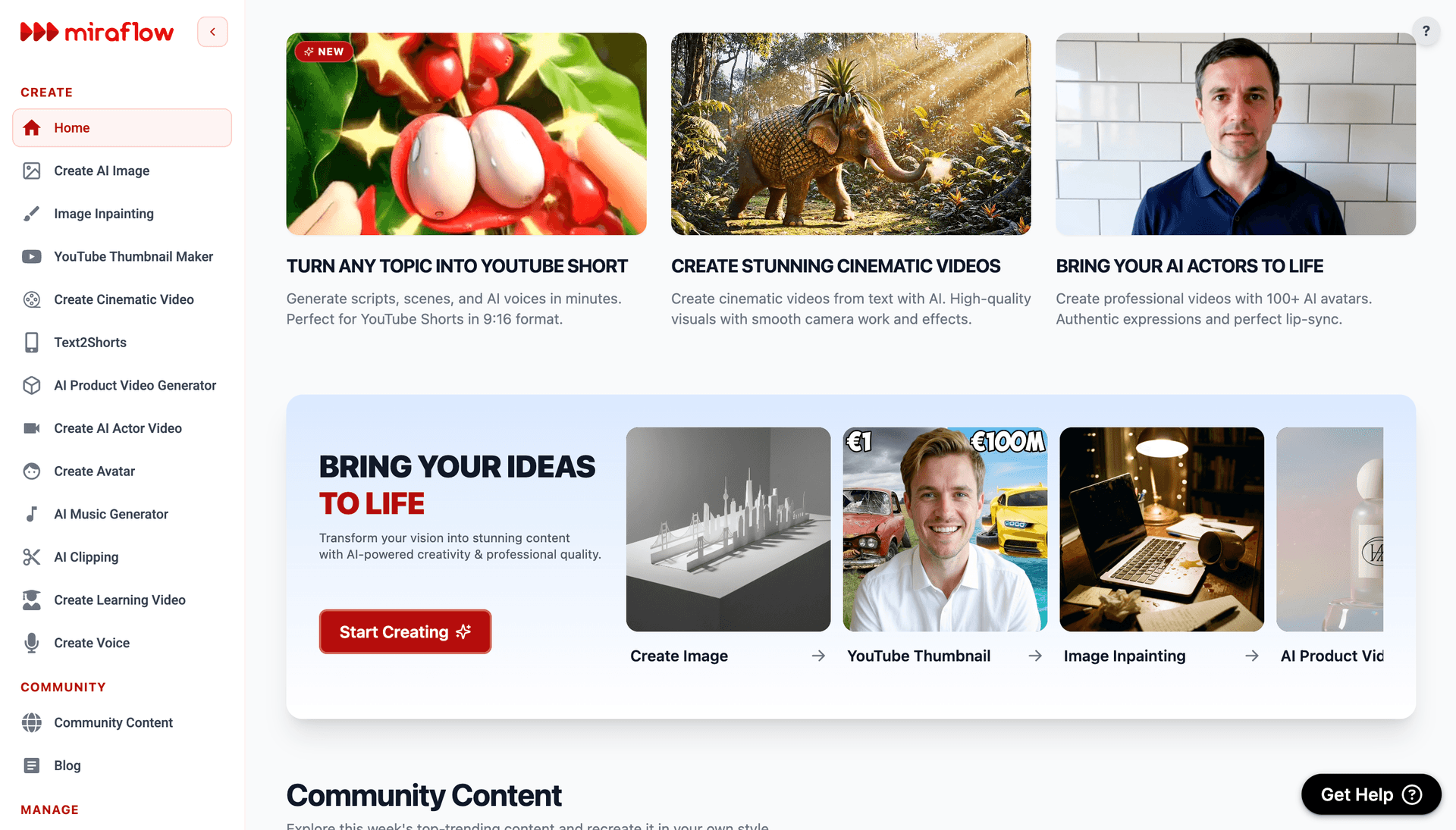
The Cinematic AI Video Generator on Miraflow AI lets you extend the visual concepts from these trust marketing prompts into short cinematic brand videos. An atmospheric push into the human-AI collaboration workspace, a slow reveal of the precision data architecture, or a cinematic sequence showing the human outcome of the AI product all communicate trust in a video format that performs strongly on LinkedIn, YouTube pre-roll, and conference presentation screens. Video content for AI startup marketing consistently outperforms static images in brand awareness campaigns and investor communications.
For AI startups building organic content marketing alongside paid acquisition, Text2Shorts on Miraflow AI generates complete vertical short videos from a topic description in a single workflow. Educational content explaining how the AI works, use case demonstrations, team introduction content, and customer outcome stories all perform well as short-form organic content for AI startup brands on LinkedIn, TikTok, and YouTube Shorts, reaching the growing audience of buyers and talent who discover B2B software through short-form video.
The YouTube Thumbnail Maker on Miraflow AI is directly relevant for AI startups using YouTube for product demo content, founder thought leadership, and customer success story videos. Maintaining the same trust-building visual aesthetic in YouTube thumbnails as in landing page and advertising imagery creates visual brand consistency that reinforces credibility across every platform where prospects encounter the brand.
For AI startups producing long-form content including webinars, product demos, customer interviews, and conference presentations, AI Clipping on Miraflow AI automatically identifies the most compelling and quotable moments, crops them for vertical format with animated captions, and distributes them as short-form social proof content. Customer success moments, product capability demonstrations, and founder vision statements all perform well as short-form trust-building clips for AI startup social distribution.
The AI Music Generator on Miraflow AI generates original background tracks for AI startup brand videos in under a minute. A clean, confident contemporary ambient track for a product demo, a warm precise composition for a customer success story, or a measured professional rhythm for a company overview video all create the sonic brand identity that reinforces the visual trust signals without the licensing concerns of using commercial music.
The Miraflow AI blog covers visual content strategies, image generation techniques, and marketing approaches for technology companies and creators, useful alongside this prompt library for developing a comprehensive AI startup visual content strategy.
How Different Visual Treatments Perform Across AI Startup Marketing Channels
Different marketing channels have different trust signal requirements, and understanding how to adapt these visual templates for each channel maximizes the impact across the full marketing mix.
LinkedIn is the primary B2B discovery channel for enterprise AI buyers. Trust visuals that work best on LinkedIn emphasize professional credibility: team imagery, precision data architecture, and human-AI collaboration scenes. LinkedIn audiences respond to visual evidence of serious people doing serious work, and the visual quality of a company's LinkedIn content directly affects how seriously they are taken in the B2B context. Research on B2B digital marketing consistently shows that LinkedIn visual content quality is among the top factors in enterprise buyer brand perception, making visual investment particularly high-return for AI startups targeting enterprise customers.
Paid advertising on Meta platforms targeting SMB buyers or consumer AI products requires warmer, more approachable visual trust signals. Human-AI collaboration scenes, customer success outcome visuals, and warm workspace imagery perform better for this audience than cold technical architecture visualizations.
Google Display and Programmatic advertising contexts require images that communicate trust at very small display sizes and very fast processing speeds. Bold, high-contrast trust visuals with a clear single visual statement perform better here than complex multi-element compositions.
Conference and event marketing materials benefit from the most visually ambitious trust signals, including responsible AI governance visuals, scientific rigor imagery, and enterprise architecture visualizations that communicate the company's sophistication to the informed conference audience.
Website landing pages can use the full range of visual trust signals across different page sections, allowing the awareness-to-decision funnel mapping to be built into the page scroll experience itself.
According to data on AI startup marketing performance, companies that consistently use trust-specific visual language in their marketing content achieve significantly higher qualified lead conversion rates than those using generic technology visuals, particularly at the enterprise sales tier where the trust evaluation process is most deliberate.
Common Mistakes in AI Startup Trust Visual Generation
The AI element dominates and the human element disappears. The single most common failure in AI startup trust visuals is generating images where the AI visualization is so visually dominant that no human presence or accountability is visible. Review every generated image against the question: where is the human in this image? If no human presence is visible or implied, the image is likely activating the black box anxiety rather than building trust.
The visual communicates general tech quality rather than specific AI trust. Trust in the AI category is specific to AI, not generic to technology. A visualization that could belong to any SaaS, data, or tech company communicates general professional quality but does not specifically address the AI trust concerns. Review generated visuals against the question: does this image specifically address why people hesitate to trust AI?
The color palette signals hype rather than credibility. Over-saturated electric blue and neon color treatments are associated with the AI hype aesthetic that sophisticated buyers distrust. Toning the palette toward professional, institutional quality, whether warm professional workspace tones, deep navy institutional tones, or cool precise grey professional tones, consistently produces stronger credibility signals than neon-bright AI aesthetic treatments.
The image is technically beautiful but emotionally cold. Some of the most visually polished AI marketing imagery fails at trust building because it has no emotional warmth. Trust is fundamentally an emotional judgment, not a rational one, and images that communicate precision at the expense of warmth often fail the trust test even when they look impressive. Introducing genuine human warmth into even the most technical trust visuals consistently improves trust performance.
The scale of the AI visualization implies autonomous operation. Large, complex AI architecture visualizations that span the entire frame with no human scale reference communicate AI operating at a scale that dwarfs human oversight. Introducing a human scale reference, even in abstract terms, brings the AI system within the register of human comprehension and control.
FAQ
What is the most important trust visual for an early-stage AI startup with no customer evidence yet?
The team and human expertise visual, combined with the human-AI collaboration scene, provides the strongest trust foundation when customer case studies do not yet exist. These visuals communicate that serious, credible people are building and governing the AI, which is the primary trust signal available before product evidence accumulates. The AI image generator on Miraflow AI can apply a professional marketing quality treatment to real team photographs through the image-to-image workflow.
How do I communicate that our AI is accurate without making false precision claims?
Use visual precision signals rather than numerical claims in the imagery itself. Visualizations that communicate the precision of data organization, the clarity of decision architecture, and the rigor of the analytical process create the impression of accuracy without making specific performance claims that require substantiation. Reserve specific accuracy statistics for case study content where they can be properly contextualized.
What visual approach works best for AI startups marketing to regulated industries?
Security and compliance architecture visuals, transparency and explainability visuals, and scientific rigor visuals perform best in regulated industry contexts including healthcare, finance, and legal. These industries have explicit visual vocabularies associated with institutional credibility, and aligning your marketing visual language with those institutional conventions communicates that your AI was built with regulatory context in mind.
How do I show the human-AI collaboration model without it looking staged?
Using the image-to-image workflow in the Miraflow AI image generator with real photographs of your actual team in real working environments produces more authentic human-AI collaboration visuals than fully generated scenes. The genuine character of a real workspace, applied with the marketing quality treatment from these prompts, communicates authenticity that pure generation cannot fully replicate.
Should AI startup trust visuals always include a human figure?
Not always, but the absence of human presence should be intentional rather than accidental. Technical architecture visuals, precision data visualizations, and security infrastructure images can be effective trust-builders without human figures. However, every category of AI trust visual benefits from at least some human-presence content in the overall marketing visual mix, even if individual images are purely technical.
What visual approach works best for an AI startup at Series A fundraising stage?
For investor audiences, scientific rigor and research credibility visuals, enterprise reliability infrastructure visuals, and customer success outcome visuals perform best because they address the three primary investor concerns: is the technology genuine, can it scale, and does it create real customer value. The team visual is also critical for early-stage investor communications, since investors at this stage are explicitly evaluating the human capability behind the product.
How do I use these trust visuals for content marketing rather than just advertising?
Trust visuals perform well as LinkedIn post images accompanying thought leadership content, as website blog header images for articles about AI safety and ethics, as webinar background imagery, and as email marketing visual headers. Using these visuals consistently across content marketing creates a cumulative brand trust impression that compounds across multiple touchpoints with the same potential customer.
Conclusion
Trust is not a marketing message for AI startups. It is the market condition that needs to exist before any other marketing message can be heard. The visual communication choices an AI startup makes either contribute to building that condition or they contribute to the trust deficit that is already making AI marketing harder than it needs to be in every buyer category.
The 15 prompt templates in this post cover the full range of trust-building visual requirements for AI startups at different product stages, in different industry verticals, and addressing different stakeholder audiences. Every prompt is built around a specific trust mechanism rather than a general aesthetic preference, which means each image is doing targeted work in the trust-building process rather than simply looking like a technology company's marketing.
The unifying principle across every prompt in this list is that genuine trust comes from showing human presence, human oversight, human outcomes, and the specific evidence that the AI operates within understandable, auditable, accountable processes. Every time an AI startup's marketing imagery communicates these qualities, it is doing something more valuable than generating impressions. It is building the foundation of confidence that turns cautious evaluators into committed customers.
All of these prompts work directly in the AI image generator on Miraflow AI, where text-to-image generation creates fresh trust marketing visuals from scratch, image-to-image workflows apply professional marketing quality to authentic team and workspace photographs, and inpainting refines specific elements like human presence quality or color palette after generation. From there, the full Miraflow AI platform extends your AI startup trust visual system into brand videos, short-form content, conference materials, YouTube thumbnails, and original music, building a complete multi-channel marketing presence that communicates genuine trustworthiness at every touchpoint where your potential customers make their decisions.