How Inception's Mercury Voice Hits 320ms Latency With a Diffusion LLM, Explained

Written by
Aerin Kim
Inception Labs' Mercury Voice hits a 320ms median latency using a diffusion LLM instead of autoregressive decoding. Here is the mechanism, the benchmarks, and the real integration.
If you build voice agents for a living, you already know the one number that decides whether a call feels like talking to a person or talking to a phone tree with a chatbot bolted on: the time between when the caller stops speaking and when the agent starts responding. Cross roughly half a second and the pause reads as a glitch. Cross a full second and callers start repeating themselves, assuming the line dropped. On October 1, 2026, Inception Labs, the Palo Alto startup that has spent two years betting the entire company on diffusion language models instead of the autoregressive architecture every other frontier lab uses, announced a model built to solve exactly that problem: Mercury Voice, a diffusion LLM (dLLM) purpose-built to power real-time voice agents [1].
This is not a reheated explainer of "what is a diffusion language model," a concept this blog has already covered in depth through Google DeepMind's DiffusionGemma research project. Mercury Voice is a different thing entirely: a shipping, commercially available product, tuned specifically for the voice-agent use case, with a named benchmark number that is unusually easy to check against your own call logs. Inception reports a median time-to-first-answer-token (TTFAT) of 320 milliseconds on a test set of real customer-service prompts, which the company says makes it the only model it tested that lands under the roughly 500 millisecond budget voice-agent builders target for a conversation to still feel natural [1] [4].
This post walks through what Mercury Voice actually is, the mechanical reason diffusion generation gets you there faster than token-by-token decoding ever can, a worked example of where that 320 milliseconds actually sits inside a full voice-agent latency budget, a direct look at the benchmark claims Inception has and has not published, a real OpenAI-SDK-compatible integration you can drop into LiveKit, Pipecat, Vapi, or Retell today, and the production mistakes that will bite you if you treat a vendor's launch numbers as a finished SLA instead of a starting point to verify yourself.
Step 1: What Inception Actually Shipped, and Where It Sits in the Mercury Lineage
Mercury Voice did not appear out of nowhere. Inception Labs, founded in 2024 by Stanford professor Stefano Ermon alongside his former students Aditya Grover and Volodymyr Kuleshov, built its entire identity around one architectural bet: that diffusion, the generation technique behind image models like Stable Diffusion and Midjourney, could be adapted to generate text, and that doing so would be meaningfully faster than the autoregressive decoding every GPT, Claude, and Gemini model uses [7]. Ermon's academic lab had already co-invented foundational techniques used across modern generative AI, including DDIM and FlashAttention, which gave the company a genuine research head start rather than a marketing angle bolted onto someone else's architecture.
The lineage is worth laying out explicitly, because Mercury Voice is the fourth major step in it, not a standalone launch:
| Model | Launch | Headline Capability |
|---|---|---|
| Mercury Coder | February 26, 2025 | First commercial-scale diffusion LLM, ~1,100 tokens/sec on one H100 |
| Mercury 2 | 2025 | General-purpose successor, broader task coverage |
| Mercury 2.5 | October 1, 2026 | Largest diffusion LLM Inception has trained; 1,107 tokens/sec, 260K context |
| Mercury Voice | September 29 - October 1, 2026 | Voice-agent-tuned variant; 320ms median time-to-first-answer-token |
Mercury Coder, unveiled on February 26, 2025, was the first commercial-scale diffusion large language model, generating up to 1,100 tokens per second on a single Nvidia H100 by producing tokens through a coarse-to-fine denoising process instead of one at a time [7] [17]. Mercury 2 followed as a general-purpose successor, and Mercury 2.5, released October 1, 2026 alongside the Mercury Voice preview, is what Inception calls the largest diffusion language model ever trained, reaching 1,107 tokens per second on standard Nvidia GPUs with a 260,000 token context window and roughly a 40 percent intelligence improvement over Mercury 2, landing in the same tier as cost-optimized frontier models like GPT-5.6 Luna (Low) and Gemini 3.5 Flash-Lite [2].
Mercury Voice is a variant tuned specifically on top of that lineage for the voice-agent job: it reasons, calls tools, and follows long system prompts, the same things any capable agentic model needs to do, but the entire training and serving stack is optimized around one constraint that general-purpose chat models are not held to, getting a usable first token out the door before a caller notices the silence [1]. It launched to enterprise customers on September 29, 2026, with public coverage and the official Inception announcement following in the first days of October [5]. As of this writing, access runs through Inception's enterprise sales channel rather than a fully self-serve signup, which matters for the realistic adoption timeline covered further down.
Early named customers give a sense of who this is actually built for. Audivi AI, which automates drive-through ordering, says Mercury Voice "shortened ours without making us dumb down the agent." Altur, a financial services voice-agent company, calls it "by far the fastest model we've tested," adding that "it's the first time the language model isn't the bottleneck in our voice pipeline." OpenCall, which handles live inbound calls, reports a production median model response latency around 170 milliseconds, even faster than the 320 millisecond figure measured on Inception's own test set, because production call flows often hit shorter, more predictable prompts than a generalized benchmark does [1] [4].
Step 2: The Mechanism, Why Generating Tokens in Parallel Actually Gets You to a Lower Latency
To understand why a diffusion LLM can plausibly beat an autoregressive model at time-to-first-token, you need the mechanical difference between the two approaches, not just the marketing shorthand of "parallel versus sequential."
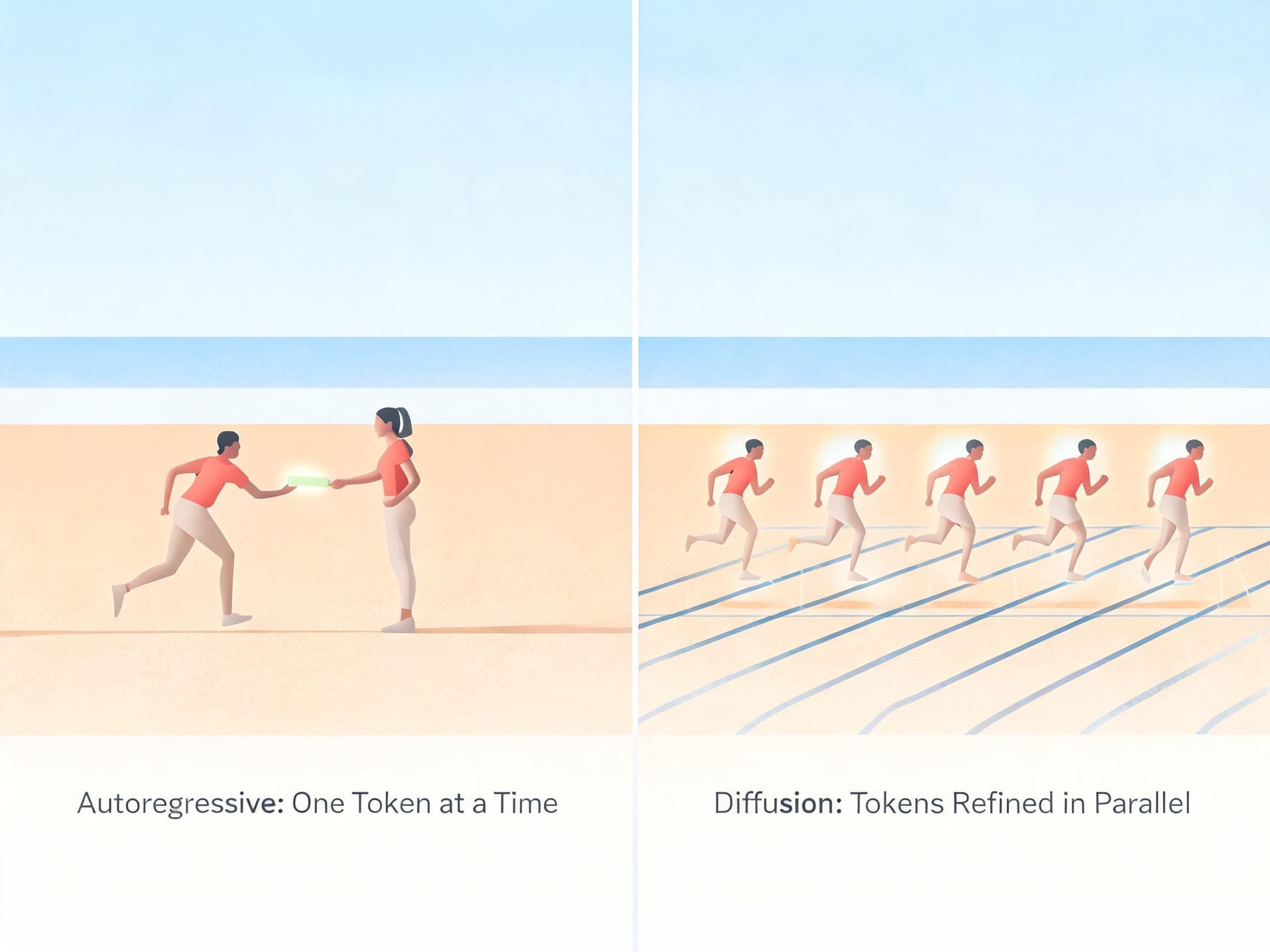
An autoregressive model, the architecture behind GPT, Claude, Gemini, and essentially every other production chat model, generates text by predicting one token, feeding that token back in as part of the context, predicting the next token, and repeating. Every single token's prediction depends on every token generated before it, which is exactly what makes autoregressive models so good at coherent, logically consistent writing, each new word is conditioned on everything that came before. It is also exactly why latency scales with output length in a fundamentally serial way: generating token 50 requires token 49 to already exist, which required token 48, all the way back to the start of the response.
A diffusion language model inverts that relationship. Instead of predicting the next single token, it starts from a fully masked or noised version of the output, a block of tokens that are all unknown, and iteratively denoises the entire block at once, refining many token positions in parallel across a handful of denoising steps until the text converges to a finished sequence. This is the same forward-noising, reverse-denoising structure that made image diffusion models like Stable Diffusion work for pixels, applied instead to a sequence of discrete word tokens. The foundational academic work behind this approach, LLaDA (Large Language Diffusion Models), demonstrated that a model trained with a masked diffusion objective, iteratively predicting and reconstructing masked tokens across the entire sequence rather than left to right, can reach generation quality and in-context learning performance comparable to similarly sized autoregressive baselines, while fundamentally changing the shape of the compute-to-latency relationship [10].
The practical consequence is what actually matters for a voice agent. Because a block of output tokens can be refined simultaneously rather than one at a time, a diffusion LLM can produce a usable chunk of response text in a small, roughly fixed number of denoising steps, instead of a number of serial steps that grows with the length of the response. For a voice agent, where the caller needs to hear something within a few hundred milliseconds regardless of whether the eventual full answer is five words or fifty, that is precisely the property that matters: your time-to-first-token stops being tightly coupled to how long the final answer turns out to be. Mercury 2.5's reported 1,107 tokens per second throughput on standard GPU hardware, versus the low hundreds of tokens per second typical of similarly sized autoregressive models, is the same mechanism showing up as a raw speed number instead of a latency number [2].
It is worth being precise about what this mechanism does not magically solve. A diffusion LLM still has to run its own forward passes through a neural network, it still costs real compute, and it is still bound by the same fundamental limits on how much a model can reason correctly in a bounded number of steps. What changes is the shape of the latency curve, not an escape from physics. Mercury Voice's three configurable reasoning-effort settings, low, medium, and high, exist precisely because more denoising steps and more internal deliberation buy you better answers at the cost of some of that latency advantage, the same low-medium-high tradeoff dial that shows up across most modern agentic models, just applied to a fundamentally faster base generation process [1].
Step 3: A Worked Latency Budget, Where 320 Milliseconds Actually Sits
Headline latency numbers are easy to misread in isolation, so it helps to place Mercury Voice's reported figures inside an actual end-to-end voice-agent latency budget rather than treating "320ms" as the whole story.
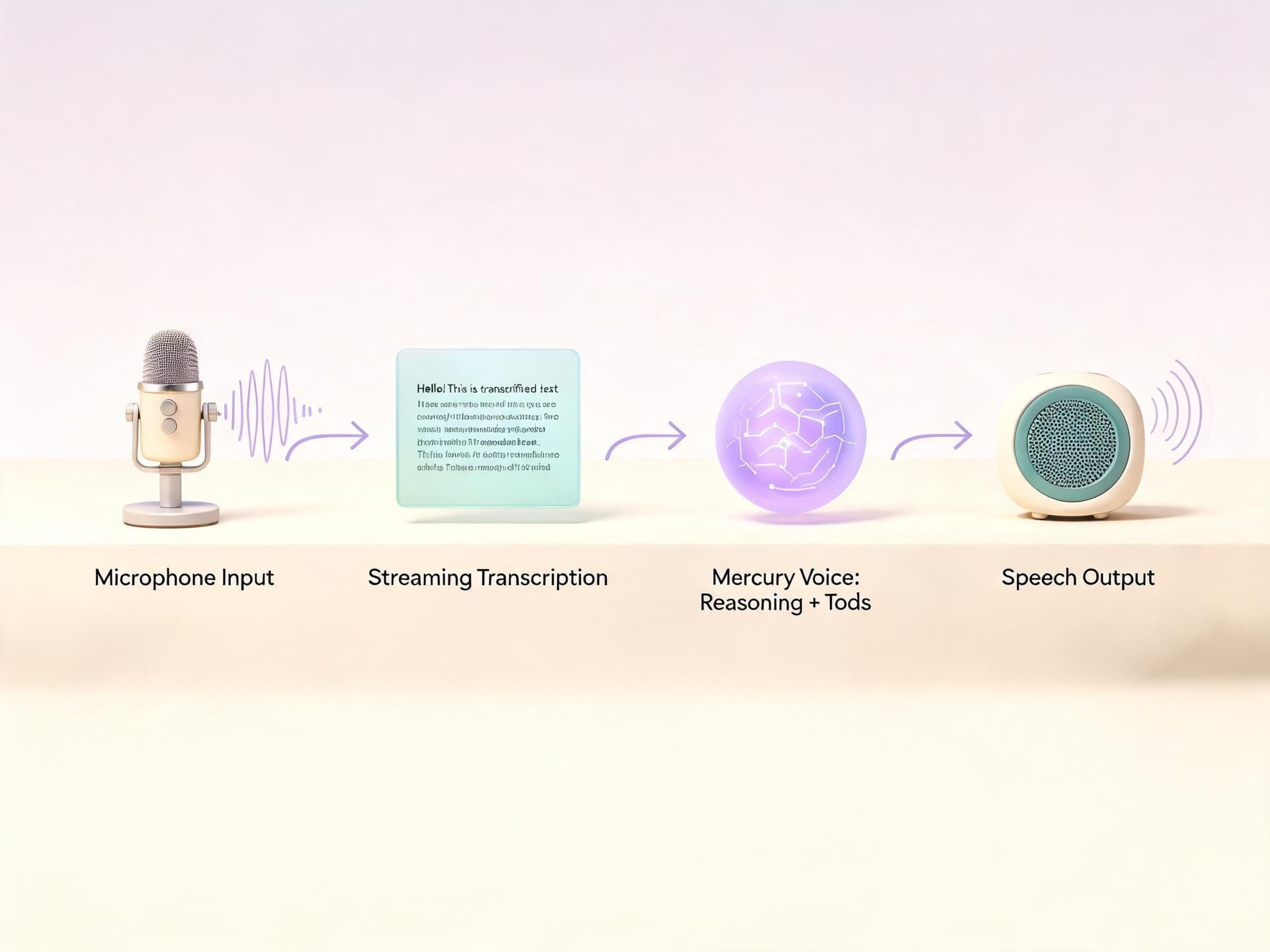
A full conversational turn in a real-time voice agent is not just the language model's job. It runs through several distinct stages, each consuming its own slice of the total time before the caller hears a response: the system has to detect that the caller actually finished speaking (turn detection), transcribe the speech into text (speech-to-text, ideally streaming so partial transcripts arrive before the caller finishes), run that text through the language model to decide what to say and generate the reply (the stage Mercury Voice targets), convert that reply back into audio (text-to-speech, specifically the time to first audio chunk), and finally push that audio back over the network and through a jitter buffer to the caller's device. Here is roughly how that budget breaks down, using Mercury Voice's reported numbers for the language-model stage and the kind of typical component latencies builders in this space work with:
| Pipeline Stage | Typical Budget | Reported Figure |
|---|---|---|
| Turn detection | ~50-100ms | Varies by provider, not Mercury Voice's job |
| Speech-to-text (first partial) | ~100-150ms | MAI-Transcribe-2-Streaming: ~100ms to first partial |
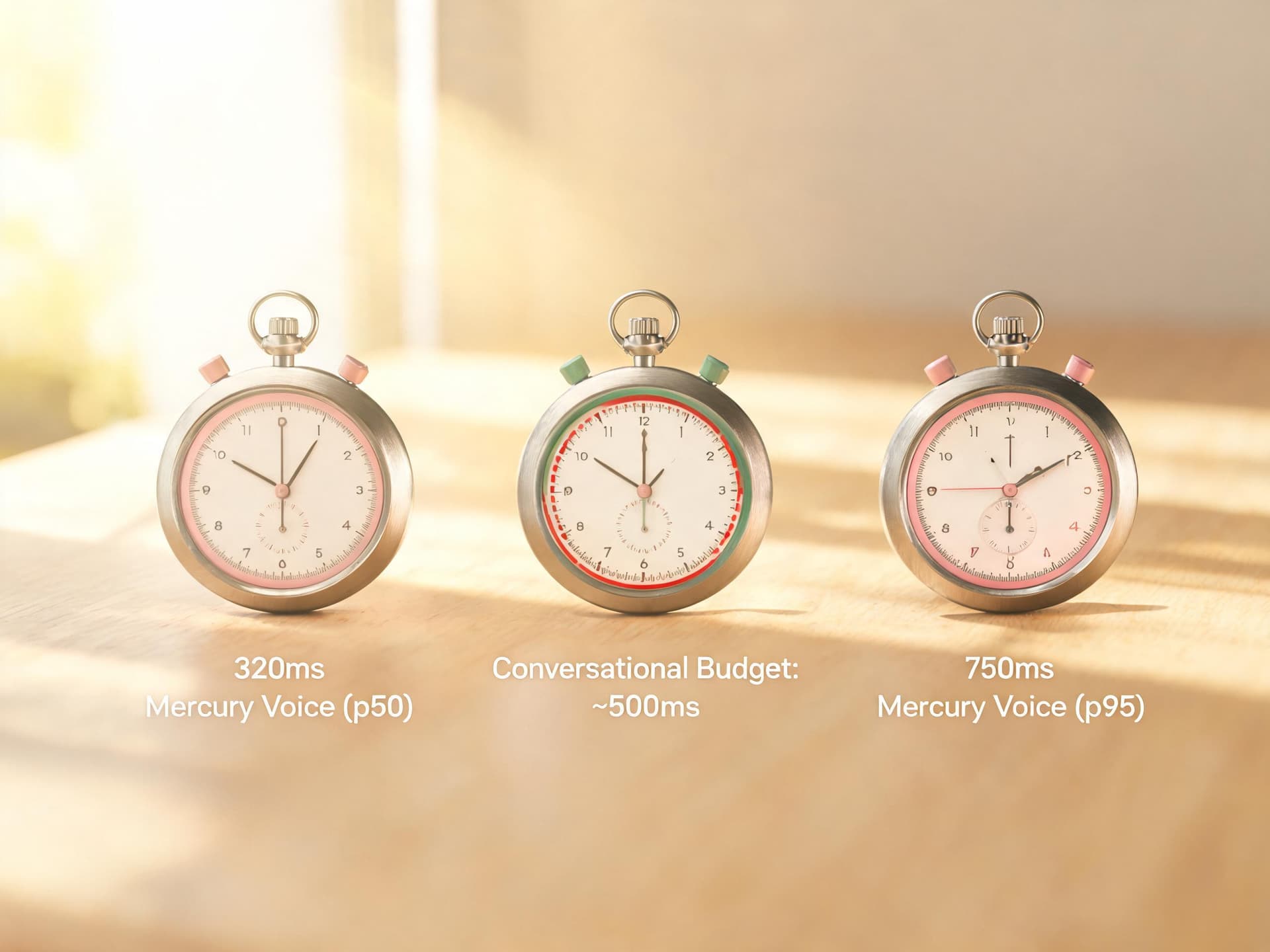
| Language model time-to-first-token | Target under ~500ms total budget | Mercury Voice: 320ms median (p50), 750ms p95 |
| Text-to-speech (first audio) | ~150ms | MAI-Voice-2.1-Flash: ~150ms |
| Network + jitter buffer | ~50-100ms | Varies by transport (WebRTC vs PSTN) |
| Caller-perceived total | ~500-800ms is the natural-feeling range | Sum of all stages above, not the LLM figure alone |
Two things jump out from laying the budget out this way. First, Mercury Voice's reported 320 millisecond median time-to-first-answer-token is genuinely competitive against the roughly 500 millisecond ceiling voice-agent builders target for the entire round trip, but it is explicitly the model's own contribution, not the full caller-perceived delay. Turn detection, transcription time-to-first-partial, TTS time-to-first-audio, and network and jitter buffer overhead all sit on top of that 320 milliseconds before a caller actually hears anything [6]. Second, the 95th percentile matters more than the median for a production system, because a p95 of 750 milliseconds means roughly one in twenty calls is already consuming most of the entire conversational budget on the language-model stage alone, before text-to-speech has even started [1] [6]. Any voice-agent team evaluating Mercury Voice should be benchmarking their own p95 and p99 against their own real call transcripts, not just the median number from a vendor's launch post.
Inception's own comparison claims Mercury Voice runs roughly 5.9 times faster than GPT-6 Luna on the same class of prompt when neither model is using extended reasoning, and "about twice as fast as the next-fastest model" in its comparison set [1] [4]. Treat that ratio as a useful signal about the gap between a voice-tuned diffusion model and an autoregressive model not specifically tuned for this workload, rather than as a universal multiplier, since the actual gap depends heavily on prompt length, system prompt size, and how much tool-calling and reasoning the comparison allowed each model to do.
Step 4: What the Benchmarks Actually Claim
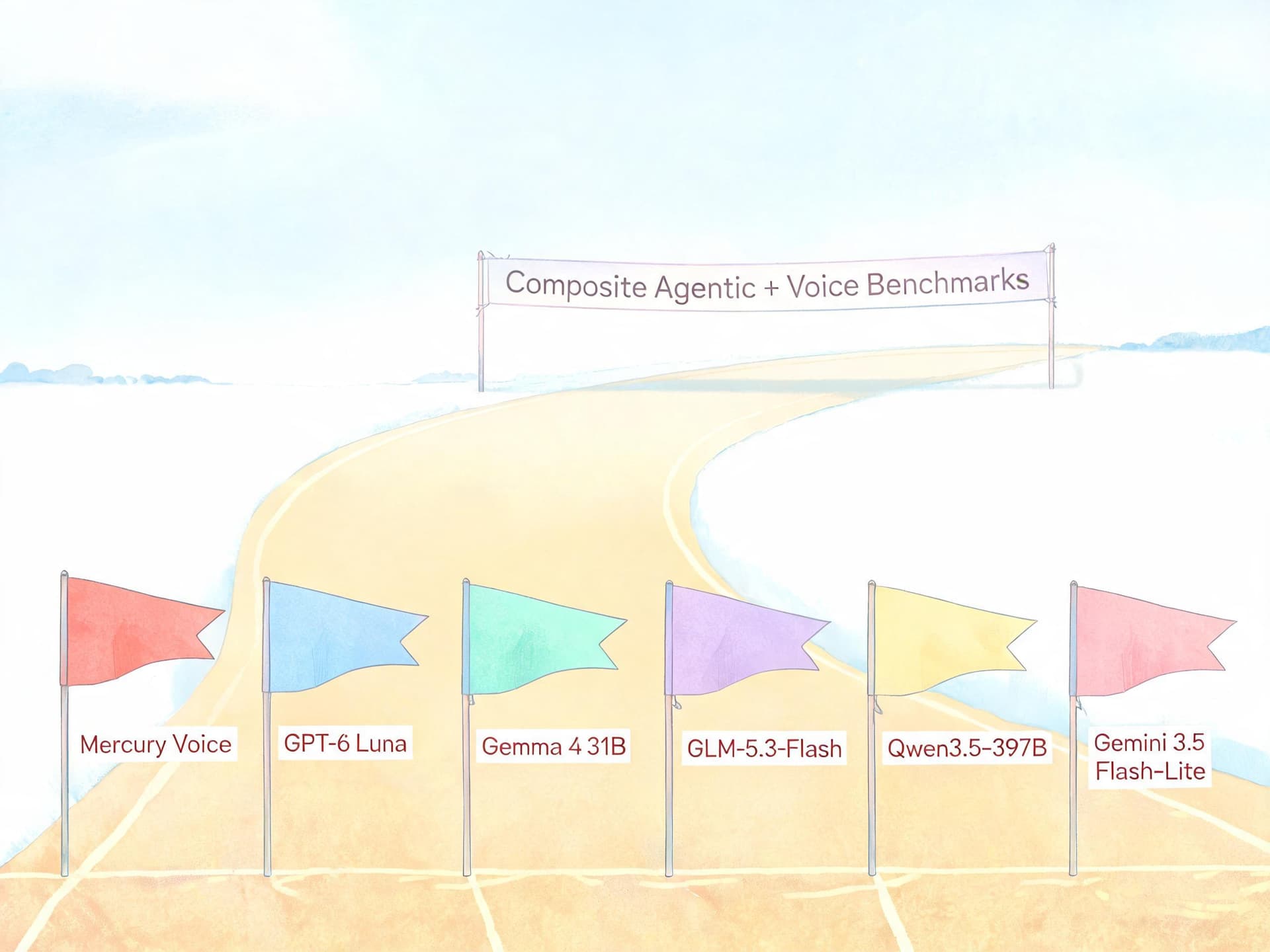
Inception positions Mercury Voice as beating several named models on a composite set of agentic and voice-relevant benchmarks: Gemma 4 31B, GPT-6 Luna, GLM-5.3-Flash, Qwen3.5-397B, and Gemini 3.5 Flash-Lite [1] [4]. The benchmark suite behind that claim is a mix of real, independently maintained evaluation sets rather than an invented internal metric, which is the baseline worth checking before taking any vendor's win claim at face value.
τ²-bench, maintained by Sierra, is the natural choice for a voice-agent-focused launch because it was built specifically to emulate dynamic, multi-turn conversations between a simulated user and a tool-using agent operating under a domain policy, with telecom, retail, and airline domains each testing a distinct flavor of real-world constraint handling [11] [12] [13]. IFBench tests instruction-following under the kind of long, detailed system prompts a real voice-agent deployment actually uses, which maps directly onto Inception's claim that Mercury Voice "follows long system prompts" without losing coherence [1]. BFCL v4, the Berkeley Function Calling Leaderboard maintained by UC Berkeley's Gorilla project, is the closest thing the field has to a standard for how reliably a model calls the right tool with the right arguments, now covering agentic, multi-turn, live, and non-live function-calling scenarios after its April 2026 revision [14].
GPT-6 Luna is a genuinely relevant comparison point, not a strawman. OpenAI released it alongside GPT-6 Sol on September 22, 2026 as the fast, cost-efficient model in the GPT-6 family, priced at $0.10 per million input tokens and $0.50 per million output tokens, and independent testing from Artificial Analysis puts its top configuration at an Intelligence Index of 37 with output speeds up to 157 tokens per second [15] [16]. That is a fast model by conventional autoregressive standards. Mercury Voice's claim is not that it beats GPT-6 Luna on general intelligence, it is that it beats it on the specific composite of agentic and conversational benchmarks above while running meaningfully faster, which is a narrower and more defensible claim than "Mercury Voice is smarter than GPT-6 Luna" would be.
| Benchmark | What It Measures | Published Numeric Scores? |
|---|---|---|
| tau2-bench (Telecom, Retail, Airline) | Multi-turn tool use under a domain policy, simulated caller | Not published by Inception as of early October 2026 |
| IFBench | Instruction-following under long, detailed system prompts | Not published by Inception as of early October 2026 |
| BFCL v4 | Function-calling accuracy across agentic, multi-turn, live, and non-live tasks | Not published by Inception as of early October 2026 |
Here is the honest caveat that belongs directly next to this section rather than buried in a footnote: Inception's own announcement states that Mercury Voice wins on these benchmarks, but as of this writing it has not published the actual numeric scores for either Mercury Voice or the comparison models on its own blog [1] [6]. That gap is exactly what Step 5 is about.
Step 5: Reading the Benchmark Claims Critically, Before You Trust Them
This is the section a lot of launch-day coverage skips, and it is the difference between a press-release summary and something a working engineer can actually use to make a buying decision.
The first and most important caveat is the one already flagged above: Inception's benchmark win is a vendor-reported claim without published scores. Inception says Mercury Voice outperforms Gemma 4 31B, GPT-6 Luna, GLM-5.3-Flash, Qwen3.5-397B, and Gemini 3.5 Flash-Lite on its composite suite, but has not released the actual numbers behind that ranking, which means there is currently no way for an outside team to verify the margin of the win, or even confirm all five comparison models were run under matched conditions (same system prompt length, same tool set, same reasoning-effort setting) [6]. A benchmark claim without a published scoreboard is a useful signal of confidence, not proof.
The underlying benchmarks themselves also have real, documented limitations worth knowing before you lean on them. BFCL v4 has been flagged by independent evaluators at Epoch AI as having defects affecting a meaningful share, reportedly around 48 percent, of sampled test items, which means a strong BFCL v4 score should be read as directionally useful rather than a precise, bulletproof ranking [6] [14]. τ²-bench-style provider comparison tables, when published without matched controls across vendors, are better treated as a useful data point from that specific provider's own test run than as a single apples-to-apples leaderboard everyone agrees on [6] [11].
There is also a structural gap worth internalizing regardless of which model you evaluate: research on deployed voice agents has found that the large majority of real-world failures, cited around 79 to 90 percent in independent research, stem from agent behavior and conversational handling rather than from raw text-benchmark intelligence, meaning a model's score on a text-only benchmark predicts voice-agent production performance only loosely [6]. A model can win every composite text benchmark in its launch post and still produce an agent that interrupts callers awkwardly, mishandles barge-in, or loses track of a multi-turn booking flow, because those failure modes live in the voice-specific layer the text benchmark never tests.
The cost claim deserves the same scrutiny. Inception's $0.009-per-conversation-minute figure is a real, calculable number given the launch pricing and a reasonable token-per-minute assumption, but Inception has not published the specific token-per-minute breakdown behind it, so outside estimates land in a range rather than an exact figure, and one independent calculation puts the actual savings at closer to 27 percent over a comparable setup once you price in realistic token counts, a number that evaporates entirely if the model's accuracy or call-containment rate drops even slightly in exchange for the lower unit cost [6]. A cheaper model that requires more escalations to a human agent is not actually cheaper.
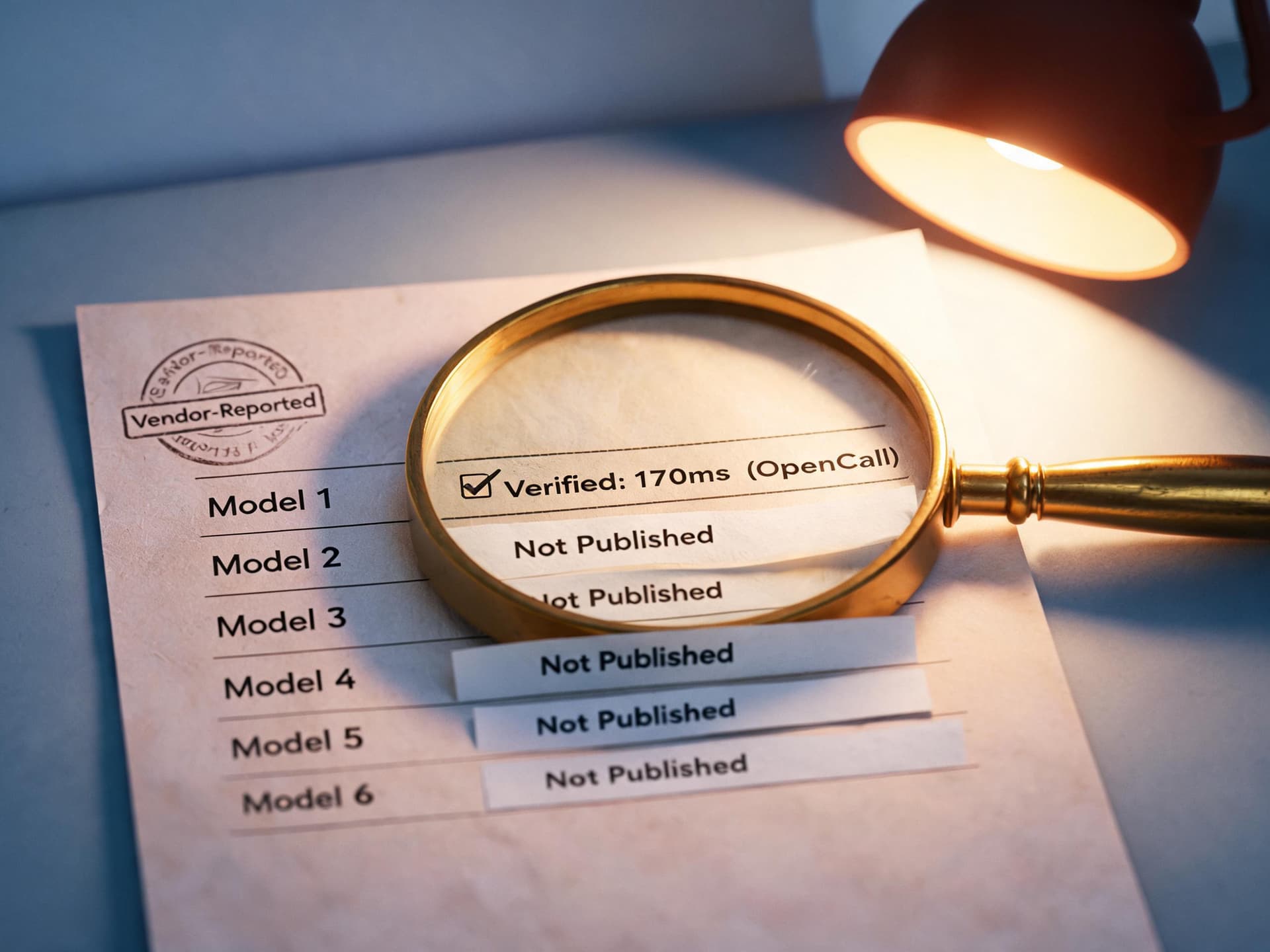
And finally, there is no published service-level agreement for Mercury Voice's latency numbers as of this writing. The 320 millisecond median and 750 millisecond p95 are self-reported figures from a specific test set, not a contractual guarantee backed by a penalty clause, which is a meaningfully different thing for a team planning to put this model in a customer-facing call path [6]. None of this means Mercury Voice's numbers are wrong. OpenCall's independently reported 170 millisecond production latency is a genuinely encouraging real-world data point that corroborates the general shape of Inception's claim [1]. It means the responsible way to evaluate this model is to run your own latency and accuracy benchmarks against your own call data before committing, the same diligence you would apply to any new vendor claim in a production system, regardless of how credible the underlying architecture is.
Step 6: A Real Integration, Dropping Mercury Voice Into an Existing Voice-Agent Stack
The practical reason this launch matters beyond the benchmark debate is that Mercury Voice ships as an OpenAI-API-compatible endpoint through the Inception API, which means it drops directly into the LLM slot of whatever voice-agent framework you are already running, LiveKit, Pipecat, Vapi, or Retell, without a framework-specific integration [1] [4].
Here is a real, runnable example using the standard OpenAI Python SDK, pointed at Inception's base URL instead of OpenAI's, including streaming (essential for low time-to-first-token in a voice pipeline) and a tool-calling definition, since Mercury Voice's whole pitch rests on reasoning and calling tools without giving up speed:
python/code
# Mercury Voice via the standard OpenAI Python SDK, pointed at Inception's
# OpenAI-API-compatible endpoint instead of OpenAI's own base URL.
# Install once: pip install openai

import os
from openai import OpenAI

client = OpenAI(
    api_key=os.environ["INCEPTION_API_KEY"],
    base_url="https://api.inceptionlabs.ai/v1",  # Inception's OpenAI-compatible endpoint
)

# A realistic voice-agent tool definition: looking up an order status,
# the kind of real-time tool call a customer-service voice agent needs
# to make without breaking conversational flow.
tools = [
    {
        "type": "function",
        "function": {
            "name": "get_order_status",
            "description": "Look up the current status of a customer order by order ID.",
            "parameters": {
                "type": "object",
                "properties": {
                    "order_id": {"type": "string", "description": "The order ID the caller provided."},
                },
                "required": ["order_id"],
            },
        },
    }
]

stream = client.chat.completions.create(
    model="mercury-voice",
    messages=[
        {
            "role": "system",
            "content": (
                "You are a calm, concise customer service voice agent for a "
                "logistics company. Keep responses short enough to speak "
                "naturally over the phone. Use the get_order_status tool "
                "whenever a caller asks about an existing order."
            ),
        },
        {"role": "user", "content": "Hi, can you check on order 48213 for me?"},
    ],
    tools=tools,
    tool_choice="auto",
    reasoning_effort="low",  # low/medium/high: trade reasoning depth for latency
    stream=True,  # streaming is what actually lets you measure time-to-first-token
)

first_token_seen = False
for chunk in stream:
    delta = chunk.choices[0].delta
    if delta.content and not first_token_seen:
        first_token_seen = True
        print("[first token received]")
    if delta.content:
        print(delta.content, end="", flush=True)
    if delta.tool_calls:
        print("\n[tool call requested]", delta.tool_calls)
Because the endpoint is OpenAI-API-compatible, swapping it into an existing Pipecat or LiveKit agent pipeline is usually a one-line change to whichever service object wraps your LLM call, not a rewrite. Here is what that swap looks like in a Pipecat-style pipeline, where the LLM service is configured once and the rest of the voice pipeline, speech-to-text, turn detection, text-to-speech, stays untouched:
python/code
# Swapping Mercury Voice into an existing Pipecat-style voice pipeline.
# Because the Inception endpoint is OpenAI-API-compatible, this is a
# configuration change to the LLM service, not a pipeline rewrite.
# Install once: pip install pipecat-ai

import os
from pipecat.services.openai import OpenAILLMService
from pipecat.pipeline.pipeline import Pipeline

# The only change versus a standard OpenAI-backed Pipecat agent: point the
# service at Inception's base URL and model name. Speech-to-text, turn
# detection, and text-to-speech services elsewhere in the pipeline are
# untouched.
llm = OpenAILLMService(
    api_key=os.environ["INCEPTION_API_KEY"],
    base_url="https://api.inceptionlabs.ai/v1",
    model="mercury-voice",
    params=OpenAILLMService.InputParams(
        temperature=0.3,
        extra={"reasoning_effort": "low"},  # keep latency low for live calls
    ),
)

# llm then plugs into the rest of the existing pipeline exactly as any
# other OpenAI-compatible LLM service would:
#
#   pipeline = Pipeline([
#       transport.input(),
#       stt_service,
#       llm,
#       tts_service,
#       transport.output(),
#   ])
#
# No other stage needs to know the LLM underneath changed.
Before trusting any launch-day latency number for your own workload, measure it yourself against your own representative prompts. Here is a small, honest benchmarking script that hits the endpoint directly and reports the time-to-first-token your own system prompt and conversation history actually produce, which is the only number that matters more than the one in a vendor's blog post:
bash/code
# Measure your own time-to-first-token against Mercury Voice using your
# real system prompt and conversation history, rather than trusting a
# vendor's launch-post median. Run this multiple times across your actual
# call transcripts and compute your own p50/p95/p99, not just one sample.

set -euo pipefail

START_TIME=$(date +%s%N)

curl -s -N \
  -H "Authorization: Bearer $INCEPTION_API_KEY" \
  -H "Content-Type: application/json" \
  https://api.inceptionlabs.ai/v1/chat/completions \
  -d '{
    "model": "mercury-voice",
    "stream": true,
    "reasoning_effort": "low",
    "messages": [
      {"role": "system", "content": "You are a concise phone support agent."},
      {"role": "user", "content": "My package has not arrived, order 48213."}
    ]
  }' | while IFS= read -r line; do
    if [[ "$line" == data:* && "$line" != "data: [DONE]" ]]; then
      NOW=$(date +%s%N)
      ELAPSED_MS=$(( (NOW - START_TIME) / 1000000 ))
      echo "Time to first streamed chunk: ${ELAPSED_MS}ms"
      break
    fi
done
A smooth, clean 3D motion-graphics style animation, soft studio lighting with gentle ambient reflections, camera slowly dollying left to right across a minimal pastel-toned tabletop scene. A stylized microphone on the left catches a soft rippling sound wave, which flows into a translucent panel resolving the wave into short lines of text, which flows into a glowing rounded node pulsing gently as if reasoning, which finally flows into a small speaker on the right emitting a soft outward sound wave. Each stage lights up in sequence as the camera passes it, with a short, clean caption fading in beneath each stage reading 'Transcription', 'Reasoning', and 'Speech Output' in turn. Soft pastel color grading throughout, no people, no readable text beyond the three short captions, no flickering artifacts, no garbled text, no watermark or logo.
Step 7: The Other Half of the Pipeline, Where Transcription Fits
A language model is only one stage of a real-time voice agent, and the same week Mercury Voice launched, Microsoft shipped the complementary half of that pipeline. On October 1, 2026, Microsoft released MAI-Transcribe-2-Streaming, its first real-time speech-to-text model, alongside MAI-Voice-2.1 and a faster MAI-Voice-2.1-Flash variant for text-to-speech [8] [9].
MAI-Transcribe-2-Streaming reports a 2.5 percent word error rate across 60 automatically detected languages, with the first partial transcript available in roughly 100 milliseconds and a final transcript landing about 130 milliseconds after speech ends, ranking it first on Artificial Analysis's real-time speech-to-text leaderboard at launch [8]. MAI-Voice-2.1-Flash, the text-to-speech half, reports roughly 150 milliseconds of latency for the text-to-speech stage [9]. Lining these up against Mercury Voice's reported numbers is a useful sanity check on the latency budget from Step 3: a roughly 100 millisecond transcription stage, plus Mercury Voice's 320 millisecond median language-model stage, plus a roughly 150 millisecond text-to-speech stage, lands close to 570 milliseconds of pure processing time before network and jitter overhead, which is both why the 500 millisecond target is genuinely tight and why every stage of the pipeline, not just the language model, has to be independently fast for the full conversation to feel natural.
Neither Mercury Voice nor Microsoft's MAI models claim to replace the other half of the stack. Microsoft's transcription and synthesis models are not language models and do not reason or call tools, and Mercury Voice does not transcribe audio or synthesize speech. A production voice agent in late 2026 is increasingly a three-vendor (or at least three-model) composition: a fast streaming transcription model, a fast reasoning and tool-calling language model, and a fast text-to-speech model, stitched together by an orchestration framework like the ones Mercury Voice already plugs into.
Step 8: Production Best Practices for Voice-Agent Builders
Treat the following as a working checklist drawn from how teams in this space actually evaluate and deploy a new low-latency model like this one.
Benchmark time-to-first-token on your own representative call transcripts, not the vendor's test set, and track the full percentile curve, p50, p90, p95, p99, not just the median, since the tail is what determines how often a caller actually notices a pause [6]. Measure your true end-to-end latency, turn detection plus transcription plus language model plus text-to-speech plus network, not just the language-model stage in isolation, because that is the number your callers actually experience.
Evaluate accuracy and tool-calling reliability under your real system prompt length and your real tool schema, not a short demo prompt, since IFBench-style instruction-following and BFCL-style function-calling scores both degrade as system prompts and tool counts grow in realistic enterprise deployments [14]. Track containment rate, the percentage of calls the agent resolves without escalating to a human, alongside raw cost per minute, because a cheaper model that escalates more often is not actually saving you money once you account for the human agent's time.
Build your pipeline to tolerate the p95 case gracefully, not just the median case, with a fallback behavior (a brief acknowledgment phrase, a graceful hold message) for the roughly one-in-twenty call where the language-model stage alone eats most of your latency budget [1]. And negotiate or confirm an actual SLA before routing production call volume through any new vendor's endpoint, since a self-reported median latency from a launch blog post is not a contractual guarantee [6].
Common Mistakes When Evaluating Mercury Voice or Any New Voice-Specialized Model
Treating a vendor's composite benchmark win as a published, auditable score. Inception's claim against GPT-6 Luna, Gemma 4 31B, and the rest is real and plausible given the architecture, but as of this writing it comes without published numeric scores, which means it should inform your shortlist, not replace your own evaluation [1] [6].
Reading median latency as the number that matters. A p50 of 320 milliseconds next to a p95 of 750 milliseconds means roughly one in twenty calls lands near or past the entire conversational budget before text-to-speech even starts. Design and test for your tail latency, not your average case.
Confusing model latency with caller-perceived latency. The 320 millisecond figure is Mercury Voice's own time-to-first-answer-token. Turn detection, transcription, text-to-speech time-to-first-audio, and network and jitter buffer overhead all still sit on top of it [6].
Optimizing for cost per minute while ignoring containment rate. A cheaper model that requires more human escalations, more repeated turns, or more call transfers is not actually the cheaper option once support labor is priced in.
Assuming diffusion generation is a free latency win with no tradeoffs. Mercury Voice's own low, medium, and high reasoning-effort settings exist because more denoising steps and deeper reasoning still cost real latency. Parallel token generation changes the shape of the curve, it does not eliminate the underlying compute-latency relationship [1] [10].
What This Means for Voice-Driven Content Tools
Step back from the specific benchmark debate and the bigger signal is clear: the infrastructure underneath real-time conversational AI, the models actually doing the listening, reasoning, and speaking, is getting faster and more specialized at a pace most creators never see directly. Mercury Voice, paired with Microsoft's new MAI-Transcribe-2-Streaming and MAI-Voice-2.1 models released the same week, is a concrete sign that the three-stage voice pipeline, hear, think, speak, is being optimized stage by stage rather than treated as one generic chatbot problem [1] [8].
That matters for anyone building voice-driven content, not just phone-tree automation. Narration pipelines, AI voiceovers, and conversational tools all ultimately rest on the same underlying problem Mercury Voice is attacking: making a model sound natural without a frustrating lag between input and output. Miraflow AI's own AI Music generator and Text2Shorts workflow, which turns a script into narrated, voiced short-form video in one pipeline, depend on the same category of fast, natural-sounding voice generation infrastructure, even though Miraflow does not use Mercury Voice internally. Watching how dedicated voice-agent infrastructure like this evolves is a useful signal for where narration and conversational AI tooling broadly is headed over the next year, lower latency, more natural turn-taking, and tighter integration between the reasoning layer and the audio layer.
| Model | Input $ / 1M tokens | Output $ / 1M tokens | Est. Cost per Conversation Minute |
|---|---|---|---|
| Mercury Voice (launch, 50% off) | $0.20 | $0.75 | ~$0.009 |
| Mercury Voice (standard list rate) | $0.40 | $1.50 | Roughly double the launch estimate |
| GPT-6 Luna (for reference) | $0.10 | $0.50 | Not voice-agent-specific; lower raw token price, different workload profile |
Frequently Asked Questions
What is Mercury Voice, exactly? Mercury Voice is a diffusion LLM (dLLM) from Inception Labs, announced in preview on October 1, 2026, tuned specifically for real-time voice agents. Unlike autoregressive models that generate text one token at a time, it generates tokens through a parallel denoising process, which Inception says gets its median time-to-first-answer-token under 320 milliseconds while still reasoning and calling tools [1].
How is this different from the general "diffusion language model" concept? Diffusion language models are a broader research direction, with academic work like LLaDA and research projects like Google DeepMind's DiffusionGemma exploring the architecture in general [10]. Mercury Voice is a specific, named, commercially shipping product built on Inception's own Mercury architecture and tuned specifically for the voice-agent latency and tool-calling requirements, not a research demonstration of the underlying technique.
Is the 320 millisecond latency number independently verified? Partially. Inception reports it as the median across a test set of real customer-service prompts, and one named customer, OpenCall, independently reports a production median latency around 170 milliseconds, which corroborates the general shape of the claim. The underlying benchmark scores behind Inception's model-versus-model comparisons have not been published in detail as of this writing, so treat the comparative ranking as a vendor claim worth your own verification, not an independently audited result [1] [6].
How much does Mercury Voice cost? Launch pricing is $0.20 per million input tokens and $0.75 per million output tokens, a 50 percent discount off the standard $0.40 and $1.50 rates, which Inception estimates works out to roughly $0.009 per minute of conversation [1] [4].
Which voice-agent frameworks does it work with? Mercury Voice is available through the Inception API as an OpenAI-API-compatible endpoint, which means it drops into the LLM slot of frameworks like LiveKit, Pipecat, Vapi, and Retell without a framework-specific integration, the same way you would swap any OpenAI-compatible model into those stacks [1] [4].
Does Mercury Voice replace speech-to-text or text-to-speech models? No. Mercury Voice is the reasoning and response-generation stage of a voice pipeline. It still needs a transcription model to turn the caller's speech into text and a text-to-speech model to turn its reply back into audio, the same role Microsoft's new MAI-Transcribe-2-Streaming and MAI-Voice-2.1 models fill, just from a different vendor [8].
Does Miraflow AI use Mercury Voice? No. Miraflow AI's voice and narration features are built on their own pipeline. Mercury Voice is relevant context for understanding how the voice-agent infrastructure layer is evolving, not a component inside Miraflow's own AI Music or Text2Shorts tools.
Conclusion
Mercury Voice is a genuinely useful data point for anyone building or evaluating real-time voice agents in late 2026, not because the underlying diffusion mechanism is new, Inception has been shipping diffusion LLMs since Mercury Coder in February 2025, but because this is the first time that architecture has been tuned specifically around the one number that actually determines whether a voice agent feels natural: time-to-first-token, measured against a real conversational budget rather than a general chat benchmark [1] [7]. A 320 millisecond median, a 750 millisecond p95, and an OpenAI-compatible endpoint that drops straight into LiveKit, Pipecat, Vapi, or Retell make this a model worth actually testing against your own call data, not just reading about.
The benchmark win against GPT-6 Luna, Gemma 4 31B, GLM-5.3-Flash, Qwen3.5-397B, and Gemini 3.5 Flash-Lite is real enough to take seriously and specific enough to be checkable, which is exactly why it is worth checking yourself rather than repeating uncritically: the detailed scores are not yet published, several of the underlying benchmarks have documented noise and format sensitivity, and the real-world failure modes that actually sink voice agents in production tend to live outside what any text benchmark measures in the first place [6] [14]. Pair that honest skepticism with the fact that the model, the mechanism, and the integration path are all real and testable today, and Mercury Voice becomes a worthwhile addition to any voice-agent team's evaluation shortlist, with your own p95 latency and your own containment rate as the only numbers that should actually decide whether it ships.
References
- Introducing Mercury Voice — Inception Labs
- Introducing Mercury 2.5 — Inception Labs
- Inception Launches Mercury 2.5, the Next Tier of Intelligence for Diffusion LLMs — Business Wire
- Inception Labs' Mercury Voice Hits 320ms Response for Live AI Calls — AlphaSignal
- Inception Mercury Voice Enterprise Launch — RuntimeWire
- Inception Mercury Voice: Diffusion LLM, 320ms Latency, Unpublished Benchmark Scores, Per-Minute Cost — Beri.net
- Introducing Mercury, the World's First Commercial-Scale Diffusion Large Language Model — Inception Labs
- Microsoft AI Releases MAI-Transcribe-2-Streaming: #1 Real-Time Speech-to-Text Model on Artificial Analysis — MarkTechPost
- Microsoft Ships First Streaming Transcription Model, Completing Voice Agent Pipeline on Foundry — Tech Times
- Nie, S. et al. (2025). Large Language Diffusion Models. arXiv
- Yao, S. et al. (2024). τ-bench: A Benchmark for Tool-Agent-User Interaction in Real-World Domains. arXiv
- τ²-bench — Sierra Research (GitHub)
- τ-bench: Shaping the Development and Evaluation of AI Agents — Sierra
- Berkeley Function Calling Leaderboard (BFCL) V4 — Gorilla, UC Berkeley
- GPT-6 Sol and Luna Benchmarks Explained — Vellum
- GPT-6 Sol and Luna: API Prices, Benchmarks and Trade-offs — Digital Applied
- Inception Unveils Mercury: The First Commercial-Scale Diffusion Large Language Model — MarkTechPost