Reflection AI's Beam Explained: Inside the 501B Open-Weight MoE Model

Written by
Aerin Kim
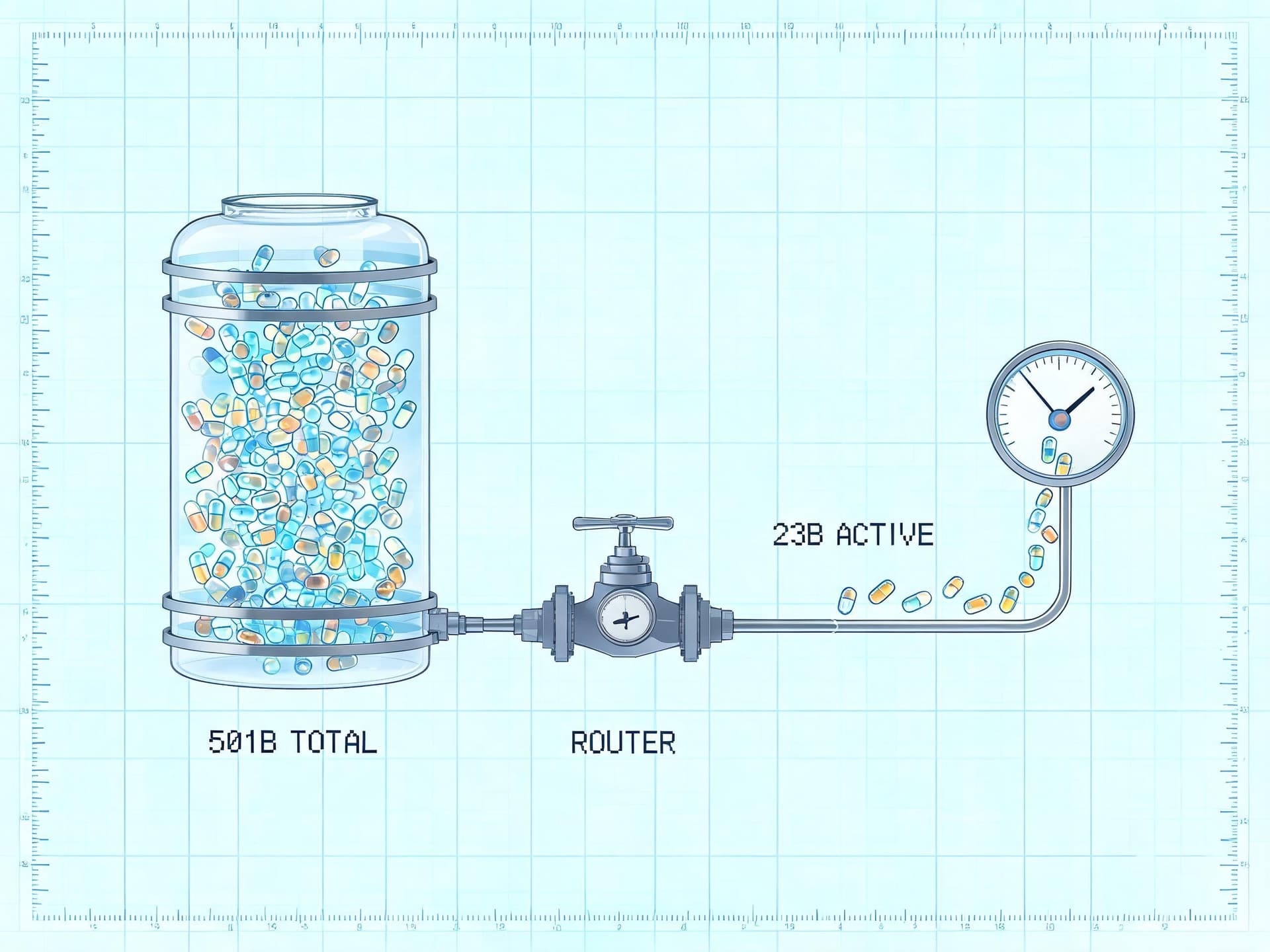
Reflection AI's Beam packs 501B parameters with only 23B active per token. Here's how its training pipeline works, how it stacks up against GLM-5.2 and Qwen3.8-Max, and when the weights actually ship.
On October 5, 2026, Reflection AI published a single blog post that most of the open-weight AI world had been waiting on for months: the introduction of Beam, the company's first open-weight frontier model [1]. Reflection had spent nearly two years building toward this moment largely out of public view, backed by roughly $4.7 billion in funding and a $25 billion pre-money valuation, with compute agreements worth more than $7 billion combined with SpaceX and Nebius to secure NVIDIA GB300 access through 2029 [2]. Beam is the first public proof of what all that capital actually bought.
The headline numbers are easy to repeat and easy to misread: 501 billion total parameters, roughly 23 billion active per token, a 1 million token context window, trained on 23.8 trillion tokens across 6,144 NVIDIA GB300 GPUs in under four weeks, then post-trained with reinforcement learning on 10,500 GB300 GPUs for about another four weeks [1]. Reflection's own framing is that Beam matches the reasoning quality of Z.ai's GLM-5.2 while using 3 to 4 times less inference compute per query [1]. Independent coverage has been more careful: on at least one widely cited benchmark, DeepSWE, Beam actually trails several open-weight competitors, not leads them [6].
This post is a technical walkthrough of what Beam actually is, why "501B total, 23B active" is the single most important sentence in its entire announcement, how its two-stage training pipeline was actually built, where it genuinely leads the field and where it does not, and what "coming later in October 2026 under Apache 2.0" really means if you are planning to self-host it. None of Beam's weights are downloadable today. Everything below is built from Reflection's own technical disclosure plus independent reporting, with every specific number traceable to a named source.
TL;DR: What Beam Is and Why It's Timely Right Now
Beam is a sparse Mixture-of-Experts (MoE) large language model from Reflection AI, a Brooklyn-based lab founded in 2024 by two former Google DeepMind researchers [2]. It is text-only, has a 1 million token context window extended through a midtraining stage, and was built specifically to compete with the current wave of large Chinese open-weight reasoning models, GLM-5.2 chief among them, at a fraction of the inference cost [1].
A few things make this announcement genuinely timely rather than another model-of-the-week post:
- It is the first serious Western open-weight model explicitly positioned as a head-to-head answer to GLM-5.2, Kimi K3, Qwen3.8-Max, and DeepSeek V4.1 Flash, all of which Reflection names directly in its own benchmark tables [1].
- The 501B/23B parameter split puts Beam in an unusual spot on the sparsity spectrum, more sparse than GLM-5.2's roughly 744B total / 40B active configuration [2], which is precisely the design choice behind its efficiency claim.
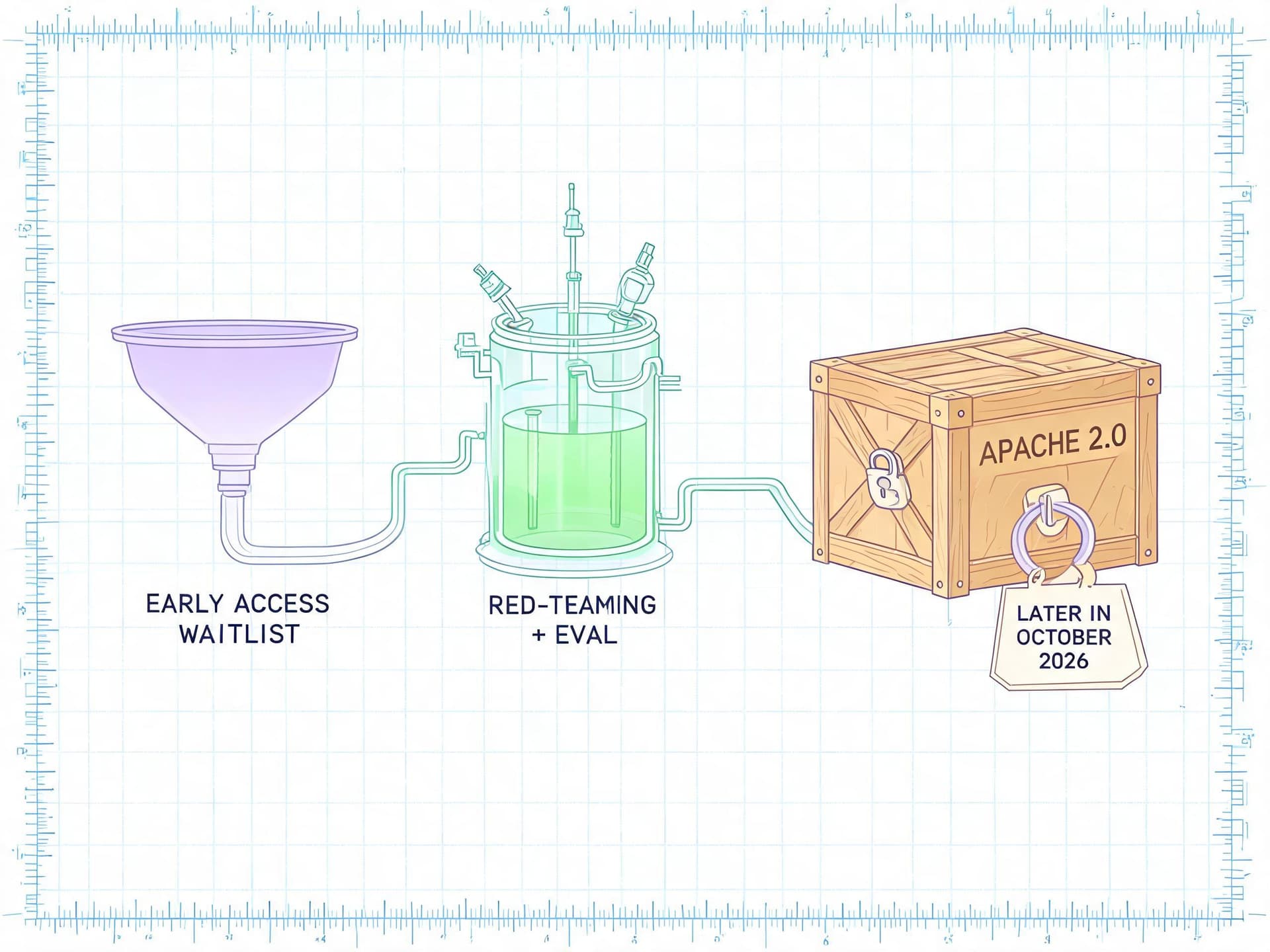
- The weights are not out yet. Reflection has only opened a waitlist for early access through its platform while final red-teaming and evaluation work continues, with a full Apache 2.0 weight release, technical report, model card, and tooling promised for "later in October 2026" [1]. Anyone telling you they've already downloaded and run Beam locally today is either confused or lying.
- Independent reporting is already pushing back on parts of Reflection's own framing, particularly around DeepSWE, which is exactly the kind of healthy skepticism a brand-new frontier claim deserves [6].
If you've been following this blog's coverage of the open-weight MoE race this year, from GLM-5.3 and Kimi K3 to Qwen3.8-Max, DeepSeek V4-Pro, and Thinking Machines' Inkling, Beam is the first entry from a well-funded American lab explicitly built to play in that exact weight class, rather than a closed frontier lab releasing a distilled smaller sibling.
Step 1: What Beam Actually Is
Start with the plain description, before the architecture diagrams. Beam is a sparse Mixture-of-Experts transformer with 501 billion total parameters, of which approximately 23 billion are active for any given token [1][2]. That works out to roughly 22x sparsity, meaning only about 1 in every 22 parameters actually participates in computing any single token's output, even though every one of those 501 billion parameters has to sit in memory the entire time.
It is text-only. Reflection is explicit that Beam does not take or produce images, audio, or video natively, unlike Thinking Machines' Inkling, which is multimodal [2]. It can still reason about content that has been converted to text (transcripts, OCR output, structured data dumps), but there's no native vision encoder or audio tokenizer bolted onto the architecture.
Context handling has two different numbers worth knowing, not one. Reflection midtrains Beam to extend its effective context window to 1 million tokens, but the reinforcement learning stage itself was run with a maximum context of 256,000 tokens [1]. That gap matters in practice: a model's raw context window and the context length its RL training actually exercised are not the same claim, and a model can technically accept a million-token prompt while having never been reinforcement-trained on reasoning chains anywhere near that long. Treat the 1M figure as an architectural ceiling and the 256K figure as the length Beam's agentic and reasoning behavior was actually shaped around.
Beam also ships with a user-facing "reasoning effort" setting, a length penalty baked into the RL reward that lets a deployer trade off response length against performance [1]. This is the same basic idea you'll recognize from OpenAI's reasoning-effort parameter or Anthropic's extended thinking budgets: more tokens of internal reasoning generally buys better accuracy on hard problems, up to a point of diminishing returns, and giving the caller an explicit knob rather than a fixed hidden budget is now table stakes for any model marketed at agentic and coding use cases.
Reflection frames Beam explicitly as "the first model in a series," not a one-off release [1]. That framing matters for anyone deciding whether to build on it: a first-in-series model from a well-capitalized lab is a very different commitment than a one-time open-weight dump a company has no roadmap reason to maintain.
Step 2: Why "501B Total, 23B Active" Is the Whole Story
This is the single most important number pair in the entire announcement, and it is worth slowing down on, because the two halves of that sentence pull in opposite directions and both are simultaneously true.
The memory side (501B). Every one of Beam's 501 billion parameters has to be resident somewhere, whether that's GPU HBM, CPU RAM, or NVMe storage with offloading, because the router that decides which experts to activate for a given token can route to any expert in the model. You cannot predict in advance which 23 billion parameters a given forward pass will need, so you cannot simply discard the rest. At even a relatively aggressive 8-bit quantization, 501 billion parameters costs roughly 501GB of memory just for weights, before you add KV cache for a long context, activation memory, or any safety margin. At a more conservative FP16/BF16 storage format, that number roughly doubles toward the 1TB range. Practically, this means Beam is never going to be a "runs comfortably on a single high-end consumer GPU" model, the way a dense 7B or 13B model might be. It needs either a genuinely heavyweight single-node server (think multiple 80GB+ datacenter GPUs, or a Mac Studio-class unified memory machine at very aggressive quantization) or a multi-node inference cluster with tensor and expert parallelism.
The compute side (23B). Here's the part that makes MoE worth the memory tax in the first place. A dense 500B-parameter model would need to run all 500 billion parameters through the arithmetic for every single token, which is enormously expensive in FLOPs and latency. Beam's router instead looks at each token and sends it to only a small subset of expert sub-networks, roughly the equivalent of 23 billion parameters' worth of compute, while leaving the other roughly 478 billion parameters untouched for that particular token. Multiply that out across a full generation and you get Reflection's efficiency pitch: similar or better reasoning quality to a dense-ish 744B-active competitor like GLM-5.2, at a fraction of the FLOPs per generated token [1].
This is precisely the mechanism behind the 3 to 4x inference compute reduction claim this post covers in depth in Step 7. It is not marketing fluff layered on top of the architecture; it is a direct, mechanical consequence of routing 1-in-22 parameters per token instead of routing most or all of them. The tradeoff Reflection is explicitly making is: pay a large, fixed one-time memory cost to host the full parameter set, in exchange for a much smaller, variable, per-token compute cost at inference time. For a company serving millions of API requests, where compute is the recurring bill and memory is a one-time infrastructure decision, that tradeoff usually favors sparsity, which is exactly why essentially every large open-weight model released in the last two years, GLM-5.2, Kimi K3, Qwen3.8-Max, DeepSeek V4.1, Tencent's Hy4, and Shanghai AI Lab's Atria Dawn, has converged on some version of the same sparse MoE pattern. Beam's specific contribution to that pattern is pushing the sparsity ratio noticeably higher than most of its named competitors while still claiming to hold reasoning quality roughly constant.
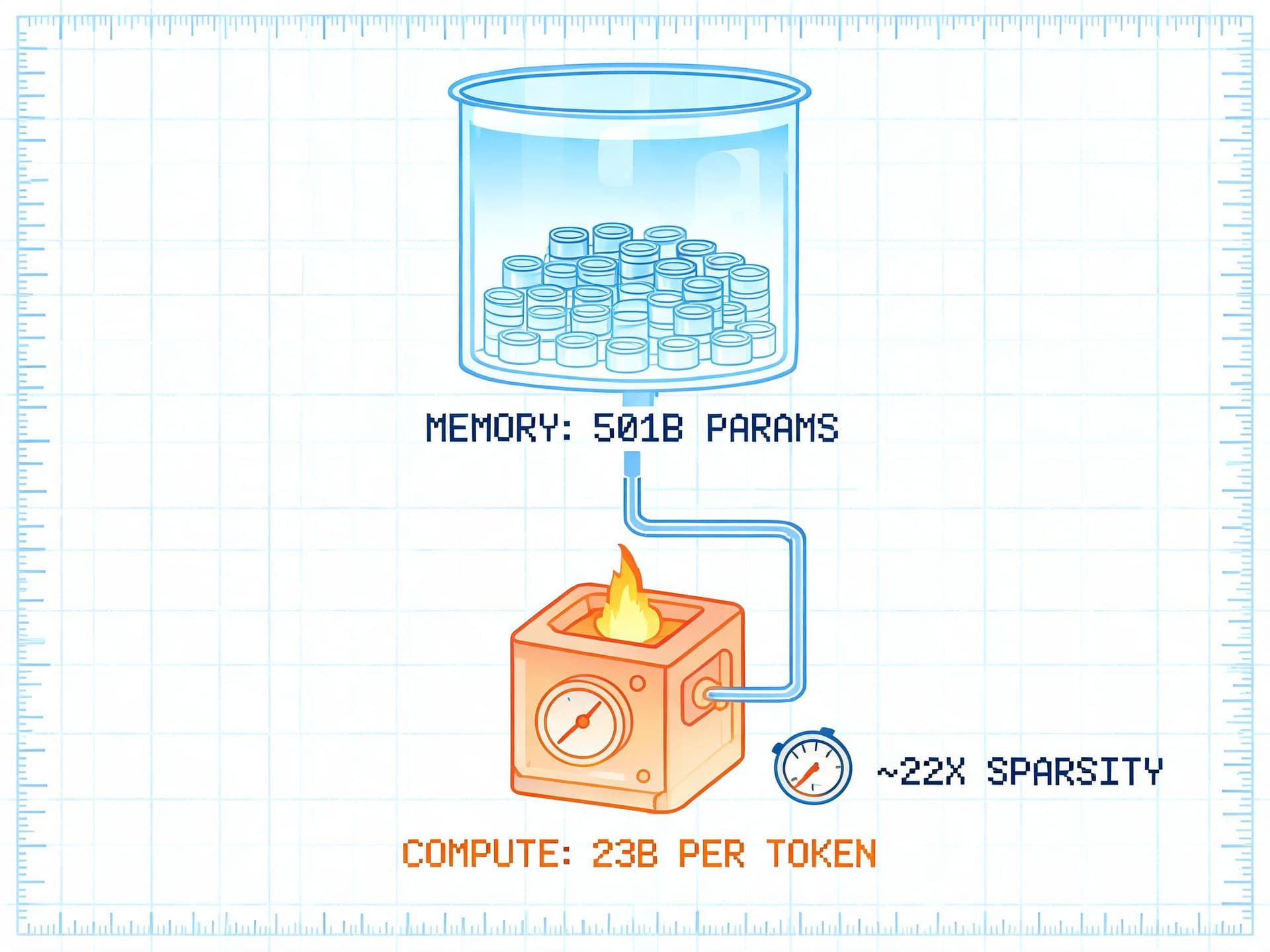
It's worth being concrete about what "22x sparsity" actually buys versus a less sparse design like GLM-5.2's reported 744B total / 40B active configuration, which is closer to 18.6x [2]. Beam's extra sparsity means a smaller fraction of the total model does more of the per-token work with fewer, more specialized experts firing, which can either be a genuine efficiency win if the router and expert specialization are well-tuned, or a quality tax if sparsity is pushed past the point where each expert gets enough gradient signal to specialize usefully during training. Reflection's benchmark table (Step 6) is effectively the evidence for which side of that tradeoff Beam actually landed on, and the honest answer is: it depends on which benchmark you look at.
Step 3: Pretraining — Building the Base Model
Pretraining is where Beam's raw knowledge and language modeling ability come from, before any reasoning-specific reinforcement learning touches it. Reflection ran pretraining end-to-end in under four weeks on 6,144 NVIDIA GB300 NVL72 GPUs, consuming about 23.8 trillion tokens drawn from web data combined with licensed proprietary datasets [1].
A few details in Reflection's own disclosure are worth calling out because they tell you something about how seriously the run was engineered, not just how big it was:
- Nine semi-automatic rewinds. At this scale, hardware failures, loss spikes, and data pipeline issues are a certainty, not a risk. Reflection reports nine rewinds during the pretraining run, meaning the training process detected a problem and automatically rolled the model state back to a known-good checkpoint nine separate times over the four-week run [1]. That's roughly one rewind every three days of continuous training on a 6,144-GPU cluster, which is a realistic cadence for a run this size and signals real production-grade training infrastructure rather than a lucky single clean run.
- 92.3% goodput by the end of the run. "Goodput" here describes the fraction of total GPU-time that went toward useful forward and backward passes rather than being lost to failures, checkpointing overhead, or rewinds. Ending at 92.3% is a genuinely strong number for a run of this scale and duration; large distributed training runs commonly see goodput drop into the 70s or lower percent range when hardware failure rates and communication overhead compound across thousands of GPUs. [1]
- Data mix. The 23.8 trillion tokens combine open web data with "licensed proprietary datasets" [1]. Reflection does not break down the exact ratio publicly, which is typical for a frontier lab protecting a competitive data-sourcing advantage, but the explicit mention of licensed data (as opposed to purely scraped web text) is itself notable, since it signals Reflection paid for at least some portion of its training corpus the way several Western labs have increasingly done as high-quality public web text has become more contested and more thoroughly mined by competitors.
To put the compute scale in perspective: 6,144 GB300 GPUs running for roughly four weeks is a training commitment on the same general order as other 2026-era frontier open-weight efforts. Nemotron 3 Ultra, Tencent's Hy4, and Atria Dawn were all trained on comparably large clusters, and the fact that Reflection could stand up and sustain a 6,144-GPU GB300 run at all speaks to the roughly $7 billion in combined compute deals with SpaceX and Nebius it signed specifically to secure that hardware access through 2029 [2].
What pretraining does not do, and this is a distinction worth being precise about, is teach a model to reason step by step, follow multi-turn agentic instructions, or behave safely under adversarial prompting. That's the entire job of the next stage.
Step 4: Post-Training — The Reinforcement Learning Pipeline That Actually Makes Beam "Beam"
If pretraining gives Beam its raw knowledge, the RL post-training stage is where it becomes a model you'd actually want to hand a coding task or an agentic workflow to. Reflection ran this stage on roughly 10,500 NVIDIA GB300 GPUs for about four weeks, nearly double the GPU count of pretraining, for a comparable duration [1].
The scale of the RL rollout infrastructure is the most striking part of Reflection's disclosure, and it reads like a real production system rather than an academic ablation:
- More than 100 million total rollouts, of which about 80 million went specifically to training the reasoning expert [1]. A "rollout" here is one complete episode of the model attempting a task, from initial prompt through however many reasoning and action steps it takes to reach a terminal state, scored against a reward signal.
- Roughly 1 million distinct environments, encompassing an estimated 1.3 billion sandboxes [1]. This almost certainly spans coding sandboxes with real test suites, tool-use environments, terminal and shell tasks, and agentic multi-step scenarios, the same general category of RL environment scaling this blog has covered before as a defining trend of 2026-era post-training.
- An average of 110,000 concurrent rollouts, peaking at up to 170,000 concurrent sandboxes running at once [1]. Running six-figure concurrent rollout counts requires an orchestration layer that can spin up, tear down, and route rewards for hundreds of thousands of simultaneous sandboxed environments without the policy update pipeline stalling, which is a genuinely hard distributed-systems problem independent of anything about the model itself.
- Asynchronous RL with up to one day of policy staleness, reported stable throughout the run [1]. In synchronous RL, every rollout must be generated by the exact current policy before an update happens, which bottlenecks throughput to the slowest rollout in the batch. Asynchronous RL instead lets rollouts generated by a slightly older ("stale") version of the policy still count toward training, which unlocks much higher throughput but risks training instability if the policy drifts too far from what generated the data. Tolerating up to a full day of staleness at this scale, without the training run destabilizing, is a meaningful systems achievement that several other labs have written about as one of the hardest parts of scaling RL post-training.
The reward design includes a length penalty that works alongside the user-facing reasoning-effort setting mentioned in Step 1, explicitly shaping how much internal reasoning Beam produces before answering, rather than letting response length grow unchecked the way early reasoning models sometimes did [1].
On the safety side, Reflection describes a three-tier structure for Beam's behavioral principles: hard rules, consistent qualities, and default style, trained in via multi-teacher on-policy distillation and deliberative alignment [1]. Full safety evaluation results are promised alongside the eventual technical report, and Reflection says it will open-source its internal evaluation suite, which would be a genuinely useful contribution to the field if it actually ships, since independently reproducing a lab's safety claims is usually the hardest part of evaluating any new frontier release.
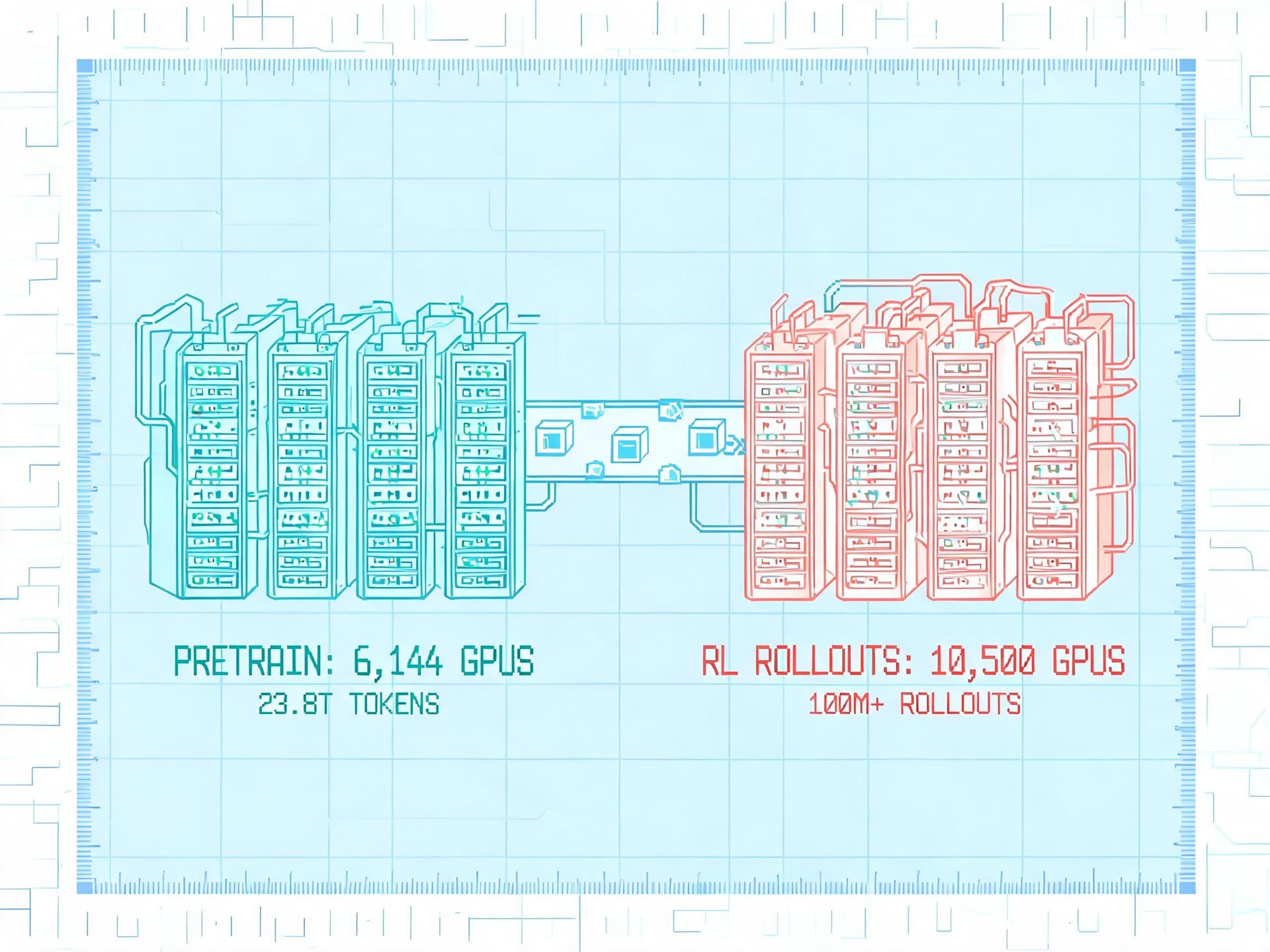
Put pretraining and post-training side by side and a clear production pipeline emerges: a roughly four-week, 6,144-GPU pretraining run builds the base model's knowledge and language ability, handed off to a roughly four-week, 10,500-GPU RL run that builds everything people actually associate with a "reasoning model," step-by-step problem solving, tool use, coding ability, and agentic task completion. Total compute committed across both stages, even before counting evaluation, red-teaming, and the eventual public release engineering, is on the order of tens of thousands of GPU-weeks, which is a useful anchor point for understanding why frontier open-weight releases increasingly come only from labs that have raised multiple billions of dollars specifically earmarked for compute.
Step 5: Simulating Top-K MoE Routing in Python
Before getting into benchmarks, it's worth actually building a small, runnable simulation of what a sparse MoE router does, since "23 billion active out of 501 billion" is an abstract number until you've watched a router actually make that routing decision token by token.
To be completely explicit: this is an educational, illustrative implementation of the general top-k MoE gating mechanism used across the field (the same basic idea behind GLM-5.2, Kimi K3, DeepSeek's MoE line, and Beam), not Reflection's actual Beam codebase, which is not public. Reflection has not disclosed its specific router architecture, number of experts, or routing algorithm beyond the headline parameter counts. The code below uses small, toy dimensions you can run on a laptop CPU in under a second, purely to make the mechanism tangible.
python/code
"""
Illustrative top-k Mixture-of-Experts (MoE) routing simulation.

This is an EDUCATIONAL, toy implementation of the general top-k MoE gating
mechanism used across the field (the same basic idea behind GLM-5.2, Kimi K3,
DeepSeek's MoE line, and Reflection AI's Beam). It is NOT Reflection's actual
Beam code, which is not public. Dimensions below are shrunk way down, and it
uses only the Python standard library (no numpy/torch required), so it runs
anywhere in under a second, purely to make "top-k routing" and "501B total /
23B active" style sparsity concrete.
"""

import math
import random

random.seed(7)

# --- Toy model dimensions (scaled down from something like Beam's real size) ---
NUM_EXPERTS = 8          # Beam's real expert count is not disclosed publicly
TOP_K = 2                # how many experts each token activates
HIDDEN_DIM = 16          # toy hidden size
PARAMS_PER_EXPERT = 12_500_000   # toy per-expert parameter count

TOTAL_PARAMS = NUM_EXPERTS * PARAMS_PER_EXPERT
ACTIVE_PARAMS = TOP_K * PARAMS_PER_EXPERT
SPARSITY = TOTAL_PARAMS / ACTIVE_PARAMS

print(f"Total parameters (all experts): {TOTAL_PARAMS:,} (scaled toy model)")
print(f"Active parameters per token (top-{TOP_K} of {NUM_EXPERTS}): {ACTIVE_PARAMS:,}")
print(f"Effective sparsity: {SPARSITY:.1f}x")


def random_vector(dim):
    return [random.gauss(0, 1) for _ in range(dim)]


def random_matrix(rows, cols):
    return [[random.gauss(0, 1) for _ in range(cols)] for _ in range(rows)]


def matvec(matrix, vector):
    return [sum(row[i] * vector[i] for i in range(len(vector))) for row in matrix]


def dot(a, b):
    return sum(x * y for x, y in zip(a, b))


def softmax(xs):
    m = max(xs)
    exps = [math.exp(x - m) for x in xs]
    total = sum(exps)
    return [e / total for e in exps]


def route_token(token_vector, router_weights):
    """
    A simplified top-k router: score every expert for this token, keep the
    top-k highest-scoring experts, and re-normalize their scores into
    routing weights with a softmax so they sum to 1.
    """
    scores = [dot(token_vector, router_weights[e]) for e in range(NUM_EXPERTS)]
    ranked = sorted(range(NUM_EXPERTS), key=lambda e: scores[e], reverse=True)
    top_k_idx = ranked[:TOP_K]
    top_k_scores = [scores[e] for e in top_k_idx]
    top_k_weights = softmax(top_k_scores)
    return top_k_idx, top_k_weights


def moe_forward(token_vector, router_weights, expert_matrices):
    """
    Route a single token, run it through only its selected experts, and
    combine their outputs with the router's softmax weights. This is the
    core mechanism that lets a model hold 501B parameters in memory while
    only computing through ~23B worth of weights for any given token.
    """
    expert_idx, weights = route_token(token_vector, router_weights)
    output = [0.0] * len(token_vector)
    for idx, w in zip(expert_idx, weights):
        expert_output = matvec(expert_matrices[idx], token_vector)
        output = [o + w * e for o, e in zip(output, expert_output)]
    return output, expert_idx, weights


if __name__ == "__main__":
    # One router weight vector per expert, used to score each token.
    router_weights = random_matrix(NUM_EXPERTS, HIDDEN_DIM)

    # Each "expert" here is just a random linear layer standing in for a
    # real feedforward expert sub-network.
    expert_matrices = [random_matrix(HIDDEN_DIM, HIDDEN_DIM) for _ in range(NUM_EXPERTS)]

    # Simulate 3 tokens in a tiny "sequence" to show routing varies per token.
    tokens = [random_vector(HIDDEN_DIM) for _ in range(3)]

    for i, token_vector in enumerate(tokens):
        _, expert_idx, weights = moe_forward(token_vector, router_weights, expert_matrices)
        rounded_weights = [round(w, 2) for w in weights]
        print(f"Token {i} routed to experts: {expert_idx} with weights {rounded_weights}")
Running that script prints something like this (your exact numbers will vary with the random seed, but the shape of the result will not):
```
Total parameters (all experts): 100,000,000 (scaled toy model)
Active parameters per token (top-2 of 8): 25,000,000
Effective sparsity: 4.0x
Token 0 routed to experts: [0, 4] with weights [0.89, 0.11]
Token 1 routed to experts: [1, 7] with weights [0.99, 0.01]
Token 2 routed to experts: [1, 2] with weights [0.89, 0.11]
```
Notice the two things this tiny simulation makes concrete that the headline "501B / 23B" number alone does not. First, routing happens independently per token, not once per sequence or per request, so two tokens right next to each other in the same prompt can activate completely different experts. Second, the router doesn't just pick experts, it also produces a weighted combination (the softmax weights in the printout above), so the "active" computation is a blend of however many experts were selected (top-2 in this toy example, likely a different top-k in Beam's real router), not a hard single-expert switch. Scale this toy 8-expert, 100M-parameter router up to whatever real expert count and per-expert size Beam actually uses to reach 501B total and 23B active, and you have the real mechanism, just at a size nobody can run on a laptop.
Step 6: Benchmarks — Where Beam Actually Leads, and Where It Doesn't
This is the part of Beam's announcement that deserves the most scrutiny, because Reflection's own framing ("competitive with GLM-5.2, approaching Qwen3.8-Max") and the raw numbers in its own benchmark table don't tell quite the same story depending on which benchmark you look at [2].
| Benchmark | Beam | GLM-5.2 | GLM-5.3 | Kimi K3 | Qwen3.8-Max | DeepSeek V4.1 Flash |
|---|---|---|---|---|---|---|
| SWE-Bench Verified | 80.9 | - | - | - | - | - |
| SWE-Bench Pro v1 | 65.5 | 62.1 | - | - | 67.7 | - |
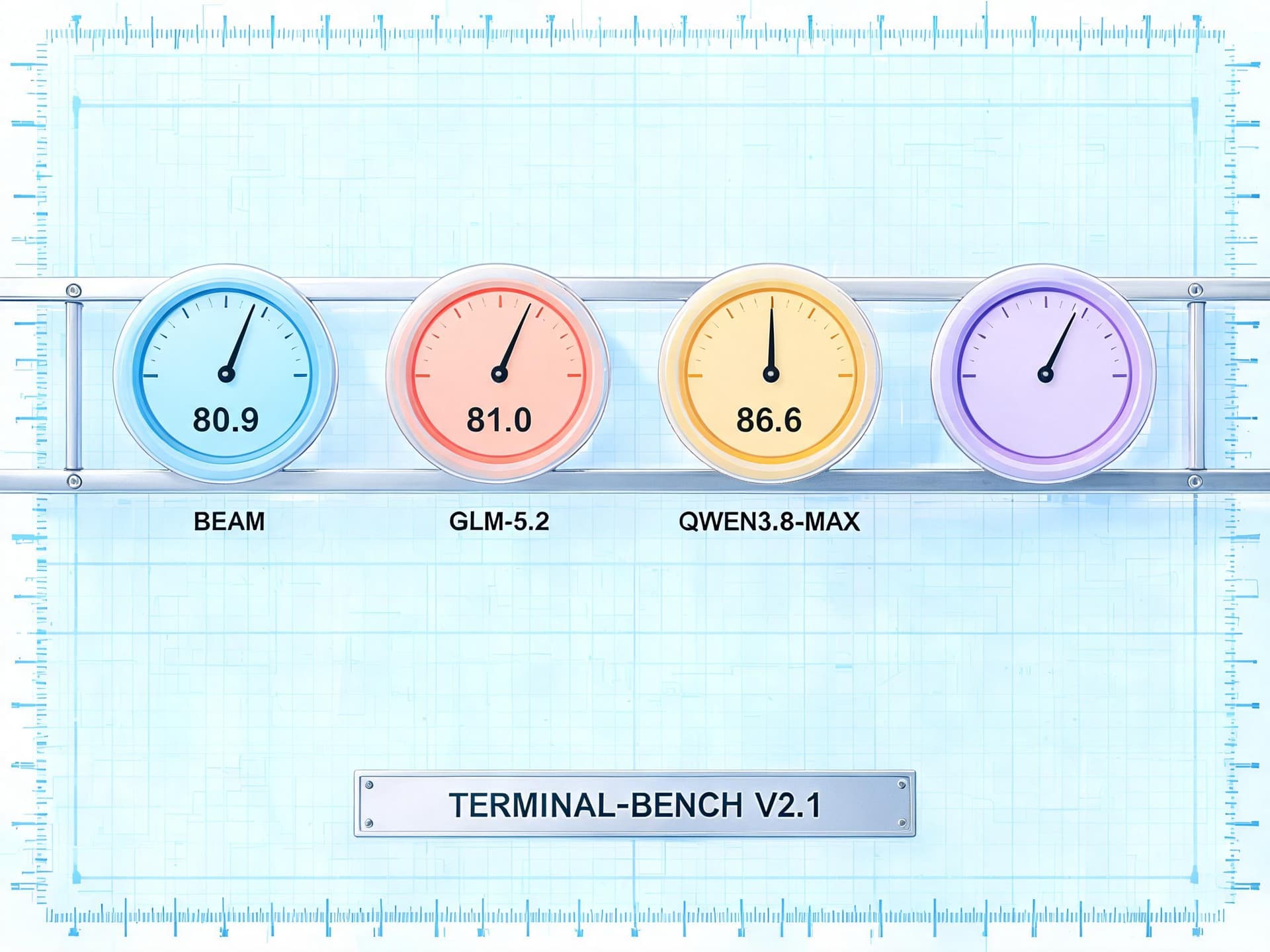
| Terminal-Bench v2.1 | 80.1 | 81.0 | 88.2 | 88.3 | 86.6 | 90.6 |
| DeepSWE v1.1 | 44.4 | 44.0 | 61.0 | 68.0 | 51.0 | 74.2 |
| MCP Atlas | 78.7 | 77.8 | - | - | - | - |
| GPQA Diamond | 90.5 | 91.2 | - | - | - | - |
| AIME 2026 | 97.8 | 99.2 | - | - | - | - |
| HLE (no tools) | 36.2 | 40.5 | - | - | - | - |
A few honest observations reading across that table:
Where Beam genuinely leads. On SWE-Bench Verified, Beam's 80.9 beats Thinking Machines' Inkling (77.6) and NVIDIA's Nemotron 3 Ultra (70.7) by a comfortable margin [1]. On SWE-Bench Pro v1, Beam's 65.5 edges out GLM-5.2's 62.1, though it still trails Qwen3.8-Max's 67.7. On MCP Atlas, an agentic tool-use benchmark, Beam's 78.7 slightly beats GLM-5.2's 77.8.
Where it's essentially tied or a close second. GPQA Diamond (90.5 vs GLM-5.2's 91.2) and AIME 2026 (97.8 vs GLM-5.2's 99.2) put Beam within a point or two of GLM-5.2, which is the comparison Reflection built its entire efficiency pitch around, matching reasoning quality at a fraction of the compute, so landing this close on both of these reasoning-heavy benchmarks is meaningful supporting evidence for that pitch, even if Beam doesn't outright win either one.
Where Beam genuinely trails, and trails by a lot. This is the part independent coverage has been right to flag plainly rather than soften [6]. On DeepSWE v1.1, Beam's 44.4 is barely ahead of GLM-5.2's own 44.0, but it sits well behind GLM-5.3 (61.0), Qwen3.8-Max (51.0), Kimi K3 (68.0), and especially DeepSeek V4.1 Flash (74.2), which beats Beam on this benchmark by a full 30 points. On Terminal-Bench v2.1, the pattern repeats: Beam's 80.1 is in roughly the same range as GLM-5.2 (81.0) but clearly behind GLM-5.3 (88.2), Kimi K3 (88.3), Qwen3.8-Max (86.6), and DeepSeek V4.1 Flash (90.6). And on HLE (Humanity's Last Exam) without tools, Beam's 36.2 trails GLM-5.2's 40.5 by more than four points.
The fair summary, and the one this post is going to commit to rather than hedge on: Beam is competitive with GLM-5.2 specifically, the exact model Reflection chose as its primary comparison point, landing ahead on some benchmarks and within a point or two on others. But against the newer or larger models in the field, GLM-5.3, Kimi K3, Qwen3.8-Max, and especially DeepSeek V4.1 Flash, Beam is currently behind, sometimes by a wide margin, on agentic coding benchmarks like DeepSWE and Terminal-Bench specifically. Reflection's own table includes these numbers, to its credit, rather than hiding them, which makes the honest reading of "matches GLM-5.2, not necessarily the field" the correct one, not a hostile one.
It's also worth remembering Reflection's own disclosure that these benchmark figures were updated as recently as October 8, 2026, three days after the initial announcement [1], which is itself a reminder that none of these numbers have been independently reproduced by a third party running Beam's actual weights. Every figure in the table above, and in this entire section, comes from Reflection's self-reported evaluation or secondary reporting on that same self-reported table. Until the weights ship and outside labs can run their own evaluation harnesses against Beam directly, "self-reported until proven otherwise" is the correct epistemic status for every number here, a caveat that applies to essentially every frontier model launch this year, not uniquely to Beam.
Step 7: The 3-4x Inference Compute Claim, and What It Actually Measures
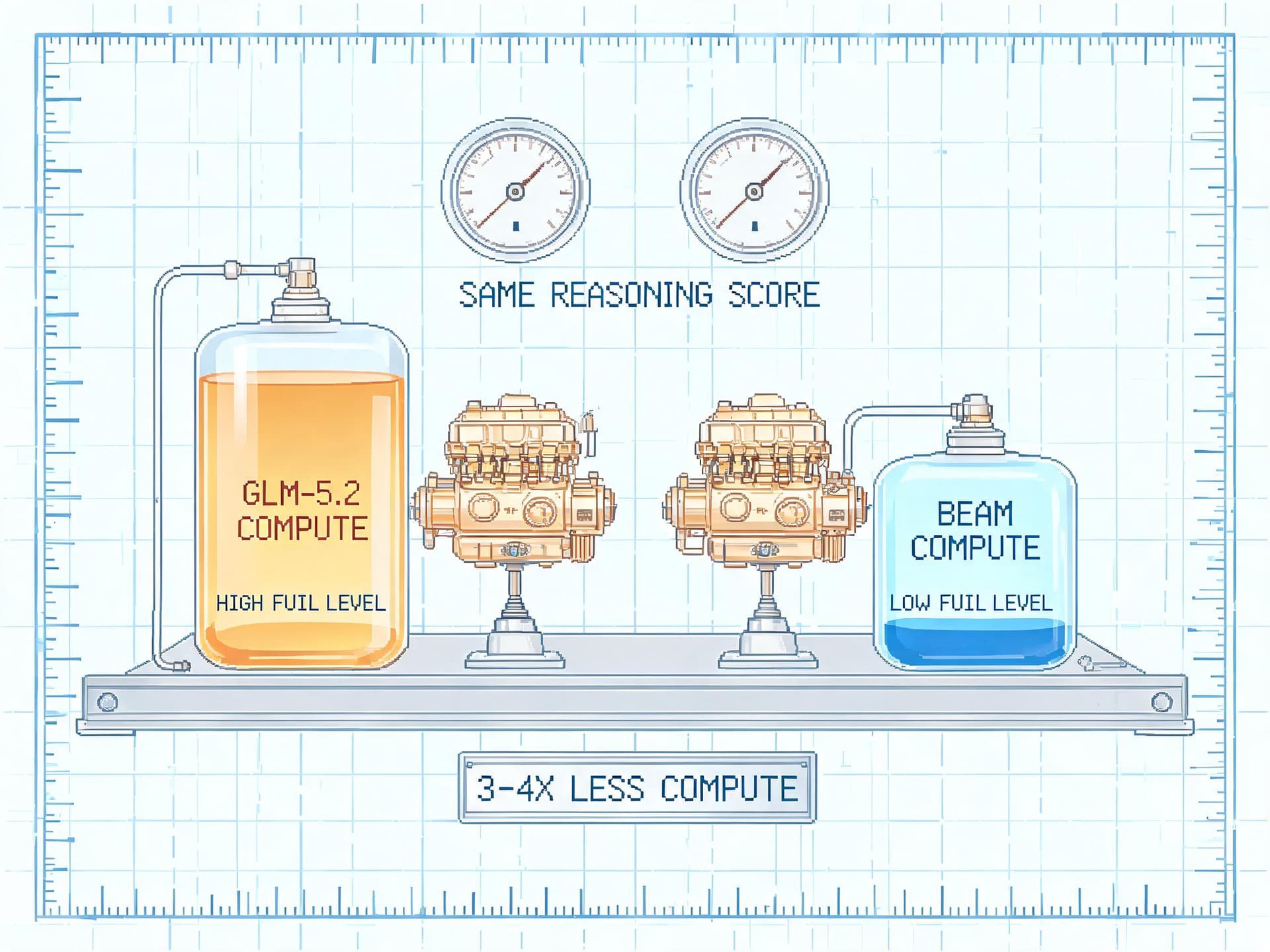
Reflection's central efficiency pitch is that Beam matches GLM-5.2 on advanced reasoning benchmarks while using 3 to 4 times less inference compute per query, with the gap widening further against larger dense-leaning models like Qwen3.8-Max [1].
The mechanical basis for this claim traces directly back to Step 2's sparsity discussion: Reflection's own methodology note states that these compute figures are estimated as active parameters multiplied by generated tokens, and explicitly exclude prefill cost, attention computation, and serving/infrastructure overhead [1]. That's an important asterisk to sit with rather than skip past. "Active parameters times generated tokens" is a reasonable proxy for the dominant cost of autoregressive decoding in a standard transformer, but it is a proxy, not a measured wall-clock or dollar-cost comparison run on identical hardware under identical serving conditions. Two things that proxy specifically leaves out matter a lot in a real production deployment:
- Attention cost scales with context length, not just active parameters. A model being used with a long context window, which Beam explicitly supports up to 1 million tokens, pays an attention cost that the "active parameters times generated tokens" formula doesn't fully capture, since attention's cost grows with sequence length in a way that's architecture-dependent (standard quadratic attention versus various sparse or linear-attention variants) and isn't simply proportional to how many feedforward parameters are active.
- Serving overhead and routing load balancing are real costs in an MoE system that a dense model doesn't pay at all. Running an MoE model efficiently in production requires either expert parallelism across many GPUs, which introduces network communication overhead every time a token's routed experts live on a different GPU than where that token currently sits, or keeping every expert resident on every serving node, which brings back most of the memory cost discussed in Step 2 without actually load-balancing compute evenly. Neither of these costs shows up in a raw "active params times tokens" FLOPs estimate.
None of this means Beam's efficiency claim is wrong. The underlying sparsity math in Step 2 is sound and the general direction, lower active-parameter count should mean lower inference FLOPs for a comparable quality bar, is basic MoE theory that's well established across the field, not something unique to Reflection's marketing. But "3 to 4x less compute" as reported is best read as "3 to 4x less estimated FLOPs under a specific accounting method that explicitly excludes several real serving costs," not as "your cloud GPU bill will be 3 to 4x lower," which is a different and currently unverified claim. Anyone planning capacity around this number should treat it as a useful directional signal for architecture comparison, not a number to plug directly into a cost model until independent, end-to-end serving benchmarks exist.
Step 8: Where Beam Sits in the Open-Weight MoE Landscape
2026 has been an unusually crowded year for frontier-scale open-weight releases, and it's worth placing Beam on that map rather than evaluating it in isolation.
GLM-5.2 and its successor GLM-5.3 from Z.ai remain the explicit target Reflection chose for its headline comparison, at roughly 744B total and 40B active parameters [2], making Beam noticeably more sparse (22x versus roughly 18.6x) at a smaller total parameter count. Kimi K3 from Moonshot AI, at a reported 2.8 trillion total parameters, sits in an entirely different weight class and currently outscores Beam on both DeepSWE and Terminal-Bench by wide margins, which lines up with Reflection's own acknowledgment that Kimi K3 remains ahead on raw capability [1]. Qwen3.8-Max from Alibaba, at 2.4 trillion total parameters, consistently beats Beam on agentic coding benchmarks while Beam claims a larger relative compute advantage against it specifically, since Qwen3.8-Max leans toward a denser, less sparse configuration than GLM-5.2 or Beam. DeepSeek V4.1 Flash turns in the single strongest DeepSWE and Terminal-Bench scores of any model in Reflection's own comparison table, a reminder that DeepSeek's architecture choices are still setting the pace on agentic coding specifically, even as other labs compete on reasoning benchmarks and raw parameter count.
Against Western open-weight competition specifically, Thinking Machines' Inkling from Mira Murati's lab is Beam's closest direct comparison, both being first open-weight releases from well-funded American labs founded by researchers who previously worked at major frontier labs, though Inkling is multimodal where Beam is text-only, and Beam reports beating Inkling on the four coding benchmarks where both report results [2]. NVIDIA's Nemotron 3 Ultra, a hybrid Mamba-MoE design, trails Beam clearly on SWE-Bench Verified. Chinese labs beyond the headline names are also active in this exact weight class: Tencent's Hy4 at 770B and Shanghai AI Lab's Atria Dawn at 744B are both pursuing broadly similar large-sparse-MoE strategies, underlining just how converged the field's architectural thinking has become even as individual labs compete hard on benchmark leaderboards.
The honest framing of Beam's place in this landscape: it is a credible, well-engineered, first-generation entry from a serious new competitor with genuinely unusual sparsity and a real efficiency argument behind it, not yet a clear leader on agentic coding benchmarks against the strongest 2026-era Chinese releases, and explicitly positioned by its own maker as the first of a planned series rather than a finished, settled answer.
Step 9: What "Later in October 2026, Apache 2.0" Actually Means for Self-Hosting
This is worth stating plainly, because it's easy to read a well-produced launch blog post and come away thinking the weights are already sitting on Hugging Face. They are not.
As of this post's writing, Reflection is still completing final red-teaming and evaluation work on Beam. The only access currently available is a waitlist for early access through Reflection's own hosted platform at platform.reflection.ai, not open weights [1]. The full release, weights under an Apache 2.0 license, a technical report, a model card, documentation, and tooling for running, evaluating, and fine-tuning Beam, is explicitly planned for "later in October 2026," with distribution expected through hyperscalers and neoclouds alongside integrations with open-source serving libraries and agent harnesses [1][2]. Reflection did not respond to TechCrunch's request for comment ahead of the article's publication, which is a small but real sign of a company still in the quiet, controlled-rollout phase of a launch rather than fully in public communication mode [2].
Apache 2.0 specifically matters for a model this size. Apache 2.0 is a permissive license that allows commercial use, modification, and redistribution with minimal restrictions, essentially the same license family GLM-5.2, Qwen3.8-Max, and DeepSeek's recent releases have used. If Reflection follows through on the Apache 2.0 commitment exactly as stated, Beam would be legally usable in commercial products, fine-tunable on proprietary data, and redistributable in modified form, without the usage restrictions some other "open" model licenses carry (output-use restrictions, revenue-based license tiers, or required attribution in user-facing products). That's a meaningfully different proposition from a research-only license, and it's the detail that will determine whether enterprises and sovereign AI customers, the exact audience Reflection says it is targeting with its "AI factories" pitch, including a reported sovereign AI partnership being tested with South Korea's Shinsegae Group [2], can actually build on it the way Reflection is pitching.
What to actually watch for once weights do ship:
- The technical report itself. Reflection has promised one alongside the weights [1]. This is where router architecture details, exact expert count, training hyperparameters, and (hopefully) independently reproducible evaluation methodology should actually show up, replacing the current situation where every number in this post traces back to a single company blog post and secondary reporting on it.
- Independent benchmark reproduction. Until a third party, whether that's an academic lab, a competing AI company, or a well-known open benchmark maintainer, runs Beam's actual released weights through standard evaluation harnesses, every number in Step 6's table remains Reflection's own self-reported figure. This is the single most important gap between "announced" and "verified" for any frontier model, and it applies to Beam exactly as it applied to GLM-5.2, Kimi K3, and every other model named in this post when they first launched.
- Real-world quantized inference numbers. A 501B-parameter MoE model is a serious hosting commitment even for a well-resourced team. Watch for community quantization work (GGUF, AWQ, or similar formats) and real reports of what minimum hardware configuration actually runs Beam at usable latency, since official architecture disclosures rarely translate directly into "here's what you need to buy" guidance.
- The promised open-sourced internal evaluation suite. Reflection specifically says it plans to open-source its internal safety evaluations [1]. If that actually ships as a usable, runnable eval suite rather than a results table, it would be a genuinely useful contribution independent of how Beam itself performs, since reproducible safety evaluation tooling is consistently scarcer than reproducible capability benchmarks across the entire field.
- Whether "first in a series" becomes real. Reflection explicitly frames Beam as the start of a model series, not a single release [1]. Given the roughly $7 billion in compute commitments already signed through 2029 [2], there is real infrastructure behind that claim, but a second release actually shipping on a reasonable timeline is the real test of whether Beam was a one-time proof of capability or the start of an ongoing open-weight program the way Qwen, DeepSeek, and GLM have each built out over multiple generations.
Common Mistakes to Avoid When Reading Beam's Launch Coverage
Treating "announced" as "available." The single most common error already showing up in early social media reaction to Beam's launch is describing it as an already-downloadable open-weight model. It is not, not yet. The weights are not public as of this writing; only a hosted early-access waitlist exists [1].
Quoting the 3-4x compute claim as a universal, hardware-agnostic truth. As covered in Step 7, that figure is an estimate based on active-parameter-times-token-count, explicitly excluding prefill, attention, and serving overhead [1]. It is a reasonable architecture-level efficiency signal, not a guaranteed real-world hosting cost multiplier.
Cherry-picking a single benchmark to declare a winner. Reflection's own table shows Beam ahead of GLM-5.2 on some benchmarks (SWE-Bench Pro, MCP Atlas), essentially tied on others (GPQA Diamond, AIME 2026), and behind on several agentic coding benchmarks against GLM-5.3, Kimi K3, Qwen3.8-Max, and DeepSeek V4.1 Flash specifically [1]. Reporting only the favorable comparisons, or only the unfavorable ones, both misrepresent what's actually a mixed, nuanced result.
Confusing Beam's context window with its RL-trained reasoning length. The 1 million token figure is the midtrained architectural context window; the RL stage that actually shapes Beam's reasoning and agentic behavior ran at a maximum of 256,000 tokens [1]. Expect reasoning quality to degrade somewhere between those two numbers in practice, a pattern seen consistently across other long-context models whose RL training didn't fully exercise their maximum architectural context.
Assuming Beam's safety and alignment claims are independently verified. Reflection describes a real-sounding three-tier safety framework and promises open-sourced evaluations [1], but as with the capability benchmarks, none of this has been independently audited yet. Treat safety claims with the same "self-reported until proven otherwise" standard as capability claims.
Production Considerations: Planning to Actually Run a Model Like This
Once Beam's weights do ship, teams evaluating whether to self-host it (versus using Reflection's hosted platform) should plan around a few realities that apply broadly to any 500B+ parameter sparse MoE model, not just Beam specifically:
Hardware sizing has to account for total parameters, not active parameters. As covered in Step 2, every one of the 501 billion parameters needs to be resident in memory across your serving cluster, regardless of how few are active per token. Budget for roughly 500GB to 1TB of aggregate GPU memory depending on quantization level, plus headroom for KV cache that scales with your expected context lengths and concurrent request count. A single-GPU deployment is not realistic at this scale; plan for multi-GPU, likely multi-node, serving from the start.
Expert parallelism and routing-aware serving infrastructure matter more than raw GPU count. An MoE model's serving efficiency depends heavily on how evenly tokens get routed across experts in practice (load balancing) and how much network overhead your serving stack pays when a token's selected experts live on a different GPU or node than where that token's other computation is happening. Popular open-source serving frameworks (vLLM, SGLang, and similar) have been adding increasingly sophisticated MoE-aware serving support throughout 2026 specifically because of releases like GLM-5.2, Kimi K3, and now Beam; checking for Beam-specific support in whichever serving framework you plan to use, once weights ship, should be an early step rather than an afterthought.
Quantization will almost certainly be necessary for anything short of a well-resourced enterprise deployment. Expect the community to produce GGUF, AWQ, or similar quantized variants quickly after release, the way it has for every other major open-weight MoE model this year. Aggressive quantization (4-bit or lower) can meaningfully shrink the memory footprint discussed above, at some cost to output quality that's usually worth benchmarking against your specific use case rather than assuming from general reputation.
Fine-tuning a model this size is a different cost proposition than fine-tuning a dense 7B-70B model. Even parameter-efficient fine-tuning approaches like LoRA still require loading the full base model into memory for most standard implementations, meaning the same roughly 500GB-1TB memory floor applies to fine-tuning infrastructure as to inference infrastructure. Budget accordingly, and expect fine-tuning-as-a-service offerings (likely including Reflection's own "AI factory" positioning) to be a meaningfully more accessible path than from-scratch self-hosted fine-tuning for most teams below the scale of a well-resourced enterprise or sovereign deployment.
Build in an evaluation step before trusting any benchmark number for your specific use case. Given everything covered in Step 6 about the gap between Reflection's self-reported benchmarks and independent verification, any team planning a production deployment around Beam should run their own representative evaluation set against the real released weights once available, rather than assuming the published SWE-Bench or Terminal-Bench numbers will transfer directly to their own workload.
Frequently Asked Questions
Is Beam's 501B parameter model available to download right now?
No. As of this post, only a waitlist for hosted early access exists at platform.reflection.ai. Reflection has stated the open weights, under an Apache 2.0 license, along with a technical report and supporting tooling, are planned for later in October 2026, not immediately at announcement [1].
What does "23 billion active parameters" actually mean if you're not an ML engineer?
Think of Beam as a huge library of specialized sub-models (experts) totaling 501 billion parameters, with a router that reads each piece of text and decides which small subset of those experts, roughly 23 billion parameters' worth, should actually process it. The whole library has to be available on standby, but any single word only actually "asks" a small fraction of the library's specialists for help, which is what keeps per-token compute costs down even though the total model is enormous.
Does Beam support images, audio, or video input?
No. Beam is explicitly text-only, unlike Thinking Machines' multimodal Inkling model [2]. It can process content that's already been converted to text, but has no native image, audio, or video encoder.
Is Beam actually better than GLM-5.2, Kimi K3, Qwen3.8-Max, and DeepSeek V4.1 Flash?
It depends entirely on which benchmark and which comparison. Beam is roughly competitive with or slightly ahead of GLM-5.2, its explicitly chosen comparison target, on several benchmarks, while trailing GLM-5.3, Kimi K3, Qwen3.8-Max, and especially DeepSeek V4.1 Flash on agentic coding benchmarks like DeepSWE and Terminal-Bench, sometimes by a wide margin. See Step 6 above for the full honest breakdown rather than a single yes-or-no answer.
What hardware would be needed to self-host Beam once weights are released?
Expect to need somewhere between roughly 500GB and 1TB of aggregate GPU memory depending on quantization, realistically spread across a multi-GPU, likely multi-node, serving setup, plus MoE-aware serving infrastructure to handle expert routing efficiently. A single consumer GPU will not be sufficient at full precision; watch for community quantized releases to lower that bar.
Is the "3-4x less inference compute" claim trustworthy?
The underlying mechanism (lower active parameter count generally means lower per-token FLOPs) is sound and well-established MoE theory. But Reflection's own methodology note states the figure is an estimate based on active parameters times generated tokens, explicitly excluding prefill, attention, and serving overhead. Treat it as a reasonable architectural signal, not a verified end-to-end cost comparison, until independent serving benchmarks exist.
Who is behind Reflection AI, and is this their first model?
Reflection AI was founded in 2024 in Brooklyn by two former Google DeepMind researchers, and has raised roughly $4.7 billion at a $25 billion pre-money valuation, with over $7 billion in combined compute agreements with SpaceX and Nebius for NVIDIA GB300 access through 2029 [2]. Beam is explicitly described as Reflection's first open-weight model and the first in a planned series [1].
How does Beam's context window actually work in practice?
Beam's architecture is midtrained to support up to 1 million tokens of context, but its reinforcement learning stage, the part of training that actually shapes reasoning and agentic behavior, was run with a maximum context of 256,000 tokens [1]. Expect the strongest, most reliable reasoning performance within that 256K range, with some falloff as you push toward the full 1M architectural ceiling.
Conclusion
Beam is a genuinely serious entry into the open-weight frontier model race, not a marketing exercise dressed up as one. The underlying engineering, a 23.8 trillion token pretraining run that held 92.3% goodput across 6,144 GPUs, a reinforcement learning stage that sustained over 100 million rollouts across up to 170,000 concurrent sandboxes with asynchronous policy updates tolerating a full day of staleness, is real, well-documented production infrastructure, not a research toy scaled up for a press release [1]. The 501B total, 23B active parameter split is a deliberate, well-reasoned architectural bet on sparsity, and it produces a real, if partial, efficiency advantage over less sparse competitors like GLM-5.2.
But the honest read of Beam's own benchmark disclosure is a mixed one, not a clean victory. It's competitive with, not clearly ahead of, its chosen primary comparison on most reasoning benchmarks, and it trails several 2026-era open-weight competitors, GLM-5.3, Kimi K3, Qwen3.8-Max, and especially DeepSeek V4.1 Flash, on agentic coding benchmarks specifically, sometimes by wide margins. And critically, none of it is independently verified yet, nor are the weights actually available to anyone outside Reflection's hosted early-access waitlist as of this writing. "Later in October 2026" is a real, specific commitment from a well-capitalized lab with billions of dollars in locked-in compute through 2029, which gives it more credibility than a vague roadmap promise, but it is still a promise, not a shipped artifact.
For anyone tracking the open-weight model race alongside this blog's other 2026 coverage, Beam is worth watching closely, both for what it says about the current ceiling on inference efficiency through sparsity, and as a genuine test of whether a well-funded Western lab can sustain an ongoing open-weight release cadence the way Alibaba's Qwen line, DeepSeek, and Z.ai's GLM line already have. The real verdict on Beam won't be possible to render responsibly until the weights ship, the technical report lands, and someone outside Reflection actually runs it.
References
- Introducing Beam - Reflection AI
- Reflection debuts Beam, an open-weight AI model to rival Chinese models at lower compute cost - TechCrunch
- Reflection AI launches Beam open-weight model - Quartz
- Reflection AI's Beam Model Explained - DevX
- Reflection AI Unveils Beam - Hyper.ai
- Reflection Launches 501B Parameter Beam Model, Lags Behind Top Chinese Open-Source Models - KuCoin
- Reflection Unveils Beam, Open 501B-Parameter MoE - El Solitario