Google Ads Is Retiring Call-Only Ads: The Full RSA + Call Assets Migration Timeline (2026-2027)

Written by
Aerin Kim
Google is phasing out call-only ads: no new ones after February 2026, full shutoff by February 2027. Here's the exact timeline and how to migrate to RSA Call Assets.
A plumbing company in Phoenix has run the exact same call-only ad for three years. No landing page, no headlines to test, just a business name, a phone number, and a single line of ad copy that sends an emergency caller straight into a ringing phone instead of a website they'd have to navigate on a cracked phone screen while standing in a flooded kitchen. It has been the single highest-converting ad in the account for years, mostly because that's exactly what it was built for: one tap, one call, no detour.
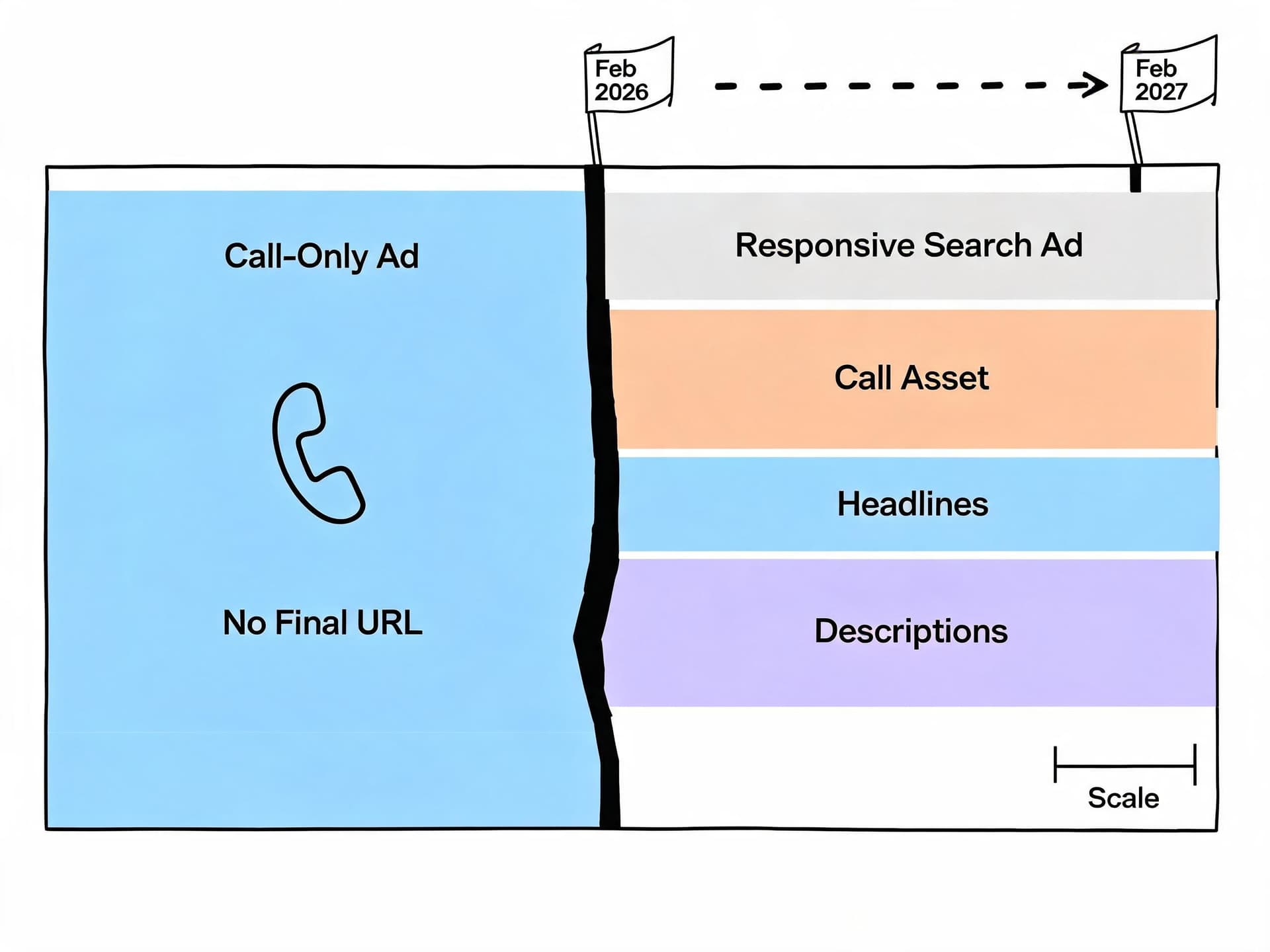
That ad format is going away. Not quietly deprecated in some future roadmap note, but on a real, dated, two-stage shutdown Google has already put in writing. Starting February 2026, nobody can create a new call-only ad anywhere in Google Ads, in the interface or through the API. The ones already running get a one-year grace period before they stop serving entirely in February 2027. After that, the format simply does not exist anymore, and every advertiser who built a lead pipeline around a plain phone-number ad has to have already moved to the replacement: a responsive search ad carrying a call asset.
If you manage Google Ads for a plumber, an HVAC company, a personal injury attorney, a locksmith, a dentist, a home security installer, or any other business where a ringing phone is worth more than a form fill, this is one of the more consequential format changes landing in 2026. It is not cosmetic. The mechanics of bidding, the shape of the ad itself, and the way you track whether a call was actually worth paying for all change under the new format, and the businesses that wait until the February 2027 cutoff to deal with it are going to lose calls they didn't have to lose.
TL;DR: The Call-Only Ads Retirement Timeline
- February 2026: Google removes the ability to create any new call-only ad, in the Google Ads interface and through the Google Ads API. Existing call-only ads keep running.
- February 2027: Every remaining call-only ad, no matter how old or how well it has performed, stops receiving impressions entirely. This is the full, final sunset.
- The announcement is real and already official. Google notified advertisers on October 3, 2025, and published the change through its own Google Ads Help Center and the Google Ads developer blog, not through a leak or a third-party rumor.
- The replacement is not a new standalone format. There is no "call-only ad 2.0." The replacement path is a responsive search ad (RSA) with a call asset attached, the same call-asset mechanism that already exists for standard search ads today.
- This hits phone-reliant local businesses hardest. Plumbers, electricians, HVAC companies, roofers, locksmiths, garage door repair, personal injury and family law firms, healthcare practices, and any other business that treats "the phone rang" as the primary conversion event.
- You have roughly 16 months from the October 2025 announcement to the February 2027 hard deadline, but Google itself recommends migrating now rather than waiting, since RSAs with call assets need a real learning period to perform well, and a last-minute switch in early 2027 gives you no runway to fix a weak migration before the old format disappears.
What's Actually Changing
For as long as most advertisers have used Google Ads, call-only ads have been their own distinct format, separate from a standard text or responsive search ad. A call-only ad has no final URL at all. There is nowhere for it to send a click except straight into a phone call. It shows a business name, a short headline, a couple of lines of description, and a phone number rendered as a clickable call button, and clicking it does exactly one thing: it dials the number. For a local service business where a web page adds friction instead of value, that single-purpose simplicity was the entire appeal.
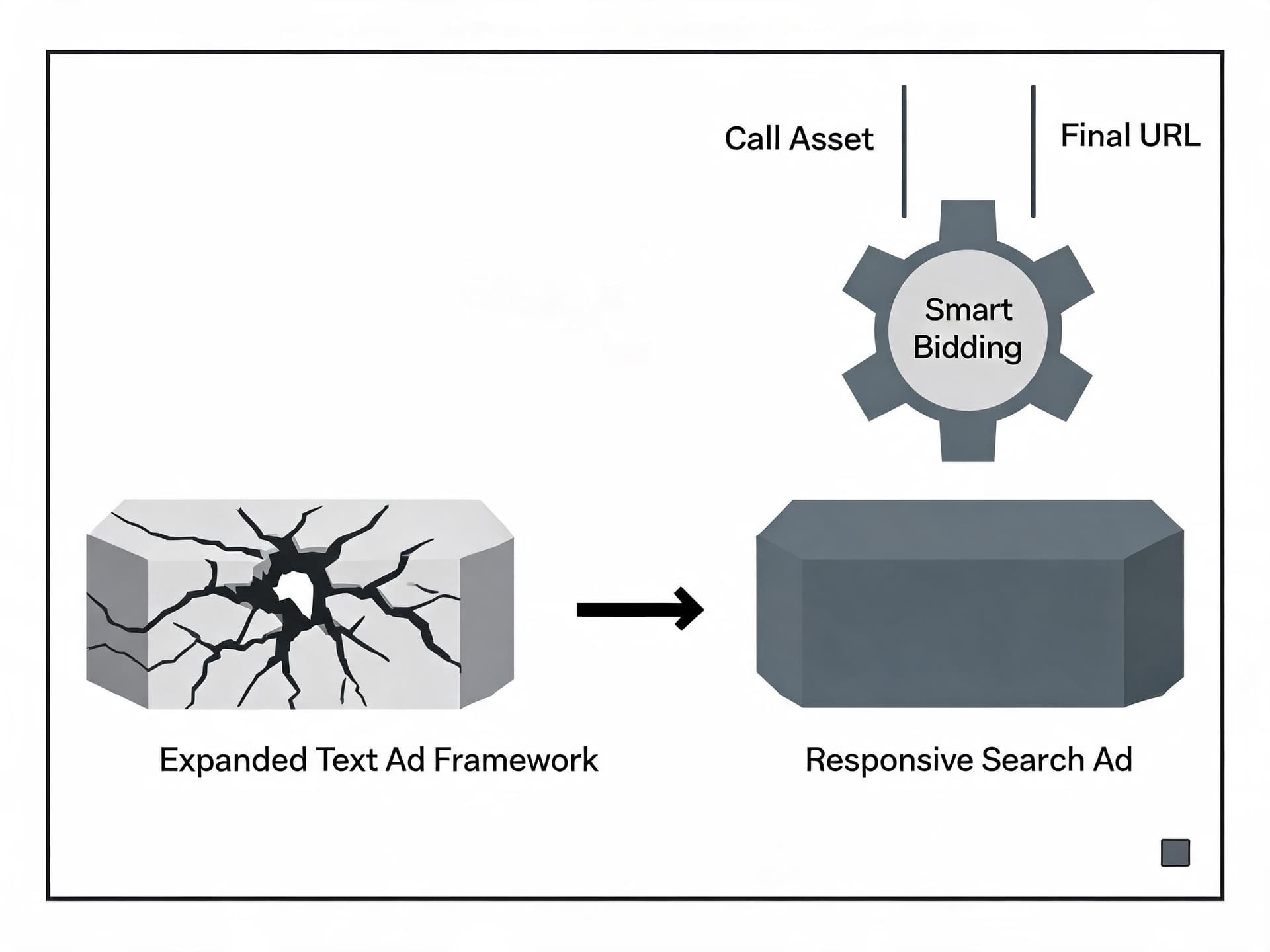
Google is formally deprecating that format. The deprecation notice frames the change plainly: call ads are being retired, and the underlying ad infrastructure that call-only ads were built on, the older expanded text ad (ETA) framework, has already been deprecated on its own separate timeline. Call-only ads were, under the hood, still riding on that older non-responsive ad architecture, which means they were never going to get the ongoing machine-learning improvements Google has been building into responsive search ads for years. Retiring call-only ads is, in part, Google finally retiring the last visible format still running on infrastructure it stopped investing in.
The replacement mechanism already exists today and isn't new. A call asset is one of several asset types, alongside sitelinks, callouts, and structured snippets, that can attach to a responsive search ad. When a call asset is active on an RSA, Google can show that ad with a clickable phone number and call button directly in the search result, functionally replicating what a call-only ad used to do on its own, except now it's layered onto an ad that also has a working final URL, multiple headline and description combinations being tested against each other, and the full responsive search ad machine-learning stack behind it.
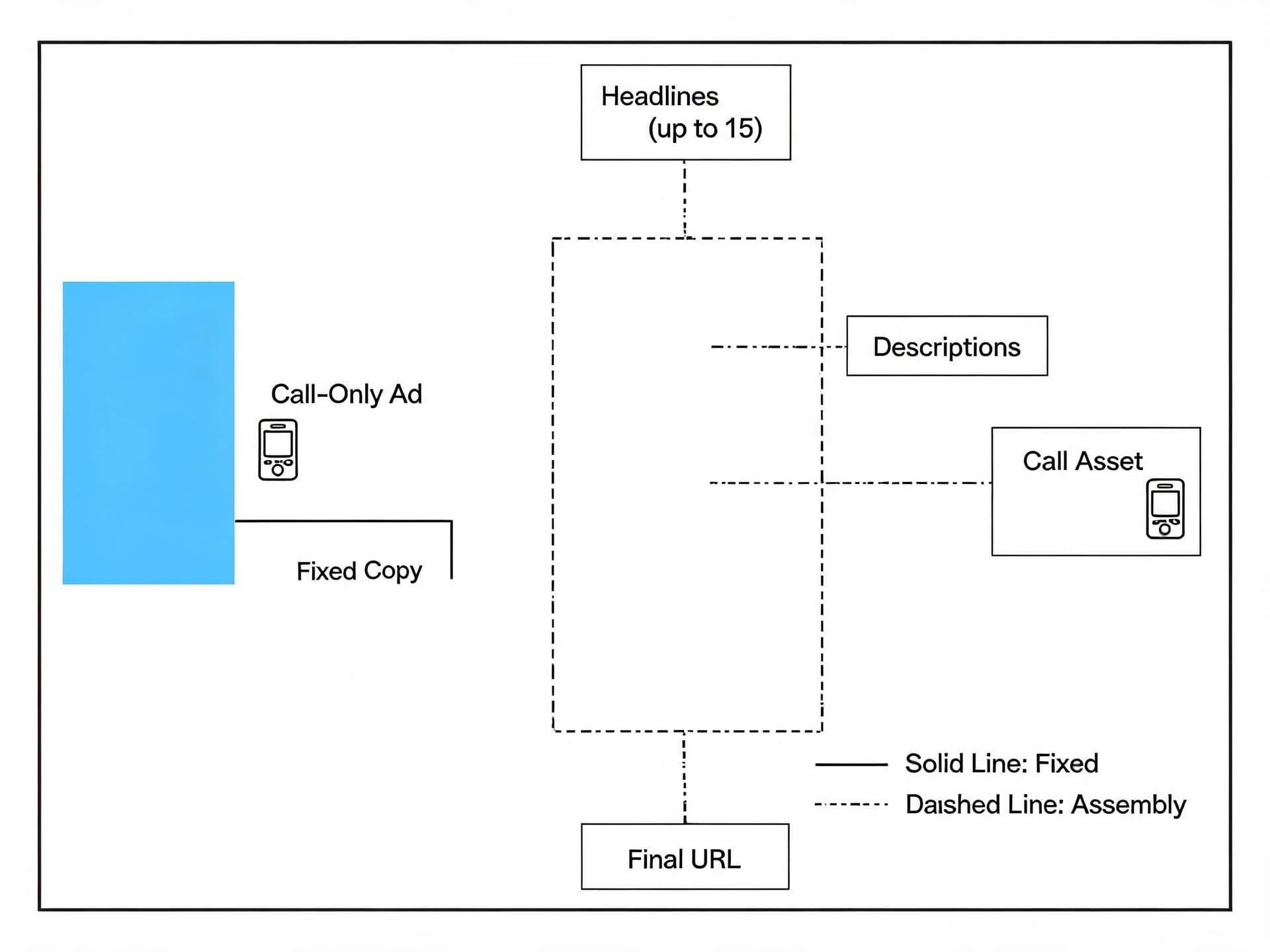
The practical difference for a searcher is small. They still see a phone number and a tappable call button in the ad. The practical difference for the advertiser is much bigger: the ad itself becomes a real responsive search ad with a landing page, multiple creative combinations being tested, and the ability to earn impressions on queries where a pure call-only ad historically struggled to compete for placement at all, since Google's ad auction has increasingly favored assets and formats it can optimize dynamically over a single static creative.
| Call-Only Ads (retiring) | RSA + Call Assets (replacement) | |
|---|---|---|
| Can you still create new ones? | No, removed from creation starting February 2026 | Yes, this is the ongoing, supported format |
| Final URL / landing page | None, the ad has no destination besides the call | Required, a real landing page the RSA points to |
| Headline and description testing | Fixed, one combination only | Up to 15 headlines and 4 descriptions, auto-tested in combination |
| Underlying ad architecture | Legacy expanded text ad (ETA) framework, already deprecated | Modern responsive ad framework with ongoing AI investment |
| Call tracking and reporting | Supported, but tied to the static ad only | Supported via call asset plus Google forwarding number, same mechanism |
| Bidding flexibility | Limited, no responsive combination to optimize | Full Smart Bidding support, e.g. Maximize conversion value on calls |
| Auction competitiveness | Increasingly limited as Google favors dynamic formats | Competes on equal footing with every other RSA in the auction |
| Still serving after February 2027? | No, full sunset, zero impressions | Yes, this is the ongoing standard going forward |
The Exact Timeline, Date by Date
It's worth separating the two dates clearly, because conflating them is the single most common mistake advertisers are already making with this change.
October 3, 2025: The Announcement
Google notified advertisers of the deprecation on October 3, 2025, through its Help Center and a follow-up post on the Google Ads developer blog a few days later, on October 9, 2025, specifically aimed at advertisers and developers managing call-only ads through the Google Ads API. Industry coverage, including Search Engine Land and PPC Land, picked the change up almost immediately, and the dates in that initial coverage have held steady since, which is itself worth noting. Plenty of Google Ads deprecation announcements get walked back, delayed, or quietly softened in the months after they're first published (the DSA-to-AI-Max migration delay covered in Miraflow's breakdown of that postponement is a recent example of exactly that happening). As of this writing, the call-only ads timeline has not moved.
February 2026: Creation Ends
Starting in February 2026, the option to build a new call-only ad disappears from the Google Ads interface entirely, and the corresponding API calls used to create one stop working. This is the date that matters most for any advertiser who was planning to launch a new call-only ad campaign, duplicate an existing one for a new service area, or spin up a seasonal call-only push. After this date, that specific move simply isn't available anymore, full stop, regardless of account history or spend level.
It's worth being precise about what February 2026 does not do. It does not touch call-only ads that are already live. An ad that was created in 2024 and is still running keeps serving exactly as it did before, through this date and for a full year afterward. February 2026 is a creation freeze, not a shutoff.
February 2027: Full Sunset
One year later, in February 2027, every remaining call-only ad, regardless of age, performance history, or how central it has been to an account's lead flow, stops receiving impressions. This is the real deadline. There is no indication from Google that this date carries any exception for high-performing ads, legacy accounts, or any other special case. Once February 2027 arrives, the format is gone from live serving entirely, and any account still relying on a call-only ad for its primary call volume loses that channel outright unless a replacement is already in place and already generating comparable call volume.
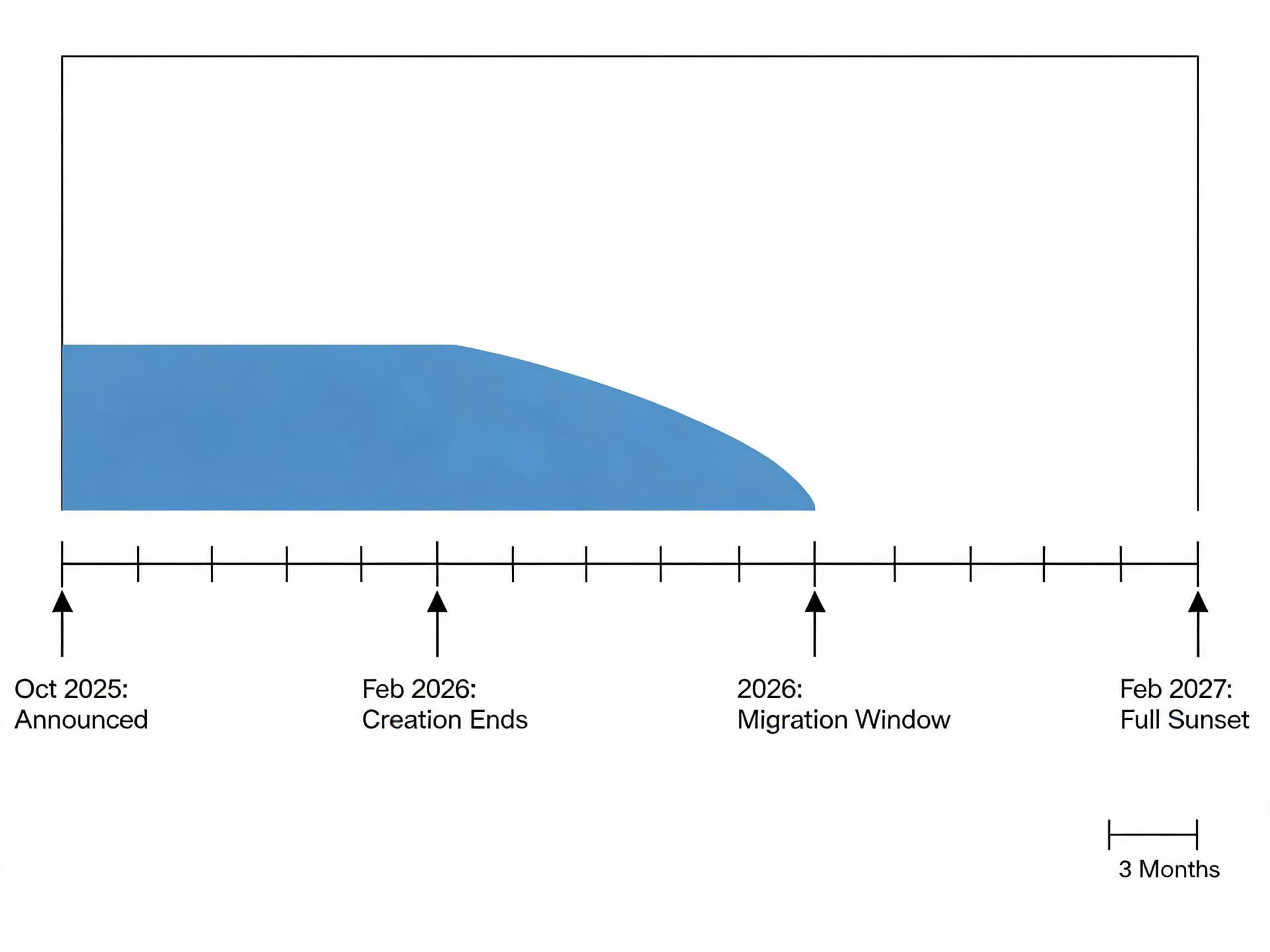
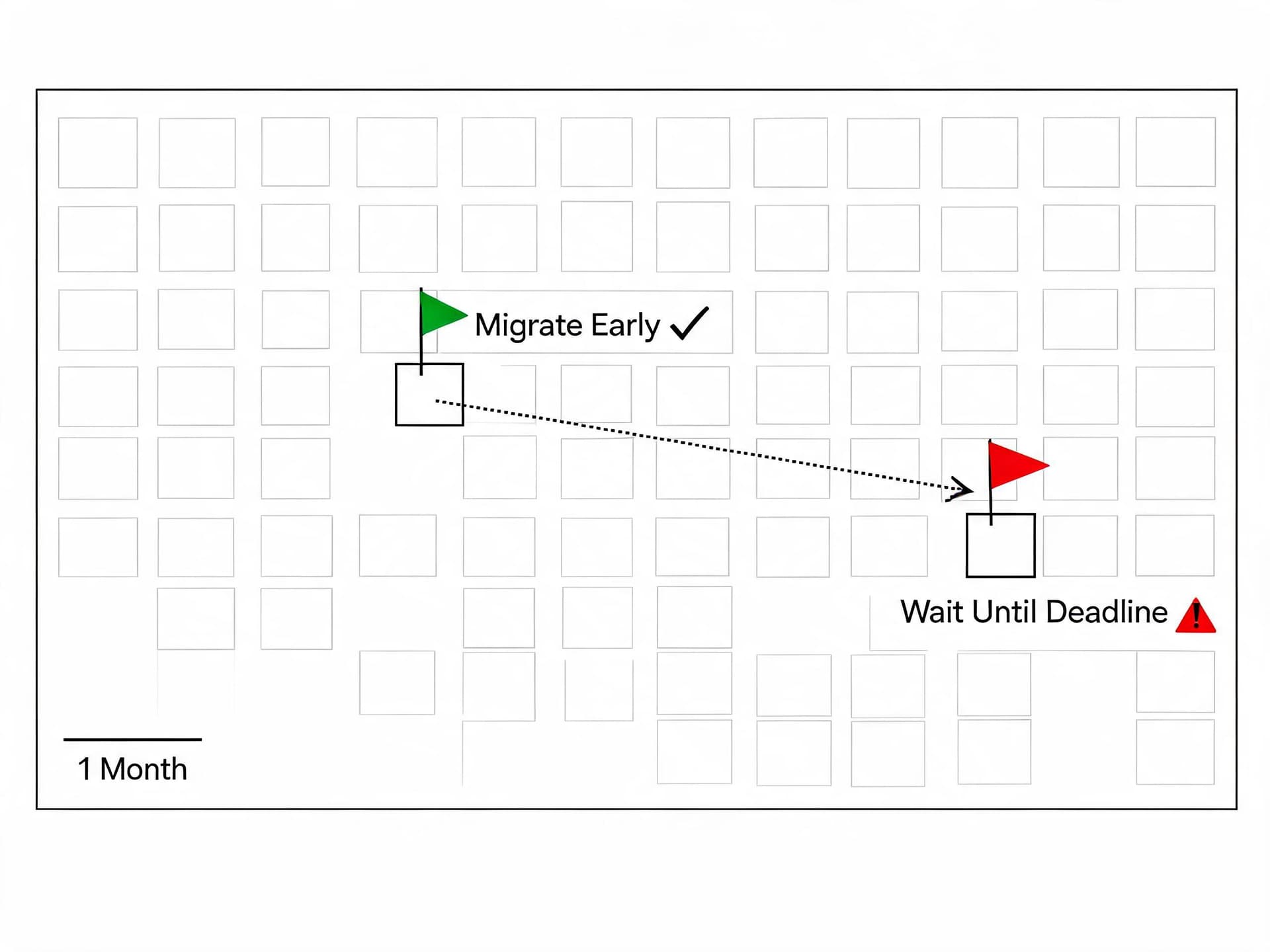
The gap between those two dates, roughly twelve months, is best thought of as a one-way migration runway, not a grace period to relax into. Google's own guidance is to migrate proactively well before the final sunset, not to ride the existing call-only ads until the last possible month and then scramble. The reason comes down to how RSAs actually work: a brand-new responsive search ad needs real serving time for Google's systems to learn which headline and description combinations perform best for your business and your audience. An RSA switched on in January 2027, a month before the deadline, has had essentially no time to build that performance history, which means the business is walking directly from a mature, fully-optimized call-only ad into an untested, unoptimized RSA at the worst possible moment, right as the old format disappears entirely. Migrating now, with a full year or more of overlap where both formats run side by side, gives the new RSA real time to mature before it has to carry the full weight of your call volume alone.
Why Google Is Doing This
Google's own stated rationale centers on two related points, and it's worth taking both at face value while also recognizing the business logic sitting underneath them.
The underlying ad format call-only ads ran on was already obsolete. Call-only ads were built on the same non-responsive, fixed-combination ad architecture as expanded text ads (ETAs), a format Google deprecated for standard search ads back in mid-2022 in favor of RSAs. Call-only ads were effectively the last format still standing on that older architecture, quietly exempted from the ETA sunset because nothing had replaced its specific call-button mechanic yet. Once call assets matured enough to replicate that mechanic inside an RSA, the exemption had no remaining technical justification. Retiring call-only ads completes a platform-wide move toward one unified ad architecture, responsive search ads with modular assets layered on top, rather than maintaining a second, separate, static ad type indefinitely for one specific use case.
RSAs benefit from continuous machine-learning investment that a static format never will again. Google has been explicit that responsive search ads are where its ongoing AI and machine-learning improvements land first, testing headline and description combinations against real query intent, adjusting in real time to what's actually converting. A call-only ad, frozen in its fixed combination of one headline and one description, was never going to receive that same ongoing optimization, because Google had already stopped investing engineering effort in the format years before this announcement. Advertisers running call-only ads were, in effect, stuck on a format that had already quietly stopped improving while the rest of Search moved forward around it.
There's also a measurement and attribution angle worth naming directly, even though Google's own public framing leans more on the automation argument than this one. A standalone call-only ad, with no final URL, generates a call but very little else: no landing page visit to analyze, no on-site behavior to feed into broader conversion modeling, no way to connect that call to the rest of a business's digital footprint beyond the call itself. An RSA with a call asset still produces the call, but it also carries a real final URL, which means Google Ads can now attribute that same ad to both a call conversion and whatever happens afterward if the searcher chooses to visit the site instead of dialing. For a platform increasingly built around holistic, cross-channel conversion value optimization, especially with Smart Bidding strategies like Maximize conversion value trying to weigh calls, form fills, and purchases against each other in one unified model, a format that produces only a phone call and nothing else is a measurement dead end. Folding call behavior into the same RSA infrastructure that already reports on clicks, visits, and on-site conversions gives Google's bidding systems a much richer, more comparable signal to optimize against.
It's reasonable to be a little skeptical of a platform's own stated rationale for a change that also, not coincidentally, pushes every remaining static ad format toward the one format Google can keep improving and monetizing with AI. Both things can be true: the technical architecture argument is coherent and matches Google's broader pattern of consolidating ad formats around RSAs (see also the Demand Gen migration absorbing Display campaigns and the DSA-to-AI-Max migration), and the change also happens to steer every advertiser toward a format with more surface area for Google's automated bidding and creative optimization to operate on.
Who Is Affected Most
This change does not land evenly across advertiser types. A handful of categories are disproportionately exposed, and it's worth being specific about why.
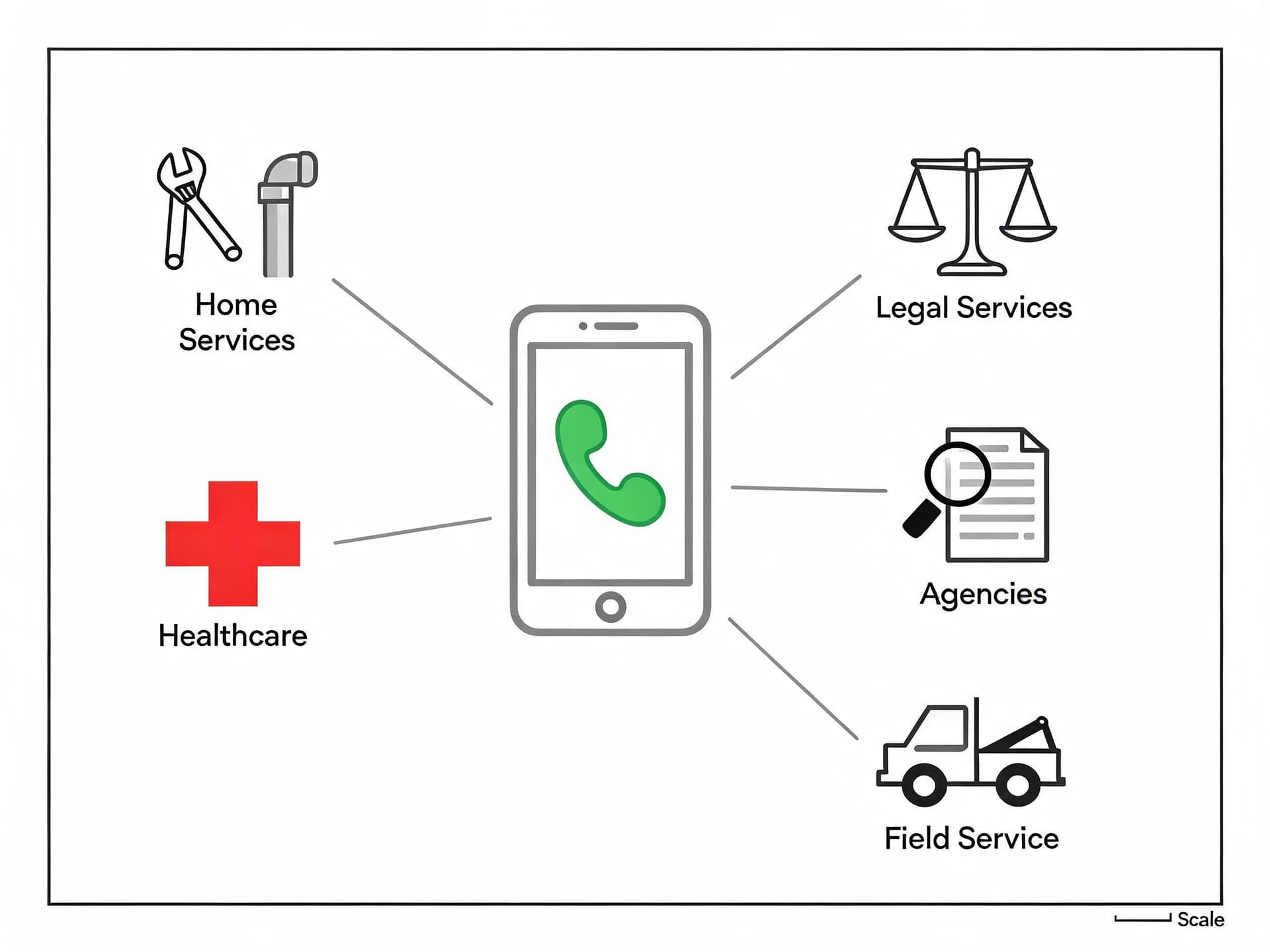
Local home services businesses (plumbing, HVAC, electrical, roofing, garage door repair, locksmiths, pest control) are the single most exposed category. These businesses have historically leaned on call-only ads precisely because their customers are often dealing with an urgent, time-sensitive problem, a burst pipe, a broken AC in July, a lockout, where a phone call beats a web form every time. Many of these accounts have call-only ads that are years old, deeply entrenched, and responsible for the majority of the account's lead volume, which makes the migration both more urgent and more disruptive than for an advertiser who only dabbled in the format.
Legal services, particularly personal injury and family law. A caller researching a car accident claim or a custody dispute is frequently in a high-stress moment where picking up the phone and talking to a real person matters more than browsing a firm's website. Call-only ads became a staple format in this category for the same reason they did in home services, and the cost-per-call economics in competitive legal verticals make a clean migration especially important, since a poorly optimized RSA replacement can quietly raise cost per lead in an already expensive auction.
Healthcare practices and urgent care. Dental emergencies, urgent care visits, and specialist appointment requests often follow the same call-first pattern, and healthcare advertisers additionally have to navigate Google's healthcare and medicines advertising policies when building out RSA copy and call assets, which adds a layer of review time that a simple call-only ad never required.
Field service and on-demand businesses more broadly, including appliance repair, moving companies, towing services, and auto glass repair, share the same urgency-driven call pattern as home services without necessarily having the brand recognition or review volume of better-established local competitors, which makes losing a well-performing call-only ad's placement a real competitive risk if the RSA replacement underperforms during its learning period.
Smaller agencies and solo PPC managers running many small local accounts feel this differently than an in-house team at one company: the task isn't one migration, it's dozens, each with its own call history, its own ad copy, and its own bidding strategy to carry over cleanly, which is exactly the kind of repeatable, checklist-driven work worth standardizing across an entire client roster rather than handling account by account as the February 2027 deadline gets closer.
Step-by-Step Migration Guide: Call-Only Ads to RSA + Call Assets
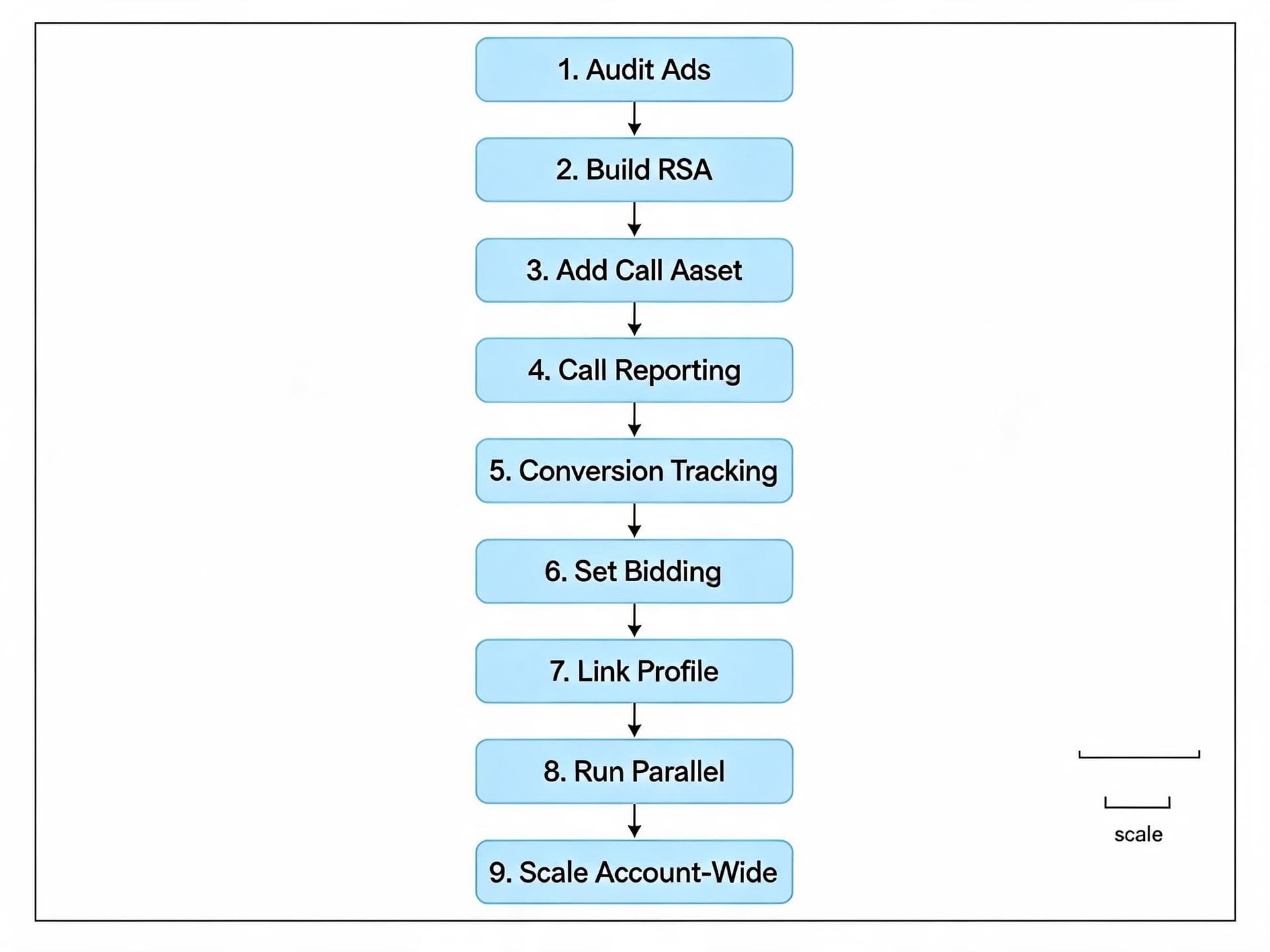
This is the part worth actually bookmarking. The migration is not a single toggle. It touches your ad copy, your assets, your bidding strategy, and your conversion tracking, and doing each piece properly is what separates a migration that holds call volume steady from one that quietly bleeds leads for months.
Step 1: Audit every call-only ad currently live in the account
Before building anything new, pull a complete list of every call-only ad running today. In the Google Ads interface, go to Campaigns > Ads & assets > Ads, and filter by ad type to isolate call-only ads specifically. For each one, note the campaign and ad group it lives in, its historical call volume and cost per call over at least the last 90 days, and the exact phone number and business name it displays. This audit becomes your baseline. Without it, you have no real way to judge whether the RSA replacement is actually holding call volume steady once it's live, only a vague sense that things feel different.
Step 2: Build the responsive search ad in the same ad group
Inside the same ad group that currently holds the call-only ad, create a new responsive search ad rather than deleting the call-only ad first. Go to Ads & assets > Ads > the blue plus button > Responsive search ad. An RSA needs a real final URL, which is itself a meaningful shift for an advertiser used to call-only ads having none. Point it at a landing page that actually supports a phone call as the primary action, a service page with the phone number prominently displayed and a click-to-call button of its own, not a generic homepage, since a searcher who does click through instead of calling should land somewhere that still makes calling easy.
Write at least 8 to 10 headlines (RSAs support up to 15) and at least 2 to 4 descriptions (up to 4 supported), varying the framing rather than writing near-duplicate phrasing. For a call-driven business, headlines should lean into urgency, locality, and credibility signals that would make someone want to call right now: "24/7 Emergency Plumber," "Same-Day HVAC Repair," "Licensed & Insured Electricians," "Call Now, We Answer," naming your service area by name rather than staying generic. Pin the business name or phone-related headline to position 1 if you want certain copy to always appear, but leave most headlines unpinned so Google's combination testing can actually do its job, which is the entire advantage an RSA has over the fixed combination a call-only ad was stuck with.
Step 3: Add a call asset to the ad group or campaign
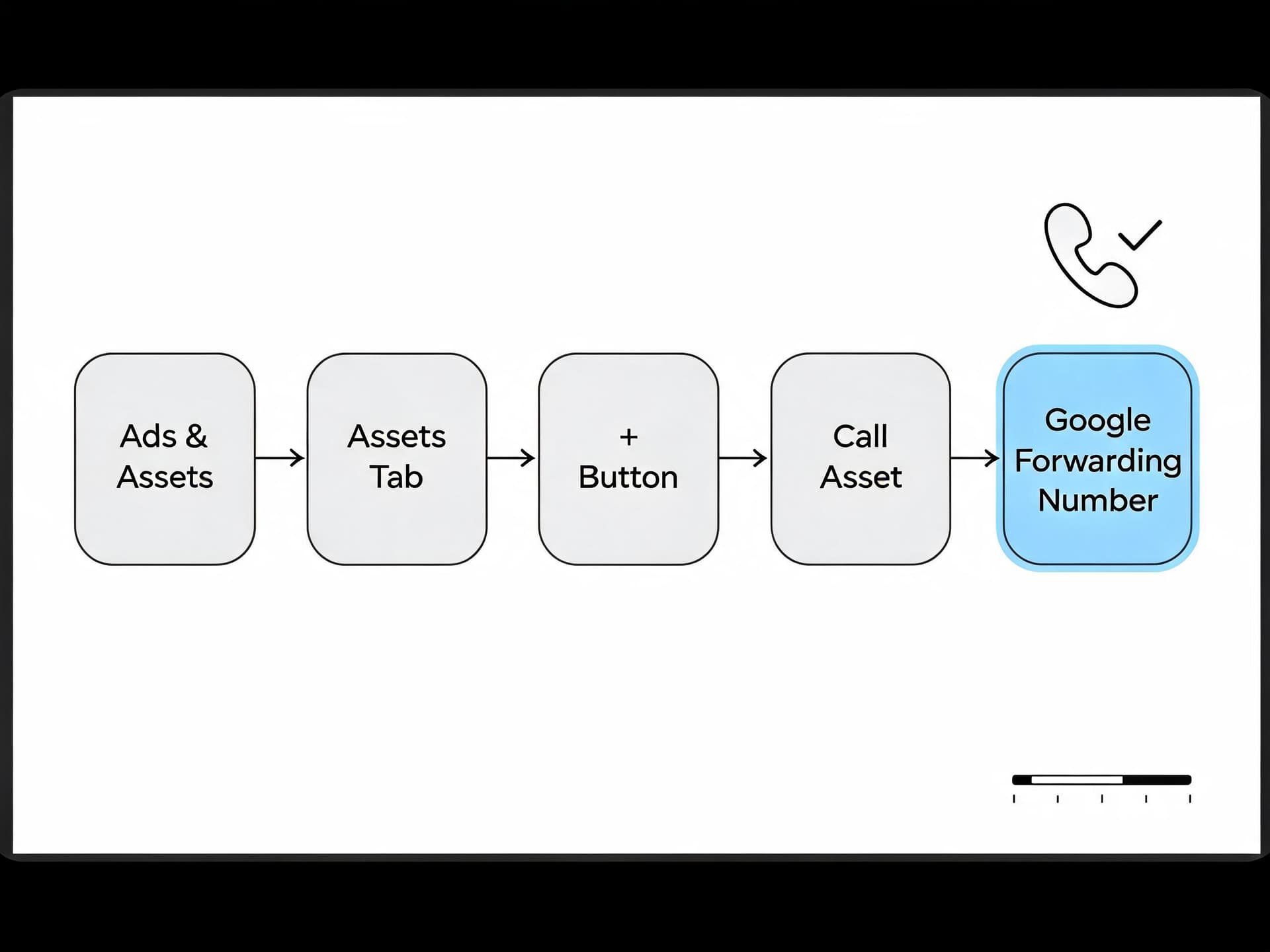
This is the piece that actually recreates the call-only ad's core function. Navigate to Ads & assets > Assets, choose the account, campaign, or ad group level depending on how granular you want the phone number to be, and click the blue plus button to add a new asset. Select Call asset, then enter your business phone number exactly as you want it displayed.
At this step you'll be asked whether to use a Google forwarding number or your own direct number. Choose the Google forwarding number. It costs nothing extra and it's what unlocks real call reporting and call conversion tracking in the next steps, since Google can only measure a call's duration and outcome when the call is routed through its own forwarding infrastructure. A call routed directly to your own number without forwarding still displays and still rings, but Google has no visibility into whether it connected, how long it lasted, or whether it qualifies as a conversion.
You can also set a call schedule here, restricting the call asset to display only during hours someone is actually available to answer, which matters more than it might seem: a call asset showing a phone number at 2am when nobody's picking up wastes the exact intent signal this whole migration is trying to preserve.
Step 4: Enable call reporting at the account level
Before any of the call-duration or conversion data in the next step becomes useful, confirm call reporting itself is turned on. This is an account-level setting, found under Tools and Settings (the wrench icon) > Setup > Account settings > Call reporting. If it isn't already enabled, turn it on here. This is the setting that governs whether Google's systems track and report on call duration, caller area code, and call outcome at all, independent of any specific call asset or conversion action layered on top of it.
Step 5: Set up call conversion tracking with a real minimum duration
With call reporting enabled and a call asset using a Google forwarding number in place, go to Tools and Settings > Measurement > Conversions, and look for the Calls from ads conversion action, which Google creates automatically once the prerequisites above are met. Confirm it's active, and critically, set a realistic minimum call duration before a call counts as a conversion. A default threshold around 60 seconds is a reasonable starting point for most local service businesses, long enough to filter out a wrong number or a call that got hung up during hold music, short enough not to exclude a genuinely quick but valuable call like confirming an appointment time. Adjust this up or down based on what your own call patterns actually look like; a plumbing company fielding detailed emergency dispatch calls might reasonably set the threshold higher than a locksmith business where a legitimate call can be genuinely brief.
Once the conversion action is active and collecting data, set it as a primary conversion goal under Tools and Settings > Conversions > Summary > Conversion goals and actions, so your bidding strategy actually optimizes toward it directly rather than treating it as a secondary, informational metric.
Step 6: Choose a bidding strategy built around the call conversion
With call conversions flowing in as a real, trackable goal, move the ad group or campaign onto a Smart Bidding strategy that optimizes toward it, typically Maximize conversions or Maximize conversion value if you've also set relative values on different conversion types, found under the campaign's Settings > Bidding section. Avoid leaving a freshly migrated RSA on manual CPC or a generic Maximize clicks strategy, since neither one has any signal about which clicks are actually turning into the calls you care about. Give the campaign a real learning period, generally two to four weeks of consistent spend, before judging whether the new bidding strategy is performing, the same patience any Smart Bidding transition requires.
Step 7: Link your Google Business Profile
Under Tools and Settings > Setup > Linked accounts > Google Business Profile, confirm your business profile is linked to the Google Ads account. A linked profile strengthens location relevance for local search queries and can surface additional location-based assets alongside your RSA, reinforcing exactly the kind of "this business is near me and open now" signal that made call-only ads effective for urgent, local searches in the first place.
Step 8: Run both formats in parallel before pausing the call-only ad
Do not pause the original call-only ad the same day you launch the RSA replacement. Let both run simultaneously for at least two to four weeks, long enough for the RSA to accumulate real headline-combination data and for its call asset to start generating a comparable volume of tracked calls. Compare the audit numbers from Step 1 against what the RSA is producing at a similar spend level before making the call-only ad's pause permanent. If call volume or cost per call looks meaningfully worse on the RSA side after a fair comparison window, that's a signal to revisit ad copy, call asset scheduling, or the landing page the RSA points to, not a reason to abandon the migration and quietly keep the call-only ad running until Google forces the issue in February 2027.
Step 9: Repeat across every ad group, then every campaign
Once one ad group's migration is validated, apply the same nine steps across the rest of the account. For an agency managing this across many client accounts, this is exactly the kind of repeatable checklist worth standardizing into a single internal process now, rather than relearning it account by account as the deadline approaches. For a deeper look at how Smart Bidding and budget testing fit around a change like this, see Miraflow's coverage of Google Ads' Search Experiments for multi-campaign budget and ROI testing, which is a reasonable way to validate a migrated campaign's bidding setup against a control before rolling changes out account-wide.
How to Set Up Call Conversion Tracking and Call Reporting Properly
The migration steps above cover the mechanics of turning call reporting and conversion tracking on. It's worth going a level deeper here, because a surprising number of advertisers flip these settings on, see a "Calls from ads" conversion action appear, and assume the job is done without checking whether the data underneath it is actually trustworthy.
Understand what a Google forwarding number actually does. When you choose a Google forwarding number for a call asset instead of displaying your real number directly, Google assigns a tracking number that forwards every call through to your actual business line, invisibly to the caller, who never sees or dials anything other than what looks like your normal number in the ad. That forwarding layer is what lets Google measure the call's duration and connect it back to the specific ad, keyword, and device that generated it. Without it, you can still display a phone number and still receive calls, but you lose the entire reporting layer this migration depends on, which defeats much of the point of moving to a trackable RSA in the first place.
Set your minimum call duration based on your own sales cycle, not a borrowed default. A 60-second threshold is a common starting point, but it isn't universal. If your business genuinely qualifies a lead within the first 20 to 30 seconds, confirming the caller's location and the general nature of the job before scheduling a callback, a 60-second minimum may exclude real, valuable leads from your conversion count, which quietly understates how well the campaign is actually performing and can mislead Smart Bidding into undervaluing keywords that are working. Pull a sample of your own recent call recordings or call logs if you have them, and set the threshold around the point where a call genuinely becomes a qualified lead in your specific business, not a generic industry rule of thumb.
Separate call reporting from call conversion tracking in your mental model, because they aren't the same thing. Call reporting is the account-level setting that lets Google observe and report call data at all: duration, area code, time of day. Call conversion tracking is the layer built on top of that data which decides when a call counts as a conversion goal your bidding strategy optimizes toward. An account can have call reporting on without ever setting up call conversion tracking properly, which means it's collecting data nobody is actually using to drive bidding decisions, a half-finished setup that looks complete in the interface but isn't doing the job.
Consider importing offline call conversions for calls that don't route through Google's forwarding number, such as calls from a dedicated landing page phone number tracked through a separate call-tracking platform, or calls logged manually by front-desk staff. Google Ads supports importing these as offline conversions through Google Ads Help's documented process, which lets a business reconcile calls that happened outside Google's own forwarding infrastructure back into the same conversion data Smart Bidding uses, rather than losing that signal entirely because it came through a different pipe.
Check call reporting eligibility for your country and category before assuming it's fully available. Call reporting through Google forwarding numbers isn't universally available in every market or every advertiser category, particularly in some regulated verticals. Confirm availability for your specific account rather than assuming the feature works identically everywhere Google Ads itself is available.

Common Mistakes Advertisers Are Already Making
A handful of missteps are already showing up as accounts work through this migration, and most of them are avoidable with a little more care up front.
Waiting until early 2027 to start. The single most expensive mistake available here is treating the February 2027 date as the actual deadline to act by, rather than the deadline by which the migration has to already be finished and proven to work. A fresh RSA with a call asset needs real weeks of serving time to find its best-performing headline combinations and for Smart Bidding to learn the account's call patterns. Starting that process in January 2027 means walking into the final sunset with an unoptimized, untested replacement right as the safety net of the old format disappears.
Pausing the call-only ad the same day the RSA goes live. Running both formats in parallel for a real comparison window is the only way to know whether the migration is actually working before you remove your fallback. Advertisers who swap instantly, treating this like a simple like-for-like replacement, lose the ability to catch a weak RSA setup before it costs them real call volume.
Forgetting that an RSA needs a real final URL, and pointing it somewhere generic. A call-only ad never needed a landing page, so advertisers migrating to RSAs sometimes default to pointing the new ad at a homepage or a generic contact page out of habit, missing the chance to send searchers who do click through (rather than calling) to a page built around the same service and urgency the ad copy is promising.
Skipping the Google forwarding number to "keep things simple." Displaying a direct number instead of a forwarding number feels like it avoids an extra setup step, but it quietly disables call duration tracking and conversion measurement entirely, which removes the exact data Smart Bidding needs to optimize the campaign going forward.
Setting a minimum call duration without checking it against real call patterns. Defaulting to whatever threshold Google suggests without validating it against your own business's actual qualifying-call length either inflates conversion counts with calls that never went anywhere, or deflates them by excluding real, short-but-valuable calls, either way feeding bad signal into Smart Bidding.
Assuming this is the same change as other 2026 Google Ads deprecations. It's easy to lump this in with the broader wave of format consolidation happening across Google Ads this year, including Local Services Ads moving into Performance Max and Display campaigns folding into Demand Gen. Call-only ads retiring into RSA call assets is its own distinct change with its own dates and its own migration mechanics, worth tracking on its own timeline rather than assuming it's covered by a broader migration you're already handling elsewhere.
Not updating ad scheduling on the call asset to match real staffing hours. A call asset showing a phone number around the clock, when nobody answers after 6pm, generates unanswered calls that still cost money and still count against your call-volume expectations, the same operational mismatch covered in more depth in Miraflow's breakdown of Google's new missed-call billing policy for Local Services Ads, which is a useful read alongside this migration since both changes reward businesses that actually answer the phone during the hours they claim to.
Where the Rest of Your Ad Creative Fits In
None of the steps above change how your business actually looks to someone deciding whether to tap call or scroll past your listing, and that's a real, underused lever in this migration. An RSA with a call asset still needs to earn attention in a crowded search result, and once a searcher does click through to the landing page instead of calling directly, that page's own photos and video matter for whether they follow through. Local service businesses whose photo library has gone stale, old truck photos, a storefront shot from years before a renovation, are leaving conversion rate on the table regardless of how well the call asset and conversion tracking are configured underneath it.
This is a reasonable, honest spot to mention Miraflow. Miraflow is a content creation platform, not a Google Ads tool, so it has no direct role in building call assets or conversion tracking. What it's actually useful for is the adjacent problem a lot of these same advertisers face: producing current, trustworthy-looking creative fast. A plumbing or HVAC business refreshing a landing page to go with a newly migrated RSA can use Miraflow's AI Image Generator to update a storefront or service photo without booking a new shoot, or Miraflow's Cinematic AI Video Generator to put together a short, polished clip showing a technician at work for a landing page or a Demand Gen asset running alongside the RSA. Neither tool touches the migration mechanics covered above, but for a business juggling a real deadline and limited marketing resources, having a fast way to keep creative current is a genuine, practical adjacent win.
Frequently Asked Questions
When exactly can I no longer create a new call-only ad?
Starting in February 2026, the option to create a new call-only ad is removed from both the Google Ads interface and the Google Ads API. Existing call-only ads created before that date keep running until the final sunset.
When do my existing call-only ads actually stop working?
February 2027. That's the full sunset date, when every remaining call-only ad, regardless of age or performance, stops receiving impressions entirely.
Is there a new call-only-style ad format replacing the old one?
No. There is no new standalone call-focused ad format. The replacement is a responsive search ad with a call asset attached, using the same call asset mechanism that has already existed for RSAs for years.
Do I have to migrate every call-only ad individually, or is there a bulk tool?
Google has not announced an automatic bulk-conversion tool that rewrites your call-only ads into RSAs for you. The migration is a manual rebuild: writing new RSA headlines and descriptions, adding a call asset, and setting up conversion tracking for each affected ad group, which is exactly why starting early rather than waiting for the deadline matters so much for accounts with many call-only ads across many ad groups.
Will my cost per call go up after migrating?
Not necessarily, and Google's own stated position is that RSAs with call assets tend to perform at least as well, often better, than static call-only ads once they've had a real learning period, partly because RSAs can compete for impressions that call-only ads increasingly struggled to win as the auction favored more dynamic formats. A poorly executed migration, rushed, under-tested, missing proper conversion tracking, can absolutely raise cost per call temporarily, which is the real argument for migrating with enough runway to do it properly rather than waiting for the deadline to force a rushed switch.
Can I keep running my call-only ad and just ignore this until it actually breaks?
Technically yes, right up until February 2027, but Google's own guidance explicitly recommends against it. An RSA launched at the last minute has no accumulated performance history, no mature headline-combination data, and no proven conversion tracking setup, which means an advertiser who waits is choosing to make their highest-stakes format change with zero runway to fix mistakes before the safety net of the old format disappears.
Does this affect call assets that are already attached to my existing RSAs?
No. This change specifically affects the standalone call-only ad format. If you already have a responsive search ad running with a call asset attached today, it is already on the surviving format and isn't directly affected by this deprecation, though it's still worth auditing that existing setup against the conversion tracking and bidding guidance above to make sure it's configured as well as it could be.
Is this related to the Local Services Ads migration to Performance Max?
No, they're separate changes affecting different products. Local Services Ads is migrating into a dedicated pay-per-lead Performance Max campaign type, covered in Miraflow's dedicated breakdown of that migration. Call-only ads are a standard Search campaign ad format, unrelated to Local Services Ads specifically, and this retirement runs on its own separate timeline.
What happens to the historical performance data from my call-only ads once they're paused or expire?
Historical reporting data for a paused or expired call-only ad generally remains visible in your account's reporting for the standard data retention window Google applies account-wide, but it stops accumulating new data the moment the ad stops serving. It's worth exporting or documenting the baseline numbers from your Step 1 audit above regardless, so you have a durable record outside the interface for comparing against your RSA replacement's performance over time.
Conclusion
February 2026 and February 2027 are not soft target dates Google might quietly extend the way a few other 2026 deprecation timelines already have. They're the two fixed points of a real, already-announced retirement, and the gap between them is exactly the amount of runway you have to migrate without rushing. The mechanics aren't complicated once you've done it once: build the RSA, attach a call asset with a Google forwarding number, turn on call reporting, set a conversion duration threshold that actually matches your business, point bidding at the call conversion, and run both formats side by side long enough to trust the comparison before you let the old call-only ad go.
What makes this migration worth taking seriously now, rather than filing away until next year, is the asymmetry in the risk. Migrating early costs you a few hours of setup and a few weeks of patient comparison. Migrating late, in the narrow window right before February 2027, costs you the exact thing call-only ads were always best at: a phone that rings reliably, priced fairly, and tracked properly. For more on the broader wave of format consolidation Google Ads is pushing through in 2026, see Miraflow's coverage of the Local Services Ads to Performance Max migration, Display campaigns folding into Demand Gen, the DSA-to-AI-Max migration delay, and Google's new missed-call billing policy for Local Services Ads, or browse the rest of the Miraflow blog for ongoing Google Ads policy coverage as these changes continue rolling out.