AI Prompts for Kitchenware Product Photography: 15 Catalog-Ready Visuals (Copy & Paste)

Written by
Jay Kim
15 copy-paste AI prompts for kitchenware product photography. Covers cast iron, copper, ceramic, bakeware, knives, Dutch ovens, and more for catalog-ready results.
Getting kitchenware photography right is harder than most product categories for one specific reason: every piece of kitchenware exists in direct relationship to food, heat, and active use, and the photography needs to communicate all three simultaneously alongside the material quality and design of the product itself. A cast iron skillet on a white background tells buyers what the pan looks like. That same skillet with a sear crust on steak, steam rising from the hot surface, and a garlic clove split open on the slate beside it tells them why they need it and what it is capable of.
Catalog-ready kitchenware photography is a specific standard. It means images that are clean enough for commercial print and digital catalogs, detailed enough to communicate material quality accurately, and styled enough to communicate the aspirational cooking lifestyle the product belongs to. Getting that combination right consistently across an entire product range is what separates a brand catalog that converts serious buyers from one that blends into the background of a crowded kitchen product market.
This post gives you 15 ready-to-use AI prompt templates for kitchenware product photography, covering white background catalog heroes, dark moody cooking scenes, bright marble kitchen shots, stovetop steam photography, knife blade details, copper cookware luxury shots, bakeware in action, morning coffee equipment, Dutch oven centerpieces, and more. Every prompt is designed to be copy-pasted into an AI image generator and produce catalog-quality results immediately.
What Catalog-Ready Means for Kitchenware Photography
The phrase catalog-ready sets a higher technical and visual standard than general product or lifestyle photography, and understanding what it means practically changes how you approach both prompt writing and image selection.
Technical precision in material rendering. Catalog photography requires that the surface properties of each material are rendered accurately and consistently. Seasoned cast iron has a specific deep black texture that is completely different from enameled cast iron, which has a glossy smooth finish with slight color depth. Polished stainless steel creates different reflections than brushed stainless steel. Copper has a specific warm orange-gold specular quality that no other metal replicates. Specifying these material properties precisely in every prompt is not an aesthetic choice, it is a catalog accuracy requirement.
Consistent image quality across multiple SKUs. A product catalog needs visual consistency across all entries so that buyers browsing the range can compare pieces fairly. This means establishing consistent lighting direction, background surface, and compositional approach across your prompts and applying them systematically to every product category in the range.
Clean enough for print and digital reproduction. Catalog images are typically reproduced at high resolution across multiple formats including printed catalogs, digital PDF lookbooks, e-commerce product pages, and print advertising. This means the generated images need genuine sharpness, accurate color, and sufficient detail rendering to hold quality at large reproduction sizes.
Compelling enough to communicate the product's value proposition. Pure white background product images are necessary but not sufficient for a complete kitchenware catalog. The most effective catalogs use a mix of clean product shots for technical reference and atmospheric lifestyle images that communicate the cooking experience the product enables. Understanding which image type serves which commercial purpose within the catalog helps you allocate your prompt generation effectively.
How Kitchenware Materials Require Different Photographic Treatment
Kitchenware spans more material diversity than almost any other product category, and each material has a distinct visual language that determines how it should be lit, styled, and positioned to communicate its quality honestly.
Cast iron communicates its value through the texture and depth of its seasoning, which shows as a deep, almost velvet black with a characteristic non-reflective surface. Cast iron photography performs best with a single warm directional light from above or the side that creates texture shadows across the surface rather than flat illumination. The weight and solidity of cast iron is communicated through dark, grounded surfaces rather than light-and-airy backgrounds.
Copper communicates its value through the warm orange-gold specular reflection that is unique to the material. A single directional light source at a specific angle creates the characteristic warm glow that makes copper cookware instantly recognizable and aspirational. The contrast between the warm copper exterior and a bright tin or stainless interior is one of the defining visual details of premium copper cookware photography.
Ceramic and stoneware communicates value through the character of the glaze, including natural color variation, slight surface irregularities, and the organic quality of handmade forms. These materials photograph best in warm, natural diffused light that reveals the depth of the glaze without creating harsh reflections.
Stainless steel communicates value through precision, cleanliness, and controlled reflections. Brushed stainless benefits from a single directional light that follows the brush grain direction. Polished stainless requires careful light placement to avoid unwanted environment reflections while still showing the mirror quality of the surface.
Enameled cookware communicates value through the evenness and depth of the enamel color, the precision of the rim finishing, and the contrast between the outer color and any interior enamel. These materials photograph beautifully in both bright and dark settings because the enamel color is itself the brand identity signal.
Carbon steel and non-stick require different light treatments than cast iron despite being used for similar purposes. Carbon steel benefits from side lighting that reveals the hammered or rolled texture of the metal. Non-stick surfaces benefit from overhead or angled light that communicates the smooth, clean surface quality without harsh reflections.
How to Use These Prompts
Every prompt in this post is structured with a product description, a surface or kitchen environment, a lighting specification, food or ingredient styling elements, and a style reference. Together these elements produce catalog-ready results that communicate both technical product quality and lifestyle cooking aspiration.
To customize any prompt for your specific product, replace the generic kitchenware description with your actual piece including its specific material, color, and finish. For example, replacing "cast iron skillet" with "pre-seasoned cast iron skillet in the 26cm diameter size with a helper handle and pour spout" produces significantly more accurate results.
The AI image generator on Miraflow AI supports both text-to-image and image-to-image workflows, making it practical to generate full catalog image sets from scratch and to incorporate actual product photographs when specific design accuracy is required.
Generate at least five to eight variations of each prompt before selecting finals, since the placement of food styling elements, steam, and light direction varies meaningfully between generations and the best compositional result is rarely the first one produced.
15 AI Prompt Templates for Kitchenware Product Photography
1. Clean White Catalog Hero Shot
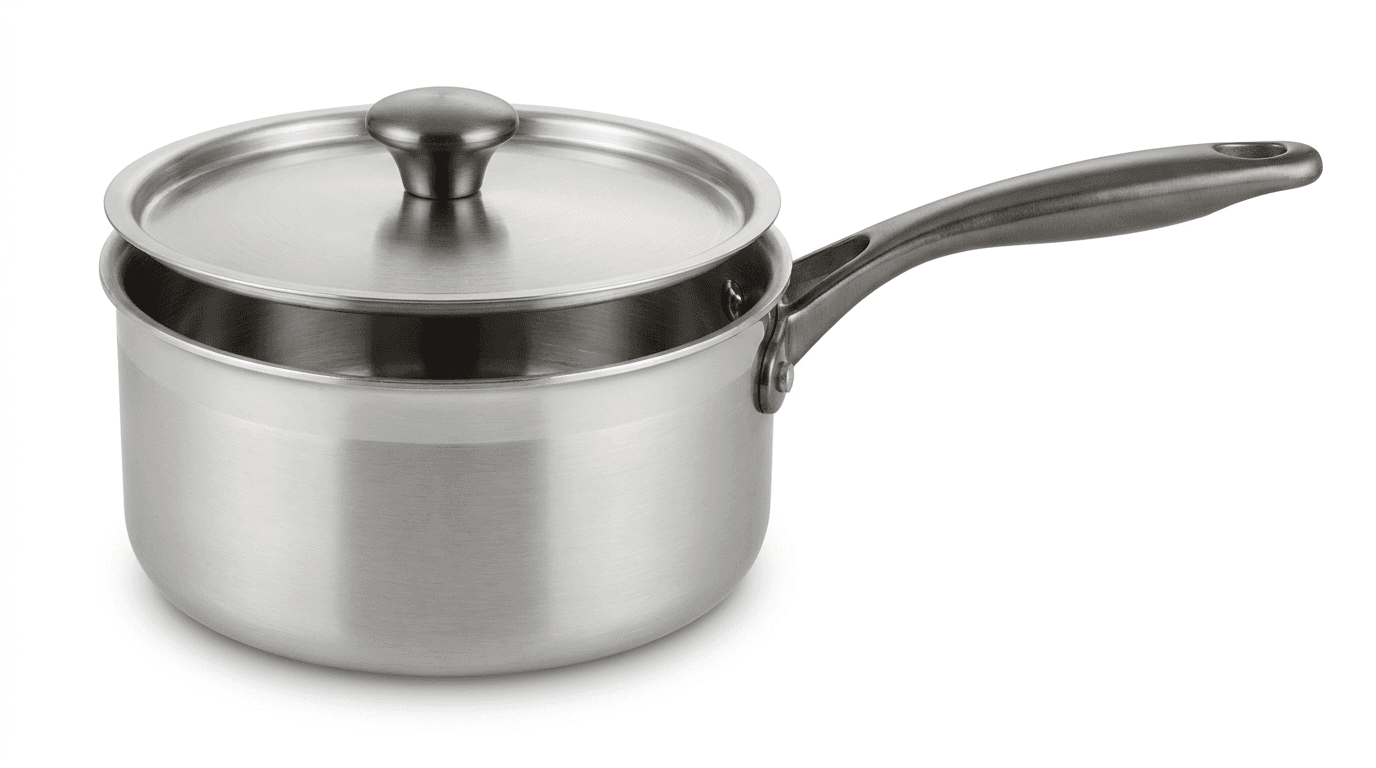
The white background catalog hero is the foundation image for every kitchenware product listing and the image most used in print and digital catalog contexts. It needs to meet commercial printing standards while communicating the material quality of the piece accurately.
Prompt
Single kitchenware piece positioned at a slight three-quarter elevation angle on a pure white seamless studio surface showing both the top opening and the full side profile, a soft minimal drop shadow directly beneath the product, single large overhead softbox creating even, clean exposure across the product surface with no blown highlights on metal surfaces and no lost shadow detail in recessed areas, the handle or knob material and construction is clearly visible from this angle, ultra-realistic material surface rendering whether stainless steel brushed grain, enameled exterior color depth, cast iron surface texture, or ceramic glaze quality, the interior of any open vessel partially visible showing lining material quality, no lifestyle props no styling elements no background other than seamless white, professional commercial catalog photography standard, precise technical product photography quality
2. Dark Moody Cast Iron Cooking Scene
Cast iron cookware belongs to a visual tradition of dark, substantial, working kitchen photography that communicates cooking confidence and the kind of results only heavy, properly seasoned cookware can produce. The dark setting amplifies the material's inherent drama.
Prompt
Seasoned black cast iron skillet on a dark charcoal slate kitchen counter surface, a perfectly seared protein with a golden crust and visible Maillard reaction browning resting in the pan or just removed to a cutting board beside it, gentle wisps of steam rising from the hot cast iron surface catching the single overhead warm directional spotlight, a sprig of fresh thyme and a cracked garlic clove scattered naturally on the slate beside the pan, a wooden-handled spatula resting across the pan rim, the cast iron surface shows the deep velvet black of well-seasoned cookware with characteristic surface texture, deep charcoal and warm amber tones, editorial dark kitchen product photography, the image communicates cooking power and the specific quality of cast iron searing, ultra-realistic cast iron surface texture and steam rendering, professional cookware brand campaign quality, no text no logos
3. Bright Airy Marble Kitchen Scene
Bright marble kitchen photography is the visual language of premium modern kitchenware brands positioning their products around clean, aspirational everyday cooking. The marble communicates kitchen quality at the same time as the cookware does.
Prompt
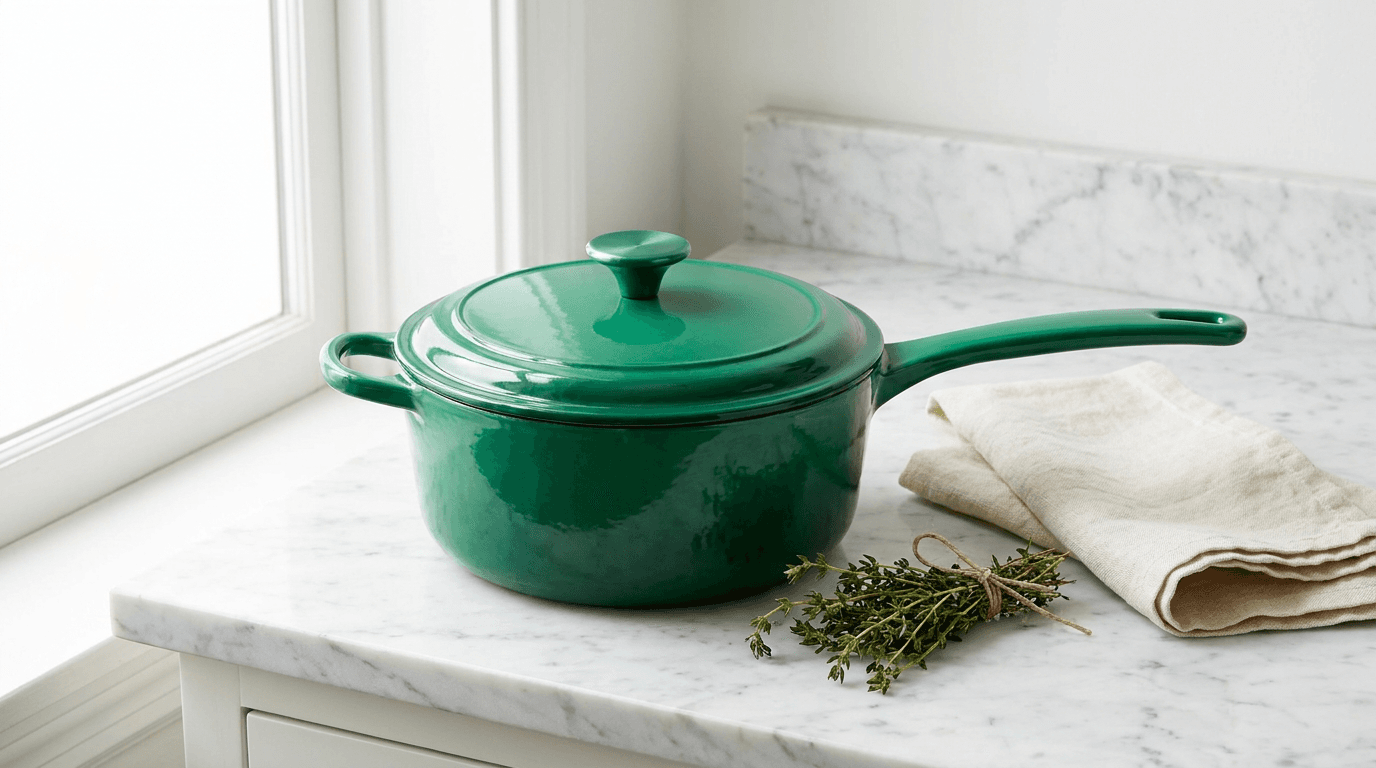
Premium enameled or ceramic-coated saucepan with lid in a signature brand color on a white Carrara marble kitchen counter with natural grey veining, bright natural daylight from a large kitchen window creating soft even illumination that shows the enamel color depth and the surface quality, a small bunch of fresh thyme or rosemary tied with kitchen string laid beside the pan, a clean white heavy linen dish towel folded into thirds in the near background, the marble surface shows natural grey veining catching the clean window light, the pan color contrasts elegantly with the white marble, warm white and light grey marble tones with the pan color as the primary accent, editorial bright kitchen lifestyle photography, ultra-realistic enamel surface and marble texture rendering, professional modern kitchenware brand campaign quality, no text no logos
4. Overhead Flatlay Kitchen Collection Display
Overhead flatlay photography serves the catalog function of communicating a complete cookware collection or product range in a single image, allowing buyers to understand the breadth and coherence of the product family.
Prompt
Overhead flatlay of a complete cookware collection arranged on a clean dark slate or light marble kitchen surface, the collection includes a large stockpot, a medium saucepan, a wide sauté pan, and a small saucepan arranged in an organized layout from largest to smallest with clear spacing between pieces, a natural wooden spoon, a small bunch of fresh sage, and a few whole black peppercorns placed naturally in the negative space between the pieces, photographed from directly overhead with perfectly even diffused studio lighting, each piece facing upward showing interior lining quality and rim construction, the collection communicates visual coherence and completeness as a range, ultra-realistic cookware material rendering on each individual piece with consistent surface quality, professional kitchenware catalog photography standard, no text no logos
5. Active Stovetop Steam and Heat Scene
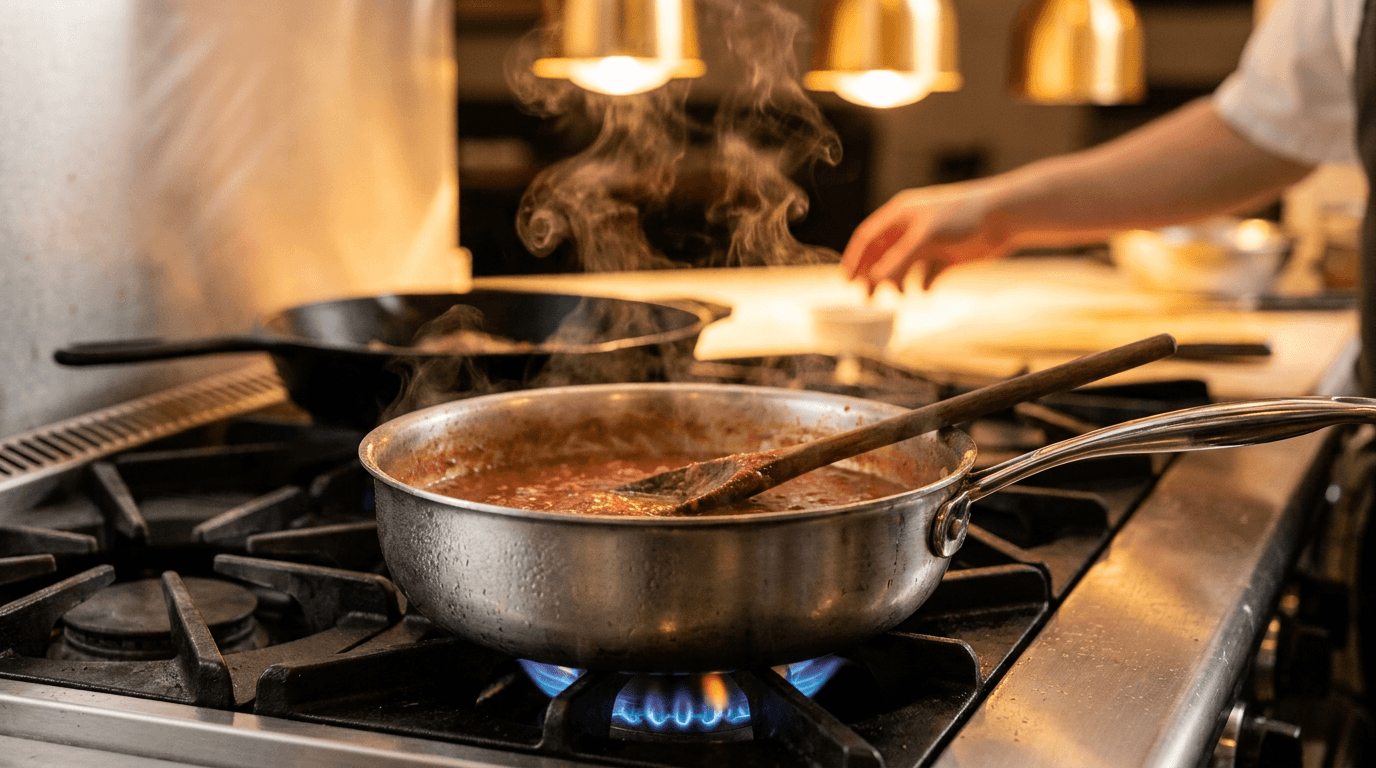
Cooking-in-progress photography communicates product performance through the visible evidence of heat, steam, and active cooking. For many buyers this type of image is the most persuasive because it shows the product doing its job in real kitchen conditions.
Prompt
Deep saucepan or sauté pan on a gas stovetop with visible blue gas flame beneath, liquid or sauce actively simmering with multiple steam columns rising from the surface catching the warm overhead kitchen light, small moisture droplets visible on the pan exterior from the cooking heat, a wooden spoon or silicone spatula resting across the pan with visible sauce from active stirring, a second burner with another pan partially visible in the background creating depth and kitchen context, warm amber gas flame light combined with overhead kitchen ambient light, the pan material including its exterior finish and handle construction are visible in the scene, editorial active cooking kitchen photography, ultra-realistic steam dynamics and gas flame light rendering, the image communicates the thermal performance and cooking capability of the product, professional cookware brand campaign quality, no text no logos
6. Premium Knife Blade and Handle Detail
Knife photography occupies its own specialized category within kitchenware catalog work because it must communicate two completely different quality signals simultaneously: the precision of the blade and the quality of the handle, each of which requires different light to render accurately.
Prompt
Premium chef's knife or santoku positioned diagonally on a dark walnut end-grain cutting board surface, single directional studio light from the left side raking along the blade length creating a brilliant sharp specular line of light along the cutting edge that communicates edge precision and blade geometry, the blade steel showing its grind pattern and surface finish whether mirror polished, satin finished, or Damascus pattern, the bolster area showing the precise fit between blade and handle, the handle material visible in full detail whether pakkawood grain, forged stainless, or black polymer texture, two or three fresh herb sprigs positioned at the blade base for scale reference, deep walnut and polished steel tones, editorial premium knife product photography, ultra-realistic blade edge and handle material texture rendering, the image communicates precision craftsmanship through material detail, professional premium cutlery brand campaign quality, no text no logos
7. Ceramic and Stoneware Natural Kitchen Scene
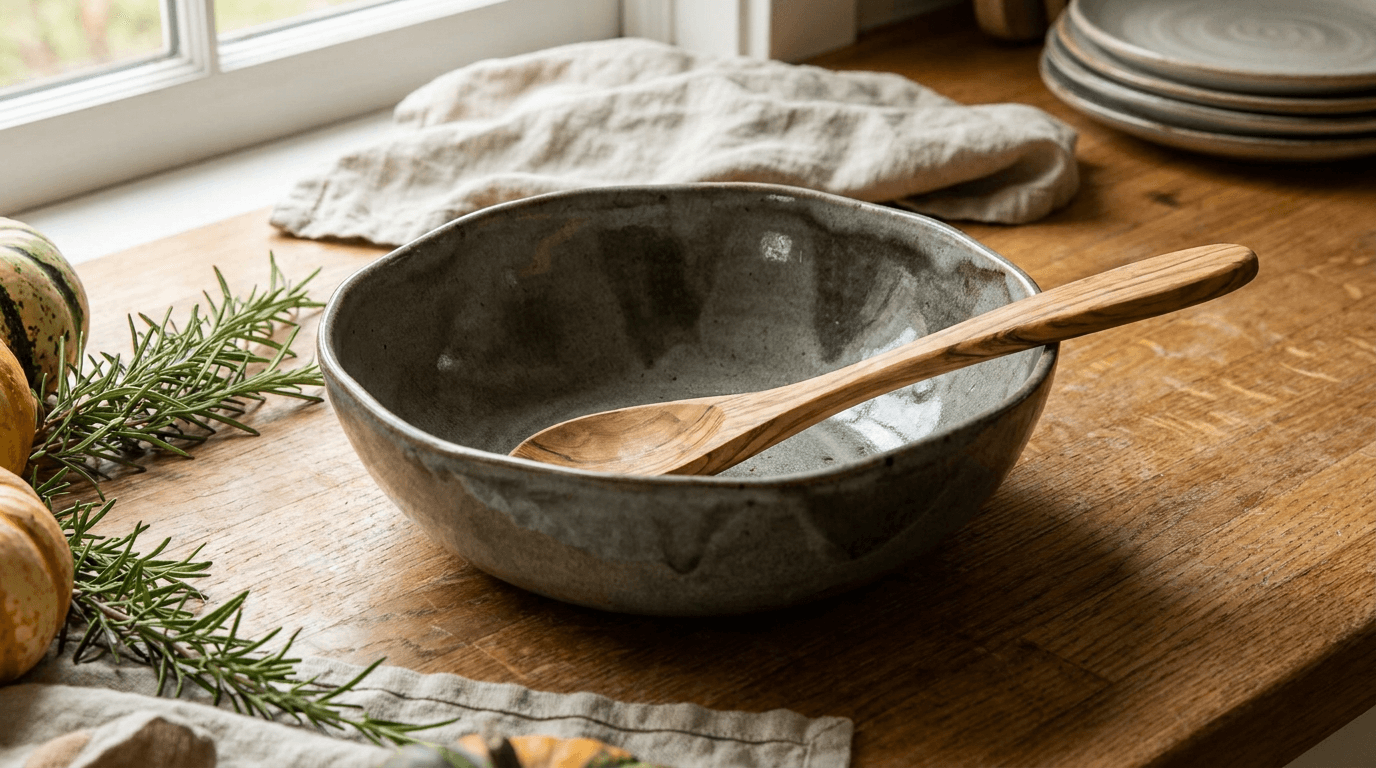
Handmade ceramic and stoneware kitchenware has its own distinct visual aesthetic that communicates the artisan quality through natural material variation, organic form, and the warm kitchen environment these pieces belong to.
Prompt
Handmade ceramic serving bowl or stoneware casserole dish on a warm natural butcher block or solid oak kitchen counter surface, soft warm natural afternoon light from a nearby kitchen window revealing the depth and natural color variation of the ceramic glaze surface, an olive wood serving spoon resting in or beside the piece with its grain visible, a loose arrangement of seasonal vegetables or fresh herbs placed naturally around the base of the piece, the ceramic body showing the slight thickness variation and organic form quality that communicates handmade craftsmanship, a clean natural linen textile partially visible in the background, warm natural wood and warm grey ceramic tones, editorial artisan kitchenware photography, ultra-realistic ceramic glaze surface and wood grain texture rendering, the image communicates the warmth and character of handmade kitchenware in a real home kitchen context, professional ceramics brand campaign quality, no text no logos
The AI image generator on Miraflow AI supports image-to-image generation, which is particularly useful for kitchenware photography when you need your actual product's specific color, form, or branding to appear accurately within the generated kitchen setting. Upload a reference product photograph and apply the lighting and kitchen context described in the prompt around it.
8. Copper Cookware Luxury Shot
Copper is the most visually distinctive material in premium kitchenware, and its photography has a specific set of requirements centered on capturing the characteristic warm orange-gold specular reflection that no other material produces.
Prompt
Polished copper saucepan with matching copper lid and riveted cast iron handle on a dark veined marble or black granite counter surface, single warm directional studio spotlight from the upper right angle creating the characteristic brilliant orange-gold specular reflection along the pan body and lid, the warm copper tone contrasting with the cool dark marble beneath, the tin or stainless steel interior visible at the rim showing the quality of the interior lining, a folded white chef's cloth and a sprig of fresh thyme placed beside the pan for scale and styling, the copper surface shows its characteristic warm tone with natural patina depth suggesting quality rather than cheap plating, deep dark marble and warm orange-gold copper tones, editorial luxury copper cookware photography, ultra-realistic copper specular rendering with authentic warm gold reflection quality, the image communicates the premium material and craftsmanship of genuine copper cookware, professional luxury kitchenware brand campaign quality, no text no logos
9. Bakeware with Ingredients Scene
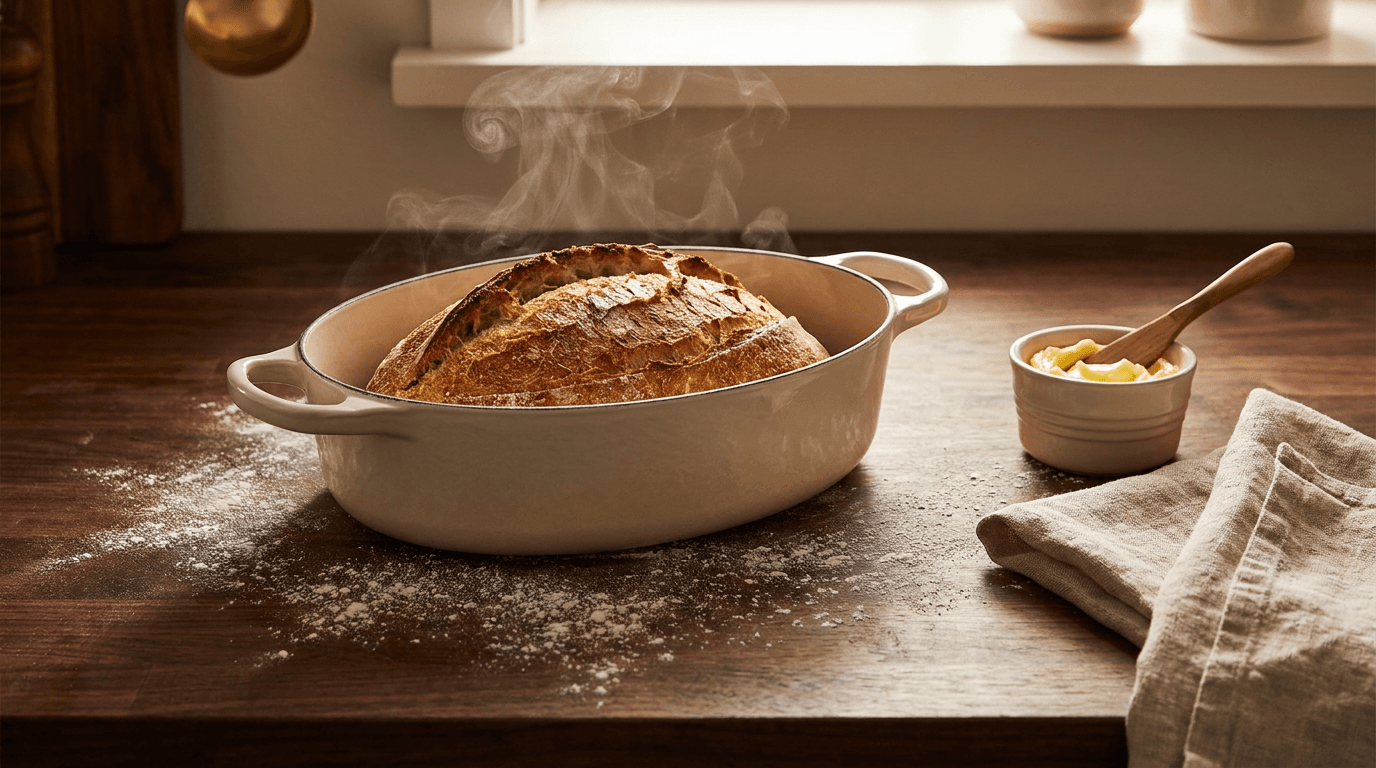
Bakeware photography benefits from showing the product in the context of the baking process rather than in isolation, because baking is an intimate and ritual-rich activity that buyers connect with emotionally as much as practically.
Prompt
Enameled or ceramic baking dish or cast iron loaf pan on a flour-dusted dark oak or walnut wooden surface, a freshly baked loaf or golden-crusted dish resting inside the bakeware with visible steam rising from the surface, a light scatter of flour on the wooden surface around the base of the pan from the baking preparation, a small ceramic ramekin of softened butter and a natural linen tea towel with visible texture folded beside the piece, warm kitchen ambient light suggesting the warmth of a recently used oven, the bakeware exterior finish and construction details including the rim, handles, and base are clearly visible, warm golden baked-good and natural kitchen tones, editorial baking lifestyle photography, ultra-realistic bakeware surface rendering and fresh-baked steam, the image communicates the specific pleasure of baking with quality equipment, professional bakeware brand campaign quality, no text no logos
10. Morning Coffee and Tea Equipment Scene
Coffee and tea equipment represents a distinct subcategory within kitchenware that has its own highly developed visual aesthetic around slow mornings, warmth, and ritual. This visual language is one of the most practiced in food and lifestyle photography.
Prompt
Premium pour-over coffee dripper or French press positioned on a light natural marble or warm wood kitchen counter, a quality ceramic coffee mug beside it with freshly brewed coffee visible, thin steam rising from the mug surface catching the soft morning light, a small ceramic bowl with whole coffee beans scattered beside the equipment for context, morning window light creating a warm directional soft glow across the scene, a natural linen napkin folded loosely in the background, the coffee equipment material and design quality are clearly visible including handle attachment, spout precision, and filter basket construction, warm cream and amber morning coffee tones, editorial slow morning kitchen lifestyle photography, ultra-realistic steam and ceramic rendering in soft morning light, the image communicates the specific quality of a considered morning ritual, professional coffee equipment brand campaign quality, no text no logos
11. Dutch Oven Hero Shot
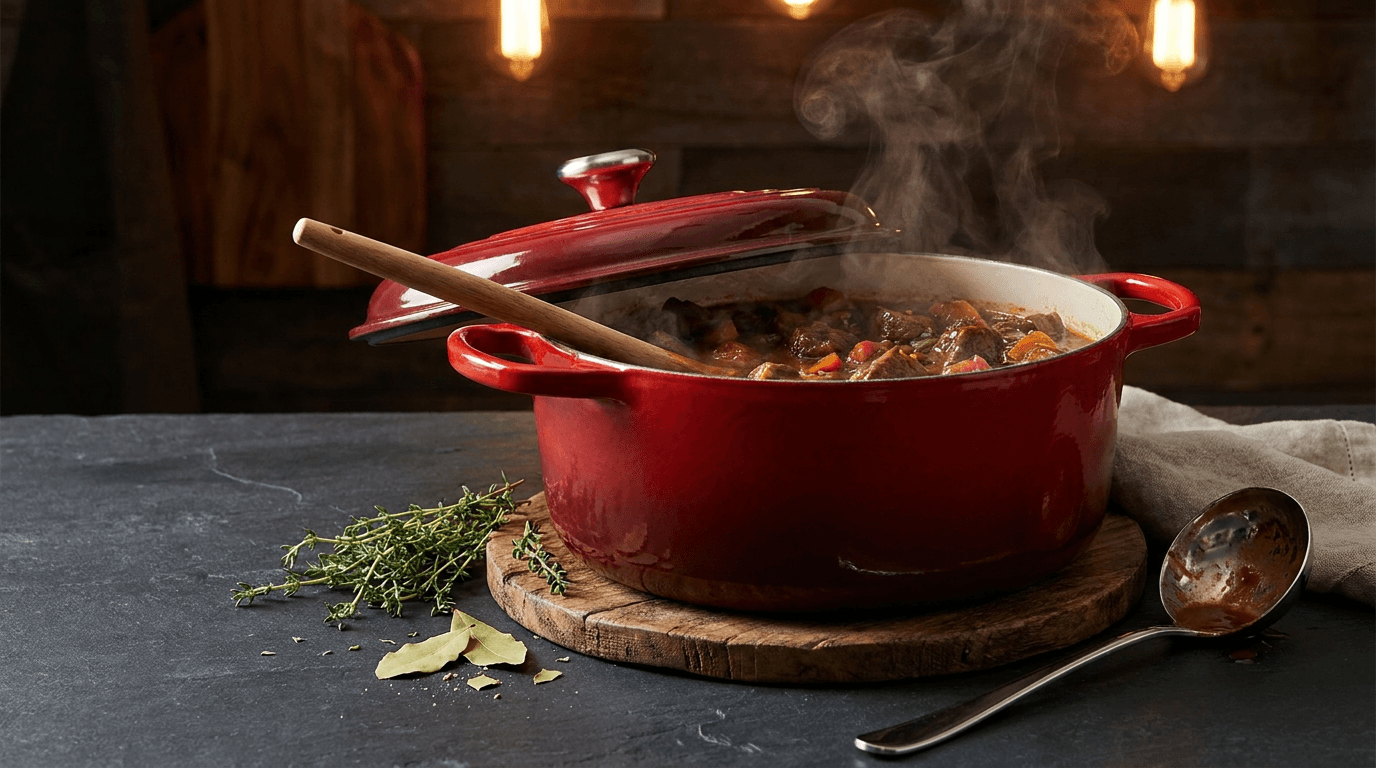
The Dutch oven is one of the prestige pieces in any cookware range, and its photography needs to communicate the weight, depth, and cooking versatility of the piece while creating an aspirational image around the kind of slow, nourishing cooking it enables.
Prompt
Large enameled cast iron Dutch oven with the lid slightly ajar at an angle revealing the deep slow-cooked contents inside, fragrant steam rising from the open gap between lid and pot rim, the pot positioned on a natural wood trivet on a dark stone or slate kitchen counter, a quality ladle resting beside the pot with sauce visible, the exterior enamel color is fully lit showing its depth and evenness, fresh herb sprigs and a cracked bay leaf scattered naturally on the counter near the base, the lid knob and side handles show the casting quality and material finish, warm evening kitchen ambient light suggesting a long-cooked meal nearing readiness, deep rich food and pot color tones with dark counter, editorial luxury cookware centerpiece photography, ultra-realistic enamel surface and steam rendering, the image communicates the soul of slow cooking with quality equipment, professional premium cookware brand campaign quality, no text no logos
12. Stack and Range Collection Display
Stack and range display photography serves catalog buyers who are evaluating a full product family rather than a single piece, communicating the completeness of the range and the coherent design system across all SKUs.
Prompt
Three or four matching pots and pans from a cookware collection nested and stacked in a visually pleasing graduated composition on a clean kitchen counter surface, the largest pot at the base with progressively smaller pieces stacked above and slightly forward to show each rim and interior, the stack photographed from a slight elevation three-quarter angle that shows the side profile of each piece and the nested efficiency of the collection, each piece in the same material and color finish communicating collection coherence, soft even overhead studio lighting, the handles of each piece visible from the viewing angle, the stack communicates that this is a complete, well-considered system rather than individual mismatched pieces, ultra-realistic cookware material surface rendering on each piece, clean neutral kitchen counter background, professional kitchenware catalog collection photography standard, no text no logos
13. Outdoor Serving and Dining Scene
Premium serving pieces and outdoor-appropriate kitchenware benefit from an outdoor dining context that communicates the aspirational version of summer entertaining and the versatility of the product across indoor and outdoor settings.
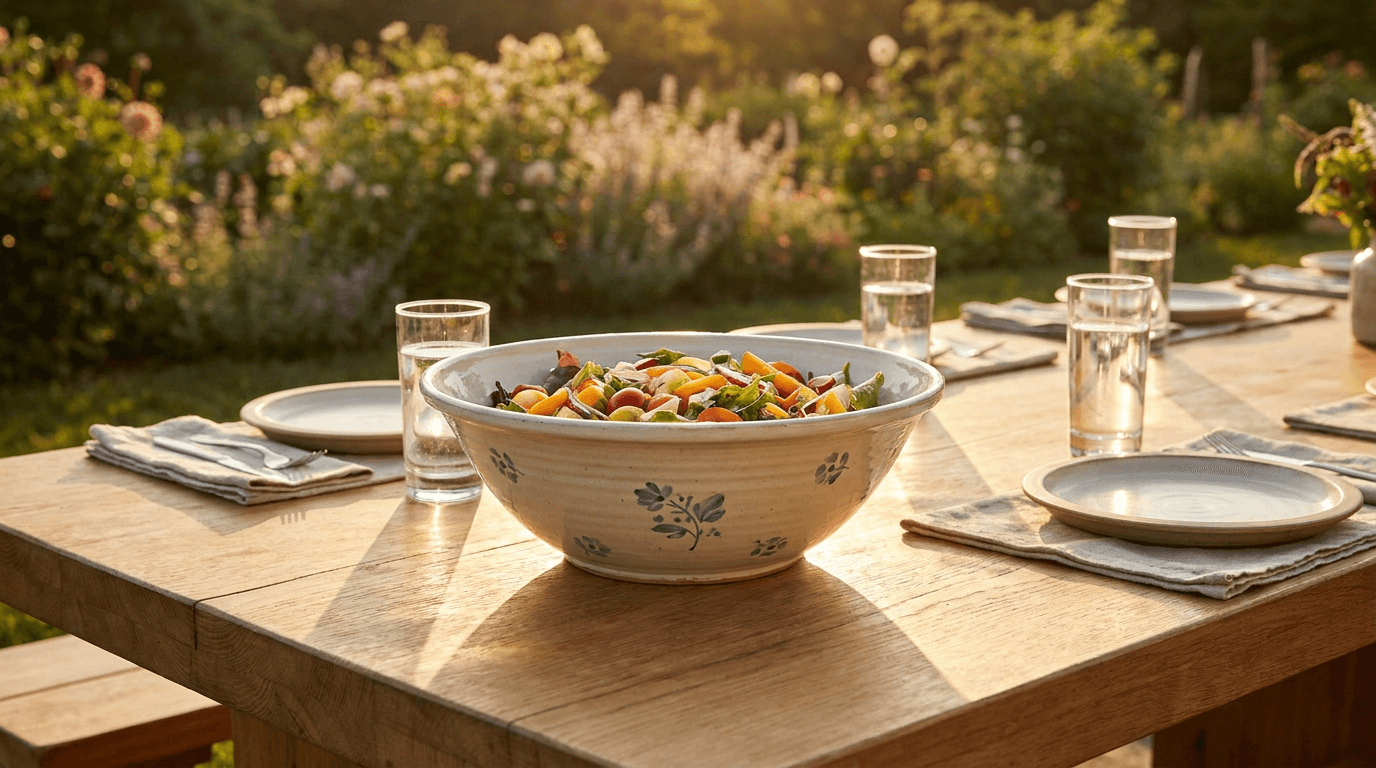
Prompt
Premium ceramic serving bowl or large enamelware serving platter filled with a colorful seasonal salad or shared dish on a natural wood outdoor dining table set for summer dinner, warm late afternoon golden light illuminating the table from the side and creating long soft shadows from the serving pieces, the table setting includes linen napkins, simple ceramic dinner plates, and tall glasses, the garden setting beyond the table is softly out of focus showing green plants and a warm evening atmosphere, the serving piece exterior is clearly visible showing its finish and form quality, warm golden outdoor light and deep garden green tones, editorial outdoor dining lifestyle photography, ultra-realistic ceramic or enamelware surface rendering in warm outdoor light, the image communicates the versatility and beauty of quality kitchenware in an outdoor social dining context, professional serving ware brand campaign quality, no text no logos
14. Dark Slate Prep and Cutting Board Scene
Prep-focused photography communicates the workhorse quality of kitchenware through the active context of food preparation, and the dark slate or butcher block surface creates a richly textured environment that complements precision kitchen tools beautifully.
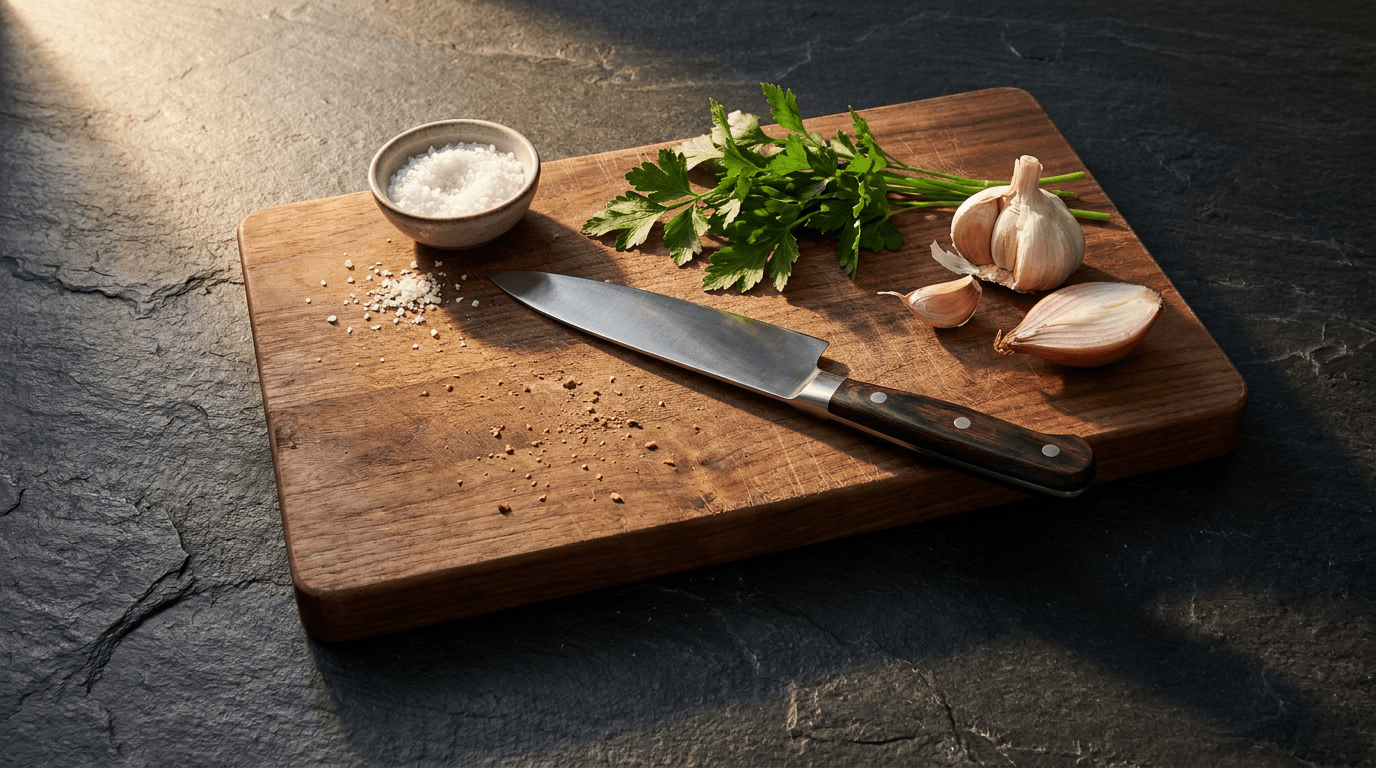
Prompt
Quality kitchen knife set or premium cutting board on a dark slate kitchen prep surface, a partially prepared ingredient scene showing a halved shallot, a bunch of fresh flat-leaf parsley, a head of garlic with one clove separated, and a small ceramic bowl of sea salt arranged naturally around the cutting board and knife, single warm directional light from the upper left creating long shadows across the slate surface and a sharp specular line along the knife blade edge, the cutting board surface showing its wood grain and natural working character, the knife handle material quality is visible in the warm light, deep charcoal slate and warm natural food tones, editorial professional kitchen preparation photography, ultra-realistic slate surface texture and blade steel rendering, the image communicates the pleasure and quality of professional kitchen preparation, professional cutlery and prep tool brand campaign quality, no text no logos
15. Universal Kitchenware Catalog Template
This flexible foundation prompt works for any kitchenware piece, material, or visual context not covered by the prompts above. Replace each bracketed section with your specific product and preferred visual treatment.
Prompt
[Describe your specific kitchenware piece including type, material, color, and key design details here] positioned on a [white seamless studio surface, white Carrara marble counter, dark slate kitchen counter, warm natural butcher block, dark walnut prep surface, natural wood outdoor dining table], [describe the lighting: clean even overhead studio light, single warm directional spotlight from the upper left, soft diffused natural daylight from a kitchen window, warm evening kitchen ambient light], [describe the styling context: no props for a clean catalog hero, with fresh herbs and seasonal ingredients for lifestyle staging, with active cooking steam or food content for in-use communication, with complementary kitchenware pieces for collection display], the product material surface is the primary visual subject with ultra-realistic rendering of [describe the material: cast iron seasoning texture, enamel color depth and surface quality, copper specular reflection, ceramic glaze character, stainless steel brushed grain or polished mirror finish], professional kitchenware catalog photography standard, no text no logos in the generated image
Tips for Stronger Kitchenware Catalog Photography Results
Match the Background Surface to the Product Material
The background surface choice in kitchenware photography is a brand and material pairing decision as much as an aesthetic one. Different kitchenware materials communicate their quality more effectively on certain surfaces than others.
Cast iron and carbon steel produce their most compelling imagery on dark surfaces: charcoal slate, dark granite, aged black oak. The dark background reinforces the material's inherent weight and seriousness. Enameled cookware in bright brand colors performs best on white marble or neutral light surfaces where the color can read cleanly without competition. Copper cookware needs either dark marble or black granite to create the contrast that makes the warm gold specular reflection visible and dramatic. Handmade ceramics and stoneware photograph most authentically on natural wood, particularly butcher block or rough-sawn oak that communicates a shared artisanal quality.
Building this material-to-surface logic into every prompt ensures the background choice reinforces the product's specific value proposition rather than simply providing a neutral resting place.
Steam and Heat Signals Are Product Performance Claims
Steam rising from a hot pan, a visible simmer in a pot, condensation on a cold cocktail glass, and the char marks on a grill pan are all visual performance claims specific to kitchenware. When you include these elements in a prompt, you are not just adding atmosphere. You are showing the product doing the thing it was designed to do.
Adding specific steam and heat descriptions to cooking-context prompts significantly improves the conversion power of the generated images. Terms like "visible steam columns rising from the hot surface," "active simmer with small bubbles visible at the liquid surface," and "char pattern visible on the grill surface from high-heat cooking" all communicate performance in ways that a product-only shot cannot.
Include Scale References Through Kitchen Context
Scale is as important in kitchenware photography as it is in furniture photography, and for similar reasons: buyers cannot hold the piece before purchase and need visual cues to understand the actual size of what they are ordering. A 28cm skillet and a 20cm skillet need to look different in the image, and the kitchen context provides the scale references that make those differences legible.
Including a recognizable-scale object alongside the product, a wooden spoon, a kitchen towel, a standard-size coffee mug, or a bunch of herbs, gives the buyer a reference point that communicates actual product dimensions more effectively than specifications alone.
Control Food Styling to Support Rather Than Compete
Food is one of the most powerful supporting elements in kitchenware photography, but it needs to be controlled carefully to support rather than compete with the product. When the food styling becomes more visually interesting than the product itself, the image converts buyers of the dish rather than buyers of the pan.
The safest approach is to use food and ingredients in a supporting role that communicates cooking context without becoming a hero element. Fresh herbs, whole spices, a simple cut vegetable, or a small portion of a finished dish as evidence of the pan's performance all communicate context without stealing visual attention. Full food styling spreads with elaborate dishes take the image toward food photography territory where the product can disappear.
Building a Complete Kitchenware Brand Content System
Strong catalog photography is the foundation, but a complete kitchenware content strategy extends significantly beyond product images. The Miraflow AI platform provides the tools to extend static catalog imagery into a full multimedia content ecosystem.

The Cinematic AI Video Generator on Miraflow AI lets you translate the visual concepts from your catalog prompts into short cinematic video content. A slow-motion pour of golden sauce from a quality saucepan, a close-up push toward a perfectly seasoned cast iron surface, or a lingering shot of steam rising from a Dutch oven in evening kitchen light all communicate product quality in a register that still photography cannot access. This type of atmospheric kitchen video content performs exceptionally well for premium cookware brands on Instagram and Pinterest, where the sensory quality of cooking is the primary emotional driver of purchase consideration.
For organic social media growth, Text2Shorts on Miraflow AI generates complete vertical short videos from a topic description in a single workflow. Content around cooking techniques, recipe ideas, kitchen organization, cookware care and seasoning guides, and chef skills content consistently drives discovery for kitchenware brands on TikTok, Instagram Reels, and YouTube Shorts. This type of educational and entertaining content reaches buyers at the research and consideration stage, when they are actively looking for guidance on which products are worth their investment.
The YouTube Thumbnail Maker on Miraflow AI is directly useful for kitchenware brands building YouTube content around cooking tutorials, product demonstrations, or kitchen lifestyle content. Consistent, high-quality thumbnail visual identity that matches your catalog photography aesthetic communicates brand premium quality at every touchpoint in the channel.
For brands producing longer-form content like kitchen video essays, cooking demonstration series, or product unboxing content, AI Clipping on Miraflow AI automatically identifies the most visually compelling and engaging moments from full-length videos, crops them to vertical format with animated captions, and scores them by viral potential. A fifteen-minute cast iron care demonstration becomes several short-form clips that drive ongoing discovery across platforms long after the original video's initial reach.
Background music for kitchenware brand videos and social content also plays a larger role in brand quality perception than most brands account for. The AI Music Generator on Miraflow AI generates original tracks in under a minute in any described style. A warm acoustic guitar piece for morning coffee content, a confident upbeat jazz rhythm for a premium cookware launch, or a calm ambient composition for a Dutch oven slow-cooking video all create a sonic brand identity that elevates the content without licensing concerns.
For more guidance on building AI-powered visual content strategies for product brands, the Miraflow AI blog covers image generation techniques, platform-specific content strategies, and visual content approaches in depth.
Platform-Specific Considerations for Kitchenware Catalog Content
Kitchenware brands typically distribute catalog content across several platforms simultaneously, and each platform has distinct requirements and audience behavior patterns that determine which image types perform best.
Amazon and large marketplace platforms require white background primary images for product listings and favor additional images that communicate scale, material quality, and in-use context. Prompts 1, 4, and 12 from this list are specifically suited for marketplace listing primary and secondary images. The stovetop steam scene and Dutch oven hero shot work well as lifestyle secondary images within Amazon listings.
Brand websites and DTC Shopify stores benefit most from the atmospheric lifestyle imagery that communicates brand identity and cooking aspiration alongside product quality. The dark moody cooking scene, copper luxury shot, and bakeware ingredient scene all perform strongly in DTC contexts where the buyer is evaluating the brand as much as the specific product. According to Shopify's research on product page performance for kitchen and home goods categories, multiple contextual lifestyle images combined with a clean product hero consistently produce the strongest conversion rates for premium kitchenware brands.
Pinterest is one of the highest-performing discovery platforms for premium kitchenware because it is a primary research channel for people planning kitchen upgrades and home cooking investments. Tall portrait-format images, particularly overhead flatlays and atmospheric cooking scenes, perform consistently well on Pinterest for kitchenware brands. The platform also has a longer content lifespan than Instagram or TikTok, which means well-generated catalog imagery continues driving traffic and consideration for months or years after initial posting.
Instagram and TikTok reward active cooking content over pure product shots, which makes the stovetop steam scene, the bakeware in action prompt, and the Dutch oven hero shot particularly useful for these platforms. Short-form video content using these visual concepts consistently outperforms static product posts in reach and engagement metrics for kitchenware brands on both platforms.
Print and digital catalogs have the highest technical quality requirements of any distribution format. For print catalog use, ensure generated images have sufficient resolution and that material colors are rendered accurately. The white background catalog hero shot and the collection stack display are the most frequently used image types for print catalog layouts. Industry print catalog standards for premium kitchenware often follow design and visual communication guidelines established by the Specialty Food Association and similar industry bodies, which emphasize material accuracy and visual consistency across product families.
Common Mistakes in Kitchenware Catalog Photography Prompts
The metal surface shows unrealistic reflections. Metal kitchenware, particularly stainless steel and copper, is highly sensitive to the environment reflected in its surface. Adding "no visible environment in the metal reflections, only controlled studio light reflected on the surface" prevents unwanted room or sky reflections that undermine the clean catalog quality of the image.
The food styling overwhelms the product. When food elements become more visually prominent than the kitchenware piece itself, the image loses its catalog function. Adding "the food and ingredient elements support the product as a supporting context rather than a hero element" and "the kitchenware surface and form remain the primary visual subject" keeps the product in its correct role.
The ceramic glaze renders as flat and plastic-looking. Add "natural glaze color variation visible across the ceramic surface," "the glaze shows depth and slight translucency," and "hand-thrown form with slight organic thickness variation" to push ceramic and stoneware renders toward authentic handmade quality rather than flat digital uniformity.
The steam looks fake or computer-generated. Steam is one of the most difficult photographic elements to generate convincingly. Adding "realistic steam physics with natural column density and gentle drift," "steam catching the light from the right side creating a visible atmospheric quality," and "multiple steam wisps at different heights rather than a single uniform column" produces more authentic steam rendering.
The cast iron surface looks shiny rather than seasoned. Cast iron's characteristic deep velvet black with no sheen is the opposite of the glossy surfaces that AI generators often default to for dark cookware. Add "deep matte black cast iron surface with characteristic velvet texture and no glossy reflections anywhere on the surface" and "the surface shows the specific non-reflective quality of well-seasoned cast iron" to push the render toward authentic cast iron appearance.
The knife blade edge looks rounded or dull. Add "razor-sharp blade edge visible as a clean precise line," "the cutting edge geometry is crisp and precise," and "the grind transition from the flat of the blade to the edge is sharp and well-defined" to communicate the precision of a quality knife in the generated image.
How to Build a Systematic Catalog Image Set
Most kitchenware brands need to maintain consistent visual quality across large catalogs covering dozens or hundreds of individual SKUs, and the challenge of producing that consistency at scale is where a systematic prompt approach produces the most significant practical value.
The most effective approach is to define your brand's core catalog template prompts, selecting three to five image types from this list that serve your specific catalog requirements, and then applying those templates systematically across every product in the catalog by changing only the product description in each template.
For a cookware collection, this might mean a white background hero shot template, a dark moody stovetop template, and a marble counter ingredient styling template, all applied consistently to every pan in the range. The visual consistency across these three image types for every SKU produces a catalog that reads as a coherent designed system rather than a collection of individually photographed pieces.
This batch approach is particularly practical with the AI image generator on Miraflow AI, where you can generate multiple variations of each template prompt in sequence, building a complete catalog image set for a new product range in a single working session.
FAQ
What image resolution should I generate for print catalog use?
For print catalog reproduction, generate at the maximum available resolution. Most offset printing at standard catalog quality requires a minimum of 300 DPI at the intended print size, which for a full-page catalog image typically means a native image file of at least 2400 pixels on the shortest edge. Generate at the highest available resolution and then evaluate whether the image holds sufficient detail at the intended print size before committing to print production use.
How do I accurately represent a product's color in a generated image?
Color accuracy is one of the most critical requirements for catalog images and one of the most challenging aspects of AI generation. Including the brand's color description in the most specific possible terms, such as "deep matte forest green with no blue undertone" or "warm cream with a slight yellow warmth rather than a cool white," significantly improves color accuracy. For brand-critical color accuracy, using the image-to-image workflow with a color-accurate reference image in the Miraflow AI image generator produces the most reliable results.
Can I generate consistent imagery for an entire product range at once?
Yes, with a systematic prompt approach. Define your core catalog templates once and apply them to each product by changing only the product description. This produces visual consistency across a full range. For a complete cookware collection of twelve SKUs across three image types per product, you would be generating thirty-six images total, which is practical to complete in a single session using the batch approach.
How do I communicate a product's size accurately without showing dimensions in the image?
Including a recognizable scale reference object in the styling elements of the prompt is the most effective approach. A standard wooden cooking spoon, a recognizable kitchen item like a single egg, or a consistently sized herb bundle all give buyers a subconscious scale reference without requiring dimension text overlays in the image. For very large or very small items, including an architectural counter context with a recognizable standard counter height visible in the composition communicates absolute scale more effectively than any single prop.
What is the best approach for photographing a product range that includes both premium and entry-level pieces?
Use distinct visual treatments for different price tier positioning within the catalog. Premium pieces benefit from the darker, more atmospheric settings like the dark moody cooking scene, copper luxury shot, and Dutch oven hero. Entry-level and mid-range pieces photograph more effectively in bright, clean, accessible settings like the white background hero and bright airy marble scene. The visual treatment hierarchy in the catalog communicates the pricing hierarchy to buyers who are navigating the range.
Can these prompts generate food photography for recipe content alongside the kitchenware imagery?
Yes, with a shift in emphasis. For catalog-standard kitchenware photography, the product is the hero and the food is supporting context. For recipe and food content, the food becomes the hero and the kitchenware provides the context. Adjusting the balance of description between food and product in the prompt shifts the output between these two functions. Both approaches are useful for a complete kitchenware content strategy: catalog images for product pages and food-forward images for social and recipe content.
How do I use these images in an e-commerce context most effectively?
Structure the product page image gallery with the white background hero shot as the primary listing image to meet marketplace requirements and communicate the product clearly. Follow with the atmospheric lifestyle image that best communicates the product's cooking context. Add the material detail close-up as a trust-building secondary image for buyers evaluating quality. For collections and sets, include the flatlay or stack display image to communicate range coherence. This four-image structure covers the complete conversion journey from discovery through to confident purchase for most kitchenware products.
Is it possible to show a product's interior quality, such as a non-stick coating or an enamel interior, in an AI-generated image?
Yes. Specifying the viewing angle to show the interior and including specific interior surface descriptions in the prompt produces reliable results. Adding "the pan is photographed at a slight overhead angle that reveals the interior surface quality," "the non-stick interior coating color and surface smoothness are visible from this angle," or "the bright enamel interior is visible at the pan rim showing the interior color and quality" directs the generator to prioritize interior visibility in the composition.
Conclusion
Kitchenware catalog photography works when it solves the specific visual challenge of the category: communicating material quality, product performance, and cooking aspiration simultaneously in images that meet the technical standards of commercial catalog reproduction. The 15 prompt templates in this post cover every major kitchenware subcategory and visual treatment, from clean white catalog heroes and dark moody cast iron scenes to bright marble kitchen shots, stovetop steam photography, copper luxury images, bakeware in action, morning coffee rituals, and complete collection displays.
The principles behind every effective prompt in this list are the same: match the background surface to the product material, describe the surface properties of each material with enough specificity to produce authentic rendering, use food and ingredients as context rather than competition, include scale references through kitchen objects, and let the visual treatment communicate the brand's position in the market alongside the individual product's quality.
All of these prompts work directly in the AI image generator on Miraflow AI, where text-to-image generation builds complete catalog scenes from scratch, image-to-image workflows incorporate your actual products with color and form accuracy, and inpainting refines specific elements like steam quality or food styling after generation. From there, the full Miraflow AI platform extends your catalog imagery into atmospheric kitchen video content, short-form social media videos, YouTube thumbnails, and original brand music, building a complete content system that communicates the quality of your kitchenware across every platform where your buyers are making their next kitchen investment.