15 AI Prompts for Architecture & Interior Design Portfolio Images (Copy & Paste)

Written by
Jay Kim
15 copy-paste AI prompts for architecture and interior design portfolio images. Exterior hero façade portraits, interior signature room presentations, detail and materiality close-ups, kitchen and dining showcases, bathroom and wellness spaces, living room compositions, bedroom retreat visuals, workspace environments, staircase and circulation features, outdoor living and landscape integration, before-and-after transformations, construction process documentation, twilight blue-hour exterior drama, mood board and concept presentations, and aerial site context overviews designed for architecture firms, interior design studios, residential and commercial practices, renovation specialists, and any design professional building a portfolio that communicates spatial intelligence, material quality, and atmospheric design through compelling two-dimensional imagery.
15 copy-paste AI prompts for architecture and interior design portfolio visual content. Exterior hero façade and building portrait compositions, interior signature room and space presentations, detail and materiality close-up examinations, kitchen and dining environment showcases, bathroom and wellness space presentations, living room and social space compositions, bedroom and private retreat visuals, workspace and home office environments, staircase and circulation feature presentations, outdoor living and landscape integration scenes, before-and-after transformation narratives, construction and process documentation visuals, twilight and blue-hour exterior drama shots, mood board and concept presentation layouts, and aerial and site context overview compositions designed for architecture firms and solo practitioners, interior design studios and independent designers, residential architecture specialists, commercial and hospitality design practices, landscape architecture firms, renovation and restoration specialists, kitchen and bath design studios, real estate developers with design-forward portfolios, property staging and styling professionals, architectural visualization studios, sustainable and green architecture practices, historic preservation architects, luxury home builders and custom home designers, boutique hotel and hospitality designers, retail and commercial interior designers, workplace and office design firms, healthcare and wellness facility designers, educational facility architects, multi-family and residential development designers, exhibition and experiential space designers, and any professional whose built work, designed space, or spatial vision must be communicated through images that make a person feel what it would be like to stand inside the room, to walk through the building, to live in the space, to inhabit the design.
The building exists in three dimensions. The photograph exists in two. Between those dimensions lives the entire challenge of architectural and interior design photography — the compression of spatial experience into a flat rectangle that must somehow communicate volume, proportion, light quality, material texture, atmospheric mood, circulatory logic, and the fundamental human experience of being inside a space. The architect designs a room where morning light enters through east-facing windows and moves across a limestone floor throughout the day, where the ceiling height creates a specific feeling of openness, where the proportions of wall to window to floor generate a particular sense of balance, where the materials — the warmth of oak against the coolness of steel, the roughness of exposed brick against the smoothness of plaster — create a tactile experience that unfolds over time as the inhabitant moves through the space. The interior designer specifies a fabric whose texture catches afternoon light in a way that changes the room's character hourly, selects a paint color that shifts between warm and cool depending on the light source, positions furniture to create conversation zones and circulation paths and sight lines that give the room its social intelligence. All of this — the light, the volume, the proportion, the material, the texture, the atmosphere, the movement, the time — must be communicated through a single image, or a series of images, that the viewer experiences on a screen in seconds rather than in a space over hours. The portfolio image is not a record of the space. It is an argument for the space. It is the evidence that the designer's decisions were correct, that the architect's vision was realized, that the built result justifies the investment and the trust the client placed in the professional's judgment.
This is the fundamental operating condition of the architecture and interior design portfolio. The work is spatial, temporal, experiential, and material. The portfolio is flat, instantaneous, visual, and digital. The gap between what the work is and what the portfolio can show is enormous, and the quality of the imagery that bridges that gap determines whether the potential client hires this firm or the next one, whether the publication features this project or the next one, whether the award jury selects this submission or the next one, whether the developer partners with this designer or the next one. The portfolio is not supplementary to the design practice. The portfolio is the design practice's public face — the medium through which the work reaches every audience that has not physically visited the built project. For most potential clients, editors, jurors, and collaborators, the portfolio image is the only encounter they will ever have with the work. The image is the work, as far as these audiences are concerned, and the quality of the image determines the quality they attribute to the design.
If you have worked with AI prompts for product photography, brand visual content, or social media imagery, the methodology will be familiar. Copy the prompt, adjust the details to match your specific architecture or interior design practice — your project type (residential, commercial, hospitality, institutional, mixed-use, renovation, restoration, new construction), your design philosophy and aesthetic language (minimalist, warm modernism, traditional, transitional, maximalist, biophilic, industrial, Scandinavian, Mediterranean, Japanese-influenced, mid-century modern, contemporary classical), your material palette (the specific woods, stones, metals, fabrics, finishes, and surfaces that define your work), your signature design elements (the recurring spatial moves, material combinations, detail solutions, and atmospheric qualities that distinguish your practice), your geographic and climatic context (the landscape, the light quality, the vernacular that shapes your work), and the specific visual identity that distinguishes your projects from every other firm's projects competing for the same client, the same publication, the same award — generate, and deploy. What distinguishes these prompts from general photography templates is that every element has been engineered specifically for the architecture and interior design portfolio context: the exterior hero façade portraits that communicate the building's form, materiality, and relationship to site and sky, the interior signature room presentations that communicate spatial quality, light, and atmosphere, the detail and materiality close-ups that reveal the craft and the material intelligence of the design, the kitchen and dining environments that showcase the most client-evaluated rooms in residential design, the bathroom and wellness spaces that demonstrate the practice's ability to create intimate luxury, the living room and social space compositions that show how design facilitates human gathering, the bedroom and private retreat visuals that communicate comfort, serenity, and personal sanctuary, the workspace and home office environments that prove the practice's relevance to contemporary living, the staircase and circulation features that demonstrate three-dimensional design intelligence, the outdoor living and landscape integrations that show the design's relationship to the exterior, the before-and-after transformations that prove the design's impact, the construction and process documentation that demonstrates the practice's build intelligence, the twilight and blue-hour exterior drama shots that create the most visually arresting façade imagery, the mood board and concept presentations that communicate the practice's design thinking, and the aerial and site context overviews that show the project's relationship to its broader environment. These are not general photography prompts applied to buildings and rooms. They are precision-engineered visual systems designed to solve the specific challenge of communicating three-dimensional spatial experience through two-dimensional portfolio images.
Why Portfolio Image Quality Is the Defining Competitive Advantage for Architecture & Interior Design Practices
Architecture and interior design practices operate through client-acquisition, publication, and recognition mechanisms that are fundamentally visual. Understanding how potential clients discover, evaluate, and select design professionals — and how publications, awards, and industry recognition function — reveals why portfolio image quality has become the decisive competitive advantage in a field where the work is spatial and experiential but the evaluation is almost entirely conducted through flat, two-dimensional, screen-based visual content.
The work cannot be experienced before it is commissioned. Unlike a product that can be sampled, a garment that can be tried on, or a meal that can be tasted, an architectural or interior design project cannot be experienced before the client commits. The potential client evaluating firms is evaluating completed work through images — through portfolio presentations, website galleries, Instagram feeds, Houzz profiles, magazine features, and award submissions. The client cannot walk through the architect's previous kitchen to feel the countertop or see how the light enters at 3:00 p.m. The client cannot sit in the interior designer's previous living room to sense the proportions and the material palette. The client experiences the designer's previous work entirely through the portfolio image, and the quality of that image determines the quality the client attributes to the design. A mediocre photograph of a brilliant design communicates mediocre design. A brilliant photograph of a competent design communicates brilliant design. The portfolio image does not merely represent the work — it establishes the perceived quality of the work.
Client selection is a visual comparison process. When a homeowner, a developer, a hospitality group, or a commercial tenant selects an architecture or interior design firm, the evaluation almost always involves comparing the portfolios of multiple firms. The firms are compared side by side — image against image, project against project, visual quality against visual quality. In this comparative evaluation, the firm with the most compelling, most professionally photographed, most atmospherically resonant portfolio images wins the perception battle before a single conversation about design philosophy, budget, or timeline occurs. The client selects the firm whose work looks the best, and the work that looks the best is the work that is photographed the best. This is not a cynical observation — it is the operational reality of how clients who cannot visit the built work make their evaluation.
Publications and media select projects based on image quality. Architectural and design publications — whether print (Architectural Digest, Dwell, Elle Decor, Dezeen, The Architectural Review) or digital (ArchDaily, Dezeen, Design Milk, Yellowtrace) — receive hundreds of project submissions and select a fraction for publication. The selection process begins with the images. An editor evaluating submissions sees the photographs before reading the project description, and if the photographs do not immediately communicate compelling spatial quality, material richness, and atmospheric distinction, the submission is passed over regardless of the design's actual merit. Publications need images that perform on their platforms — images that stop the scroll, that generate engagement, that look striking on a magazine page or a website header. The firm that invests in exceptional portfolio photography gets published; the firm that does not, does not.
Award submissions are evaluated through imagery. Architecture and design awards — from local AIA chapter awards to national and international recognition — are evaluated by juries who review the work primarily through submitted images. The jury members cannot visit every submitted project; they evaluate the photographs, the drawings, and the narrative description. The photographs carry the majority of the evaluative weight because they communicate the experiential quality of the completed work. A project with stunning imagery has a measurable advantage over a project of equal or greater design merit with mediocre photography.
Social media has become the primary discovery channel for design professionals. Instagram, Pinterest, Houzz, and increasingly TikTok have become the dominant channels through which potential clients discover architecture and interior design firms. A homeowner renovating a kitchen searches Instagram hashtags, browses Pinterest boards, scrolls Houzz project pages, and discovers firms through visual content long before visiting a firm's website or making a phone call. The visual content on these platforms is the first impression — often the only impression — that determines whether the potential client pursues the firm further. The firms that consistently produce compelling, platform-optimized visual content dominate the discovery process.
The design industry is intensely competitive. In every market — from residential architecture and interior design to commercial, hospitality, and institutional practice — multiple competent firms compete for the same projects, the same publications, the same recognition. The design quality among competing firms at any tier is often closer than firms would like to admit. In this environment, the visual presentation of the work — the portfolio quality, the photographic consistency, the atmospheric resonance of the imagery — becomes the primary differentiator. When the design quality among competitors is comparable, the firm that presents its work most compellingly wins.
Portfolio images have an extraordinarily long productive life. A single well-photographed project generates portfolio value for years, sometimes decades. The images appear on the firm's website, in publications, in award submissions, on social media, in client presentations, in conference talks, in monographs, and in retrospective features long after the project is completed. A poorly photographed project generates diminished value across all of these channels for the same duration. The investment in exceptional portfolio photography is amortized across years of professional benefit, making it one of the highest-return investments a design practice can make.
The portfolio communicates the practice's design intelligence. Beyond showcasing individual projects, the portfolio — taken as a body of work — communicates the practice's aesthetic consistency, its material vocabulary, its spatial priorities, its relationship to light and landscape, and its overall design intelligence. A portfolio with consistent visual quality across projects communicates a practice with consistent design standards. A portfolio where the photographic quality varies wildly communicates a practice without quality control. The visual consistency of the portfolio is itself a design statement about the practice's standards and attention to detail.
The Visual Language of Architecture and Interior Design Photography
Architecture and interior design photography has developed a specific visual vocabulary over decades — a set of conventions governing perspective, light, composition, styling, and atmosphere that the professional audience (clients, editors, jurors, fellow designers) reads fluently and expects to see in portfolio-quality work.
Light is the co-designer. In architecture and interior design, light is not merely illumination — it is a design material as fundamental as stone, wood, or steel. The way natural light enters a space, moves through it during the day, illuminates surfaces, creates shadows, and shapes the atmospheric experience of the room is one of the architect's primary design tools. The portfolio photograph must capture and communicate this light quality: the specific character of the light in the space as designed. Morning light entering an east-facing window and warming a wood floor. The diffused, even north light of a studio or gallery. The dramatic, directional afternoon light casting geometric shadows through a skylight. The golden-hour light flooding a west-facing living room. The light quality in the photograph communicates the architect's light-design intelligence — one of the most sophisticated and difficult-to-achieve aspects of spatial design.
Composition communicates spatial logic. The photographer's compositional choices communicate the designer's spatial logic. A one-point perspective down a long corridor communicates axiality and procession. A wide-angle composition that captures floor, walls, and ceiling communicates volume and proportion. A composition that frames a view through a doorway into the next room communicates spatial sequence and enfilade. A composition that includes the foreground, the middle ground, and the background through a window communicates the relationship between interior and exterior. Every compositional decision in architectural photography is a statement about the spatial experience — what the designer intended the inhabitant to see, to feel, to understand about the space.
Vertical lines must be vertical. One of the most fundamental conventions in architectural photography — and one of the most immediately visible markers of professional versus amateur work — is the correction of vertical perspective distortion. When a camera tilts upward to capture a tall building or a high ceiling, the vertical lines converge toward the top of the frame, making the building appear to lean backward. Professional architectural photography corrects this distortion through tilt-shift lenses or post-processing, rendering verticals as true verticals. This correction communicates precision, professionalism, and respect for the architect's geometry. Uncorrected converging verticals immediately mark an image as amateur.
The human-scale reference communicates livability. Architecture and interior design exist for human habitation, and the portfolio image must communicate the space's human dimension. This can be achieved through the inclusion of human figures (people in the space, scaled appropriately, providing the immediate scale reference and the human-inhabitation narrative) or through the inclusion of human-scale objects (furniture, lighting, objects, plants) that provide indirect scale reference and communicate that the space is designed for living, not for photography. The completely empty, unstaged architectural interior communicates construction completion, not design completion. The styled, inhabited, human-referenced interior communicates the designer's full vision.
Material texture must be visible and tactile. Architecture and interior design are fundamentally material arts. The specification of materials — the selection of a particular stone, a particular wood species, a particular metal finish, a particular tile, a particular fabric — is one of the designer's primary creative acts. The portfolio photograph must render these materials with enough tactile quality that the viewer can sense them through the screen: the grain of the oak, the veining of the marble, the patina of the brass, the weave of the linen, the texture of the plaster, the smooth density of the concrete. Material texture is communicated through directional lighting that creates the small-scale highlight-and-shadow patterns that the eye reads as texture. Flat lighting eliminates material texture and reduces all surfaces to flat color — one of the most damaging photographic failures in architectural imaging.
Color accuracy communicates design integrity. Interior designers and architects select specific colors with extraordinary precision — the exact shade of gray for a wall, the specific tone of white for a ceiling, the particular warmth of a wood stain, the exact saturation of a fabric. The portfolio photograph must render these colors accurately, because the color relationships in the design are intentional and specific. A warm-toned photograph that shifts a carefully specified cool gray wall into a warm taupe communicates a different design than the one the designer created. Color accuracy requires careful white-balance control and color management throughout the photographic and post-production process.
The wide angle communicates volume; the vignette communicates intimacy. Architectural photography uses a range of focal lengths to communicate different spatial qualities. Wide-angle compositions (roughly 16-24mm equivalent) communicate volume, proportion, and the full spatial experience of a room — the relationship between floor, walls, ceiling, windows, and the furniture within. These wide compositions are essential for communicating the architect's spatial design. Tighter compositions (roughly 35-85mm equivalent) communicate vignettes — intimate moments within the space: a reading corner, a material detail, a furniture grouping, a window view. The vignette communicates the designer's attention to detail, the human-scale moments within the larger spatial design. A complete architectural portfolio includes both wide spatial compositions and intimate vignettes.
Exterior photography communicates the building's public identity. The exterior photograph — the façade, the elevation, the building in its site — communicates the architect's public statement: the design's relationship to the street, the landscape, the sky, and the context. The exterior photograph is the building's portrait, and it must communicate form, materiality, scale, proportion, and the architect's approach to the public realm. The quality of the exterior image determines the building's photographic identity in publications, awards, and the public imagination.
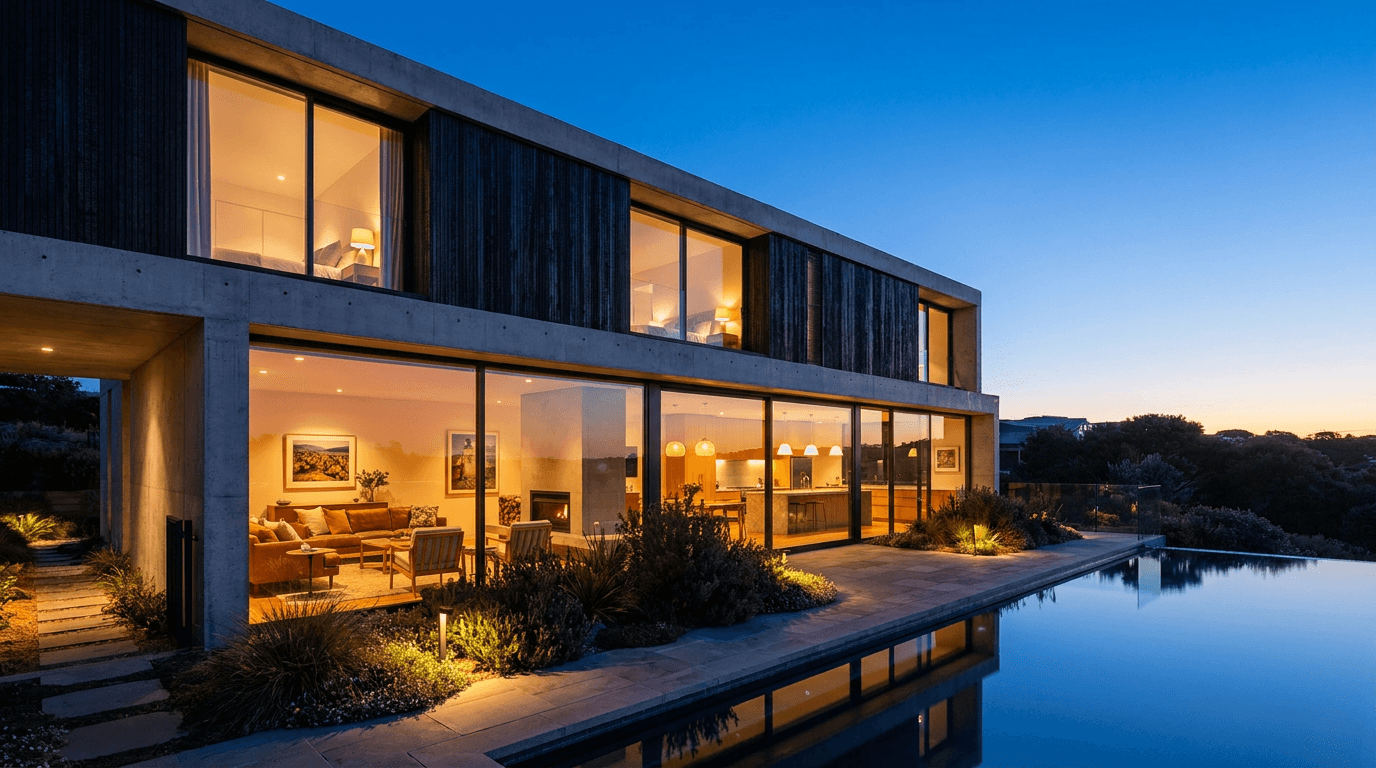
The twilight shot is the architectural glamour image. The twilight or blue-hour exterior photograph — shot at dusk when the sky transitions from warm to cool blue and the building's interior lights glow warmly through the windows — is the single most visually dramatic convention in architectural photography. The contrast between the warm interior light and the cool blue sky creates an image of extraordinary atmospheric power that communicates the building as a vessel of warmth and life within the larger landscape. The twilight shot is often the most published, the most shared, and the most immediately impactful image in an architectural portfolio.
Styling communicates the design's intended life. In interior photography, the styling — the books on the coffee table, the flowers in the vase, the throw on the sofa, the objects on the shelf — communicates the designed life the designer intended for the space. Styling is not decoration of the photograph; it is the completion of the design vision. The designer specified the furniture, the finishes, the lighting, and the spatial arrangement; the styling communicates the human life that inhabits these specifications. Over-styling creates clutter; under-styling creates emptiness. The precise calibration of styling communicates the designer's ability to create spaces that feel lived-in, personal, and complete.
Negative space and selective emptiness communicate architectural quality. While interior spaces benefit from styling and human reference, certain architectural photographs benefit from selective emptiness — compositions where the architecture itself (the volumes, the light, the materials, the proportions) is the subject and human-scale objects are minimized or absent. A staircase, a corridor, a double-height space, a skylight detail — these architectural features may be most powerfully communicated with minimal styling, allowing the spatial quality and the architectural design to speak without distraction.
Consistency across the portfolio communicates practice quality. A portfolio where every project is photographed with the same level of quality, the same visual sensibility, and the same atmospheric standard communicates a practice with consistent standards. A portfolio where quality varies — some projects brilliantly photographed, others poorly — communicates inconsistency and undermines the most compelling individual images. The portfolio should read as a coherent body of work, with the photographic quality as consistent as the design quality.
15 AI Prompt Templates for Architecture & Interior Design Portfolio Images
Each template includes a content concept, the full copy-paste prompt, and deployment guidance. All prompts are formatted for the Miraflow AI Image Generator and compatible with any high-quality text-to-image tool. Adjust the bracketed descriptive elements in each prompt to match your specific architecture or interior design practice — your project type, your design philosophy and aesthetic language, your material palette, your geographic and climatic context, your signature spatial moves, and the particular visual identity that distinguishes your work from every other practice competing for the same client, the same publication, the same recognition. Generate at 3:2 or 4:3 for portfolio and website gallery, 16:9 for website hero banners and presentations, 4:5 for Instagram feed, 9:16 for Stories and vertical social content, 1:1 for social media profile and grid, and 2:3 for Pinterest and vertical editorial.
Template 1: The Exterior Hero — Façade and Building Portrait
This is the building's public identity — the exterior portrait that communicates the architect's formal language, material choices, relationship to context, and the design's presence in the landscape or the streetscape. The exterior hero is the image that represents the project in publications, awards, and the public imagination.
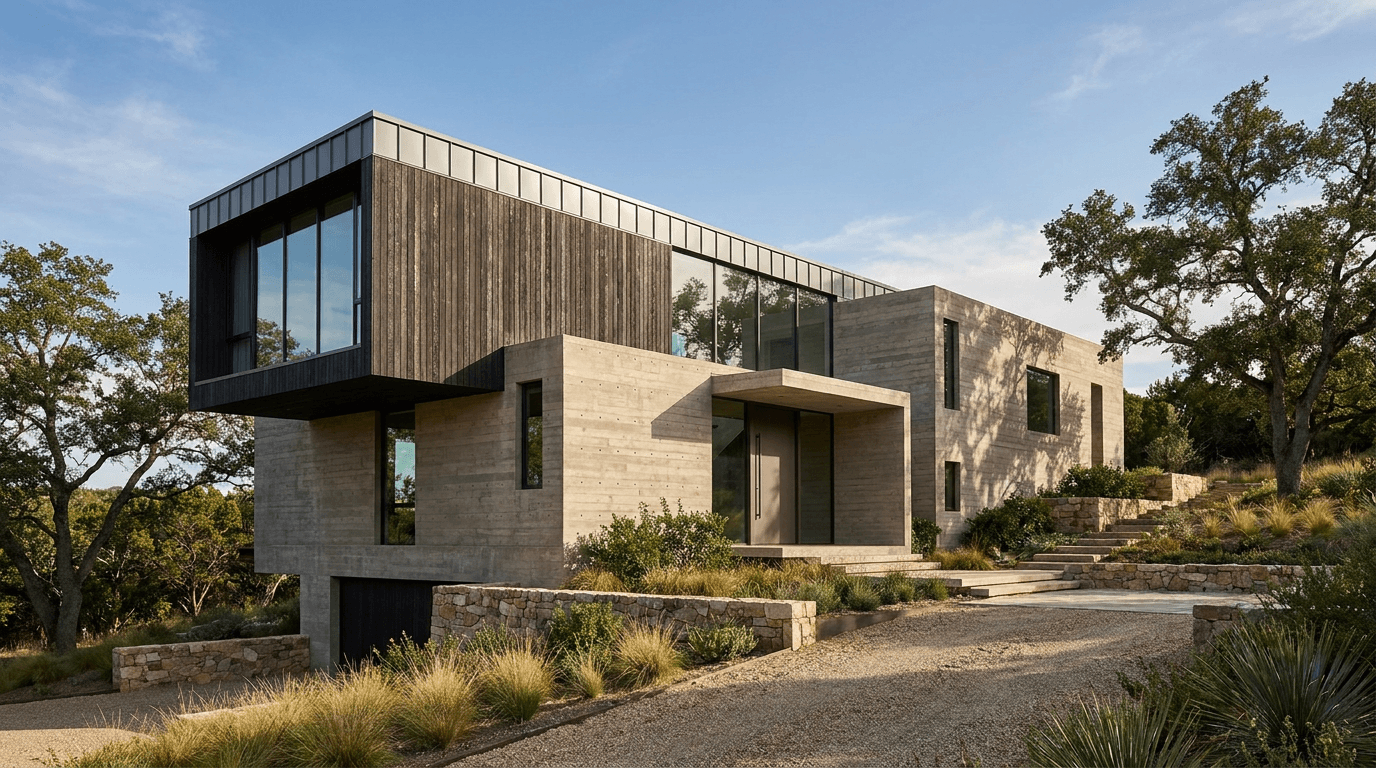
Prompt:
exterior hero façade and building portrait photograph of [a specific architectural project — the building presented as the definitive visual statement of the architect's formal language, material intelligence, and relationship to site: the building is a specific project — the particular residential, commercial, hospitality, institutional, or mixed-use building that is the portfolio's hero or signature project: the building's form communicates the design language — specify the exact architectural form: a contemporary residential house with its specific massing (a single volume or articulated volumes, cantilevered elements, recessed entries, the interplay of solid and void in the façade composition), its roofline (flat, pitched, butterfly, shed, green roof, the specific profile against the sky), its fenestration pattern (large floor-to-ceiling glazing panels, rhythmic punched openings, ribbon windows, a curtain wall, the specific window-to-wall relationship that defines the façade character), its material expression on the exterior (exposed concrete with its board-formed or smooth texture, natural stone cladding with its color and coursing pattern, timber cladding with its species and profile — vertical or horizontal boards, charred or natural, the specific wood character — metal cladding or standing-seam roofing, stucco or render, brick with its bond pattern and mortar color, glass with its reflective or transparent character), its entry sequence (the approach, the threshold, the front door or entry moment), its relationship to grade (elevated, at grade, partially below grade, on a slope), and its site features (the landscaping, the driveway, the hardscape, the trees, the garden, the pool, the walls or fences that define the property); or a commercial or institutional building with its specific typology and form; or a hospitality project with its public-facing identity; or a renovation or addition with its specific relationship between existing and new — the building's complete exterior described, the materials are specific and architecturally significant — every exterior material identifiable and rendered to show its authentic character: the concrete showing its formwork texture or its smooth, precise surface, the stone showing its natural veining and color variation and its coursing or setting pattern, the wood showing its grain and its weathering character (new and precise or weathered and silver-gray), the metal showing its specific finish (Corten with its rust patina, zinc with its blue-gray matte surface, copper with its green patina or its new bright character, anodized aluminum, painted steel), the glass showing its transparency or its reflective quality depending on the light and the angle, the brick showing its specific color, texture, and bond pattern — every material surface communicating the architect's material selection and the building's material identity, the context and site are visible — the landscape, the streetscape, the neighboring context, the topography, the vegetation, the sky — the building in relationship with its environment rather than isolated from it, the sky provides the atmospheric context — the specific sky condition that best presents the building: a clear blue sky for clean, graphic, form-reading conditions; a dramatic clouded sky for atmospheric, moody conditions; a golden-hour sky for warm, inviting conditions; a twilight sky for dramatic contrast conditions — the sky as a design element in the composition, the overall impression communicates the architect's design intelligence — the viewer should understand the formal logic, the material palette, the relationship to site, and the design's overall character — the exterior hero as the building's definitive public image] in a carefully positioned, full-building, exterior-portrait composition, the building fills the primary frame — the full form visible from foundation to roofline, the proportions and the massing readable, the material surfaces and the fenestration pattern identifiable, the building is presented from its most compelling angle — the viewpoint chosen to reveal the maximum design information: the primary façade composition, the relationship between volumes, the material palette, the entry, and the site context simultaneously (typically a three-quarter view that shows two façades and communicates the building's three-dimensional form, or a frontal elevation for buildings with a strong axial or symmetrical composition), the site context frames the building — the landscape, the streetscape, the topography, the vegetation providing the environmental frame that shows how the building sits in its place, the vertical lines are corrected — the building's vertical edges true and parallel, the geometry precise and architecturally honest (the corrected-perspective convention of professional architectural photography), the depth of field is deep — the full building and its immediate site context in sharp focus from foreground landscape to background sky, the architectural form and its details readable throughout, the lighting is natural, directional, and architecture-revealing — the specific natural light condition that best presents the building's form and materials: natural, directional, form-revealing, material-communicating daylight — the specific quality of natural light that professional architectural photography uses to communicate three-dimensional form and material character: directional sunlight from one side creating the dimensional modeling that reveals the building's massing — the sunlit façade bright and material-readable, the shadowed façade or the shadow side of projecting elements darker and recessive, the shadow pattern across the building communicating the three-dimensional relief of the façade composition (projecting volumes casting shadows, recessed windows creating shadow pockets, overhangs and canopies casting shadow lines that reveal their depth), the sun position chosen to create the optimal balance between illuminated and shadowed surfaces (typically mid-morning or mid-afternoon light that creates dimensional modeling without excessive contrast), the materials catching the directional sunlight with their specific character — the concrete revealing its surface texture in the raking light, the stone showing its color and veining in direct illumination, the wood showing its grain and its warm color, the metal showing its reflective or matte surface quality, the glass showing its transparency (the interior visible through the glass) or its reflection (the sky and landscape reflected in the glass) depending on the light angle, the sky providing the atmospheric ceiling — the sky's color, the cloud character, the overall atmospheric quality framing the building from above, exterior hero palette — the building's specific material tones on the exterior (specify: [your building's exterior materials, e.g., exposed board-formed concrete with warm gray tone, vertical charred timber cladding with deep black-brown, floor-to-ceiling glazing with visible interior, zinc standing-seam roof, native landscape with green and earth tones]) — the landscape and site tones — the sky condition and its tones — natural directional daylight — and the architecturally honest, material-specific, site-contextual palette of a building exterior in natural directional light as the color palette, the mood is architecturally commanding materially authentic site-responsive and the specific exterior message — this building is a considered response to its site, its program, and its material and formal possibilities, the design intelligence is visible in every decision from massing to material to detail — the exterior hero as the building's definitive public identity and the architect's formal statement, professional architectural photography with natural directional light and deep depth of field with corrected perspective, composed as a full-building exterior portrait with the architectural form and the material palette and the site relationship as the primary visual subject, architecturally honest material palette in natural directional daylight, no text overlays, no watermarks
Best for: Website homepage hero and project page primary imagery, portfolio and project presentation lead images, publication and editorial submission primary exteriors, award submission primary images, social media signature project content, print and digital advertising, monograph and book primary project images, press and media kit primary imagery, client presentation lead visuals, conference and lecture presentation slides
Template 2: The Interior Signature — Primary Room and Space Presentation
This template captures the interior signature space — the primary room or volume that defines the project's spatial quality, the designer's material and atmospheric vision, and the full experience of being inside the designed environment. The interior signature image is the portfolio equivalent of the exterior hero — the definitive presentation of the designed interior.
Prompt:
interior signature room and space presentation photograph of [the primary interior space — the room or volume that represents the project's spatial quality, material intelligence, and atmospheric character: the space is specific and design-significant — the particular room that best communicates the designer's vision: a living room or great room — the primary social space with its specific spatial character: the ceiling height and its effect on the room's atmosphere (a standard ceiling creating intimate proportion, a double-height volume creating dramatic openness, a cathedral or vaulted ceiling creating upward-reaching drama, exposed structure creating industrial or rustic character), the floor plan and its furniture arrangement (the seating group composition — the sofa, the chairs, the coffee table — arranged to create the conversation zone, the circulation paths clear and logical, the spatial organization communicating the room's social function), the window and light condition (the specific windows — floor-to-ceiling sliding doors opening to a terrace, a picture window framing a landscape view, clerestory windows washing light down a wall, skylights pouring light from above — and the specific light quality they create in the space), the material palette on every surface (the floor material — wide-plank oak, polished concrete, stone tile, terrazzo — and its specific color and texture; the wall treatment — smooth plaster in a specific color, exposed brick, stone accent wall, wood paneling, textured plaster, wallcovering; the ceiling treatment — smooth white, exposed beams, coffered, wood-lined; the millwork — built-in cabinetry, shelving, window seats, fireplace surround in specific materials), the furniture and the design selections (the specific furniture pieces — their style, their materials, their upholstery — communicating the designer's furniture-specification intelligence), the lighting design (the specific fixtures — pendants, sconces, recessed, floor lamps, table lamps — and the light quality they create), the fireplace or focal feature if present, the styling and the lived-in quality (the books, the objects, the plants, the art, the textiles — the human life that completes the design); or a kitchen as the interior signature; or a master suite; or a dining room; or an entry or foyer; or any space that best represents the project's design quality — the complete interior described with every surface, every material, every design decision specified, the spatial quality is the hero — the room's proportions, its volume, its light, its atmosphere as the primary subject: the feeling of being in this space, the way the ceiling height creates its specific atmospheric quality, the way the windows admit their specific light, the way the materials create their specific warmth or coolness or texture, the way the furniture creates its specific arrangement — the spatial experience communicated through every visible element, the material palette is rich and identifiable — every surface showing its specific material character: the floor with its grain or texture or pattern, the walls with their treatment and color, the millwork with its material and detail quality, the furniture with its upholstery and frame materials, the stone or tile with its veining and color, the metal hardware and fixtures with their finish — the material palette readable and design-significant, the styling is complete and life-suggesting — the space styled to communicate its intended life: the objects personal and curated, the textiles warm and inviting, the plants adding life and organic quality, the art and objects communicating the inhabitant's taste — the styling completing the design vision without overwhelming the spatial and material story, the overall impression communicates: this space has been designed with spatial intelligence, material care, and atmospheric intention — the interior feels considered, complete, and beautiful — the interior signature as the definitive presentation of the designed spatial experience] in a wide, space-revealing, architecturally composed interior composition, the room is presented from its most revealing angle — the viewpoint that communicates the maximum spatial information: the proportions, the volume, the material palette, the window condition, the furniture arrangement, and the atmospheric quality all visible in a single, carefully positioned composition (typically from a corner or an entry point that opens the room's full depth and width, or from an angle that captures the relationship between the primary living zone and the window or the view), the spatial depth is communicated — the composition reads from foreground to background, creating the three-dimensional depth that allows the viewer to feel the room's volume: foreground elements (a furniture edge, a lamp, a plant, a material surface) establishing the near plane, the primary living zone in the middle ground, and the window or the far wall providing the background and the depth termination, the ceiling and the floor are both visible — the vertical extent of the space communicated by showing the floor plane and the ceiling plane (or at minimum the upper wall approaching the ceiling), the proportional relationship between floor and ceiling defining the room's sense of height, the vertical lines are corrected — the walls' vertical edges true and parallel, the architecture geometrically precise, the windows and doors square, the depth of field is deep to moderate — the primary spatial volume in sharp focus from the foreground styling to the background wall or window, the full material palette and spatial quality readable, the lighting is natural and architecturally motivated — the specific quality of natural light as it exists in this particular space: natural, directional, space-defining, architecturally motivated interior light — the natural daylight entering the space through its specific windows and openings, creating the specific light quality that the architect designed: the directional quality of the natural light modeling the room's volumes and surfaces — the sunlit areas bright and material-revealing, the light falling across floors and walls with its specific pattern determined by the window positions, the light quality warm or cool depending on the orientation and the time of day (warm golden west or south light, cool even north light, bright morning east light), the natural light supplemented by the interior lighting design — the designer's specified light fixtures providing the warm, layered ambient illumination that complements the natural light: overhead fixtures providing general illumination, task lighting providing focused quality, accent lighting highlighting art or architectural features, the combined natural and designed light creating the specific atmospheric quality that defines this interior — the warmth, the brightness, the shadow quality, the overall light character that makes this space feel the way the designer intended, the materials catching the interior light with their specific character — every surface responding to the light with its authentic material quality: the wood floor reflecting warm light and showing its grain, the stone showing its veining and its polished or honed surface, the fabric showing its texture and its color in the light, the metal fixtures showing their finish quality, interior signature palette — the room's complete material and color palette (specify: [your interior palette, e.g., wide-plank white oak floors, warm white plaster walls, black steel window frames, natural linen upholstery, walnut millwork, Calacatta marble fireplace surround, brass light fixtures and hardware, charcoal wool rug]) — natural directional daylight combined with warm interior lighting — and the materially rich, atmospherically warm, spatially deep palette of a designed interior in natural and designed light as the color palette, the mood is spatially generous materially considered atmospherically beautiful and the specific interior message — this space has been designed with intelligence and care, every surface and every proportion and every material decision is intentional, the light and the atmosphere reward inhabitation — the interior signature as the definitive portfolio presentation of the designed spatial experience, professional architectural interior photography with natural and designed interior lighting and deep-to-moderate depth of field with corrected perspective, composed as a wide interior portrait with spatial depth and material richness and atmospheric quality as the primary visual subject, architecturally honest interior palette in natural and designed light, no text overlays, no watermarks
Best for: Website project page primary interior imagery, portfolio and project presentation signature interiors, publication and editorial submission primary interior images, award submission interior documentation, Instagram and social media primary interior content, client presentation lead interior visuals, print and digital advertising interior creative, monograph and book primary interior images, Houzz and platform portfolio galleries, real estate marketing (for developer and builder clients)
Template 3: The Detail & Materiality — Close-Up Craft and Surface Examination
This template zooms to the material detail — the joinery, the stone veining, the hardware, the texture transition — the close-up examination that reveals the designer's material intelligence and the builder's craft quality at the intimate scale where specification decisions become visible as physical reality.
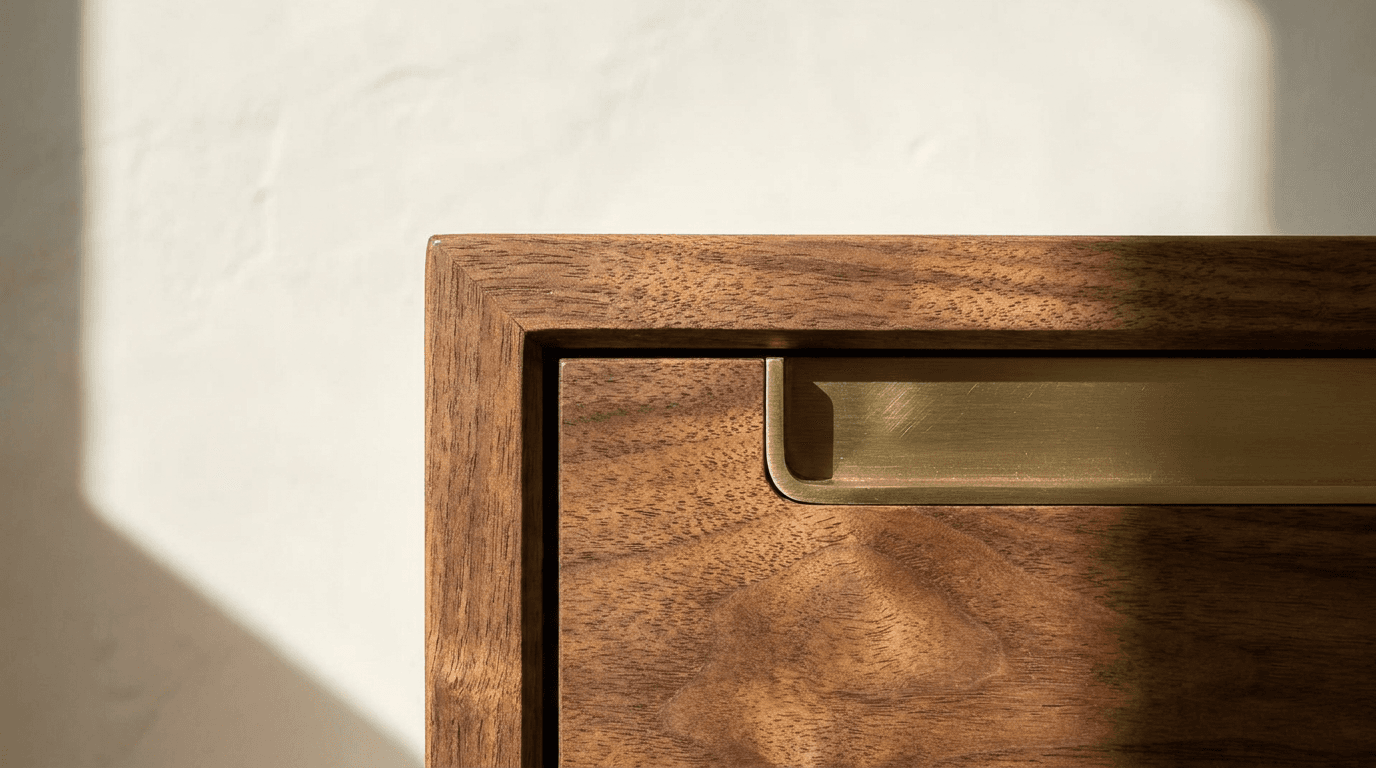
Prompt:
architecture and interior design detail and materiality close-up photograph of [the material detail, the construction joint, the surface texture, the hardware, the craft quality — examined at close range where the designer's material intelligence and the builder's execution quality are visible: the detail is specific and design-significant — the particular material or construction detail that reveals craft quality and design intention: a material junction — the point where two materials meet: the edge where the stone countertop meets the wood cabinetry below, the clean shadow gap or the flush joint communicating the precision of the installation; the transition from the oak floor to the stone threshold, the materials meeting with specific geometric precision; the steel window frame seated in the concrete wall, the raw industrial meeting of metal and masite; the wood shelf floating against the plaster wall with the concealed bracket creating the illusion of hovering; the tile meeting the wood at a bathroom threshold — every material junction a test of craft quality and design precision; or a surface texture in close-up — the specific character of a material at intimate scale: the veining pattern of a specific marble (the bold, dramatic veining of Calacatta, the subtle gray movement of Carrara, the warm honey tones of onyx) filling the frame as an abstract landscape of geological character; the grain of a specific wood (the tight, even grain of maple, the dramatic figuring of walnut, the coarse, rustic character of reclaimed oak) visible at the scale where the wood's individual character is the subject; the texture of a specific plaster (the hand-applied, slightly uneven, artisanal quality of lime plaster or tadelakt, the smooth precision of Venetian plaster with its depth and its polish) visible at the scale where the hand of the plasterer is readable; the texture of brick or stone in close-up; the weave of a specific fabric on a piece of furniture; the surface of concrete showing its aggregate or its formwork pattern; or a hardware and fixture detail — the specific fitting, the handle, the hinge, the faucet, the light switch examined at the scale where the designer's specification intelligence is visible: the lever handle in its specific material and finish (brushed brass, blackened steel, polished nickel, bronze), the shape and the proportions of the handle design, the quality of the finish, the precision of the fit against the door — the hardware as a miniature design object that communicates the designer's attention to every scale of the project; or a millwork detail — the cabinet door profile, the shelf edge treatment, the panel detail, the drawer pull relationship, the precision of the joinery — the millwork as evidence of custom craftsmanship, the overall detail examination communicates: the design intelligence extends to every material, every junction, every fitting — the designer's care operates at every scale from the room proportion to the drawer pull — the detail and materiality close-up as the craft-quality, specification-intelligence, design-depth visual] in a close-up, detail-focused, material-examining composition, the detail fills the frame — the specific material, junction, texture, or fitting visible at intimate, quality-revealing scale, the material character is the subject — the viewer examines the specific material quality, the craft precision, the design intention at the detail scale, the context is minimal but locating — enough of the surrounding architecture visible to understand where this detail exists within the larger project (the edge of the counter locating the junction in the kitchen, the wall surface locating the hardware on the door), the depth of field is shallow to moderate — the nearest detail surface in sharp focus with surrounding elements falling into contextual depth, the shallow focus creating the intimate, examining quality of detail photography, the lighting is natural, directional, and texture-revealing — the illumination that makes material surfaces show their authentic physical character: natural, directional, surface-raking, texture-revealing light — the light positioned to reveal the three-dimensional quality of the material surface: the directional natural light raking across the textured surface to reveal its dimensional character — the grain of the wood catching light and casting micro-shadows, the veining of the stone visible as three-dimensional relief in the raking light, the plaster texture visible as a surface of tiny hills and valleys, the hardware catching light with its specific metallic finish (the warm glow of brass, the cool reflection of chrome, the dark absorption of matte black), the material junction catching the light to reveal the precision of the meeting — the shadow gap, the flush joint, the clean edge all readable under directional illumination, detail materiality palette — the specific material tones at close-up scale (specify: [your detail subject, e.g., Calacatta marble veining with gold and gray movement on white ground; walnut millwork with natural oil finish showing grain and warm brown tones; brushed brass hardware against matte black door; hand-troweled lime plaster with subtle warm cream texture]) — natural directional raking light — and the material-honest, texture-revealing, craft-quality-visible palette of an architectural detail in natural directional light as the color palette, the mood is materially intimate craft-precise design-considered and the specific detail message — the design intelligence extends to this scale, the material selection is intentional, the craft quality is visible, the specification decisions are evidence of the designer's care — the detail close-up as the material-intelligence and craft-quality visual, professional architectural detail photography with natural directional light and shallow-to-moderate depth of field, composed as a material close-up with the texture and the craft precision and the material character as the visual subject, material-honest palette in natural raking light, no text overlays, no watermarks
Best for: Instagram and social media detail and material-appreciation content (high save rate), website project detail sections, publication and editorial submission supporting detail images, award submission detail documentation, Pinterest material and detail content, client presentation material-palette and detail-quality evidence, brand-book and practice-identity documentation, Houzz and platform detail imagery, product and material specification partner content, design process documentation
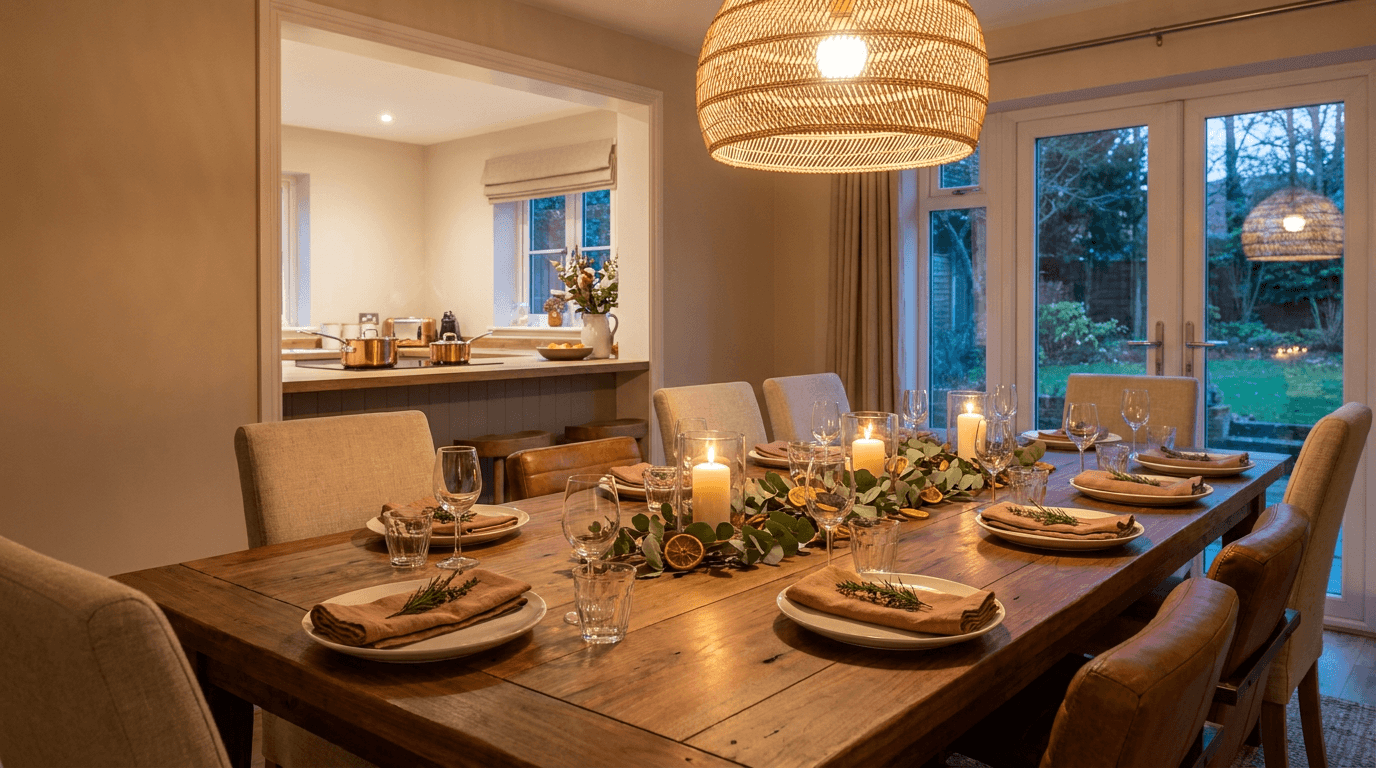
Template 4: The Kitchen — Culinary and Gathering Space Showcase
This template presents the kitchen — the most scrutinized, most client-evaluated, most published, and most design-intensive room in residential architecture and interior design. The kitchen image is often the single most important interior in a residential portfolio.
Prompt:
kitchen and culinary space interior design photograph of [the kitchen — the complete culinary and gathering environment presented as the designer's most intensive specification and spatial challenge: the kitchen is specific and design-comprehensive — the particular kitchen with every surface, every fitting, every material described: the layout and spatial organization — the specific kitchen arrangement: a galley kitchen with its efficient parallel counters, an L-shaped kitchen with its corner efficiency, a U-shaped kitchen with its three-wall enclosure, an island kitchen with its central work surface and its social dimension (the island as the primary design feature — its material, its form, its overhang for seating, its integrated sink or cooktop, its relationship to the rest of the kitchen), a peninsula kitchen, or an open-plan kitchen integrated with living and dining — the spatial arrangement communicating the kitchen's functional organization and its social relationship to the rest of the home, the cabinetry is specified — the specific cabinet design: the door style (flat-panel contemporary, shaker-profile transitional, raised-panel traditional, slab with integrated handle, fluted or reeded), the material (painted MDF in a specific color — matte white, warm gray, deep green, navy blue, matte black — or natural wood in a specific species — white oak, walnut, maple, cherry), the hardware (the pulls, the knobs, the edge profiles — brushed brass, satin nickel, matte black, unlacquered brass, integrated handle), the upper cabinets (present and matching, glass-fronted, open shelving replacing uppers, no uppers at all for a minimalist approach), the pantry configuration, the relationship between base and upper cabinetry, the countertop is specified — the specific counter material: marble (Calacatta, Carrara, Statuario, with its veining visible), quartzite, granite, engineered quartz in a specific color and pattern, butcher block, concrete, stainless steel, terrazzo — the counter edge profile (waterfall edge extending to the floor on an island end, eased square edge, bullnose, mitered), the counter thickness, the material's surface character (polished, honed, leathered), the backsplash is specified — the specific backsplash material: tile (subway, zellige, large-format, mosaic, handmade, geometric), stone slab continuing from the counter, painted or plastered wall, open shelving serving as backsplash zone — the backsplash material, its color, its pattern, and its relationship to the counter and the cabinetry, the appliances are integrated — the specific appliance strategy: fully integrated (panel-ready appliances matching the cabinetry for a seamless, furniture-like quality), professional-style (stainless steel range, range hood as a design feature), the range hood (integrated or concealed, statement copper or steel hood, floating shelf hood, chimney hood), the refrigerator presentation, the sink and faucet — the specific fixtures: the undermount, farmhouse, or integrated sink; the faucet in its specific style and finish — the appliance and fixture selections communicating the kitchen's functional quality, the lighting is designed — the specific kitchen lighting: pendant lights over the island (their style, material, number, and scale), undercabinet task lighting, recessed ceiling lights, the light quality warm and functional, the styling communicates the kitchen's life — the fruit bowl, the cutting board, the cookware, the herbs, the open shelving contents, the stools at the island — the kitchen styled as a working, lived-in, beautiful culinary space, the overall composition communicates: this kitchen is comprehensively designed, every surface and every fitting specified with care, the space functions beautifully and looks beautiful — the kitchen as the designer's most intensive material and specification showcase] in a wide, kitchen-encompassing composition, the kitchen fills the frame — the full spatial arrangement visible: the island or the primary counter, the cabinetry, the backsplash, the appliances, the lighting, the windows, the floor, and ideally the ceiling visible to communicate the room's complete design, the island is the compositional anchor (if present) — the island or the primary work surface centered or prominently positioned as the kitchen's design feature, all material surfaces are visible and readable — the counter, the cabinetry, the backsplash, the floor, the hardware — the full material palette identifiable in a single composition, the styling is warm and life-suggesting — the kitchen appears functional and inviting, the vertical lines are corrected — the cabinetry, the windows, the walls all geometrically true, the depth of field is deep — the full kitchen in sharp focus from the nearest counter surface to the far wall, the lighting is the combined quality of natural light and designed kitchen lighting — the specific illumination that makes kitchens look their most beautiful: natural daylight from the kitchen's windows combined with warm designed interior lighting — the natural light entering through the kitchen's windows (the specific light quality — bright morning east light, warm afternoon west light, even north light — creating the directional quality that models the room's volumes and reveals the materials), the interior lighting providing the warm, layered quality: the pendant lights over the island creating their warm, focused pools, the undercabinet lights providing the warm task illumination that makes the backsplash and the counter glow, the recessed lights providing the even overhead fill, the combined natural and designed light creating the warm, functional, beautiful atmosphere that makes the kitchen inviting — the materials catching this combined light with their specific character: the counter showing its material quality (the marble veining, the wood grain, the concrete texture), the cabinetry showing its finish (the painted surface quality, the wood grain, the color in the warm light), the backsplash showing its material and pattern, the hardware catching light with its metallic finish, the appliances showing their surface quality, kitchen palette — the kitchen's complete material and color palette (specify: [your kitchen palette, e.g., white oak flat-panel cabinetry with honed Calacatta marble counters with waterfall island end, zellige tile backsplash in warm white, brushed brass hardware and fixtures, matte black faucet and range hood, wide-plank white oak floor, warm white painted walls, rattan counter stools]) — natural daylight combined with warm pendant and task lighting — and the materially rich, warm, functionally beautiful palette of a designed kitchen in natural and designed light as the color palette, the mood is culinary-warm designfully complete functionally inviting and the specific kitchen message — this kitchen is fully designed, every surface specified with care, the space invites gathering and cooking and living — the kitchen as the designer's most specification-intensive portfolio piece, professional architectural interior photography with natural and designed kitchen lighting and deep depth of field with corrected perspective, composed as a wide kitchen interior with the spatial arrangement and the material palette and the functional beauty as the visual subject, kitchen material palette in warm combined lighting, no text overlays, no watermarks
Best for: Website project page kitchen imagery, portfolio primary residential interior content, publication and editorial submission kitchen images, award submission kitchen documentation, Instagram and social media kitchen content (highest engagement residential interior category), Houzz and platform kitchen portfolio, Pinterest kitchen content, client presentation kitchen design evidence, real estate marketing kitchen features, kitchen and bath design specialist portfolio
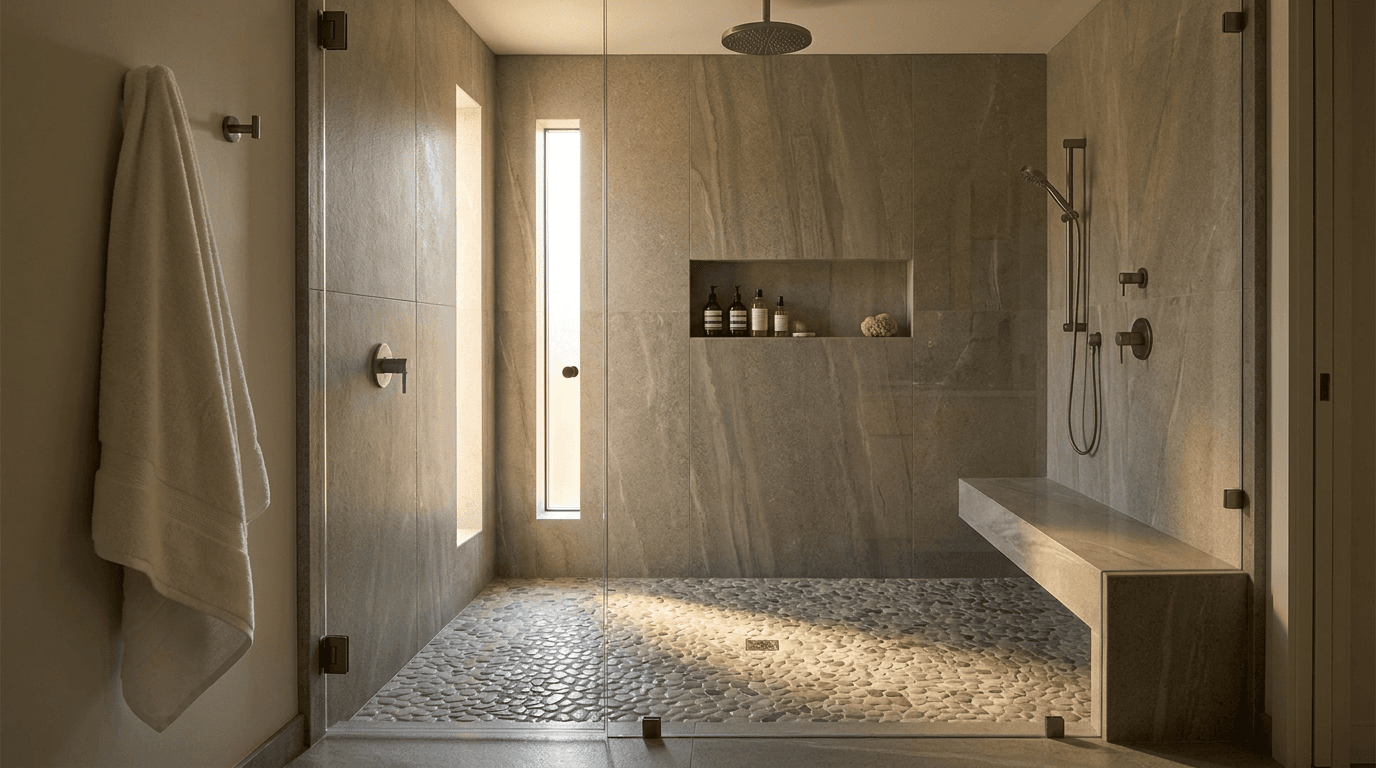
Template 5: The Bathroom & Wellness — Intimate Luxury Space
This template presents the bathroom — the space where material quality is experienced most intimately, where the designer's ability to create sensory luxury at an intimate scale is most visible, and where the specification of stone, tile, fixtures, and hardware reaches its most concentrated expression.
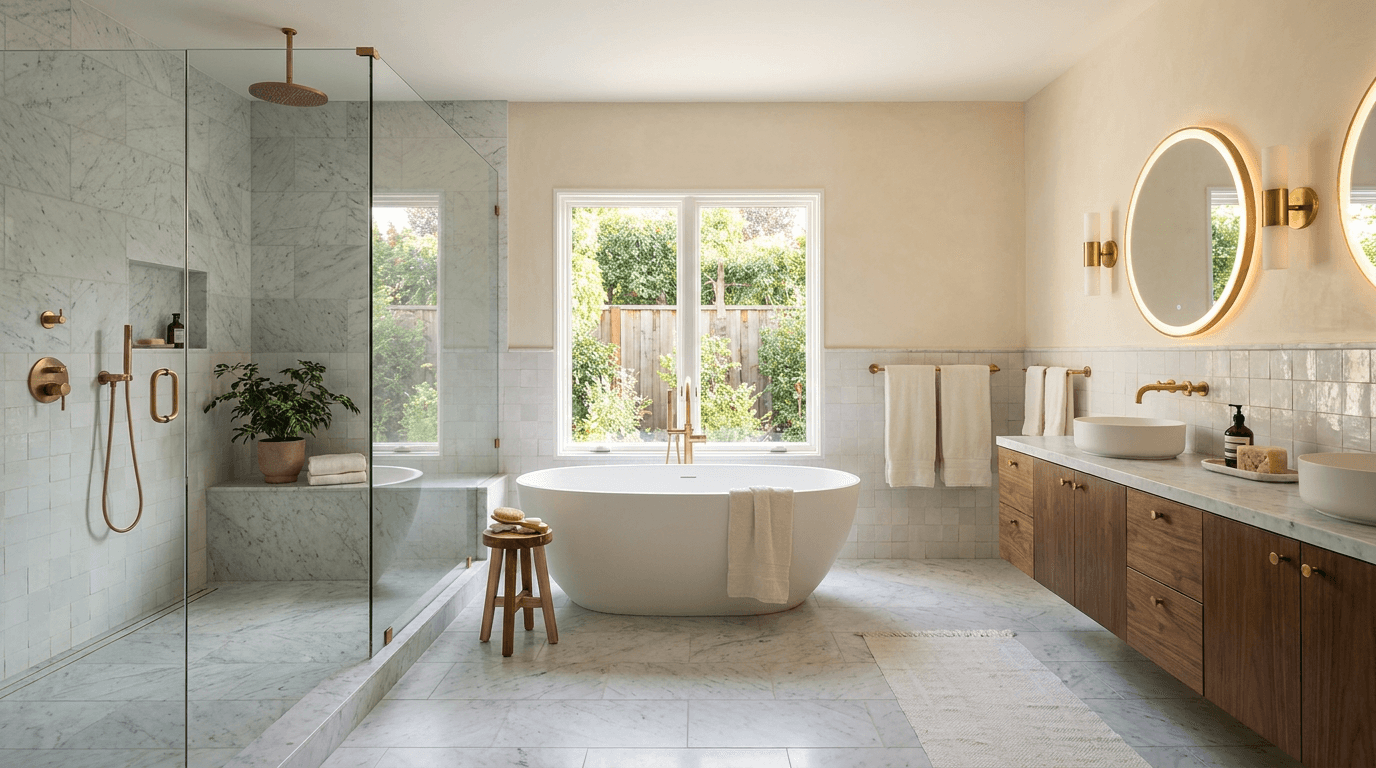
Prompt:
bathroom and wellness space interior design photograph of [the bathroom — the intimate luxury environment where material specification reaches its most concentrated and sensory expression: the bathroom is specific and materially rich — the particular bathroom with every surface and fixture described: the spatial type — the specific bathroom: a primary master bathroom with its generous proportions and its full complement of fixtures (freestanding tub, walk-in shower, double vanity, water closet, dressing area), a powder room with its concentrated design impact (a small space where every surface is specified with maximum material intensity), a guest bathroom, a children's bathroom with its playful-yet-designed quality, a spa bathroom designed for wellness and retreat, or a pool bath or outdoor-adjacent bathroom — the bathroom type defining its spatial character and its design intensity, the fixture layout and the primary feature — the specific fixtures and their arrangement: the bathtub (freestanding sculpted tub as the room's focal point — its material: cast iron, stone, composite, copper — its form: classic clawfoot, modern oval, Japanese soaking, sculptural contemporary; or a built-in tub with its surround material and its design integration), the shower (walk-in with frameless glass, wet room with no enclosure, the shower walls in their specific material — large-format stone slab, tile in its specific type and color, tadelakt — the shower fixture: rain head, wall-mounted, handheld, the shower fixture finish), the vanity (floating vanity in its specific material — walnut, oak, painted, stone — with its specific counter: stone slab, integrated basin, vessel sink — and its mirror: frameless, framed in specific material, backlit, medicine cabinet), the toilet (wall-hung for clean lines, or concealed in a separate water closet), the materials are the primary design content — the specific material palette on every surface: the floor (stone tile, porcelain, marble, terrazzo, heated, and its specific color and pattern), the walls (stone slab, tile — the specific tile type: zellige, subway, hexagonal, fish-scale, large-format, mosaic — in its specific color, or plaster: tadelakt, Venetian plaster, lime wash — the wall material defining the room's sensory character), the vanity top (marble, quartzite, concrete, terrazzo), the shower walls, the niche detail, the threshold, the trim — every surface contributing to the bathroom's material density, the fixtures and hardware — the specific faucets, the shower valves, the towel bars, the robe hooks, the toilet paper holder, the cabinet hardware — all in their specific finish (brushed nickel, unlacquered brass, matte black, polished chrome, oil-rubbed bronze) and their specific design style (minimalist, transitional, traditional, industrial) — the fixtures as the jewelry of the bathroom, the lighting — the vanity lighting (sconces flanking the mirror, a light bar above, backlit mirror), the ambient lighting (recessed, the natural light from a window or skylight), the accent lighting (niche lighting in the shower, undercabinet glow, the specific light quality warm and flattering), the styling — the towels, the bath accessories, the plant, the stool or bench, the candle, the soap — the styling communicating the bathroom's sensory, wellness-oriented character, the overall composition communicates: this bathroom is a material sanctuary, every surface specified with sensory intention, the space invites pause and luxury — the bathroom as the designer's most materially concentrated portfolio piece] in a medium-to-wide, bathroom-revealing composition, the bathroom is presented from its most compelling angle — the viewpoint that reveals the maximum design information: the primary fixture (the tub or the vanity as the focal point), the material palette on floor, walls, and surfaces, the window or light source, and the spatial proportion, the materials are the visual hero — every surface readable: the stone, the tile, the plaster, the wood, the metal fixtures — the material density visible and impressive, the primary fixture anchors the composition — the tub, the vanity, or the shower as the design focal point, the styling is minimal and sensory — the towels, the accessories, the organic elements suggesting the spa quality, the vertical lines are corrected — the tile lines, the walls, the shower glass all geometrically true, the depth of field is moderate to deep — the bathroom in focus from the nearest material surface to the far wall, the lighting is natural and atmospherically warm — the illumination that makes bathrooms feel like sanctuaries: natural daylight from the bathroom's window or skylight combined with warm designed bathroom lighting — the natural light creating the bright, clean, fresh quality that makes stone and tile look their most beautiful (the natural light revealing the veining in the marble, the texture of the tile, the color depth of the plaster), the designed lighting adding the warm, flattering, spa-like atmospheric quality: the vanity sconces casting warm, face-flattering light, the recessed lighting providing even ambient, any accent lighting (niche, under-vanity) creating the subtle glow that adds depth and warmth, the combined light creating the bright-yet-warm atmosphere of a well-designed bathroom — the materials catching this light with their specific character: the stone showing its veining and its surface quality (polished, honed, leathered), the tile showing its color and its surface variation (the handmade quality of zellige, the precision of porcelain, the warmth of terracotta), the plaster showing its texture and its depth, the hardware catching light with its metallic finish, bathroom palette — the bathroom's specific material and color palette (specify: [your bathroom palette, e.g., honed Carrara marble floor and shower walls, white zellige tile wainscoting, tadelakt plaster upper walls in warm cream, walnut floating vanity with integrated Carrara top, unlacquered brass fixtures and hardware, freestanding matte white composite tub, frameless shower glass, warm white linen towels]) — natural daylight combined with warm vanity and ambient lighting — and the materially dense, sensorially rich, spa-quality palette of a designed bathroom in natural and warm designed light as the color palette, the mood is sensorially luxurious materially dense intimately considered and the specific bathroom message — this bathroom is a material sanctuary, every surface chosen for its sensory quality, the space is designed for wellness and luxury at the most intimate scale — the bathroom as the designer's material-specification showcase, professional architectural interior photography with natural and warm designed bathroom lighting and moderate-to-deep depth of field with corrected perspective, composed as a bathroom interior with the material density and the fixture design and the sensory atmosphere as the visual subject, bathroom material palette in warm combined lighting, no text overlays, no watermarks
Best for: Website project page bathroom imagery, portfolio primary bathroom and material-quality content, publication and editorial submission bathroom images, award submission bathroom documentation, Instagram and social media bathroom content (high engagement and save rate), Houzz and platform bathroom portfolio, Pinterest bathroom and material content, client presentation bathroom and material-quality evidence, kitchen and bath design specialist portfolio, real estate marketing bathroom features
Template 6: The Living Room — Social Space and Spatial Intelligence
This template presents the living room as a social architecture — the space where spatial proportion, furniture arrangement, material warmth, light quality, and design intelligence combine to create the environment for human gathering, conversation, and comfort.
Prompt:
living room and social space interior design photograph of [the living room — the primary social space where spatial proportion, furniture intelligence, material warmth, and light quality combine to create the designed environment for human gathering: the living room is specific and spatially described — the particular room with its complete design: the spatial character — the room's defining proportions and architectural features: the ceiling condition (the specific height and treatment — a standard nine-foot ceiling creating comfortable proportion, a ten-to-twelve-foot ceiling creating generous volume, a double-height space creating dramatic openness, exposed beams or structure creating character, a coffered ceiling creating classical proportion), the window condition (the specific fenestration — floor-to-ceiling glass walls opening to a view or a garden, a bay window creating a reading alcove, tall double-hung windows with their traditional proportion, clerestory windows adding light without sacrificing wall space — the windows defining both the light quality and the room's visual connection to the exterior), the fireplace or focal feature (if present — the fireplace as the room's anchor: its material — stone surround, plaster hood, steel insert, brick, marble mantel — its design — modern linear firebox, traditional mantel and hearth, corner fireplace, double-sided, or an alternative focal feature: a media wall, an art wall, a built-in bookcase), the architectural features (built-in millwork, paneling, crown molding, picture rail, window seats, the specific architectural elements that give the room its character), the furniture arrangement and the social design — the specific furniture composition: the primary seating group (the sofa — its form, material, color — facing or perpendicular to the fireplace or the view, the accent chairs flanking or facing, the coffee table or ottoman anchoring the group), the secondary zones (a reading corner, a console with objects, a window seat, a bar cart, a desk), the rug defining the seating area (its material, color, pattern), the spatial arrangement creating the conversation geometry and the circulation paths — the furniture as spatial design, the material palette on every surface — the floor (wide-plank hardwood in its specific species and finish, stone, tile, carpet), the walls (the paint color, the paneling, the texture, the art), the millwork (its material, its design detail), the textiles (the upholstery fabrics, the curtains or the absence of window treatments, the throw pillows, the blankets), the metals (the light fixtures, the furniture frames, the hardware), the decorative objects (the pottery, the books, the sculptures, the collected items that communicate the inhabitant's personality), the lighting design — the specific fixtures and their atmospheric effect: the overhead fixture (chandelier, pendant, recessed), the floor lamps, the table lamps, the sconces, the art lighting — the lighting layered to create the warm, inviting, dimensionally beautiful atmosphere, the styling is comprehensive — the room fully styled to communicate its intended life: the art on the walls, the books on the shelves and the coffee table, the plants, the flowers, the personal objects, the textiles — the styling complete and personal, the overall composition communicates: this living room is spatially intelligent, materially warm, and socially designed — the space invites human gathering and rewards inhabitation — the living room as the designer's spatial and atmospheric showcase] in a wide, room-encompassing composition from the most revealing angle, the full spatial character visible — ceiling height, window condition, fireplace or focal feature, furniture arrangement, material palette all readable, the furniture group anchors the composition — the seating arrangement as the room's social center, the architectural features frame the design — the ceiling, the windows, the millwork providing the architectural context, the material palette is readable — every surface identifiable and texturally present, the styling is complete and personal — the art, the objects, the textiles communicating the inhabited quality, the vertical lines are corrected, the depth of field is deep, the lighting creates the living room's warm, layered, atmospheric quality — the illumination of a living room at its most inviting: natural daylight through the windows creating the directional base illumination — the natural light modeling the room's volumes and revealing the material surfaces, the light warm or cool depending on orientation and time, the designed interior lighting layered to create the warm, dimensional, inviting atmosphere: table and floor lamps creating warm pools of light that invite sitting, overhead fixtures providing ambient quality, the combined lighting creating the specific warm, layered, golden-atmospheric quality that makes a living room feel its most welcoming, living room palette — the room's complete palette (specify: [your living room palette, e.g., medium-tone white oak floors, warm white plaster walls with subtle texture, large limestone fireplace surround, deep green velvet sofa, cream linen accent chairs, walnut coffee table, brass floor lamp and sconces, vintage Persian rug in warm reds and blues, black steel window frames, natural linen curtains]) — natural daylight combined with warm layered interior lighting — and the warm, material-rich, atmospherically inviting palette of a designed living room in golden combined light as the color palette, the mood is socially warm spatially intelligent atmospherically inviting and the specific living room message — this room is designed for human life, the proportions reward gathering, the materials create warmth, the furniture creates conversation — the living room as the practice's spatial-intelligence and atmospheric-design showcase, professional architectural interior photography with natural and warm layered interior lighting and deep depth of field with corrected perspective, composed as a wide living room interior, warm atmospheric interior palette in combined light, no text overlays, no watermarks
Best for: Website project page living room imagery, portfolio primary social space content, publication and editorial submission living room images, Instagram and social media living room content, Houzz and platform living room portfolio, Pinterest living room content, client presentation spatial-design and atmospheric evidence, award submission living room documentation, real estate marketing living room features, design philosophy illustration
Template 7: The Bedroom — Private Retreat and Comfort Design
This template presents the bedroom — the space where the designer's ability to create serenity, comfort, and intimate luxury reaches its most personal expression. The bedroom portfolio image communicates the practice's understanding of rest, retreat, and the design of private life.
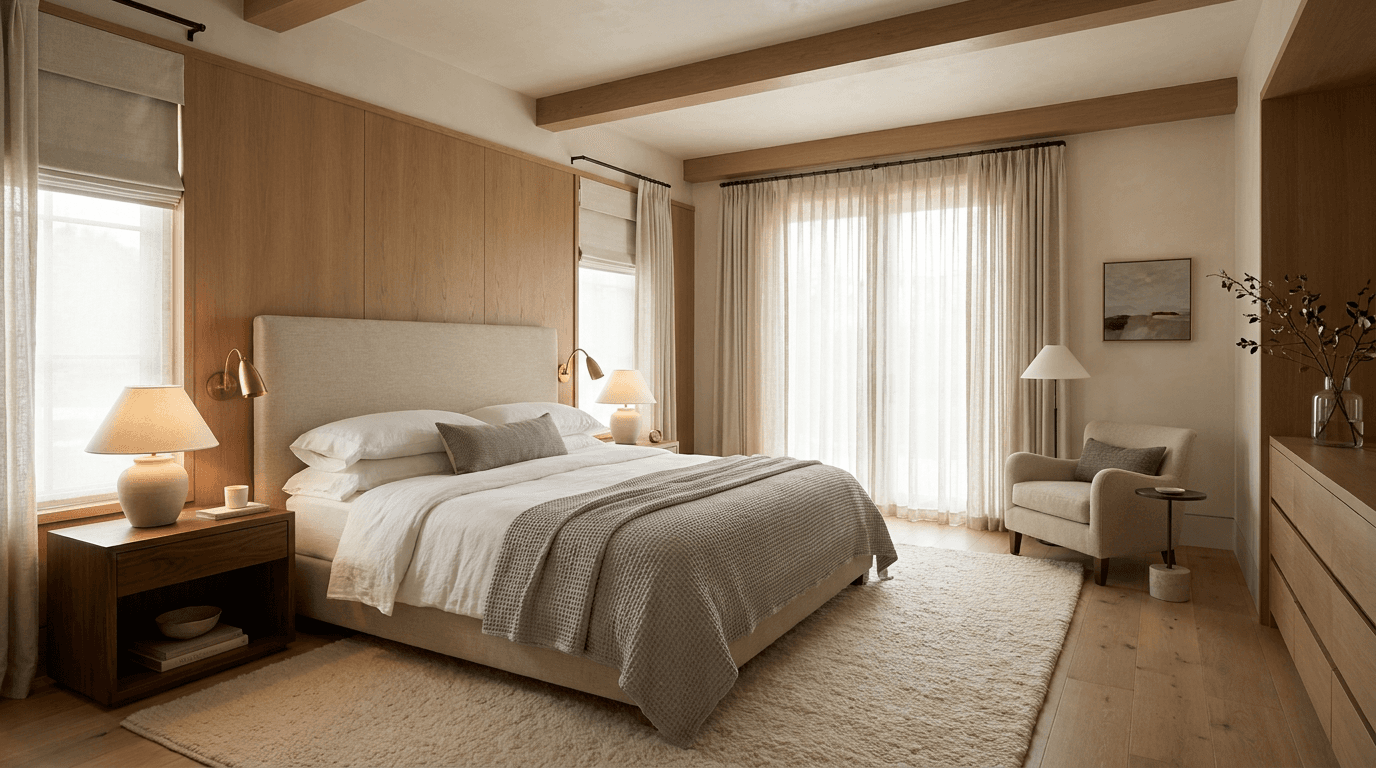
Prompt:
bedroom and private retreat interior design photograph of [the bedroom — the private retreat space where design creates serenity, comfort, and intimate luxury: the bedroom is specific and comfort-focused — the particular bedroom with its complete design: the spatial character — the room's proportion and its relationship to rest: the ceiling (its height and treatment creating the specific overhead quality — the cocooning quality of a lower ceiling, the airy quality of a higher ceiling, the warmth of a wood-lined ceiling, the texture of exposed beams), the window and light condition (the specific windows and their treatment — sheer curtains filtering morning light to a soft glow, blackout treatments for sleep quality, no treatment for a view-focused bedroom — the window condition defining the room's relationship to morning and the natural world), the bed wall (the focal wall behind the bed — the headboard: upholstered in a specific fabric with its texture and color, wood with its species and finish, built-in with flanking nightstands and integrated lighting; or the wall treatment: a painted accent wall, a wallcovered wall with a specific pattern, wood paneling, textured plaster, stone — the bed wall as the room's primary design statement), the bed itself (the bed frame, the bedding — the specific layers: crisp white linen, a textured coverlet or duvet, accent pillows, a throw at the foot — the bedding communicating the specific quality of rest the room promises), the furniture beyond the bed — nightstands (their material, design, and the objects on them: the lamp, the book, the small vessel), a bench or seating at the foot of the bed, a dresser or wardrobe, an armchair or reading corner with its own lamp and side table, the closet entry or dressing area, the material palette — the floor (hardwood with a soft rug, carpet, the specific floor quality under bare feet), the walls (the paint color and its specific tone — the warm, enveloping quality of a darker tone or the clean serenity of a lighter tone), the textiles (the curtains, the bedding, the rug, the upholstery — the textile density creating the softness and the warmth that bedrooms require), the lighting — the specific bedroom lighting: bedside sconces or table lamps providing the warm, low, intimate light quality (the light functional for reading but warm enough for rest), ambient overhead (a pendant, recessed, a ceiling fan with an integrated light), the overall lighting warm and layered and never harsh, the styling communicates rest and personal life — the bedroom styled for sleep and retreat: the bedding inviting, the personal objects present (a book, a glass of water, a small artwork), the textiles creating the softness, the plant adding organic life — the styling minimal, serene, and personal, the overall composition communicates: this bedroom is designed for rest, the materials are soft, the light is gentle, the proportions create serenity — the bedroom as the practice's comfort-design and private-retreat showcase] in a medium-to-wide, bedroom-revealing composition, the bed is the compositional anchor — the bed and its wall treatment as the room's design focal point, the room's proportion is communicated — the ceiling, the windows, the spatial envelope creating the atmosphere, the material palette is readable — the floors, the walls, the textiles, the wood, the metal all identifiable, the styling is serene and personal — the bedding inviting, the objects personal, the atmosphere restful, the vertical lines are corrected, the depth of field is moderate to deep, the lighting is the specific quality that makes bedrooms feel serene — natural light filtered or soft combined with warm intimate designed lighting: soft, filtered, gentle natural light combined with warm, intimate bedroom lighting — the natural daylight softened by curtains or filtered through sheers creating the diffused, gentle quality that bedrooms demand (not the harsh, direct sunlight that belongs in a kitchen or a living room, but the soft, enveloping, quiet light quality that creates serenity), the designed lighting providing the warm, low, intimate atmospheric quality: the bedside lamps casting warm, contained pools, the ambient light low and even, any accent light subtle — the combined illumination creating the warm, quiet, restful atmosphere, bedroom palette — the bedroom's complete palette (specify: [your bedroom palette, e.g., light oak floors with natural wool rug in cream, limewash walls in warm white, upholstered headboard in oatmeal linen, white linen bedding with waffle-weave throw in fog gray, walnut nightstands with ceramic lamps, sheer linen curtains, brass reading sconces, small abstract artwork in muted tones]) — soft filtered natural daylight combined with warm intimate lighting — and the soft, textile-rich, serenity-communicating palette of a designed bedroom in gentle combined light as the color palette, the mood is serenely restful privately luxurious softly enveloping and the specific bedroom message — this room is designed for rest, the materials are chosen for comfort, the light is calibrated for serenity, the design creates sanctuary — the bedroom as the practice's comfort-design and retreat showcase, professional architectural interior photography with soft filtered natural light and warm intimate interior lighting with moderate-to-deep depth of field and corrected perspective, composed as a bedroom interior with the bed and the material warmth and the serene atmosphere as the visual subject, soft bedroom palette in gentle combined light, no text overlays, no watermarks
Best for: Website project page bedroom imagery, portfolio primary bedroom and comfort-design content, publication and editorial submission bedroom images, Instagram and social media bedroom content (high save rate), Pinterest bedroom content, Houzz and platform bedroom portfolio, client presentation comfort and retreat design evidence, award submission bedroom documentation, real estate marketing bedroom features, hospitality design portfolio (hotel room presentations)
Template 8: The Workspace — Home Office and Professional Environment
This template presents the workspace — the home office, the study, the library, the professional workspace — the space that demonstrates the practice's ability to design environments that support concentration, creativity, and the contemporary reality that the home includes space for work.
Prompt:
workspace and home office interior design photograph of [the workspace — the designed environment for concentration, productivity, and professional life within the home or the commercial context: the workspace is specific and functionally designed — the particular workspace with its complete design: the spatial type — the dedicated home office (a separate room with a door, designed for privacy and concentration), the open study area (a workspace integrated into a living space, a hallway, a bedroom alcove), the library and study (a book-lined room that is both workspace and cultural repository), the creative studio (a workspace designed for making, drawing, designing), or the commercial office (a professional workplace designed for a team, a practice, a business), the desk is the compositional anchor — the specific desk: its material (walnut slab, white oak, painted, stone top, metal frame, built-in millwork desk that extends from wall-to-wall), its form (freestanding, floating, built-in, standing-height), its position in the room (centered, against a wall, facing a window with the view as the backdrop, positioned between bookshelves), the items on the desk (the lamp, the screen or the absence of visible technology, the books, the objects, the workspace tools — styled as a working desk, not an empty surface), the storage and shelving — the bookshelves (built-in floor-to-ceiling shelving with books and objects, floating shelves, freestanding bookcases), the filing and storage (integrated, concealed, furniture-based), the books and objects on the shelves (the curated, personal, intellectually engaged library that communicates the inhabitant's mind), the seating — the desk chair (its design quality, its material, its position), the additional seating (a reading chair, a sofa for conversation, a window seat), the material palette — the walls (painted, paneled, wallcovered, the specific character), the floor (hardwood, carpet, rug), the millwork (the shelving, the desk, the trim — its material and its detail quality), the metals (the lamp, the hardware, the desk accessories), the textiles (the rug, the curtain, the chair upholstery), the lighting — the specific workspace lighting: the task lamp (its design, its material, its light quality), the ambient lighting (overhead, sconces), the natural light (the window and its relationship to the desk — the side light for reading and working, the view for creative pause), the overall composition communicates: this workspace is designed to support serious work and creative thought, the environment is beautiful, functional, and intellectually stimulating — the workspace as the practice's relevance to contemporary living patterns] in a medium, workspace-focused composition, the desk and its immediate environment fill the primary frame — the work surface, the chair, the shelving, the window, the objects creating the workspace world, the shelving and books provide the intellectual context — the library visible and curated, the lighting communicates the working atmosphere — the task light and the ambient quality creating the productive, warm environment, the styling is intellectually engaged — the desk working, the shelves personal and curated, the vertical lines are corrected, depth of field is moderate to deep, the lighting creates the specific quality of a productive, warm workspace: natural directional light from the window combined with warm task and ambient lighting — the natural light providing the bright, clear, reading-quality illumination from the window, the task lamp providing the focused, warm work light on the desk surface, the ambient lighting providing the overall warm atmospheric quality — the combined illumination creating the bright-yet-warm, productive-yet-comfortable atmosphere of a well-designed workspace, workspace palette — the room's palette (specify: [your workspace palette, e.g., dark green painted walls, white oak built-in bookshelves floor-to-ceiling, walnut floating desk, cognac leather desk chair, brass task lamp and hardware, Persian rug in warm tones, natural linen curtains, white ceiling]) — natural directional daylight combined with warm task and ambient lighting — and the intellectually warm, functionally beautiful palette of a designed workspace in productive combined light as the color palette, the mood is intellectually engaging productively warm designfully complete and the specific workspace message — this workspace is designed for serious work in a beautiful environment, the design supports concentration and creative thought — the workspace as the practice's contemporary-relevance showcase, professional architectural interior photography with natural and warm task lighting with moderate-to-deep depth of field and corrected perspective, composed as a workspace interior, intellectually warm workspace palette in combined productive light, no text overlays, no watermarks
Best for: Website project page workspace imagery, portfolio workspace and contemporary-living content, Instagram and social media workspace content, Pinterest workspace and study content, Houzz and platform workspace portfolio, publication workspace features, client presentation workspace-design evidence, commercial interior design portfolio, real estate marketing workspace features
Template 9: The Staircase & Circulation — Three-Dimensional Design Feature
This template presents the staircase or the circulation space — the hallway, the landing, the connector — the three-dimensional design element that demonstrates the architect's ability to create spatial drama, sculptural form, and experiential sequence in the vertical and horizontal movement through the building.
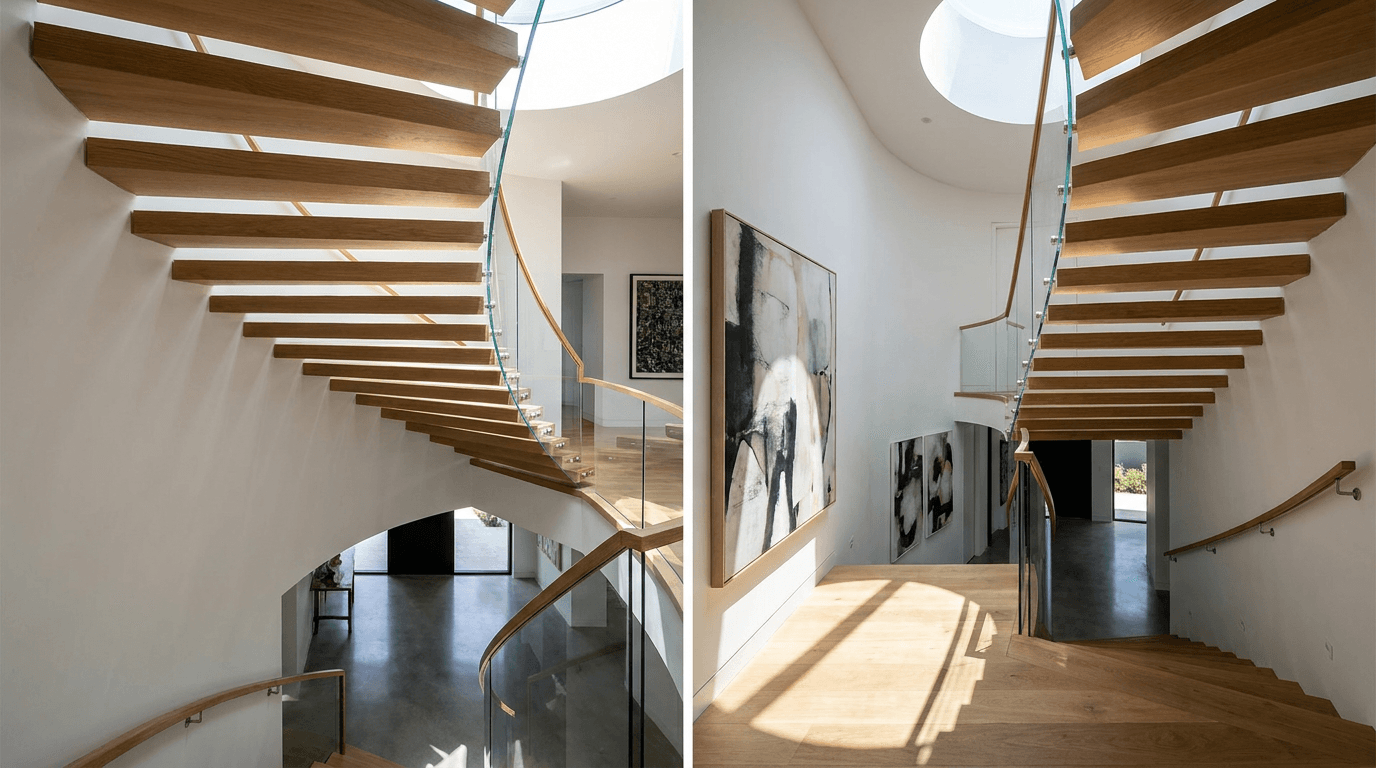
Prompt:
staircase and architectural circulation feature photograph of [the staircase, the hallway, the landing, the entry — the circulation element that demonstrates three-dimensional spatial and sculptural design intelligence: the circulation feature is specific and architecturally significant — the particular staircase or connector: a staircase as architectural sculpture — the specific stair design: the stair type (straight run, L-shaped with a landing, U-shaped, spiral, helical, cantilevered floating treads, sculptural free-form), the material composition (the treads: solid wood in a specific species, stone, concrete, steel plate, glass; the risers: closed in matching material, open for visual transparency; the stringer: a visible structural stringer in steel or wood or a concealed structure creating the floating-tread effect; the balustrade: a glass panel — frameless or with a metal cap rail, a metal railing — steel cable, steel rod, forged iron, minimalist flat bar — a wood railing with its specific profile and species, or no visible balustrade for the most minimal expression; the handrail: wood, leather-wrapped, steel, its profile and material), the staircase's relationship to the space (rising through a double-height volume, wrapping around a central void, emerging into a loft or upper level, connecting the public ground floor to the private upper floor — the vertical journey the stair creates), the wall treatment along the stair (gallery wall for art, the specific paint or material, a window or skylight illuminating the stair volume from above), the landing (its material, its design, any feature — a window seat, a niche, a moment of pause in the vertical journey); or a hallway or corridor — the horizontal connector with its specific design: its proportion (the width and the height creating its character), its material palette (the floor, the walls, the ceiling treatment), its light source (the window at the end creating the visual terminus, the skylights washing the walls with light, the designed fixtures), the doors or openings along it creating rhythm, the art or objects creating the gallery quality; or an entry and foyer — the transitional space between outside and inside with its design significance: the front door, the threshold, the first interior experience, the coat closet, the console, the mirror, the first impression of the home's design, the overall element communicates: the circulation is designed, the movement through the building is a spatial experience, the stair or the hallway is architecture at its most three-dimensional and experiential — the circulation feature as the practice's sculptural and spatial-sequence showcase] in a composition that reveals the three-dimensional quality of the circulation element, the staircase or corridor occupies the primary frame — the three-dimensional form, the material palette, and the spatial drama visible, the vertical or horizontal dimension is emphasized — the stair's rise or the corridor's depth creating the sense of spatial movement and dimension, the materials are visible — the treads, the balustrade, the walls, the floor, the railing all identifiable, the light quality enhances the three-dimensional drama — directional light creating the dimensional modeling, the vertical lines are corrected, the depth of field is moderate to deep — the circulation element in focus throughout its visible extent, the lighting creates the dimensional drama: natural directional light enhancing the three-dimensional quality of the circulation space — the natural light from a window, a skylight, or an opening creating the specific directional illumination that models the staircase or corridor's three-dimensional form: light falling down a stairwell from a skylight above, illuminating the treads and creating shadows under each step that reveal the three-dimensional construction; or light entering from a window at the landing, casting diagonal shadows across the stair that communicate the vertical movement; or light from a terminal window at the end of a corridor creating the perspective and the visual draw — the directional natural light making the three-dimensional quality of the circulation element dramatic and readable, staircase palette — the element's material palette (specify: [your staircase or circulation palette, e.g., white oak floating treads cantilevered from a white plaster wall, frameless glass balustrade with oak handrail, polished concrete landing, skylight above washing the stair volume with natural light, gallery wall with art in the stair volume]) — natural directional light from overhead or lateral source — and the three-dimensional, materially honest, spatially dramatic palette of an architectural circulation feature in directional natural light as the color palette, the mood is spatially dramatic vertically sculptural architecturally significant and the specific circulation message — the movement through this building is designed, the staircase is architecture, the circulation is spatial experience — the staircase or hallway as the practice's three-dimensional and sculptural design showcase, professional architectural photography with natural directional light and moderate-to-deep depth of field with corrected perspective, composed to reveal three-dimensional form and spatial drama, architectural material palette in directional natural light, no text overlays, no watermarks
Best for: Website project page architectural-feature imagery, portfolio signature architectural-element content, publication and editorial submission feature imagery, award submission architectural-detail documentation, Instagram and social media architectural-feature content (high engagement), Pinterest staircase and architectural content, Houzz and platform feature-element portfolio, client presentation design-ambition evidence, conference and lecture visual content
Template 10: The Outdoor Living — Landscape Integration and Exterior Rooms
This template presents the outdoor living space — the terrace, the patio, the garden room, the pool area, the courtyard — the designed exterior environment that extends the interior into the landscape and demonstrates the practice's ability to create atmospheric outdoor rooms.
Prompt:
outdoor living and landscape integration photograph of [the outdoor living space — the designed exterior room that extends the interior into the landscape: the outdoor space is specific and designed — the particular exterior environment: a terrace or patio — the outdoor floor plane with its specific material (stone pavers, wood decking, concrete, tile, gravel), its furniture (outdoor dining table and chairs, lounge seating, day beds, the specific materials and style — teak, woven rope, powder-coated metal, the outdoor furniture communicating the same design care as the interior), its relationship to the interior (the sliding doors or the bi-fold walls that connect interior and exterior, the threshold treatment, the continuity of material or the deliberate material shift from inside to outside), the overhead treatment (a pergola, an overhead structure, a retractable shade, a mature tree canopy, open sky), the landscaping edge (the planted beds, the lawn, the hedge, the garden wall that defines the outdoor room's boundary); or a pool and pool terrace — the pool as landscape architecture: the pool shape and material (the water surface, the pool edge treatment — infinity edge, flush deck, raised coping — the pool interior finish), the pool deck (its material, its furniture: the loungers, the umbrellas, the poolside table), the landscaping around the pool (the planting, the screening, the trees, the garden context), the pool house or cabana if present; or a courtyard — the enclosed exterior space: the courtyard's walls (the building walls that enclose it), its ground plane, its central feature (a fountain, a tree, a seating area), its overhead condition (open sky framed by the building), the interior rooms visible through the courtyard's windows and doors; or a garden as designed landscape — the planted landscape as a design project: the planting design, the hardscape paths and terraces, the garden structures, the relationship between the designed landscape and the building, the indoor-outdoor relationship is the design story — the connection between the interior and the exterior: the view from inside looking out (the window or the door framing the garden as a living painting), or the view from outside looking in (the building visible through the garden, the lit interior visible through the glazing), or the transitional moment (the threshold, the open door, the material continuity or change) — the designed relationship between building and landscape as the portfolio's environmental-design showcase, the overall composition communicates: the design extends beyond the building's walls, the outdoor space is designed with the same care as the interior, the landscape is architecture — the outdoor living image as the practice's environmental and landscape design showcase] in a medium-to-wide, outdoor-environment composition, the outdoor space fills the primary frame — the terrace, the pool, the courtyard, the garden visible as a designed exterior room, the indoor-outdoor connection is visible — the building, the doors, the windows visible in relationship to the outdoor space, the furniture and the landscape define the outdoor room — the outdoor furnishings, the planting, the hardscape creating the livable exterior environment, the sky provides the ceiling — the sky visible above the outdoor space, the light quality reflecting the outdoor atmosphere, the depth of field is deep — the outdoor space, the landscape, and the building all in focus, the lighting is natural, atmospheric, and outdoor-specific: natural outdoor light at a specific atmospheric moment — the light quality of the outdoor environment at its most beautiful: the warm, golden, late-afternoon or early-evening light that makes outdoor spaces glow with warmth and invitation (the golden-hour light creating long shadows across the terrace, warm light on the stone or wood surfaces, the planting catching the warm lateral light with dimensional, textural quality); or the bright, clear midday light of a summer day showing the outdoor space in its full, vivid quality; or the soft, overcast light of a gentle day creating the even, atmospheric quality that makes gardens look their most lush — the natural light condition matching the outdoor space's intended atmosphere, the materials catching the natural outdoor light with their specific character: the stone or wood deck surface showing its texture in the outdoor light, the furniture showing its material quality, the planting showing its color and its form, the water (if present) showing its reflective, liquid, atmospheric surface, outdoor living palette — the outdoor space's palette (specify: [your outdoor palette, e.g., bluestone terrace pavers, teak dining table and lounge chairs with white cushions, white stucco building walls with black steel-framed glass doors, mature olive trees and lavender planting, swimming pool with blue-gray interior finish, warm golden late-afternoon light]) — natural outdoor light at the specific atmospheric moment — and the natural, material-honest, landscape-integrated palette of a designed outdoor space in atmospheric natural light as the color palette, the mood is outdoors-designed landscape-integrated atmospherically beautiful and the specific outdoor message — the design extends to the landscape, the outdoor space is as considered as the interior, the building and the garden are one project — the outdoor living image as the practice's environmental-design and indoor-outdoor showcase, professional architectural and landscape photography with natural atmospheric outdoor light and deep depth of field, composed as an outdoor living environment with the designed landscape and the building and the furniture creating the exterior room, outdoor material palette in natural atmospheric light, no text overlays, no watermarks
Best for: Website project page outdoor and landscape imagery, portfolio outdoor living and landscape content, publication and editorial submission garden and outdoor images, Instagram and social media outdoor and garden content, Pinterest outdoor living content, Houzz and platform outdoor portfolio, client presentation outdoor and landscape design evidence, award submission landscape-integration documentation, real estate marketing outdoor features, landscape architecture portfolio primary imagery
Template 11: The Before & After — Transformation and Design Impact
This template creates the before-and-after transformation narrative — the visual evidence of the design's impact, the contrast between the pre-design condition and the designed result that is the most powerful proof of the practice's value and the most compelling content for renovation, restoration, and remodeling portfolios.
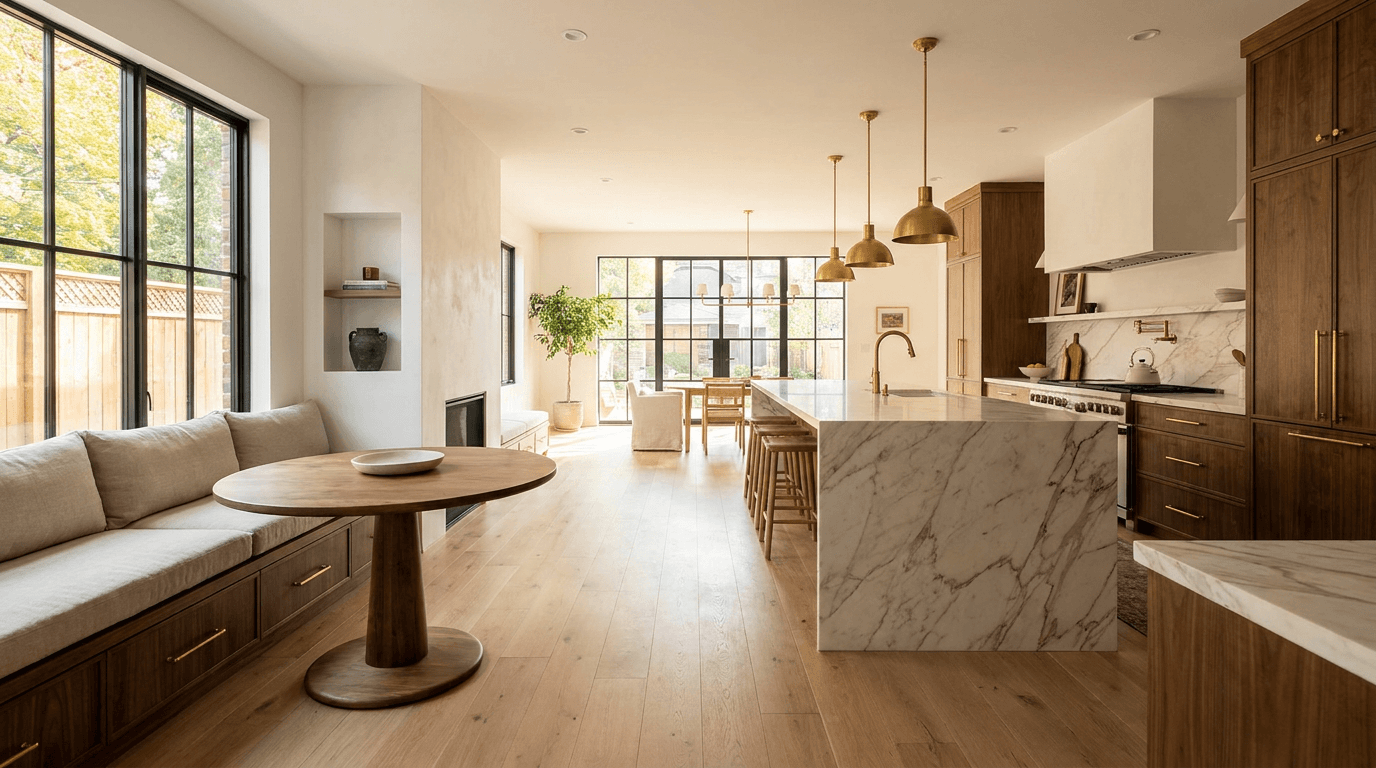
Prompt:
architecture and interior design before-and-after transformation photograph showing the completed "after" result of [a renovation, remodeling, or transformation project — the designed result shown in its full, completed, designed glory with the implicit narrative of dramatic transformation from a previous condition: the completed design is the hero — the finished space presented at its most beautiful and design-communicating, with the composition and the styling and the atmosphere emphasizing the design transformation: the "after" space is specific and shows the design's transformative impact — the particular completed renovation: a kitchen transformation — the completed kitchen showing the designer's full material specification: new cabinetry in its specific design and material, new countertops, new backsplash, new appliances, new lighting, new flooring — every surface new, considered, and beautifully specified, the kitchen looking like a space that could not have existed before the designer's intervention; or a bathroom transformation — the completed bathroom at its materially dense, sensorially luxurious best: the stone, the tile, the fixtures, the vanity, the tub or shower — the complete material overhaul visible; or a living space transformation — the opened floor plan, the new window openings, the refinished or replaced floors, the new fireplace, the new millwork, the new spatial proportion created by the renovation; or a whole-house transformation — the completed home showing the design's comprehensive impact on every visible surface: the cohesive material palette, the spatial improvements, the light quality, the overall design coherence, or an exterior transformation — the new façade, the new entry, the addition, the landscape redesign — the building's public face transformed, the spatial improvements are visible — where walls were removed, where openings were enlarged, where ceilings were raised, where natural light was introduced — the architectural interventions visible in the completed result, the new materials are the visual content — every new surface specified with design intention: the floor, the walls, the counters, the cabinetry, the tile, the fixtures, the lighting, the hardware — the comprehensive material transformation visible, the light quality demonstrates the design's spatial impact — the natural light in the completed space showing the impact of new or enlarged windows, removed walls, added skylights — the light quality itself as evidence of the design's success, the styling communicates the space's new life — the completed space styled to communicate its new identity: the furniture, the objects, the textiles, the plants all contributing to the transformed character, the overall composition communicates: this space has been transformed by design, the before-condition (which the viewer may imagine or which will be presented alongside) is dramatically different from this designed result, the transformation proves the designer's value — the after image as the design-impact, transformation-proof, value-demonstration visual] in a wide, space-revealing composition that maximizes the visible transformation, the completed space fills the frame — the full design visible: every new surface, every new material, every spatial improvement, the design improvements are prominent — the opened plan, the new light, the new materials, the new proportions all visible and impressive, the material palette is comprehensively new — every surface showing the designer's specification, the styling communicates the new life — the space furnished, decorated, and lived-in in its new identity, the vertical lines are corrected, depth of field is deep, the lighting shows the space at its designed best — the same combined natural and designed lighting quality described in the relevant room-specific templates (Template 2 for general interiors, Template 4 for kitchens, Template 5 for bathrooms, Template 6 for living rooms), the light quality bright, warm, and design-communicating, emphasizing the spatial improvements and the material quality, transformation palette — the completed space's designed palette (specify: [your "after" palette, e.g., opened floor plan with white oak floors throughout, warm white walls, black steel window frames where walls were removed, Calacatta marble kitchen island, walnut cabinetry, brass fixtures, natural light flooding through new full-height windows]) — bright, warm, design-quality combined lighting — and the transformation-communicating, design-impact, materially beautiful palette of a completed renovation in its designed best light as the color palette, the mood is transformation-proven designfully realized dramatically improved and the specific transformation message — this space has been transformed by design intelligence and material care, the before and after are different worlds, the design proves its value through the visible impact — the after image as the practice's transformation-capability and design-impact showcase, professional architectural interior photography with bright combined lighting and deep depth of field with corrected perspective, composed to maximize the visible design transformation, bright completed-design palette, no text overlays, no watermarks
Best for: Website before-and-after and renovation portfolio sections, Instagram and social media transformation content (highest engagement content type for renovation and remodeling practices), Houzz and platform before-and-after portfolio, Pinterest before-and-after and renovation content, client presentation design-impact evidence, paid advertising renovation and remodeling services creative, email marketing transformation features, publication renovation and transformation submissions, YouTube renovation and transformation video content, real estate marketing renovation-value features
Template 12: The Construction Process — Building and Design Documentation
This template documents the construction process — the site, the structure, the work in progress — the behind-the-scenes documentation that demonstrates the practice's build intelligence, its involvement beyond the drawing phase, and its understanding of how designs become built reality.
Prompt:
architecture construction process and design documentation photograph of [the construction phase — the project during building: the structure, the site, the work in progress — the behind-the-scenes reality that demonstrates design intelligence in the field: the construction phase is specific — the particular stage of the building process: the structural phase — the building's bones visible before finishes are applied: the steel or timber frame exposed, the concrete structure visible, the spatial volumes readable in their raw, structural state — the architecture visible as engineering and spatial logic before the finish materials soften and complete it: the ceiling joists or the exposed beams showing the structural grid, the window openings framed in the rough structure showing the light strategy before the glass is installed, the floor planes at different levels showing the sectional relationship — the raw structure as architecture in its most honest, exposed, essential state; or the material installation phase — the materials being applied: the stone being laid, the wood being installed, the tile being set, the plaster being applied — the transformation from raw structure to finished surface in progress: the half-finished wall showing the substrate and the finish side by side, the material palette emerging from the construction; or the site and foundation phase — the excavation, the foundation, the site work — the project's relationship to the ground and the landscape visible at the most fundamental level; or the framing and enclosure phase — the building taking its form: the walls rising, the roof being placed, the form emerging from the scaffold and the formwork, the active work — the construction workers, the tools, the machinery, the scaffolding, the temporary supports — the human effort and the physical reality of building visible and respected, the design intent visible in the construction — the architect's drawings becoming physical reality: the spatial volumes taking form, the material palette emerging, the light quality beginning to appear through the openings — the design visible in its unfinished state, demonstrating that the design vision persists through the messy, physical, complex reality of construction, the overall composition communicates: this practice understands construction, the design survives the building process, the firm's involvement extends from concept through completion — the construction documentation as the build-intelligence, process-understanding showcase] in a medium-to-wide, site-and-construction composition, the construction scene fills the frame — the structure, the materials, the site, the work in progress visible, the architectural intent is readable — the spatial volumes, the material choices, the design strategy visible even in the unfinished state, the human effort is present — the workers, the tools, the machinery showing the physical reality, the scale is communicated — the building's size relative to the human figures, the machinery, the landscape, the vertical lines are corrected where the structure permits, depth of field is deep, the lighting is natural, site-specific, and documentary: natural outdoor construction-site light — the natural, unmanipulated, documentary-quality daylight of the active construction site: the bright, clear, honest illumination of the outdoor work environment — the sun creating directional light on the structure that reveals its three-dimensional form and its material reality, the exposed structure catching the natural light with its raw, honest character: the concrete showing its formwork texture, the steel showing its industrial surface, the wood framing showing its structural logic, the partially installed materials showing their quality emerging from the construction, the sky visible above the structure — the building against the open sky in its most dramatic, unfinished, possibility-communicating state, construction palette — the honest, raw, material-reality tones of the construction phase (specify: [your construction scene, e.g., exposed timber frame with steel connectors, concrete slab floor, window openings framed and awaiting glass, construction workers installing exterior cladding, blue sky visible through the unfinished roof, scaffolding and temporary bracing]) — natural daylight in the outdoor construction environment — and the raw, honest, construction-reality, architecturally intentional palette of a building in progress in natural site light as the color palette, the mood is honestly constructive architecturally intentional process-revealing and the specific construction message — this practice understands building, the design survives construction, the firm is present from foundation to finish — the construction documentation as the build-intelligence and process-involvement showcase, professional documentary and architectural photography with natural outdoor site light and deep depth of field, composed as a construction documentation scene with the structure and the process and the emerging design as the visual subject, raw construction palette in natural daylight, no text overlays, no watermarks
Best for: Website process and about sections, Instagram and social media behind-the-scenes and process content, YouTube and video content construction process documentation, client presentation build-process and involvement evidence, publication process documentation for project features, blog and content marketing construction stories, press and media kit process imagery, client communication and progress reporting, contractor and trade-partner relationship materials, conference and lecture process-documentation content
Template 13: The Twilight Shot — Blue-Hour Exterior Drama
This template creates the twilight exterior — the blue-hour building portrait shot at dusk when the sky transitions to deep blue and the interior lights glow warmly through the windows. The twilight shot is the single most visually dramatic convention in architectural photography and the image most likely to be published, shared, and remembered.
Prompt:
architectural twilight and blue-hour exterior photograph of [the building at twilight — the exterior captured during the blue hour when the sky transitions from warm to cool blue and the interior lights glow warmly through the windows, creating the dramatic contrast between cool exterior atmosphere and warm interior life that is the most visually powerful convention in architectural photography: the building is the same specific project described in the exterior hero but now at the blue-hour moment — the building's form, materials, and site visible in the twilight condition: the building's fenestration is the design hero at twilight — the windows glow with warm interior light, each opening becoming a luminous rectangle or shape that reveals the life within: the living room glowing with warm amber light visible through the floor-to-ceiling glass, the kitchen illuminated by its pendant lights, the bedroom softly lit by bedside lamps, each room's interior visible as a warm, inhabited, inviting scene framed by the building's exterior structure — the windows transform from transparent openings to glowing lanterns that reveal the building as a vessel of warmth and human activity, the building's exterior materials are visible in the transitional light — the façade materials catching the last ambient light of the fading sky: the concrete or stone showing its color in the blue-gray twilight, the wood cladding catching the last warm reflections, the metal reflecting the sky's gradient, the landscape elements (trees, plants, the garden) silhouetted or softly visible in the diminishing light, the sky is the atmospheric backdrop — the deep blue twilight sky creating the cool, atmospheric ceiling against which the warm building glows: the sky in its specific blue-hour gradient from warm at the horizon to deep blue overhead (or from deep blue to near-black depending on the exact timing within the blue hour), possibly with clouds catching the last warm light, the stars potentially beginning to appear, the overall twilight quality creating the atmospheric drama, the site elements at twilight — the landscape, the pool (reflecting the sky and the building's warm glow), the path or driveway (potentially lit by landscape lighting), the surrounding environment in its twilight character — the site completing the atmospheric composition, the interior styling is visible through the windows — the furniture, the art, the objects visible through the glass as warm, inviting, inhabited scenes that communicate the life within the architecture, the overall composition communicates: this building is a warm, inhabited, beautiful vessel of human life set against the vast, atmospheric, natural sky — the twilight shot as the most emotionally powerful, most visually dramatic, most publication-worthy image in the architectural portfolio] in a carefully positioned, full-building, exterior composition identical to the exterior hero viewpoint but at the blue hour, the building fills the primary frame — the full form visible against the twilight sky, the windows glow with warm interior light — every lit room visible as a warm, inviting lantern, the sky provides the dramatic blue backdrop — the deep blue twilight sky contrasting with the warm building, the site elements are visible in the twilight — the landscape, the hardscape, the pool in the atmospheric light, the vertical lines are corrected, depth of field is deep, the lighting is the specific, exacting, balanced illumination of professional blue-hour architectural photography: the precise balance between ambient sky light, interior illumination, and any exterior lighting that defines the blue-hour architectural photograph — the critical lighting balance: the ambient twilight sky providing the overall cool, blue atmospheric illumination — the sky bright enough to read as blue (not black) and to provide enough light on the building's exterior surfaces that the form and materials are readable against the sky; the interior lights providing the warm, glowing, amber-toned illumination through the windows — every room lit to its designed lighting scenario (the living room at its evening warmth, the kitchen with its task and pendant lights, the bedroom with its intimate glow), the warm interior light creating the dramatic temperature contrast against the cool blue exterior; any exterior landscape lighting (path lights, up-lights on trees, pool lights, entry lighting) providing the warm accents that define the site in the darkness — the three-source lighting balance (cool ambient sky + warm interior glow + warm landscape accents) creating the rich, layered, dramatic lighting that defines the blue-hour architectural photograph, the building materials catching the twilight ambient with their blue-shifted character — the surfaces cooler and more atmospheric than in daylight, the windows catching the interior light with their warm, glowing, life-revealing character, the pool or water (if present) catching both the blue sky reflection and the warm building reflection creating the doubled, atmospheric, reflective image, twilight palette — the building in its blue-hour palette (specify: [your building at twilight, e.g., concrete and charred timber exterior in blue-gray twilight, floor-to-ceiling glass revealing warm-lit white oak and white interior, landscape lighting illuminating native plantings, infinity pool reflecting the blue sky and the warm building, deep blue sky gradient from warm horizon to cool overhead]) — the cool blue sky ambient + the warm amber interior glow + the warm landscape accent lighting — and the dramatically atmospheric, warm-versus-cool, emotionally powerful palette of architectural twilight photography as the color palette, the mood is atmospherically dramatic warmly inhabited emotionally powerful and the specific twilight message — this building is a vessel of warmth and human life set in the vast atmospheric landscape, the architecture contains and protects and illuminates the life within — the twilight shot as the most emotionally powerful and visually dramatic image in the architectural portfolio, professional blue-hour architectural photography with the precisely balanced three-source lighting and deep depth of field with corrected perspective, composed as a full-building twilight exterior with the warm interior glow and the cool blue sky and the atmospheric drama as the visual subject, blue-hour palette with warm-cool contrast, no text overlays, no watermarks
Best for: Website homepage hero imagery (the most impactful single image), portfolio and project presentation signature images, publication and editorial submission primary images (highest publication acceptance rate), award submission primary dramatic images, Instagram and social media highest-engagement architectural content, print advertising primary imagery, monograph and book signature images, press and media kit primary dramatic imagery, real estate marketing hero exterior images, conference and lecture signature presentation slides
Template 14: The Mood Board — Concept and Design Vision Presentation
This template creates the mood board or concept presentation — the curated arrangement of materials, colors, textures, and inspirational elements that communicates the practice's design thinking, its material vocabulary, and the conceptual process behind the finished work.
Prompt:
architecture and interior design mood board and concept presentation of [a curated, editorially arranged composition of materials, colors, textures, and design elements that communicates the practice's design process and material vision — the mood board as the visual window into the designer's thinking: the mood board includes specific, design-significant elements — the particular materials and references that define a project or a practice's aesthetic: material samples — physical material swatches arranged with curatorial precision: a stone sample showing its specific character (the marble swatch with its veining, the limestone showing its fossil-embedded, warm surface, the slate showing its layered, dark quality), a wood sample showing its grain and its finish (the oak with its natural oil finish, the walnut with its dark, figured character, the reclaimed wood with its history), a fabric swatch showing its texture and color (the linen in its specific neutral tone, the velvet in its deep color, the wool in its natural, tactile quality), a metal finish sample (the brass disc or plate, the blackened steel sample, the copper in its specific patina state), a tile or ceramic sample (the zellige in its variation, the handmade tile showing its artisanal quality), a paint chip or color sample (the specific paint color in its swatch form), color and texture elements — the broader palette references: dried flowers or botanical elements suggesting the natural-color inspiration, paper or card stock in the palette's specific tones, ribbon or thread in accent colors, the color references supporting and extending the material palette, inspirational references — images, sketches, or objects that communicate the design concept: a photograph of a reference building, landscape, or artwork that inspired the project's direction, a hand sketch or drawing showing a spatial concept, a fabric or material from a reference source, an object (a ceramic, a stone, a shell, a piece of hardware) that carries the project's conceptual DNA, the arrangement is editorially precise — the elements arranged on a neutral background surface (a white or off-white or light-toned surface for clean, bright mood boards; a darker surface for more dramatic, moody mood boards) with the specific spacing, overlap, and angular relationships that professional editorial styling achieves: not random, not symmetrical, but carefully composed with the deliberate, considered, asymmetric balance that communicates design intelligence in the curation itself, the overall mood board communicates: this is how the designer thinks, the material palette is intentional and specific, the color relationships are considered, the design process begins with physical material intelligence — the mood board as the design-process and material-vision visual] in a flat-lay or near-overhead, editorially arranged composition, the material samples and design elements fill the frame — the complete mood board visible as a curated arrangement, the materials are physically identifiable — the stone, the wood, the fabric, the metal, the tile all readable as specific physical materials, the color palette is cohesive — the overall tonal composition showing the project's or the practice's color relationships, the arrangement is editorially precise — the asymmetric, considered, designfully balanced layout, the background surface provides the neutral base — the clean surface unifying the arrangement, the depth of field is moderate to deep — the flat-lay plane in focus throughout, the lighting is clean, even, and material-revealing: clean, soft, overhead-to-slightly-directional editorial lighting — the bright, even illumination that makes material samples and color swatches look accurate and readable: the light strong enough to reveal each material's texture and color at its most accurate, slightly directional to create subtle shadows that give the arrangement its three-dimensional quality (the material samples casting soft shadows that communicate their physical thickness and presence), the materials catching the clean light with their authentic character — the stone showing its true color and veining, the wood showing its grain and finish, the fabric showing its texture, the metal showing its surface quality, mood board palette — the mood board's designed palette (specify: [your mood board palette, e.g., Calacatta marble sample, white oak wood swatch with natural oil, linen fabric in oatmeal, brushed brass disc, zellige tile sample in warm white, dried eucalyptus, paint swatch in Benjamin Moore White Dove, hand sketch on trace paper, natural linen ribbon — all on a white card background]) — clean editorial lighting — neutral background — and the material-accurate, palette-communicating, design-process-revealing arrangement in clean editorial light as the color palette, the mood is designfully curated materially intelligent process-transparent and the specific mood board message — this is the designer's material mind, the palette is intentional, the process is informed by physical material intelligence — the mood board as the design-thinking and material-vocabulary showcase, professional editorial and still-life photography with clean overhead lighting and moderate-to-deep depth of field, composed as a mood board flat lay with the material samples and the color palette and the design references creating the process narrative, material-accurate mood board palette in clean editorial light, no text overlays, no watermarks
Best for: Instagram and social media design-process and material content (high save rate), website design-process and about sections, Pinterest mood board and material palette content, client presentation design-process and material-direction evidence, Houzz and platform ideabook content, email marketing design-thinking and process features, blog and content marketing process articles, brand-book and practice-identity documentation, new-client proposal and concept presentation materials, design education and workshop content
Template 15: The Aerial & Site Context — Overview and Environmental Relationship
This template provides the aerial or elevated perspective — the bird's-eye view that reveals the building's relationship to its site, its neighborhood, its landscape, and its broader environmental context. The aerial view communicates site strategy, landscape architecture, roof design, and the project's urban or rural integration.
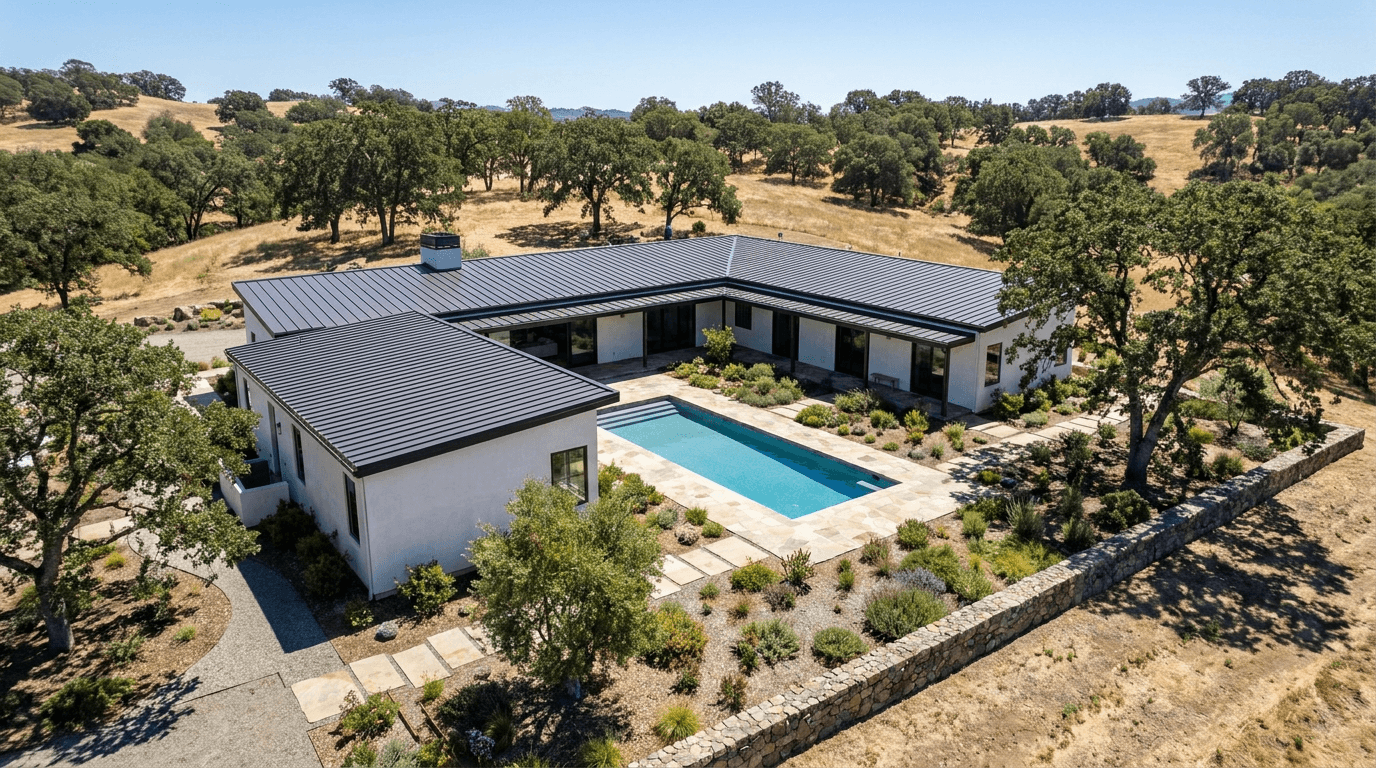
Prompt:
aerial and site context architectural photograph of [the building and its site from an elevated or aerial perspective — the overview that reveals the project's relationship to its broader environment: the aerial perspective reveals specific site relationships — the particular information visible from above: the building's footprint and roof — the plan shape of the building visible from above: the roof design (a flat roof with its clean, geometric plan, a pitched roof with its ridges and valleys, a green roof with its planted surface, a multi-level roof showing the building's sectional complexity, the roofing material — standing seam metal, flat membrane, tile, slate — visible and identifiable), the building's plan relationship to the property (the building positioned within the lot: centered, pulled to one edge, wrapped around a courtyard, the relationship between built area and open area visible), the landscape design — the landscape architecture visible from above: the garden design (the planting beds, the lawn areas, the paths, the trees — the landscape plan visible as a designed composition from the aerial perspective), the pool (its shape and its material visible from above — the water surface, the deck surround, the landscape framing), the hardscape (the terrace, the driveway, the walkways — the material patterns visible from above: the paving pattern, the gravel areas, the stone or concrete surfaces), the property boundaries (the fences, the walls, the hedges defining the property), the environmental context — the surrounding context visible from the aerial perspective: the neighboring properties, the street, the natural landscape (the coastline, the hillside, the forest, the desert), the urban fabric (the surrounding buildings, the block structure, the neighborhood character) — the project's relationship to its broader environment visible from the elevated viewpoint, the natural features — the topography (the slope, the ridge, the flat terrain), the water features (the ocean, the lake, the river, the creek adjacent to the property), the vegetation (the mature trees, the natural landscape, the agricultural context) — the natural environment framing the built project, the overall aerial perspective communicates: the design extends beyond the building's walls, the site strategy is intentional, the relationship between building, landscape, and context is designed — the aerial overview as the site-strategy, landscape-design, environmental-integration showcase] in an aerial or elevated overhead composition, the building and its site fill the primary frame — the full property visible from above: the building, the landscape, the hardscape, the context, the building's footprint and roof design are readable — the plan shape, the roof material, the building's relationship to the property visible, the landscape design is visible — the gardens, the paths, the pool, the terraces readable as a designed landscape plan from above, the surrounding context provides the environmental frame — the neighborhood, the natural landscape, the broader environment visible, the composition reveals the site strategy — the building's placement, its orientation, its relationship to views, sun, and landscape all communicated, the depth of field is deep — the full scene in sharp focus from the building to the distant context, the lighting is natural, overhead, and site-revealing: natural overhead daylight from the aerial perspective — the bright, clear, shadow-creating overhead light that makes aerial and elevated photography most readable: the midday or moderate-angle sun creating the shadows that communicate three-dimensional form from above — the building's overhangs and projections casting shadows on the ground plane that communicate depth, the trees casting shadows that communicate their height and form, the topography visible through the shadow-and-highlight modeling of the terrain, the building's exterior materials visible from above — the roof material, the wall materials at the upper portions, the landscape materials (the paving, the pool surface, the planted areas) all catching the overhead light with their specific character, the environmental context catching the natural overhead light — the surrounding landscape, the neighboring properties, the broader environment in its natural daylight character, aerial palette — the project from above in its environmental palette (specify: [your aerial view, e.g., contemporary flat-roofed house with white stucco walls and dark standing-seam roof, L-shaped plan wrapping around a courtyard with pool, native landscape garden with gravel paths and drought-tolerant planting, surrounding rural hillside with oak trees, blue sky overhead]) — natural overhead daylight — and the site-revealing, plan-readable, environmentally-contextual palette of an architectural aerial view in natural overhead light as the color palette, the mood is site-strategic environmentally integrated comprehensively designed and the specific aerial message — the design is a site strategy, the landscape is architecture, the building's relationship to its context is intentional — the aerial view as the site-design and environmental-integration showcase, professional aerial or elevated architectural photography with natural overhead light and deep depth of field, composed as an overhead site view with the building and the landscape and the environmental context creating the site-strategy narrative, aerial site palette in natural overhead daylight, no text overlays, no watermarks
Best for: Website project page site and context imagery, portfolio site-strategy and landscape content, publication and editorial submission site and context documentation, award submission site and context images, Instagram and social media site and aerial content, Houzz and platform project overview imagery, client presentation site-strategy and landscape design evidence, real estate marketing property overview imagery, landscape architecture portfolio primary imagery, urban design and planning portfolio context imagery, developer marketing site and property overview materials
How to Customize These Prompts for Your Specific Architecture or Interior Design Practice
The templates produce compelling architectural and interior design visual content, but the most effective imagery reflects your actual practice — your specific design philosophy, your real material palette, your project types, your geographic context, and the particular visual identity that differentiates your work from every other practice competing for the same client, the same publication, the same recognition.
Specify your design philosophy and aesthetic language precisely. "A minimalist practice influenced by Japanese spatial sensibility" produces fundamentally different imagery than "a traditional practice rooted in regional vernacular." Define your aesthetic: minimalist, warm modernism, mid-century modern, contemporary classical, traditional, transitional, maximalist, biophilic, industrial, Scandinavian, Mediterranean, Japanese-influenced, or your specific blend. The aesthetic language determines every visual decision — the color temperature, the material palette, the styling density, the compositional approach.
Replace generic material descriptions with your actual material palette. Your material vocabulary is your identity. "Wide-plank white oak floors with a matte natural oil finish, hand-troweled lime plaster walls in warm white, Calacatta marble counters with bold gold veining, unlacquered brass hardware developing a natural patina" generates dramatically different imagery than "wood floors, white walls, marble counters, brass hardware." Describe your actual materials: the specific stone (not just "marble" but "honed Carrara with subtle gray veining"), the specific wood (not just "oak" but "rift-sawn white oak with a natural matte finish"), the specific metal (not just "brass" but "unlacquered solid brass developing a living patina"). Material specificity is the difference between generic and portfolio-quality.
Match the light quality to your geographic context. The quality of natural light varies dramatically by geography. The bright, high-contrast Mediterranean light is different from the soft, diffused Nordic light, which is different from the warm, golden California light, which is different from the cool, gray Pacific Northwest light. Specify the light quality that matches your practice's geographic context, because light quality is one of the most powerful location signals in architectural photography.
Style according to your design personality. If your interiors are minimal, style minimally. If your interiors are collected and layered, style with density. If your practice values the personal and the eclectic, style with personality. The styling in the portfolio image should match the styling in the real project — the level of object density, the character of the accessories, the degree of personal expression all consistent with your design approach.
For portfolio documentation, photograph your actual built work. Use the AI-generated compositions as visual direction, lighting reference, compositional guidance, and atmospheric benchmarks, then invest in professional architectural photography of your actual projects. Design professionals, editors, jurors, and clients are extraordinarily space-literate — they will recognize inconsistencies between generated environments and real architecture. The Image Inpainting tool can enhance the atmosphere, adjust the light quality, and bring the production standard of your actual project photography up to the benchmark that the generated references establish, while preserving the authentic architectural and interior content.
Develop a consistent color temperature across your portfolio. Choose warm, cool, or neutral color temperature for your photography and apply it consistently. A practice that photographs some projects with warm golden light and others with cool blue-toned light loses the visual coherence that communicates practice identity. The color temperature should reflect your design personality: warm for practices that value warmth and comfort, cool for practices that value crispness and precision, neutral for practices that value timelessness and balance.
Platform-Specific Deployment for Architecture & Interior Design Practices
Each platform where architecture and interior design practices build their audience has specific content expectations, audience behaviors, and format requirements.
Instagram is the dominant discovery platform for design professionals. Instagram's visual format and its concentration of design-interested audiences make it the most important social platform for architecture and interior design. The content mix should maintain approximately 30% signature interior and exterior content (Templates 1, 2, 13 — the hero project imagery), 25% room-specific content (Templates 4, 5, 6, 7, 8 — the room-by-room portfolio content), 20% detail and material content (Templates 3, 14 — the craft and material appreciation content that generates saves), 15% process and transformation content (Templates 11, 12 — the before-and-after and construction documentation that generates highest engagement), and 10% site and outdoor content (Templates 9, 10, 15 — the landscape, circulation, and aerial content). Use 4:5 for feed posts, 9:16 for Stories and Reels, 1:1 for grid consistency.
Pinterest drives aspirational discovery and project research. Pinterest's audience actively researches design ideas, room-specific inspiration, and material palettes. Templates 4 (kitchen), 5 (bathroom), 6 (living room), 7 (bedroom), 14 (mood board), and 11 (before-and-after) perform exceptionally well on Pinterest. Use 2:3 vertical format exclusively for maximum pin visibility.
Houzz is the specialized platform for residential design discovery. Houzz's audience consists of homeowners actively planning projects — the most commercially valuable audience for residential architects and interior designers. Every room-specific template (4, 5, 6, 7, 8, 10) should be optimized for Houzz with detailed project descriptions, material specifications, and style tags. Houzz accepts multiple aspect ratios; 3:2 and 4:3 perform well.
The practice website is the definitive portfolio presentation. The website should deploy Template 1 or 13 (exterior hero or twilight for homepage hero), Template 2 (interior signature for project page leads), Templates 3-10 (room-specific and detail content for project page galleries), Template 11 (before-and-after for renovation portfolio sections), Template 12 (construction for process sections), Template 14 (mood board for design-process pages), and Template 15 (aerial for site and context). The website represents the practice's most controlled presentation environment. Use 16:9 for hero banners, 3:2 or 4:3 for gallery images.
YouTube serves project walkthroughs and process documentation. YouTube is where design practices build deeper narratives through project tours, construction documentation, design talks, and process videos. Templates 2 (interior signature), 9 (staircase and circulation), 12 (construction), and 11 (before-and-after) serve YouTube's documentary format. Use 16:9 exclusively.
LinkedIn serves commercial and professional practice development. For commercial architecture, workplace design, hospitality design, and institutional practice, LinkedIn is the platform for reaching developer, corporate, and institutional clients. Templates 1 (exterior hero), 2 (interior signature), 8 (workspace), and 15 (aerial) serve the professional positioning that LinkedIn requires. Use 16:9 for articles and 1:1 for posts.
Publication submissions require specific image standards. Architecture and design publications expect large, high-resolution images with corrected perspectives, accurate colors, and professional lighting. Templates 1, 2, 13 (exterior hero, interior signature, twilight) are the primary publication images. Every template in this post is designed to meet publication-quality visual standards.
Common Mistakes in Architecture & Interior Design Portfolio Photography
Architecture and interior design practices fail in specific, identifiable visual ways that directly impact how the work is perceived by clients, editors, jurors, and peers.
Using wide-angle lenses without discipline. Ultra-wide-angle photography (below 16mm equivalent) distorts proportions, stretches furniture at the frame edges, and makes rooms look larger than they are — a visual dishonesty that experienced viewers read immediately. The most professional architectural photography uses moderate wide-angle (17-24mm equivalent) that captures the spatial volume without distortion. The right focal length makes the room look like itself; the wrong focal length makes the room look like a lie.
Failing to correct vertical perspective. Uncorrected converging verticals — walls that lean inward, doorframes that taper, windows that narrow toward the top — are the single most visible marker of amateur architectural photography. Professional architectural photography corrects verticals through tilt-shift lenses or post-processing. Every template in this post specifies corrected verticals.
Flat, flashlit interiors. On-camera flash or poorly positioned artificial lighting that eliminates all shadow, flattens all surfaces, and creates the harsh, clinical, depth-free quality of a real estate listing rather than a design portfolio. The beauty of a designed interior comes from its light quality — the natural light, the designed lighting, the interplay of light and shadow that gives the space its atmosphere. Flash-lit interiors destroy this atmosphere entirely. Professional architectural photography uses available natural light, supplemented judiciously with carefully placed additional light that matches the natural and designed light quality.
Over-processing and heavy-handed HDR. High Dynamic Range processing that compresses the tonal range until every shadow is filled and every highlight is muted creates an artificial, hyper-real quality that experienced design audiences find immediately off-putting. The best architectural photography preserves the natural tonal range — the bright areas and the darker areas that give the space its atmosphere and its dimensional quality. Shadows are not the enemy; they are the architectural vocabulary that communicates depth, volume, and the three-dimensional quality of the space.
Inconsistent color temperature. Mixing warm and cool light sources in a single image — warm daylight through one window and cool fluorescent from another, or warm tungsten from a lamp and cool daylight from the window — creates color-temperature inconsistencies that make the design look unintentional. Professional architectural photography manages color temperature to create a consistent, intentional, design-communicating quality across the frame.
Cluttered or unstaged spaces. A portfolio image of a space that has not been properly styled — with personal clutter, unmade beds, everyday mess, or the lived-in disorder that is normal in real life but devastating in photography — communicates a practice that does not understand the importance of presentation. Conversely, a completely empty space with no styling communicates construction completion rather than design completion. The calibration described in each template — complete, personal, life-suggesting styling without clutter — is the standard.
Photographing at the wrong time of day. Interior photography in harsh midday sun creates high-contrast, burned-out windows and dark interiors. Exterior photography on overcast days creates flat, atmosphereless building portraits. The light quality varies dramatically throughout the day, and each space has an optimal moment — the time when its specific windows and orientation create the best light condition. Professional photographers scout the light and return at the optimal moment.
Neglecting the detail and material content. A portfolio of only wide room shots fails to communicate the material intelligence and the craft quality that distinguishes the design. Templates 3 and 14 (detail and materiality, mood board) address this directly. The detail shots provide the evidence that the designer's care operates at every scale.
Ignoring the exterior and the site context. Interior-focused practices that never photograph the exterior or the site miss the opportunity to communicate the project's environmental integration, the building's public identity, and the landscape architecture. Templates 1, 10, 13, and 15 address exterior, outdoor, twilight, and aerial presentations that complete the project narrative.
Building a Complete Architecture & Interior Design Visual Portfolio System
A successful architecture and interior design portfolio is a cohesive system that communicates spatial intelligence, material vocabulary, atmospheric quality, and the practice's comprehensive design capability across every project type, every room, every scale, and every platform.
Establish your visual standards before photographing projects. Define the core decisions: your preferred color temperature (warm, cool, neutral), your styling density (minimal, moderate, layered), your compositional approach (graphic and geometric, natural and atmospheric, documentary and honest), your material-rendering priorities (which materials in your palette are the visual heroes), and your atmospheric mood (bright and airy, warm and intimate, dramatic and moody, clean and precise). Document these decisions and apply them to every project photography session.
Photograph every significant project comprehensively. A complete project photography set includes the exterior hero (Template 1), the twilight exterior (Template 13), the interior signature (Template 2), each significant room (Templates 4-8 as applicable), the staircase or circulation features (Template 9), the outdoor spaces (Template 10), multiple material details (Template 3), and the site context (Template 15). This comprehensive documentation creates the maximum portfolio value from each project — the images serving the website, social media, publications, awards, client presentations, and marketing for years after the project is complete.
Invest in a professional architectural photographer. Architectural photography is a specialized discipline requiring specific expertise: the ability to manage mixed light sources (natural daylight and interior designed lighting simultaneously), the ability to compose with corrected verticals and controlled perspective, the ability to expose for high-dynamic-range scenes (bright windows and darker interiors in the same frame), the ability to style for the camera (adjusting furniture positions, adding or removing objects, managing reflections), and the ability to return at the optimal light conditions. A specialist architectural photographer produces dramatically better results than a generalist. Use the AI-generated templates as shot-list references, lighting guides, and atmospheric benchmarks.
Create multi-format versions of every key image. Every important portfolio image should exist in 16:9, 3:2, 4:3, 4:5, 1:1, 9:16, and 2:3 formats. A single interior signature image reformatted for the website hero banner, the website gallery, the Instagram feed, the Instagram Story, the Pinterest pin, the Houzz gallery, the publication submission, and the client presentation maintains visual consistency across every audience and platform.
Develop video content for the spatial-experience platforms. Architecture and interior design are spatial, temporal experiences — the movement through a space, the changing light, the sequential discovery of rooms. Video captures this temporal quality in ways that still photography cannot. The Cinematic Video Generator creates atmospheric architectural video from still imagery. The Text2Shorts tool produces short-form content for Instagram Reels and TikTok. The AI Music Generator creates mood-appropriate audio — ambient, atmospheric compositions that match the project's character. The AI Clipping tool extracts compelling moments from project walkthrough footage. Visual consistency between still and video content reinforces the practice's visual identity.
Track which visual content drives actual business development. Monitor which content types drive website visits, inquiry form submissions, phone calls, social media saves (an indicator of future project inspiration), and direct messages. In most design practices, kitchen and bathroom content drives the most immediate residential inquiry, living room and bedroom content builds the lifestyle aspiration, exterior and twilight content drives the highest social engagement and publication interest, and before-and-after content drives the most viral sharing and broadest reach. Understanding these patterns allows strategic allocation of photography investment and content production effort.
How Miraflow AI Supports Your Architecture & Interior Design Visual Workflow
Every prompt in this post can be generated inside Miraflow AI. Open the AI Image Generator, paste your customized prompt with your specific design philosophy, material palette, room description, geographic context, light quality, and practice personality, select the appropriate aspect ratio, and generate. Multiple aspect ratios including 1:1, 4:5, 3:2, 4:3, 16:9, 9:16, and 2:3 are available, covering every deployment from Instagram feed to website hero to publication submission to client presentation.
For the most effective architecture and interior design visual workflow, these AI-generated images serve as visual direction, mood boards, lighting references, compositional guides, atmospheric benchmarks, and conceptual exploration tools. They establish the light quality, the material atmosphere, the compositional approach, the color temperature, and the overall visual standard that your real project photography should achieve. When you invest in a professional photography session for a completed project, share these generated references with your photographer as the visual target — the specific light quality, the specific composition, the specific atmospheric mood, the specific material-rendering approach — that the session should pursue. The references communicate the precise visual quality the practice requires in a way that verbal description alone cannot achieve.
For your real project photography and existing portfolio content that needs targeted enhancement — improving the light quality in an otherwise strong interior, adjusting the color temperature for consistency across a portfolio, extending a composition to accommodate a wider format, correcting an unwanted element in an otherwise excellent exterior, or enhancing the material readability in a detail shot — the Image Inpainting tool allows precise editing of specific image regions while preserving the authentic photographic content. This tool is particularly valuable for design practices because the most credible portfolio content is real photography of real built work — your actual building, your actual interior, your actual materials in their actual light — and the enhancement brings the visual quality to the portfolio standard without replacing the architectural reality.
The recommended workflow operates in three phases. The conceptual phase uses these AI prompts to generate visual direction for each project and each room type — establishing the lighting approach, the compositional standard, the atmospheric target, and the material-rendering benchmark before any photography begins. The production phase creates your actual portfolio content — the professional architectural photography session for completed projects, the ongoing content production for social media and marketing — using the generated visual direction to guide every decision. The enhancement phase uses inpainting to bring your production materials to the highest portfolio standard — adjusting light quality, improving color consistency, optimizing material rendering, and maintaining visual coherence across the complete portfolio.
For practices building a complete visual ecosystem including motion and audio content, Miraflow's suite extends the capability. The Cinematic Video Generator creates atmospheric architectural video from still imagery and project sequences. The Text2Shorts tool produces short-form architectural content for social platforms. The AI Music Generator creates ambient, atmospheric audio that matches the project's mood and the practice's personality. The AI Clipping tool extracts compelling moments from project walkthrough and construction footage. The YouTube Thumbnail Maker creates thumbnails for project tour and design-talk video content. Together, these tools allow an architecture or interior design practice to produce a complete visual and motion portfolio system that maintains quality and identity consistency across every platform and format.
FAQ
Can AI-generated images replace real project photography for my architecture or interior design portfolio?
For conceptual applications — visual direction, mood boards, design exploration, unbuilt project visualization, concept presentations to clients, atmospheric references for photographers — AI-generated images provide exceptional value. However, for portfolio documentation of built work, real photography of real projects remains essential. Your portfolio is the evidence that your designs are built, inhabited, and real. Design-literate audiences — potential clients, editors, jurors, fellow designers — can identify the difference between a photographed real space and a generated environment, and the credibility of your portfolio depends on the authenticity of the built work. AI-generated imagery excels as visual direction for photographers, conceptual exploration for unbuilt work, and atmospheric reference for establishing your visual standard. The Image Inpainting tool bridges the gap by enhancing your real project photography to meet the visual standard the generated references establish.
What is the single most important image in an architecture or interior design portfolio?
For exterior architectural impact: the twilight shot (Template 13). The blue-hour exterior with warm interior glow is the most visually dramatic, most published, most shared, and most emotionally powerful single image in architectural photography. For interior design practices: the kitchen (Template 4). The kitchen is the most scrutinized, most client-evaluated, and most commercially important room in residential design. If you invest in one professionally photographed image per project, make it the twilight exterior for architectural practices or the kitchen signature for interior design practices.
How do I photograph spaces with windows that are much brighter than the interior?
This is the fundamental technical challenge of architectural interior photography — the high dynamic range between bright windows and darker interior surfaces. Professional photographers manage this through multiple exposures blended in post-production (capturing separate exposures for the bright windows and the darker interior and compositing them), through supplemental lighting that raises the interior light level to reduce the contrast ratio, or through timing (photographing when the exterior light level is lower — overcast conditions, twilight, or when the window faces away from direct sun). The AI-generated references in these templates show the desired final result — the balanced, natural-looking image where both the interior and the window view are visible and beautiful.
Should my portfolio photography look bright and airy or dark and moody?
This should reflect your actual design aesthetic and your geographic light quality. If you design bright, light-filled spaces with white walls and natural materials in a sun-drenched geography, your photography should be bright and airy. If you design intimate, richly layered spaces with deeper colors and dramatic lighting, your photography should be warmer and more atmospheric. The photography should feel like the design — the visual quality matching the spatial quality. The most important thing is consistency: choose your atmospheric register and maintain it across all projects.
How important is styling in architectural and interior photography?
Critical. The styling is the completion of the design vision. A designed interior photographed without styling (no objects on counters, no books on shelves, no plants, no personal items) looks like a construction completion photograph — technically finished but not designed. The styling communicates the life the designer intended: the books suggest the inhabitant's mind, the flowers suggest their care, the objects suggest their taste, the textiles suggest their comfort priorities. Over-styling is equally damaging — too many objects, too many flowers, too much visual noise competes with the design. The precise calibration described in each template — complete, personal, life-suggesting without clutter — is the professional standard.
How many images should I include per project in my portfolio?
Quality over quantity. For a comprehensive residential project: the exterior hero, the twilight exterior, the interior signature, each significant room (kitchen, primary bathroom, living room, primary bedroom, any significant additional rooms), two to four detail shots, the outdoor living, and optionally the staircase and the site context. This typically produces 12 to 20 images for a full residential project. Select the strongest 8 to 12 for your primary portfolio presentation, with additional images available for expanded project pages. For commercial, hospitality, and institutional projects, the count may be higher depending on the project's complexity.
How do I create visual consistency across projects photographed by different photographers or in different conditions?
Establish your color temperature standard (warm/cool/neutral), your brightness standard (bright and airy versus warm and atmospheric), your styling density standard (minimal to layered), and your compositional approach standard (geometric precision versus natural atmosphere). Communicate these standards to every photographer as the practice's visual requirements. In post-production, apply consistent color grading and tonal adjustment across all projects to create the unified visual quality that reads as a coherent practice portfolio.
What about rendering and visualization for unbuilt work?
For unbuilt projects, proposals, and competition entries, AI-generated visualization can be extraordinarily valuable. The prompts in this post can be adapted to generate atmospheric visualizations of proposed designs by replacing built-project descriptions with design-proposal descriptions. These visualizations complement traditional architectural renderings by providing the atmospheric, light-filled, materially rich quality that renders sometimes lack. For unbuilt work, clearly identify the images as visualizations in your portfolio.
Conclusion
The building exists in three dimensions. The room has height, width, depth. The light moves. The surfaces have texture. The proportions create feeling. The materials have weight. The air has temperature. The space unfolds as you walk through it — the entry gives way to the corridor, the corridor opens to the living room, the living room connects through the glazing to the garden, and at every transition the light changes, the ceiling height shifts, the material palette evolves, and the spatial experience accumulates into the complex, temporal, bodily understanding that is the architecture. The interior designer has specified every surface, every fixture, every fabric, every object to create a specific atmospheric experience that unfolds differently in the morning than in the evening, differently in winter than in summer, differently when the family gathers than when the inhabitant is alone with a book and the fire. All of this — the three-dimensionality, the temporality, the materiality, the atmospheric specificity, the experiential complexity — must be compressed into a rectangle.
The rectangle is merciless. It has two dimensions. It exists for seconds on a screen. It cannot be walked through, sat in, or experienced over time. It must do in an instant what the space does over hours. It must communicate volume through composition, material through lighting, atmosphere through color, proportion through the relationship of elements within the frame, and the fundamental human experience of "what it feels like to be in this room" through the purely visual medium of the photograph.
This is the challenge. This is what these fifteen templates address.
The exterior hero that communicates the building's formal language and its relationship to the sky and the site. The interior signature that captures the spatial volume, the material palette, and the atmospheric quality of the primary designed room. The detail close-up that reveals the material intelligence operating at the scale of the junction, the grain, the hardware. The kitchen that showcases the most scrutinized room in residential design. The bathroom that demonstrates material luxury at its most intimate. The living room that proves the designer's ability to create social space. The bedroom that communicates comfort and retreat. The workspace that demonstrates contemporary relevance. The staircase that proves three-dimensional design intelligence. The outdoor living that extends the design to the landscape. The before-and-after that proves the design's transformative impact. The construction document that demonstrates build intelligence. The twilight shot that creates the most emotionally powerful architectural image. The mood board that reveals the design mind. The aerial that shows the building in its world.
Copy the templates that serve your practice. Customize them with your actual design philosophy, your real material palette, your specific room designs, your geographic light quality, your built projects, and the visual identity that distinguishes your work from every other practice competing for the same recognition. Generate them inside Miraflow AI to establish your visual direction, use them as the photographic standard when you invest in the professional architectural photography that documents your actual built work — your real buildings, your real interiors, your real materials in their real light. Enhance your project photography with the Image Inpainting tool to achieve the portfolio quality that the generated references define.
The building exists in three dimensions. The portfolio exists in two. Between those dimensions, the photograph does its work — compressing volume into frame, converting material into pixel, translating atmosphere into image, transforming spatial experience into visual argument. The design is extraordinary. The spaces reward inhabitation. The materials are specified with intelligence. The light is designed. Make the portfolio worthy of the architecture. The practice's public identity starts with the image.