Google Ads Is Making Demand Gen View-Through Conversion Video-Only by Default (2026)

Written by
Aerin Kim

Google Ads is reportedly making Demand Gen view-through conversion bidding video-only, default-on, and shifting Display video to CPM billing. Here's what to audit now.
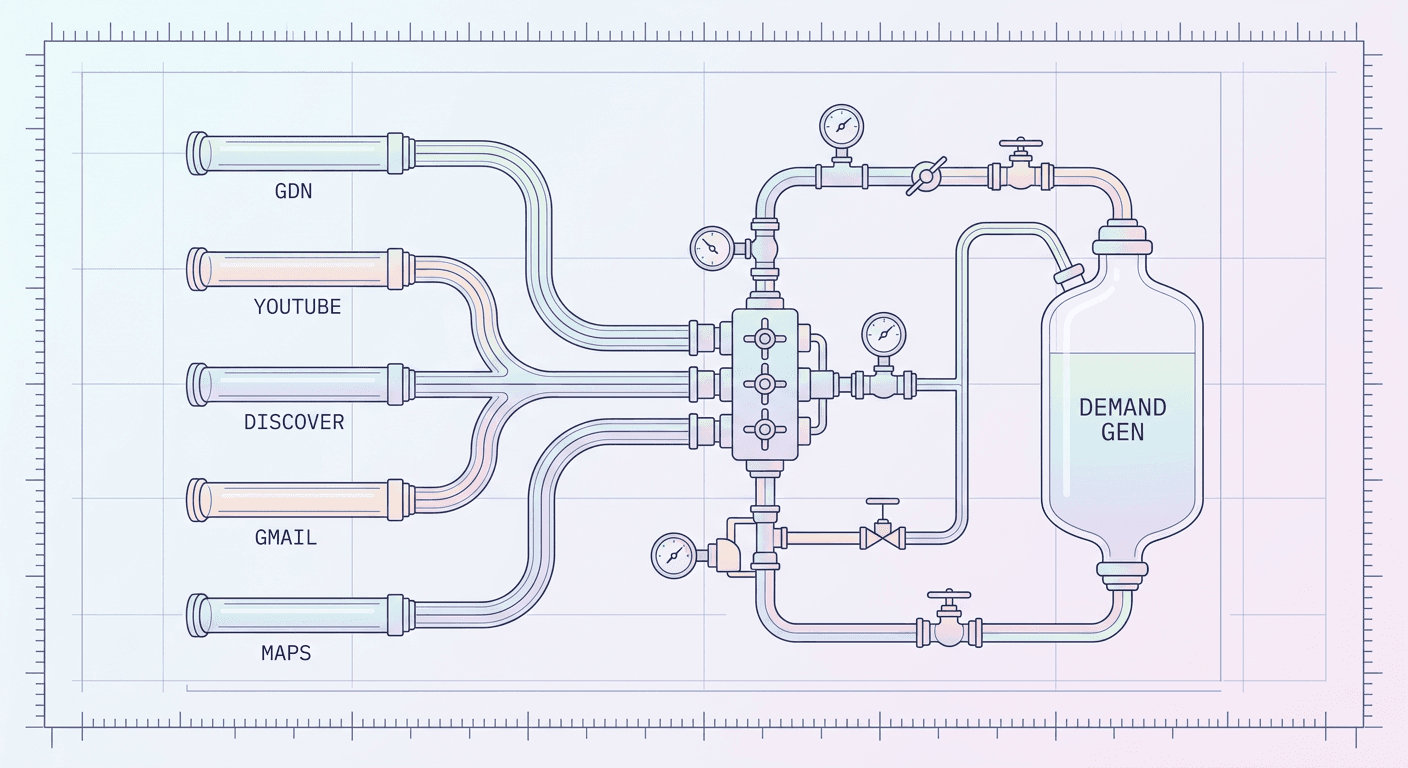
If you run Demand Gen campaigns, a setting most advertisers have never touched is about to change shape under them, and the billing model for your video assets is changing right alongside it. Google first brought view-through conversion optimization to Demand Gen campaigns in April 2026, letting campaigns optimize toward a conversion that happens after someone views your ad without clicking, rather than only counting clicks and direct engagements [1]. Advertiser communications first reported by PPC News Feed on August 15, 2026 and corroborated by Search Engine Land two days later describe a meaningfully bigger set of changes landing on top of that original feature: VTC bidding is becoming video-only, eligible inventory is expanding to the Google Display Network, the setting is switching to enabled by default for new campaigns, and Display video assets are moving from cost-per-click to cost-per-thousand-impression billing regardless of whether you use VTC at all [2].
It is worth being precise about where this information comes from before acting on it. As of this writing, Google's own public help documentation still describes the original April 2026 version of VTC optimization, not these additional changes, and the reporting itself is explicit that these details surfaced through advertiser communications rather than a public Google blog post [2]. That does not make the changes less real, trade press catching a rollout before Google's own documentation catches up is a common pattern, but it does mean the exact account-level timing is not yet confirmed, and you should expect to verify the details below against your own campaign settings as the rollout actually reaches your account rather than assuming every account changes on the same day.
This is not an isolated update. Google has spent 2026 steadily pushing advertisers toward Demand Gen and toward video specifically, from migrating standalone Display campaigns into Demand Gen to adding AI-powered video dubbing inside Asset Studio so a single video asset can run across dozens of language markets without a reshoot. The VTC changes described here fit the same direction: value video assets more in bidding, make them easier to produce and localize, and quietly reduce how much static image creative can carry a campaign on its own.
What VTC Optimization Already Does
Before getting into what is changing, it helps to be clear on the mechanic as it exists today. VTC optimization lets Demand Gen campaigns use view-through conversions, a conversion that happens after someone views your ad without clicking it, in the bidding system itself, following a conversion hierarchy of clicks, then engagements, then views [1]. A view-through conversion counts when a conversion request matches to a view within a 24-hour conversion window [1].
As of the original April 2026 rollout, the feature was in Open Beta, available to all interested advertisers, and supported for YouTube, Display, and Discover Feed inventory, applying to video assets [1]. Earlier reporting on the initial beta specifically noted it applied to YouTube traffic for both image and video assets, and that it does not support offline conversions, store visits, or offline conversion imports, only online web conversions created through Google Ads and Floodlight conversions tracked through Display & Video 360 [3]. To turn it on or off at the campaign level today, you open the campaign settings gear icon, find the Conversions Optimization dropdown, and check or uncheck "Include view-through conversions" [1].

The Four Real Changes Reportedly Coming
| Change | What it does | Applies to |
|---|---|---|
| Video-only VTC bidding | Image-based view-through conversions become secondary, reporting-only, no longer biddable | All Demand Gen campaigns using VTC optimization |
| Default-on for new campaigns | VTC optimization enabled automatically; existing campaigns keep current settings | Newly created Demand Gen campaigns |
| Display Network expansion | VTC-eligible inventory expands beyond YouTube and Discover Feed to include the Google Display Network | Demand Gen campaigns using Display placements |
| CPC to CPM billing | Display video assets billed per thousand impressions instead of per click, regardless of VTC usage | All Display video assets in Demand Gen |
Each of these four changes is reported independently but they clearly function as one coordinated shift: push VTC bidding and billing toward video specifically, make it the default rather than something advertisers have to discover and enable, and widen where video assets can earn that treatment.
Why Video-Only Bidding Is the Change That Matters Most
Under the current system, image assets can generate view-through conversions the same way video assets can. Under the reported change, image-based view-through conversions become secondary, reporting-only conversions. They will still show up in your account for visibility, but they stop being eligible for bidding and stop appearing in your primary Conversions column [2].
This is the detail most likely to catch an advertiser off guard if a Demand Gen campaign has been quietly relying on image-based view-through conversions to hit a conversion volume target. If a meaningful share of your reported VTC volume currently comes from static image assets rather than video, that volume is about to stop counting toward bidding decisions and toward your primary conversion total, even though the impressions and the views themselves have not changed at all. The conversions did not disappear, they simply stopped being the kind of conversion your bid strategy is allowed to optimize toward.

The practical fix is straightforward but requires actual production work, not just a settings change: campaigns that want to keep benefiting from VTC bidding need a real video asset doing that job, not a static image asset repurposed into a video slot. If your Demand Gen creative library is currently image-heavy, this is a concrete, dated reason to prioritize producing real video assets before the rollout reaches your account rather than after. Tools built for fast video production, like Miraflow's cinematic AI video generator and Text2Shorts, can turn an existing product shot or script into a finished video asset without a reshoot, which matters if your current library was built assuming images and video would be treated equivalently.
The CPM Billing Shift: What It Actually Does to Your Budget
Separately from the bidding change, Display video ads in Demand Gen are reportedly moving from cost-per-click to cost-per-thousand-impression billing, and this applies to all Display video assets, whether or not the campaign uses VTC optimization at all [2].
This is a genuinely different cost model, not just a different number on the same model, so it is worth walking through what changes mechanically. Under CPC billing, you only pay when someone clicks, so a video asset that gets a lot of impressions but very few clicks is effectively cheap to run, regardless of how many people actually watched it. Under CPM billing, you pay for every thousand impressions regardless of whether anyone clicks at all, which means a video asset's cost is now tied to its reach rather than its click behavior.

Consider a simple illustrative comparison to see the direction this pushes budgets, using round numbers rather than a real account's data: a Display video asset that serves 500,000 impressions and earns 2,500 clicks, a fairly typical 0.5 percent click-through rate for Display video, previously cost whatever your CPC bid times those 2,500 clicks totaled. Under CPM billing, that same 500,000 impressions costs a fixed amount regardless of whether those clicks happened at all. A low-click-through, high-reach video asset gets meaningfully more expensive under this change relative to a high-click-through one, since you are now paying for the full audience you reached rather than only the audience that acted on it. Advertisers who have leaned on Display video specifically for broad reach with a lower expectation of direct clicks, brand awareness style placements, should budget for this shift rather than being surprised by it mid-month.
Default-On for New Campaigns: The Setting You Need to Actually Check
The setting itself is reportedly switching from currently disabled by default to enabled by default for newly created Demand Gen campaigns, while existing campaigns retain whatever setting they currently have [2]. This is a meaningful change in direction. Under the current Open Beta, an advertiser has to actively discover and enable VTC optimization through the Conversions Optimization dropdown. Once this change lands, a newly launched campaign will have it running from day one unless someone actively opts out.
For most advertisers running video-forward Demand Gen campaigns, this default is probably a reasonable one, since VTC optimization is designed to capture conversion value that genuinely exists but was previously invisible to the bid strategy. For advertisers with a specific reason to exclude view-through conversions from their bidding, a strict last-click attribution policy required by a client or finance team, for example, the real risk is simply not noticing the new default on a freshly built campaign and ending up optimizing toward a conversion definition nobody actually signed off on.
A realistic scenario where this bites an agency specifically: a media buyer duplicates an existing, well-performing Demand Gen campaign to launch a new product line, a completely normal workflow. If campaign duplication counts as a new campaign for purposes of this default, and that has not been confirmed either way in current reporting, the duplicated campaign could launch with VTC optimization enabled even though the original campaign it was copied from had it manually disabled to satisfy a client's attribution policy. The safest practice until this is clarified is treating every newly launched campaign, duplicated or built from scratch, as a fresh check of the Conversions Optimization setting rather than assuming it inherited the source campaign's configuration.
The Display Network Expansion: A Real Opportunity, Not Just a Change to Manage
The one unambiguously positive change in this set is the expansion of eligible inventory beyond YouTube and Discover Feed to include the Google Display Network [2]. Display has historically been a weaker fit for conversion-focused bidding specifically because so much of its value is attention and brand impact that never generates a click, exactly the kind of value view-through conversion tracking is built to capture. Widening VTC eligibility to Display means a channel that previously looked conversion-inefficient under click-only measurement gets a more honest accounting of the conversions it is actually driving.

The catch, worth repeating because it is easy to miss while focused on the upside, is that this same expansion is paired with the CPC-to-CPM billing shift for Display video specifically. The channel's measured performance may look better once VTC captures conversions it was previously missing credit for, while the actual billed cost of running video there shifts to a reach-based model at the same time. Evaluating Display video performance after this rollout means looking at both numbers together, conversion volume including the newly counted view-throughs, and total spend under the new CPM model, rather than comparing either one in isolation against your pre-rollout baseline.
How to Audit Your Demand Gen Campaigns Before This Rolls Out
A short, concrete checklist to run through now, before the rollout reaches your account, rather than discovering the impact after the fact:
- Pull a breakdown of your current VTC-attributed conversions by asset type. If a meaningful share comes from image assets rather than video, flag those campaigns specifically, since that conversion volume is about to stop counting toward bidding and your primary Conversions column.
- Identify every Display video asset currently running under CPC billing. These are the assets whose cost structure is about to change the most directly, and they are worth a deliberate cost-per-result recalculation under an assumed CPM model before the change lands, not after.
- Check whether any campaign has a hard attribution requirement that conflicts with view-through conversions. If a client contract or internal finance policy requires strict last-click attribution, document which campaigns need VTC manually disabled so the new enabled-by-default setting does not silently override that requirement on new campaign builds.
- Inventory your video asset library against your image asset library. If video is thin relative to image assets across your Demand Gen campaigns, treat that as a production gap to close now rather than a settings problem to solve later, since no bidding setting can make an image asset eligible for video-only VTC bidding.
- Set a calendar reminder to re-check your account's actual settings in four to six weeks. Given the rollout timing itself is not yet officially confirmed by Google, a short follow-up check is more reliable than trying to guess the exact date it reaches your account.
Common Mistakes Advertisers Make With This Kind of Rollout
Treating VTC optimization as something to enable once and forget about. Bidding strategies perform differently once VTC is in the mix, since the model is now optimizing toward view-through activity in addition to clicks and engagements. Monitor performance for at least a few weeks after any related setting changes rather than assuming performance holds steady by default.
Assuming the CPM billing change only affects campaigns that use VTC optimization. It does not. The reported billing shift for Display video assets applies regardless of whether a given campaign uses VTC bidding at all, so even advertisers who have no interest in view-through conversion optimization still need to plan for the cost model change on any Display video asset [2].
Waiting for an official Google announcement before doing anything. Google's own help documentation has not yet caught up to describe these changes as of this writing [2]. Advertisers who wait for official documentation before auditing their accounts are choosing to find out about billing impact from their invoice rather than from preparation.
Letting video asset production lag behind the policy change. The single biggest lever any advertiser has here is simply having strong video assets ready. If your Demand Gen library is still mostly static images, closing that gap with Miraflow's AI image generator for stills that convert well into motion, paired with Miraflow's cinematic AI video generator for the finished asset, is more valuable right now than any settings adjustment.
Not testing creative variations before committing budget to the new billing model. Since Display video cost is reportedly shifting to a reach-based model, the cost of a weak-performing video asset goes up relative to a strong one in a way that CPC billing partly masked. Running structured creative tests, the same way we cover in Performance Max asset experiments, before leaning heavily on Display video spend reduces the risk of paying CPM rates for an asset nobody actually responds to.
Assuming this only affects Demand Gen and ignoring the overlap with Performance Max. Advertisers running both Demand Gen and Performance Max campaigns should check whether similar video-asset incentives are showing up in Performance Max reporting too, since Google has made comparable video-forward changes there, including the data strength uplift metric and AI video resizing controls, rather than treating each campaign type's video push as a fully separate policy.

Frequently Asked Questions
When exactly do these changes take effect? Not confirmed. Advertiser communications first reported by PPC News Feed on August 15, 2026 and corroborated by Search Engine Land describe the rollout as happening "over the coming months," and Google's own public help documentation had not yet been updated to reflect these changes as of the most recent check [2]. Treat specific dates for your own account as unconfirmed until you see the settings change directly.
Will my existing campaigns automatically switch to VTC optimization enabled? Reportedly no. The enabled-by-default change applies to newly created Demand Gen campaigns. Existing campaigns are expected to retain whatever setting they currently have [2].
Does the CPM billing change apply to YouTube and Discover Feed video too, or just Display? Based on current reporting, the CPC-to-CPM billing shift is specifically described for Display video assets. YouTube and Discover Feed inventory are not described as changing billing models in this round of reported updates [2].
Can I still get credit for view-through conversions on my image assets? Reportedly yes, but only as secondary, reporting-only data. Image-based view-through conversions are expected to remain visible in your account for reference but will no longer be eligible for bidding or count toward your primary Conversions column [2].
How do I turn VTC optimization off if I don't want it? Through the campaign settings gear icon, in the Conversions Optimization dropdown, where you can uncheck "Include view-through conversions" [1]. Once the enabled-by-default change for new campaigns lands, checking this setting on every new Demand Gen campaign build becomes a necessary step rather than an optional one for advertisers who need it off.
Does this affect Performance Max campaigns too? Not directly. This specific round of reported changes is described for Demand Gen campaigns. Performance Max has separately seen its own video-forward changes in 2026, including a data strength uplift metric and new AI video resizing opt-out controls, so advertisers running both campaign types should treat them as related but separate tracks of the same broader video-first direction rather than assuming one policy covers both.
What's the fastest way to close a video asset gap in my creative library? Generating stills with a tool like Miraflow's AI image generator and turning your strongest concepts into finished video with Miraflow's cinematic AI video generator is a faster path than a traditional production shoot, and it gives you assets that qualify for video-specific bidding treatment rather than assets that only work as static images. You can find more Demand Gen and Performance Max breakdowns on the Miraflow AI blog.
Conclusion
None of these four changes individually would be worth a full account audit on its own, but together they represent a real, coordinated shift in how Google Ads wants Demand Gen video treated, favored in bidding, exposed to more inventory, and billed on a reach basis rather than a click basis. The advertisers who come out ahead are the ones who treat this as a production prompt, not just a settings checklist: build the video assets this bidding model actually rewards, run the audit above before the rollout reaches your account rather than after, and keep checking your account's actual settings since the official timing has not been confirmed by Google directly as of this writing.
References
[1] Google Ads Help. "About view-through conversion optimized bidding for Demand Gen campaigns."
[2] Onemetrik. "Demand Gen VTC Optimization Goes Video-First."
[3] TechWyse. "Google Demand Gen View-Through Conversion & Commerce Media Suite."