YouTube Video Hooks in 2026 How to Save the First 30 Seconds

Written by
Jay Kim
In 2026 most videos lose viewers in the first thirty seconds. Learn how to write YouTube hooks that keep people watching and turn intros into a real growth lever.
If your YouTube videos lose viewers in the first thirty seconds in 2026, the algorithm will not care how good the rest of the content is.
Most ranking breakdowns say the same thing now
Watch time, audience retention, and click through rate sit at the top of YouTube’s real ranking factors.
Audience retention reports also show that a huge chunk of viewers decide in the first thirty to sixty seconds whether they stay or leave. Many creators lose thirty to forty percent of viewers in that window.
This article is all about that window.
You will learn
- Why the first thirty seconds matter so much in 2026
- What a good hook actually needs to do
- Eight hook patterns you can copy
- How to package hooks with titles and thumbnails for high CTR
- How to fix weak intros using YouTube Analytics
- A simple way to use Miraflow AI to draft and test stronger hooks
Use this as a checklist next time you script or reshoot an intro.
Why the first thirty seconds matter so much in 2026
YouTube in 2026 ranks videos heavily on
- Watch time and audience retention
- Click through rate from impressions
- Session duration and viewer satisfaction signals
Audience retention rate is one of the highest weight signals in current SEO guides. A retention of fifty to sixty percent is considered solid, and videos that hold seventy percent or more often get priority in suggested and browse.
Where do most videos fail
Right at the start.
Recent retention research shows
- Average YouTube videos retain only around twenty to twenty five percent of viewers to the end
- Only about one in six videos keep more than fifty percent of viewers all the way through
- The first sixty seconds are the main decision point for viewers
Algorithm guides for 2025 and 2026 also highlight that most videos lose thirty to forty percent of viewers in the first thirty seconds, and top creators fight that by starting with the result or a strong hook.
So if your opening is weak, you are handing YouTube three bad signals at once
- Low retention in the intro key moment report
- Low watch time per impression
- Low click through rate on future impressions if people back out fast
This post will fix that.
What a YouTube hook really needs to do in 2026
A hook is not just a catchy sentence.
In the first fifteen to thirty seconds your hook has to do three jobs at once
- Confirm the promise
The viewer must recognise that the video is about what the title and thumbnail promised, or they feel tricked and leave. - Create a reason to stay
You need at least one open loop, question, or preview of a payoff that sits later in the video. - Build minimum credibility
The viewer needs a quick reason to trust that you can deliver the promised result or explanation.
That means a good hook usually contains
- Topic confirmation
- A future payoff
- One credibility hint
All in under thirty seconds, often under fifteen.
The three second, fifteen second, thirty second view of your hook
It helps to think of your hook in micro stages.
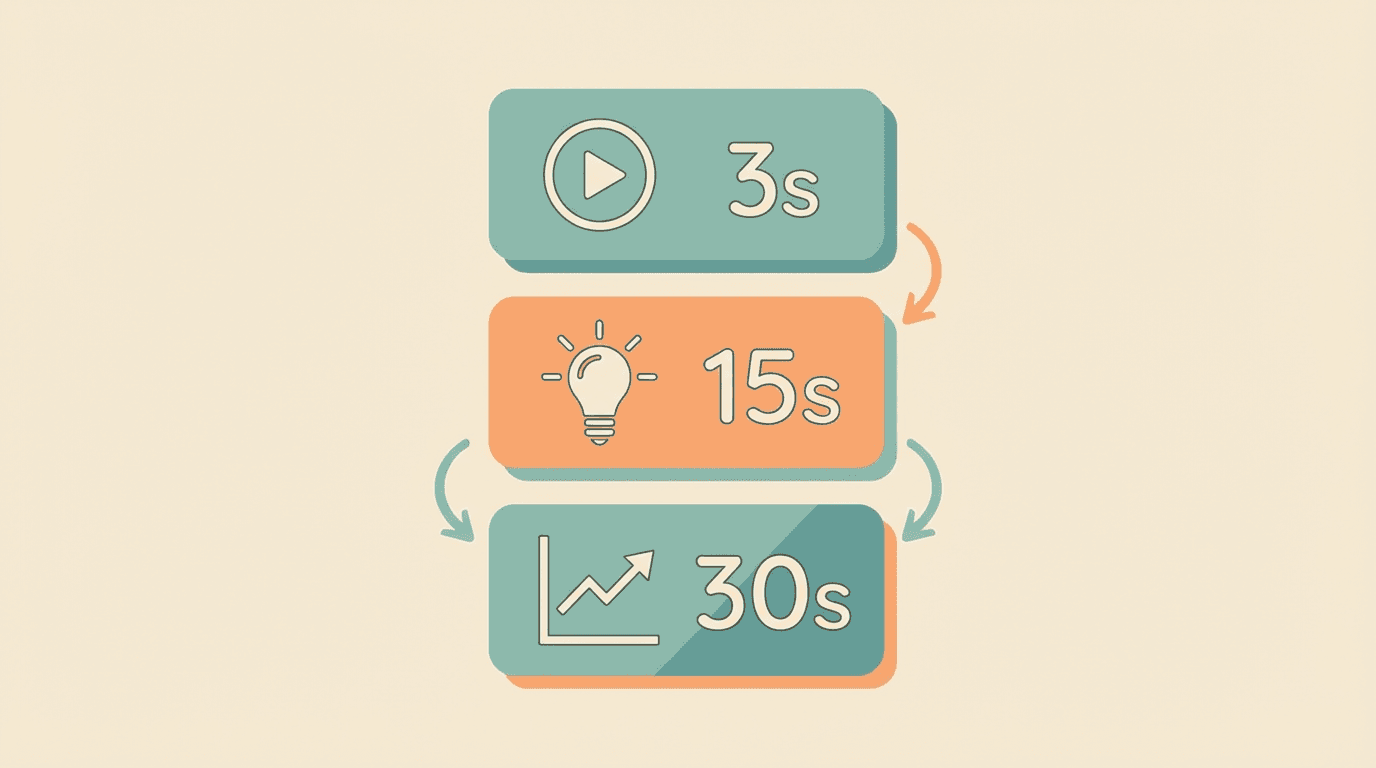
First three seconds
Goal
Stop the scroll, prove relevance.
Do
- Use a visual that clearly matches the title
- Say the topic in simple language
- Avoid your logo, hello, or backstory here
This is where a freeze frame that looks like a thumbnail can help in long form, and a strong first frame is essential in Shorts.
First fifteen seconds
Goal
Set the stakes and promise a payoff.
Do
- Clarify what changes by the end of the video
- Hint at a specific metric, result, or transformation
- Mention a tension point your viewer already feels
Guides on retention strongly recommend nailing the first fifteen seconds with bold hooks, teasers, or surprising visuals.
First thirty seconds
Goal
Lock in commitment.
Do
- Briefly explain what you will do and in what order
- Show one piece of visual proof or a mini result
- Drop an open loop that resolves later
Retention specialists often suggest aiming for at least forty percent of viewers staying to the end as a baseline, with fifty percent or more being excellent. That is almost impossible without a strong first thirty seconds.
Eight hook patterns you can copy in 2026
You do not need to reinvent hooks every time. Reuse templates.

1. Result first, then process
Best for
Tutorials, case studies, transformation content.
Template
- Open on the end result
- State the before and after
- Promise to show the path
Example skeleton
- You see this retention graph here, last month it looked terrible. By the end of this video you will see every change I made to turn this curve from flat to rising.
Back up this kind of hook with content like your watch time or analytics posts, for example YouTube Shorts Watch Time in 2026 How Much You Need for Real Growth or YouTube Shorts Analytics in 2026 How to Read Your Graphs and Actually Fix Your Videos.
2. Big mistake then fix
Best for
Creators who teach skills, business, or study.
Template
- Show the painful outcome
- Admit the mistake
- Promise the fix
Example skeleton
- This video completely died in the first hour. Same niche, same quality, and I broke one rule in the first thirty seconds. I will show you what that mistake was and how to fix it in your next upload.
This pairs well with content like Why are my videos getting 0 views or Why Your YouTube Shorts Get Views But No Subscribers.
3. Question hook that restates the viewer’s fear
Best for
Educational and search based videos.
Template
- Ask the exact question your viewer is silently asking
- Answer that you will walk through it step by step
Example skeleton
- Wondering why your Shorts get views but almost no watch time beyond five seconds In this video we will look at the first thirty seconds of three real videos and fix each one.
This can link naturally to YouTube Shorts Best Practices in 2026 a Complete Guide.
4. Pattern interrupt hook
Best for
Faceless channels, commentary, creativity based content.
Template
- Start with a visual or sound that is unusual in your niche
- Then quickly connect it back to the topic
Example skeleton
- Open with a silent five second clip of a graph collapsing, then cut to you.
- That graph was my channel last month. Strong ideas, terrible hooks. Today we will rebuild the first thirty seconds that actually keep viewers.
Use this style sparingly but it works well when most competitors open in the same safe way.
5. Story in one sentence
Best for
Case studies, challenges, and vlogs.
Template
- Compress the story into a single sentence that includes time and stakes
Example skeleton
- In thirty days I went from videos that lost half of viewers in the first twenty seconds to videos that keep sixty percent through the whole story, and I did it with three changes to my hook.
Then you can zoom out and show your analytics inside the video.
6. Teaser of a later moment
Best for
Videos with a strong climax, reveal, or twist.
Template
- Show a short clip or screenshot from a later section
- Cut back to the start and promise to show how you get there
Example skeleton
- Show a split screen of two thumbnails and retention graphs.
- One of these has an average view duration of two minutes, the other has eight. The only difference is the first thirty seconds. Let me show you why.
This approach lines up nicely with topics like YouTube Thumbnail Makeovers in 2026 Before and After Using AI.
7. Benchmark hook
Best for
Analytics, business, money, or growth content.
Template
- State a benchmark that feels real and specific
- Compare your video or viewer to that benchmark
Example skeleton
- Most videos on YouTube keep only twenty to twenty five percent of viewers to the end. I will show you how to design first thirty seconds that push you into the top sixteen percent of videos on the platform.
8. Call out the wrong way first
Best for
Educational content where many people follow bad advice.
Template
- Briefly show the typical weak intro
- Cut and label it as wrong
- Then promise the better version
Example skeleton
- Hi welcome back to the channel, today we are going to be talking about watch time. That was my intro for months, and it killed my videos. Let us rebuild the first thirty seconds into something that YouTube actually wants to push.
This type of hook works especially well when paired with YouTube Session Time in 2026 How Your Videos Keep Viewers on the Platform.
Packaging hooks for high CTR in 2026
Hooks happen after the click, but CTR determines whether viewers ever see your hook at all.
Recent ranking factor breakdowns agree that watch time and audience retention are top signals, but click through rate also has very high weight. Poor CTR often means YouTube simply shows your video less.
The key is alignment
- Topic defines the value
- Title sets the expectation
- Thumbnail visualises that expectation
- Hook confirms it instantly
Title patterns that support strong hooks
For hook driven videos, build titles that hint at a story or transformation, not just a general tip.
Patterns
- I fixed X in the first thirty seconds and Y happened
- How I went from A to B by changing my intro
- Three hook templates that saved my watch time in 2026
Keep the important keywords near the start, for example YouTube hook, watch time, retention in 2026.
Thumbnail concepts for hook focused videos
Thumbnails that work well for this topic often show
- A retention graph, simplified into a rising versus dropping curve
- A before and after intro side by side
- Your face reacting to analytics or a dramatic change
Apply CTR principles you already use in posts like YouTube Shorts Thumbnail Strategy in 2026 and YouTube CTR in 2026 What Is a Good Click Through Rate and How to Improve It With AI Thumbnails
- One main subject
- High contrast between subject and background
- Two to four words of text maximum, if any
- No clutter
Example ideas
- A diagonal split thumbnail, left side titled weak hook visually, right side strong hook, with different shaped graphs behind
- A close up of you covering your face with one hand while a plummeting graph sits beside you
The hook and packaging should tell the same story from first impression to first thirty seconds.
How to diagnose weak hooks using YouTube Analytics
You do not have to guess which hooks work. YouTube Studio already shows you.

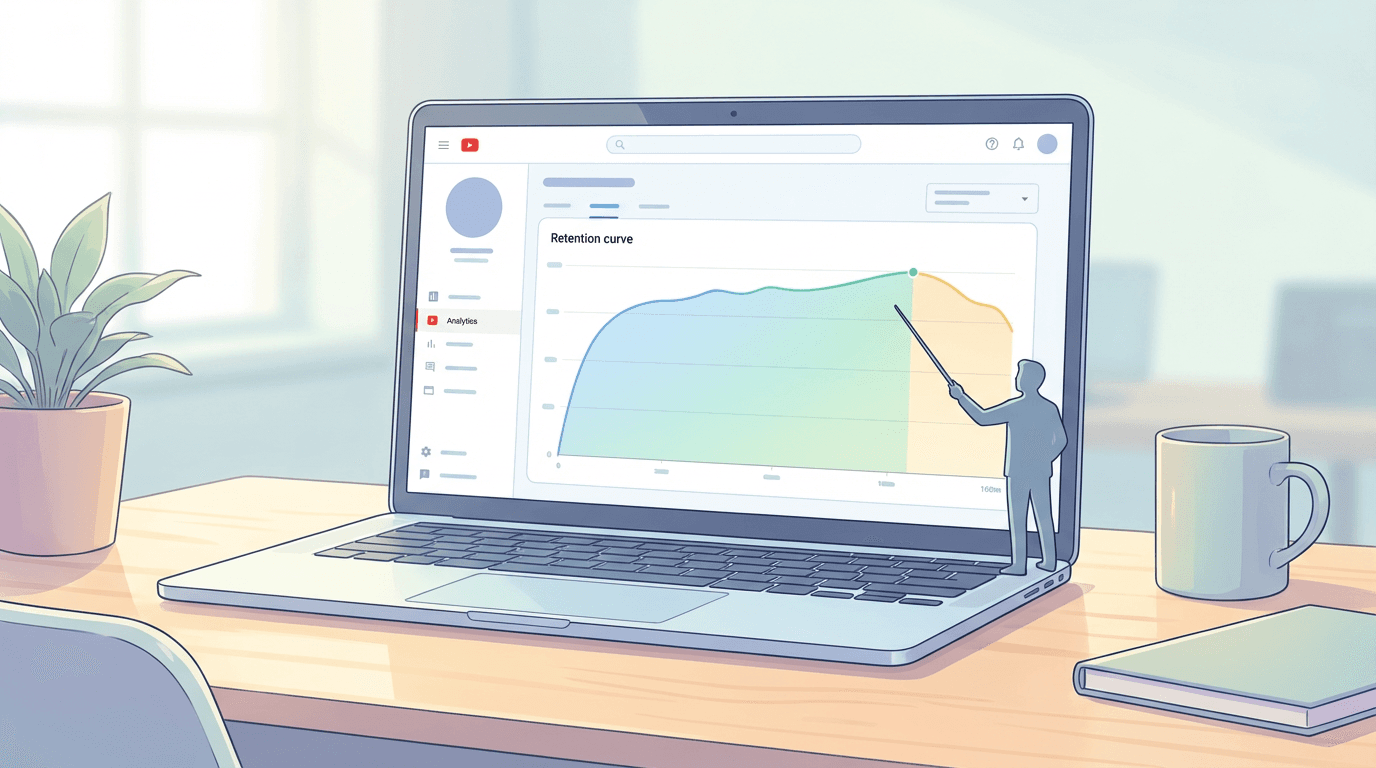
Use the audience retention key moments report
In Analytics
- Go to a video
- Open the Engagement tab
- Look at audience retention and key moments for audience retention
Focus on
- Intro key moment
- If the curve drops sharply in the first ten to fifteen seconds, your opening is confusing, slow, or does not match the title
- Continuous segments
- These show where the graph stays relatively flat, meaning viewers are engaged
- Spikes
- Often replays or heavy scrubbing that show interesting sections
Take two or three of your top performing videos and two or three underperformers.
Ask
- What did I say in the first fifteen seconds
- What did viewers see on screen
- How does that compare to the title and thumbnail
Write down patterns. Many creators find that their best hooks are shorter, show proof earlier, and restate the promise faster.
Use A B testing where possible
If you have access to thumbnail testing or are willing to experiment over time
- Test different hook ideas on similar topics
- Compare audience retention at the thirty second mark
- Keep the hook that holds more viewers, even if the total views are not massive yet
Look at metrics like
- Average percentage viewed
- Average view duration
- Click through rate on the same impressions window
That gives you hard data on which intro style fits your audience.
Using Miraflow AI to script and test hooks faster
You can do all of this by hand, but Miraflow AI helps reduce friction so you can test more hook ideas quickly.
A simple approach
- Draft hooks with Text2Shorts
- Paste your topic, the working title, and your desired outcome
- Ask for multiple hook variations based on patterns from this article, for example result first or big mistake then fix
- Keep the ones that feel closest to your voice
- Turn hooks into visual beats
- For each hook, note what should be on screen in the first five, fifteen, and thirty seconds
- Use the AI Image Generator or cinematic video features to create the specific shots or graphics you need, like retention graphs, dashboards, or visual metaphors
- Create supporting Shorts
- Take your best hooks and turn them into Shorts with Text2Shorts, so you can test variations of the idea in the Shorts feed as well
- Design thumbnails that match the hook
- Use YouTube Thumbnail Maker to preview different combinations of intro visual and thumbnail visual
- Make sure the first frame of the video and the thumbnail feel related, especially for Shorts
You still decide the positioning and story. Miraflow AI just helps you generate and iterate on hooks without spending hours staring at a blank script.
Practical next steps for your next upload
To make this concrete, here is a quick checklist:
- Pick a new video idea you want to publish soon
- Write three titles that include your main keyword and a clear promise
- Use one of the hook patterns above to write at least three intro scripts
- Choose a hook that
- Confirms the promise fast
- Shows some proof early
- Sets up a later payoff
- Design a thumbnail that visually matches that promise
- After publishing, wait for the audience retention data, then
- Check the curve at ten seconds, fifteen seconds, thirty seconds
- Compare it to older videos
- Adjust your hook pattern for the next upload
Repeat this cycle across five to ten videos, and your first thirty seconds will improve simply because you are now treating hooks as a system instead of an afterthought.
Related posts to deepen this
If you want to build a full retention and packaging system around your hooks, read these next
- Why The First 3 Seconds of Youtube Shorts Matter
- YouTube Shorts Watch Time in 2026 How Much You Need for Real Growth
- YouTube Shorts Analytics in 2026 How to Read Your Graphs and Actually Fix Your Videos
- YouTube CTR in 2026 What Is a Good Click Through Rate and How to Improve It With AI Thumbnails
Together they cover the path from click, to hook, to full session.