Why The First 3 Seconds of Youtube Shorts Matter

Written by
Jay Kim

Most YouTube Shorts fail before viewers even notice them. Learn why the first 3 seconds matter, what causes early swipe-aways, and how creators can fix it.
Short-form video dominates YouTube, but most Shorts never get a second chance. They appear briefly in the feed, then disappear without traction. For many creators, this feels random or unfair, but actually, it isn't.
The reality is simple: most YouTube Shorts fail because viewers decide to swipe away almost immediately. The first few seconds determine whether the video earns attention or gets ignored.
This guide explains why those opening moments matter so much, what actually causes early drop-off, and how creators can rethink Shorts creation to work with the algorithm instead of against it.
The First 3 Seconds Decide Everything
YouTube Shorts live in a fast, swipe-based environment. Viewers are not searching or committing, they are reacting.
When a Short appears in the feed, the viewer subconsciously asks:
- What is this?
- Why should I watch?
- Does this feel worth my time?
If the video fails to answer even one of these questions quickly, the viewer swipes.
YouTube does not publicly state that “3 seconds” is a hard cutoff. However, creator analytics, retention graphs, and YouTube’s own discussions around viewer behavior all point to the same pattern: early engagement heavily influences distribution.
Shorts that lose viewers immediately tend to stop being shown. Shorts that hold attention early get more chances.

Why Early Drop-Off Hurts Shorts Performance
YouTube Shorts are evaluated primarily through viewer behavior, not only titles or descriptions.
Key signals include:
- Did the viewer keep watching?
- Did they swipe away immediately?
- Did they watch to the end or loop?
- Did they engage after watching?
When many viewers swipe away at the start, the system interprets the video as low-interest for that audience. As a result, it reduces further distribution.
This is why creators often notice:
- Shorts with strong openings suddenly spike
- Shorts with slow or confusing intros flatline
- Even high-quality visuals fail without a clear hook
The algorithm is not judging effort. It is reacting to behavior.
Common Reasons Shorts Fail in the First 3 Seconds
1. The Opening Is Visually Unclear
If a viewer cannot immediately tell what the video is about, they leave.
Examples:
- Generic scenery
- Slow zooms with no context
- Abstract visuals without explanation
In a feed environment, ambiguity works against you.
2. The Video Starts Too Slowly
Many creators treat Shorts like mini long-form videos. They build up gradually.
That approach does not translate well.
Slow fades, delayed reveals, or polite intros often cause viewers to swipe before the video even begins.
3. The Hook Is Verbal but Not Visual
Some Shorts rely on spoken hooks like:
“Let me explain why…”
The problem is that many viewers decide whether to stay before fully processing audio.
If the first frame does not visually support the idea, the hook is lost.
4. The Context Is Missing
Shorts do not benefit from titles the same way long-form videos do.
If the viewer needs external context to understand the video, the opening has already failed.
The idea must be readable from the screen itself.
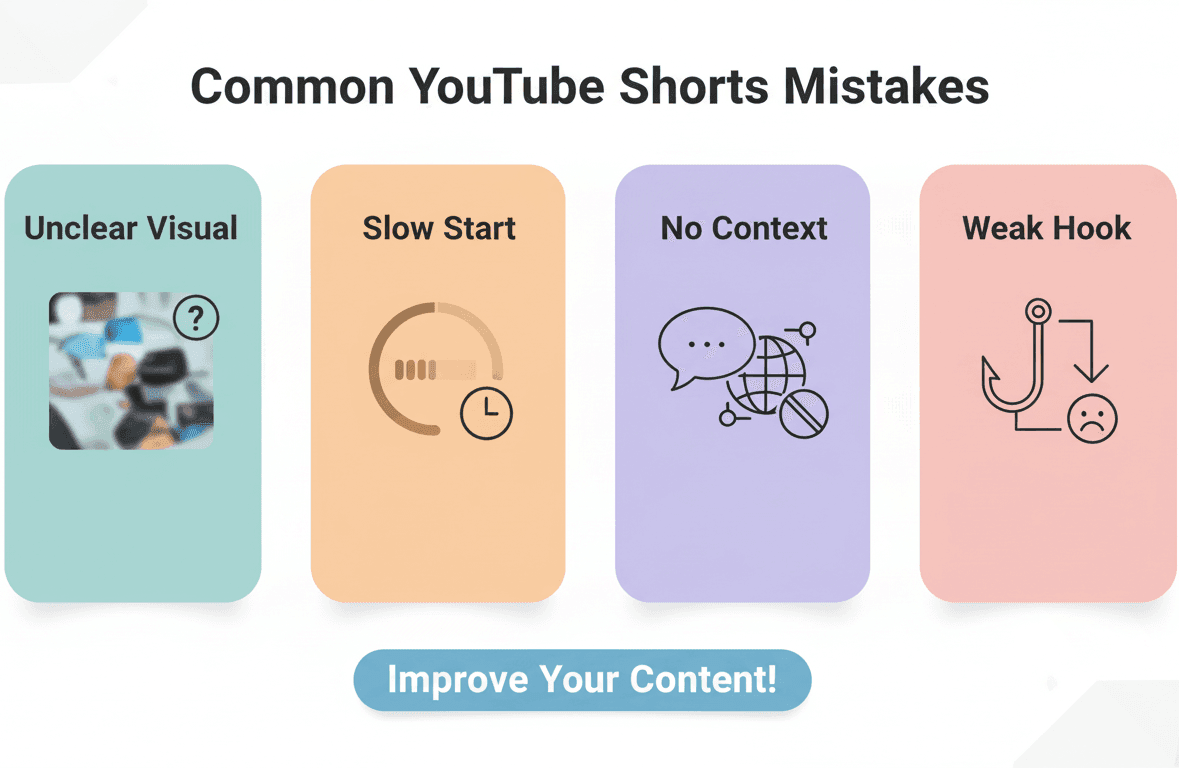
The table below summarizes the most common reasons YouTube Shorts fail early, and how they impact viewer behavior.
| Common Issue | What Viewers Experience | Algorithm Signal |
|---|---|---|
| Unclear opening visual | Can’t tell what the video is about | Immediate swipe-away |
| Slow or delayed intro | Feels like wasted time | Low early retention |
| Verbal hook without visual support | Audio context arrives too late | Weak engagement signal |
| Missing on-screen context | Confusion in a swipe-based feed | Reduced distribution |
| Late value delivery | Viewer never reaches payoff | Poor completion rate |
How Miraflow AI Fixes the First-3-Seconds Problem Automatically
The biggest reason YouTube Shorts fail in the first 3 seconds is execution, not ideas.
Creators often know what they want to say — but struggle with:
- Opening hooks
- Visual pacing
- Matching visuals to the message fast enough
This is exactly where Miraflow AI’s Text2Shorts feature helps.
With Text2Shorts, you only provide a single topic, and Miraflow AI automatically:
- Generates a strong hook optimized for the first 1–3 seconds
- Structures the short for fast visual engagement
- Maintains high pacing to prevent early drop-off
- Formats the video specifically for YouTube Shorts and Instagram Reels
Instead of manually worrying about hooks, timing, and retention mechanics, creators can focus on ideas, while Miraflow handles the execution details that affect algorithm performance.
If you want a detailed, step-by-step walkthrough of how Text2Shorts works — from entering a topic to generating the final video — this guide breaks down the full process:
From Prompt to Reel: Text2Shorts AI Shorts.

Shorts That Succeed Do One Thing Well Early
Successful Shorts tend to do at least one of the following immediately:
- Show the result before the explanation
- Present a clear visual contrast
- Introduce a strong emotional cue
- Create curiosity through framing, not delay
This does not mean every Short needs to be loud or dramatic. It means clarity beats buildup.
Why Many Creators Struggle to Fix This
The biggest challenge is not knowing what the hook should be.
It is the cost of iteration.
Traditional Shorts creation often involves:
- Writing a script
- Planning scenes
- Editing clips manually
- Re-exporting after changes
That process discourages experimentation. Creators stick with “good enough” openings instead of testing better ones.
How Prompt-First Shorts Change the Workflow
This is where prompt-driven tools change how creators work.
Instead of starting with footage or timelines, creators start with the idea itself:
- What is the core message?
- What moment should appear first?
- What progression makes sense for a short format?
With Miraflow AI’s Text2Shorts, creators can generate full vertical Shorts from a single topic. The system automatically structures the video into short segments, each designed to flow into the next.
Rather than rebuilding edits, creators adjust wording, regenerate, and compare results.
This makes it far easier to test different openings without friction.

Why This Matters for Growth
YouTube Shorts reward creators who:
- Iterate quickly
- Test multiple ideas
- Learn from real viewer behavior
Early retention is not about luck. It is about alignment between idea, presentation, and timing.
When creators can experiment freely, they improve faster.
Rethinking the First 3 Seconds
The most important mindset shift is this:
You are not asking viewers to “give you a chance.”
You are proving value instantly.
That value can be:
- Information
- Emotion
- Curiosity
- Visual interest
If the opening delivers one of those clearly, the viewer stays. If it does not, the swipe happens.
Conclusion
Most YouTube Shorts fail early not because the content is bad, but because the opening does not communicate fast enough.
Short-form platforms reward clarity, not patience.
When creators focus on strong early moments and use tools that reduce editing friction, they gain the freedom to test ideas instead of guessing.
If you want to explore a faster way to turn ideas into structured Shorts, visit Miraflow AI and try Text2Shorts to see how prompt-first creation changes the process.