AI Prompts for Automotive Dealership Marketing: 15 Car Photography Visuals

Written by
Jay Kim
15 copy-paste AI prompts for automotive dealership marketing photography. Studio showroom shots, dynamic driving scenes, luxury interior details, lifestyle compositions, rugged truck environments, EV modern settings, and cinematic hero visuals for car dealerships, used car lots, luxury auto dealers, independent sellers, and automotive e-commerce platforms.
15 copy-paste AI prompts for automotive dealership marketing photography. Showroom studio shots, dynamic driving scenes, lifestyle aspirational compositions, detail close-ups, lot inventory presentations, and cinematic hero visuals designed for car dealerships, used car lots, luxury auto dealers, independent sellers, fleet sales operations, auto brokers, car subscription services, EV dealerships, motorcycle dealers, auto detailing businesses, car rental agencies, automotive e-commerce platforms, and private sellers listing vehicles online.
A car is the second most expensive purchase most people will ever make, and it is the most emotionally complex. A house is a rational decision wrapped in emotion. A car is an emotional decision wrapped in rationality. The buyer tells themselves they are choosing based on fuel economy, safety ratings, cargo space, and resale value — and all of those factors matter — but the moment they saw the car, before they read a single specification, something happened. They felt something. They saw themselves in it. They saw who they would be driving it. They imagined the way it would look in their driveway, the way it would feel pulling onto the highway, the way other people would see them behind the wheel. That emotional moment — that flash of identity projection — is where the sale begins. Everything that follows, the test drive, the negotiation, the financing conversation, is the rational architecture built around an emotional foundation that was laid by a single visual impression.
This is why automotive photography is not a support function for dealership marketing. It is the marketing. In an industry where the average customer visits 1.6 dealerships before purchasing but consumes dozens of online listings, reviews, and images, the photograph is the primary sales encounter for most buyers. The image is the showroom floor. It is the lot walk. It is the first handshake between the customer and the vehicle. And like a first handshake, it sets the tone for everything that follows. A poorly lit, carelessly composed, parking-lot-snapshot photograph of a beautiful vehicle does the same thing that a disinterested salesperson does: it makes the customer feel that the dealership does not care enough about the product or the customer's experience to present the vehicle with respect. A professionally lit, thoughtfully composed, aspirationally styled photograph of the same vehicle does what the best salesperson does: it makes the customer feel that this vehicle is special, that this dealership understands quality, and that buying from here will be an experience worthy of the investment.
Automotive photography carries specific technical and emotional demands that distinguish it from other product categories. Cars are large, reflective, geometrically complex objects that interact with light in ways that are simultaneously beautiful and treacherous. The curved metal surfaces act as mirrors, reflecting everything in the environment — the photographer, the equipment, the surroundings — and these reflections must be controlled or they become visual noise. The paint finish is the vehicle's skin, and its quality — the depth of gloss, the richness of color, the smoothness of the surface — must be rendered with accuracy because customers are extraordinarily sensitive to paint quality as a signal of overall vehicle condition. The proportions matter: a wide-angle lens that distorts the vehicle's lines misrepresents the design that engineers spent years perfecting. The environment matters: the setting in which a vehicle is photographed communicates as much about the vehicle's positioning as the vehicle itself — a luxury sedan on a cobblestone European street is a different proposition than the same sedan in a suburban parking lot, even though the vehicle is identical. And the details matter: the brake calipers visible through the wheel spokes, the stitching on the leather seat, the ambient lighting on the dashboard, the badge on the grille — these details are what differentiate a sixty-thousand-dollar vehicle from a thirty-thousand-dollar vehicle, and they must be photographed with the precision and attention they deserve.
If you have worked with AI prompts before for product photography, e-commerce content, or social media visuals, the workflow will be familiar. Copy the prompt, replace the placeholder vehicle description with your actual vehicle — its make and model styling characteristics, color, body type, and key visual features — generate, and deploy. What makes these prompts distinct from general product photography is that every element has been engineered specifically for automotive subjects: the lighting that models sheet metal curves without overblowing reflections, the angles that respect automotive design proportions, the environments that communicate the vehicle's market positioning, the depth of field that balances vehicle sharpness with atmospheric context, and the color science that renders paint finishes with the depth and richness that customers expect. These are not generic product-on-background shots. They are automotive marketing images — photographs designed to make a customer stop scrolling, feel something, and click through to the listing.
A note on vehicle representation: These prompts generate atmospheric automotive scenes with vehicles as the subject. AI generators produce stylistically accurate vehicles but may not render exact make-and-model details with photographic precision — specific grille designs, badge placements, headlight shapes, and model-specific design elements may vary from the actual production vehicle. For exact vehicle representation, the most effective approach is to photograph your actual inventory vehicle and use the Image Inpainting tool to composite it into a generated atmospheric scene, or use these prompts to generate aspirational brand and lifestyle content while maintaining real photography for specific inventory listings. When using fully AI-generated imagery for vehicle sales listings, ensure the generated vehicle closely matches the actual vehicle's appearance, color, body type, and condition to maintain customer trust and comply with advertising accuracy standards.
Why Professional Photography Sells Cars
The relationship between image quality and automotive sales conversion is not theoretical. It is one of the most measured and documented relationships in digital commerce, and the data is unambiguous: better photographs sell more cars, faster, at higher prices.
Online listings with professional photography receive dramatically more engagement. Dealership marketing research consistently shows that vehicle listings with high-quality, professionally styled photographs receive significantly more views, more click-throughs, more saved listings, and more inquiry submissions than identical vehicles photographed casually. The engagement differential is not marginal — it is substantial, often measuring in multiples rather than percentages. On platforms where customers scroll through dozens or hundreds of listings, the photograph is the primary filter. The customer does not read the description of every vehicle. They scan images and stop on the ones that catch their attention. A well-lit, well-composed photograph catches attention. A dark, cluttered, poorly angled snapshot does not.
Image quality directly affects perceived vehicle value and condition. Research in consumer psychology demonstrates that the quality of a product photograph directly influences the viewer's perception of the product's quality and value — independent of the product itself. A vehicle photographed in clean, professional lighting against a controlled background is perceived as being in better condition, better maintained, and worth more than the identical vehicle photographed in a cluttered lot with poor lighting, even when the customer is told the vehicles are the same. This perception gap translates directly to pricing power: professionally photographed vehicles command higher prices because the customer's value perception starts higher, and negotiations begin from a higher baseline.
The first image determines whether the listing is opened. On every major automotive marketplace — whether manufacturer sites, third-party listing platforms, social media marketplace, or dealership websites — the first image in the listing is the thumbnail that appears in search results. This single image determines whether the customer clicks through to view the full listing or scrolls past. The first image must accomplish three things simultaneously: identify the vehicle (body type, approximate segment, color), communicate quality (lighting, composition, condition), and trigger emotional interest (aspiration, excitement, desire). A generic lot photo accomplishes only the first. A professional automotive photograph accomplishes all three.
Consistency of photography signals dealership quality. When a customer browses a dealership's inventory online, the consistency of the photography across listings communicates as much about the dealership as any individual image. A dealership where every vehicle is photographed with consistent quality, consistent angles, consistent lighting, and consistent backgrounds communicates professionalism, attention to detail, and respect for the customer's experience. A dealership where photography quality varies wildly — some vehicles professionally shot, others snapped with a phone in the lot — communicates inconsistency, which the customer unconsciously maps onto expectations about the sales experience, the service department, and the overall trustworthiness of the operation.
Mobile browsing has elevated photography's importance further. The majority of automotive shopping now occurs on mobile devices, where the screen is small and the browsing is fast. On a small screen, a well-composed, well-lit vehicle photograph is immediately legible and appealing. A cluttered, poorly lit photograph becomes even less effective on a small screen because the details that might partially redeem it on a desktop are lost at mobile resolution. Mobile-first automotive marketing is, fundamentally, photography-first automotive marketing.
The Visual Language of Automotive Photography
Automotive photography has a rich and specific visual vocabulary that has been developed over a century of car advertising and has been internalized by consumers to the point where they read these visual cues instinctively, even if they cannot articulate them.
The three-quarter front angle is the default hero position. In automotive photography, the three-quarter front view — approximately 30 to 45 degrees from the front corner, showing the front fascia and one full side of the vehicle — is the established hero angle because it communicates the most visual information in a single frame. This angle shows the front design identity (grille, headlights, badge), the side profile (proportions, roofline, wheel design), and enough of the vehicle's three-dimensional form to communicate presence and scale. The three-quarter front angle is so standardized in automotive marketing that customers instinctively expect it as the primary listing image, and its absence can feel disorienting.
Low camera angles communicate power and aspiration. Photographing a vehicle from a low angle — camera at or below bumper height, looking slightly upward — makes the vehicle appear larger, more imposing, and more powerful. This is the angle of automotive advertising, automotive magazines, and the aspirational automotive photograph. It is how the customer imagines the vehicle looking when other people see them driving it. Low angles are particularly effective for SUVs, trucks, sports cars, and luxury vehicles where presence and authority are core selling propositions.
Eye-level angles communicate approachability and trust. A camera at approximately door-handle or belt-line height produces a more natural, approachable perspective that communicates the vehicle as it would appear to someone walking toward it on a lot or in a driveway. This angle is less dramatic but more trustworthy — it shows the vehicle as it actually appears in life, without the aspiration-enhancing distortion of a low angle. Eye-level angles are appropriate for family vehicles, daily drivers, and used vehicle listings where the customer values honesty and accurate representation.
Reflections tell the environment story. The curved, glossy surfaces of a vehicle's paint act as convex mirrors, and the reflections visible in the paint are a critical part of the photograph's storytelling. A vehicle reflecting an open sky, a beautiful landscape, or a clean studio environment looks premium and desirable. A vehicle reflecting a cluttered parking lot, power lines, or the photographer's shadow looks neglected. Professional automotive photographers obsess over reflection control because the reflections are, in a very real sense, painting the vehicle's emotional context onto its own surface.
Paint depth and color accuracy are non-negotiable. Automotive customers are extraordinarily sensitive to paint color. A customer searching for a specific color — deep blue metallic, pearl white, racing red — will immediately notice if the photograph's color does not match their expectation for that color. Metallic and pearl paints have a depth and complexity — base color, metallic flake, clear coat depth — that must be rendered through lighting that models the paint's multiple layers rather than flattening it into a single tone. These prompts specify paint rendering details because getting the paint wrong is one of the fastest ways to lose customer trust.
Wheel and tire presentation signals care and condition. In the visual hierarchy of automotive details, wheels and tires are disproportionately important because they are one of the first things buyers examine as a proxy for overall vehicle care. Clean, detailed wheels with fresh tire dressing on properly inflated tires signal a vehicle and a dealership that cares about details. Dirty wheels with curb rash and flat-looking tires signal neglect. Every prompt that includes the full vehicle specifies clean, properly presented wheels because this detail has outsized influence on perceived quality.
Interior photography closes the deal that exterior photography opens. The exterior photograph creates initial interest. The interior photograph determines whether the customer can see themselves living with the vehicle every day. Interior photography must communicate space, material quality, technology, and condition. The angle should show the dashboard and center console (the vehicle's technological face), the seating (comfort and quality signals), and enough of the cabin to suggest spaciousness. Interior lighting is challenging because vehicle cabins are enclosed spaces with complex lighting — ambient interior lighting, instrument panel glow, light from windows — and the photograph must balance these light sources to show the interior clearly without looking artificial.
The environment positions the vehicle in the customer's life. A pickup truck on a mountain trail. A luxury sedan on a boulevard lined with architecture. A family SUV in front of a suburban home with a warm-lit interior. An electric vehicle at a modern charging station. The environment in which the vehicle is photographed is not just a background — it is a lifestyle proposition. It tells the customer where this vehicle belongs and, by extension, whether it belongs in their life. Choosing the right environment for the right vehicle is one of the most important decisions in automotive marketing photography.
15 AI Prompt Templates for Automotive Dealership Marketing
Each template includes a content concept, the full copy-paste prompt, and deployment guidance. All prompts are formatted for the Miraflow AI Image Generator and compatible with any high-quality text-to-image tool. Replace the bracketed [vehicle description] placeholder in each prompt with your actual vehicle details. Generate at 16:9 for website banners and listing heroes, 4:5 for Instagram and social media, 1:1 for marketplace listings, 9:16 for Stories and vertical video thumbnails, and 4:3 for print and editorial.
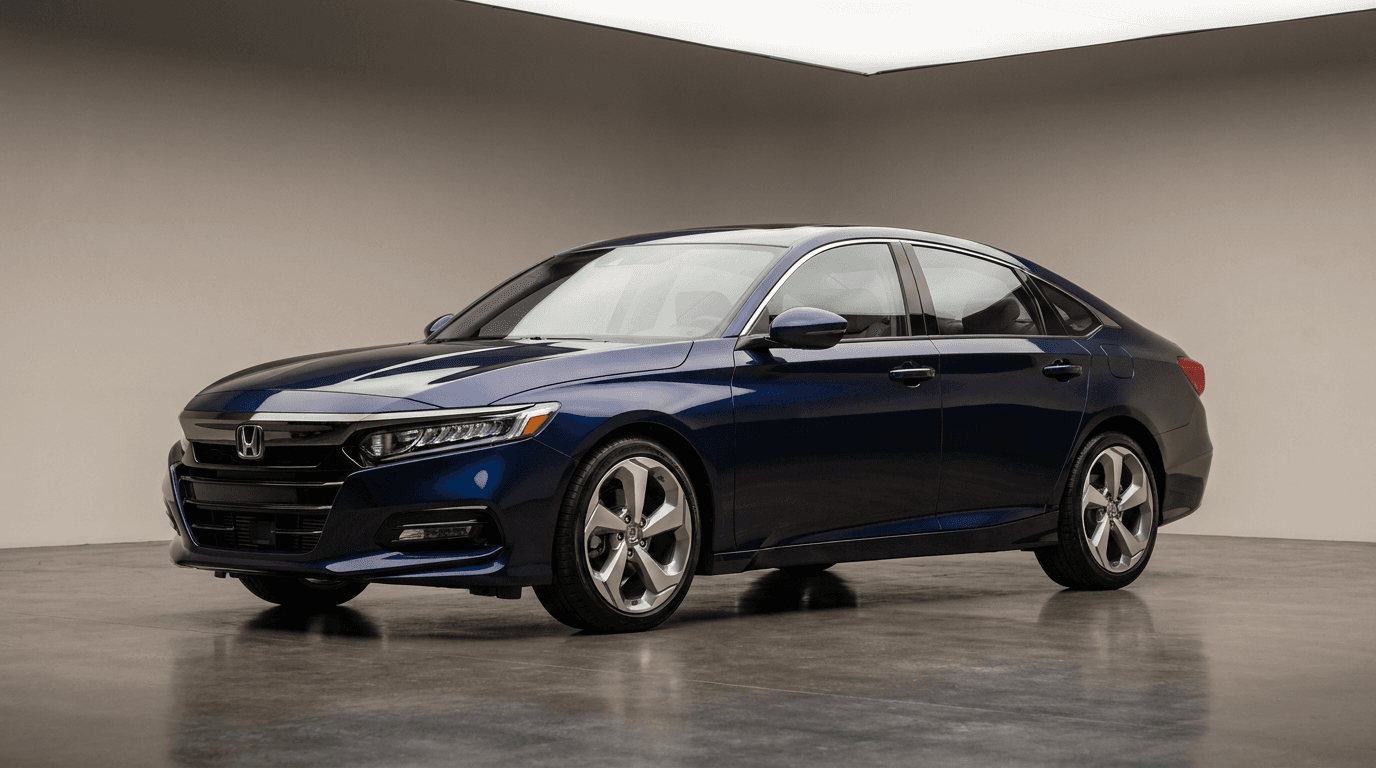
Template 1: The Showroom Hero — Studio Three-Quarter Front
This is the foundational dealership image: a clean, professionally lit studio-style photograph that presents the vehicle with the authority and clarity that customers expect from a serious dealership. This is your primary listing image, your website hero, and the photograph that establishes your dealership's visual standard.
Prompt:
professional automotive marketing photograph of [a mid-size luxury sedan in deep metallic navy blue with a sleek aerodynamic profile, chrome window trim, LED headlights with daytime running light signatures, a bold front grille with horizontal chrome elements, five-spoke alloy wheels in polished silver with low-profile performance tires, the paint finish is a deep lustrous metallic blue with visible depth and clarity showing the quality of the clear coat and the metallic flake catching highlights] in a clean professional showroom studio environment, the vehicle is positioned at a classic three-quarter front angle approximately 35 degrees from the front corner showing the full front fascia with headlights grille and badge prominently visible and the full driver's side profile revealing the roofline proportions shoulder line and wheel design, the vehicle sits on a polished dark floor — dark grey or black polished concrete or a reflective surface that shows a subtle mirror reflection of the vehicle's underside adding depth and premium quality to the presentation, the lighting is professional automotive studio lighting with a large soft overhead light source creating a smooth even highlight across the roof and hood surfaces modeling the sheet metal curves with a broad clean reflection, a secondary fill from the front-left maintaining detail in the front fascia and grille area, and controlled side lighting that runs a clean bright highlight along the vehicle's shoulder line and body contours defining the design lines without creating harsh hot spots, the deep metallic navy blue paint is rendered with full depth and richness — the metallic flake visible in the broader highlight areas creating a complex multi-layered paint appearance with warm undertones in the highlights and cooler depth in the shadows, the wheels are clean and detailed with each spoke catching individual light creating a precise engineered appearance, the headlights show their internal LED elements clearly with the distinctive light signature visible, the background is a clean neutral studio environment — smooth warm grey walls with a subtle gradient from lighter near the ceiling to slightly darker at the edges creating a controlled infinity-cove feeling with no distractions, the overall impression is of a vehicle presented with the seriousness and precision that a significant purchase deserves, deep metallic navy blue with lustrous depth polished silver alloy wheels chrome trim accents clean LED headlight elements polished dark floor with subtle reflection warm grey studio background and professional multi-source studio lighting as the color palette, the mood is confidently premium precisely presented seriously impressive and the particular authority of a well-designed vehicle presented in an environment that matches its quality, professional automotive studio photography with controlled multi-source lighting and moderate depth of field keeping the entire vehicle sharp from front wheel to rear quarter with the studio background in smooth clean soft focus, composed at the classic three-quarter front hero angle with the camera at approximately belt-line height giving the vehicle natural proportions with a slight sense of presence, the design lines and paint quality as the visual foundation, clean premium automotive tones with no distracting elements, no text, no logos, no watermarks, no license plates
Best for: Primary vehicle listing image, website inventory hero, dealership homepage featured vehicles, online marketplace listing primary photo, print advertising hero, email marketing vehicle features, CRM and sales presentation materials, manufacturer-standard inventory photography
Template 2: The Dynamic Driving Shot — Road in Motion
The driving shot transforms the vehicle from a static object into a dynamic experience. It communicates speed, capability, and the visceral thrill of driving — the emotional dimension of car ownership that static showroom shots cannot capture. This is aspirational content that makes the customer want not just the car but the feeling of driving it.
Prompt:
cinematic automotive marketing photograph of [a sports coupe in vivid racing red with an aggressive low-slung profile, sculpted side air intakes, a rear spoiler, wide performance tires on dark gunmetal alloy wheels, quad exhaust tips visible at the rear, the paint finish is a deep glossy red with exceptional depth and clarity that catches the ambient light in rich warm tones] captured in dynamic driving motion on a sweeping mountain road, the vehicle is photographed at a three-quarter front angle while moving through a wide curve on a smooth mountain highway with the front wheels turned slightly into the curve communicating active driving engagement, the road surface is clean and dark with painted lane markings visible and the road curves ahead of the vehicle into a scenic mountain landscape suggesting an open road with rewarding driving ahead, motion is communicated through a very subtle directional motion blur in the road surface and background landscape while the vehicle itself remains sharp — the technique of a professional tracking shot where the camera moves with the vehicle keeping it frozen while the world blurs behind it, the landscape surrounding the road is dramatic mountain terrain with warm tones — golden rocky hillsides and warm-toned vegetation in afternoon light or dramatic mountain peaks with warm atmospheric haze suggesting altitude and adventure, the lighting is late afternoon golden hour with warm directional sunlight from the front-left that catches the red paint in rich glowing highlights and creates warm specular reflections along the body lines while the shadows on the far side of the vehicle maintain deep rich detail, the low warm sun creates a subtle warm lens atmosphere and golden warmth across the entire scene, the vehicle appears planted confident and fast — low to the road with the suspension loaded through the curve communicating mechanical capability and driver engagement, the red paint glows with warm intensity in the golden light appearing almost luminous, vivid deep racing red with warm golden highlights dark gunmetal wheels warm mountain landscape golden afternoon light warm road surface and the cinematic warmth of a golden hour driving scene as the color palette, the mood is exhilaratingly dynamic viscerally thrilling aspirationally free and the specific rush of driving a powerful car on a perfect road in perfect light with the windows down and the road opening up ahead, professional cinematic automotive photography with golden hour directional light and moderate depth of field keeping the vehicle sharp with the background landscape in motion-blurred atmospheric softness, composed from a low tracking angle at approximately bumper height with the camera slightly ahead of the vehicle capturing the three-quarter front in motion with the curving road providing leading lines into the frame, the vehicle's speed and the landscape's beauty as dual visual narratives, warm cinematic golden tones throughout, no text, no logos, no watermarks, no license plates
Best for: Social media hero and aspirational content, website lifestyle and brand pages, email marketing emotional and aspirational features, print advertising and billboard campaigns, YouTube and video thumbnail imagery, Instagram high-engagement automotive content, brand-level marketing beyond inventory listing, seasonal and campaign hero content
Template 3: The Luxury Detail — Interior Craftsmanship
The interior detail shot communicates the daily experience of owning the vehicle - the materials the driver touches, the technology they interact with, the environment they sit in for hours every week. For luxury and premium vehicles, the interior is often the primary differentiator, and this photograph must make the customer feel the leather, see the stitching, and understand the material quality through the screen.
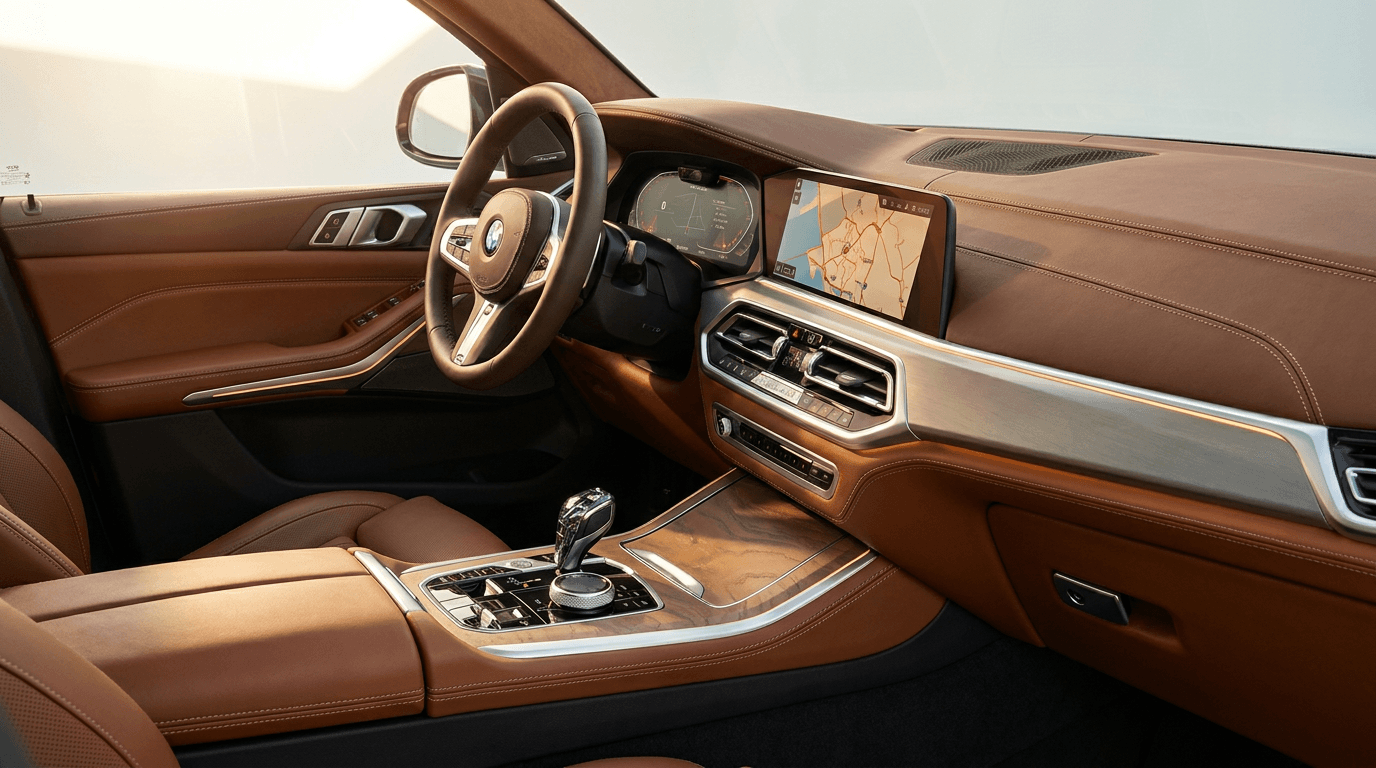
Prompt:
professional automotive interior detail photograph of [a luxury vehicle cabin showing the driver's side dashboard and center console area, the interior features rich cognac-brown full leather upholstery with visible detailed stitching in a contrasting lighter thread color, the dashboard is wrapped in soft-touch leather with a smooth clean design, a large central infotainment display with a crisp high-resolution screen showing a navigation interface, polished aluminum or brushed metal trim accents running along the dashboard and door panel, a leather-wrapped steering wheel with multifunction controls and a prominent badge at the center, the center console features a gear selector in polished metal and chrome a tactile control dial and an open-pore wood trim insert with warm natural grain] in warm ambient cabin lighting, the photograph is composed from the passenger side looking across toward the driver's seat and dashboard showing the full sweep of the dashboard design the center console the steering wheel and the front portion of the driver's seat, the angle reveals the layered architecture of the interior design — the instrument panel flowing into the center console the relationship between the displays and the physical controls and the material transitions from leather to metal to wood, the interior ambient lighting of the vehicle is activated — warm accent LED lighting in subtle strips along the dashboard edges and door panels in a soft warm amber or white creating gentle illumination that highlights the interior architecture and adds a premium technological glow, soft natural light enters from the driver's side window from the left side of the frame providing the primary illumination in a warm directional quality that models the leather texture grain and the stitching detail in dimensional warm light, the leather surface shows realistic texture — the natural grain pattern of high-quality hide the slight variation in color that indicates genuine leather and the precise even stitching that indicates premium craftsmanship, the polished metal trim catches focused bright highlights that communicate the quality and precision of the metalwork, the wood trim shows its natural grain pattern with warm organic depth, the infotainment screen emits a soft glow that contributes to the technological ambiance without overpowering the warm material textures, rich cognac-brown leather with warm highlights warm natural wood grain polished metal and aluminum trim accents soft warm ambient LED interior lighting warm natural window light and the deep warm tones of a luxury automotive cabin as the color palette, the mood is quietly luxurious materially rich technologically sophisticated and the particular tactile satisfaction of sitting in a beautifully crafted interior where every surface you touch has been considered and executed with precision, professional automotive interior photography with warm natural directional light supplemented by ambient interior lighting and a moderate depth of field that keeps the steering wheel dashboard and center console in sharp detail with the far door and rear cabin in gentle soft focus, composed from a passenger-side angle looking across the cabin with the steering wheel in the foreground left the center console in the middle ground and the dashboard display as a background element creating depth through the cabin, the leather texture and stitching quality as the tactile anchor and the warm ambient lighting as the atmospheric anchor, warm rich luxury interior tones with material detail, no text, no logos, no watermarks
Best for: Luxury and premium vehicle listing interior images, website vehicle detail and features pages, social media interior and craftsmanship content, email marketing luxury features and trim level highlights, magazine and editorial automotive interior features, print brochure interior spreads, customer comparison and decision-stage content showing interior quality
Template 4: The Lifestyle Context — Suburban Arrival
The lifestyle context photograph places the vehicle in the customer's life rather than in a studio or on a scenic road. This is the photograph that answers the customer's real question: what will this vehicle look like in my world? The suburban arrival scene — a vehicle in a driveway or in front of a home — is the most relatable lifestyle context for family vehicles, daily drivers, and mainstream market segments.
Prompt:
aspirational lifestyle automotive photograph of [a mid-size family SUV in a warm pearl white with a clean modern design, a prominent front grille, roof rails in silver, silver alloy wheels with an elegant multi-spoke design, and a smooth confident stance with enough ground clearance to communicate capability without looking oversized] parked in the driveway of an attractive residential home, the vehicle is positioned at a three-quarter front angle in a clean residential driveway — the driveway surface is clean pavers or smooth concrete — with the vehicle centered and the home visible behind and to one side providing lifestyle context without dominating the frame, the home is an attractive modern or transitional residential design in warm neutral tones — warm stone or painted exterior with well-maintained landscaping including green lawn sections and mature plantings suggesting an established desirable neighborhood, warm light glows from the home's windows suggesting evening and the family inside, the time of day is late afternoon approaching dusk — the sky shows warm sunset colors in soft gradients of warm peach and soft blue, and the vehicle is illuminated by the last warm directional sunlight of the day creating a golden glow on the pearl white paint that gives it a warm creamy luminosity, the headlights of the vehicle are on creating a crisp bright LED light signature that adds a technological focal point to the warm ambient scene, the pearl white paint is rendered with full depth — not flat white but a lustrous warm pearl with subtle iridescent quality visible in the broad highlight areas where the low sun catches the paint surface showing the depth of the pearl finish, the scene communicates arrival — this is the moment of coming home to a beautiful place in a vehicle that belongs here, the driveway and home environment are aspirational but attainable — this is not a mansion but an attractive home that represents the achievable aspiration of the target customer, warm pearl white vehicle with golden sunset luminosity silver trim accents warm LED headlight signatures clean driveway warm residential architecture warm glowing windows green landscaping warm sunset sky and soft directional golden hour light as the color palette, the mood is warmly aspirational comfortably accomplished peacefully arrived and the deep satisfaction of pulling into your driveway in a vehicle you are proud of to a home where the lights are on and the people you love are inside, professional lifestyle automotive photography with warm golden hour directional light and moderate depth of field keeping the vehicle sharp with the home and landscaping in contextual soft focus, composed from a three-quarter front angle at slightly below eye level from the street or drive approach perspective showing the vehicle in its residential context as if the viewer is seeing it for the first time as they approach, the vehicle and home relationship as the lifestyle narrative, warm golden residential tones with sunset atmosphere, no text, no logos, no watermarks, no license plates
Best for: Family and mainstream vehicle lifestyle marketing, website lifestyle and brand context pages, social media aspirational lifestyle content, email marketing lifestyle and family vehicle features, print advertising and brochure lifestyle spreads, seasonal content for spring and autumn campaigns, social media community and family-oriented content, targeted demographic marketing for suburban family buyers
Template 5: The Truck in Its Element — Rugged Capability
Truck buyers purchase capability, toughness, and the promise that the vehicle can handle whatever work or adventure demands of it. The truck-in-nature photograph communicates these qualities through environmental context — placing the truck in terrain that demonstrates its capabilities and speaks to the outdoor, work-capable lifestyle of the truck buyer.
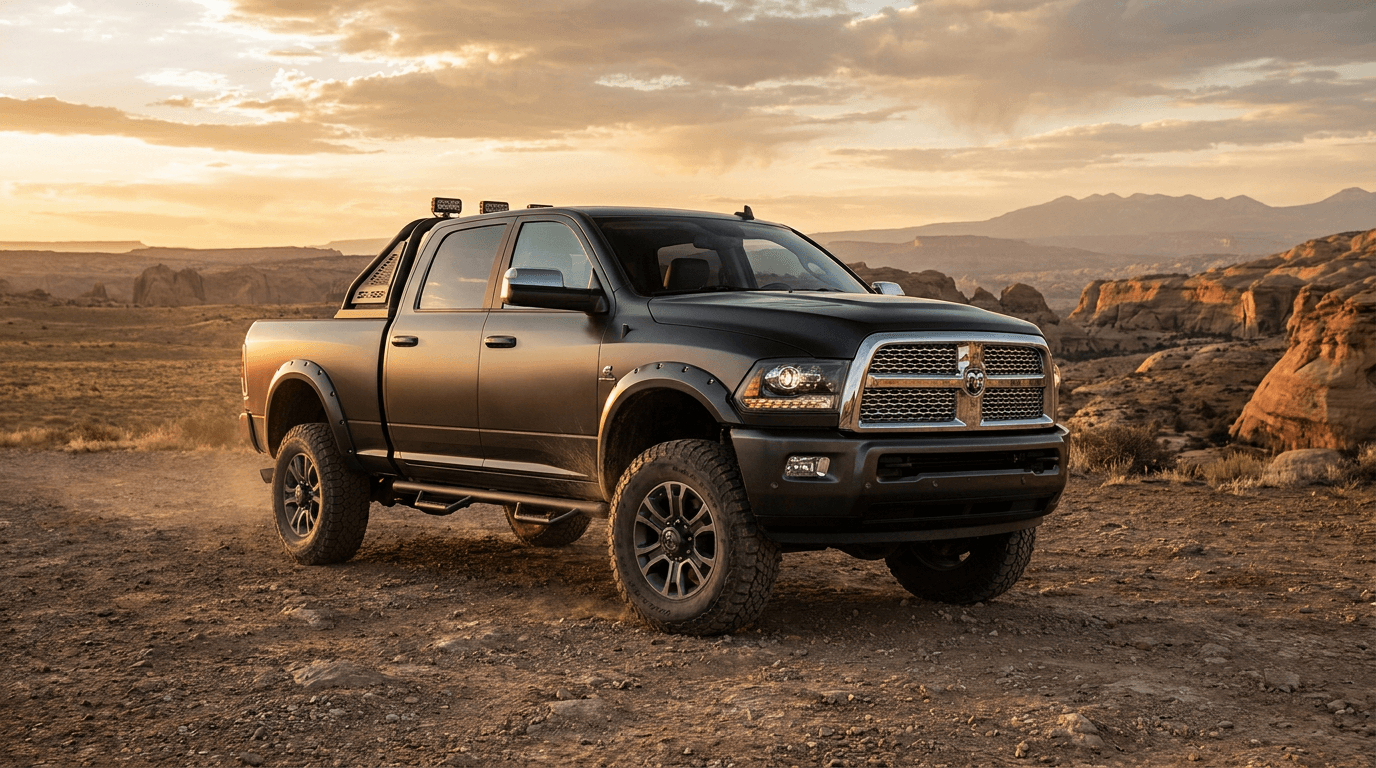
Prompt:
powerful automotive marketing photograph of [a full-size pickup truck in matte-finish dark grey or charcoal with a commanding presence, a tall ride height with visible ground clearance, aggressive all-terrain tires with deep tread pattern on dark heavy-duty alloy wheels, a bold chrome front grille and bumper, a muscular fender flare design, running boards, a bed-mounted toolbox or rack suggesting work readiness, and LED headlights with a wide aggressive lighting signature] positioned in a rugged outdoor environment, the truck is parked at a slight angle on a natural terrain surface — hard-packed dirt and gravel at the edge of a mountain trail or a cleared area near a work site — with the vehicle positioned to show its tall stance and commanding profile against a dramatic natural landscape, the terrain beneath the vehicle shows some dust and loose ground that contextualizes the truck in an off-pavement environment, the tires show slight dust from the terrain reinforcing the sense that this truck has been working or adventuring rather than sitting on a lot, the landscape is dramatic American West terrain — warm-toned rock formations open rangeland distant mountains or canyon edges in warm earth tones under a dramatic sky with volumetric clouds catching warm light, the time is late afternoon with warm golden directional sunlight from a low angle that catches the truck's bold lines in dramatic relief — the fender flares cast defined shadows the grille catches strong geometric highlights and the dark charcoal paint shows warm amber reflections from the landscape and sky, the overall lighting is dramatic and cinematic with strong directional warmth and deep natural shadows that give the scene a heroic quality, the truck dominates the frame with visual mass and presence — it looks heavy planted capable and unapologetically powerful in the way that full-size trucks are designed to look, the environment serves the truck rather than the other way around — the landscape is dramatic but the truck is the most commanding object in the scene, dark charcoal matte-finish body warm chrome grille and bumper highlights dark heavy-duty wheels aggressive tire tread warm earth-toned terrain dramatic warm sky late afternoon golden directional light and the rugged warm palette of the American outdoor landscape as the color palette, the mood is powerfully capable ruggedly confident dramatically commanding and the primal satisfaction of standing next to something built to handle anything — a machine that communicates toughness and readiness without saying a word, professional cinematic automotive photography with dramatic warm directional golden hour light and moderate depth of field keeping the truck sharp and dominant with the landscape receding into atmospheric warm depth behind it, composed from a low front three-quarter angle with the camera near ground level looking slightly up at the truck making it appear towering and powerful against the dramatic sky and landscape, the truck's mass and the landscape's drama as complementary visual forces, warm dramatic rugged tones with strong directional light, no text, no logos, no watermarks, no license plates
Best for: Truck and off-road vehicle listing hero and lifestyle content, website truck and capability showcase pages, social media rugged lifestyle and capability content, email marketing truck and outdoor vehicle features, print advertising and billboard campaigns for truck market, seasonal outdoor and adventure campaign content, YouTube and video thumbnail for truck reviews and content, targeted marketing for truck and utility vehicle buyer demographics
Template 6: The Electric Vehicle — Modern and Clean
The EV photograph communicates the future: clean technology, modern design, environmental consciousness, and the quiet sophistication of electric propulsion. The visual language of EV marketing differs from traditional automotive photography — it is cleaner, brighter, more architectural, and more aligned with technology marketing aesthetics than with traditional car advertising.
Prompt:
modern clean automotive marketing photograph of [a sleek electric vehicle crossover in a light matte silver or cool grey with a smooth aerodynamic body design that minimizes panel gaps and traditional grille elements, a closed front fascia with a subtle body-colored panel where a grille would traditionally be, flush door handles, aerodynamically optimized alloy wheels in a modern turbine-style design, thin LED headlights and taillights with a distinctive continuous light bar signature, and an overall design language that communicates technological advancement and clean efficiency] in a modern urban environment, the vehicle is positioned at a three-quarter front angle in a clean modern architectural setting — perhaps a minimalist concrete and glass building entrance a modern parking structure with clean geometric lines or a contemporary urban plaza with architectural elements in glass steel and concrete, the ground surface is clean and modern — smooth architectural concrete or clean stone pavers, a modern EV charging station is visible nearby connected or not to the vehicle — a clean sleek charging post in white or silver that reads as modern infrastructure rather than industrial equipment, the setting is clean bright and modern — the architectural environment uses clean lines neutral materials and geometric precision that visually rhymes with the vehicle's own design language, the time is a bright overcast day or a clear day with bright even ambient light — the lighting is bright and clean without strong shadows, creating a high-key modern look where the silver vehicle glows with soft bright reflections from the ambient light and the architectural surfaces, the paint finish is rendered as a smooth matte or satin silver — not the high-gloss mirror finish of traditional cars but a sophisticated matte surface that absorbs and scatters light in soft broad tones communicating modern material technology, the flush door handles and seamless body design create uninterrupted surface flows that catch soft ambient light in continuous gradients, the LED light signature is visible even in daylight as a thin precise technological accent, light matte silver vehicle body modern wheel design thin LED light signatures clean concrete and glass architecture white charging station bright overcast ambient light and the clean neutral palette of modern architecture and technology as the color palette, the mood is quietly technological cleanly sophisticated forward-thinking and the particular appeal of a machine that represents what comes next — cleaner quieter smarter and designed with a confidence that does not need to shout, professional modern automotive photography with bright clean ambient light and full depth of field keeping both the vehicle and the architectural environment sharp and detailed, composed from a three-quarter front angle at approximately eye level giving the vehicle a natural approachable proportion within its architectural context, the clean design lines of the vehicle echoing the clean lines of the architecture as a visual harmony, bright clean modern tones with technological precision, no text, no logos, no watermarks, no license plates
Best for: EV and modern vehicle listing hero, website EV and technology showcase, social media future-forward and technology-focused content, email marketing EV and clean technology features, dealership EV section and showroom content, press and editorial automotive technology coverage, targeted marketing for technology-forward and environmentally conscious buyers, brand positioning content for forward-thinking dealerships
Template 7: The Overhead Drone Shot — Vehicle and Landscape
The overhead drone perspective is one of the most dramatic and visually distinctive angles in automotive photography. It places the vehicle within a larger landscape, communicating both the vehicle's relationship to the road and the aspirational freedom of driving. This cinematic angle generates exceptionally high engagement on social media because it offers a perspective that is inherently dramatic and unusual.
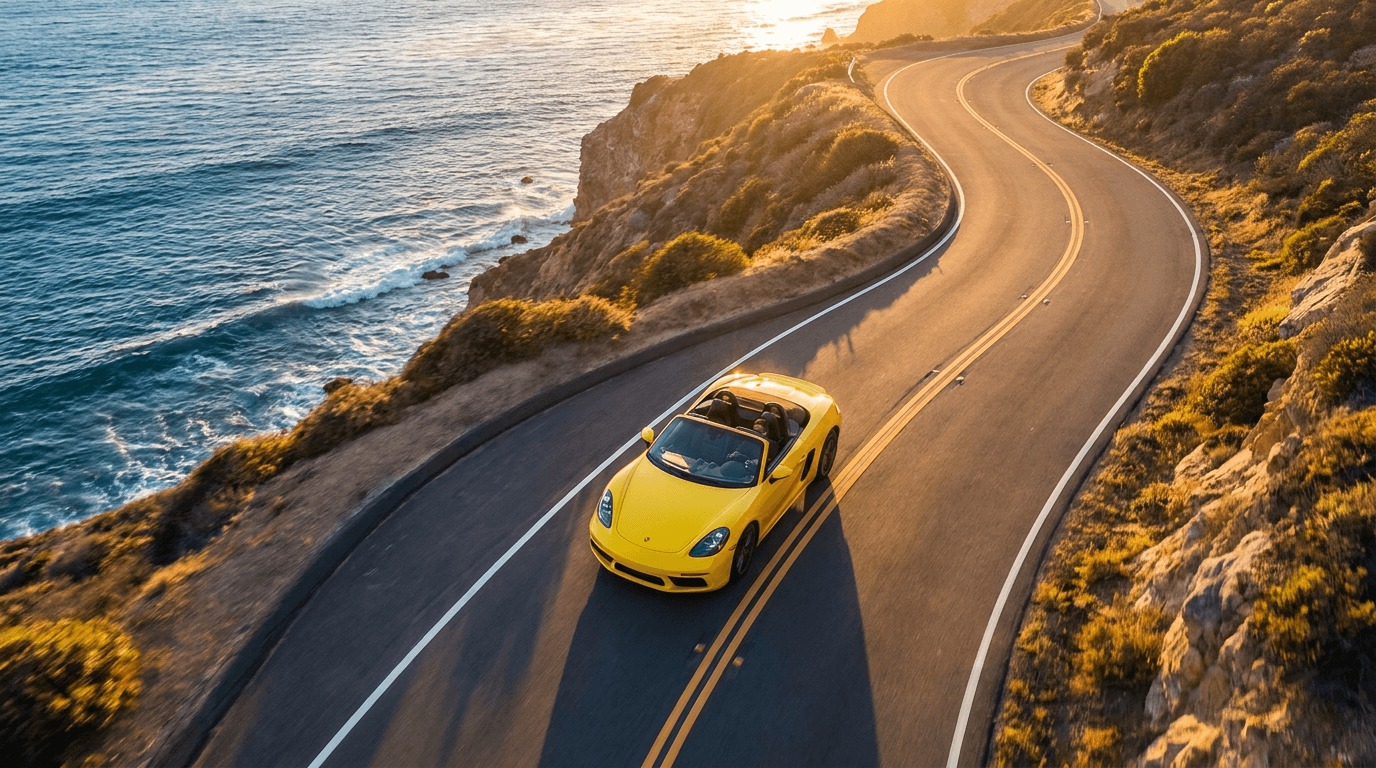
Prompt:
cinematic aerial automotive photograph taken from a high drone perspective looking down at a steep angle at [a convertible sports car in bright vivid yellow with the top down revealing dark leather interior and a clean cockpit design, the car has a long hood short rear deck classic sports car proportion with sculpted rear haunches and dual round exhaust tips] driving on a dramatic coastal road, the vehicle is captured from approximately 45 degrees above and behind while moving along a winding coastal highway that hugs a dramatic cliff edge, the road is a smooth dark ribbon with clean painted markings carving along the coastline with dramatic curves visible ahead and behind the vehicle creating a flowing S-curve composition, on one side of the road the terrain drops away to a dramatic ocean view — deep blue water with white wave lines breaking against rocky cliffs far below, on the other side warm-toned coastal terrain with natural scrub vegetation and warm rock formations rises from the road edge, the convertible top is down and the dark interior is visible from above creating a contrast with the bright yellow exterior and showing the cockpit as an open invitation, the vehicle is positioned in its lane with a slight dynamic quality suggesting it is actively driving the curves with purpose and enjoyment, the lighting is bright warm afternoon or golden hour light casting warm tones across the landscape and creating a rich warm glow on the yellow paint from above, the ocean reflects the sky in deep blues with warm highlights and the coastal terrain glows with warm golden afternoon tones, the overall image reads as a map of a perfect drive — the winding road the dramatic landscape the open car and the freedom of driving with no roof between you and the sky, bright vivid yellow sports car dark open cockpit deep blue ocean white breaking waves warm coastal terrain dark winding road warm golden afternoon light and the dramatic palette of a coastal landscape from above as the color palette, the mood is breathtakingly free cinematically dramatic gloriously open and the pure aspirational fantasy of driving a bright sports car on a perfect coastal road with the top down and the ocean far below and the road curving endlessly ahead, professional cinematic aerial automotive photography with warm bright natural light and full depth of field keeping the vehicle the road and the landscape all sharp from the elevated perspective, composed from a high three-quarter overhead drone angle with the road creating a leading line through the frame and the vehicle positioned at the dynamic point of a curve with the ocean landscape creating the dramatic context, the road as a compositional spine and the vehicle as the bright focal point against it, warm cinematic tones with vivid yellow accent against blue ocean and warm earth, no text, no logos, no watermarks, no license plates
Best for: Social media hero and high-engagement cinematic content, website banner and homepage hero, print advertising and billboard campaigns, YouTube and video thumbnail for driving content, Instagram and Pinterest automotive boards, email marketing aspirational and lifestyle features, brand-level marketing and campaign hero imagery, seasonal and summer driving campaign content
Template 8: The Pre-Owned Lot — Clean Inventory Presentation
The pre-owned or used vehicle inventory photograph has different priorities than aspirational brand photography. It must communicate trust, honesty, and quality above aspiration. The customer looking at a used vehicle listing wants to see the vehicle clearly, assess its condition, and feel confident that the dealership is presenting the vehicle honestly. This is clean, clear, well-lit inventory photography that builds trust.
Prompt:
clean honest automotive inventory photograph of [a pre-owned mid-size sedan in solid medium blue with a well-maintained exterior showing clean paint with good gloss, standard alloy wheels in silver that are clean and presentable, chrome trim in good condition, clear headlights and taillights, and an overall appearance that communicates a well-cared-for vehicle in good condition without trying to appear brand-new] in a clean dealership setting, the vehicle is positioned at the standard three-quarter front angle on a clean surface — a clean section of dealership lot or a designated photography area with clean pavement or concrete and no other vehicles or clutter visible in the immediate surroundings, the background is a clean dealership environment — perhaps the dealership building in a neutral and professional appearance or a clean wall or backdrop that provides a neutral undistracting context, the area is tidy and well-maintained communicating dealership professionalism and care, the lighting is bright clean and honest — a bright overcast day that provides even diffused light across all surfaces showing the vehicle's condition clearly without harsh shadows that hide details or dramatic lighting that obscures reality, the bright even light shows the paint condition clearly — the blue paint has good gloss and color consistency with the even light revealing the surface condition honestly, the vehicle is clean and well-presented — it has been washed and detailed for the photograph with clean glass clean wheels and a tidy appearance that shows the dealership took care in preparing it, the photograph is informational first and aspirational second — every panel line every body line every trim piece and every wheel is visible and assessable and the customer can evaluate the vehicle's condition from this single clear well-lit photograph, the composition is professional and standardized — this is the kind of consistent inventory photography that communicates a dealership that photographs every vehicle with the same care and professionalism, medium blue vehicle clean silver wheels chrome trim clean pavement bright even overcast light professional dealership background and the straightforward honest palette of clean inventory photography as the color palette, the mood is honestly presented professionally photographed trustworthily clear and the reassurance of a dealership that shows its vehicles clearly and confidently because it has nothing to hide, professional automotive inventory photography with bright even ambient light and full depth of field keeping the entire vehicle sharp and assessable from front wheel to rear quarter, composed at the standard three-quarter front angle at eye level showing natural honest proportions with the vehicle centered on clean ground against a professional background, the vehicle's condition and honest presentation as the visual priority, clean bright honest tones with no dramatic manipulation, no text, no logos, no watermarks, no license plates
Best for: Used vehicle inventory listing primary images, pre-owned certification and CPO program listings, online marketplace and classified listing primary photos, dealership website used inventory pages, auction and wholesale vehicle photography, fleet and commercial vehicle listings, trust-building content for pre-owned programs, standardized inventory photography for consistency across all listings
Template 9: The Night City — Urban Electric Glow
The night urban photograph transforms the vehicle into a character in a cinematic city scene. Reflections of city lights on wet streets, the glow of neon, the drama of a vehicle illuminated in darkness — this is high-engagement content that generates shares, saves, and emotional responses on social media. It positions the vehicle as part of a lifestyle that is urban, dynamic, and exciting.
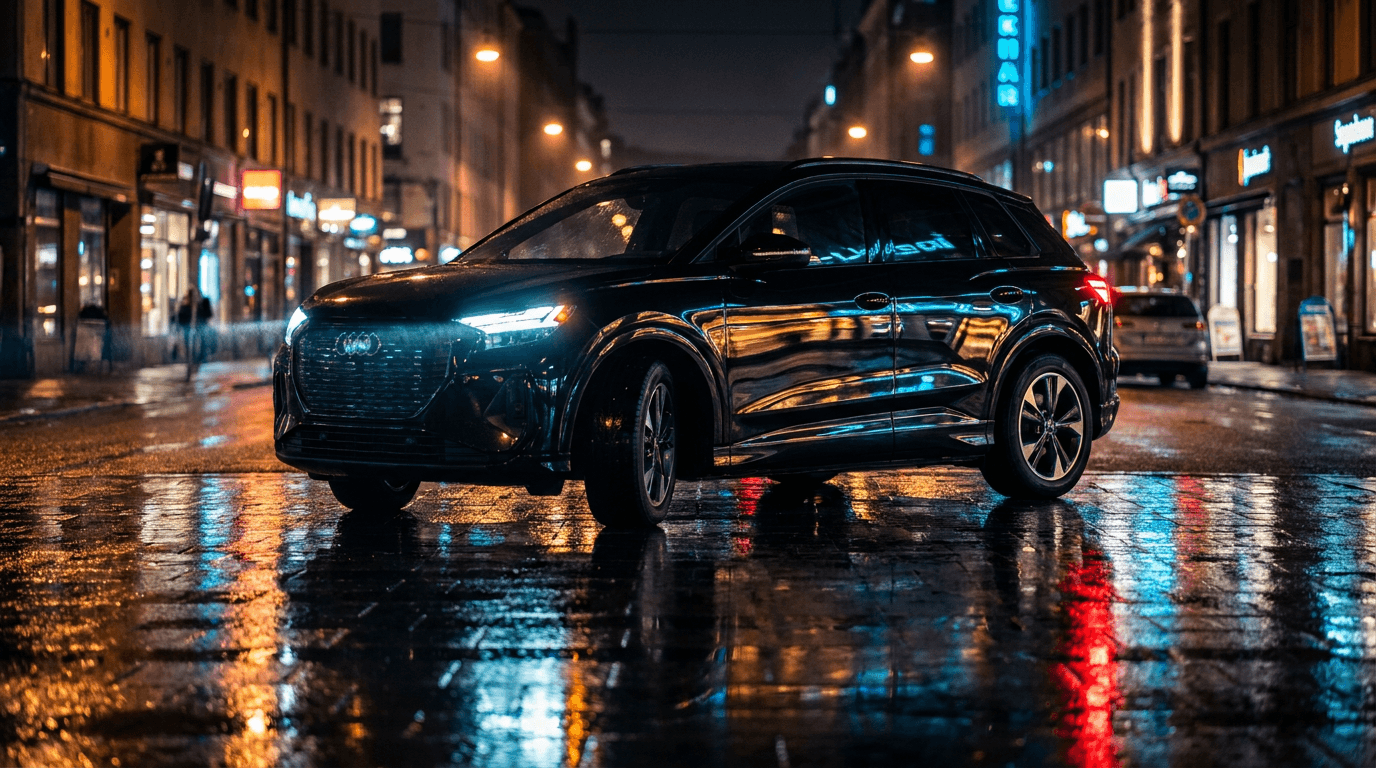
Prompt:
cinematic night automotive photograph of [a compact luxury crossover or sporty hatchback in deep gloss black with a sleek modern design, LED headlights on with sharp bright white light projecting forward, LED taillights glowing with a distinctive red light signature, the vehicle's paint is so deeply glossy that it acts as a mirror reflecting the surrounding city lights in colorful streaks across its dark surface] parked in a dramatic urban night scene, the vehicle is positioned at a three-quarter front angle on a city street at night with the headlights on casting bright white beams into the darkness ahead, the street surface is wet from recent rain creating a reflective mirror-like surface that doubles the city lights and the vehicle's own lighting in stretched colorful reflections on the wet pavement, the urban environment around the vehicle is a mix of city elements — the warm glow of street-level businesses and restaurants on one side casting warm amber and golden light, modern building facades with architectural lighting, and the suggestion of a vibrant city nightlife district, the city lights create a rich tapestry of colorful reflections on the wet vehicle surfaces — warm amber from street lights cool blue from building accent lights the warm glow of nearby windows — each reflected in stretched abstract forms across the curved black paint creating a constantly moving light painting on the vehicle's body, the vehicle's LED headlights are the brightest and sharpest light sources in the scene projecting crisp white light forward through the slight mist or humidity of the wet night air creating subtle visible light beams, the LED taillights glow with warm red intensity reflected in the wet pavement behind the vehicle, the night sky above is dark urban sky with the diffused warm glow of city light pollution creating a warm dark canopy, deep gloss black vehicle body with colorful city light reflections crisp white LED headlights warm red LED taillights wet reflective street surface warm amber business lights cool blue architectural accents the mixed warm and cool lights of a city night and the cinematic darkness of an urban night scene as the color palette, the mood is cinematically dramatic urbane and sophisticated electrically alive and the particular magnetism of a beautiful car on a wet city street at night when the lights are doubled in the pavement and the whole scene looks like a frame from a film, professional cinematic night automotive photography with mixed urban light sources and shallow to moderate depth of field keeping the vehicle and immediate street surface sharp with the background city lights falling into atmospheric bokeh, composed from a low three-quarter front angle with the camera near street level emphasizing the wet street reflections and the vehicle's presence against the urban backdrop, the wet street reflections and the vehicle's LED lighting as the visual anchors, rich dark cinematic tones with colorful urban light accents, no text, no logos, no watermarks, no license plates
Best for: Social media high-engagement and shareable content, website hero and brand imagery, Instagram and TikTok automotive lifestyle content, email marketing aspirational and lifestyle features, print and digital advertising night-themed campaigns, YouTube and video thumbnail for night driving content, automotive brand-level marketing imagery, targeted marketing for urban and young professional demographics
Template 10: The Side Profile — Design Showcase
The pure side profile is the automotive equivalent of an architectural elevation drawing: it shows the vehicle's design proportions — roofline, beltline, greenhouse, stance — with mathematical clarity. This is the angle that automotive designers use to evaluate their work, and it is the angle that enthusiasts and informed buyers study to assess design quality.
Prompt:
clean professional automotive design photograph of [a luxury grand touring coupe in a rich dark British racing green with a long hood fastback roofline short rear overhang wide rear haunches and elegant proportions that communicate speed even while stationary, the side profile reveals a flowing character line that runs from the front fender through the door and kicks up over the rear wheel creating a muscular visual tension, the roofline arcs smoothly from the A-pillar through a gently sloping fastback to a subtle integrated rear spoiler, multi-spoke forged alloy wheels in a dark brushed metal finish with thin high-performance tires, the side windows are framed in a chrome surround that defines the greenhouse shape, and the overall profile reads as a single flowing line from nose to tail with no abrupt transitions] in a clean neutral environment that showcases the design profile, the vehicle is photographed in a pure side-on profile — perfectly perpendicular to the vehicle's centerline showing the complete profile from nose to tail with the full roofline silhouette visible against the background, the vehicle sits on a clean neutral surface — polished concrete or smooth light asphalt — that provides a calm ground plane without competing for attention, the background is deliberately simple and clean — a long neutral wall in warm light grey or a natural landscape reduced to soft color blocks of warm earth and sky, the simplicity of the environment ensures that every curve line proportion and design detail of the vehicle's profile is visible and can be studied and appreciated without distraction, the lighting is clean directional and modeling — a large soft source from slightly above and from the viewing side that creates a smooth gradient across the vehicle's surface brightening the upper shoulder and hood and gradually deepening in tone toward the lower body and rockers, this lighting gradient reveals the body's three-dimensional form through the subtle tonal changes across its surfaces while maintaining rich color saturation in the dark green paint, the racing green paint is rendered with full complexity — a deep dark green with warm undertones that emerge in the highlighted areas giving the color a rich British-luxury quality and dark depth in the shadow areas where the green approaches black, the chrome window surround catches a clean bright highlight that defines the greenhouse shape, the dark wheels are detailed and precise with each spoke visible, rich dark British racing green with warm highlight undertones chrome window surround highlights dark brushed alloy wheels clean neutral ground plane warm neutral background and clean directional modeling light as the color palette, the mood is designfully pure proportionally perfect elegantly restrained and the particular appreciation that comes from seeing a beautifully proportioned vehicle in pure profile — when you can see every line decision every curve transition and every proportion relationship that makes the design work as a complete whole, professional automotive design photography with clean directional light and full depth of field keeping every detail of the profile sharp from front bumper to tail with the clean background in soft neutral tone, composed in a pure side profile with the vehicle centered in the frame and space above and below to show the full silhouette against the clean background, the flowing profile line and proportional harmony as the sole visual subject, clean elegant tones with deep rich paint color, no text, no logos, no watermarks, no license plates
Best for: Design-focused and enthusiast content, website vehicle design and specification pages, social media automotive design and appreciation content, print magazine and editorial automotive features, comparison content showing design differences between models, brand marketing highlighting design philosophy, poster and wall art automotive content, enthusiast community and forum content
Template 11: The Fleet and Commercial — Professional Utility
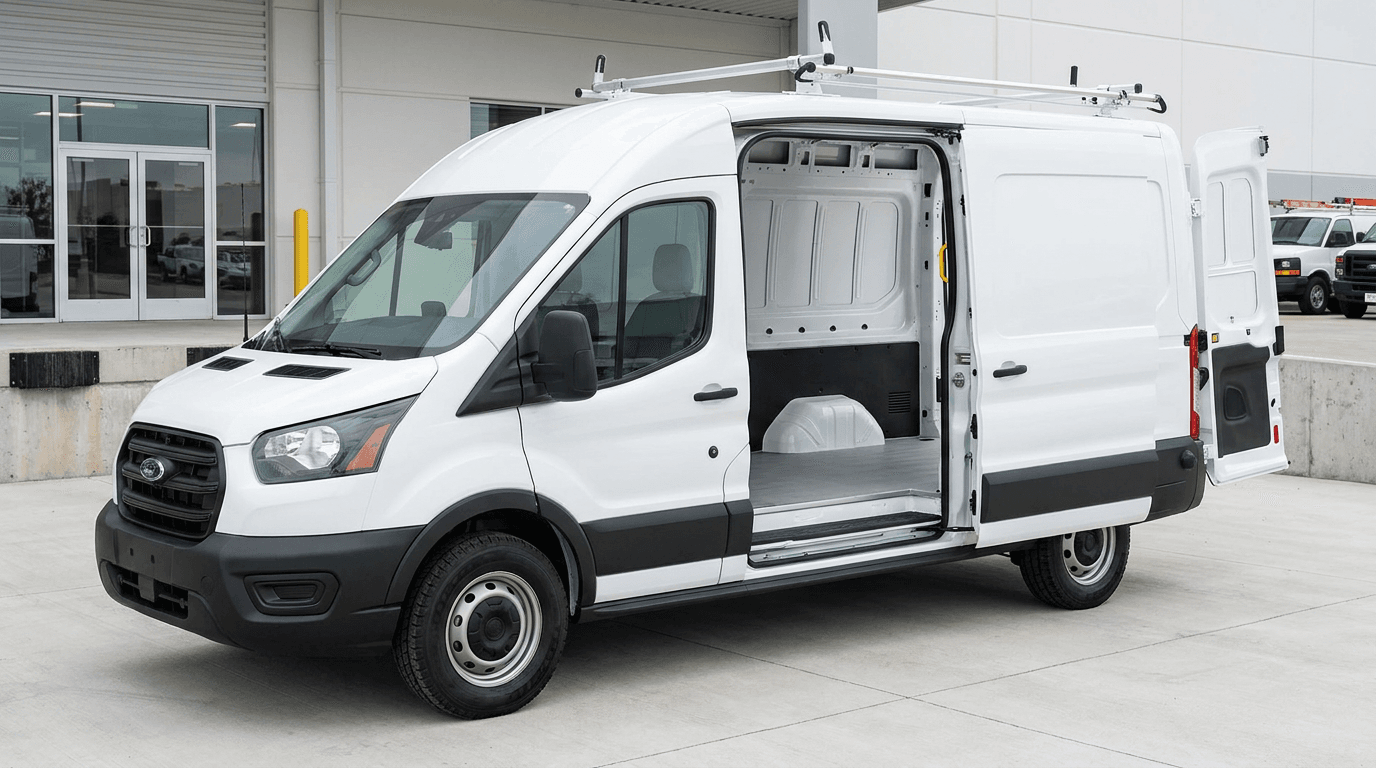
Fleet, commercial, and work vehicles require photography that communicates professional capability, reliability, and the practical virtues that fleet managers and business owners evaluate: cargo space, durability, configuration options, and total cost of ownership. This is functional, professional photography that speaks the language of business utility.
Prompt:
professional commercial automotive photograph of [a fleet-spec cargo van or work truck in clean white with commercial body graphics or a clean fleet-ready appearance, the vehicle has a high-roof cargo configuration with rear cargo doors and a sliding side door, practical steel wheels with commercial-grade tires, roof-mounted cargo rails or a ladder rack, and a clean professional appearance that communicates work-ready reliability with a well-maintained commercial fleet vehicle condition] in a professional commercial environment, the vehicle is positioned at a three-quarter front angle in a clean commercial or light industrial setting — a clean warehouse entrance a commercial district street or a professional business park with clean modern commercial architecture visible in the background, the side sliding door is open revealing the clean organized cargo area interior — the cargo space is visible and appears spacious clean and ready to be configured or loaded with a clean floor surface and clean interior walls, the opening of the cargo area communicates the practical utility of the vehicle showing the usable space that is the vehicle's primary value proposition for a commercial buyer, the ground surface is clean commercial pavement or concrete — a professional loading area or clean parking surface suggesting a well-maintained business operation, the lighting is bright clear and professional — a bright clear day with clean even light that shows the vehicle's condition and configuration clearly and communicates the practical transparency that commercial buyers expect, the white paint is clean and bright showing good maintenance and fleet-readiness, the practical details are visible and sharp — the commercial tires the roof rack the cargo dimensions the door configuration — each element readable as a feature that serves a professional purpose, the surrounding commercial environment provides business context without distraction — clean functional architecture working vehicles in the background if appropriate a sense of an active but organized commercial operation, clean white commercial vehicle practical steel or alloy wheels commercial tires roof rack visible cargo interior bright even daylight clean commercial pavement professional commercial architecture and the straightforward palette of commercial and fleet photography as the color palette, the mood is professionally capable reliably functional practically impressive and the particular confidence that comes from a commercial vehicle that is so clean well-maintained and work-ready that it communicates the professionalism of the business that operates it, professional commercial automotive photography with bright even light and full depth of field keeping the vehicle and its visible cargo space fully sharp and assessable, composed at a three-quarter front angle with the side door open showing cargo space at a commercial eye-level perspective, the vehicle's utility and the open cargo space as the commercial selling points, clean bright professional tones with practical commercial context, no text, no logos, no watermarks, no license plates
Best for: Fleet and commercial vehicle listings, commercial vehicle dealer website and inventory pages, fleet management and leasing company marketing, commercial vehicle auction and wholesale photography, email marketing fleet and commercial vehicle features, print and digital advertising for commercial vehicle programs, B2B marketing and fleet sales presentations, work truck and van upfitter marketing
Template 12: The Wheel and Detail Close-Up — Premium Finish
The detail close-up is the photograph that communicates the level of quality that distinguishes premium vehicles from standard ones. It is the stitching on the leather, the machined finish of the alloy wheel, the jewel-like quality of the headlight lens, the precision of the badge — the details that justify the price point and that the customer wants to examine before committing to a significant purchase.
Prompt:
professional automotive detail close-up photograph of [a premium vehicle's front wheel and brake assembly — a large-diameter multi-spoke forged alloy wheel in a polished silver and machined-face finish showing the precise geometric pattern of the spoke design, behind the spokes a visible performance brake caliper in a bold painted finish — red or yellow — with the manufacturer's lettering embossed on the caliper body, the brake rotor is a cross-drilled or slotted ventilated disc with a metallic machined surface showing the engineering of the braking system, the tire is a premium ultra-high-performance specification with a clean sidewall showing the tire brand and size markings in crisp relief, the wheel arch above shows a section of the vehicle's body in a deep metallic color with the fender shape visible] in a premium close-up detail context, the photograph is composed tight on the wheel and brake assembly filling the frame with the wheel as the primary subject — the spoke pattern the brake caliper and rotor visible through the spokes and a portion of the tire and fender creating a complete wheel-corner detail study, the wheel surface shows the precision of the manufacturing — the machined face of each spoke has a mirror-bright finish while the inner areas have a complementary satin or painted finish creating visual depth within the wheel design, the brake caliper is rendered in crisp detail with the painted surface smooth and glossy and the embossed text readable, the cross-drilled rotor shows its individual drill holes in precise geometric patterns communicating engineering sophistication, the lighting is dramatic and close — a strong directional light from one side that catches the machined wheel surface in bright detailed highlights while creating depth through shadows between the spokes and behind the caliper, the metallic surfaces interact with the light in different ways — mirror-like reflections on the machined spoke faces smooth glossy reflections on the painted caliper and a matte metallic texture on the rotor face — creating a rich study in metallic surface textures, the vehicle body section visible above is rendered in deep rich color with the directional light creating a smooth gradient that shows the paint quality and fender curve, polished silver machined alloy wheel faces bold red or yellow brake caliper metallic rotor surface black tire sidewall deep metallic body color dramatic directional side light and the rich metallic palette of precision automotive engineering as the color palette, the mood is precisely engineered beautifully machined technically impressive and the specific appreciation of automotive engineering expressed through the details that most people never look at closely enough — the details that separate ordinary vehicles from extraordinary ones, professional automotive detail photography with dramatic directional light and shallow depth of field keeping the wheel spokes and brake caliper in razor-sharp detail with the tire outer edge and fender falling into soft focus, composed tight from a slight low angle looking at the wheel face with the brake assembly visible through the spokes as the secondary subject behind the primary spoke pattern, the machined precision and material quality as the visual fascination, dramatic metallic tones with bold caliper color accent, no text, no logos, no watermarks
Best for: Premium and performance vehicle detail pages, website feature and specification highlight content, social media detail and engineering appreciation content, email marketing performance and premium trim features, print advertising and brochure detail insets, automotive review and comparison detail photography, enthusiast and performance community content, aftermarket wheel and brake marketing
Template 13: The Dealership Showroom — Vehicle in Retail Context
The showroom photograph bridges the gap between online browsing and the physical dealership experience. It shows the vehicle in the actual retail environment — the dealership floor, the showroom lighting, the professional context — giving the online customer a preview of the in-person experience and communicating the dealership's quality and professionalism.
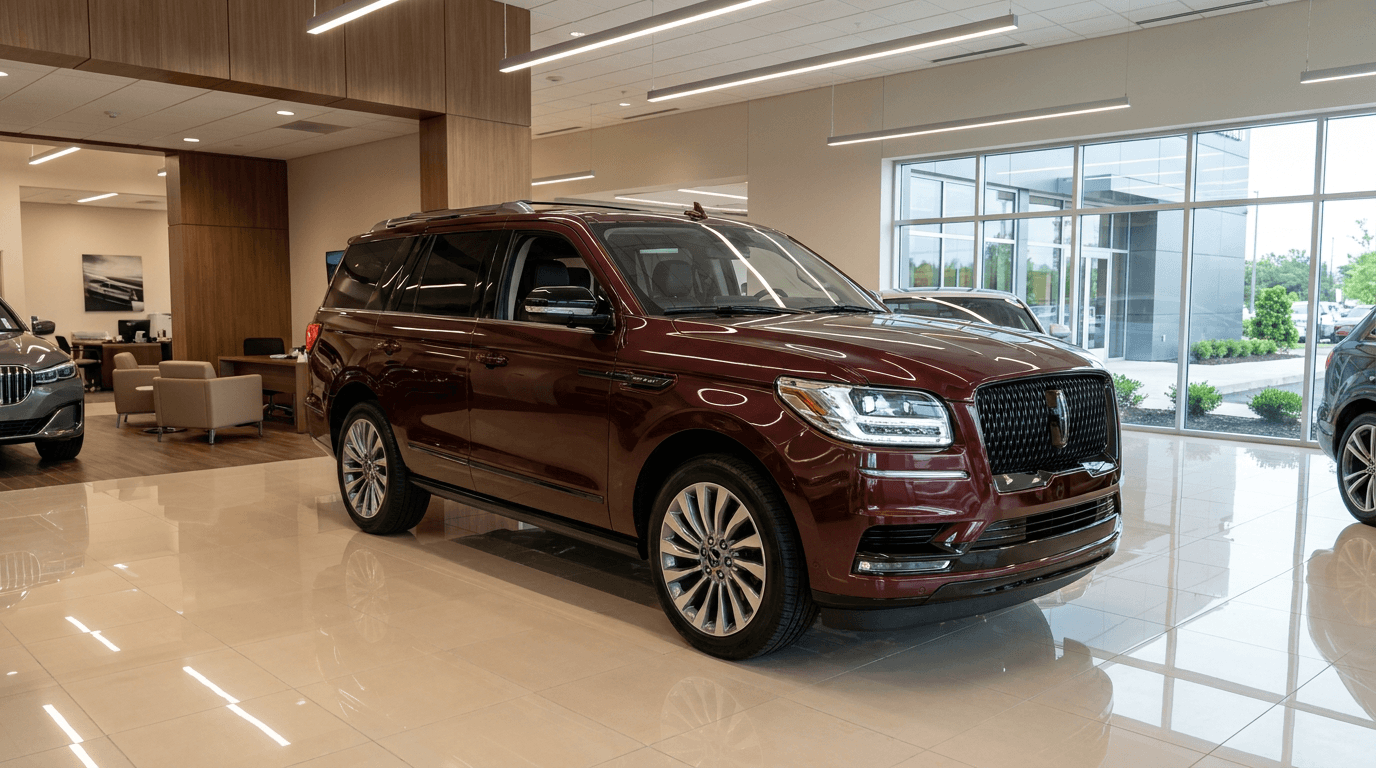
Prompt:
professional automotive showroom photograph of [a new luxury SUV in a deep metallic burgundy or maroon with a commanding presence, LED headlights with jewel-like DRL signatures, a bold upright front grille with premium chrome or gloss black detailing, polished multi-spoke alloy wheels, and the substantial proportions of a full-size premium SUV that fills the showroom space with presence] displayed on the showroom floor of a premium dealership, the vehicle is positioned at a three-quarter front angle on the polished showroom floor — the floor surface is highly polished light-colored tile or polished concrete that shows a clear mirror reflection of the vehicle beneath it adding visual depth and a sense of premium retail environment, the showroom environment around the vehicle communicates dealership quality — large glass windows or walls allowing natural light to enter and views of the outside landscaping or the dealership exterior, modern architectural elements in warm neutral materials with clean lines, a portion of the showroom ceiling with modern lighting fixtures visible providing the overhead illumination, the showroom is clean spacious and modern with the vehicle having room around it as the featured centerpiece rather than being crowded among other vehicles, other vehicles may be partially visible at the far edges of the frame in soft focus suggesting inventory depth without competing with the hero vehicle, a customer lounge area or a consultation desk may be subtly visible in the background adding human and retail context, the lighting is a combination of bright showroom overhead lighting — modern LED fixtures that provide clean even illumination — and natural daylight entering through the glass walls creating a bright open atmosphere, the overhead showroom lights create multiple precise highlight reflections on the vehicle's curved surfaces mapping the ceiling lights across the hood roof and fenders in clean bright points and streaks that communicate the paint's gloss and the showroom's professional lighting, the deep metallic burgundy paint is rich and luxurious under the mixed lighting showing warm depth in the natural light areas and precise reflections under the overhead fixtures, deep metallic burgundy body polished chrome or gloss black trim polished alloy wheels bright LED DRL accents polished light showroom floor with reflection warm neutral showroom architecture natural light through glass walls overhead showroom lighting and the bright clean palette of a premium automotive retail environment as the color palette, the mood is retail-ready professionally displayed invitingly premium and the anticipation of walking into a showroom and seeing a beautiful vehicle perfectly presented under perfect light on a perfect floor waiting for the customer who will take it home, professional showroom automotive photography with bright mixed natural and showroom lighting and moderate depth of field keeping the vehicle sharp with the showroom environment providing context in gentle soft focus, composed from a customer-perspective three-quarter front angle at approximately standing eye level as if the viewer has just walked onto the showroom floor and seen this vehicle across the space, the vehicle and its floor reflection as the visual centerpiece within the premium retail context, bright clean showroom tones with rich vehicle color, no text, no logos, no watermarks, no license plates
Best for: Dealership website homepage and featured inventory, showroom virtual tour and Google Business imagery, social media new arrival and featured vehicle content, email marketing new vehicle and featured inventory announcements, print advertising dealership experience and quality, customer-facing presentation and CRM materials, manufacturer co-op advertising, Google and social media paid advertising imagery
Template 14: The Classic or Vintage — Heritage and Character
The classic or vintage vehicle photograph requires a distinct visual approach that honors the vehicle's age, character, and historical significance while presenting it as a desirable acquisition. This is the aesthetic of automotive heritage — patina, character, timeless design, and the particular beauty of a machine that has endured.
Prompt:
evocative automotive photograph of [a classic vintage sports car from the 1960s era in a warm faded racing red or warm terracotta red with gentle patina showing its age gracefully, chrome bumpers with warm reflections, round headlights with chrome surrounds, wire spoke wheels with thin whitewall or classic-profile tires, a long elegant hood with subtle bulge and hood louvers, a small curved windshield, and the flowing organic body lines that characterize hand-formed coachwork of the era — curves that no modern stamping process can replicate] in a setting that honors its era and character, the vehicle is positioned at a three-quarter front angle on a surface and in an environment that complements its vintage character — a cobblestone courtyard a gravel drive in front of a warm stone building or a rural road with warm-toned countryside, the surface has warm natural texture — aged stone warm gravel or weathered pavement that visually belongs to the same era as the vehicle, the environment carries the warmth and character of the vehicle's historical context — warm-toned architecture with aged stone or brick natural vegetation with warm green and golden tones the suggestion of a European countryside or a historic estate, the chrome elements — bumpers headlight surrounds door handles and grille — catch warm reflections from the environment creating soft warm bright accents across the vehicle's form that are the visual signature of vintage chrome, the red paint shows the complexity of age — the color is still rich and beautiful but has a warmth and depth that only decades of sun and polish produce, with subtle variation in tone that tells the story of the car's life, the wire wheels are detailed and intricate — each spoke visible catching light individually creating a web of bright thin highlights that contrast with the dark hub and brake drum behind them, the round headlights have a simple honest character that modern complex headlight designs cannot replicate, the lighting is warm golden afternoon light that is perfectly suited to vintage vehicles — warm directional light from a low angle that catches the chrome in warm highlights models the flowing body curves in rich warm light and shadow and gives the entire scene a timeless warmth that could be this afternoon or fifty years ago, the warm light and the warm environment create an amber warmth that envelops the vehicle in the visual atmosphere of memory and enduring beauty, warm faded racing red or terracotta with age character warm chrome reflections wire spoke wheel highlights warm stone or cobblestone warm natural surroundings golden afternoon light and the warm nostalgic palette of vintage automotive beauty as the color palette, the mood is timelessly beautiful characterfully aged romantically nostalgic and the particular emotional response that a beautiful old car produces — the understanding that this machine has outlived its original owner lived through decades of history and is still beautiful still desirable still capable of making someone feel something profound, professional vintage automotive photography with warm golden afternoon directional light and moderate depth of field keeping the vehicle in rich sharp detail with the period-appropriate environment in soft warm atmospheric blur, composed from a three-quarter front angle at a slightly low position that gives the vintage vehicle a sense of presence and importance, the flowing body lines and chrome details as the visual anchors within the warm atmospheric setting, warm rich vintage tones with nostalgic golden light quality, no text, no logos, no watermarks, no license plates
Best for: Classic and vintage vehicle listings, specialty and collector vehicle dealership marketing, website classic car inventory and feature pages, social media vintage automotive and heritage content, email marketing special inventory and collector vehicle features, print advertising and editorial classic car features, auction and consignment marketing materials, enthusiast event and car show promotional content, automotive heritage and brand history content
Template 15: The Key Handover — The Purchase Moment
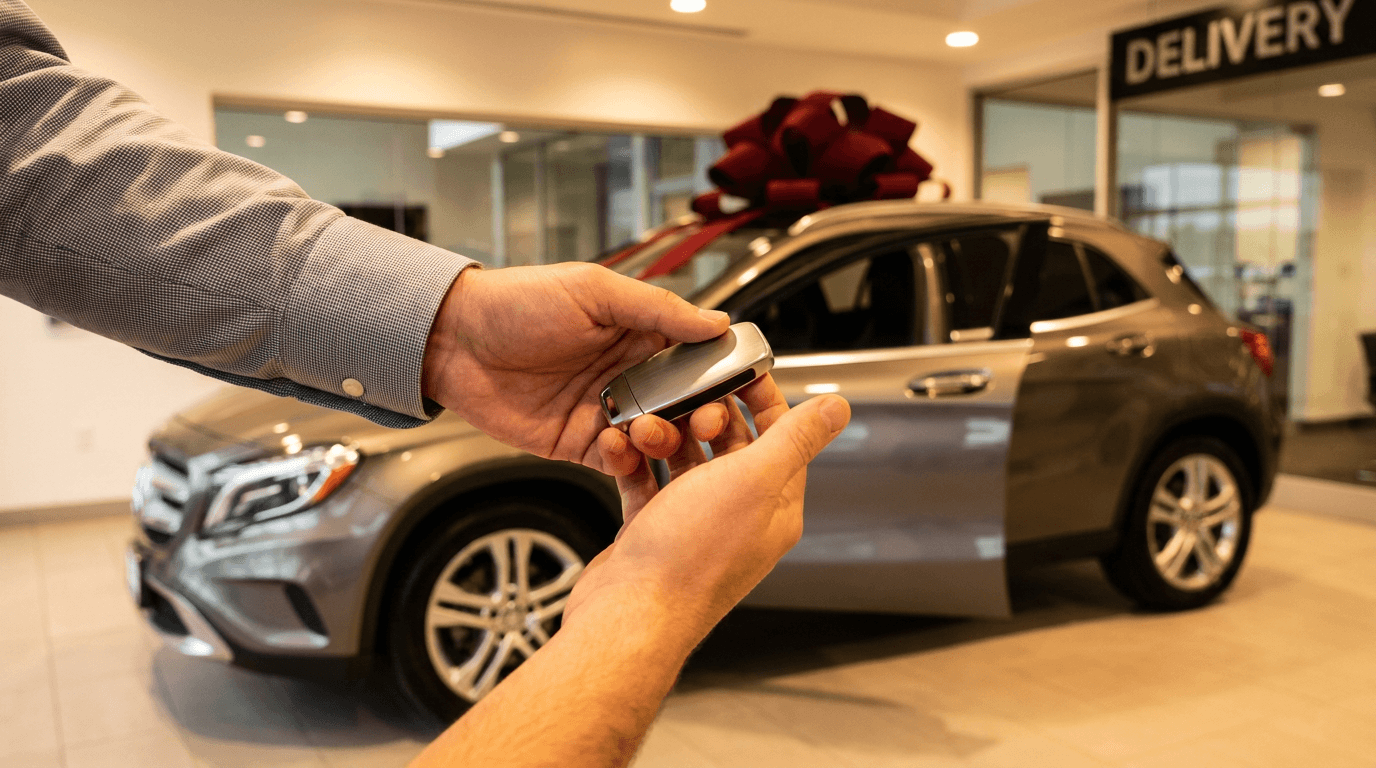
The key handover photograph captures the emotional peak of the car buying journey: the moment the customer receives the keys to their new vehicle. This is the most emotionally potent image in dealership marketing because it shows the moment that every potential buyer wants to experience. It transforms the transaction into a celebration and the dealership into the place where that celebration happens.
Prompt:
emotionally resonant automotive lifestyle photograph of [a new compact luxury crossover in a sophisticated warm metallic grey or champagne with a clean modern design, polished alloy wheels, and a fresh just-detailed showroom condition with the paint gleaming under showroom lighting] at the moment of customer delivery, the scene shows the moment of key handover — a dealership sales professional's hand extends a modern key fob toward the customer's reaching hand, the hands are the focal point of the frame meeting over the key fob in the gesture that represents the transition of ownership, the key fob is a modern premium design — clean sculpted with the suggestion of a quality finish — catching the light as the central object of the exchange, the vehicle is visible behind the handover moment positioned in a clean delivery area — this could be the showroom floor a dedicated delivery bay or a clean covered area of the dealership, the vehicle is perfectly prepared — freshly detailed gleaming under clean light with a large ceremonial bow or simply in its immaculate showroom condition, the vehicle's driver door may be open welcoming the new owner, the dealership environment is professional and warm — clean modern architecture warm lighting and the sense of a well-maintained premium facility, the mood is one of celebration achievement and the beginning of a new relationship between the customer and their vehicle, the lighting is warm and bright with a slight warm emphasis on the key handover moment — the key fob catches a bright highlight and the hands meeting over it are warmly lit creating a human emotional focal point within the automotive context, the vehicle behind glows with clean showroom light in its polished metallic finish, the overall image tells the story that every car buyer wants to be part of — the moment when the months of research the visits the decisions all resolve into the simple physical act of receiving the keys and the vehicle becomes yours, warm metallic grey or champagne vehicle polished wheels warm skin tones modern key fob bright showroom lighting warm dealership environment and the bright warm tones of a celebration moment as the color palette, the mood is celebratorily joyful genuinely exciting warmly personal and the specific unforgettable thrill of the moment you receive the keys to a new car — when everything becomes real and the vehicle that was a listing on a screen becomes a physical presence in your life that you can touch and drive and call your own, professional lifestyle and event photography with warm bright lighting and shallow depth of field keeping the key handover hands in razor-sharp emotional focus with the vehicle behind in soft but recognizable showroom blur, composed from a close medium angle focusing on the hands and key at chest height with the vehicle visible behind and above creating a visual connection between the intimate human moment and the vehicle that occasions it, the key fob and the reaching hands as the emotional anchor and the vehicle as the aspirational context, warm celebratory tones with human warmth and automotive gleam, no text, no logos, no watermarks, no license plates
Best for: Dealership website delivery and customer experience pages, social media customer delivery celebration content, email marketing purchase experience and customer milestone features, Google Business and review platform dealership experience imagery, print advertising dealership experience and customer care, internal dealership marketing and employee training materials, CRM and post-purchase communication imagery, dealership brand-building content showcasing the buying experience, testimonial and review request accompanying imagery
How to Customize These Prompts for Your Specific Inventory
The templates above generate compelling automotive marketing imagery, but the vehicle in the generated image must correspond to what you actually have on your lot or in your showroom. Automotive customers are precise in their visual expectations — they notice when a wheel design does not match, when a body style is wrong, or when a color is off — and inconsistency between marketing imagery and actual inventory erodes the trust that professional photography is meant to build.
Replace the vehicle description with your actual inventory details. Every prompt contains a bracketed [vehicle description] placeholder. Replace this with a comprehensive visual description of the actual vehicle: body type and size (compact sedan, mid-size SUV, full-size truck), the general design language (sleek and aerodynamic, bold and upright, classic and flowing), paint color with finish type (metallic, pearl, matte, gloss, solid — and the specific color rendered as a visual description rather than a marketing name), wheel design (spoke pattern, finish, size impression), key exterior design elements (grille style, headlight shape, body lines, roof style), and any distinctive features (spoilers, roof rails, running boards, chrome trim levels). AI generators will interpret these descriptions to create a vehicle that matches the overall character and appearance you describe, even if the precise model-specific details vary.
Match the environment to the vehicle's market position. A luxury sedan should not be photographed in a blue-collar industrial setting, and a work truck should not be photographed in front of a fashion boutique. The environment communicates who the vehicle is for and how it fits into the buyer's life. Luxury vehicles belong in upscale architectural, urban, or resort settings. Family vehicles belong in residential, suburban, or lifestyle settings. Trucks and off-road vehicles belong in outdoor, rugged, or work-capable settings. Sports cars belong on dramatic roads, at racetracks, or in urban-nightlife contexts. EV vehicles belong in modern, clean, architecturally progressive settings. Match the template's environment to the lifestyle your target buyer aspires to.
Adjust the color palette for the vehicle's actual paint color. Each prompt specifies lighting and environmental colors that complement the placeholder vehicle color. When you change the vehicle color, consider whether the environment still works. A bright yellow sports car on a coastal road is vibrant and exciting. A dark grey sedan on the same coastal road may need warmer environmental tones to avoid looking muted. A white vehicle against a white studio background may need a darker floor for contrast. A dark vehicle needs stronger lighting to show its form and detail. Adjust the prompt's environmental and lighting descriptions to ensure the vehicle's actual color is presented at its best.
Use the appropriate template tier for each vehicle's market position. Not every vehicle in your inventory needs a cinematic hero treatment. A aspirational brand-new luxury SUV benefits from Template 13 (Showroom) or Template 4 (Lifestyle Context). A reliable pre-owned daily driver benefits from Template 8 (Clean Inventory) with perhaps an additional Template 3 (Interior Detail) shot. A specialty or collector vehicle benefits from Template 14 (Classic Heritage) or Template 10 (Side Profile). A performance vehicle benefits from Template 2 (Dynamic Driving) and Template 12 (Wheel Detail). Apply the appropriate visual weight to each vehicle based on its value, margin, and marketing priority.
For exact vehicle representation, composite real photos into generated scenes. The most effective approach for vehicle-specific listings is to photograph your actual inventory vehicle — even a clean, well-lit phone photograph — and use the Image Inpainting tool to composite it into a generated atmospheric scene. This gives you the exact vehicle representation that inventory photography demands with the aspirational environmental context that generates engagement and emotional response. Photograph the vehicle against a neutral background, generate the atmospheric scene with the vehicle removed or with a placeholder, and composite the real vehicle into the generated environment.
Platform-Specific Deployment for Automotive Dealership Marketing
Each platform in the automotive customer's research and purchase journey serves a distinct function, and the image that converts on a marketplace listing may differ from the image that builds brand on social media. Strategic deployment ensures maximum impact at every touchpoint.
Your dealership website needs a structured image hierarchy per vehicle. Each vehicle listing should present a primary exterior hero (Template 1 or Template 13) as the first image, followed by a sequence that builds understanding and desire: additional exterior angles covering the full vehicle (front, rear, side profile using Template 10 principles), interior overview and details (Template 3), wheel and feature close-ups (Template 12), any condition-relevant details for pre-owned vehicles, and an aspirational lifestyle or context shot (Template 4, 5, or 9 depending on the vehicle type). The hero image sells the click. The complete image set sells the inquiry or visit.
Automotive marketplace listings demand immediate clarity. On platforms like Autotrader, Cars.com, CarGurus, Facebook Marketplace, and similar listing services, the thumbnail image is the primary competitive weapon. The first image must be a clean, well-lit three-quarter front shot (Template 1 or Template 8 depending on the vehicle category) that is immediately legible at thumbnail size. Avoid atmospheric or lifestyle images as the first photo — these perform well as supplementary images but confuse the initial identification scan. Generate at 4:3 or 16:9 depending on the platform's display format, and ensure the vehicle is large in the frame, well-centered, and on a clean background with high contrast between the vehicle and its surroundings.
Instagram and social media build brand and drive discovery. The dealership Instagram is not the inventory list — it is the brand. It should mix aspirational lifestyle content (Templates 2, 7, 9), detail appreciation content (Templates 3, 12), delivery celebrations (Template 15), and community and culture content (Template 14 for heritage events, Template 5 for lifestyle alignment). Post at 4:5 for maximum feed presence, use Stories at 9:16 for new arrivals and behind-the-scenes content, and use Reels for dynamic and process content. The Instagram audience is broader than active buyers — it includes future buyers, enthusiasts, and community members who amplify the dealership's reach. For additional Instagram content strategies, the dedicated guide covers platform-specific optimization.
Google Business profile images influence local search visibility and click-through. Dealerships with comprehensive, high-quality Google Business profile photos receive significantly more direction requests, website clicks, and phone calls. Prioritize exterior dealership and showroom photos (Template 13), inventory highlights showing your best vehicles, and the delivery experience (Template 15). These images appear in Google Search, Google Maps, and the local pack, and they often form the customer's first visual impression of the dealership before they visit the website.
YouTube is the primary platform for automotive video content. Car reviews, walkarounds, test drives, and dealership content perform exceptionally on YouTube, where automotive is one of the largest content categories. While these prompts produce still images, they provide visual foundations for video thumbnails and key frames. The YouTube Thumbnail Maker can produce compelling thumbnails for walkaround and review videos, and the Cinematic Video Generator can create atmospheric driving clips, showroom reveals, and lifestyle content that complements your static photography.
Email marketing nurtures leads through the extended automotive purchase cycle. The automotive purchase cycle is long — often months from initial research to purchase — and email marketing maintains engagement throughout this journey. Weekly or bi-weekly inventory highlight emails should lead with a strong hero image of a featured vehicle. Seasonal campaign emails can use lifestyle templates (Template 4 for spring/summer, Template 5 for autumn/winter outdoor, Template 9 for year-round urban) as atmospheric heroes. Delivery celebration emails (Template 15) build social proof and emotional engagement. Each email hero image should be approximately 600px wide and immediately appetite-triggering — the automotive equivalent of the bakery photograph that creates craving.
TikTok and short-form video drive discovery among younger buyers. The next generation of car buyers discovers vehicles on TikTok, Instagram Reels, and YouTube Shorts. Automotive content that performs includes dramatic reveals, detail close-ups with satisfying sounds, night driving scenes, and emotional delivery moments. The Text2Shorts tool can create short-form narratives — vehicle reveals, feature walkthroughs, comparison content — with generated visuals and captions. For TikTok visual content strategies, the dedicated guide covers short-form optimization.
Print advertising and physical marketing still matter in automotive. Dealership mailers, newspaper inserts, billboard campaigns, showroom signage, and event materials all require high-quality imagery. Generate at the highest resolution available for print applications, and use the cinematic and aspirational templates (Templates 2, 5, 7, 9, 14) for brand-level print advertising and the clean inventory templates (Templates 1, 8, 13) for inventory-specific print materials. Print automotive photography benefits from especially strong compositions because the image is viewed at larger sizes and for longer durations than digital content.
Common Mistakes in Automotive Dealership Photography
Automotive photography has specific pitfalls that can undermine the professional impression and customer trust that the photography is meant to build.
Reflections that reveal the environment or photographer. The single most common problem in dealership photography is uncontrolled reflections. A vehicle's glossy paint surface reflects its surroundings like a curved mirror, and if those surroundings include other vehicles on the lot, power lines, buildings, the photographer and their equipment, or any other visual clutter, those reflections become part of the photograph and undermine the vehicle's presentation. Studio-style prompts (Template 1) and controlled environment prompts eliminate this issue. For on-location templates, the prompts specify environments that create attractive reflections — sky, landscape, architectural elements — rather than visual noise.
Wide-angle distortion that misrepresents vehicle proportions. Wide-angle lenses are commonly used in dealership photography because they allow the entire vehicle to be captured from a close distance, which is necessary on cramped lots. However, wide-angle perspectives distort vehicle proportions — the end of the car closest to the camera appears disproportionately large, and the far end appears to recede. This distortion misrepresents the vehicle's design and makes it look abnormal. Professional automotive photography uses moderate telephoto lenses from greater distances to maintain accurate proportions. The prompts specify composition angles and perspectives that produce natural, undistorted proportions.
Cluttered backgrounds that compete with the vehicle. A vehicle photographed with other vehicles, lot signage, utility poles, dumpsters, or random objects in the background loses its visual impact because the viewer's eye is pulled away from the subject. Every prompt specifies controlled backgrounds — studio environments, clean architectural settings, natural landscapes, or softly blurred contexts — that keep the vehicle as the dominant visual subject.
Inconsistent photography across inventory. If your website shows some vehicles with professional studio photography, some with casual lot snapshots, and some with dark indoor photos taken with a phone flash, the inconsistency communicates disorder and undermines the dealership's professional image. Establish a standard template (Template 1 or Template 8) for all inventory photography, and apply it consistently across every vehicle. Supplementary creative content can vary, but the primary listing image should maintain visual consistency.
Poor interior photography. Vehicle interiors are challenging to photograph well because of the enclosed space, mixed lighting, complex surfaces, and the need to show a comprehensive view in a single frame. Common mistakes include using flash (which creates harsh reflections on every surface), not cleaning the interior (steering wheel marks, dust on the dashboard, debris in cup holders), and choosing an angle that shows mostly the ceiling or floor rather than the dashboard and console. Template 3 specifies an angle and lighting approach that avoids these issues and presents the interior with the quality it deserves.
Ignoring wheel and tire presentation. Dirty wheels, flat tires, curbed rims, and mismatched wheel covers are among the first things a buyer notices in a vehicle photograph, and they communicate neglect. Before photographing any vehicle — real or AI-generated — ensure the wheels are clean, the tires are properly inflated, and the wheel finish is in good condition. For AI-generated imagery, the prompts specify clean, detailed wheels, but when compositing real vehicles into generated scenes, the real vehicle's wheel presentation is critical.
Color inaccuracy that misrepresents the vehicle. A vehicle's paint color is one of the primary selection criteria for buyers, and photography that renders the color inaccurately — making a deep blue appear grey, making a red appear orange, making a white appear yellow — creates customer frustration and erodes trust. Automotive paint colors, especially metallics and pearls, are complex and interact with lighting in nuanced ways. The prompts specify paint rendering with depth and accuracy, but if you are advertising a specific vehicle in a specific color, verify that the generated color matches the actual paint to the customer's reasonable expectation.
Underlit or overlit vehicles. Too little light and the vehicle is a dark, formless shape where the customer cannot evaluate the condition or design. Too much light and the vehicle is a blown-out white shape where all detail is lost in overexposure. The prompts specify controlled lighting that models the vehicle's form — bright enough to show every detail, directional enough to create dimensional form, and controlled enough to avoid overexposure on the brightest reflections.
Building a Complete Automotive Marketing Content Pipeline
A dealership operating across a physical showroom, website, multiple marketplace listings, social media, email, video, and print needs a systematic content approach that maintains quality and consistency while covering the volume demands of a constantly rotating inventory.
Organize content production around inventory cycles and campaign calendars. New inventory arrivals need immediate photography for listing purposes — use Template 1 (Studio Hero) or Template 8 (Clean Inventory) as your standard inventory template and generate immediately upon intake. Featured and high-value vehicles deserve additional creative content — lifestyle, detail, and aspirational shots from multiple templates — generated as part of a weekly or bi-weekly creative batch. Seasonal campaigns require dedicated content: spring and summer content emphasizing convertibles, outdoor vehicles, and driving freedom (Templates 2, 7, 15); autumn and winter content emphasizing capability, comfort, and all-weather performance (Templates 4, 5); year-round urban and lifestyle content (Templates 9, 6). Plan generation sessions by category and season, building an image library that serves both inventory and brand marketing needs.
From still photography to video content. The automotive category is inherently cinematic — moving vehicles, dramatic reveals, driving experiences — and video content significantly outperforms static imagery in engagement metrics on every social platform. The Cinematic Video Generator can produce atmospheric driving clips, showroom reveals, detail studies, and lifestyle sequences that extend your static photography into motion content. A slow pan across a vehicle's side profile, a dramatic reveal from darkness to showroom light, a tracking shot on a mountain road — these motion concepts translate directly from the static templates into cinematic video content.
Short-form video for social discovery and engagement. The automotive customer's social media experience is increasingly video-first. The Text2Shorts tool can create short-form inventory highlights, feature walkthroughs, comparison content, and new arrival announcements with generated visuals, voiceover, and captions formatted for TikTok, Reels, and Shorts.
YouTube content strategy for automotive authority. YouTube is the primary platform for in-depth automotive content — reviews, comparisons, walkarounds, test drives, and dealership content. The YouTube Thumbnail Maker ensures every video has a professionally designed, brand-consistent thumbnail, and the channel banner art guide covers extending your dealership's visual identity across the entire YouTube presence.
Audio branding for video and content. For dealership video content, showroom ambiance, and multimedia marketing, the AI Music Generator can produce custom atmospheric and brand-aligned audio — from high-energy performance content music to sophisticated luxury brand ambient tracks — maintaining brand consistency across all audio-visual touchpoints.
Repurpose long-form content into social clips. Dealership walkaround videos, event coverage, and brand features contain multiple potential short-form clips. The AI Clipping tool extracts the most engaging moments from longer content into platform-ready clips with captions for cross-platform distribution.
Emerging Trends in Automotive Marketing Photography
The automotive marketing visual landscape continues to evolve with technology, consumer expectations, and platform dynamics.
360-degree and interactive photography is becoming standard. Customers increasingly expect the ability to rotate a vehicle, explore its interior, and examine it from multiple angles interactively rather than through a fixed sequence of static images. While these prompts produce individual static images, they can serve as key-frame visual references for the specific angles within a 360-degree presentation, ensuring visual consistency across the rotation.
Personalization and configurator-style content. Customers want to see the specific vehicle they are considering — in their chosen color, with their chosen wheels, in their preferred trim level. The ability to generate imagery of specific configurations quickly allows dealerships to show vehicles in combinations that may not exist on their lot, supporting the customer's decision process. Use these templates to generate images of different color and wheel combinations for incoming inventory or custom orders, giving the customer a visual preview of their configured vehicle.
Vertical video is overtaking horizontal for social discovery. The shift to mobile-first, vertical-format content consumption means that traditional horizontal automotive photography is increasingly supplemented by vertical compositions. Generate at 9:16 for Stories and vertical video content, and consider vertical-format hero images for mobile-first website experiences. The dynamic driving (Template 2), night city (Template 9), and aerial (Template 7) templates adapt well to vertical formats.
Authenticity and transparency are increasingly valued. The era of automotive photography that obscures imperfections and presents only the most flattering angles is giving way to an expectation of honest, comprehensive visual presentation. Customers trust dealerships that show vehicles clearly and completely more than dealerships that use only dramatic, aspirational imagery. Template 8 (Clean Inventory) reflects this transparency trend, and the most effective content strategies balance aspirational brand content with honest, clear inventory presentation.
EV-specific visual language is maturing. As electric vehicles become a larger share of the market, the visual language for marketing them is developing its own conventions — cleaner compositions, brighter lighting, more architectural environments, technology-forward styling — that distinguish EV marketing from traditional automotive photography. Template 6 (Electric Vehicle) reflects this emerging visual vocabulary, and dealerships with growing EV inventory should develop a distinct visual approach for these vehicles.
Drone and aerial perspectives are becoming accessible and expected. The overhead driving shot (Template 7) was once the exclusive domain of high-budget commercial productions. Consumer drones have made this perspective accessible, and audiences now expect to see vehicles from aerial perspectives in marketing content. This cinematic angle generates exceptionally high engagement and should be part of every dealership's creative content rotation.
For more on visual trends and content strategies across product categories, the product photography prompts guide and the real-world-looking photo prompts collection offer additional templates that complement these automotive-specific approaches.
How Miraflow AI Supports Your Automotive Content Workflow
Every prompt in this post can be generated inside Miraflow AI. Open the AI Image Generator, paste your customized prompt with your specific vehicle description replacing the bracketed placeholder, select the appropriate aspect ratio for your target platform, and generate. Multiple aspect ratio options including 1:1, 4:5, 9:16, 16:9, 5:4 are available, covering every platform from Instagram feed to marketplace listing to website banner to print advertising.
For images that need targeted refinements — adjusting paint color accuracy, correcting wheel design details, refining interior material appearance, modifying environmental elements, or compositing your real inventory photos into generated atmospheric scenes — the Image Inpainting tool allows precise editing of specific image regions while preserving the overall composition. This is particularly valuable for automotive photography where paint color accuracy and vehicle-specific details directly affect customer trust and advertising compliance.
The recommended workflow for dealership content production operates on two parallel tracks. The inventory track processes each new vehicle through your standard inventory template (Template 1 or Template 8) immediately upon intake, generating consistent, professional listing imagery for all platforms. The creative track produces aspirational, lifestyle, and brand content on a weekly or campaign basis, selecting vehicles from inventory to feature in dynamic, lifestyle, and detail templates that build brand engagement and emotional connection across social media, email, and advertising. This dual-track approach ensures that every vehicle is professionally presented for listing purposes while the dealership brand is continuously elevated through creative content.
For dealerships building a complete content ecosystem, Miraflow's suite extends beyond static photography. The Cinematic Video Generator produces atmospheric automotive video content with the motion and drama that static photography cannot capture. The Text2Shorts tool creates short-form video content for social platforms. The AI Music Generator produces custom audio for video content and multimedia marketing. The AI Clipping tool repurposes longer video content into platform-ready clips. Together, these tools allow a dealership to produce a complete marketing content library across photography, video, and audio, maintaining the professional visual quality that builds trust and drives sales while operating at the production volume that a rotating inventory and multi-platform marketing presence demands.
FAQ
Can AI-generated images replace real photographs of my actual inventory?
AI-generated images are excellent for brand-level marketing, lifestyle and aspirational content, social media engagement, advertising campaigns, and environmental or contextual imagery where the specific vehicle is representative rather than exact. For direct inventory listings where the customer expects to see the specific vehicle they will purchase, the most effective approach is to photograph your actual vehicle and use the inpainting tool to composite it into a generated atmospheric scene, or to use real photography for the primary listing image and supplement with AI-generated lifestyle and detail content. The critical principle is accuracy: the customer must receive a vehicle that closely matches the visual representation in the listing.
How do I make the generated vehicle look like my actual inventory?
Describe the vehicle comprehensively in the prompt: body type, size category, design language (angular/rounded, aggressive/elegant, modern/classic), paint color as a visual description (not a marketing name — "deep metallic dark blue" rather than "Midnight Sapphire"), wheel design, key exterior features, and any distinctive elements. Generate multiple variations and select the one that most closely matches your actual vehicle. For critical accuracy, photograph your real vehicle and composite it into the generated scene, or generate the atmospheric background separately and overlay your real vehicle photography.
What is the most important image in a vehicle listing?
The first image — the thumbnail that appears in search results and listing grids. This image determines whether the customer clicks through to view the full listing. It should be a clean, well-lit three-quarter front view (Template 1 or Template 8) that clearly shows the vehicle's body type, color, and general condition. Save the dramatic, lifestyle, and detail images for positions two through ten in the listing, where they build desire in a customer who has already clicked through.
How many images should I include in each vehicle listing?
For your own website, aim for fifteen to twenty-five images that comprehensively cover the vehicle: multiple exterior angles, interior overview and details, engine bay if relevant, trunk or cargo area, any special features or condition notes, and lifestyle or context imagery. For marketplace listings, most platforms support twelve to thirty images, and you should use every available slot. Research consistently shows that listings with more high-quality images receive more engagement, more inquiries, and convert faster than listings with few images.
Should my used vehicle photography look different from new vehicle photography?
Yes. New vehicles should be photographed with aspirational, brand-aligned styling that communicates the premium experience of buying new (Templates 1, 3, 4, 13). Used vehicles should prioritize honest, clear, well-lit photography that communicates condition and builds trust (Template 8), supplemented with detail shots that show the vehicle's current condition accurately. Dramatic or highly styled photography for used vehicles can appear as if the dealership is trying to distract from the vehicle's condition, which erodes trust rather than building it.
What aspect ratio should I use for automotive marketplace listings?
Most automotive marketplaces display thumbnails in a landscape or near-square format. Generate at 4:3 or 16:9 for horizontal landscape listings, 1:1 for square format platforms, and check your specific platform's display dimensions. For social media, use 4:5 for Instagram feed (which shows more of the vehicle in the scrolling feed than 16:9), 9:16 for Stories and vertical content, and 16:9 for YouTube thumbnails and website banners.
How do I maintain consistent photography across my entire inventory?
Establish a standard template and stick to it. Choose one template as your primary inventory image standard — Template 1 (Studio Hero) for a premium presentation or Template 8 (Clean Inventory) for an honest, trust-building presentation — and generate every vehicle's primary listing image using that template with consistent background, lighting, and composition. This consistency creates a visual signature for your dealership that communicates professionalism and attention to detail across your entire inventory, regardless of the individual vehicle's value or category.
Can I use these images for manufacturer co-op advertising programs?
Manufacturer co-op advertising programs typically have specific guidelines regarding vehicle imagery, including requirements for actual vehicle photography, approved angles, and brand-compliant styling. Check your manufacturer's co-op advertising guidelines before using AI-generated imagery in co-op funded advertising. These images are most safely used for dealership-branded content, social media, email marketing, and non-co-op advertising. For co-op submissions, use real photography of actual inventory and supplement with AI-generated lifestyle and environmental content where permitted.
Conclusion
The car in the photograph is not the car the customer buys. The car the customer buys is the one in the showroom or on the lot, with its real paint and its real seats and its real mileage. But the car in the photograph is the one that brought the customer to the showroom. It is the one that caught their eye in a scroll of identical listings. It is the one that made them feel something — aspiration, excitement, confidence, possibility — before they read a single specification. It is the one that made them click, and that click is the first and most critical step in the automotive purchase journey. Every step after the click — the inquiry, the visit, the test drive, the negotiation, the financing, the handshake — is possible because the photograph did its job.
The 15 templates in this post span the complete visual vocabulary of automotive dealership marketing: studio hero shots that present vehicles with showroom authority and clean professional quality, dynamic driving scenes that capture the visceral thrill and freedom of the road, luxury interior details that communicate the tactile daily experience of ownership, suburban lifestyle contexts that place the vehicle in the customer's aspirational life, rugged outdoor capability scenes that speak to the truck buyer's identity, modern EV compositions that communicate technological sophistication and the future of driving, dramatic aerial perspectives that provide cinematic context, honest pre-owned inventory presentations that build trust through clarity, cinematic night urban scenes that generate high-engagement social content, pure side profiles that showcase design proportions for enthusiasts, fleet and commercial utility presentations for B2B buyers, premium detail close-ups that communicate engineering quality, dealership showroom contexts that preview the retail experience, classic and vintage heritage presentations for specialty vehicles, and key handover celebration moments that capture the emotional peak of the purchase journey. Each template encodes the specific visual psychology of automotive marketing: reflective surfaces that must be controlled, paint finishes that must be rendered with depth, proportions that must be respected, environments that must communicate lifestyle positioning, and the particular emotional architecture of a photograph that must make someone want to drive something they have not yet touched.
Copy the templates that match your inventory, your market position, and your marketing objectives. Replace the vehicle descriptions with your actual inventory details. Customize the environments, lighting, and compositions for your brand's identity and your customer's aspirations. Generate them inside Miraflow AI, and deploy them across your listings, your website, your social channels, your email campaigns, your advertising, your print materials, and your showroom displays. Build a workflow that produces professional, consistent, brand-building content for every new arrival, every seasonal campaign, every platform, and every stage of the customer's purchase journey — maintaining the professional quality that communicates dealership integrity and the emotional resonance that makes a customer stop scrolling, feel something, and take the first step toward the keys.
The customer will drive the real car. But first, they need to see the photograph. And if the photograph does its job — if it is honest and beautiful, if it is well-lit and well-composed, if it captures not just the vehicle but the feeling of owning it — then the customer will do what every dealership wants them to do: they will stop browsing and start buying.