AI Prompts for Children's Book Illustrations: 15 Whimsical Styles (Copy & Paste)

Written by
Jay Kim
15 ready-to-copy AI prompts for whimsical children's book illustrations — from soft watercolor and bold cartoon to vintage storybook, naïve art, and mixed media collage. Designed for authors, illustrators, educators, and children's content creators.
The illustration in a children's book is not decoration. It is the story. Before a child can decode a single sentence, they are "reading" the images — absorbing character, emotion, setting, and narrative arc through color, shape, and composition alone. The choice of children's book illustration style serves as the primary bridge between a child's imagination and the written word. Before a toddler can decode a sentence, they are "reading" the images.[3] A children's book with weak or inconsistent illustrations does not simply look less attractive — it fails at its fundamental purpose. In children's books, the image isn't decoration — it's the narrator. When you're five, you don't "analyze composition." You notice that the bunny looks worried. You sense that the forest feels safe. You remember the color of the sky on the page where something important happened. That's visual storytelling at its most honest: the image carries emotion before language can.[7]
The children's publishing market reflects this reality with hard numbers. The children and young adult books market size has grown steadily in recent years, growing from $12.16 billion in 2025 to $12.44 billion in 2026 at a compound annual growth rate (CAGR) of 2.3%.[9] Illustration-intensive books averaged 62% higher print runs than text-only formats.[4] Illustration isn't an optional embellishment — it is the engine that drives commercial success in children's publishing, and the style of that illustration determines how the story lands with its audience.
In 2026, as children's publishing evolves with new styles and technology, one thing remains true: beautiful, thoughtful illustrations make stories memorable and inspire kids to fall in love with reading.[1] AI image generation has opened a powerful new pathway for creating, visualizing, and prototyping children's book illustrations. Whether you are an author developing your picture book concept, a designer building a pitch deck for a publisher, an educator creating custom classroom materials, or a content creator producing children's media, AI-generated illustrations let you explore artistic styles and scene compositions in minutes that would otherwise require weeks of professional illustration work.
This post gives you 15 ready-to-copy AI prompt templates for children's book illustrations, each representing a distinct whimsical style — from soft watercolor to bold cartoon, from vintage storybook to modern minimalist. Each prompt is engineered for the Miraflow AI Image Generator and designed to produce a complete illustration scene with characters, environments, and narrative energy. If you have used similar prompt workflows for portrait photography backgrounds, Instagram post images, or blog featured images, the approach will feel familiar — but children's book illustration carries its own unique demands for emotional expression, visual clarity, and narrative storytelling that require carefully adapted prompts.
Why Illustration Style Defines a Children's Book
The illustration style of a children's book is not a cosmetic decision made after the writing is complete. It is a strategic, narrative, and commercial decision that determines how the story communicates, who it appeals to, and whether it succeeds in the marketplace. Choosing the right illustration style can make or break your children's book. With hundreds of picture books published every month, your visual approach determines whether young readers pick up your book or scroll past it entirely. The illustration style serves as your story's first impression, setting the emotional tone and capturing imagination before a single word is read.[4]
The relationship between style and story is symbiotic. When the style aligns perfectly with the genre — such as a "moody, atmospheric" style for a mystery or a "bright, bouncy" style for a comedy — it creates a seamless immersion that keeps children returning to the book again and again.[3] A whimsical watercolor style creates a different emotional reading experience than a bold, graphic vector style — even when illustrating the same story. The style tells the child how to feel about what they are seeing before a single word is processed.
Illustration isn't just one piece of the process. It's usually the first thing people notice. It sets the tone right away, it shapes how the story comes across, and in a lot of cases, it's what gets someone to pick the book up in the first place.[5] For parents browsing online stores or library shelves, the illustration style on the cover is the primary purchase decision driver — a fact that makes style selection one of the most commercially significant choices an author or publisher makes.
The financial stakes are real. A children's book illustrator typically costs between $100 and $500 per illustration, with a full picture book running $1,800 to $12,000 depending on style, complexity, and the artist's experience.[1] According to analysis of 2,500+ children's book projects, illustration costs typically represent 40–60% of a book's total production budget.[10] AI-generated illustrations provide a way to explore, prototype, and visualize different styles before committing this significant investment — ensuring the final illustration direction is exactly right for the story.
How AI-Generated Illustrations Serve Children's Book Creators
AI-generated children's book illustrations serve multiple practical purposes across the publishing workflow, each with distinct creative and financial advantages.
Style exploration and concept development. Before committing to a professional illustrator and a specific artistic direction, authors can generate AI illustrations in multiple styles to test which visual approach best serves their story. This pre-visualization step transforms an abstract creative decision into a concrete visual comparison, making it far easier to brief an illustrator or pitch a publisher with confidence.
Mood board and pitch deck creation. Publishers and literary agents respond to visual pitches. AI-generated illustration samples allow authors to include professionally rendered visual concepts in their submissions, demonstrating the intended look and feel of the finished book. This is especially valuable for self-publishing authors building their brand and marketing materials.
Classroom and educational materials. Educators creating custom story materials, reading worksheets, or classroom displays can generate illustrations that match specific themes, cultural contexts, and curriculum requirements. Books that help children understand and manage emotions dominate multiple bestseller categories. Titles about anxiety, friendship conflict, self-regulation, empathy, and emotional vocabulary continue to outsell traditional narrative fiction in many subcategories.[10] Custom AI illustrations can support these social-emotional learning themes with visuals tailored to specific classroom needs.
Self-published picture book creation. Children's book self-publishing services empower authors to independently publish their works without relying on traditional publishing houses. These platforms offer end-to-end solutions, including editing, illustration, formatting, printing, and distribution, often through print-on-demand models to minimize upfront costs.[2] For indie authors working within tight budgets, AI-generated illustrations can provide a viable path from manuscript to published book — particularly for initial editions, proof-of-concept runs, or digital-only formats.
Content marketing and social media. Children's book authors and publishers need consistent visual content for their online presence. AI-generated illustrations can power social media posts, blog headers, email newsletter images, and marketing graphics that maintain the visual identity of a book series without requiring additional commissioned artwork for every piece of content.
2026 Children's Book Illustration Trends That Shape Style Choices
Understanding the dominant aesthetic trends in 2026 children's book illustration ensures your AI-generated images feel current, resonant, and commercially viable. These trends directly inform the visual language of every prompt template in this post.
Tactile digital art is surging. Industry analysts predict a surge in "tactile digital" art — illustrations that are created on tablets but feature heavy textures like charcoal, linen, and sponge-stamping. Children's book illustration styles in 2026 are expected to be defined by a "back-to-basics" movement infused with high-tech execution.[3] This means AI prompts that specify visible brushwork, paper texture, and organic imperfection will produce illustrations that feel aligned with current market expectations.
Authenticity outperforms polish. The overarching theme is authenticity. Art that feels handmade, culturally genuine, and emotionally expressive outperforms generic, polished digital work.[10] This is a significant insight for AI prompt engineering: prompts that specify "hand-painted feel," "visible brushstrokes," and "organic imperfection" will generate illustrations more aligned with what publishers, parents, and educators are seeking in 2026.
Mixed media and collage are gaining ground. Artists are pushing creative boundaries with mixed media and collage, combining paper, fabric, paint and digital art. This layered, textured approach creates rich visuals that captivate a child's curiosity, making a book feel truly unique. This style adds artistic sophistication while keeping stories lively and engaging.[1]
The naïve style is on the rise. In recent years, the world of children's book illustration has seen a delightful surge in the popularity of the "naïve" style. Simple colors, loose lines, and an overall childlike aesthetic characterize this approach to illustration.[10] Culturally, the pendulum has swung from ultra-smooth computer art to more genuine, hand-drawn looks. Today's parents and teachers appreciate creativity, expressiveness, and familiarity; they see these elements in the naïve aesthetic.[10]
Hyper-expressive characters are essential. Hyper-expressive characters with large, emotive eyes and exaggerated gestures help children develop emotional intelligence.[3] Books about emotional intelligence require characters with exceptionally clear and nuanced emotional expressions.[10] Every prompt in this post emphasizes expressive character design because emotional readability is the single most important quality in children's book illustration.
Inclusive representation is the industry baseline. Diverse representation has evolved from "nice to have" to industry baseline. In 2026, the conversation has shifted from "we need more diverse books" to "we need better diverse books" — moving past surface representation toward authentic, nuanced storytelling from #ownvoices creators.[10] When customizing these prompts, always consider the cultural backgrounds, family structures, and physical abilities of the characters you describe to ensure your illustrations reflect the world children actually live in.
15 AI Prompt Templates for Children's Book Illustrations
Each template includes the style name, the visual concept, the ready-to-copy prompt, and customization notes. All prompts are optimized for the Miraflow AI Image Generator. Generate at portrait (3:4) for standard picture book pages, landscape (3:2) for double-page spreads, or square (1:1) for social media content. Each prompt creates a complete illustrated scene with characters and environment.
Template 1: Soft Watercolor Storybook
Watercolor is one of the most enduringly popular illustration mediums in children's publishing, and for good reason. The soft bleeding edges, luminous transparency, and gentle color gradients create a dreamlike warmth that feels safe and inviting to young readers. Whether it's the soft, bleeding edges of a watercolor wash or the sharp, high-contrast lines of a vector design, each style carries an emotional weight.[3]
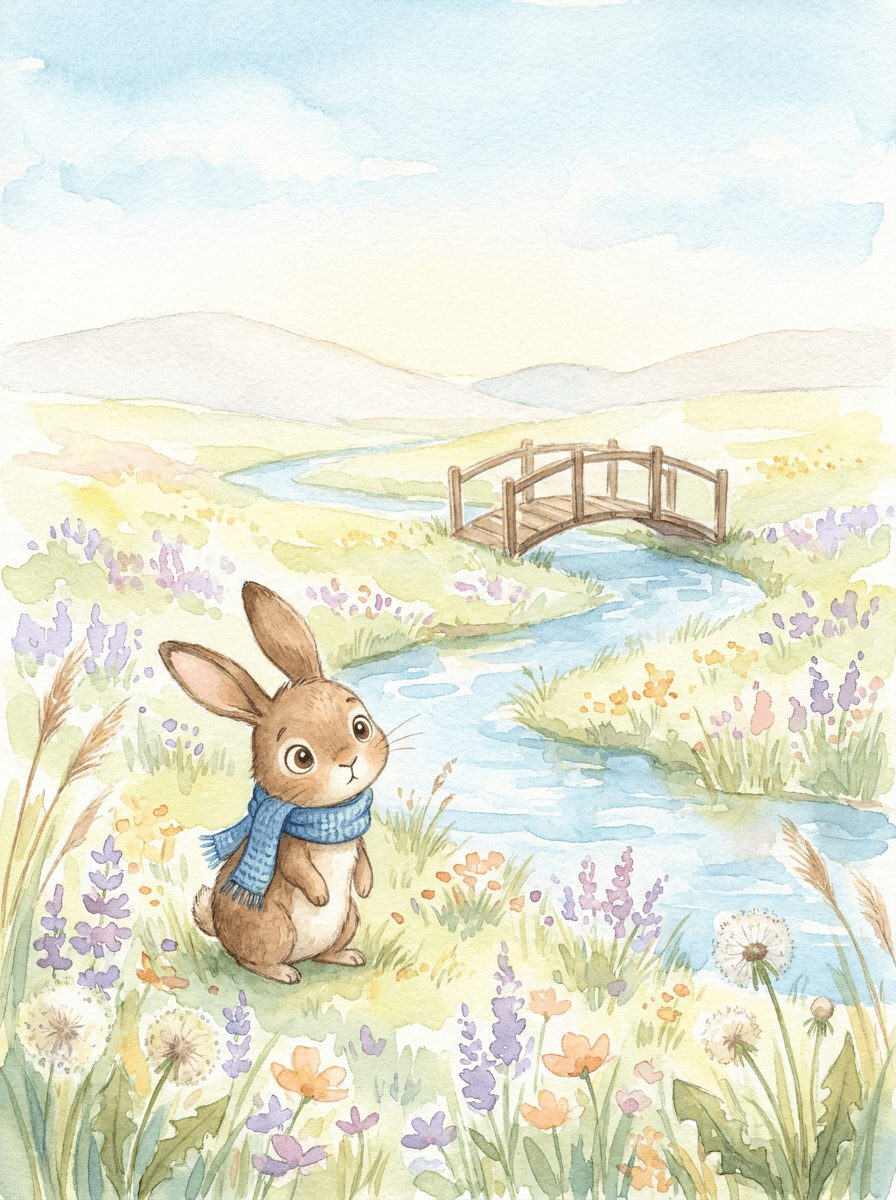
Prompt:
children's book illustration in soft watercolor style, a small curious rabbit wearing a blue knitted scarf stands at the edge of a gentle stream in a sunlit meadow, the rabbit has large expressive eyes full of wonder and slightly tilted head, soft watercolor washes of pale green and warm yellow fill the meadow with wildflowers painted in loose delicate strokes of lavender pink and soft orange, the stream reflects the clear blue sky with gentle watercolor ripples, a wooden footbridge arches gracefully over the stream in the middle distance, tall grasses and dandelion puffs frame the foreground with soft organic shapes, distant rolling hills fade into a pale watercolor sky with soft wispy clouds, the entire scene has the beautiful transparent luminous quality of traditional watercolor painting with visible paper texture showing through the washes, colors are soft and warm with gentle gradients and no harsh edges, the lighting is warm and diffused suggesting a peaceful morning, whimsical children's picture book art style with gentle hand-painted feel, no text no watermarks
Best for: Picture books for ages 2–5, bedtime stories, gentle nature-themed narratives, social-emotional learning stories, classic storybook aesthetics, spring and garden themes
Template 2: Bold Cartoon with Thick Outlines
A cartoon style is probably the most common one you'll see in children's books, mostly because it's easy to make it colorful, expressive, and fun to look at.[5] Bold cartoon illustration with thick black outlines and saturated colors creates maximum visual energy and character expression — perfect for humorous, action-driven, or adventure stories.
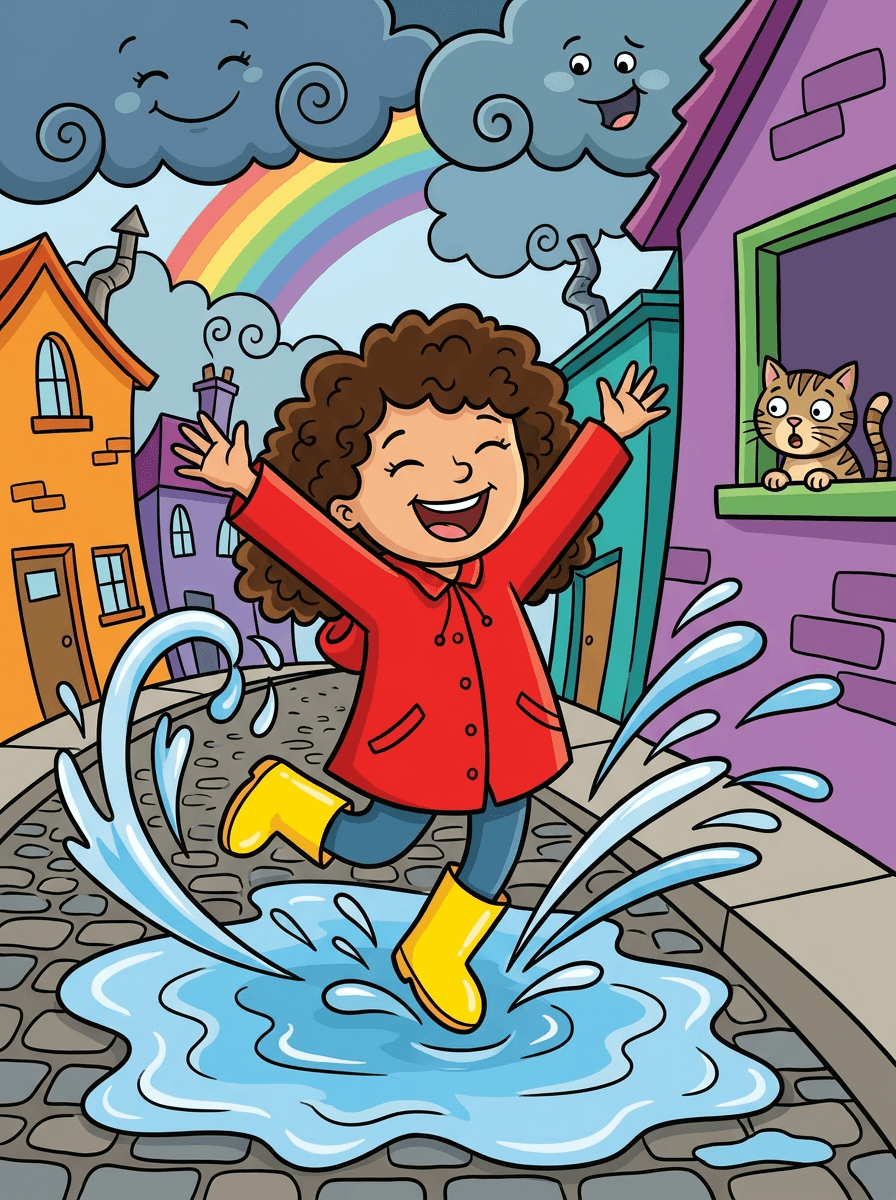
Prompt:
children's book illustration in bold cartoon style with thick black outlines, a cheerful young girl with curly brown hair wearing bright yellow rain boots and a red raincoat jumps gleefully into a giant puddle sending splashes of water in every direction, her expression is pure joy with a wide open mouth smile squinted eyes and arms thrown up in celebration, the splashing water creates dynamic curved shapes around her in bright blue and white, the background shows a colorful town street with charming buildings in orange purple and teal with whimsical crooked chimneys, dark rain clouds above are playful and friendly-looking with cartoon swirl shapes, a rainbow peeks through a break in the clouds adding vibrant color arcs, a small striped cat watches from a windowsill with a surprised expression, the illustration uses bold flat colors with thick confident black outlines around every element, the composition is dynamic and energetic with strong diagonal movement, bright saturated color palette with primary and secondary colors creating maximum visual punch, playful cartoon children's book illustration style, no text no watermarks
Best for: Humorous picture books, adventure stories, ages 3–7, character-driven narratives, books about feelings and self-expression, series with recurring characters
Template 3: Vintage Storybook with Gold Accents
Vintage storybook illustration evokes the golden age of children's literature — richly detailed, slightly ornate, and infused with the warmth of classic fairy tales. This style appeals to both children and the parents reading to them, creating a sense of timeless heritage.
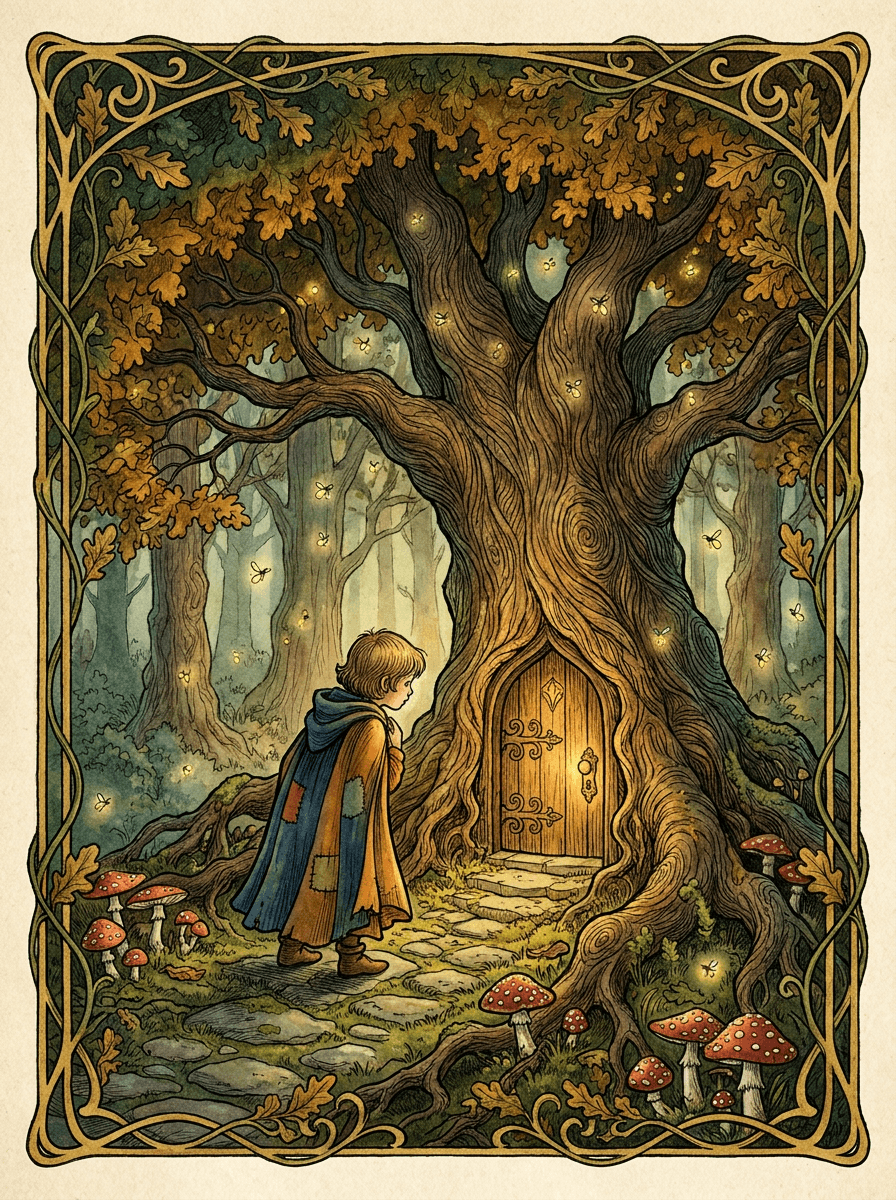
Prompt:
children's book illustration in vintage storybook style reminiscent of classic fairy tale illustration, a young child in a flowing cape stands before a grand ancient tree with a small carved wooden door nestled between its massive roots, the tree is magnificently detailed with gnarled bark textured branches and a canopy of leaves in deep rich greens with touches of gold, tiny glowing fireflies dot the air around the tree creating points of warm golden light, mushrooms with red spotted caps grow in clusters around the base of the tree, a winding path of mossy stones leads from the foreground to the magical door, the background shows a deep enchanted forest with layered trees fading into misty atmospheric depth, the illustration has the rich detailed quality of classic book illustration with fine crosshatching and detailed linework visible in the textures, a subtle decorative border frames the scene with Art Nouveau-inspired vine and leaf motifs with touches of metallic gold, the color palette is rich and warm featuring deep forest green warm brown golden amber and touches of crimson, the lighting is theatrical with the tree door emitting a warm inviting glow, classic fairy tale illustration style with fine detail and rich atmosphere, no text no watermarks
Best for: Fairy tales, fantasy adventure stories, bedtime stories for ages 4–8, gift book editions, heritage and heirloom quality picture books, stories about magical worlds
Template 4: Scandinavian Minimalist
Scandinavian minimalist illustration uses a restricted color palette, simple geometric shapes, clean compositions, and generous negative space to create illustrations that feel calm, modern, and deeply readable for young children. Minimalist and flat design styles use simple shapes and soft colors, which help young learners stay focused.[1]
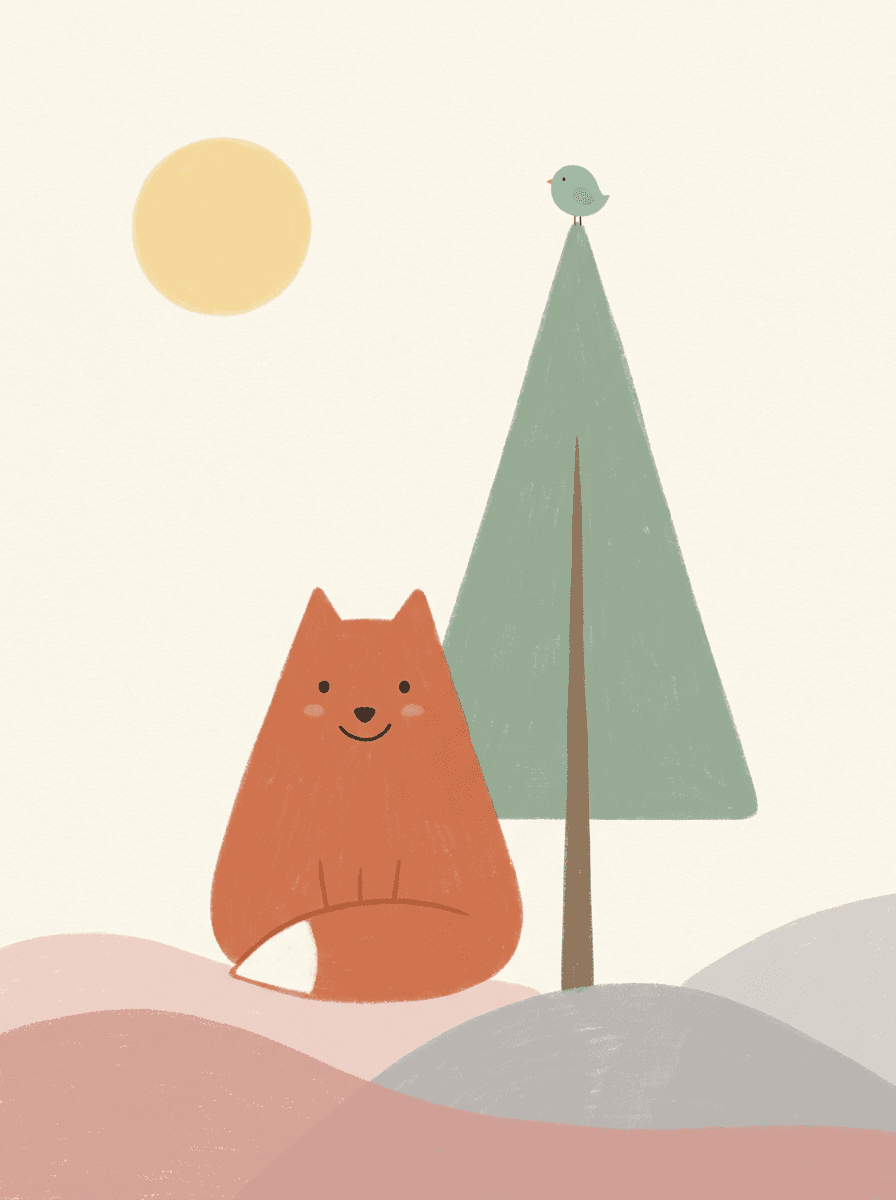
Prompt:
children's book illustration in Scandinavian minimalist style, a small fox with a simple geometric body shape in warm burnt orange sits contentedly beside a tall stylized pine tree, the fox has a friendly minimal face with two dots for eyes and a small curved line for a smile, the pine tree is a simple triangular shape in muted sage green with a thin brown trunk, a round pale yellow sun sits in the upper corner of a soft warm cream background, simple geometric hills in muted dusty pink and soft gray roll gently across the bottom third of the composition, a tiny bird with a round body in soft teal perches on the very top of the pine tree, the entire composition uses generous white space and clean simple shapes with no unnecessary detail, the color palette is strictly limited to five colors: burnt orange sage green dusty pink soft teal and warm cream, shapes are soft and slightly rounded with no harsh angles, the overall feeling is calm friendly and gently modern, clean Scandinavian children's book illustration style with a focus on simplicity and negative space, no text no watermarks
Best for: Board books for ages 0–3, concept books (counting, colors, shapes), modern nursery decor, calm and soothing stories, educational picture books, gift books for new parents
Template 5: Gouache Folk Art
Gouache folk art illustration combines the rich opacity and matte texture of gouache paint with folk art patterns, decorative motifs, and cultural visual storytelling. This style creates illustrations that feel handcrafted, warm, and culturally rooted.
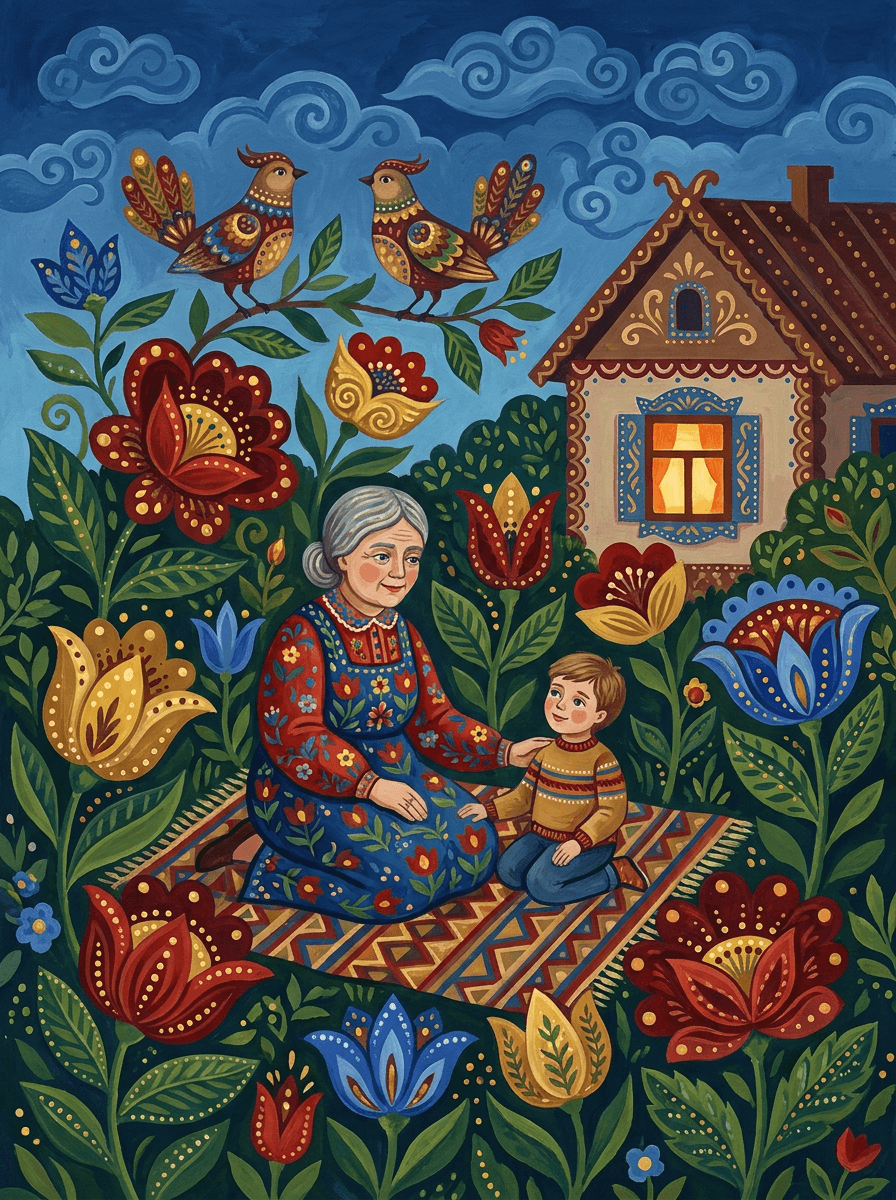
Prompt:
children's book illustration in rich gouache folk art style, a grandmother and grandchild sit together on a colorful woven blanket in a flower-filled garden, the grandmother wears a beautifully patterned dress with folk art floral motifs in warm red and blue, the grandchild leans close listening intently with wide curious eyes, they are surrounded by lush folk art style flowers with decorative petals in stylized shapes using rich warm colors of deep red golden yellow cobalt blue and forest green, birds with decorative plumage perch on branches overhead in a symmetrical ornamental arrangement, a small cottage with a warm glowing window sits in the background with folk art decorative trim along the roofline, the sky is a rich warm blue with stylized cloud shapes, every surface is richly decorated with folk art patterns including dots swirls and geometric motifs, the paint quality shows the beautiful matte opacity of gouache with visible brushwork and rich saturated flat color areas, the overall feeling is warm loving and culturally rich, folk art gouache illustration style for children's book with decorative richness and emotional warmth, no text no watermarks
Best for: Multicultural stories, family-themed picture books, intergenerational narratives, ages 3–7, folktale retellings, heritage and cultural celebration books
Template 6: Digital Vector with Flat Colors
Digital vector illustration offers crisp, scalable artwork with clean lines and flat colors, perfect for multi-platform publishing while maintaining professional polish and commercial appeal.[4] This style is ideal for books that will be published simultaneously in print and digital formats.
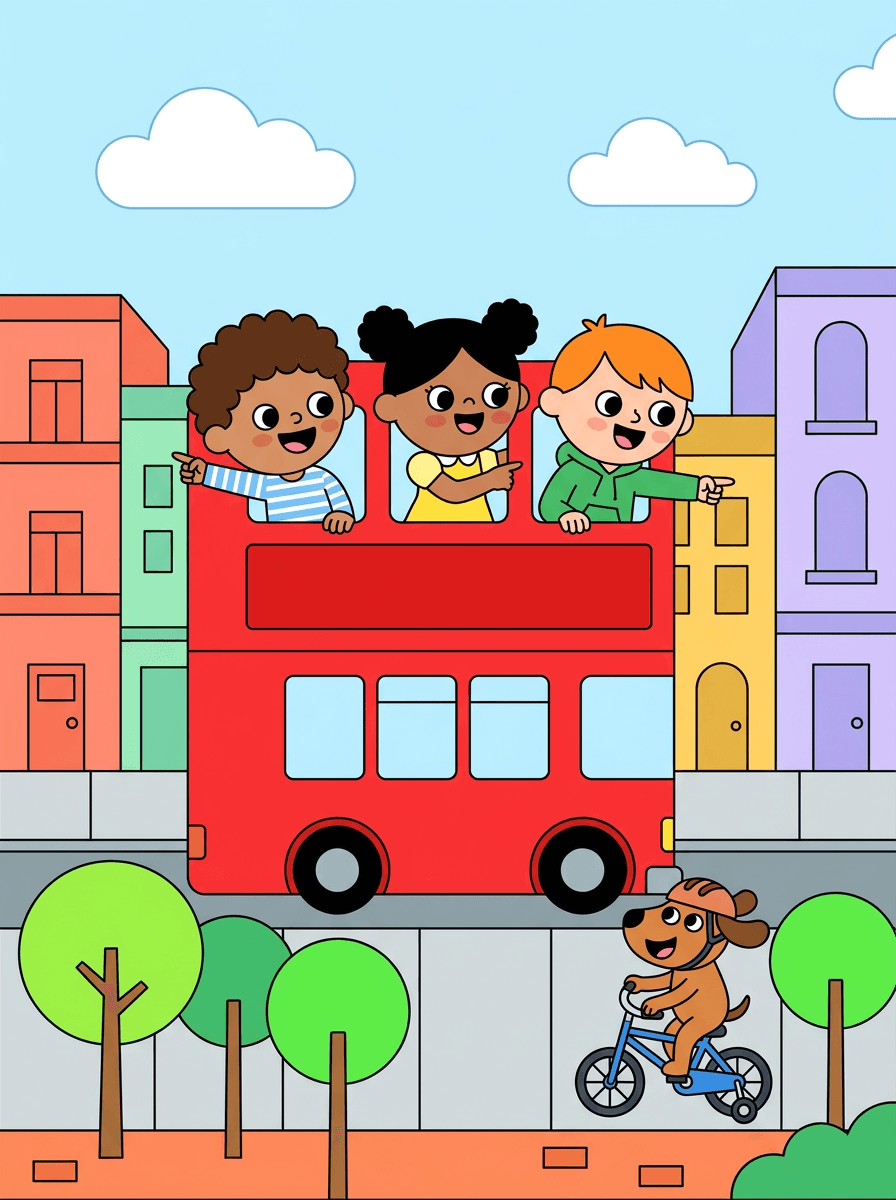
Prompt:
children's book illustration in clean digital vector style with flat colors, a group of three diverse children ride a bright red double-decker bus through a colorful city, the children lean out of the upper deck windows pointing excitedly at the sights below with joyful exaggerated expressions, the cityscape features simplified geometric buildings in a cheerful palette of coral mint green warm yellow and soft lavender, trees along the street are simple lollipop shapes in bright green, a friendly dog rides a bicycle on the sidewalk below adding whimsical humor, fluffy white clouds dot a clear blue sky, the entire illustration uses crisp clean vector shapes with flat unshaded color fills and no gradients, each element has smooth precise edges and bold confident color blocking, the characters have large round heads simple dot eyes and wide expressive smiles in a modern graphic style, the composition is balanced and orderly with clear visual hierarchy, the color palette is cheerful and contemporary using modern pastel tones with bright accent colors, clean professional vector illustration style for children's book, no text no watermarks
Best for: Educational series, STEM-themed books, ages 4–8, multi-format publishing (print and digital), app-based storybooks, character series with merchandise potential
Template 7: Pencil and Ink Sketch with Spot Color
Pencil and ink illustration with selective spot color creates a sophisticated, artistic aesthetic that bridges the gap between picture books and illustrated chapter books. The limited color approach draws attention to specific narrative elements while the detailed pencil work adds warmth and artistic credibility.
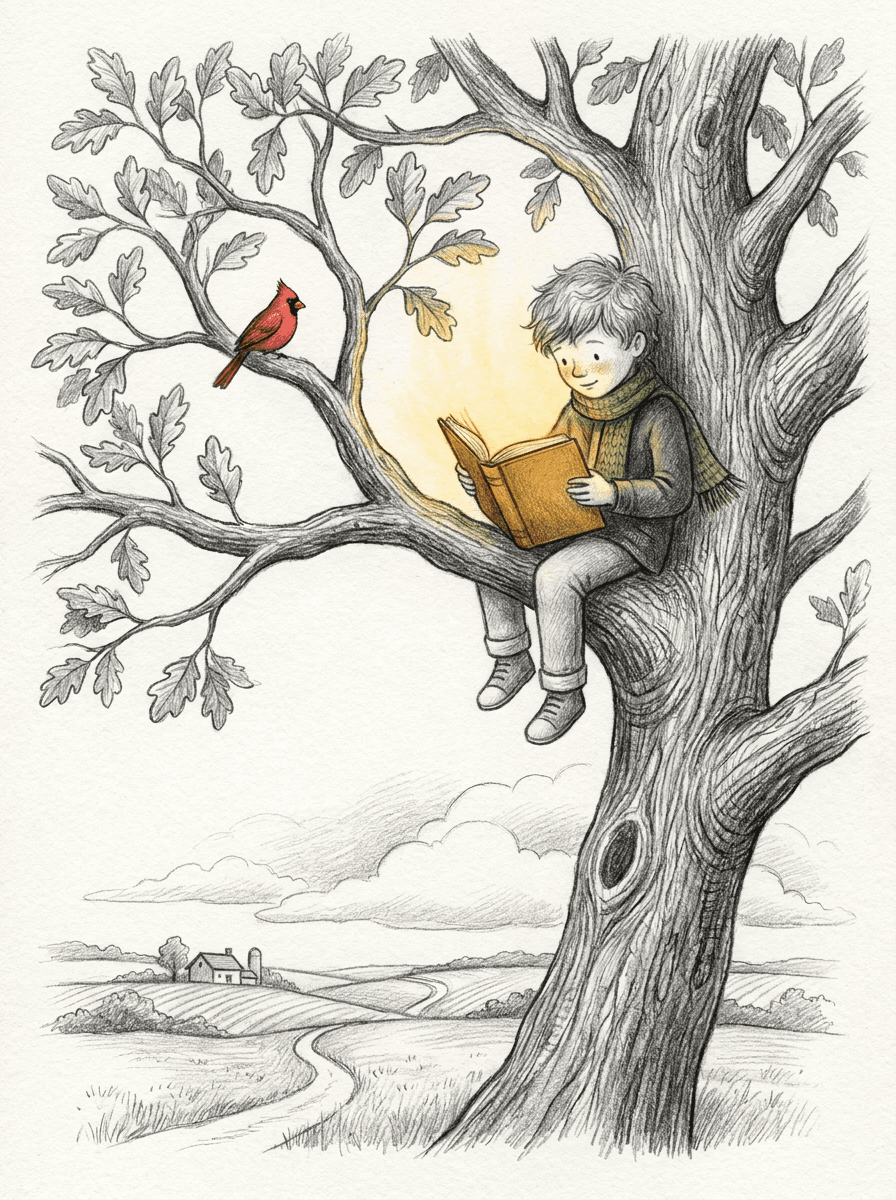
Prompt:
children's book illustration in detailed pencil sketch style with selective spot color, a boy with tousled hair sits high in the branches of a large oak tree reading a book that emits a soft golden glow, the entire scene is rendered in beautifully detailed graphite pencil with fine crosshatching and subtle shading showing the intricate texture of bark leaves and fabric, only select elements are colored: the book's golden glow in warm amber yellow and a small red cardinal perched on a nearby branch and the boy's green scarf, the pencil work shows masterful detail in the tree's gnarled branches with individual leaves carefully drawn, the boy's expression is one of peaceful absorption with softly rendered features, below the tree a pastoral landscape stretches with pencil-drawn fields a winding path and a distant farmhouse, clouds are rendered with soft pencil shading creating atmospheric depth, the spot color elements create focal points that draw the eye through the composition, the paper texture is visible giving the illustration an authentic hand-drawn quality, sophisticated pencil illustration with selective color for children's book, no text no watermarks
Best for: Chapter books for ages 6–10, literary picture books, stories about imagination and reading, quiet contemplative narratives, gift editions, crossover books that appeal to adults
Template 8: Whimsical Fantasy with Dreamlike Palette
Whimsical and fantasy art create magical worlds full of dreamy colors and imaginative characters, encouraging children to dream big.[1] You'll usually see softer shapes, more fluid environments, and a kind of dreamlike quality to everything, where the goal isn't accuracy but feeling.[5] This style prioritizes imagination and emotional atmosphere over realistic representation.
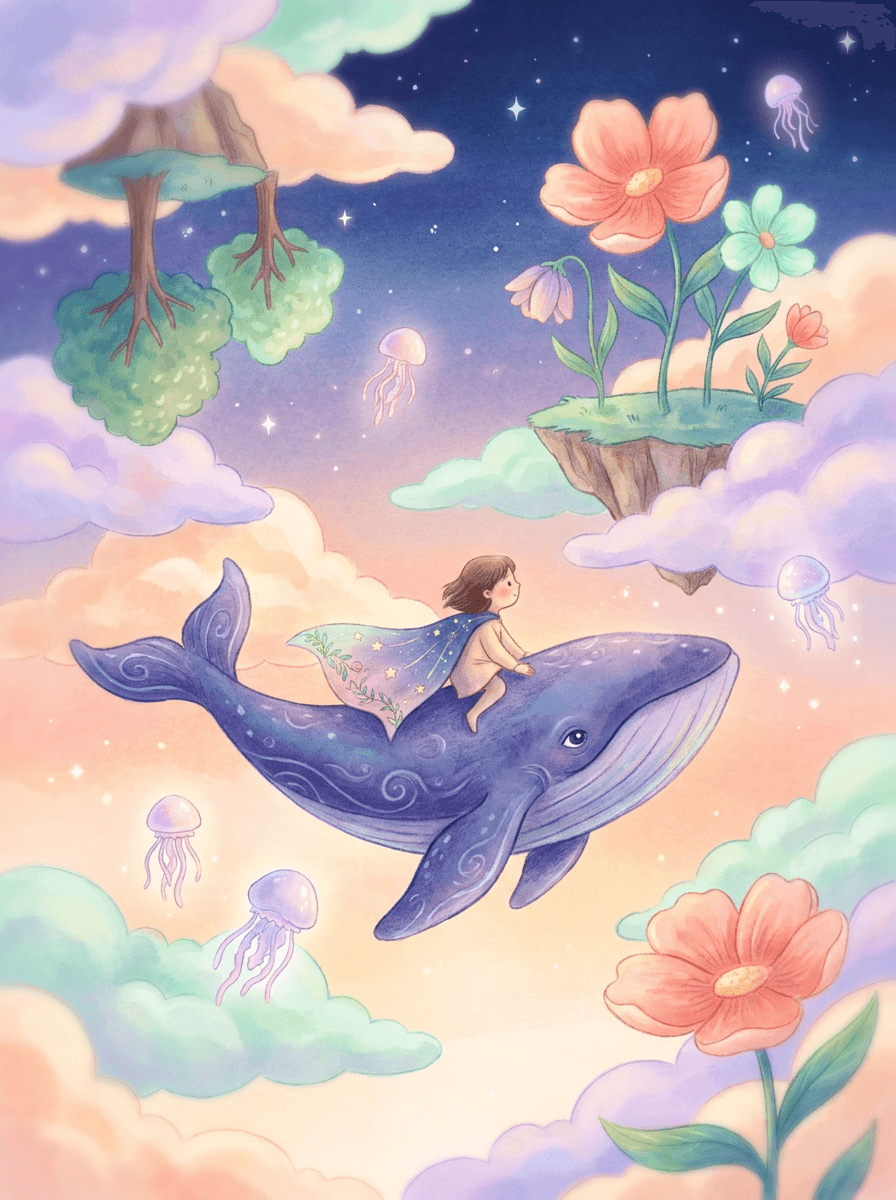
Prompt:
children's book illustration in whimsical fantasy style with a dreamlike color palette, a small child wearing a flowing starry cape rides on the back of a gentle giant whale that floats through a sky filled with soft pastel clouds and floating islands, the whale is a beautiful deep blue-purple with kind wise eyes and a gentle smile, tiny glowing jellyfish drift through the air around them like luminous lanterns in soft pink and lavender, the floating islands are lush with impossible vegetation including oversized flowers in coral and mint and trees that grow upside down, the sky transitions from warm peach at the horizon through soft lavender to deep midnight blue with scattered stars above, the child's cape billows dramatically behind them scattered with tiny embroidered constellations, the entire scene has a soft slightly blurred dreamlike quality as if viewed through enchanted glass, colors are ethereal and luminous with gentle light seeming to emanate from within every element, the composition sweeps upward creating a feeling of flight and freedom, magical dreamy children's book illustration with luminous ethereal color palette, no text no watermarks
Best for: Fantasy stories, bedtime and dream-themed narratives, ages 3–7, imaginative adventure tales, books about creativity and possibility, magical realism stories
Template 9: Retro Mid-Century Modern
Mid-century modern illustration brings a specific retro charm with its geometric shapes, limited color palettes, and distinctive graphic sensibility. This style appeals strongly to design-conscious parents and creates a nostalgic warmth that stands out on contemporary bookshelves.
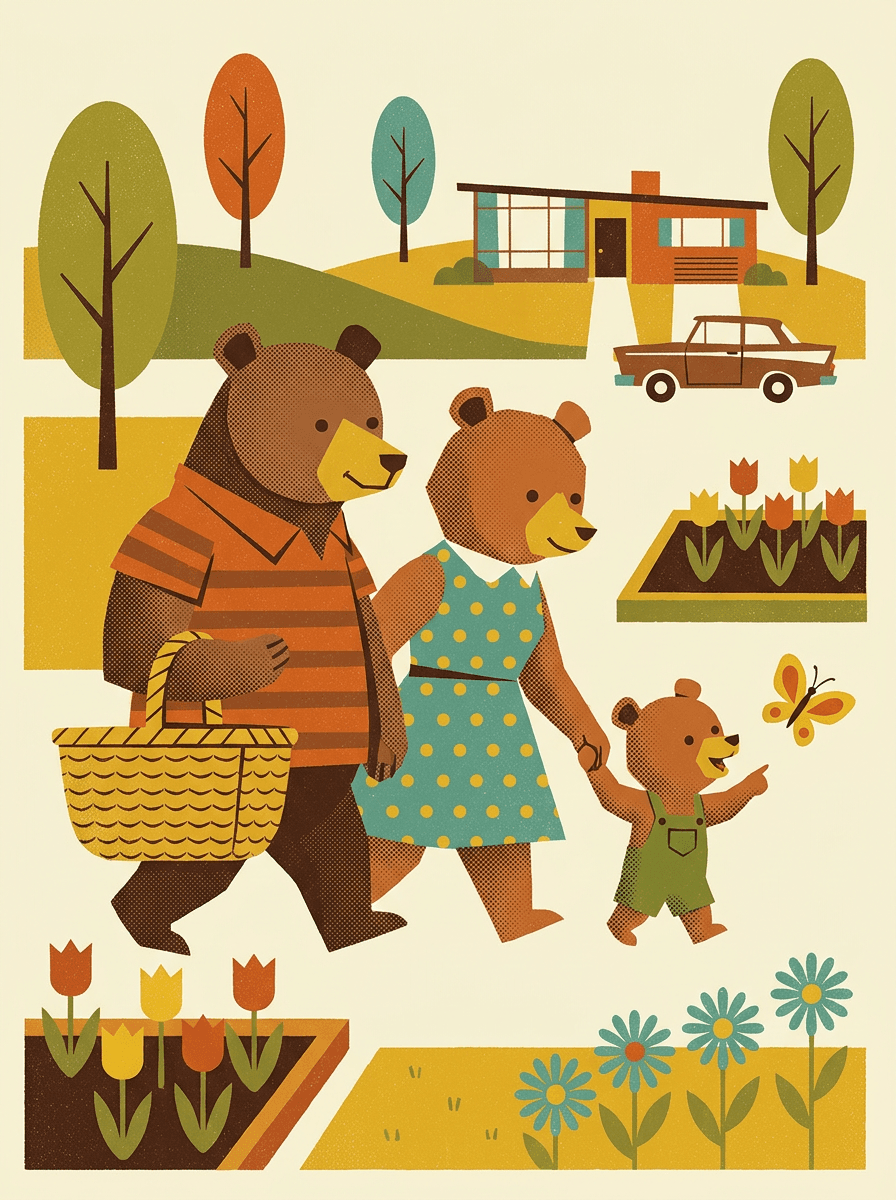
Prompt:
children's book illustration in retro mid-century modern style from the 1950s and 1960s, a family of bears prepares for a picnic in a stylized park, papa bear in a striped shirt carries a wicker basket while mama bear in a polka dot dress holds the hand of a small bear cub who points excitedly at a butterfly, the park features trees rendered as simple atomic-age shapes with oval canopies on thin trunks, geometric flower beds with stylized tulips and daisies dot the foreground, the background shows gentle hills with a retro-style mid-century house with large windows and a flat roof, a vintage car is parked in the distance, the illustration uses a strictly limited retro color palette of warm mustard yellow burnt orange olive green teal and warm brown against a cream background, textures include subtle halftone dot patterns and screen-print grain giving the illustration an authentic vintage print quality, shapes are simplified and geometric with a distinctly mid-century graphic sensibility, the overall feeling is warm nostalgic and charmingly retro, vintage mid-century children's book illustration style, no text no watermarks
Best for: Retro-themed picture books, family stories, ages 3–6, design-conscious gift books, nursery prints, books with nostalgic or historical settings
Template 10: Collage and Mixed Media
Unique children's book illustration styles include "collage" and "mixed media," where an artist might combine scanned fabrics, photographs, and hand-drawn elements.[3] Mixed media creates a rich, tactile quality that feels handcrafted and artistically distinctive — making each illustration feel like a one-of-a-kind piece of art.
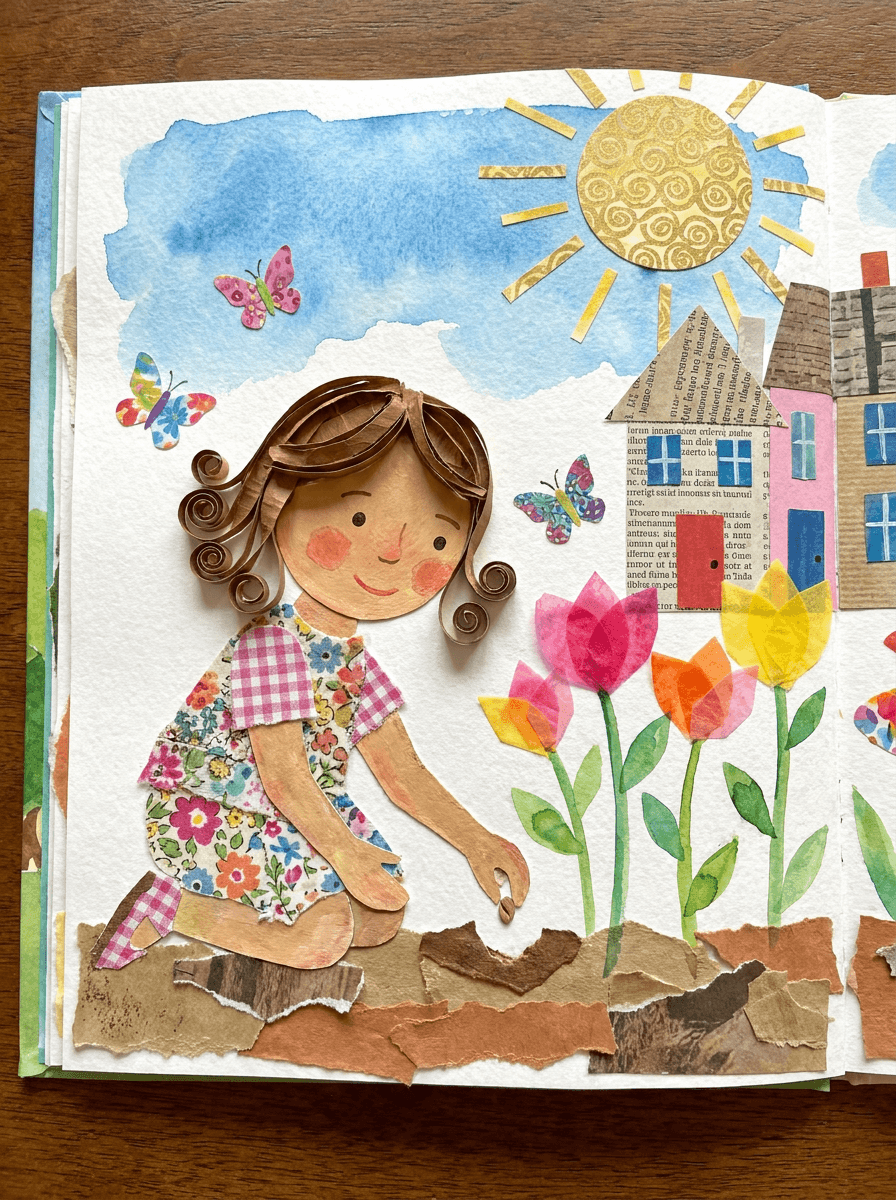
Prompt:
children's book illustration in mixed media collage style, a young girl plants a small seed in a garden, the illustration combines different artistic elements: the girl's body is created from pieces of patterned fabric in floral prints and gingham check, her face is painted with simple warm features and rosy cheeks, her hair is made of curling brown paper strips, the garden soil is textured with real earth-toned paper in various shades of brown with torn edges visible, the growing plants emerge as painted watercolor elements in vibrant green with collaged tissue paper flowers in bright pink orange and yellow, the sky is a wash of blue watercolor on visible textured paper, a sun is created from a circle of golden patterned paper with painted ray lines extending outward, butterflies made from colorful patterned paper scraps flutter through the scene, the background includes houses made from newspaper clippings and colored paper with painted details added on top, the entire illustration celebrates the layered handmade quality of collage with visible paper edges glue texture and the combination of multiple media, tactile mixed media collage illustration style for children's book, no text no watermarks
Best for: Craft-themed stories, nature and gardening narratives, ages 3–7, Eric Carle-inspired visual storytelling, books about creativity, hands-on activity companion books
Template 11: Cozy Digital Painting with Warm Light
Rich digital painting with warm interior lighting creates the visual equivalent of being tucked into a safe, warm space. This style excels at intimate domestic scenes that make children feel secure and loved — ideal for bedtime reading and family-centered stories.
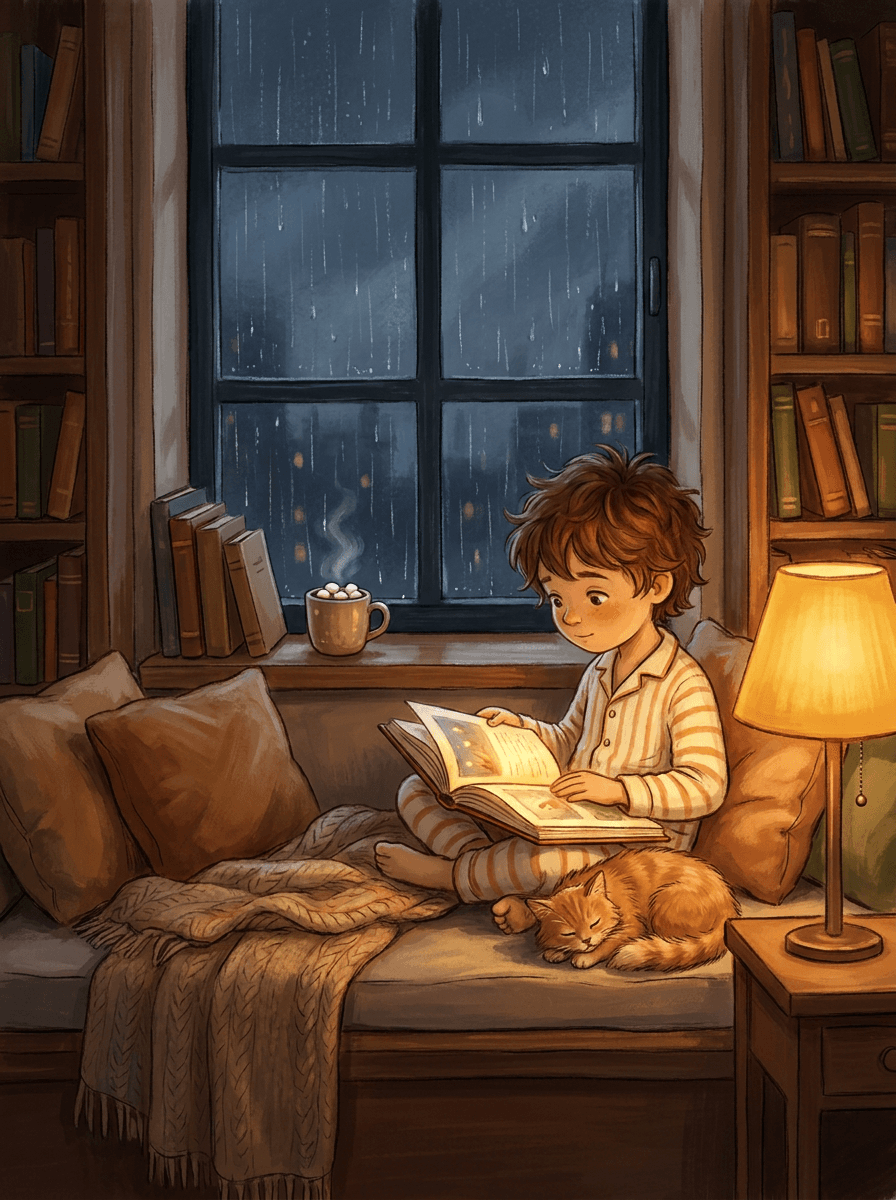
Prompt:
children's book illustration in cozy digital painting style with warm rich lighting, a child in soft pajamas sits on a plush window seat surrounded by stacked pillows and a knitted blanket reading a large picture book, warm golden lamplight from a nearby table lamp illuminates the scene casting a beautiful warm glow on the child's face and the book's pages, rain streaks down the dark window behind them creating a gentle pattern of droplets catching the warm indoor light, a fluffy cat curls contentedly at the child's feet also bathed in warm light, the window seat is in a cozy nook with wooden bookshelves overflowing with colorful books on either side, a mug of cocoa with tiny marshmallows sits on the windowsill steam curling upward into the warm air, the room is rendered with rich painterly detail showing wood grain in the shelves soft fabric textures in the pillows and warm shadows in the corners, the color palette is dominated by warm amber gold deep brown soft cream and the cool blue-gray of the rainy night visible through the window, the painting style shows visible digital brushstrokes creating a handcrafted painterly quality, cozy warm children's book illustration with rich atmospheric digital painting, no text no watermarks
Best for: Bedtime stories, rainy day narratives, reading-themed books, ages 3–7, autumn and winter seasonal stories, stories about finding comfort and safety
Template 12: Bright Naïve Style
The naïve style of illustration is a celebration of simplicity in design. It welcomes rough strokes and little detail and even looks like children's drawings. The defining characteristic of this style is its easy-going lines, which may be achieved through felt-tip pen marks or pencil scratches, and a restricted but expressive color scheme.[10] This deliberately childlike approach creates a powerful emotional bond between young readers and the art.
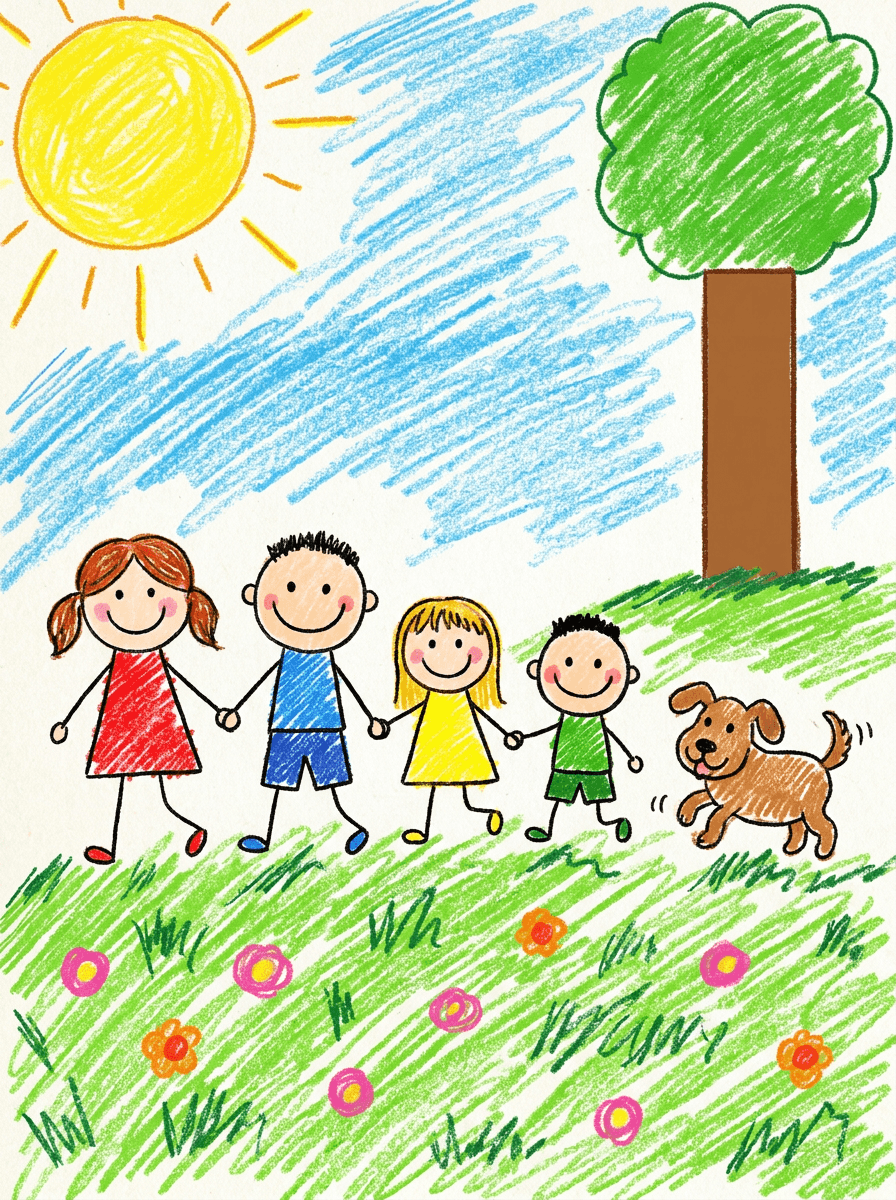
Prompt:
children's book illustration in bright naïve art style resembling a child's drawing, a happy family of four holds hands walking through a park on a sunny day, the figures are drawn with simple stick-figure-like proportions with large round heads big bright eyes and wide wobbly smiles, each family member wears brightly colored clothes in primary red blue yellow and green drawn with thick crayon-like strokes, the sun is a big bright yellow circle with straight lines radiating outward in the upper corner, the sky is colored in with broad visible strokes of sky blue that don't quite reach every edge, the grass is bright green applied in energetic back-and-forth crayon strokes, flowers are simple circles with petal shapes in bright pink and orange scattered across the ground, a tree has a thick brown rectangle trunk and a round green blob for the canopy, a family dog with a wagging tail bounces alongside drawn with endearing simplicity, the entire illustration has the charming imperfection and joyful energy of a child's artwork including slightly wobbly lines uneven coloring and cheerful proportional exaggeration, bright naïve children's book illustration with childlike authenticity, no text no watermarks
Best for: Social-emotional learning books, ages 2–5, stories about family and belonging, inclusive and accessible visual style, books designed to encourage children's own art, therapeutic storybooks
Template 13: Atmospheric Night Scene with Glow Effects
Nighttime illustrations with luminous glow effects create a magical, contemplative atmosphere that is perfect for bedtime reading. The contrast between darkness and warm light sources naturally draws children's attention and creates visual intimacy.
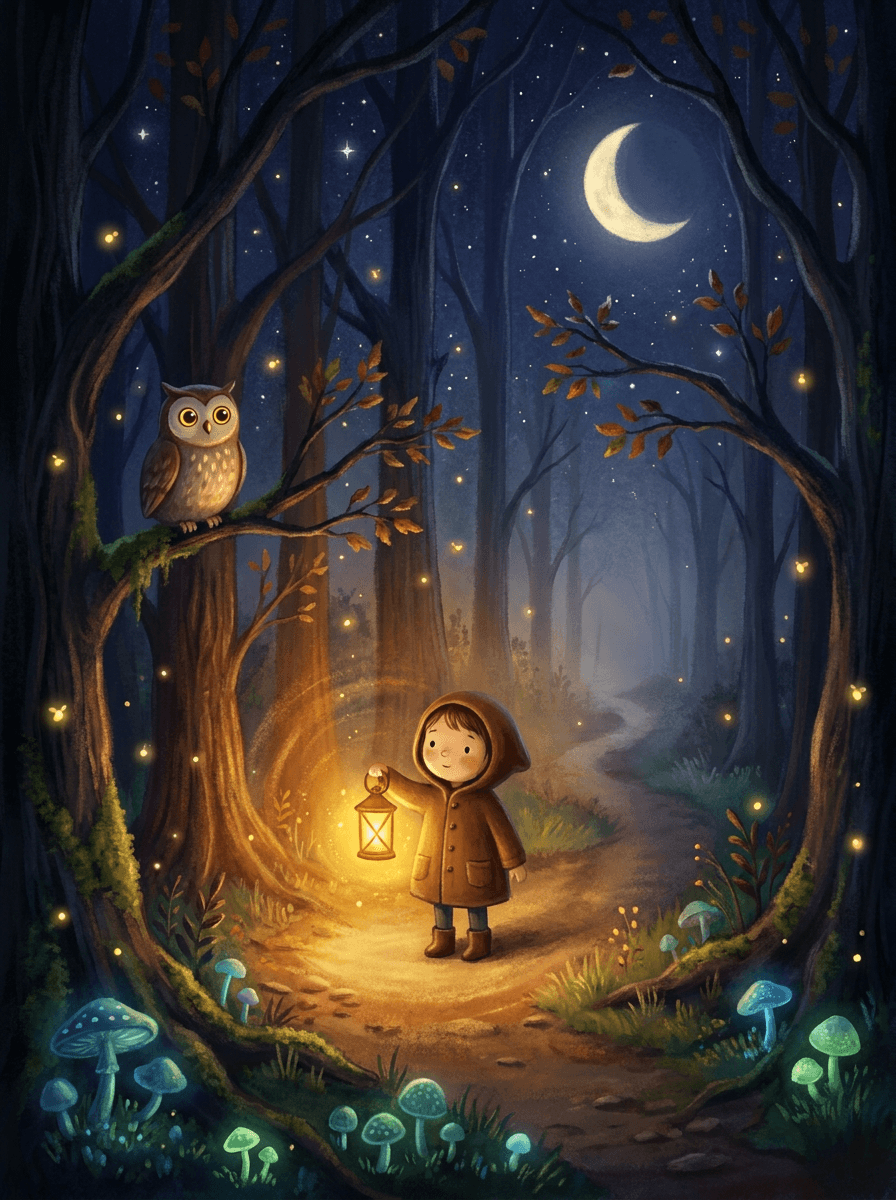
Prompt:
children's book illustration of a magical nighttime scene with beautiful glow effects, a small child in a hooded coat walks along a path through a dark enchanted forest carrying a glowing lantern that casts a warm golden circle of light, the lantern light illuminates the child's face and the immediate surroundings in rich warm tones creating a safe bubble of light in the mysterious darkness, tall dark trees frame the path with their trunks and branches visible where the lantern light touches them, dozens of tiny fireflies create points of soft warm light scattered through the dark forest, a friendly owl with luminous golden eyes watches from a low branch just at the edge of the lantern light, glowing mushrooms in soft blue and green dot the forest floor adding spots of magical bioluminescent light, the night sky visible through the tree canopy is deep indigo scattered with bright stars and a large crescent moon, the path ahead disappears into soft mysterious darkness creating a sense of adventure and the unknown, the contrast between warm lantern light and cool moonlight creates a rich atmospheric color dynamic, the painting style is rich and atmospheric with soft edges where light meets darkness, magical nighttime children's book illustration with luminous atmospheric lighting, no text no watermarks
Best for: Bedtime adventure stories, brave and courage-themed narratives, ages 4–8, nighttime exploration stories, overcoming fear of the dark themes, magical journey tales
Template 14: Textured Storybook with Visible Brushwork
This style emphasizes the tactile, hand-painted quality that dominates 2026 children's illustration trends. Visible brushwork, paint texture, and organic imperfection create illustrations that feel authentically crafted — the "tactile digital" aesthetic that industry analysts identify as a defining trend.
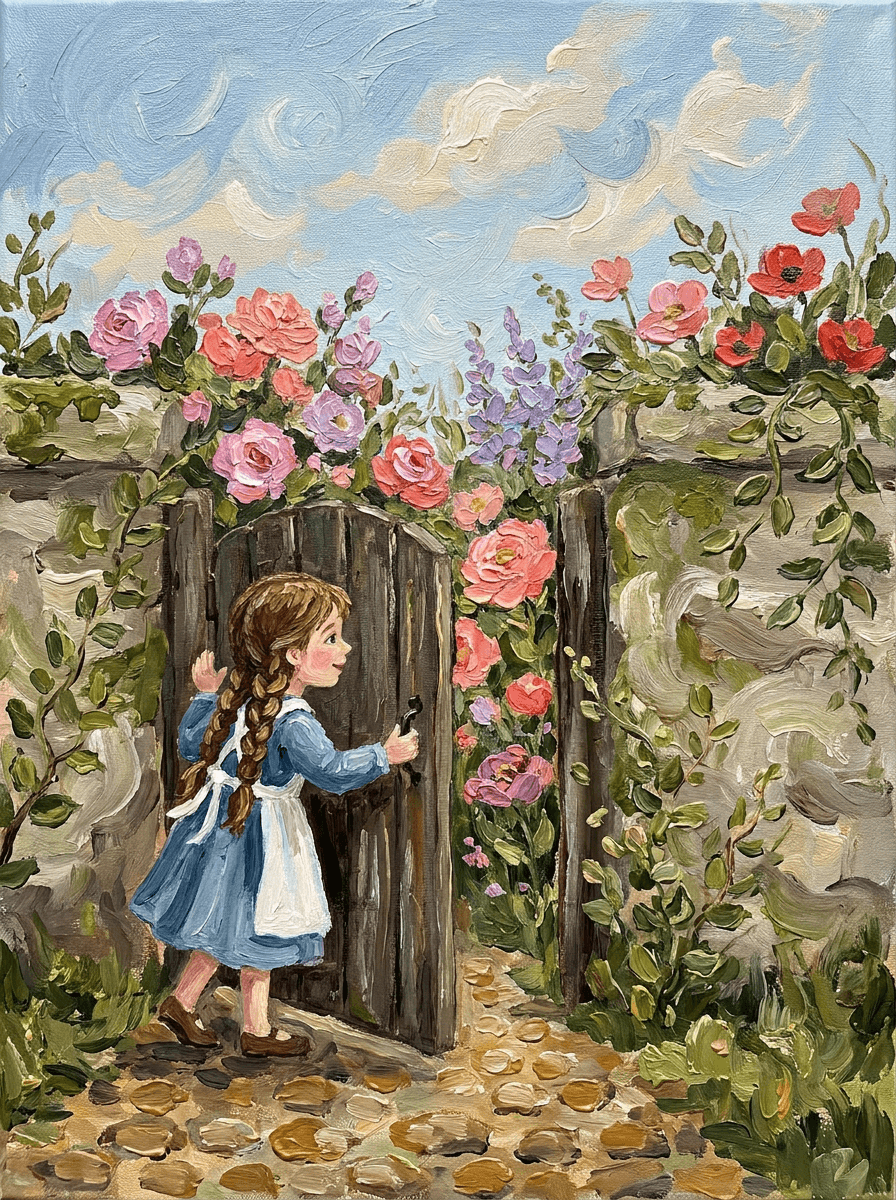
Prompt:
children's book illustration with visible hand-painted texture and rich brushwork, a young girl with braided hair discovers a hidden garden behind an old stone wall, she pushes open a weathered wooden gate and peers inside with an expression of delighted wonder, the garden beyond is lush and overgrown with abundant flowers painted in thick impasto-like brushstrokes showing visible paint texture in warm pink coral soft purple and bright poppy red, the old stone wall shows beautiful painterly texture with visible brushwork in warm gray and moss green, leafy vines climb the wall with each leaf showing individual brushstrokes, the wooden gate has rich textured wood grain painted with confident directional strokes, the sky visible above the garden wall is painted in sweeping brushstrokes of soft blue with creamy cloud shapes, the foreground shows a cobblestone path painted with dabbed textured strokes in warm earth tones, the girl's dress is painted with flowing brushwork in soft blue with a white apron, the entire illustration celebrates visible paint quality with thick and thin strokes dry brush effects and the beautiful texture of paint on canvas, hand-painted textured children's book illustration with rich authentic brushwork, no text no watermarks
Best for: Secret garden and discovery-themed stories, literary picture books, ages 4–8, stories with rich natural settings, books that celebrate curiosity and wonder, award-seeking artistic quality
Template 15: Storybook Map and Panoramic Adventure
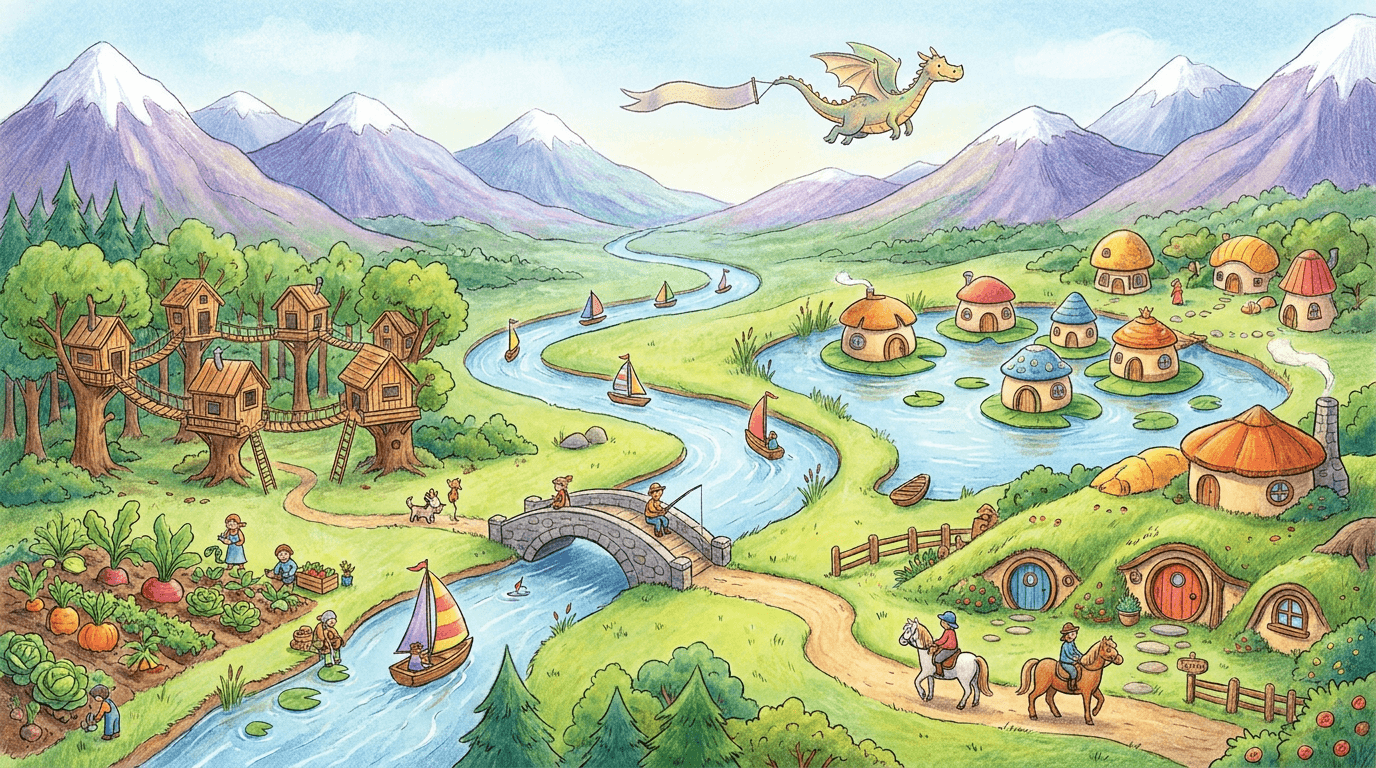
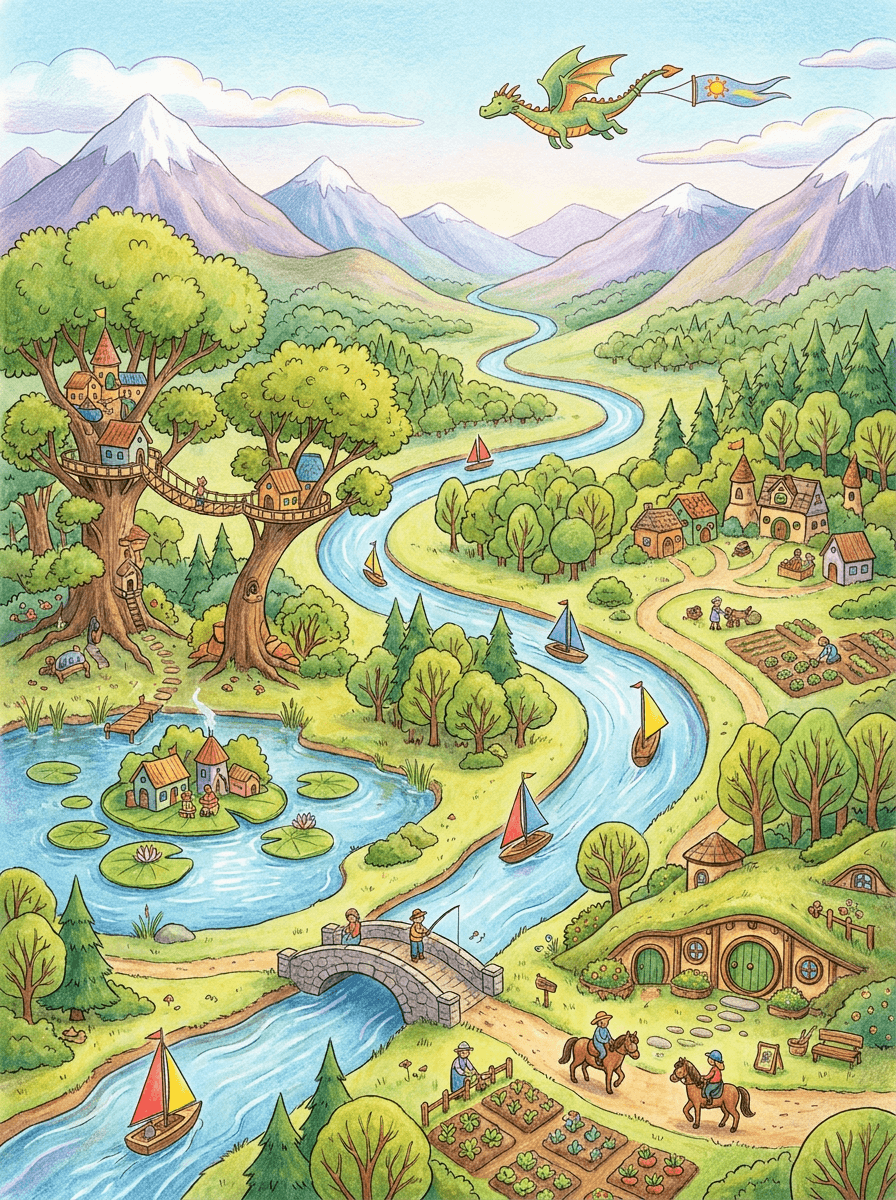
Panoramic adventure illustrations with a storybook map quality create expansive worlds that children can explore visually for extended periods. This Wimmelbuch-inspired approach encourages active visual engagement, discovery, and storytelling beyond the main narrative.
Prompt:
children's book illustration in detailed panoramic storybook style showing a whimsical fantasy world from a slightly elevated bird's eye perspective, the scene shows a winding river that flows from snow-capped mountains in the background through a lush green valley dotted with tiny colorful villages, each village has a distinct character: one is built in the treetops with rope bridges connecting tiny houses another floats on lily pads in a lake and another is nestled into a hillside with round hobbit-like doors, the river has tiny boats with colorful sails navigating its curves, a friendly dragon flies in the distance trailing a banner, miniature characters are visible throughout the landscape engaged in various activities: fishing from a bridge tending gardens riding horses along winding paths, the mountains are soft purple and blue with white snow peaks, forests are rendered as clusters of individual trees in varying shades of green, the entire illustration is rich with tiny discoverable details and visual stories happening in every corner, the color palette is warm and varied with each area of the map having its own color identity, the style balances detailed world-building with a warm handcrafted quality, panoramic storybook map illustration for children's book with rich discoverable detail, no text no watermarks
Best for: Adventure and exploration stories, ages 5–10, interactive search-and-find books, world-building fantasy narratives, classroom display illustrations, books that invite repeated reading and discovery
Customizing These Templates for Your Specific Story
These templates provide aesthetically calibrated starting points for 15 of the most versatile and commercially relevant children's book illustration styles. Transforming them into illustrations that serve your specific story requires adjustments along several key dimensions.
Match your character descriptions precisely. Every prompt includes a default character. Replace those character descriptions with your specific protagonist — their appearance, clothing, expression, and any distinctive features that make them recognizable across multiple illustrations. Character consistency is one of the most important requirements in children's book illustration: readers need to immediately recognize the same character from page to page.
Adapt the setting to your story's world. The environments in these prompts are versatile starting points. Replace them with the specific settings your story requires. If your narrative takes place in an urban apartment rather than a meadow, swap the setting details while keeping the style descriptors intact. The style keywords (e.g., "soft watercolor," "bold cartoon," "Scandinavian minimalist") should remain consistent even as settings change.
Calibrate the age appropriateness. Define the story's visual tone — cartoon, watercolor, sketch, digital painting — based on the age group and story theme. For toddlers, simpler and bolder visuals work best. For older kids, more detailed and expressive styles might be appropriate.[8] The prompts in this post span from board book simplicity (Template 4, Template 12) to illustrated chapter book sophistication (Template 7, Template 15). Choose and modify the complexity level based on your target age group.
Maintain emotional expression. Books that help children understand and manage emotions dominate multiple bestseller categories. Titles about anxiety, friendship conflict, self-regulation, empathy, and emotional vocabulary continue to outsell traditional narrative fiction in many subcategories. These books require characters with exceptionally clear and nuanced emotional expressions.[10] When modifying character descriptions, always specify the facial expression and body language that conveys the emotional beat of the scene. Prompts like "wide eyes full of wonder" or "slumped shoulders showing disappointment" give the AI the emotional direction it needs.
Generate consistent series. For a full picture book, you need illustrations that look like they belong together. Use the same style descriptors, color palette language, and character descriptions across all your prompts. Change only the scene, action, and setting elements from page to page while keeping the artistic style keywords identical. Run each prompt through the Miraflow AI Image Generator with the same settings to maximize visual consistency.
Technical Considerations for AI Children's Book Illustrations
When using AI-generated illustrations for children's book production, several technical factors determine whether the final result meets publishing standards.
Resolution for print. A typical 32-page picture book needs 15 to 20 full-page illustrations, not counting the cover and endpapers.[9] Each illustration must be generated at high resolution for print quality — typically 300 DPI at the final trim size. For an 8.5" × 8.5" picture book, that means illustrations need to be at least 2,550 × 2,550 pixels, plus bleed area. The Miraflow image upscaler can increase resolution for print-ready output.
Aspect ratio for picture book formats. Standard picture book page sizes include 8" × 10" (portrait), 10" × 8" (landscape), and 8.5" × 8.5" (square). Double-page spreads are twice the width. Match your generation aspect ratio to your intended book format. Generate at portrait for vertical single pages, landscape (2:1 or 3:2) for spreads, and square for square-trim books.
Character consistency across pages. Maintaining consistent character appearance across multiple AI-generated illustrations remains one of the primary challenges. The system works by combining character reference images with detailed prompts. You'll create a base character design once, then use that reference to generate the same character in different poses, expressions, and settings.[10] Create detailed character description text that you copy verbatim into every prompt — including specific details about hair color, clothing, body proportions, and distinguishing features.
Color management. Children's books are printed in CMYK color space, but AI generators produce RGB images. Colors that appear vibrant on screen may shift when converted to CMYK for print. After generating your illustrations, check them in CMYK preview mode using design software, and adjust saturation or hue as needed before sending to print. Neon and highly saturated electric colors are particularly vulnerable to CMYK shift.
File formats. Export or save AI-generated illustrations as PNG for maximum quality and flexibility in page layout. Use TIFF for final print production files. For digital-only formats (ebook, app), PNG at screen resolution is sufficient. For print-on-demand platforms like Amazon KDP or IngramSpark, follow their specific file preparation guidelines for interior illustrations.
Bleed and safe margins. Every illustration intended for a print picture book must include bleed (typically 0.125" on all sides) — the illustration extends beyond the trim line so there is no white edge after cutting. Important elements (characters, key objects) should be kept within the safe margin area, away from the trim edge and especially away from the gutter where facing pages meet.
Ethical Considerations: AI and Children's Book Illustration
The children's publishing community has strong feelings about AI-generated illustration, and navigating these conversations with transparency and respect is essential.
The professional illustration community's perspective. The consensus in children's publishing is that human illustrators remain essential for the nuanced visual storytelling, emotional expression, and cultural sensitivity that children's books require.[7] AI-generated text and illustration have increased the volume of low-quality children's books on Amazon, making professional quality more important than ever as a differentiator. Publishers, reviewers, and informed parents actively reject AI art. Professional human illustration is both a quality signal and an ethical standard in the market.[10] These are legitimate concerns that every creator using AI tools should understand and respect.
Appropriate use cases. AI-generated children's book illustrations are most ethically appropriate when used for concept development and style exploration before hiring a professional illustrator, personal or family projects not intended for commercial publication, educational materials for classroom use, marketing and social media content where the AI-generated nature is disclosed, and prototype or proof-of-concept versions that will be professionally illustrated before final publication.
Transparency is essential. If you publish a children's book using AI-generated illustrations, disclose this clearly. Amazon KDP and other platforms have policies regarding AI-generated content — familiarize yourself with these requirements. Technically yes — but with significant complications. As of 2026, AI-generated images face ongoing copyright uncertainty in many jurisdictions, which creates legal risk for commercial publishing. More practically, AI illustration tools struggle to maintain consistent character appearance across multiple pages — a critical requirement for picture books. Amazon KDP has also implemented stricter review processes for books using AI-generated art.[5]
Supporting illustrators. The templates in this post are creative tools for concept development, prototyping, and non-commercial applications. For commercial children's book publication, particularly through traditional publishing channels, working with professional illustrators ensures narrative consistency, emotional depth, cultural authenticity, and copyright clarity that current AI tools cannot fully provide. Consider using AI-generated concepts as a creative brief that helps you communicate your vision more effectively to a human illustrator.
Using AI Illustrations for Children's Book Content Marketing
Regardless of whether your final published book uses AI or human illustration, AI-generated images are powerful tools for the content marketing that surrounds children's book publishing.
Over 72% of purchasing decisions for children's books are influenced by parents aged 25–45.[4] These parents discover books through social media, blog posts, email newsletters, and online search — all channels that require consistent visual content.
AI-generated illustrations can power your entire marketing ecosystem. Create Instagram grid posts showcasing scene concepts from your upcoming book. Design email newsletter headers that maintain your book's visual identity. Build Pinterest pins with whimsical scene previews that drive traffic to your pre-order page. Generate blog post featured images for author website content about your creative process.
The key advantage is visual consistency without ongoing illustration costs. Once you establish your book's color palette and style direction using these prompt templates, you can generate unlimited marketing visuals that share the same aesthetic DNA — keeping your brand identity cohesive across every touchpoint where parents discover your work.
For authors also producing video content — book trailers, read-aloud previews, or behind-the-scenes creative process videos — AI-generated illustrations can serve as visual assets, and the AI Music Generator can create complementary whimsical soundtracks that match the tone of your children's book.
FAQ
What are the most popular children's book illustration styles in 2026?
Popular styles include playful cartoon illustrations, soft watercolor art, realistic and semi-realistic drawings, whimsical fantasy art, minimalist flat design, and digital vector illustrations.[1] Additional trending styles include mixed media collage, naïve art, gouache folk art, and tactile digital illustration with visible texture. The 15 templates in this post cover all of these major categories.
How much does professional children's book illustration cost?
In 2026, hourly rates run $30–$100 per hour depending on experience. Flat fees for the entire book range from $3,000–$12,000 for a standard children's book with 10–20 illustrations. Projects requiring detailed backgrounds, multiple characters per scene, character design work, or additional services can run $15,000 or more.[1] Agencies can be pricier — often $5,000–$25,000+ for a full project — because you're paying for coordination, consistency checks, and project management.[4]
Can I use AI-generated illustrations in a commercially published children's book?
As of 2026, AI-generated images face ongoing copyright uncertainty in many jurisdictions, which creates legal risk for commercial publishing. AI illustration tools also struggle to maintain consistent character appearance across multiple pages — a critical requirement for picture books.[5] Always check the specific terms of service for the AI generation tool you use and the submission guidelines for your publishing platform. Amazon KDP requires disclosure of AI-generated content.
What aspect ratio should I use for children's book illustrations?
For single pages, use the aspect ratio of your intended book trim size — common sizes include 8"×10" (4:5 portrait), 10"×8" (5:4 landscape), and 8.5"×8.5" (1:1 square). For double-page spreads, use a landscape ratio approximately twice the width of a single page. The Miraflow AI Image Generator supports custom aspect ratios to match your specific book format.
How do I maintain character consistency across multiple AI-generated illustrations?
Create a detailed character description that you copy verbatim into every prompt: specify hair color, hairstyle, skin tone, eye shape, clothing items, body proportions, and any distinctive features. Use the exact same wording in every prompt. Create a base character design once, then use that reference to generate the same character in different poses, expressions, and settings.[10] Some AI tools also support reference images that help maintain visual consistency across generations.
What children's book themes are strongest in the market right now?
Social-emotional learning (SEL) picture books and STEM non-fiction are the strongest growth categories. Picture books overall remain the largest children's fiction format by revenue.[10] Sales of "Social-Emotional Learning" (SEL) books for kids rose by 33% since 2020, and STEM-focused children's books have seen an 18% increase in catalog listings since 2018.[8] Environmental stewardship and diverse representation are also major market drivers.
How many illustrations does a typical picture book need?
A typical 32-page picture book needs 15 to 20 full-page illustrations, not counting the cover and endpapers.[9] A standard 32-page picture book has illustrations on every page. A typical 32-page picture book contains 14–16 double-page spreads, plus several single-page or smaller compositions for title pages, dedication pages, and chapter openings.[5]
Which illustration style works best for which age group?
Board books (ages 0–3) work best with bold, simple styles like Scandinavian minimalist (Template 4), bright naïve (Template 12), and flat vector (Template 6). Picture books (ages 3–7) suit the full range of styles including watercolor, cartoon, fantasy, and folk art. Illustrated chapter books (ages 6–10) benefit from more sophisticated approaches like pencil with spot color (Template 7) and panoramic adventure (Template 15).
Can these prompts be adapted for different AI image generators?
Yes. The prompts are written as detailed scene descriptions with style specifications that work across most text-to-image AI generators. While they are optimized for the Miraflow AI Image Generator, the descriptive language translates to other platforms. You may need to adjust formatting or add platform-specific parameters depending on the tool you use.
How do I choose the right illustration style for my story?
The right style depends on your target age group, story theme, and production budget.[4] Choosing among the popular children's book illustration styles is not just an artistic choice; it is a strategic business decision.[3] Generate two or three of these templates with your story's characters and settings inserted, then compare the results side by side. The style that makes you feel the way your story should make a child feel is the right one.
Conclusion
The illustration style of a children's book is not a surface-level decision. It is the visual language through which a child experiences the story — the colors that set the mood, the shapes that build the world, the brushstrokes that carry emotion, and the compositional choices that guide a young reader's eye across the page. Picture book illustrations are pivotal in shaping the narrative. These artistic elements complement the text and enhance the storytelling by conveying emotions, cultural contexts, and nuanced themes that words alone may not fully capture.[3]
The 15 templates in this post give you a production-ready system for generating professional children's book illustrations across the full spectrum of styles that define contemporary children's publishing: soft watercolor, bold cartoon, vintage storybook, Scandinavian minimalist, gouache folk art, digital vector, pencil with spot color, whimsical fantasy, retro mid-century, mixed media collage, cozy digital painting, bright naïve art, atmospheric night scenes, textured painterly, and panoramic storybook adventures. Each template captures the specific visual qualities — the brushwork, color palette, compositional energy, and emotional temperature — that make each style distinctive and appealing to young readers.
Copy the template that matches your story's voice, customize the characters and settings for your specific narrative, generate it inside Miraflow AI, and use the result to prototype your vision, build your marketing materials, brief your illustrator, or bring your story to visual life. Generate at multiple aspect ratios, create several variations per scene, and build a visual library that captures the whimsical world your story inhabits. The children who will eventually hold your book deserve illustrations that make them lean forward, point at the page, and say, "Read it again."