AI Prompts for Dental & Medical Practice Marketing: 15 Professional Visuals (Copy & Paste)

Written by
Jay Kim
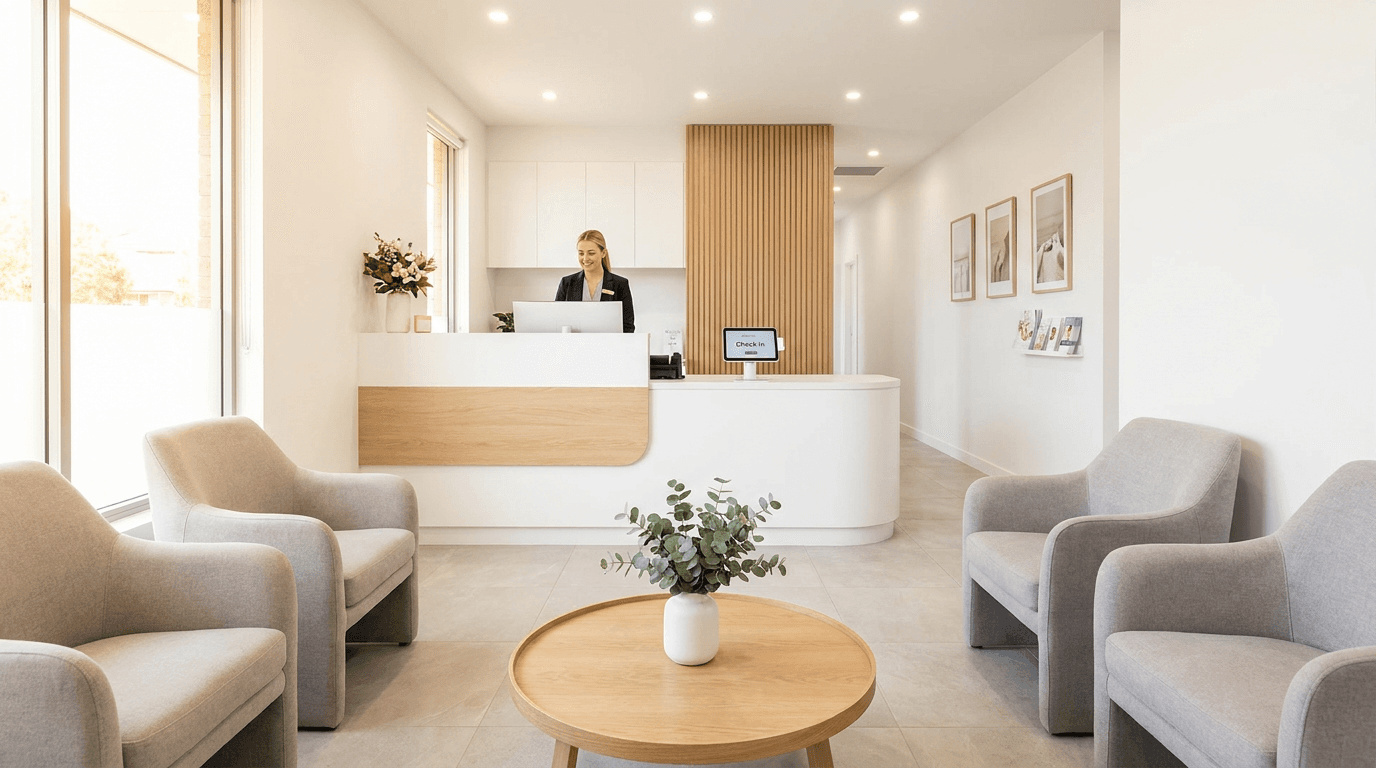
15 copy-paste AI prompts for dental and medical practice marketing. Clean clinical environments, patient experience imagery, team portraits, and professional healthcare visuals for dental offices, medical clinics, wellness centers, and healthcare marketing agencies.
15 copy-paste AI prompts for dental and medical practice marketing. Clean clinical environments, patient experience imagery, team portraits, treatment visualizations, and brand-building compositions designed for dental offices, medical clinics, dermatology practices, orthodontics, cosmetic dentistry, wellness centers, chiropractic offices, veterinary clinics, optometry practices, and healthcare marketing agencies.
A patient chooses a healthcare provider before they ever meet the provider. The decision happens on a screen — a Google search results page, an Instagram profile, a practice website, a health directory listing — and it happens fast. The patient scrolling through search results for "dentist near me" or "dermatologist accepting new patients" is not reading clinical credentials in that first moment. They are processing visual information: the look of the practice, the feeling of the space, the apparent professionalism of the team, and the overall impression of whether this place looks like somewhere they would trust with their health, their smile, their skin, their family's care. That visual impression, formed in less than a second, determines whether the patient clicks through to learn more or moves to the next listing.
The fundamental marketing challenge for dental and medical practices is that the visual content requirements of modern digital platforms are enormous, while the operational constraints on producing that content are uniquely severe. A dental office cannot pause mid-procedure to set up a photography session. A medical clinic's treatment rooms are occupied with patients whose privacy must be protected. The practitioners and staff who would appear in team photos are managing clinical schedules that leave no margin for multi-hour photoshoots. HIPAA and patient privacy regulations add an additional layer of complexity that makes casual, spontaneous content creation — the kind that works for restaurants or retail stores — essentially impossible in a healthcare setting. The result is that most practices operate with outdated, insufficient, or generic stock visual content that fails to communicate the actual quality and character of the care they provide.
AI image generation resolves this tension between the visual content demands of modern healthcare marketing and the operational and regulatory realities of clinical practice. With precisely engineered prompts, a dental or medical practice can produce photographic-quality imagery that communicates clinical excellence, patient comfort, modern technology, team warmth, and the specific brand identity of the practice — without disrupting clinical operations, involving real patients, or navigating the privacy and consent complexities of photography in a healthcare environment. Every image is generated from scratch. No real patients appear. No real procedures are depicted. No consent forms are required. And the quality of the resulting imagery meets the professional standards that healthcare audiences expect.
If you have generated AI imagery before for product photography, e-commerce content, or social media visuals, the workflow will be familiar. Copy the prompt, customize it for your specific practice, generate, and deploy. What makes these prompts distinct is that every template has been engineered around the specific visual psychology, professional standards, and patient-audience expectations of healthcare marketing. These are not generic professional images. They are healthcare brand visuals built to drive new patient acquisition, reinforce trust, communicate clinical quality, and position your practice as the confident, modern, patient-centered choice in your market.
A critical note on responsible and compliant usage: AI-generated healthcare imagery is ideal for brand content, website design, social media marketing, patient education materials, waiting room displays, advertising creative, and practice brochures. These images depict entirely fictional scenes, people, and environments. They should never be represented as photographs of actual patients, actual staff, or actual treatment outcomes. Do not use AI-generated before-and-after imagery to represent real clinical results. If your marketing includes outcome claims, those must be supported by actual patient photography obtained with proper written consent and compliant with all applicable advertising regulations. Always ensure your marketing materials comply with HIPAA, FTC healthcare advertising guidelines, state dental and medical board advertising regulations, and any other applicable healthcare marketing laws in your jurisdiction. Use AI generation as a tool to produce the consistent, high-quality visual branding content that modern practice marketing requires, while maintaining strict compliance with healthcare advertising standards.
Why Visual Content Determines Patient Acquisition in Healthcare
The healthcare provider selection process has fundamentally shifted from referral-driven to research-driven. Patients still value referrals from friends, family, and other providers, but the referral now initiates a research phase rather than directly producing a booking. The referred patient goes online, finds the practice's website and social profiles, evaluates the visual and informational content they find, and then decides whether to schedule. Practices with strong, professional, consistent visual content convert referred patients at dramatically higher rates than practices with weak or outdated visual presence — because the visual content either confirms or contradicts the trust established by the referral.
For patients discovering practices through search rather than referral, the visual content is the entire basis of initial trust formation. Healthcare is the highest-trust purchase a consumer makes: they are placing their physical wellbeing in someone's hands. The visual signals that communicate trustworthiness in a healthcare context are specific and well-established. Patients look for clinical environments that appear clean, modern, and well-equipped, because environmental quality signals care quality. They look for team imagery that communicates professionalism, warmth, and competence, because they are evaluating the people who will be responsible for their care. They look for an overall visual impression of organization, investment, and patient-centeredness, because these qualities predict the experience they will have as a patient.
The gap between patient expectations and typical practice visual content is significant. Patients in 2026 have been conditioned by consumer brands to expect high-quality visual experiences in every interaction. The same patient who evaluated your dental practice's website just came from browsing beautifully designed e-commerce sites, scrolling through professionally curated Instagram feeds, and interacting with polished brand content across every category. They apply these same visual quality standards, consciously or not, to your practice. A website with outdated stock photos, inconsistent styling, low-resolution team photos taken with a phone against a cluttered background, and generic clip art does not just fail to impress — it actively undermines the trust that drives patient acquisition.
The volume and variety of visual content required for a competitive healthcare practice marketing presence has expanded significantly. A modern dental or medical practice needs high-quality imagery for its website homepage, about page, team page, services pages, and patient resources section. It needs Google Business profile photos showing the exterior, interior, team, and atmosphere of the practice. It needs social media content across Instagram, Facebook, and potentially TikTok. It needs patient education materials, email marketing imagery, seasonal and promotional campaign visuals, print materials and brochures, and advertising creative for both digital and local campaigns. Professional photography can serve some of these needs, but producing the full volume across all channels and maintaining seasonal freshness requires either an enormous photography budget or a supplementary content production tool. AI generation provides that supplementary capability, allowing practices to maintain comprehensive, current, and consistent visual content across every patient touchpoint.
The Visual Language of Healthcare Practice Marketing
Healthcare marketing imagery operates within a specific visual framework that balances clinical professionalism with human warmth. Understanding this framework is essential for generating content that feels appropriate, trustworthy, and inviting rather than either coldly clinical or inappropriately casual.
Clean, bright environments communicate clinical excellence. The single most powerful visual signal in healthcare marketing is environmental cleanliness and order. A treatment room, reception area, or consultation space that appears immaculate, well-organized, and bright communicates that this practice maintains the standards of clinical excellence that patients expect. This is not merely aesthetic preference — it is a deeply rooted psychological association between environmental quality and care quality. Every prompt in this post specifies clean, bright, well-organized spaces because environmental visual quality is the foundation of healthcare brand trust.
Warm, natural light softens clinical environments without undermining professionalism. The challenge in healthcare imagery is avoiding the cold, institutional feeling that clinical environments can project. Fluorescent overhead lighting on hard surfaces creates an atmosphere that patients associate with hospitals and institutions rather than the welcoming, patient-centered experience that modern practices want to communicate. Warm natural light streaming through windows, supplemented by warm-toned ambient lighting, transforms a clinical space into a space that feels both professional and comfortable. The light must be bright enough to read as clean and open, but warm enough to feel welcoming. This balance is specified in every prompt.
Human expressions carry the emotional narrative. In healthcare imagery, the expressions on faces communicate more than any other element. A practitioner's confident, warm smile communicates competence and care. A patient's relaxed, comfortable expression communicates that this practice creates a positive experience. A team group's genuine, warm cohesion communicates that the staff enjoys working together, which patients correctly interpret as a signal of practice culture and stability. Describing expressions with precision — "confident warm smile," "relaxed comfortable expression," "genuine engaged warmth" — is essential for generating healthcare imagery that connects emotionally with prospective patients.
Modern equipment and technology signal investment and capability. Patients associate modern equipment with better outcomes, greater comfort, and a practice that invests in staying current. Visible modern technology in healthcare imagery — a clean digital interface, contemporary treatment chairs, modern diagnostic equipment, sleek digital displays — communicates that this practice operates at the current standard of care. This does not mean every image should be dominated by equipment, but the technology visible in environmental shots should look contemporary and well-maintained.
Color palettes in healthcare communicate specific brand positions. The colors that dominate a practice's visual content signal its market positioning. Crisp whites with soft blues communicate traditional clinical professionalism. Warm whites with natural wood and sage green communicate holistic, wellness-oriented care. Bright whites with clean teals communicate modern, technology-forward practice. Warm neutrals with soft golds communicate premium, boutique care. Every prompt includes a color palette that should be customized to match your practice's actual design palette and brand positioning.
The balance between clinical and lifestyle. The most effective healthcare marketing content exists on a spectrum between purely clinical imagery (treatment rooms, equipment, procedures) and purely lifestyle imagery (happy people, warm environments, aspirational moments). Content that is too clinical feels cold and can trigger anxiety in patients who already find healthcare settings stressful. Content that is too lifestyle-oriented feels disconnected from the actual service and can undermine credibility. The ideal balance varies by practice type and target patient demographic, but in general, the most effective healthcare imagery embeds clinical signals within warm, human, lifestyle-oriented compositions.
15 AI Prompt Templates for Dental & Medical Practice Marketing
Each template includes a content concept, the full copy-paste prompt, and deployment notes explaining where each image type performs best across practice marketing channels. All prompts are formatted for the Miraflow AI Image Generator and compatible with any high-quality text-to-image tool. Generate at 4:5 for Instagram feed posts, 9:16 for Stories and Reels, 1:1 for general social and Google Business, 16:9 for website banners and email headers, 2:3 for Pinterest, or 3:2 for horizontal blog and web content.
Template 1: Modern Reception and Waiting Area — The First Impression
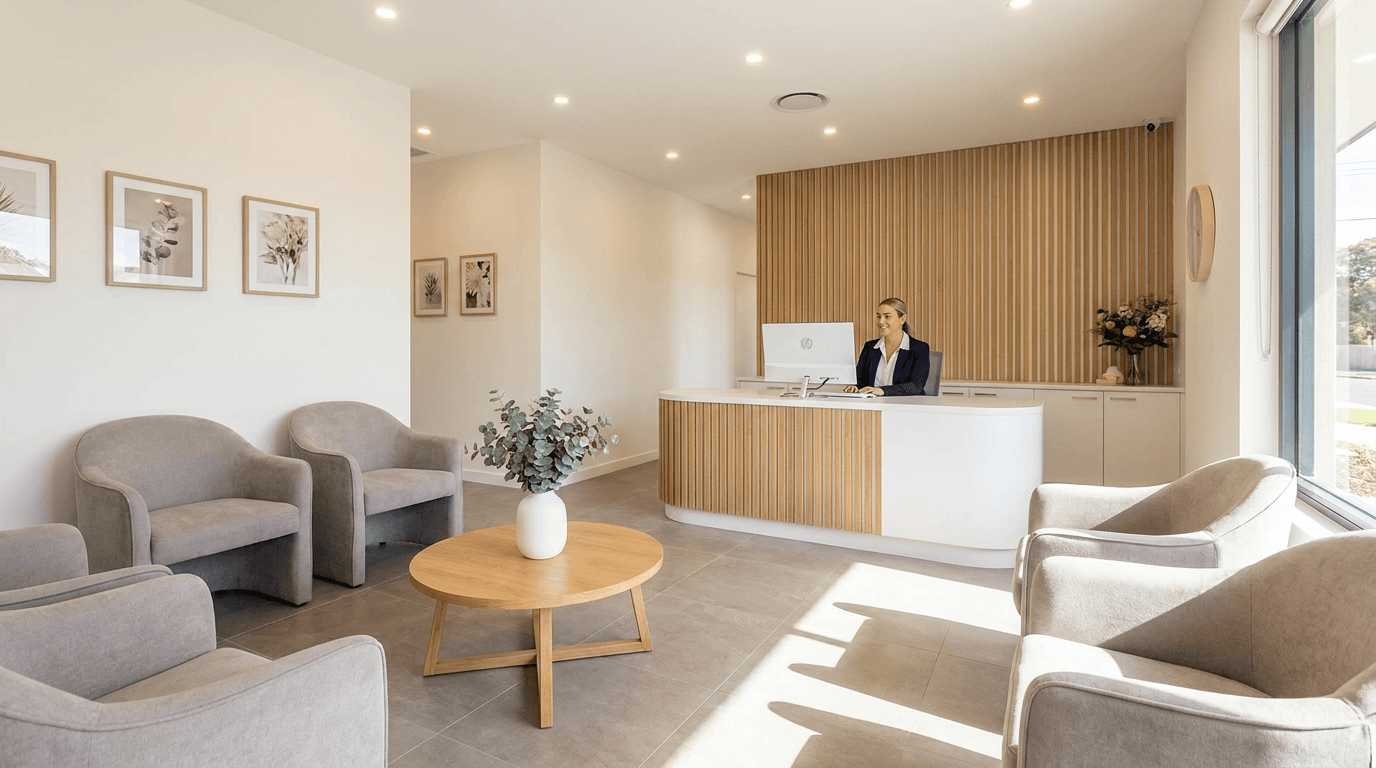
The reception area image is the most commercially important visual in practice marketing because it represents the patient's first physical experience of the practice. Before the consultation, before the treatment, before any clinical interaction, the patient walks into the reception area and forms an immediate impression that colors every subsequent experience. This template produces a warm, modern, welcoming reception environment that communicates investment, organization, and patient comfort.
Prompt:
editorial interior photograph of a modern dental or medical practice reception and waiting area, the space is bright and welcoming with a clean contemporary design, a sleek white reception desk with a smooth rounded front and a light natural oak accent panel sits at the center back of the space, behind the desk a friendly receptionist in neat professional attire smiles warmly while looking at a slim modern monitor, the waiting area features four comfortable modern armchairs upholstered in a soft warm light grey fabric arranged around a low round coffee table in light natural oak with a small arrangement of fresh eucalyptus in a simple white ceramic vase, the floor is large-format light warm grey porcelain tile with a clean uniform appearance, the walls are a crisp warm white with a feature wall behind the reception desk in vertical natural oak slats adding warmth and texture, a large window on one side allows abundant warm natural light to flood the space creating a bright open feeling, recessed warm-toned ceiling lights supplement the natural light evenly, a few simple framed prints in soft muted tones hang on one wall, a small shelf holds neatly arranged patient education brochures, a subtle modern digital check-in screen sits on the desk, the overall space reads as immaculately clean thoroughly modern warmly welcoming and designed with patient comfort as the first priority, warm white light natural oak soft warm grey upholstery soft eucalyptus green and bright warm natural light as the color palette, the mood is reassuringly professional immediately welcoming calmly organized and the feeling that you have chosen the right practice the moment you walk through the door, professional interior and architectural photography with bright warm natural light, composed as a wide shot from just inside the entrance showing the full reception area with the desk and waiting seating in balanced relationship, sharp throughout with natural depth, no text, no logos, no watermarks
Best for: Website homepage hero image, Google Business profile primary interior photo, new patient welcome materials, practice brochure cover or interior spread, social media practice tour content, patient portal and online scheduling page header, advertising campaign primary image, real estate and build-out planning reference
Template 2: The Dental Treatment Room — Clinical Excellence Environment
The treatment room image communicates the clinical environment where care actually happens. For dental practices specifically, this image directly addresses the most common patient concern — anxiety about the dental experience — by showing a space that is clean, modern, comfortable, and designed to put the patient at ease. This template produces a bright, reassuring treatment room that balances clinical professionalism with patient comfort.
Prompt:
editorial interior photograph of a modern dental treatment room that is clean bright and designed for patient comfort, a contemporary dental chair in soft warm white leather with a smooth ergonomic form is positioned in the center of the room in a reclined comfortable position, the chair is equipped with a modern articulating overhead dental light that is sleek and contemporary, a dental delivery system with a clean modern arm holds the instruments neatly organized, a slim modern monitor mounted on an adjustable arm displays a bright blue welcome screen, to the side a clean white countertop with modern cabinetry below holds neatly arranged supplies behind closed cabinet doors keeping the workspace immaculate, a large window behind the chair allows warm natural light to enter with a view of green foliage outside creating a calming connection to nature, the ceiling has recessed warm-toned lighting providing even bright illumination without the harsh institutional feel, the walls are a crisp warm white with one accent wall in a soft calming sage green, the floor is seamless light warm grey, every surface is spotlessly clean and organized, a small potted succulent on the windowsill and a neatly folded warm blanket on the chair armrest add comfort details, warm white soft sage green natural wood window trim warm natural light and the bright clean tones of modern clinical design as the color palette, the mood is clinically impeccable calmly reassuring thoughtfully comfortable and a treatment room designed by someone who understands that patients feel better when the environment feels better, professional interior photography with bright natural and ambient light emphasizing cleanliness and comfort, composed from the foot of the chair looking toward the window with the treatment setup and calming environment visible in full context, sharp throughout, no text, no logos, no watermarks
Best for: Website services page or treatment technology page, Google Business profile treatment environment photos, new patient anxiety-reduction content, social media facility tour posts, patient education materials showing the treatment environment, practice marketing brochures, insurance and referral partner materials, renovation and design planning reference
Template 3: Doctor-Patient Consultation — Trust and Communication
The consultation image communicates the relational quality of the care experience: a provider who listens, explains, and engages the patient as a partner in their care. This is the image that humanizes the practice and transforms it from a clinical facility into a relationship. This template produces a warm, genuine consultation moment that communicates both expertise and empathy.

Prompt:
editorial photograph of a doctor-patient consultation in a modern bright medical or dental office, a healthcare provider in a crisp clean white coat over professional attire sits at a slight angle facing a patient across a clean modern desk or consultation table in light natural oak, the provider is mid-explanation with a warm confident expression and one hand gesturing naturally while the other rests on the desk near a slim tablet displaying a medical diagram, the provider's posture is open and engaged communicating active attentive care, the patient is seen from behind and slightly to the side showing a relaxed comfortable posture and engaged listening body language without revealing identifying features, the consultation room is bright and professional with warm white walls and a window providing natural light, a few framed professional certificates are visible on the wall behind the provider adding credential context without being the focus, a small model of teeth for a dental office or an anatomical reference model sits on a shelf adding clinical context, the interaction between provider and patient is the emotional center of the image communicating trust rapport and partnership in care, warm white natural oak warm natural light crisp white coat and the warm tones of a professional yet personal interaction as the color palette, the mood is confidently reassuring personally attentive expertly communicative and the particular comfort of being in the care of someone who clearly knows what they are doing and genuinely cares about explaining it, professional editorial and healthcare photography with bright warm natural light, composed as a medium shot from slightly behind the patient's shoulder looking toward the provider creating a perspective that puts the viewer in the patient's position, the provider's expression and gesture as the focal point, natural depth of field, no text, no logos, no watermarks
Best for: Website homepage or about page, Google Business profile atmosphere photos, social media trust-building and provider spotlight content, patient testimonial page visual accompaniment, new patient information materials, email marketing new provider announcements, advertising campaign trust imagery, referral partner materials
Template 4: Team Group Portrait — The People Behind the Practice
The team portrait is among the most viewed images on any practice website because prospective patients want to see the people who will be caring for them. A strong team image communicates cohesion, warmth, professionalism, and the kind of positive workplace culture that patients correctly associate with better care experiences. This template produces a warm, natural, professional team portrait that feels genuine rather than stiffly posed.
Prompt:
editorial group portrait photograph of a dental or medical practice team of five people standing together in a bright modern practice hallway or reception area, the team includes a mix of clinical and administrative roles visible through their attire with two members in clean white clinical coats, two in neat professional scrubs in a soft coordinated warm blue-grey, and one in smart professional office attire, the group stands in a natural relaxed arrangement with slight variation in position rather than a rigid line creating an approachable organic grouping, everyone has a genuine warm natural smile with relaxed confident body language, the shortest members are not hidden and the group composition feels balanced and inclusive, the practice interior behind them is bright and modern with warm white walls, the natural oak accent elements, and warm even lighting, the hallway or reception space extends behind with soft depth showing the professional well-maintained environment, everyone appears well-groomed professional and genuinely happy to be working together, warm natural light from windows mixes with bright even interior lighting creating a clean flattering illumination on the group, clean white coats soft warm blue-grey scrubs warm professional attire warm white and oak interior and bright warm mixed light as the color palette, the mood is cohesively professional genuinely warm confidently capable and a team that clearly enjoys working together and will make you feel welcome and well cared for, professional group and team editorial photography with bright even flattering lighting, composed with the group centered in the frame with the practice interior providing context on both sides, everyone in sharp focus with the background providing soft professional context, no text, no logos, no watermarks
Best for: Website team page or about page hero, Google Business profile team photo, social media team introduction and culture content, practice brochure team section, new patient welcome packet, hiring and recruitment materials, social media about us content, community involvement and sponsorship materials, insurance network directory listing photo
Template 5: Pediatric-Friendly Environment — Family Practice Appeal
For practices that serve children and families, communicating a child-friendly environment is essential for attracting parent patients who are making care decisions for their children. This template produces a warm, colorful, child-welcoming space that tells parents this practice understands the unique needs of young patients.
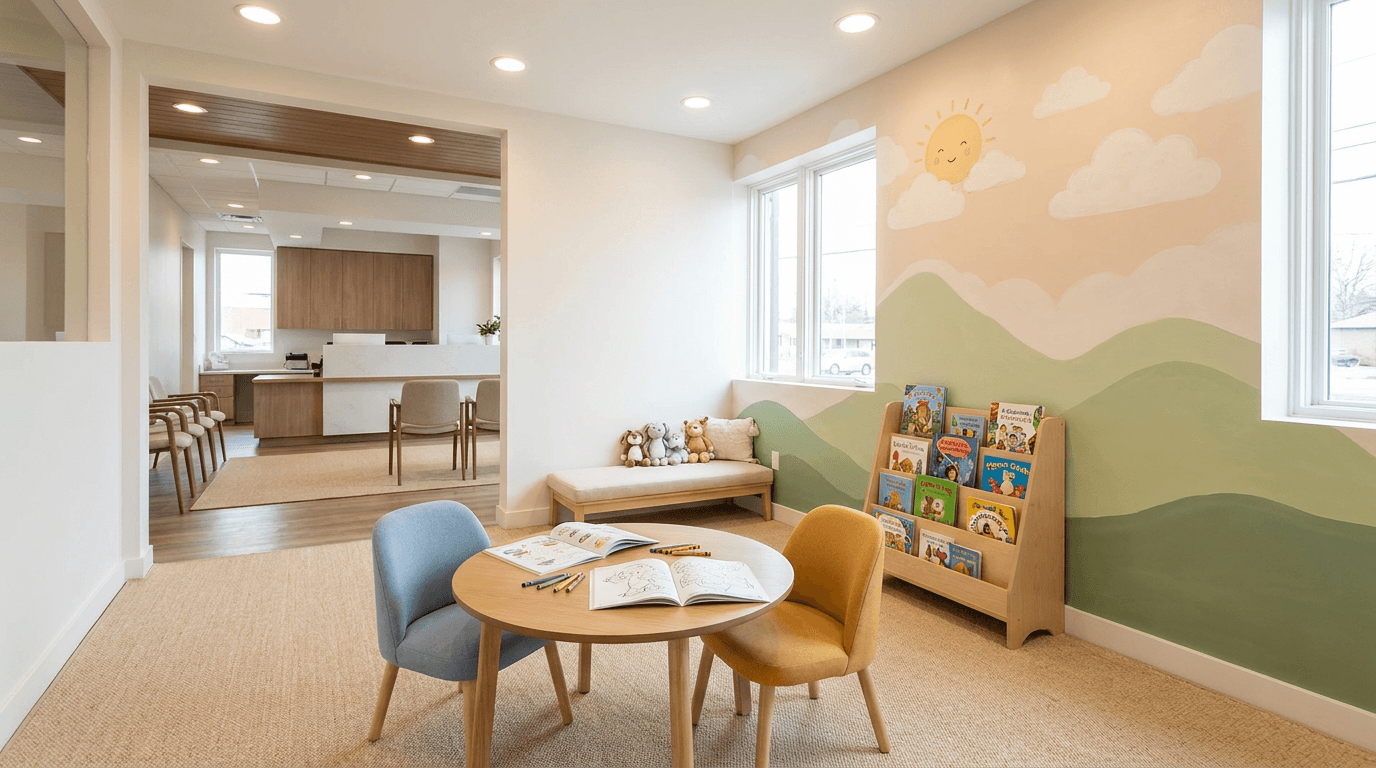
Prompt:
editorial interior photograph of a pediatric-friendly area within a modern dental or medical practice, the space is a designated children's waiting or play area adjacent to the main waiting room, the area features child-sized furniture including two small chairs in soft warm primary tones of gentle blue and warm yellow at a low round table with coloring books and crayons, a small open bookshelf holds children's books with colorful spines neatly arranged, the walls in this section feature a soft warm pastel mural of friendly simple nature imagery with rolling hills a smiling sun and a few gentle clouds in warm soft tones that are playful without being chaotic, the flooring in the children's area is a warm soft material in a clean light natural tone, a few soft plush toys sit neatly on a low bench, the space is bright and cheerful with warm natural light and supplemental warm ceiling lighting, importantly the children's area is clearly part of the larger modern clean practice environment visible in the background maintaining the professional clinical context while showing the dedicated family-friendly space, the transition between the playful children's area and the professional main space is visible showing that the practice serves both audiences thoughtfully, soft warm blue gentle warm yellow warm pastels natural light and the clean modern practice environment as the color palette, the mood is joyfully welcoming gently reassuring safely playful and designed by someone who remembers what it feels like to be small in a big clinical space, professional interior photography with bright warm cheerful lighting, composed to show both the children's area in the foreground and the professional practice environment in the background demonstrating the integrated family-friendly design, sharp throughout with natural depth, no text, no logos, no watermarks
Best for: Website pediatric or family services page, Google Business profile interior photos for family practices, social media family-focused content, parent-targeted advertising and new patient campaigns, practice brochure family section, pediatric dental or medical marketing materials, school and community partnership materials, email marketing family-focused messaging
Template 6: Before-and-After Concept — Treatment Transformation Visual
Before-and-after imagery is the most conversion-driving content type in cosmetic dentistry, dermatology, orthodontics, and aesthetic medical marketing. This template produces a clean, professional split-frame concept layout that communicates the transformative potential of treatment. Important: This template creates an illustrative concept visual only. Do not represent AI-generated before-and-after images as actual patient results. Real outcome claims require real patient photography with proper consent and regulatory compliance.
Prompt:
editorial concept photograph showing a dental or cosmetic treatment transformation concept, a clean split-composition with the left side and right side showing the same person's lower face from nose to chin in identical warm bright even lighting and positioning, on the left side the smile shows slightly discolored and mildly uneven teeth suggesting the before state with the lips in a natural relaxed smile, on the right side the same face shows bright white evenly aligned teeth in a confident open smile suggesting the after state, the person's skin is healthy and natural with a warm tone, the background on both sides is a clean soft warm neutral gradient that is identical creating a professional clinical comparison format, a thin clean vertical line or subtle division separates the two sides, the lighting is bright warm and even on both sides ensuring consistent clinical-quality comparison illumination with no dramatic shadows, the composition focuses entirely on the smile and lower face maintaining privacy while showcasing the treatment area, warm healthy skin tones clean bright teeth tones soft warm neutral background and bright even clinical lighting as the color palette, the mood is confidently transformative clinically credible professionally presented and the visual promise of what skilled care can achieve, professional clinical and cosmetic photography with bright even controlled lighting, composed as a symmetric side-by-side with the smile as the absolute focal center, sharp clinical detail on the teeth and smile, no text, no logos, no watermarks
Best for: Website cosmetic or aesthetic services page, social media transformation and results content with appropriate disclaimers, advertising campaign before-and-after concept imagery, consultation room display showing treatment possibilities, patient education materials, treatment planning visual aids, practice brochure cosmetic section — always with clear disclosure that images are illustrative concepts and not actual patient results
Template 7: Technology and Innovation — Modern Equipment Showcase
Showcasing modern technology communicates investment, capability, and a practice that stays current with advances in care. For patients evaluating multiple practices, visible modern technology is often the differentiating factor that signals which practice is more advanced. This template produces a clean, impressive technology showcase that communicates clinical innovation.
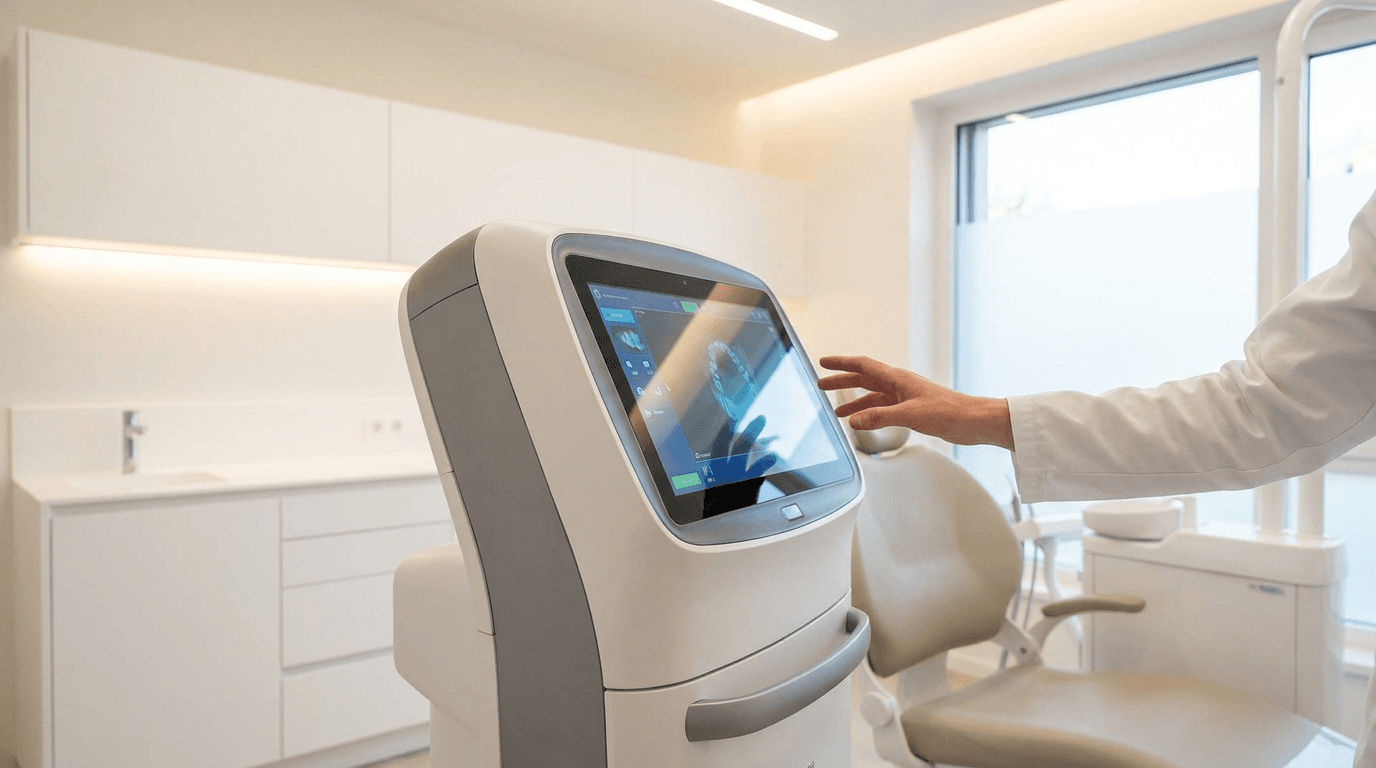
Prompt:
editorial photograph of modern dental or medical technology in a clean bright clinical environment, a contemporary piece of diagnostic or treatment technology is the central subject — a modern digital imaging system or advanced diagnostic device with a sleek clean design in white and soft grey with a modern digital display showing a bright clear interface, the technology sits in a clean bright treatment or diagnostic room with immaculate white surfaces and warm even lighting, the device is photographed at a slight angle showing its clean modern industrial design and the digital display, the room around it is spotlessly clean with modern cabinetry in warm white and a bright window providing natural light, a healthcare professional's hand or arm in a clean white coat sleeve is visible near the device suggesting professional operation without dominating the composition, the focus is on the technology itself as a symbol of the practice's investment in modern care, the clinical environment is bright and reassuring rather than cold and intimidating, clean modern white and grey device tones warm white environment bright digital display blue and warm natural light as the color palette, the mood is impressively modern technologically advanced clinically precise and the quiet confidence of a practice that invests in the best tools for the best outcomes, professional technology and clinical editorial photography with bright clean even lighting, composed with the technology as the central subject showing its form and display with the clinical environment providing clean professional context, sharp detail on the device and display, no text, no logos, no watermarks
Best for: Website technology or innovation page, social media technology spotlight content, Google Business profile equipment and facility photos, new technology announcement marketing, patient education about modern diagnostic and treatment technology, practice differentiation content, advertising campaign technology-forward positioning, insurance and referral partner capability materials
Template 8: Warm Practitioner Portrait — The Provider Headshot
The individual provider portrait is viewed by nearly every prospective patient evaluating the practice. It must communicate three things simultaneously: clinical competence, personal warmth, and approachable confidence. This template produces a polished, warm, professional headshot that makes the patient want to be in this person's care.
Prompt:
editorial professional portrait of a healthcare provider, a doctor or dentist photographed from the waist up wearing a crisp clean white clinical coat over a professional collared shirt in a soft warm blue, the provider stands with a natural confident posture with shoulders relaxed and slightly angled to the camera, their expression is a genuine warm confident smile with kind engaged eyes that communicate both expertise and approachability, their hands are relaxed and naturally positioned with one hand perhaps resting lightly on a stethoscope around their neck or a clinical tool in a coat pocket, the background is a softly blurred modern clinical environment showing the warm suggestion of a bright treatment room or office with warm white walls and the soft glow of natural light from a window, the lighting on the provider is bright warm and flattering with a soft key light from the right and gentle fill creating dimension without harsh shadows, the provider appears well-groomed professional and the kind of person you would immediately feel comfortable trusting with your care, crisp white coat soft warm blue shirt warm natural skin tones and bright warm portrait lighting against a soft clinical background as the color palette, the mood is quietly confident warmly authoritative genuinely caring and a provider who combines deep expertise with the kind of personal warmth that makes patients feel they are in exactly the right hands, professional editorial portrait photography with warm flattering controlled lighting, composed as a medium portrait with the provider centered and the clinical background providing professional context without distraction, the eyes and smile as the primary focal points, shallow depth of field with the provider sharp and the background softly diffused, no text, no logos, no watermarks
Best for: Website provider bio page, Google Business profile team photos, social media provider introduction and spotlight content, insurance network directory listings, referral partner materials, community involvement and speaking engagement bios, practice brochure provider section, patient communication and appointment reminder imagery, press and media headshot
Template 9: Patient Comfort Moment — The Positive Experience
Patients researching healthcare providers are looking for evidence that the experience will be comfortable, not just that the clinical outcomes will be good. This template produces a warm, reassuring moment of positive patient experience that counters anxiety and communicates the practice's commitment to patient comfort.
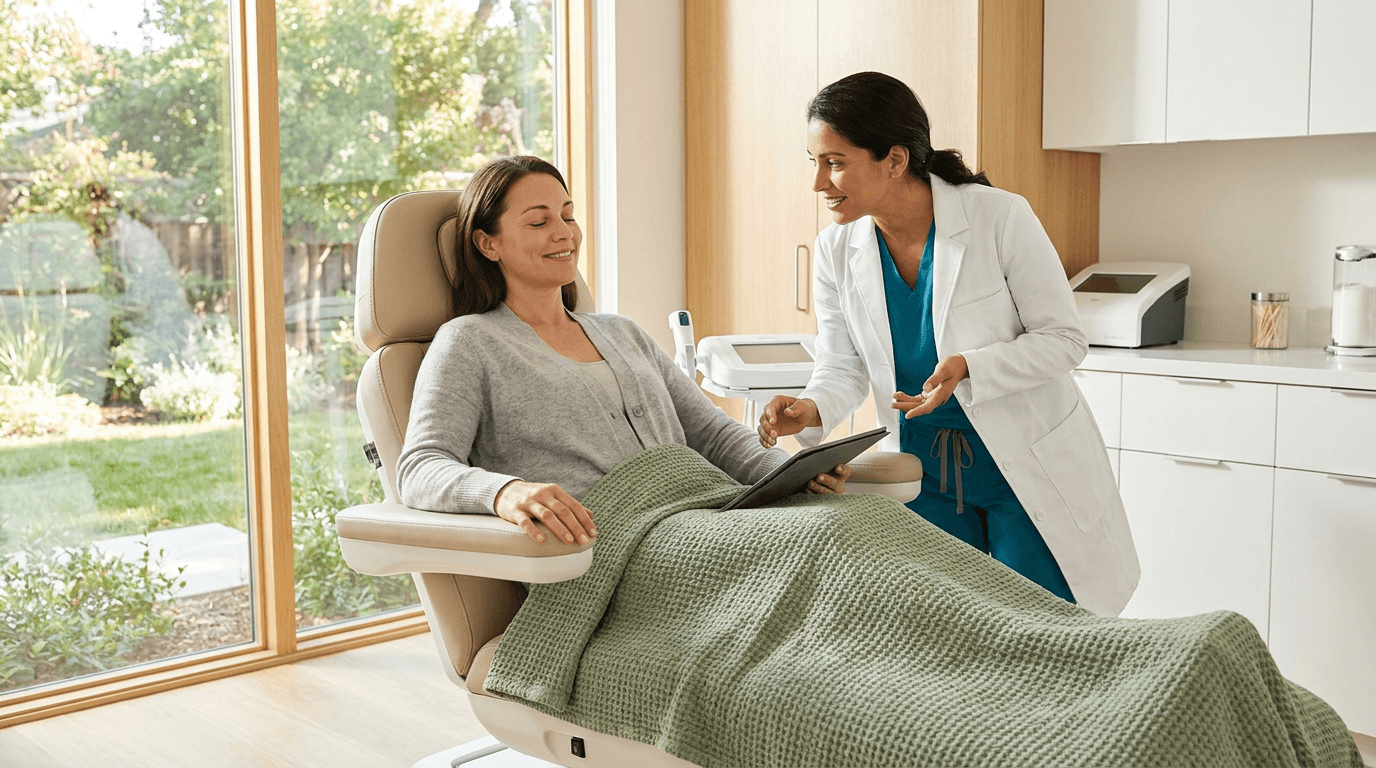
Prompt:
editorial photograph of a positive patient experience moment in a modern dental or medical practice, a patient sits comfortably in a contemporary treatment chair in a bright clean treatment room, the patient is relaxed with a natural calm smile and comfortable body language suggesting ease and trust rather than anxiety, a healthcare provider in clean professional attire is nearby in a warm attentive posture, perhaps adjusting something on the chair or gesturing reassuringly with a kind natural smile, the interaction between them communicates warmth professionalism and genuine care, the treatment room is bright and modern with a large window showing green foliage outside and warm natural light filling the space, the clinical environment is visible but secondary to the human interaction with modern equipment clean surfaces and an overall feeling of calm professional order, a warm blanket is draped over the patient's lap adding a comfort detail, the patient's expression is the emotional center showing a person who feels safe comfortable and well cared for, bright warm white calm sage green natural light warm blanket tones and the warm human tones of a positive caring interaction as the color palette, the mood is genuinely comforting positively surprising trustfully relaxed and the experience of care that is so good it changes how you feel about going to the doctor or dentist, professional editorial and healthcare photography with bright warm natural light, composed as a medium shot showing the patient-provider interaction with the bright treatment room as context, the patient's relaxed expression and the provider's warm attentive posture as the dual focal points, natural depth of field, no text, no logos, no watermarks
Best for: Website homepage or patient experience page, Google Business profile atmosphere and experience photos, social media patient comfort and experience content, anxiety-reduction marketing for dental and medical practices, new patient welcome and what-to-expect materials, advertising campaign experience-focused imagery, email marketing patient experience messaging, review and testimonial page visual accompaniment
Template 10: Dental Smile Close-Up — The Result Image
The smile close-up is the aspirational hero image of dental marketing. It communicates the end result that motivates patients to seek care: a beautiful, healthy, confident smile. This template produces a warm, natural, professionally lit smile image that is aspirational without being artificially perfect.
Prompt:
editorial close-up photograph of a beautiful healthy confident smile, the image shows the lower half of a face from just below the nose to the chin, the lips are in a natural open smile showing clean bright white teeth that are well-aligned and healthy-looking with a natural variation that reads as genuinely beautiful rather than artificially uniform, the teeth have a natural subtle translucency at the edges and a warm natural white tone rather than an impossibly bright blue-white, the lips are healthy and natural with a warm tone, the skin around the mouth is clear and healthy with a warm natural glow, the smile is genuine and confident with the natural asymmetry and character of a real smile rather than a rigid posed expression, the lighting is bright warm and even with a soft warm key light that creates a gentle highlight on the lips and teeth and a warm flattering glow on the skin, the background is a clean soft warm neutral tone that keeps all attention on the smile, natural warm skin tone natural bright tooth tone healthy lip color and bright warm even light against a clean neutral background as the color palette, the mood is confidently radiant naturally beautiful healthfully vibrant and the kind of smile that makes someone glad they invested in their dental care, professional cosmetic and dental portrait photography with bright warm controlled lighting optimized for dental aesthetic presentation, composed as a tight crop on the smile from nose to chin with the teeth and smile shape as the absolute focal center, extremely sharp detail on the teeth and smile with soft smooth skin tones, no text, no logos, no watermarks
Best for: Website cosmetic dentistry or smile gallery page, social media smile aspiration and dental aesthetic content, advertising campaign hero smile imagery, practice brochure cover or cosmetic section, in-office smile gallery display, orthodontic and cosmetic treatment marketing, email marketing cosmetic service promotion, patient consultation visual inspiration — with appropriate disclosure that images are illustrative
Template 11: Clean Clinical Detail — Instruments and Precision
Detail shots of clean, organized clinical instruments communicate the precision, standards, and meticulous care that patients want to associate with their healthcare provider. This template produces a warm, reassuring instrument detail that celebrates clinical precision as craft.
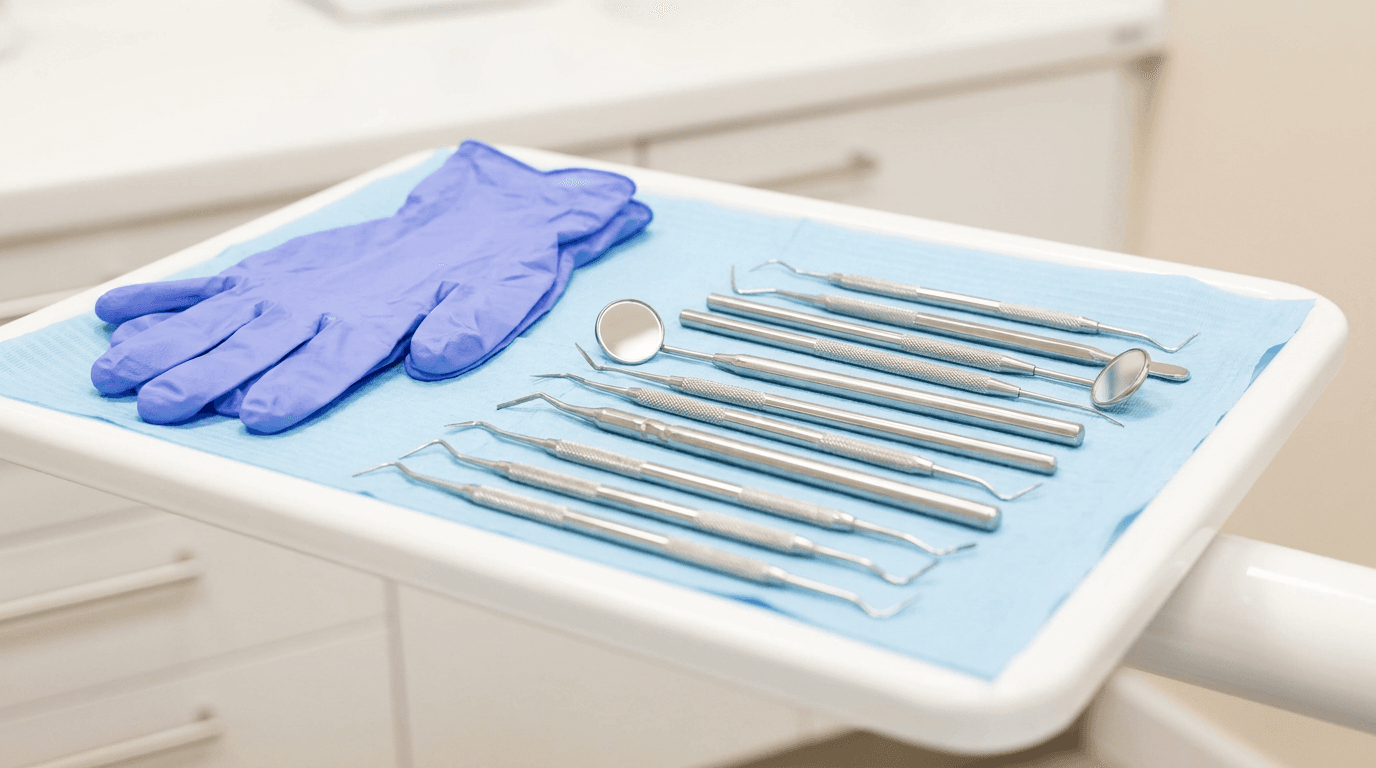
Prompt:
editorial close-up photograph of clean organized dental or medical instruments arranged on a sterile surface, a set of clinical instruments in polished stainless steel are laid out in a precise neat parallel arrangement on a clean sterilization tray or wrapped in sterile packaging on a bright clean white surface, the instruments are immaculately clean with a bright polished finish that catches the light showing the precision machining and quality of the tools, the arrangement is orderly and intentional communicating methodical professional preparation, a pair of clean clinical gloves in a soft blue-purple tone is placed neatly to one side adding a color accent and suggesting readiness for patient care, the lighting is bright clean and even with a soft directional component that creates gentle highlights on the polished metal surfaces and subtle shadows that give the instruments dimension and form, the background is clean bright and clinical with soft warm white tones, the overall image communicates meticulous standards impeccable organization and the kind of preparation that reflects how this practice approaches every aspect of patient care, polished stainless steel bright clean white soft blue-purple gloves and bright clean even clinical lighting as the color palette, the mood is precisely organized meticulously sterile professionally rigorous and the visible evidence of standards that never slip, professional clinical and still-life photography with bright clean lighting emphasizing the precision and cleanliness of the instruments, composed as a close-up to medium shot with the instrument arrangement as the central subject, sharp detail throughout showing the quality and cleanliness of every surface, no text, no logos, no watermarks
Best for: Website sterilization and safety page, social media trust-building and behind-the-scenes content, patient education about safety and sterilization standards, practice quality and standards marketing, Google Business profile detail photos, accreditation and compliance documentation imagery, advertising campaign quality-focused messaging, email marketing safety and standards content
Template 12: Exterior Practice Facade — The Street-Level Brand
The exterior image is the bridge between the patient's digital research and their physical arrival. It is the image that makes the practice findable, recognizable, and inviting from the street. For Google Business listings, the exterior photo is critical for helping patients identify the practice when they arrive. This template produces a clean, professional, inviting practice exterior.
Prompt:
editorial exterior photograph of a modern dental or medical practice storefront at street level, the facade is clean and contemporary with a well-maintained exterior in warm white or light warm grey with clean architectural lines, a modern practice sign with a professional clean sans-serif font is visible above the entrance showing the kind of thoughtful branding that communicates quality, large clean windows allow a glimpse of the bright warm interior reception area, the entrance door is modern glass with a brushed metal handle, the facade includes subtle warm design details such as a small planter box with neat green low boxwood plants or a clean modern bench beside the entrance, the sidewalk in front is clean and well-maintained, the practice sits in a professional or mixed-use neighborhood context with other well-maintained buildings or landscaping softly visible on the sides, the lighting is warm and inviting with natural daylight illuminating the facade and the warm interior lighting visible through the windows creating a welcoming glow, warm white or light grey facade natural green planters warm interior glow brushed metal accents and warm natural daylight as the color palette, the mood is professionally established immediately identifiable confidently welcoming and the kind of practice that looks as good from the outside as it feels on the inside, professional architectural and exterior photography with warm natural daylight, composed from a slight angle on the sidewalk showing the full facade with entrance sign and street-level context, sharp throughout with a natural street perspective, no text other than a generic non-readable practice sign, no specific logos, no watermarks
Best for: Google Business profile primary exterior photo, website location and contact page, new patient directions and wayfinding materials, Google Maps listing photo, social media location and community content, practice branding and signage design reference, advertising campaign location awareness imagery, email marketing location announcement or relocation content
Template 13: Wellness and Holistic — Calming Treatment Space
For practices positioning in the wellness, holistic, integrative, or spa-adjacent space — including dermatology spas, wellness clinics, holistic dental practices, and integrative medicine offices — the visual language shifts toward calm, natural, spa-like environments. This template produces a serene, nature-influenced treatment or consultation space that communicates holistic care philosophy.
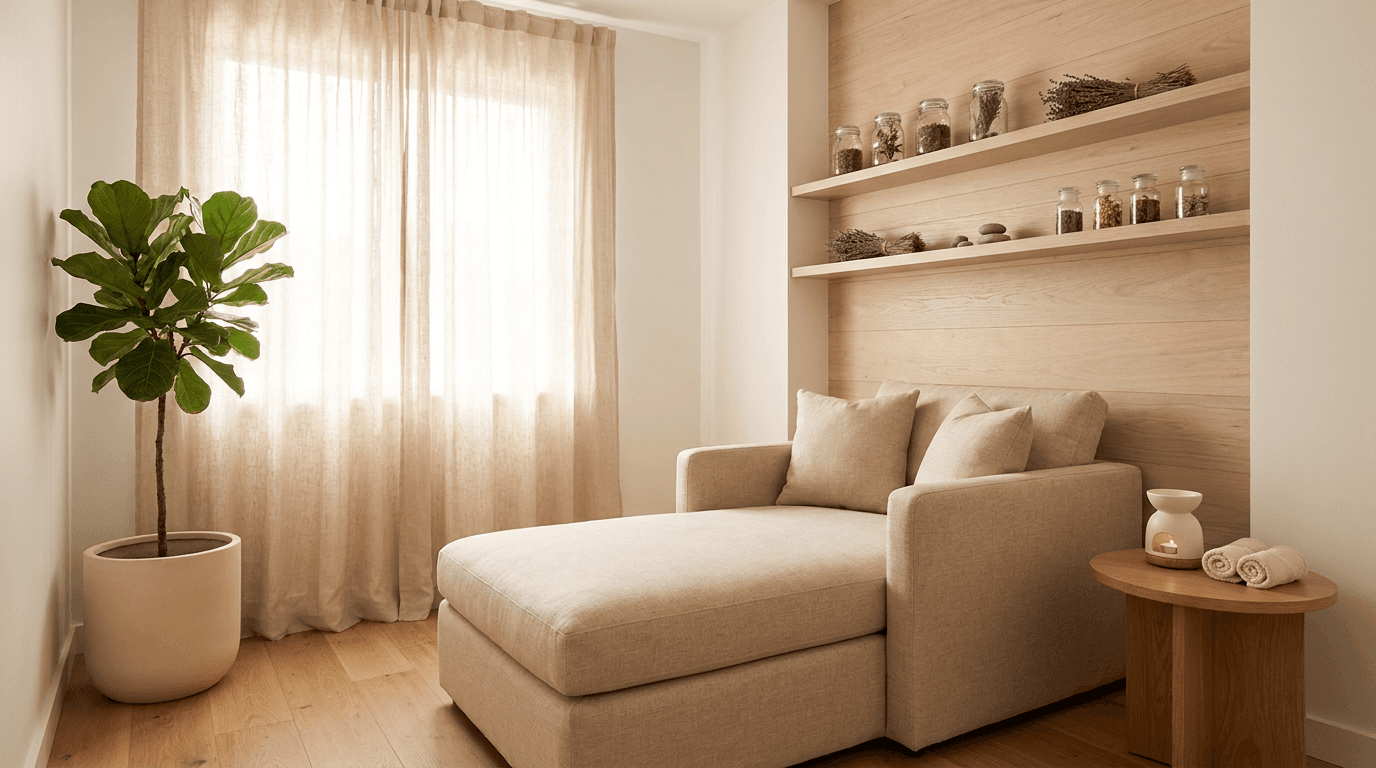
Prompt:
editorial interior photograph of a calming wellness-oriented treatment or consultation room in a modern holistic practice, the room is serene and nature-influenced with a warm minimal design that feels more like a high-end wellness retreat than a traditional clinical space, a comfortable treatment bed or consultation seating area in warm natural linen fabric in a soft warm oatmeal tone is the central element, the walls are a soft warm white with one accent wall featuring natural warm wood planking in a light ash or pale cedar tone, a large window with sheer natural linen curtains diffuses warm natural light throughout the room creating a soft ethereal glow, shelving in natural warm wood holds a curated arrangement of clear glass bottles with botanical elements, a small arrangement of dried lavender, and a few natural stone elements, a small potted monstera or fiddle leaf fig in a warm ceramic planter in matte warm cream adds living green, the floor is warm natural wood in a light warm oak tone, a small side table in natural wood holds a ceramic diffuser and two rolled warm cream towels, the lighting is entirely warm and soft with the diffused natural window light creating a peaceful ambient quality, warm oatmeal linen light natural wood soft warm white botanical green warm cream ceramic and soft diffused warm natural light as the color palette, the mood is deeply calming naturally restorative thoughtfully healing and a space where wellness is not just treated but felt in every design choice, professional interior and wellness photography with soft warm diffused natural light, composed as a medium-wide shot showing the treatment area and the natural calming environment in balanced context, soft warm tones throughout with a gentle dreamy quality to the light, no text, no logos, no watermarks
Best for: Website holistic or wellness services page, wellness-oriented practice brand positioning, social media wellness and self-care content, dermatology spa and aesthetic practice marketing, Google Business profile interior photos for wellness-oriented practices, patient education about holistic treatment approach, advertising campaign wellness positioning imagery, spa and wellness partnership materials
Template 14: Patient Education Illustration — Informative and Approachable
Patient education content that explains conditions, procedures, and preventive care builds trust and positions the practice as an authoritative, caring resource. This template produces a clean, approachable educational illustration style that makes clinical information feel accessible rather than intimidating.
Prompt:
clean professional medical or dental educational illustration in a modern friendly infographic style, a clear simplified anatomical illustration showing a cross-section view of a healthy tooth with labeled structural elements showing enamel dentin pulp and root in a clean diagram style, OR a clear simplified illustration of a common health concept relevant to the practice specialty, the illustration style is clean modern and approachable with smooth clean lines, soft warm rounded forms, and a friendly accessible quality that makes clinical information feel understandable rather than intimidating, the color palette uses soft warm clinical tones with a primary soft teal or soft warm blue for the main elements, warm white for the background, soft warm grey for secondary elements, and warm coral or soft amber for accent highlights drawing attention to key features, the illustration sits on a clean warm white background with generous white space creating a professional uncluttered educational layout, the anatomical or medical details are accurate and clear but presented with a warmth and simplicity that communicates education and care rather than clinical coldness, soft warm teal or blue primary soft warm grey secondary warm coral or amber accents and clean warm white background as the color palette, the mood is clearly educational professionally authoritative gently approachable and the kind of illustration that makes a patient feel informed and empowered rather than confused or anxious, professional medical illustration and educational graphic design with clean even lighting, composed as a centered illustration with clear visual hierarchy and generous breathing room, clean sharp lines and smooth color fills, no text, no labels, no logos, no watermarks
Best for: Website patient education and resources page, social media educational carousel content, patient handout and take-home materials, email marketing educational content, waiting room digital display educational content, blog post and article illustrations, new patient education kit, children's patient education materials
Template 15: Community and Values — The Practice Beyond the Clinic
Patients increasingly choose healthcare providers who align with their values and demonstrate community engagement. This template produces a warm, genuine image of the practice team participating in community involvement that communicates the practice's values and local commitment.

Prompt:
editorial lifestyle photograph of a healthcare practice team participating in a community wellness event outdoors, a group of four to five practice team members wearing matching clean professional t-shirts in a soft warm blue with a cohesive friendly look stand together at what appears to be a community health fair or charity event, the team members are smiling genuinely with warm engaged expressions and relaxed natural body language, they stand behind or beside a clean simple table or booth set up with wellness information and friendly welcoming materials, the outdoor setting is a green park or community space with warm natural sunlight and the suggestion of other event participants and booths softly blurred in the background creating a community atmosphere, trees and green grass provide a fresh natural backdrop, the team looks genuinely happy to be there with a cohesive group energy that communicates real commitment rather than obligatory participation, the outdoor lighting is warm bright and natural with golden afternoon light creating a warm flattering quality, soft warm blue team shirts green outdoor environment warm natural sunlight friendly community atmosphere and genuine warm human connection as the color palette, the mood is generously community-minded genuinely joyful authentically committed and a practice that cares about the community as much as it cares about the patients who walk through its doors, professional editorial and event photography with bright warm natural outdoor light, composed as a medium group shot showing the team with the community event context creating depth and narrative, warm natural expressions as the focal center, natural depth of field with the team sharp and the event atmosphere providing bokeh context, no text, no logos, no brand names
Best for: Website community involvement or values page, social media community engagement and CSR content, local press and media features, practice brochure values and community section, Google Business profile team and event photos, email marketing community event announcements and recaps, social media local engagement and sponsorship content, award and recognition nomination materials
How to Customize These Prompts for Your Specific Practice
The templates above produce strong healthcare imagery across the most commercially important content types, but the images that build your specific brand are the ones customized to your actual practice, specialty, and identity. The following dimensions are where customization transforms generic healthcare imagery into your practice's visual brand.
Replace the specialty context with your actual practice type. The templates use "dental or medical" as a flexible base. If you are an orthodontic practice, add braces models, Invisalign-style aligners, and orthodontic-specific equipment to the environmental descriptions. If you are a dermatology practice, adjust the treatment rooms to include dermatological examination equipment and skin care product displays. If you are a chiropractic office, describe adjustment tables and spinal models. If you are an optometry practice, describe eye exam equipment, lens displays, and eyewear showcases. The clinical details specific to your specialty create authenticity.
Adjust the interior design language to match your actual space. The templates describe common modern practice design elements. Your practice may feature different materials, colors, and design approaches. If your space has a warm traditional design with crown molding and rich wood rather than a modern minimalist aesthetic, describe that. If your practice uses a specific color scheme — perhaps your brand colors are navy and gold, or teal and warm grey — substitute those colors into every prompt's palette description. If your reception area has specific features like an aquarium, a living wall, or a particular art collection, include those distinctive elements.
Customize the team descriptions to reflect your actual team composition. If your practice has a larger or smaller team, adjust the group portrait numbers accordingly. If your team wears specific scrub colors or uniform styles, describe those. If your practice culture includes specific elements — perhaps the team wears matching embroidered quarter-zips rather than white coats, or your scrub colors coordinate with your brand palette — include those details for authenticity.
Adapt the patient demographic signals for your target audience. If your practice specializes in pediatric care, the patient figures in consultation and treatment images should be children with accompanying parents. If you focus on geriatric care, adjust accordingly. If your practice serves a specific demographic community, the people in your imagery should reflect the diversity of your actual patient base. Inclusive representation in generated healthcare imagery is both ethically important and commercially effective.
Modify the technology descriptions for your actual equipment. If your practice has invested in specific technology — a CEREC same-day crown system, a CBCT 3D scanner, a particular laser system, advanced imaging equipment — describe those specific technologies in the technology showcase prompt. Your actual technology investments are competitive advantages and should be visually represented with accuracy.
Adjust the atmosphere for your brand position. A high-end cosmetic dentistry practice and a friendly neighborhood family practice communicate different atmospheres. A wellness-oriented integrative medicine office and a technology-forward specialty clinic have different visual languages. Ensure the environmental descriptors, material choices, color palettes, and atmospheric qualities in your customized prompts match your actual brand positioning and the expectations of your target patient population.
For targeted refinements to generated images — changing a wall color, adjusting scrub tones, swapping a background detail, or correcting an element — the Image Inpainting tool allows precise editing of specific regions while preserving the overall composition.
Platform-Specific Deployment Strategy for Practice Marketing
Generating high-quality practice imagery is the production step. Deploying it strategically across the platforms where prospective patients research, evaluate, and choose healthcare providers is what converts visual quality into new patient appointments.
Your website is the primary conversion platform. Unlike many industries where social media drives the majority of conversions, healthcare patient acquisition still flows heavily through the practice website. Patients referred by friends, found through Google, or discovered on social media all visit the website before booking. The website must communicate clinical excellence, patient comfort, and practice values within the first few seconds of the visit. Use the reception area (Template 1) or a warm practice hero shot as the homepage banner at 16:9. The provider portrait (Template 8) and team photo (Template 4) anchor the about and team pages. Treatment room and technology images (Templates 2, 7) support services pages. Patient comfort imagery (Template 9) supports the patient experience and what-to-expect sections. Every page should feature imagery consistent in color warmth, quality, and brand identity.
Google Business Profile is the decision point for local search. When a patient searches "dentist near me" or "dermatologist [city name]," the Google Business listing and its photos are often the deciding factor between practices. Upload the exterior photo (Template 12) as the primary image so patients can identify the building on arrival. Interior shots (Templates 1, 2, 5) show the environment. Team photos (Templates 4, 8) show the people. Aim for 15 to 25 high-quality photos across Google's categories: exterior, interior, team, atmosphere, and at work. Update photos quarterly to maintain freshness and signal an active, current practice.
Instagram builds brand affinity and community connection. While Instagram may not be the primary discovery platform for healthcare providers, it serves a crucial role in brand building, community connection, and the long-form trust development that converts followers into patients. Post at 4:5 for maximum feed real estate. The educational content (Template 14), team culture (Templates 4, 15), and patient experience (Templates 3, 9) content types perform well on healthcare Instagram. Stories at 9:16 work for behind-the-scenes practice content, daily tips, and patient education snippets. Maintain a clean, professional, warm grid aesthetic. For additional Instagram content strategies, the dedicated guide covers format optimization in detail.
Facebook remains valuable for community healthcare practices. For family, general, and community-oriented practices, Facebook's local community functionality and demographic reach make it a strong platform. Community event content (Template 15), team introductions (Templates 4, 8), and practice news all perform well on Facebook. The platform's local recommendation features and group participation make it particularly valuable for practices building community presence.
TikTok reaches younger demographics and builds viral awareness. Healthcare providers and practices are building significant followings on TikTok through educational content, behind-the-scenes practice culture, and myth-busting health information. The process and technology shots (Templates 5 in the cafe guide, Templates 7 and 11 here) and educational content (Template 14) provide visual foundations for short-form video content. For TikTok visual content strategies, the dedicated guide covers scene composition for short-form video.
Email marketing maintains patient relationships and drives reactivation. For practices with patient email lists, regular email communication with strong imagery drives appointment scheduling, reactivation of inactive patients, and awareness of new services. Seasonal oral health reminders, new technology announcements, team member introductions, and service spotlights all benefit from the professional imagery these templates produce. Use hero images at 600px wide for email, typically from the treatment environment (Template 2), provider portrait (Template 8), or technology showcase (Template 7) templates.
Patient education materials extend the brand into the care experience. Print and digital patient education materials — brochures, handouts, waiting room displays, and patient portal resources — benefit from the consistent, professional imagery these templates provide. The educational illustration (Template 14), treatment environment (Template 2), and patient comfort (Template 9) templates are particularly effective in materials that patients review before, during, and after their care experience.
Common Mistakes in Healthcare Practice Content Prompts
Healthcare marketing imagery carries higher trust stakes than most commercial content. These common pitfalls can undermine credibility and trust rather than build it.
Clinical environments that look too perfect or sterile. AI generators can produce treatment rooms that are so immaculately perfect they feel artificial — like a 3D render rather than a real practice. Include small humanizing details: a neatly folded blanket on the chair, a small plant on the windowsill, a few brochures on a surface, the gentle blur of a hallway beyond. These details create the lived-in quality that reads as a real, operational practice rather than an architectural rendering.
People who look artificial or overly uniform. Healthcare team images must feel genuine. If generated team members all have identical perfect smiles, identical postures, or an uncanny uniformity, the image undermines trust rather than building it. Describe natural variation: slightly different postures, genuine versus posed smiles, natural variation in height and build, the small asymmetries and individuality that make a team photo look like a real group of people rather than a stock composite.
Inappropriate clinical content or procedure imagery. Healthcare marketing imagery should never show active procedures, open wounds, blood, or clinical scenarios that could trigger anxiety in patients who may already be nervous about seeking care. The templates in this post deliberately avoid active procedure imagery for this reason. Keep clinical content focused on environments, equipment, and outcomes rather than the process of treatment itself, which is best communicated through carefully controlled actual photography or video with proper consent.
Inconsistent branding across generated images. A practice website where the reception area image has cool blue tones, the treatment room has warm golden tones, the team photo has neutral tones, and the exterior has a completely different color temperature looks disjointed and undermines brand coherence. Define your practice's visual constants — color warmth, wall colors, material palette, lighting mood — and apply them consistently across every template. The practice should be visually recognizable as the same place across all images.
Overclaiming through imagery. AI can generate imagery showing impossibly perfect results, unrealistically luxurious environments, or equipment that does not exist in the practice. In healthcare, visual overclaiming is not just a brand risk — it is a regulatory and ethical risk. Generate imagery that represents the quality and character of your practice honestly. If your waiting room is warm and comfortable but modestly sized, do not generate a palatial lobby. If your equipment is current and well-maintained but not the absolute latest model, do not generate imagery of futuristic technology you do not possess. Honest representation builds the durable trust that sustains a practice long-term.
Ignoring diversity and representation. Healthcare serves diverse patient populations, and practice imagery should reflect the diversity of the community the practice serves. When generating team and patient figures, describe diverse representation thoughtfully and naturally. Avoid tokenistic representation, and ensure the diversity in your imagery reflects the genuine composition of your team and patient community.
Using generated imagery where real photography is required. Some healthcare marketing content requires actual photography: real patient testimonials with the patient's consent, actual before-and-after clinical documentation, specific provider headshots for credentialing, and regulatory-required documentation. AI-generated imagery supplements but does not replace these real-photography needs. Be clear about which content in your marketing pipeline requires actual photography and which can be effectively served by generated imagery.
Building a Complete Practice Content Pipeline with AI
A competitive healthcare practice in 2026 requires continuous content production spanning website imagery, social media, patient education, email marketing, community engagement, and seasonal campaigns. The prompts in this post establish the static imagery foundation that connects to a broader content ecosystem.
From static practice imagery to motion content. The same compositions that work as still photographs become more engaging as subtle motion pieces: a slow pan across a treatment room, a gentle zoom into the welcoming reception area, or a warm tracking shot down a bright practice hallway. The Cinematic Video Generator can produce practice-atmosphere video clips from text descriptions that maintain the visual quality and warmth of your static imagery, creating the short motion content that performs well on practice social media and website landing pages.
Patient education video content. Health education content — oral hygiene instructions, treatment explanations, preventive care tips, and post-treatment care guides — performs well across social media and serves patients directly. The Text2Shorts tool can transform health education content into complete short-form videos with generated visuals, scripts, and voiceover, enabling continuous educational content production that serves patients while building the practice's authority and reach.
Audio branding for practice content. Practice marketing videos and presentations benefit from professional, calm background audio that complements the visual trust-building. The AI Music Generator can produce custom background music matching your practice's brand mood — calm and reassuring for a wellness practice, confident and modern for a technology-forward clinic, warm and friendly for a family practice.
Repurposing educational content into social clips. If your practice produces longer educational content — provider interviews, treatment explanations, or health awareness presentations — the AI Clipping tool can extract the most engaging educational moments into vertical shorts with captions, ready for TikTok, Reels, and Shorts distribution where health education content consistently performs well.
YouTube presence for health education. Practices building YouTube channels for patient education, provider introductions, and health awareness content need consistent visual branding. The YouTube Thumbnail Maker can produce thumbnails carrying the practice's visual identity, and the channel banner art guide covers extending that branding across the channel.
Emerging Trends in Healthcare Practice Visual Marketing
Staying current with visual and content trends ensures your practice's imagery feels contemporary and aligned with how prospective patients discover and evaluate care providers.
Wellness-integrated healthcare positioning. The boundary between clinical healthcare and wellness continues to blur, with patients seeking providers who address holistic wellbeing alongside specific clinical needs. Visual content that communicates wellness philosophy — natural materials, calming environments, nature connections, and holistic design principles — resonates with this growing patient segment. Template 13 addresses this directly. Extending wellness visual language across all practice imagery positions the practice within this expanding market expectation.
Transparency and behind-the-scenes authenticity. Patients value transparency in their healthcare providers, and content that shows the real operation of the practice — sterilization processes, technology setup, team preparation, and the care that goes into readying the space for patients — builds trust through visibility. Templates 5 and 11 address this transparency trend. Content that demystifies the clinical environment reduces patient anxiety and builds the informed trust that drives patient loyalty.
Video-first patient education. While static imagery remains essential for websites and print, patient education content is increasingly consumed as short-form video on social platforms. Practices that produce regular educational video content build authority, reach new patient audiences through algorithm distribution, and serve existing patients with valuable health information. Design your static compositions with video extension in mind: scenes that suggest movement, moments that could be expanded into short video content, and educational illustrations that could become animated explainers.
Inclusive and representative healthcare imagery. Patient expectations for inclusive representation in healthcare marketing continue to grow. Practices whose visual content reflects the genuine diversity of their patient community in terms of age, ethnicity, body type, ability, and family structure communicate that all patients are welcome and valued. This is not a trend but an evolving standard, and practices that lead in inclusive representation build broader patient trust and market reach.
Digital-first patient experience design. As more of the patient experience moves online — from booking and intake to telehealth consultations and follow-up communication — the visual quality of digital touchpoints becomes increasingly important. Practice imagery that extends seamlessly from website to patient portal to telehealth interface to email communication creates a unified brand experience that mirrors the physical experience of the practice itself.
For more on visual trends and content strategies, the product photography prompts guide and the real-world-looking photo prompts collection offer additional templates that complement these healthcare-specific approaches.
How Miraflow AI Supports Your Practice Content Workflow
Every prompt in this post can be generated inside Miraflow AI. Open the AI Image Generator, paste your customized prompt, select the appropriate aspect ratio for your target platform, and generate. Multiple aspect ratio options including 1:1, 4:5, 9:16, 16:9, 3:2, and 3:4 are available, covering every platform and format healthcare practices use.
For images that need targeted refinements — adjusting a wall color, changing scrub tones, swapping an environmental detail, correcting a clinical element without regenerating the entire composition — the Image Inpainting tool allows precise editing of specific image regions while preserving the overall scene.
The recommended workflow for building a comprehensive practice image library is to generate by content type in focused sessions. Start with your hero reception and interior images — the visuals that establish the practice's environmental brand — and generate five to eight variations to find the strongest compositions. Then work through provider portraits, treatment environments, patient experience scenes, technology showcases, and educational content, ensuring each session carries forward the color palette, lighting warmth, and material vocabulary established in the initial environmental images. Generate three to five variations per template, select the strongest outputs, refine any details with inpainting, and export at the resolutions and aspect ratios required for each deployment platform. This systematic approach ensures visual consistency across the complete content library.
For practices building a complete content ecosystem, Miraflow's suite extends the workflow beyond static imagery. The Cinematic Video Generator produces practice atmosphere and environment video clips from text prompts. The Text2Shorts tool creates short-form patient education and practice culture content with scripts, visuals, and voiceover. The AI Music Generator produces calm, professional audio for brand videos and patient education content. The AI Clipping tool repurposes longer educational content into platform-ready shorts. Together, these tools allow a healthcare practice to produce a complete quarter's visual and video content within a single integrated workflow, freeing the practice team to focus on what matters most: providing exceptional patient care.
FAQ
Can AI-generated images be used for healthcare practice marketing?
AI-generated images are widely used in healthcare marketing for brand content, website imagery, social media, patient education materials, email campaigns, and advertising creative. The key compliance considerations are that AI-generated imagery should never be represented as photographs of real patients, should not be used to show specific clinical outcomes that imply a guarantee of results, and should comply with all applicable healthcare advertising regulations including HIPAA, FTC guidelines, and state professional board advertising rules. For brand atmosphere, environmental, team concept, and educational content, AI generation provides a powerful solution to the significant operational challenges of photography in clinical settings.
What about HIPAA and patient privacy concerns with AI-generated imagery?
AI-generated imagery actually eliminates several HIPAA and privacy concerns that arise with traditional healthcare photography, because no real patients are depicted. There are no consent forms needed, no risk of accidental patient identification, and no protected health information in the images. This is one of the primary advantages of AI generation for healthcare marketing. However, practices should still follow all advertising regulations applicable to their jurisdiction and specialty, clearly disclose when images are illustrative rather than actual patient photography (particularly for before-and-after or outcome-related content), and ensure that generated imagery does not make implicit claims that could be considered misleading.
How do I create consistent branding across all generated practice images?
Define five visual constants for your practice before generating any content. First, your color palette: the specific tones of your walls, furnishings, scrubs, and brand colors. Second, your lighting mood: bright and clinical, warm and welcoming, or calm and wellness-oriented. Third, your material vocabulary: the specific surfaces, fabrics, and finishes in your practice. Fourth, your warmth level: cool clinical, warm professional, or soft wellness-oriented. Fifth, your environmental details: the specific plants, art, furnishings, and architectural elements that characterize your space. Write these constants in a reference document and apply them to every template. This produces the visual consistency that makes a practice look intentionally branded rather than randomly assembled.
What aspect ratios work best for healthcare practice content?
For website homepage hero images, 16:9 provides cinematic width. For website interior pages and blog content, 3:2 horizontal works well. For Instagram feed posts, 4:5 vertical maximizes engagement. For Stories, Reels, and TikTok, 9:16 fills the vertical screen. For Google Business profile photos, 4:3 landscape is the standard display. For patient education handouts and brochures, aspect ratios match your print format, typically 8.5x11 portrait or tri-fold panel proportions. For email marketing headers, 600px wide at approximately 3:1 or 2:1 ratio. For waiting room digital displays, 16:9 landscape matching standard screen proportions. Generate primary images in the aspect ratios specific to their deployment rather than cropping, as composition should be optimized per format.
Can these prompts be adapted for different healthcare specialties?
These prompts adapt effectively across healthcare specialties with targeted customization. For dermatology practices, replace dental-specific elements with skin examination equipment, treatment lasers, and skin care product displays. For orthodontic offices, add braces models, aligner cases, and orthodontic-specific imaging equipment. For chiropractic practices, describe adjustment tables, spinal models, and rehabilitation equipment. For veterinary clinics, replace human patient elements with animal patients and veterinary-specific equipment and environments. For optometry practices, include eye examination equipment, eyewear displays, and vision-specific diagnostic technology. For wellness and integrative practices, lean into Template 13's holistic environment language. In each case, maintain the core principles of clean environments, warm light, professional warmth, and patient-centered design.
How many images should a practice generate for a website launch or rebrand?
A launch-ready practice image library should include approximately 30 to 50 images across these categories: two to four hero brand images for the homepage and key landing pages, five to eight interior and environment shots covering reception, treatment rooms, consultation areas, and any specialty spaces, three to five provider and team portraits, five to eight patient experience and interaction scenes, three to five technology and equipment showcases, three to five educational or informational graphics, two to three exterior and location images, and three to five seasonal or campaign-specific images. Beyond launch, plan to generate 10 to 15 fresh images monthly for ongoing social media content, seasonal updates, new service announcements, and team changes.
Should I disclose that images are AI-generated?
Current best practice for healthcare marketing is transparency. While there is no universal legal requirement to label AI-generated imagery in all contexts as of mid-2026, the healthcare field operates at a higher standard of trust and transparency than most industries. At minimum, do not represent AI-generated images as photographs of actual patients, staff, or facilities. For cosmetic and outcome-related imagery, include clear disclaimers that images are illustrative concepts. Many practices include a general disclosure in their website footer or marketing materials noting that some imagery is illustrative. When in doubt, consult with a healthcare marketing compliance advisor regarding the specific disclosure requirements in your jurisdiction and specialty.
Conclusion
A healthcare practice's visual content is not an accessory to its reputation. It is the first and often most influential expression of that reputation. In a landscape where patients research, compare, and decide online before they ever call, the quality, warmth, and professionalism of a practice's visual presence directly determines whether a prospective patient becomes an actual patient. The practice that shows a bright, modern, welcoming environment with a warm, competent team and a patient-centered atmosphere is the practice that earns the call. The visual content does not describe the quality of care — it transmits the feeling of what it would be like to receive care there, and that feeling is what patients are choosing when they choose a provider.
The 15 templates in this post cover the complete visual vocabulary that a dental or medical practice needs to build a competitive, trust-generating marketing presence: reception and environmental imagery that communicates the quality of the space, treatment room visuals that reassure and impress, provider and team portraits that humanize the practice, patient experience scenes that counter anxiety and build comfort, technology showcases that signal investment and capability, educational content that builds authority, and community imagery that connects the practice to its local context. Each template encodes the specific visual psychology, clinical credibility signals, and patient-audience expectations that make healthcare marketing content generate trust and convert that trust into new patient appointments.
Copy the templates that match your practice's specialty, design, and positioning. Customize them with your specific materials, colors, technology, team composition, and patient demographic. Generate them inside Miraflow AI, and deploy them across your website, Google Business profile, social media channels, patient education materials, email campaigns, and advertising. Build a workflow that produces fresh imagery for every new service, every seasonal campaign, every team change, and every platform need, maintaining the visual consistency and clinical warmth that transforms a digital presence into a trusted healthcare brand. The practices that thrive are the ones whose visual identity communicates care, competence, and warmth before the patient ever walks through the door — and these templates give you the tools to communicate all three at every touchpoint where patients are making their most important decisions.