AI Prompts for Personal Trainer & Coaching Content: 15 Authority-Building Visuals (Copy & Paste)

Written by
Jay Kim
15 copy-paste AI prompts for personal trainer and coaching brand visual content. Authority portraits, client transformation before-after documentation, in-session coaching action shots, exercise demonstration form breakdowns, gym environment atmospherics, nutrition and meal prep lifestyle imagery, program methodology frameworks, motivational campaign visuals, group training community energy, equipment spotlights, outdoor training environments, results dashboard progress visuals, recovery and wellness lifestyle, educational anatomy illustrations, and social media promotional graphics designed for independent personal trainers, online coaches, strength specialists, group fitness instructors, and any fitness professional building visual authority to convert followers into paying clients.
15 copy-paste AI prompts for personal trainer and coaching brand visual content. Commanding authority portrait compositions, client transformation before-after documentation, in-session coaching action shots, exercise demonstration and form breakdown visuals, gym and training environment atmospheric showcases, nutrition and meal preparation lifestyle imagery, program and methodology framework graphics, motivational and mindset campaign visuals, group training and community energy compositions, equipment and training tool spotlights, outdoor and alternative training environment compositions, results dashboard and progress tracking visual metaphors, recovery and wellness lifestyle imagery, educational anatomy and movement science illustrations, and social media promotional and offer announcement graphics designed for independent personal trainers, boutique studio coaches, online fitness coaching businesses, strength and conditioning specialists, sports performance coaches, group fitness instructors, yoga and mobility coaches, nutrition coaches and holistic wellness practitioners, bodybuilding and physique coaches, endurance and running coaches, CrossFit and functional fitness coaches, rehabilitation and corrective exercise specialists, prenatal and postnatal fitness professionals, senior fitness specialists, corporate wellness trainers, youth and athletic development coaches, martial arts and combat sports coaches, weight loss transformation specialists, lifestyle and habit coaches, hybrid in-person and online coaching operations, coaching certification educators, fitness influencers building coaching businesses, gym owners who also coach, training facility owners building personal brands, health and wellness content creators, and any fitness professional who sells expertise through demonstrated authority, documented client results, and the visual credibility that converts followers into paying clients and casual browsers into committed coaching relationships.
The personal trainer stands in the gym at 5:47 in the morning. The first client arrives in thirteen minutes. The programming is written, the equipment is staged, the coaching cues are rehearsed, the session plan accounts for the client's left shoulder limitation discovered last Tuesday and the progressive overload cycle that advances today from 75% to 80% of their tested one-rep max. The knowledge required to construct this single hour of programming spans exercise physiology, functional anatomy, biomechanics, nutrition science, behavioral psychology, injury prevention, load management, periodization theory, and the specific accumulated understanding of this particular client's body, goals, limitations, preferences, and psychological relationship with effort. The trainer carries a credential earned through hundreds of hours of study, a certification maintained through continuing education, and the practical intelligence built through thousands of coached repetitions across hundreds of clients over years of professional practice. This is expertise. This is authority. And none of it is visible.
The potential client who discovers this trainer's Instagram profile at 9:30 tonight — scrolling through the feed while sitting on a couch after a frustrating day, thinking vaguely that they should "get in shape," feeling the combination of motivation and intimidation that characterizes the pre-commitment phase of the fitness journey — will spend between three and seven seconds evaluating whether this profile belongs to someone worth following, worth trusting, worth paying. In those seconds, the potential client will not read the bio's list of certifications. Will not click through to the website. Will not read the testimonials. Will not review the programming methodology. The potential client will see: the visual impression. The grid of images. The quality of the photography. The body language in the portraits. The professionalism of the compositions. The visual evidence of client results. The atmospheric quality of the training environment. The overall visual signal that says, in three to seven seconds, either "this person is a credible professional who can help me" or "this looks like everyone else" — and the scroll continues.
If you have worked with AI prompts for product photography, brand content, or social media visuals, the methodology will be familiar. Copy the prompt, adjust the details to match your specific coaching practice — your training specialty, your client demographic, your brand colors and personality, your facility type (commercial gym, private studio, home gym, outdoor, online-only), your coaching methodology, your physique and personal presentation, your niche positioning, your pricing tier, and the particular expertise that differentiates you from the thousands of other trainers in your market — generate, and deploy. What distinguishes these prompts from general fitness or wellness content is that every element has been engineered specifically for the personal-trainer and coaching-business context: the authority portraits that establish the coach as a credible, commanding professional (not a fitness model, not a hobbyist, but a professional coach whose visual presence communicates expertise and trustworthiness), the client transformation documentation that provides the most powerful conversion evidence in the coaching industry, the in-session coaching shots that show the coach delivering expertise rather than performing exercises, the exercise demonstration visuals that communicate technical knowledge through visual form breakdowns, the gym and training environment atmospherics that establish the professional setting, the nutrition and lifestyle imagery that communicates the holistic approach, the program framework visuals that make the invisible methodology visible, the motivational campaign imagery that drives engagement and emotional connection, the group training community visuals that communicate belonging and energy, the equipment spotlights that signal professional-grade capability, the outdoor and alternative environment compositions that communicate training versatility, the results and progress visuals that make data and outcomes tangible, the recovery and wellness imagery that positions the coach as a complete health professional, the educational illustrations that demonstrate anatomical and movement-science knowledge, and the social media promotional graphics that convert attention into consultations and sign-ups. These are not generic fitness-influencer content prompts applied to coaching businesses. They are authority-building visual identity systems designed to solve the specific challenge of selling invisible expertise through visible credibility.
Why Visual Authority Is the Defining Competitive Advantage for Personal Trainers
The personal training and coaching industry operates through trust mechanisms that are fundamentally different from most other professional services. Understanding how potential clients discover, evaluate, choose, and commit to a coaching relationship reveals why visual authority — the visual communication of expertise, credibility, results, and professional legitimacy — has become the decisive factor in a field where every trainer claims to deliver transformative results and the customer cannot evaluate the product before purchasing it.
The service is invisible and the product is future-tense. A personal trainer sells a future outcome — a body that does not yet exist, a health state that has not yet been achieved, a capability that has not yet been developed. Unlike a tangible product that can be inspected before purchase, the coaching service is an ongoing, experiential, relationship-dependent process whose results emerge over weeks and months. The potential client is asked to commit money, time, physical effort, and emotional vulnerability to a professional they may have never met, based entirely on the signals available before the first session. Visual content is the primary signal. The authority portrait says "this person is a professional." The client transformation says "this process works." The in-session coaching shot says "this is what the experience looks like." The complete visual identity says "you can trust this person with your body and your goals."
The market is saturated and undifferentiated. The personal training industry has experienced massive growth in both the in-person and online coaching segments. The barriers to entry are low — a weekend certification, a smartphone, an Instagram account — and the visible difference between a highly qualified, deeply experienced coach and a recently certified beginner is, without visual authority signals, almost impossible for a consumer to detect. Both claim expertise. Both post workout content. Both promise results. The visual identity — the quality, the professionalism, the authority, the consistency of the visual presentation — is the primary mechanism through which a qualified professional differentiates from the undifferentiated mass.
Social media is the primary discovery channel and the trust-building mechanism. For both in-person and online coaching, social media — particularly Instagram, TikTok, YouTube, and increasingly Threads and LinkedIn for the business-professional coaching niche — is where potential clients discover trainers, evaluate their credibility, develop parasocial trust, and eventually convert to paying relationships. The social media profile is not a supplementary marketing channel; it is the primary storefront. The visual quality of the content determines the first impression, the follow decision, the trust development, and ultimately the conversion. A coach with exceptional expertise but mediocre visual content will be consistently outperformed in client acquisition by a coach with moderate expertise and excellent visual content — not because visual quality is more important than coaching quality, but because visual quality determines who gets the opportunity to demonstrate their coaching quality.
Authority is communicated visually before it is communicated verbally. Psychological research on credibility assessment demonstrates that visual cues — body language, environmental context, presentation quality, and professional appearance — establish perceived authority before any verbal or written content is processed. A potential client who sees a trainer's authority portrait — the commanding posture, the professional setting, the confident but approachable expression, the visual evidence of physical fitness and professional presentation — forms an authority assessment in milliseconds. That assessment creates the perceptual framework through which all subsequent content (captions, videos, testimonials, credentials) is interpreted. Strong visual authority creates a positive interpretive framework: the viewer reads the credentials and thinks "of course." Weak visual authority creates a skeptical framework: the viewer reads the same credentials and thinks "really?"
Client transformations are the industry's primary conversion mechanism. The before-and-after client transformation — the visual documentation of a real person's body and health changing through the coaching process — is the single most powerful conversion tool in the personal training industry. No testimonial, no credential, no explanation of methodology converts as effectively as the side-by-side visual evidence that the coach's process produces measurable, visible results in real human beings. The transformation photograph answers the potential client's most fundamental question: "does this actually work?" The visual evidence is the answer, and it is irrefutable in a way that verbal claims are not.
Online coaching has eliminated geographic limitations and intensified visual competition. The explosion of online coaching has created a global competitive landscape where a trainer in a small city competes for clients against coaches in every other city, every other country, every other time zone. Without geographic proximity as a differentiator, the online coach's visual identity becomes the primary competitive tool. The potential client comparing five online coaches' Instagram profiles is making a visual evaluation — the quality, the authority, the results evidence, the overall professional impression — and the coach with the strongest visual identity wins the follow, wins the trust, and wins the client.
Pricing power is directly correlated with perceived authority. A personal trainer perceived as a commodity — interchangeable with any other certified trainer — competes on price. A personal trainer perceived as an authority — a specialist with demonstrated expertise, documented results, and professional credibility — commands premium pricing. The visual identity is the primary mechanism that establishes the authority perception that supports premium pricing. The same coach, with the same expertise and the same results, at two different levels of visual presentation, will command two different price points. Visual authority is not vanity; it is a pricing strategy.
The coaching relationship requires vulnerability, and vulnerability requires trust. A client who hires a personal trainer is agreeing to be physically vulnerable (attempting difficult movements under observation), emotionally vulnerable (confronting their body's limitations in front of another person), and financially vulnerable (committing significant recurring expenditure to an uncertain outcome). The trust required for this level of vulnerability is higher than for most consumer transactions. Visual content that communicates professionalism, competence, warmth, and credibility builds the pre-relationship trust that lowers the vulnerability barrier. Every visual touchpoint — from the first Instagram impression to the website about page to the onboarding materials — either builds or erodes the trust that enables the coaching relationship.
The Visual Language of Personal Training and Coaching Authority
Personal trainers and coaches who successfully build authority through visual content employ a specific visual vocabulary — a set of aesthetic conventions, compositional strategies, and symbolic elements that communicate expertise, results, professionalism, and the specific type of coaching relationship the practitioner offers. Understanding this language is essential for creating content that positions the coach as an authority within the competitive fitness landscape.
The authority portrait is the cornerstone of the coaching visual identity. The authority portrait is not a selfie. It is not a mirror photo. It is not a candid gym shot. The authority portrait is a deliberately composed, professionally lit photograph that presents the coach as a credible, commanding, trustworthy professional. The portrait communicates three things simultaneously: physical credibility (the coach's own fitness level serves as proof of their knowledge — the embodied evidence that the coach practices what they preach), professional authority (the posture, the expression, the presentation quality signal "this person is a serious professional, not a hobbyist"), and approachability (the expression and the body language communicate "this person is confident but not intimidating, expert but not elitist, strong but willing to meet you where you are"). The balance of these three elements — credibility, authority, and approachability — defines the authority portrait and distinguishes it from both the fitness-model glamour shot (all physique, no coaching authority) and the corporate headshot (all formality, no fitness credibility).
The coaching action shot is fundamentally different from the workout content shot. Workout content shows the trainer exercising. The coaching action shot shows the trainer coaching — the hands-on cue guiding a client's movement, the watchful assessment of a client's form from a coaching position, the verbal instruction delivered with focused attention, the clipboard or tablet with the programmed session visible. The distinction is critical. Workout content says "I am fit." The coaching action shot says "I make other people fit." The former communicates personal capability; the latter communicates professional capability. Authority-building visual content emphasizes the coaching — the expertise in action, the service being delivered — not the trainer's own workout.
Client transformation documentation follows specific credibility conventions. The fitness industry's transformation photography has developed conventions that communicate credibility and distinguish genuine documented results from manipulated or misleading comparisons. Credible transformation documentation uses consistent lighting (the same lighting conditions in both before and after, so the body composition change is attributable to the coaching, not the lighting), consistent posing (the same stance, the same angle, so the comparison is direct and honest), consistent clothing (similar workout attire in both shots, so the body itself is the variable), neutral background (a clean, undistracting background that focuses attention on the body), natural-looking presentation (no extreme tan, no dehydration, no pump, no manipulative photography techniques that exaggerate changes), and clear timeline indication (the timeframe visible so the viewer can assess the rate of change). These conventions exist because the fitness industry has a history of misleading transformation imagery, and credible coaches distinguish themselves by following the conventions that signal honest documentation.
The gym environment communicates the coach's professional tier. The training environment visible in a coach's content communicates their professional positioning with remarkable specificity. A private, well-equipped, professionally designed training studio communicates premium, exclusive, high-end coaching. A well-maintained commercial gym with quality equipment communicates professional, accessible, mainstream coaching. A gritty, industrial, minimal gym communicates intensity-focused, performance-oriented, no-frills coaching. A home gym setup communicates independence, resourcefulness, and accessibility. An outdoor training environment communicates functional, adventurous, unconventional coaching. The environment is not neutral background — it is an active communication of the coach's market positioning, their client demographic, and their coaching philosophy.
The coach's physical presentation communicates specific brand positioning. The way the trainer presents physically in their visual content communicates specific market positioning to specific client demographics. An extremely lean, muscular physique in competition-style presentation attracts clients who aspire to aesthetic or competitive physique goals. An athletic, fit-but-not-extreme physique in quality athletic wear attracts the general fitness and health-focused client who wants to look and feel better without extreme measures. A strong, powerful physique with functional movement capability attracts the performance and strength-focused client. The physical presentation is not about the "best" physique — it is about the physique that communicates to the target client "this person understands what I want to achieve, because they have achieved something I aspire to." The visual match between the coach's presentation and the client's aspiration is one of the strongest conversion factors in trainer selection.
Color psychology in fitness coaching content serves specific positioning functions. The color vocabulary of fitness coaching is not arbitrary. Black communicates intensity, seriousness, premium positioning, and the no-nonsense approach of performance-focused coaching. White communicates cleanliness, clarity, the health-and-wellness approach, and the medical or clinical credibility of evidence-based coaching. Red and orange communicate energy, intensity, motivation, and the high-energy approach of transformation-focused coaching. Blue communicates trust, stability, calm authority, and the professional credibility of methodical, science-based coaching. Green communicates health, wellness, holistic approaches, and the natural, sustainable philosophy of long-term health coaching. Gold and warm metallics communicate premium, luxury, and the high-end positioning of exclusive coaching services. The coach's brand color palette — the consistent colors used in uniforms, graphics, environmental design, and content templates — communicates their positioning before any text is read.
Typography and graphic design quality signal professional legitimacy. In the fitness industry specifically, the quality of graphic design in a coach's visual content is a powerful authority signal. A coach whose Instagram features clean, professionally designed graphics with consistent typography, balanced layouts, and intentional color usage communicates professional legitimacy and business sophistication. A coach whose graphics are cluttered, inconsistently designed, and typographically amateur communicates — regardless of their actual coaching expertise — a less professional operation. The graphic design quality is particularly important for online coaches, whose entire business lives in the digital visual space.
The educational visual communicates the depth of expertise. Content that explains the "why" behind training — anatomy overlays on movement demonstrations, biomechanical breakdowns of exercise form, physiological explanations of training adaptations, nutrition science simplified into visual frameworks — communicates a depth of knowledge that workout-demonstration content alone cannot. The educational visual says "I understand the science, and I can explain it to you." This positions the coach as a knowledgeable authority rather than merely an experienced practitioner, and attracts the type of client who values understanding — the type of client who typically has higher commitment, better retention, and higher willingness to pay premium rates.
15 AI Prompt Templates for Personal Trainer & Coaching Content
Each template includes a content concept, the full copy-paste prompt, and deployment guidance. All prompts are formatted for the Miraflow AI Image Generator and compatible with any high-quality text-to-image tool. Adjust the bracketed descriptive elements in each prompt to match your specific coaching practice — your training specialty, your brand colors, your facility type, your client demographic, your coaching methodology, your physical presentation and personal brand, and the positioning that differentiates you. Generate at 1:1 for social media and profile images, 4:5 for Instagram feed, 16:9 for website banners and YouTube, 9:16 for Stories and vertical content, 3:2 for portfolio and print, and 2:3 for poster and promotional art.
Template 1: The Authority Portrait — Commanding Coach Presence
This is the foundational image of the coaching brand — the portrait that establishes the coach as a credible, commanding, trustworthy professional. The authority portrait is the image that appears at the top of the website, the profile picture across platforms, the headshot in the media kit, and the visual anchor of the entire brand identity.
Prompt:
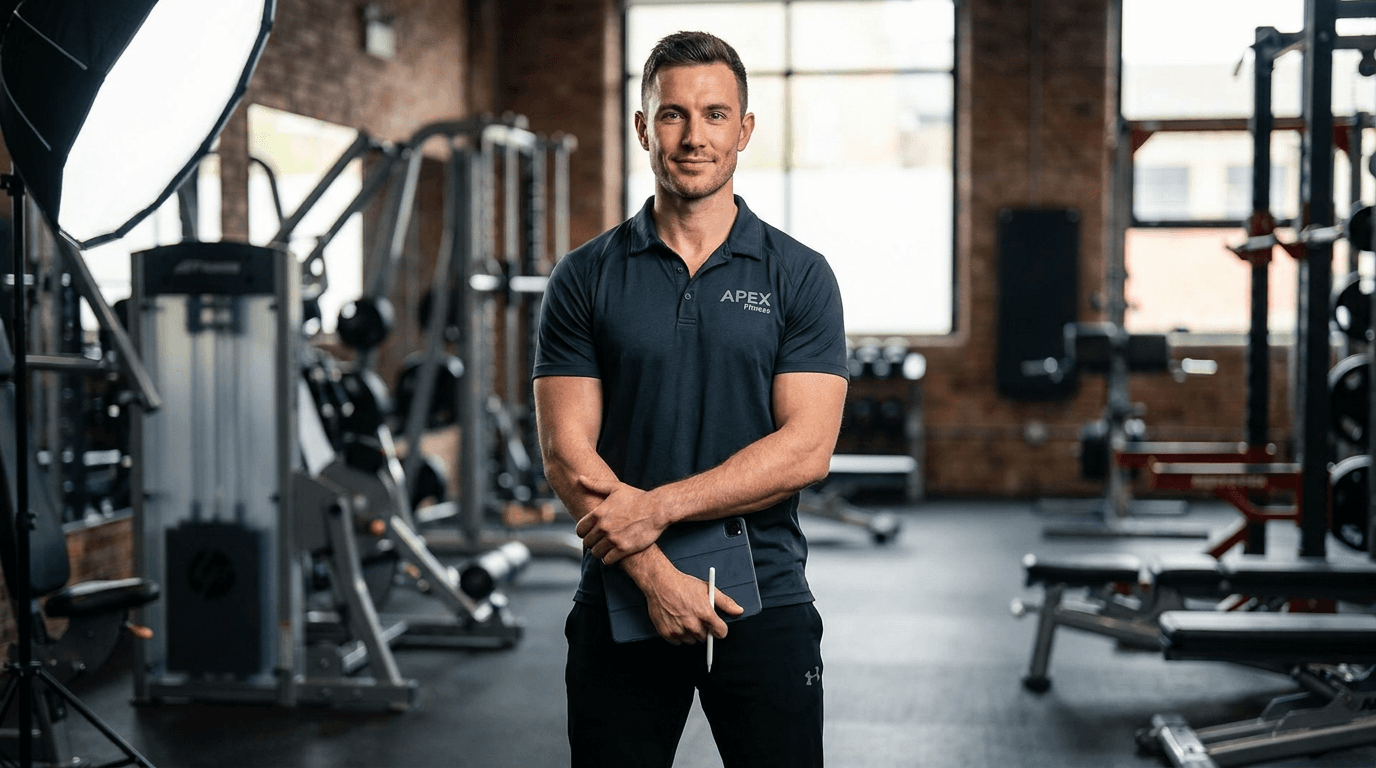
commanding personal trainer authority portrait of [a fitness professional presented as a credible, authoritative, and approachable coaching expert — the portrait communicating physical credibility, professional authority, and client-facing warmth simultaneously: the coach is a specific person — a fitness professional whose physical presentation communicates their training specialty and their client demographic: their physique is athletic and fit, the embodied evidence of their expertise — not a competition-stage physique but a strong, capable, health-radiating body that says "I practice what I preach and I understand what your body can become," the specific physique communicating the coach's specialty (lean and athletic for a general fitness coach, powerful and thick for a strength specialist, flexible and balanced for a mobility or yoga coach, muscular and defined for a physique or bodybuilding coach) — the physique appropriate to the niche and aspirational to the target client, the coach's attire is professional athletic wear — quality fitted athletic clothing that communicates both fitness credibility and professional presentation: a well-fitted performance T-shirt, polo, or tank in the brand's primary color, quality athletic pants or shorts, clean athletic shoes — the clothing professional enough for a business photograph and athletic enough for the gym context, the brand colors present in the attire and any visible branding (logo on chest, branded hat, branded accessories), the coach's expression communicates confident approachability — the eyes engaging the camera with directness and warmth, the expression serious enough to convey authority but open enough to convey "I welcome you," the face relaxed but assured, the jaw set but the eyes kind, the specific expression that communicates "I know what I am doing, and I am going to help you" — the balance of confidence and warmth that is the hallmark of the effective coaching personality, the coach's posture communicates authority — standing with weight balanced, shoulders back and set (not forced, but naturally strong), arms positioned to convey capability (crossed lightly over the chest for authority, or one hand resting on a piece of equipment for contextual professionalism, or hands at sides with open body language for approachability) — the posture of a person who is physically confident and professionally composed, the coach may hold or stand near a professional element — a coaching clipboard or tablet, a stopwatch, a resistance band, a kettlebell, or a piece of equipment — the professional prop identifying the person as a coach rather than a client, the tool-in-hand signaling "I am the expert" with the same visual authority as a doctor's stethoscope or a chef's knife, the setting is the training environment — the gym, the studio, the training floor visible behind or around the coach, the equipment providing the contextual backdrop that identifies the professional domain, the environment communicating the specific type of facility (private studio, commercial gym, functional training space, outdoor area) appropriate to the coach's brand, the overall impression is professional authority with accessible warmth — a person you would trust with your body, your goals, your vulnerability, your money — the authority portrait as the visual foundation of the entire coaching brand, the image that establishes credibility before any word is read] in a three-quarter or environmental portrait composition, the coach fills the primary frame — from mid-thigh or waist up, the body language and the facial expression both readable and commanding, the posture and the physique visible enough to communicate physical credibility without reducing the portrait to a physique shot, the face is the focal point — the expression the primary authority signal, the eyes engaging the viewer directly with the confidence and warmth that builds trust, the branded attire is visible — the clothing color, the logo or branding, the professional-athletic presentation identifying the person as a specific brand, the training environment provides context — the gym equipment, the studio space, the training floor visible as a backdrop that places the coach in their professional domain, the depth of field is portrait-standard — the coach in crisp, detailed focus with the gym environment in a smooth, atmospheric blur that provides context without distraction, the bokeh quality of the background creating the dimensional separation that makes the coach visually prominent, the lighting is dramatic and authority-building — the specific lighting quality that elevates the portrait from a gym selfie to a professional authority image: directional key light from one side at approximately 45 degrees — the dimensional, face-sculpting illumination that creates depth, definition, and visual authority: the key light models the face with controlled highlight and shadow — the cheekbone highlighted, the jaw defined, the eye socket dimensionally sculpted, the nose casting a controlled shadow that creates facial structure without harshness, the light revealing the facial features with the clarity and the drama that authority portraits require, the key light crosses the body with the same dimensional quality — the shoulder, the arm, the chest catching the directional light with contour-revealing definition that communicates physical fitness through light-and-shadow rather than through explicit musculature display, the light modeling the athletic physique with the sophistication of professional portraiture rather than the flat exposure of a gym mirror photo, a softer fill light from the opposite side gently lifts the shadows — preventing the darker side of the face and body from falling into complete darkness, maintaining readable detail in the shadow areas while preserving the dimensional contrast that the key light creates, the fill ratio (the difference between the key side and the fill side) moderate — enough contrast to create authority and drama but not so much that the portrait feels harsh or intimidating, the balance between drama and approachability maintained through the fill level, the training environment in the background catches ambient gym lighting — the overhead gym lights, the window light, the environmental illumination creating the atmospheric, warmly-lit backdrop that identifies the setting while the background blur keeps it subordinate to the coach, the hair light or rim light from behind — a subtle edge light that separates the coach from the background, creating the professional-portrait-quality dimensional separation that elevates the image from a snapshot to an authority portrait, the rim light catching the shoulders, the hair, the profile edge with a subtle, luminous outline, authority portrait palette — brand-color athletic wear as the primary chromatic anchor (specify: [your brand colors, e.g., black with red accents, navy blue with white, charcoal grey with gold]) — natural skin tone rendered accurately in the directional light — gym environment tones in the atmospheric background (equipment metallics, rubber flooring, neutral walls) — the directional key light warm-to-neutral in color temperature — and the dramatic, professional, authority-building palette of a coaching professional in dimensional portrait lighting as the color palette, the mood is commanding and credible confidently approachable authority-radiating and the specific authority message — this is a professional who knows their craft, who has the physical credibility and the professional composure to guide your transformation, whose expertise is evident in their presence before a single word is spoken — the authority portrait as the foundational brand image that establishes coaching credibility and builds the trust that converts browsers into clients, professional portrait photography with dramatic directional lighting and portrait-depth bokeh background, composed as a commanding three-quarter or environmental portrait with the coach's face and expression as the primary authority focal point, the physique and the branded attire and the gym environment as supporting credibility elements, dramatic authority palette with brand-color accents, no text overlays, no watermarks
Best for: Website homepage hero and about section primary portrait, Instagram and social media profile picture (cropped appropriately), media kit and press materials headshot, paid advertising primary creative face, Google Business Profile primary business photo, LinkedIn profile and banner imagery, email marketing header and signature, print marketing primary brand image, speaking engagement and workshop promotional materials, podcast and collaboration appearance imagery
Template 2: The Client Transformation — Before-After Results Documentation
This is the coaching industry's most powerful conversion image — the documented before-and-after transformation that proves the coach's process produces measurable, visible results in real human bodies. The transformation photograph answers the only question that matters: "does this work?"
Prompt:
client transformation before-and-after fitness documentation photograph of [a credible, honestly documented fitness transformation showing a client's body composition change over a coaching engagement — the side-by-side visual proof that the coach's programming, nutrition guidance, and coaching relationship produce real, measurable, visible results in real human bodies: the transformation shows a specific, believable change — the body visible in both the before and the after state with the differences clearly attributable to the coaching process: the BEFORE STATE shows the client at the beginning of their coaching journey — a body that is recognizably "before" without being demeaning: perhaps carrying excess body fat in typical distribution patterns (midsection, hips, upper arms), lacking visible muscle definition, the posture perhaps reflecting lower physical confidence — the body of a real person who has decided to change but has not yet started, the before state honest and unmanipulated, the lighting and the background neutral and unflattering without being deliberately harsh, the client's expression neutral or determined, the AFTER STATE shows the same person after a credible transformation timeline — the same person, identifiably the same individual, but visibly changed: reduced body fat revealing underlying muscle structure, improved muscle definition in the arms, shoulders, and midsection, improved posture reflecting increased physical confidence, the skin quality perhaps improved, the overall body composition visibly and measurably different — the change dramatic enough to be impressive but realistic enough to be believable (not a 12-week transformation that suggests pharmaceutical enhancement, but a genuine, attainable, maintainable change that the viewer can imagine achieving themselves), the after state showing the body in the same clothing style, the same angle, the same background, the same lighting — the transformation conventions that signal honest documentation, the coaching brand is subtly present — the coach's logo or brand mark visible as a small watermark or in the image border, or the client wearing branded coaching-program merchandise in the after state, or the coaching facility visible as the backdrop — the brand connection present without dominating the transformation evidence, the overall transformation communicates: this is a real person, this is a real change, this is what the coaching process produces — the transformation photograph as the irrefutable conversion evidence that answers "does this work?" with visual proof] in a clean, side-by-side, before-and-after transformation comparison composition, the two states are presented side by side — the before on the left, the after on the right, the direct comparison the compositional structure, the same person is identifiable in both states — the face (if shown) or the body's identifying characteristics consistent, the "same person, different state" quality essential to the comparison's credibility, the framing is identical in both states — the same distance, the same height, the same angle, the same crop, the compositional consistency allowing direct body-area-by-body-area comparison, the background is consistent — the same neutral background (a clean wall, a gym area, a solid-color backdrop) in both states, the environmental consistency removing any variable except the body composition change, the depth of field is deep — the full body in focus in both states, every area of change readable and comparable, the lighting is consistent and honest — the same neutral, unflattering-but-accurate illumination in both states: even, flat, documentary-quality lighting in both the before and the after — the consistent illumination that ensures the transformation is attributable to body composition change rather than lighting manipulation, the light even across the body in both states — no dramatic side-lighting that would enhance definition in the after state, no overhead shadows that would obscure areas, the same neutral, clinical, honest lighting in both frames, the body catching the even light with honest exposure — the before state showing the body as it was (the soft contours, the areas of higher body fat, the less-defined musculature) and the after state showing the body as it became (the improved definition, the visible muscle structure, the leaner contours) under the same illumination, the consistent lighting is the credibility signal — the viewer can trust the transformation because the photography conditions are visibly identical, the change is in the body, not in the photography, transformation documentation palette — neutral background tone (white, light grey, or gym-neutral) — natural skin tone in honest lighting — consistent, flat, even illumination in both states — minimal color variation between the two frames — and the clinical, honest, documentation-quality palette of a credible fitness transformation comparison as the color palette, the mood is honestly documented credibly impressive results-proven and the specific transformation message — this is real, this person changed, the coaching process produced this result, the documentation is honest and the transformation is genuine — the transformation photograph as the primary conversion image that provides irrefutable visual proof of coaching effectiveness, professional documentation photography with consistent even lighting and deep depth of field in both states, composed as a clean side-by-side before-after comparison with identical framing and background, the body composition change and the documentation honesty and the coaching-brand connection as the transformation focal points, neutral documentation palette with consistent lighting, no text overlays except optional subtle timeline and brand indicators, no watermarks
Best for: Instagram and Facebook transformation posts (highest conversion content type), website results and testimonials sections, paid advertising primary conversion creative, Google Business Profile results evidence, email marketing success-story features, sales consultation presentation materials, program landing page social proof, TikTok and Reels transformation reveals, YouTube transformation case study thumbnails, print marketing results documentation
Template 3: The Coaching Session — In-Session Action and Expertise
This template captures the coach in their element — actively coaching a client, demonstrating hands-on expertise, providing the guidance and correction and encouragement that defines the coaching service. This is not a workout photo; this is a coaching photo.
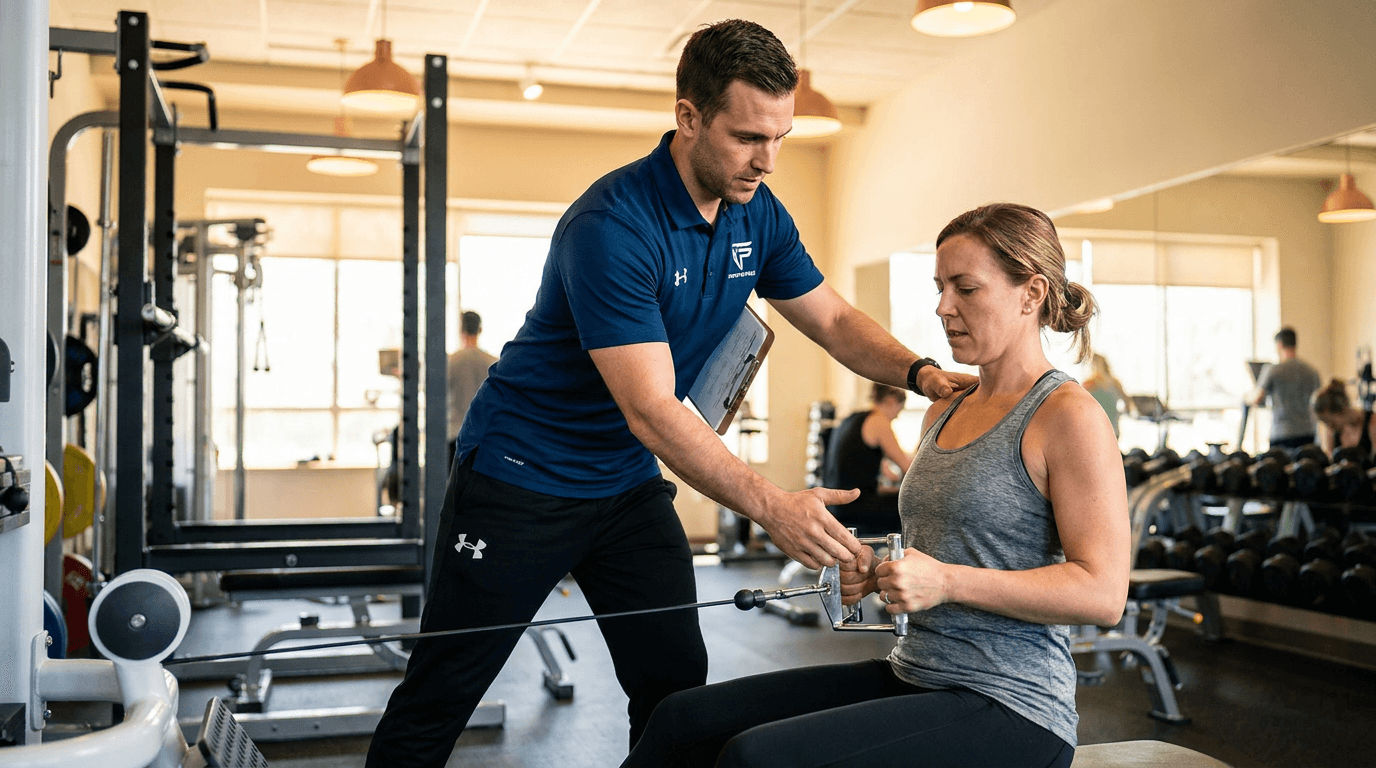
Prompt:
personal trainer coaching session action photograph of [a fitness coach actively engaged in coaching a client during a training session — the hands-on guidance, the expert observation, the professional interaction that shows the viewer what the coaching experience actually looks like: the coach is the active professional — the person delivering expertise, not the person exercising: the coach is positioned in the coaching role — standing beside, behind, or across from the client in the observer-instructor position, the body oriented toward the client, the attention focused on the client's movement, the coach's role clearly that of the expert guiding the process rather than a training partner participating in the workout, the coach provides visible guidance — hands positioned to cue the client's form (a hand on the upper back guiding posture, a finger indicating the direction of force, a hand near but not touching the client's elbow to indicate the movement path), or the coach demonstrating the movement pattern for the client to mirror, or the coach holding a coaching tool (a clipboard with the session program, a tablet showing the tracking data, a stopwatch timing the rest period) — the specific visible action of coaching happening in real time, the coach's expression communicates focused expertise — the eyes locked on the client's movement, reading the form, assessing the quality, preparing the next cue — the expression of a professional engaged in the skilled observation that produces effective coaching, the focus and the expertise visible in the face, the client is actively training — performing an exercise with visible effort and concentration, the body engaged in a movement that requires coaching attention (a barbell movement, a dumbbell exercise, a bodyweight movement, a machine exercise, a functional movement), the client's effort and the coach's guidance both visible simultaneously, the client's expression showing focused effort and the trust of someone being guided by a professional, the interaction between the two communicates the coaching relationship — the professional dynamic of expert-and-client visible in the spatial relationship, the body language, the attention patterns, and the implied verbal exchange, the interaction communicating trust, expertise, and the collaborative quality of effective coaching, the training environment surrounds the coaching moment — the gym, the studio, the equipment visible and providing the professional context, the environment appropriate to the coach's brand and facility type, the overall composition communicates: this is what coaching looks like, this is the professional guidance you are paying for, the expertise is delivered person-to-person with focused attention and skilled observation — the coaching session as the service-experience visual that shows the potential client what they will receive] in a mid-range, coaching-interaction-focused composition, the coach and the client are both visible — the coach in the instructor position and the client in the training position, the professional dynamic between them readable, the coaching action is the central element — the hands-on guidance, the focused observation, the professional interaction the visual emphasis rather than the exercise being performed, the coach's branded attire is visible — the brand colors, the logo, the professional-athletic presentation identifying the coach, the training environment provides context — the equipment, the space, the gym or studio atmosphere visible around the coaching interaction, the depth of field is moderate — the coaching interaction in crisp focus with the gym environment in softer context, the relationship between the two people isolated as the visual subject, the lighting is bright, warm, and gym-atmospheric — the training-environment lighting that makes the coaching interaction look professional and energetic: warm, bright gym lighting — the combination of overhead gym lights, natural window light, and the specific atmospheric quality of a well-lit training environment, the warm tone communicating the energy and the positive quality of the coaching experience, the coach catches the light with professional clarity — the face readable and focused, the branded attire visible, the body language and the coaching hands visible with the dimensional quality that shows the expertise in action, the client catches the light with training authenticity — the effort visible in the body position, the face showing concentration, the muscles engaged in the exercise catching the gym light with the natural quality of a body under physical effort, the equipment and the environment catch the warm gym light with their training-environment character — the barbells, the dumbbells, the racks, the rubber flooring, the gym surfaces all identifiable and contributing to the atmospheric context, coaching session palette — brand-color coach attire (specify: [your brand colors]) — client in workout attire (neutral athletic wear) — gym equipment metallic and matte tones — rubber flooring dark tones — warm overhead and natural gym lighting — and the warm, energetic, coaching-focused palette of a training session in progress as the color palette, the mood is expertly guided professionally engaged actively coaching and the specific session message — this is what the coaching experience looks like, expert guidance, focused attention, professional interaction, the service is not just a workout but a coached, guided, expertly supervised training experience — the coaching session as the service-demonstration visual that shows the potential client the professional quality of the experience they will receive, professional editorial and action photography with warm gym lighting and moderate depth of field keeping the coaching interaction in focus, composed as a mid-range action shot with the coach and the client in professional coaching interaction, the expert guidance and the coaching dynamic and the training-environment atmosphere as the session focal points, brand-color coach palette with warm gym lighting, no text overlays, no watermarks
Best for: Instagram and Facebook feed content (service demonstration), website services and experience sections, Google Business Profile service imagery, paid advertising service-experience creative, email marketing service features, sales consultation presentation materials, program landing page service-experience visuals, behind-the-scenes and day-in-the-life content, new-client onboarding materials, hiring and team-growth marketing
Template 4: The Exercise Demonstration — Form and Technique Breakdown
This template presents the coach demonstrating exercise technique with the visual clarity and the technical precision that communicates deep movement knowledge. The exercise demonstration says "I understand the science of movement, and I can teach it."
Prompt:
exercise demonstration and form breakdown photograph of [a fitness coach demonstrating an exercise with textbook form — the body positioned at the peak or most instructive moment of the movement, the technique visible and teachable, the image functioning as both a demonstration and a visual proof of the coach's movement expertise: the coach performs a specific exercise at its most instructive position — the exercise chosen for its technical complexity and its relevance to the coach's training specialty: a barbell back squat at parallel depth showing the full-body alignment (foot position, knee tracking, hip hinge, spinal neutrality, bar position, hand placement, head position, the complete kinetic chain visible and correct); or a deadlift at the lockout or the floor position showing the hip hinge mechanics, the grip, the lat engagement, the spinal position; or a pull-up at full extension or chin-over-bar showing the scapular mechanics, the elbow position, the lat engagement; or an Olympic lift at the catch position showing the mobility, the timing, the positional excellence; or a kettlebell movement showing the hip-driven mechanics; or a bodyweight movement demonstrating the control and the positional precision that coaching expertise produces — the specific exercise communicating the coach's technical domain, the form is demonstrably excellent — every joint position correct, every alignment deliberate, every technical standard met, the body presenting the movement as it should be performed, the visual functioning as a form reference that could be used as an instructional image, the excellence of the technique the primary visual message: "this coach knows how to move, and can teach you to move this way," the coach's expression communicates controlled effort and focused execution — not straining or grimacing (which would suggest the load is beyond capability) but focused, controlled, deliberate — the expression of a person executing a well-practiced skill under moderate challenge, the effort visible but subordinate to the technique, the attire is professional and movement-revealing — fitted athletic wear that shows the body's position and alignment clearly enough for the movement quality to be assessed: the joint angles visible, the muscle engagement visible, the spinal alignment trackable, the clothing fitted enough to reveal form without being revealing for its own sake, the brand colors present in the attire, the training environment is visible but secondary — the gym providing the setting without competing with the technical demonstration, the equipment appropriate to the exercise (the barbell, the rack, the platform, the kettlebell, the pull-up bar) visible and clean, the overall composition communicates: this coach has technical mastery, the movement is performed with precision and control, the expertise is demonstrated through the body's own excellence — the exercise demonstration as the technical-authority visual that proves movement knowledge] in a full-body, technique-revealing composition, the entire body is visible — from head to feet, the full kinetic chain readable and assessable for technical quality, the complete movement visible, the body is positioned at the most instructive moment of the exercise — the point where the most technical elements are simultaneously visible and where the coaching cues are most relevant, the joint angles and alignments are readable — the knee tracking, the hip position, the spinal alignment, the shoulder position, the head position — all the technical elements visible and demonstrably correct, the branded attire is visible — the coach identifiable as a specific brand through the clothing colors and any visible logo, the depth of field is moderate — the coach and the immediate equipment in sharp focus with the gym background in softer context, the technical detail of the body and the movement equipment clear while the gym provides atmospheric depth, the lighting is bright, even, and technique-revealing — the illumination quality that shows every joint angle and every alignment clearly: bright, even, slightly directional gym lighting that reveals the body's position with clarity — the light showing the muscle engagement, the joint angles, and the spinal alignment with the readable quality that makes the image instructionally useful, the body catching the bright light with anatomical clarity — the muscles engaged in the movement visible through the natural light-and-shadow that dimensional gym lighting provides on a body under physical effort, the major muscle groups involved in the movement identifiable through their engagement and their response to the directional light, the equipment catching the light with its functional quality — the barbell, the plates, the rack, the platform visible and identifiable as the specific tools of the demonstrated exercise, the gym environment catching the ambient light with its training-floor atmosphere, exercise demonstration palette — brand-color athletic wear — natural skin tone under bright gym lighting — equipment metallic and matte tones — gym environment neutral tones — bright, even, technique-revealing lighting — and the clean, technically focused palette of an exercise demonstration in bright gym lighting as the color palette, the mood is technically precise expertly executed instructionally clear and the specific demonstration message — this coach has mastered this movement and can teach it to you, the form is textbook, the execution is controlled, the technical knowledge is demonstrated through the body's own performance — the exercise demonstration as the technical-authority visual that proves movement expertise and positions the coach as a knowledgeable instructor, professional fitness and editorial photography with bright even lighting and moderate depth of field, composed as a full-body technique demonstration with all joint positions and alignments visible, the technical precision and the movement mastery and the coaching authority as the demonstration focal points, clean brand-color palette in bright gym lighting, no text overlays, no watermarks
Best for: Instagram and Facebook educational and form-tip content, website exercise library and services sections, YouTube video thumbnails for technique content, program materials and exercise library documentation, email marketing educational features, TikTok and Reels form-tip content, blog and content marketing exercise instruction, Pinterest fitness and exercise content, client onboarding and program delivery materials, continuing education and certification content
Template 5: The Training Environment — Gym and Studio Atmosphere
This template showcases the training environment — the gym, the studio, the facility where the coaching happens — as an atmospheric brand element that communicates the coach's professional positioning and the quality of the training experience.
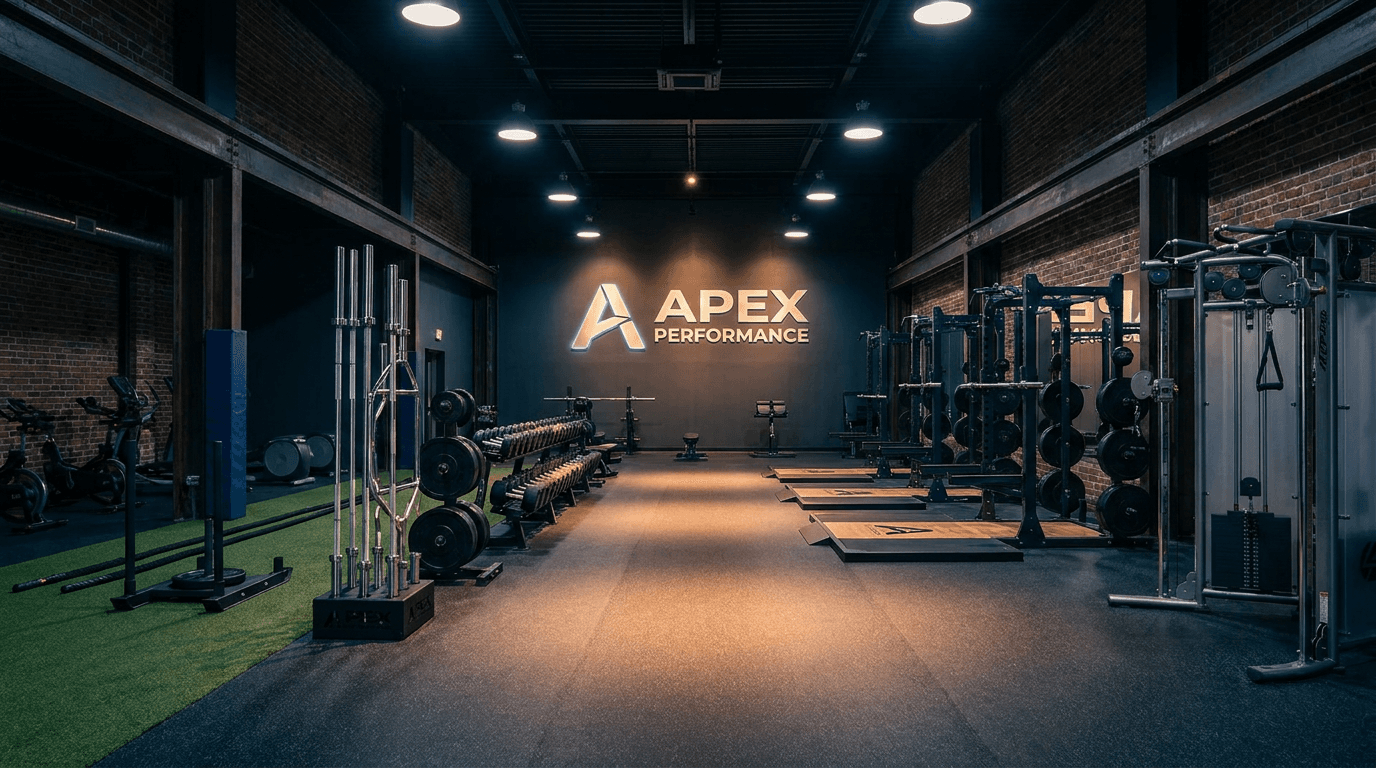
Prompt:
training environment and gym atmosphere photograph of [the training space where coaching happens — the facility presented as a professional, inspiring, purpose-built environment that communicates the quality and the character of the coaching experience: the space is a specific training environment — the type of facility that matches the coach's brand and positioning: a private personal training studio — a dedicated, professionally designed training space with quality equipment, clean aesthetics, controlled atmosphere, the premium, exclusive quality of a space built specifically for one-on-one or small-group coaching, the equipment curated and the environment designed for focused, professional training; or a well-equipped commercial gym — the training floor with racks, platforms, dumbbells, machines, cables, the breadth of equipment communicating versatility and capability, the open floor space communicating the capacity for varied programming; or a functional training facility — the open floor with kettlebells, battle ropes, plyo boxes, rigs, sleds, the performance-oriented, industrial-influenced space that communicates intensity and functional capability; or a boutique fitness studio — the clean, designed, aesthetically intentional space with specific equipment for the studio's discipline (reformers, bikes, barbells, mats), the boutique quality communicating the curated, premium, community-focused experience, the equipment is visible and impressive — the specific training tools arranged and visible: barbells and plates racked cleanly, dumbbells in organized rows, machines and cables ready for use, specialty equipment (kettlebells, bands, boxes, sleds, ropes) positioned and accessible, the equipment communicating the investment in professional-grade tools and the breadth of programming capability, the space is clean, organized, and professional — the facility maintained to a standard that communicates respect for the training experience and for the clients who use it, the equipment organized, the surfaces clean, the environment controlled and intentional, the branding elements are visible — the coach's or the facility's logo, brand colors in the environment (wall paint, equipment color, branded signage, branded merchandise displayed), the brand identity present in the physical space, the overall impression communicates: this is where transformation happens, the environment is professional and inspiring and purpose-built for the specific training experience the coach offers — the training environment as the professional-setting visual that contextualizes the coaching service in a quality, inspiring physical space] in a wide, environment-showcasing composition, the full training space is visible — the equipment, the open space, the architectural character, the maximum amount of the facility visible, the equipment creates visual depth — the arranged weights, machines, and tools creating the layered visual field that communicates breadth and capability, the branding elements are visible — the logo, the brand colors, the environmental identity, the space is empty or near-empty — the facility shown between sessions, the professional environment ready for the next coaching engagement, the pristine quality of the waiting space, the depth of field is deep — the full facility in focus from the foreground equipment to the background walls, every element contributing to the environmental impression, the lighting is dramatic and atmosphere-building — the specific lighting quality that makes the training space feel inspiring and professional: dramatic, atmospheric gym lighting with intentional direction — the moody, high-contrast, atmosphere-creating illumination that makes training environments feel inspiring and purposeful, the overhead gym lights creating pools of focused illumination on the training floor, the directional quality of the lighting creating areas of bright focus and atmospheric shadow that give the space cinematic depth, the equipment catches the dramatic lighting with its industrial beauty — the chrome of the barbells catching bright highlights, the rubber plates absorbing the light with their matte density, the machines showing their structural quality in the dimensional lighting, the organized dumbbells creating a repetitive, architecturally satisfying pattern of highlights on their chrome surfaces, the training floor catches the overhead light with its specific surface quality — the rubber matting or the hardwood or the platform surfaces showing their functional character in the atmospheric light, the walls and the architectural elements catch the light with their specific facility character — the brick, the concrete, the painted drywall, the mirror surfaces creating the specific environmental personality of the training space, the branded elements catch the light with their identification quality — the logo visible, the brand colors present, the environmental identity readable in the atmospheric illumination, gym environment palette — equipment metallic chrome, black rubber, and weight-color tones — flooring matte rubber or hardwood tones — wall and architectural tones specific to the facility — brand-color accent elements — dramatic overhead lighting with atmospheric shadows — and the dramatic, industrial, purpose-built palette of a professional training environment in atmospheric gym lighting as the color palette, the mood is atmospherically inspiring professionally equipped purpose-built and the specific environment message — this is the space where the coaching happens, the equipment is professional, the environment is inspiring, the facility is built for the specific training experience the coach delivers — the environment visual as the professional-setting, brand-atmosphere image that contextualizes the coaching service in a quality, purpose-built space, professional architectural and interior photography with dramatic atmospheric lighting and deep depth of field showing the full training environment, composed as a wide facility showcase with equipment and architectural character visible, the professional quality and the equipment depth and the brand atmosphere as the environment focal points, dramatic gym palette with brand-color accents, no text overlays, no watermarks
Best for: Website homepage and facility sections, Instagram environment and atmosphere content, Google Business Profile facility imagery, paid advertising environment-quality creative, new-client onboarding and facility-tour materials, social media behind-the-scenes and facility-pride content, print marketing facility features, real estate and location marketing for studios, commercial lease and partnership materials, YouTube and video content B-roll and background
Template 6: The Nutrition and Meal Prep — Holistic Coaching Lifestyle
This template presents the nutrition side of coaching — the meal preparation, the food quality, the dietary approach that communicates the coach's holistic understanding that training results are built in the kitchen as much as in the gym.
Prompt:
fitness nutrition and meal preparation lifestyle photograph of [a beautiful, health-communicating meal preparation scene — the food, the organization, the presentation quality showing the nutrition component of the coaching program as a visual lifestyle aspiration: the meal prep scene presents a specific nutritional approach — the food composition and the preparation style reflecting the coach's nutritional philosophy and the dietary approach they coach their clients toward: high-protein, balanced macronutrient meal prep — organized containers with lean proteins (grilled chicken breast, salmon fillets, lean ground turkey, eggs), complex carbohydrates (sweet potatoes, brown rice, quinoa, oats), vegetables in vivid colors (broccoli, asparagus, spinach, bell peppers, leafy greens), healthy fats (avocado, nuts, olive oil), the macronutrient balance visible and the portion organization communicating the systematic, coached approach to nutrition; or a single beautifully composed performance meal — a plate with a protein source, a carbohydrate source, and vegetables arranged with care on quality dinnerware, the single-meal presentation communicating the food quality and the visual appeal of eating well; or a smoothie and post-workout nutrition scene — a blender with colorful smoothie ingredients, protein powder, fruits, greens, supplements, the post-training nutrition visible as a part of the training protocol, the food is visually beautiful — the colors vivid and appetizing (the bright green of fresh vegetables, the warm tones of grilled protein, the rich colors of fruits and whole grains), the food fresh and well-prepared (not the sad, bland "diet food" aesthetic but the vibrant, appetizing, "this is how healthy eating actually looks when you know what you're doing" quality), the visual appeal communicating that nutrition coaching is not deprivation but education and optimization, the organization communicates the coached approach — the meal prep containers organized in rows, the ingredients sorted, the system visible, the organizational quality communicating that nutrition is not chaos but a structured, coached, learnable system, the kitchen or preparation surface is clean and attractive — a quality countertop, a clean cutting board, quality food storage containers, the kitchen environment communicating the lifestyle quality of someone who has their nutrition dialed in, the overall composition communicates: nutrition is half the equation, the coaching program addresses both training and nutrition, eating well is not punishment but a satisfying, organized, learnable system — the nutrition lifestyle visual as the holistic-coaching-authority image that shows the coach addresses the full picture] in a close-to-medium, food-and-preparation-focused composition, the food fills the primary frame — the proteins, the vegetables, the carbohydrates, the prepared meals visible and appetizing, the organization is visible — the containers, the portioning, the systematic approach, the preparation surface provides context — the kitchen counter, the cutting board, the preparation environment, the depth of field is moderately shallow — the nearest food elements in detailed, appetizing focus with the supporting elements in softer atmospheric context, the lighting is bright, warm, and food-photography quality — the illumination that makes food look its most appetizing: bright, warm, natural side light — the directional illumination that is the standard of professional food photography, the warm, natural light entering from one side and creating the dimensional quality that makes food look three-dimensional, textured, and appetizing, the food catches the warm side light with its natural beauty — the proteins showing their grilled or prepared surface quality, the vegetables vivid and fresh with the bright greens, reds, and oranges catching the light, the grains and carbohydrates showing their wholesome texture, the overall food presentation luminous and appetizing in the warm directional light, the containers and the preparation surface catch the light with their clean, organized quality — the meal prep system visible and professional in the warm illumination, nutrition lifestyle palette — vivid vegetable greens, reds, oranges, and yellows — warm protein tones (golden-brown grilled chicken, pink salmon, white eggs) — warm carbohydrate tones (golden sweet potato, brown rice, tan quinoa) — clean container and preparation-surface tones — bright, warm natural side lighting — and the vivid, appetizing, health-communicating palette of quality nutrition in warm natural food-photography light as the color palette, the mood is appetizingly healthy nutritionally organized lifestyle-aspirational and the specific nutrition message — the coaching program addresses nutrition as well as training, eating well is a system that can be coached and learned, the food is beautiful and satisfying and organized — the nutrition visual as the holistic-coaching image that communicates the coach's comprehensive approach to client results, professional food and lifestyle photography with warm natural side light and moderately shallow depth of field, composed as a food-forward lifestyle scene with nutrition quality and organization visible, the food beauty and the systematic organization and the lifestyle aspiration as the nutrition focal points, vivid food palette in warm natural light, no text overlays, no watermarks
Best for: Instagram and Facebook nutrition and lifestyle content, website nutrition coaching and holistic approach sections, Pinterest food and meal prep content (high-performing platform for nutrition content), email marketing nutrition features and meal prep tips, program delivery materials and nutrition coaching resources, TikTok and Reels meal prep content, blog and content marketing nutrition articles, recipe and meal plan marketing, coaching program landing page holistic-approach sections, brand partnership and supplement collaboration content
Template 7: The Program Framework — Methodology Made Visible
This template makes the invisible coaching methodology visible — the programming structure, the periodization concept, the systematic approach that distinguishes a professional coach from a random workout provider. This visual says "I have a system, and the system produces results."
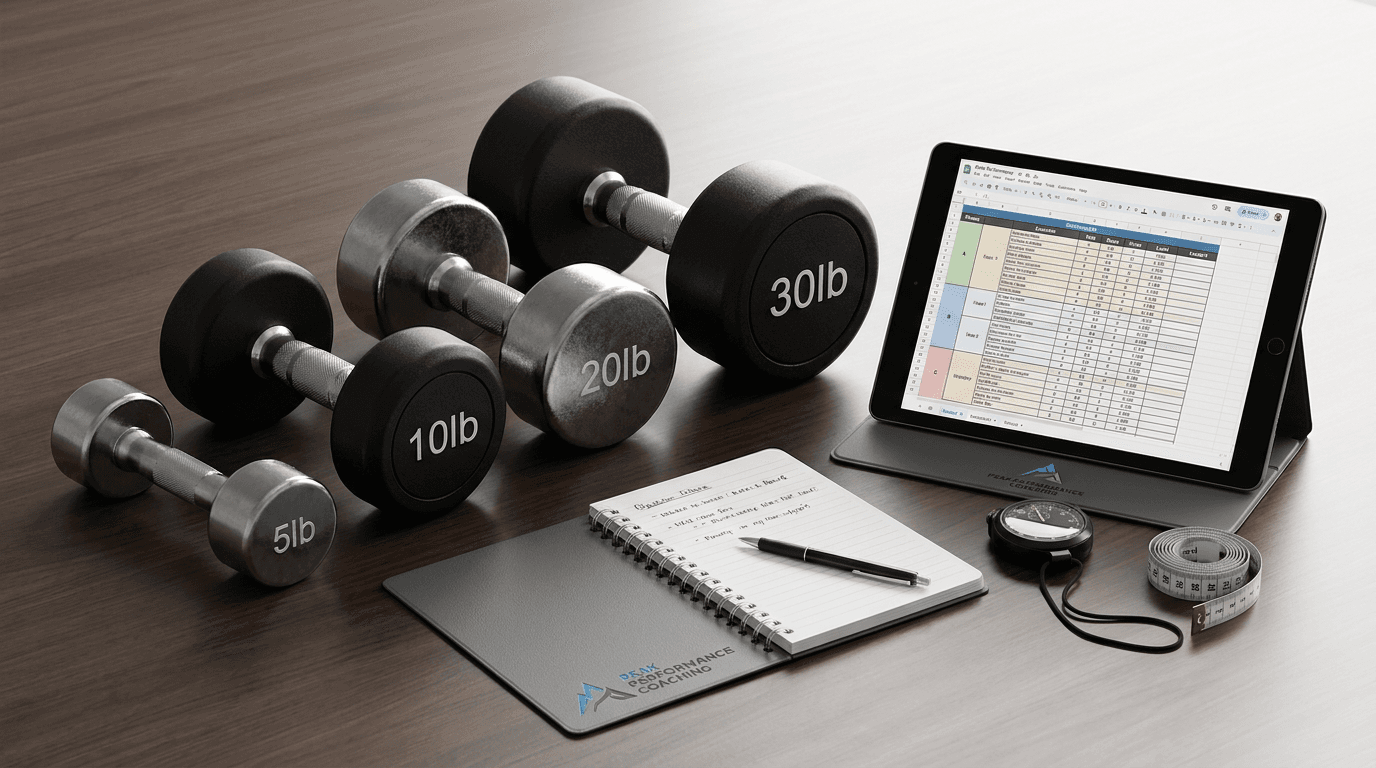
Prompt:
coaching program methodology and framework visual of [an atmospheric, concept-communicating composition that makes the coach's invisible programming methodology visible — the structure, the system, the progressive approach represented through visual metaphors and elements that communicate systematic expertise: the visual represents the coaching system through physical elements arranged as a visual metaphor — the tangible objects that represent the intangible methodology: a progression of weights arranged from light to heavy — a visual metaphor for progressive overload, the fundamental principle of effective training, the weights increasing in size from left to right across the frame communicating the systematic, incremental, coached progression that produces results, the progression visual, clean, and satisfying; or a coach's programming tools arranged as a working system — a tablet or laptop showing a training program or spreadsheet, a printed program with exercises, sets, reps, and loads visible in organized columns, a pen or marker for notation, a stopwatch, a measuring tape, a body composition caliper — the tools of the programming trade arranged as evidence of the systematic approach, the specific tools communicating that the coaching is data-driven, progressive, and methodical; or a visual progression timeline — elements representing different phases of a periodized program (accumulation, intensification, realization, or preparatory, competitive, transition) arranged sequentially, the phases communicating the long-term, planned, scientifically structured nature of the coaching program, the overall composition communicates the concept of systematic coaching — not random workouts but a progressive, periodized, data-informed, individually designed program that adapts to the client's response and advances toward their goal through structured phases, the overall composition communicates: this coach does not improvise, the programming is systematic, the progression is planned, the methodology produces predictable results — the framework visual as the methodology-authority image that differentiates the systematic coach from the workout-of-the-day provider] in a close-to-medium, concept-communicating composition, the methodology elements fill the frame — the weights, the tools, the programming materials, or the progression elements arranged with visual intention and conceptual clarity, the arrangement communicates the concept — progression, structure, system, methodology — the visual organization itself telling the story of systematic coaching, the brand identity is present — brand colors in the elements or the environment, the coaching logo or brand mark visible, the depth of field is moderately shallow — the primary concept elements in focus with supporting elements in atmospheric context, the lighting is clean and concept-appropriate — the illumination that makes methodological elements look professional and intentional: clean, bright, slightly directional lighting — the clear, professional illumination that makes the methodology elements (weights, tools, documents, progression elements) look precise and intentional, the clean light communicating the clarity and the structure of the coaching methodology, the methodology elements catch the clean light with their specific material qualities — the weights with their metallic or rubber surfaces, the tools with their functional quality, the documents with their printed, organized quality, the brand elements with their identifying color and design, framework palette — weight and equipment metallic and matte tones — document and tool professional tones — brand-color accents identifying the coaching brand — clean, bright, slightly directional lighting — and the precise, methodical, concept-communicating palette of a coaching framework visual as the color palette, the mood is systematically structured methodologically sound professionally designed and the specific framework message — the coaching is not random, it is a system, the programming is progressive and periodized and data-informed, the methodology is the reason the results happen — the framework visual as the methodology-authority image that communicates the systematic depth behind the coaching service, professional concept and still-life photography with clean directional lighting and moderately shallow depth of field, composed as a methodology concept image with progression or system elements arranged intentionally, the systematic approach and the professional methodology and the coaching authority as the framework focal points, clean methodology palette with brand-color accents, no text overlays, no watermarks
Best for: Website methodology and approach sections, Instagram educational and program content, program landing page methodology features, email marketing program-structure features, sales consultation methodology slides, webinar and workshop methodology presentations, content marketing program-explanation articles, social media carousel methodology breakdowns, coaching certification and education materials, paid advertising methodology-differentiation creative
Template 8: The Motivational Campaign — Mindset and Inspiration
This template creates the motivational, emotionally resonant visual — the atmospheric image that communicates the mindset, the emotional journey, and the inspirational energy that drives client engagement and social media sharing.
Prompt:
fitness motivation and mindset campaign photograph of [an emotionally powerful, atmospherically dramatic moment of physical effort, mental determination, or achievement — the visual that captures the emotional essence of the fitness journey and the mindset that the coaching relationship cultivates: the scene captures a specific emotional moment — the peak of effort, the threshold of determination, the instant of achievement that embodies the mindset the coach develops in their clients: a person at the bottom of a heavy squat — the moment where the weight feels heaviest and the decision to push through is purely mental, the body compressed under load, the face showing controlled determination, the muscles engaged at maximum effort, the moment representing the coached mental toughness that separates those who quit from those who complete the rep; or a person completing a challenging achievement — the final pull-up of a set that was previously impossible, the finishing stride of a personal-record run, the lockout of a weight that represents months of progression — the achievement moment capturing the emotional payoff of the coaching journey; or the pre-training moment of focus — a person standing before the barbell, the weight room quiet, the internal preparation visible in the body language and the expression, the meditation-like focus that trained athletes develop through coached mental preparation; or the post-workout moment — the person sitting on the gym floor, the workout complete, the breathing heavy, the face showing the satisfied exhaustion of a session that pushed limits under expert guidance, the overall emotional tone is determined, powerful, and aspirational — not the superficial "motivation poster" aesthetic but the genuine, atmospheric, emotionally true depiction of what it feels like to push beyond comfort under the guidance of a coach who believes in you, the overall composition communicates: the fitness journey is emotional, the coaching relationship develops mental toughness alongside physical capability, the mindset is the foundation — the motivational visual as the emotional-connection image that drives engagement and sharing and builds the parasocial trust that precedes the coaching relationship] in a cinematic, emotionally charged, atmospheric composition, the person is the central subject — the body and the expression communicating the emotional moment, the physical effort or the mental state visible and powerful, the moment is specific and genuine — not a posed motivational image but a captured (or convincingly natural-looking) moment of real effort, real focus, or real achievement, the training environment provides atmospheric context — the gym, the track, the training floor contributing dramatic atmosphere without competing with the emotional moment, the depth of field is shallow — the person in sharp emotional focus, the environment in dramatic atmospheric blur, the isolation of the subject creating the cinematic, emotional quality, the lighting is dramatic, cinematic, and emotionally powerful — the moody, high-contrast, atmosphere-creating illumination that elevates the image from a gym photo to a visual narrative: dramatic, low-key, directionally sculpted lighting — the high-contrast, shadow-rich, emotionally intense illumination of cinematic fitness photography, the key light strong and directional — coming from one side or from slightly above, creating deep shadows and bright highlights that model the body and the face with dramatic intensity, the light revealing the effort, the muscle engagement, the emotional state with theatrical clarity, the person catches the dramatic light with emotional intensity — the face sculpted by the directional light, the determination visible in the lit features while the shadow side adds depth and drama, the muscles catching the dramatic light with their effort-engaged, peak-tension definition, the sweat (if present) catching individual highlights from the directional source, the atmospheric quality and the high-contrast rendering communicating the emotional weight of the moment, the environment catches the dramatic ambient light with its atmospheric character — the gym in moody, cinematic background illumination, the equipment and the space rendered as atmospheric, story-supporting backdrop rather than documentary detail, motivational palette — high-contrast skin tones under dramatic directional light — deep shadows and bright highlights — atmospheric gym background in moody, desaturated tones — brand-color accent if present — dramatic, low-key, emotionally intense lighting — and the cinematic, high-contrast, emotionally powerful palette of a fitness motivation moment in dramatic directional lighting as the color palette, the mood is emotionally intense mentally determined inspirationally powerful and the specific motivational message — the fitness journey is about more than the body, the mindset is what the coaching relationship builds, the moment of effort and the moment of achievement are equally powerful — the motivational visual as the emotional-connection and engagement-driving image that builds the parasocial trust and the aspirational identification that precedes the coaching relationship, cinematic fitness photography with dramatic directional lighting and shallow depth of field, composed as an emotionally charged single-subject moment with the effort or the achievement or the focus as the central emotional narrative, the emotional intensity and the dramatic atmosphere and the mindset expression as the motivational focal points, cinematic high-contrast palette, no text overlays, no watermarks
Best for: Instagram and Facebook motivational and high-engagement content (text overlay with motivational quotes in post-production), TikTok and Reels motivational content, website homepage and brand-atmosphere sections, paid advertising emotional-connection creative, YouTube video thumbnails for motivational and transformation content, print marketing atmospheric and brand imagery, speaking engagement and workshop promotional materials, social media quote-card backgrounds, email marketing inspirational features, podcast and media appearance promotional imagery
Template 9: The Group Training — Community and Energy
This template captures the group training experience — the energy, the community, the shared effort that defines group coaching and communicates the belonging that many clients seek alongside the physical training.
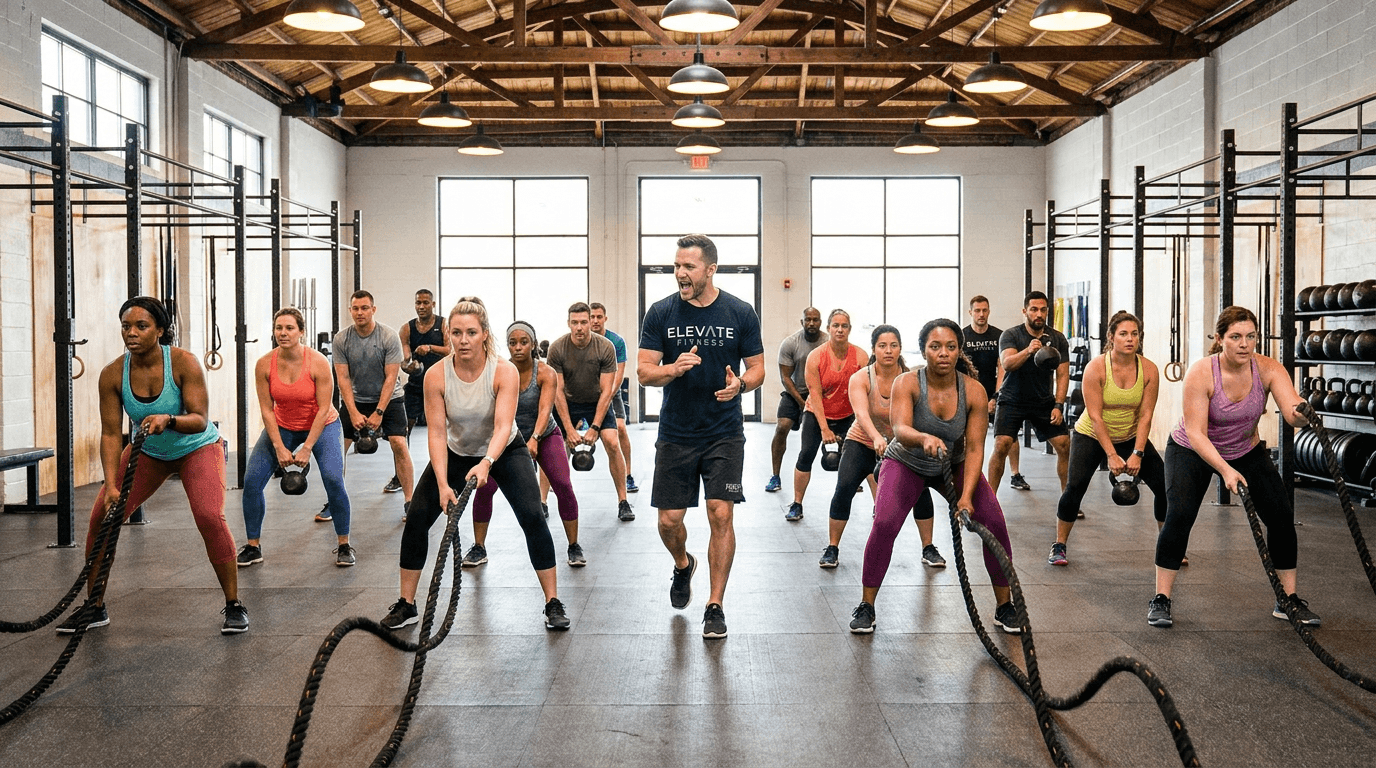
Prompt:
group fitness training energy and community photograph of [a group of people training together under coaching guidance — the collective effort, the shared energy, the community atmosphere that communicates the belonging and the motivation that group coaching provides: the group is actively training — multiple people performing the same or coordinated exercises simultaneously, the synchronized effort creating the visual energy and the community impression: a group performing a bootcamp-style workout — burpees, or kettlebell swings, or box jumps, or battle rope slams — the coordinated movement creating visual rhythm and collective energy; or a small group performing barbell or strength movements — squatting, pressing, deadlifting — at individual stations but in shared effort, the communal intensity visible; or a group class in mid-session — the participants in synchronized movement, the coach visible at the front or moving through the group, the collective physical effort creating the kinetic energy that group training photographs capture, the coach is visible within the group scene — standing at the front directing, or moving through the participants providing individual cues, or demonstrating the movement for the group to follow, the coach's role as the expert leader of the group visible and distinct from the participants' role as athletes, the coach identifiable by their branded attire, their position, and their body language, the participants represent the client demographic — a mix of people reflecting the coach's actual or target client population in terms of fitness level, age range, and body type, the diversity of the group communicating accessibility and the message "people like you train here," the participants wearing athletic clothing, their effort genuine and their engagement with the training visible, the group's body language communicates community — the shared effort creating an implicit bond, the physical proximity of people working hard together, the collective energy that is greater than any individual's effort, the community quality that clients describe when they explain why they return, the training environment shows its group-training capability — the space large enough for the group, the equipment arranged for multiple participants, the facility communicating the capacity for the group experience, the overall composition communicates: this is community, this is shared effort, the group experience provides accountability and belonging and energy that individual training cannot replicate — the group training visual as the community-and-energy image that attracts clients who seek belonging alongside fitness] in a wide, group-encompassing, energy-communicating composition, the full group is visible — multiple participants in coordinated activity, the collective effort creating visual energy, the coach is identifiable — visible within or leading the group, the professional role distinct from the participant role, the synchronized movement creates visual rhythm — the coordinated bodies creating the pattern and the energy that communicates collective effort, the training space provides the setting — the facility visible and sized for the group, the depth of field is moderate to deep — the group visible across the frame with sufficient focus to read individual body language and collective energy, the lighting is bright, energetic, and training-environment appropriate — the high-energy illumination of a group training session: bright, warm, overhead gym lighting supplemented by natural light — the energetic, well-lit quality of a training space during an active group session, the brightness communicating the energy and the vitality of the group experience, the group catches the bright light with their collective physical energy — multiple bodies in motion, the kinetic quality of synchronized effort visible across the frame, the athletic clothing and the skin and the physical effort all catching the bright light with the dynamic quality of a group in peak effort, the coach catches the light with their leadership presence — the branded attire visible, the body language of guidance and direction visible, the coaching role readable in the bright group lighting, the training space catches the bright light with its group-capability character — the open floor, the equipment arranged for multiple users, the facility scale visible, group energy palette — diverse athletic wear colors across the participants — brand-color coach attire — gym floor and equipment tones — bright, warm overhead and natural lighting — and the bright, energetic, multi-participant palette of a group training session in full-brightness gym lighting as the color palette, the mood is collectively energized community-driven shared-effort and the specific group message — the group experience is about more than exercise, it is about community, accountability, belonging, and the energy of shared effort under expert coaching — the group training visual as the community-and-belonging image that attracts clients who want the group experience, professional editorial and action photography with bright energetic lighting and moderate-to-deep depth of field showing the full group in coordinated effort, composed as a wide group-training scene with the coach and the participants visible, the collective energy and the community atmosphere and the coached-group dynamic as the group focal points, bright energetic multi-participant palette, no text overlays, no watermarks
Best for: Website group training and class sections, Instagram and Facebook group and community content, Google Business Profile class and group imagery, paid advertising group-program creative, class schedule and program landing page visuals, email marketing group program features, social media community and belonging content, event and challenge marketing imagery, Nextdoor and local community marketing, hiring and team-growth recruitment showing the community
Template 10: The Equipment Spotlight — Training Tools and Professional Gear
This template presents the training equipment as professional tools — the specific implements that the coach uses, arranged and lit as objects of purpose and expertise, communicating the coach's investment in quality tools and the specialized knowledge of how to use them.
Prompt:
training equipment and professional fitness tools spotlight photograph of [the coach's training equipment arranged as a professional toolkit — the implements, the gear, the specialized tools presented as the instruments of expertise that communicate the coach's investment in quality and the depth of their training methodology: the equipment is specific to the coach's training specialty — the particular tools that define the coaching approach and communicate the breadth or the specialization of the methodology: a strength training toolkit — barbells (a quality Olympic barbell with its knurling visible and its chrome catching the light), calibrated bumper plates in organized weight progression, quality dumbbells, specialty bars (a trap bar, a safety squat bar, a Swiss bar — the specialty tools that communicate advanced programming knowledge), a quality adjustable bench, bands in graduated resistance, a belt, chalk, wrist wraps — the strength coach's implements; or a functional training toolkit — kettlebells in graduated sizes from light to heavy, battle ropes coiled with their thick texture visible, a slam ball, a plyo box, resistance bands, suspension trainer straps, a medicine ball, mobility tools (lacrosse ball, foam roller, peanut roller) — the functional coach's versatile arsenal; or a specialized toolkit — the specific equipment of the coach's niche (Olympic lifting shoes and a platform for a weightlifting coach, a speed ladder and cones and a timing system for a performance coach, reformer and props for a Pilates coach, blocks and straps and bolsters for a yoga coach), the arrangement is intentional and visually satisfying — the equipment organized by type, by size, by visual weight, creating a composed display that communicates both the breadth of the toolkit and the organizational discipline of the coach, the arrangement not a random pile but a deliberate, pride-displaying presentation of professional instruments, the equipment shows quality — the barbells showing their knurling and their finish, the plates showing their calibration markings and their color-coding, the specialty items showing their specific construction quality, the tools looking like professional instruments rather than consumer-grade products, the branded elements tie the equipment to the coach — a branded towel or mat draped among the equipment, the coach's logo visible on a piece of branded merchandise, the brand colors present through accessories or environmental elements, the overall composition communicates: these are professional tools, chosen deliberately, maintained carefully, and used with the expertise that produces results — the equipment spotlight as the capability-communicating visual that establishes the coach's investment in quality tools] in a close-to-medium, equipment-display composition, the equipment fills the frame — the arranged tools and implements visible as a comprehensive, organized display, the arrangement creates visual satisfaction — the organization, the progression, the deliberate placement communicating the methodical approach, the quality is visible — the knurling, the calibration, the construction quality of the specific implements, the branded elements are present — the coach's identity connected to the toolkit, the depth of field is moderately shallow — the nearest equipment in detailed, material-quality focus with the supporting pieces in softer context, the lighting is dramatic and object-revealing — the industrial-beauty illumination that makes training equipment look like professional instruments: directional, dramatic, object-sculpting lighting — the moody, industrial-aesthetic illumination that reveals the texture, the material quality, and the functional beauty of professional training equipment, the directional light catching the metal surfaces with bright, precise highlights — the barbell knurling casting tiny shadows that reveal its texture, the chrome ends showing graduated reflections, the steel surfaces reflecting the light source with the bright, precise quality of polished metal, the rubber and matte surfaces absorbing the light with their dense, functional quality — the bumper plates, the kettlebells, the rubber-coated dumbbells showing their weight and their substance through their light-absorbing density, the textile elements (wraps, bands, towels) catching the light with their fabric quality — the material character of each element visible, the branded items catching the light with their identifying design, equipment spotlight palette — chrome and steel metallic highlights — matte rubber dark tones — weight plate color-coding (if present: green, yellow, blue, red) — branded elements in coach's brand colors — dark, dramatic background — directional industrial lighting — and the dramatic, industrial-aesthetic, tool-focused palette of professional fitness equipment in object-revealing directional light as the color palette, the mood is professionally equipped investment-communicating tool-pride and the specific equipment message — these are the tools of the trade, chosen for quality, maintained with care, used with the expertise that years of coaching have developed — the equipment spotlight as the capability-and-investment visual that communicates the professional infrastructure behind the coaching service, professional product and still-life photography with dramatic directional lighting and moderately shallow depth of field, composed as an organized equipment display with material quality and arrangement visible, the professional quality and the organized methodology and the coaching capability as the equipment focal points, dramatic industrial equipment palette with brand-color accents, no text overlays, no watermarks
Best for: Instagram equipment and behind-the-scenes content, website facility and equipment sections, social media day-in-the-life and tool-pride content, Google Business Profile equipment imagery, program landing page equipment and facility features, email marketing equipment and investment features, brand partnership and equipment sponsorship content, YouTube and video content B-roll, new-client onboarding facility-tour materials, print marketing capability features
Template 11: The Outdoor Training — Alternative Environment and Versatility
This template captures training outside the gym — the outdoor environment that communicates versatility, functional training philosophy, and the visual drama that natural environments provide.
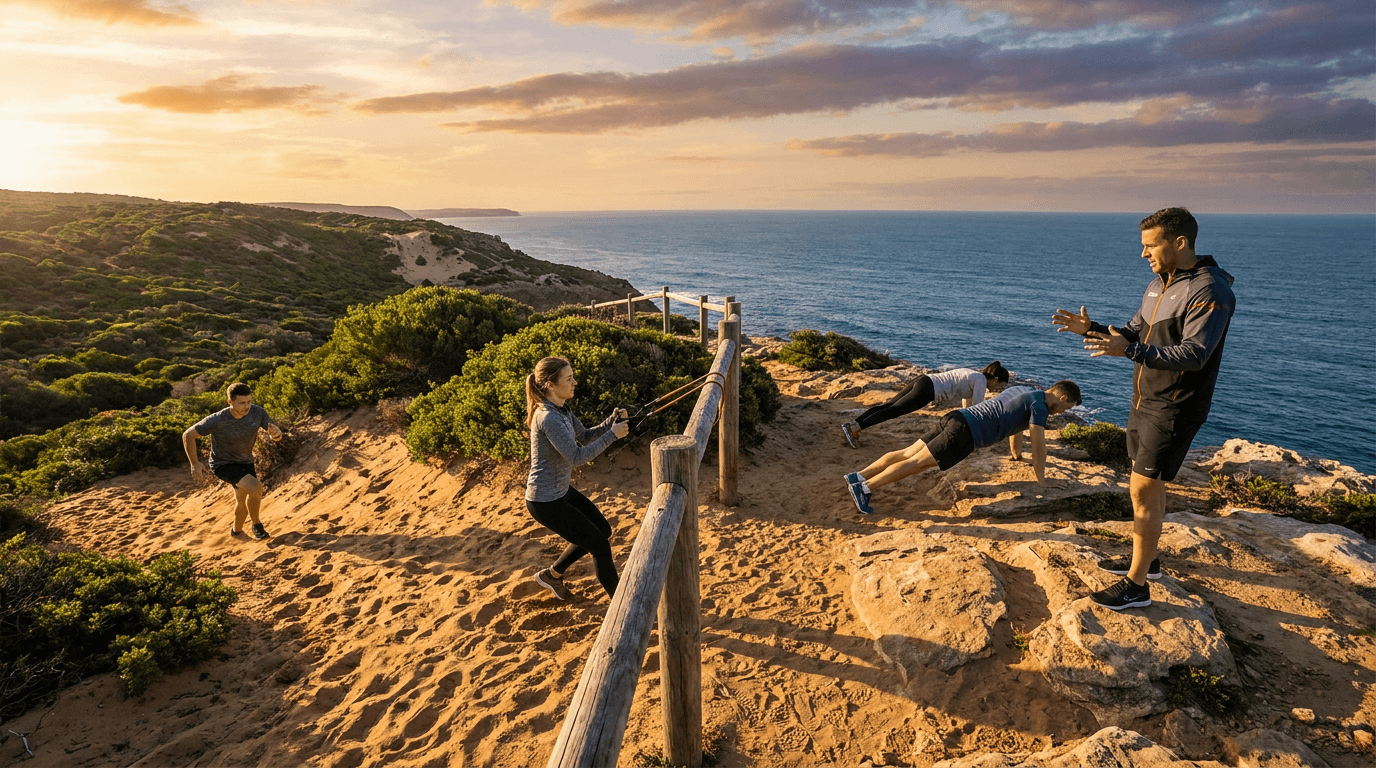
Prompt:
outdoor fitness training environment photograph of [a training scene set in a natural or outdoor environment — the coach or the training activity positioned in a location outside the traditional gym that communicates the versatility, the functional philosophy, and the visual power of outdoor fitness: the outdoor setting is a specific, visually compelling environment — a natural location that provides dramatic atmosphere and functional training opportunity: a park or urban green space with open grass, mature trees, and natural light — the accessible, community-oriented outdoor training location that communicates functional fitness and fresh-air training philosophy; or a beach or waterfront with sand, water, and open sky — the dramatic, aspirational setting that communicates the freedom and the natural challenge of sand-based, outdoor training; or an urban environment with stairs, hills, or architectural features used as training implements — stadium steps, park benches for step-ups, walls for handstands, the urban landscape repurposed as a functional training ground, communicating the coach's creativity and the "train anywhere" philosophy; or a trail or natural terrain — the hills, the uneven ground, the natural obstacles that outdoor and functional training uses, the natural environment communicating endurance, resilience, and the connection between fitness and the natural world, the training activity is visible — a person or group performing exercises that are specific to the outdoor environment: sprints on grass, hill runs, sand training, bodyweight exercises using outdoor features, resistance band work in open space, yoga or mobility work on natural ground, outdoor bootcamp activities — the exercises adapted to and enhanced by the outdoor setting, the coach may be visible — leading, coaching, demonstrating, or training in the outdoor space, the coaching presence establishing the professional context within the natural environment, the natural light and the outdoor atmosphere dominate — the open sky, the natural vegetation, the outdoor textures (grass, sand, concrete, gravel), the weather conditions, the air quality visible in the atmospheric perspective of the background — the outdoors itself a character in the composition, the overall composition communicates: training is not confined to the gym, the coach's methodology works anywhere, the outdoor environment provides natural challenge and natural beauty — the outdoor training visual as the versatility-communicating, atmosphere-rich image that differentiates the coach's visual content and communicates the functional, adaptable training philosophy] in a wide, environment-emphasizing, outdoor-training composition, the outdoor environment is prominent — the natural or urban setting providing dramatic atmospheric context, the landscape and the sky and the natural elements visible and contributing to the visual power, the training activity is positioned within the environment — the person or group engaging with the outdoor space, the physical effort integrated with the natural setting, the natural elements contribute to the composition — the trees, the sky, the terrain, the water (if present) creating the visual depth and the atmospheric quality that outdoor settings provide, the depth of field varies for the outdoor context — either deep (showing the full environmental scale and the subject within it) or moderately shallow (isolating the subject against the atmospheric outdoor background), the lighting is natural outdoor light — the specific quality of natural illumination that outdoor settings provide: golden-hour or bright-daylight natural outdoor illumination — the specific quality of outdoor natural light at the optimal shooting time: golden-hour light (early morning or late afternoon) providing warm, directional, long-shadow, cinematically beautiful illumination that models the body and the landscape with golden warmth and dimensional drama, or bright midday light providing full, high-energy, shadow-reducing illumination that shows the environment and the activity with maximum clarity and energy, the person catches the outdoor natural light with the specific quality that outdoor settings produce — the golden warmth of early or late light modeling the body with natural, flattering, dimensional quality, the skin and the muscles responding to the natural light with the organic, alive quality that only outdoor illumination provides, the landscape catches the natural light with its environmental character — the grass, the trees, the water, the terrain, the sky all rendered in the specific atmospheric quality of the outdoor moment, outdoor training palette — natural greens (grass, trees, vegetation) — sky blues or golden-hour warm tones — terrain-specific tones (sand gold, trail brown, urban grey) — athletic-wear accent colors or brand colors — natural outdoor lighting — and the natural, environment-rich, outdoor-atmosphere palette of fitness training in natural outdoor light as the color palette, the mood is naturally powerful environment-connected versatility-communicating and the specific outdoor message — the training adapts to any environment, the coach's methodology is functional and transferable, the outdoor setting provides natural challenge and natural inspiration — the outdoor visual as the versatility and atmosphere image that differentiates the coach's visual content and communicates the adaptive, functional, train-anywhere philosophy, professional outdoor and editorial photography with natural outdoor lighting and environment-appropriate depth of field, composed as a wide outdoor training scene with the natural environment and the training activity integrated, the environmental drama and the functional versatility and the outdoor atmosphere as the focal points, natural outdoor palette with brand-color accents, no text overlays, no watermarks
Best for: Instagram and Facebook outdoor and lifestyle content, website outdoor and functional training sections, social media seasonal and weather-appropriate content, paid advertising outdoor and fresh-air training creative, TikTok and Reels outdoor training content, Pinterest fitness and outdoor lifestyle content, YouTube video thumbnails and B-roll for outdoor content, seasonal marketing (spring and summer outdoor programs), event and bootcamp marketing imagery, brand differentiation content
Template 12: The Results Dashboard — Progress Tracking Made Visual
This template makes the data and the progress tracking visible — the metrics, the measurements, the tracking systems that communicate the data-driven, evidence-based approach of professional coaching and make the concept of progressive results tangible and visual.
Prompt:
fitness progress tracking and results dashboard visual of [a progress-communicating composition that makes the data-driven nature of the coaching program visible — the metrics, the tracking tools, the measured results represented through physical objects and visual metaphors that communicate evidence-based coaching: the progress-tracking elements are arranged as evidence of systematic measurement and documented results — the tangible tools that represent the data-driven approach: a tablet or phone screen showing a progress tracking dashboard or app — the screen displaying a graph that shows a measurable trajectory (weight progression over weeks, body composition change over months, strength progression charts, performance metrics trending upward), the digital tracking visible as a core coaching tool; a physical measuring tape coiled or extended — the simple, honest measurement tool, perhaps showing a measurement or positioned near a tracked number; a body composition measurement tool (calipers, a smart scale display, or their representations); a training log or journal open to a page showing progressive entries — the handwritten or printed record of sessions, loads, and progressions, the journal communicating the documented, reviewed, individually tracked nature of the coaching; photos or representations of progress photos — the visual documentation that supplements the numerical tracking; a pen or marker for notation; the coaching brand's logo or branded materials tying the tracking system to the specific coaching program, the progress data shows a positive trajectory — the numbers going in the right direction, the graph trending upward (for strength) or downward (for fat loss) or improving (for performance metrics), the visible evidence that the coached program produces measured, documented, progressive results, the arrangement communicates systematic professionalism — the tracking tools organized as a working system, not scattered but arranged as evidence of the methodical, data-informed approach that professional coaching employs, the overall composition communicates: the coaching is measured, the results are documented, the progress is tracked systematically, the approach is evidence-based — the results dashboard as the data-authority visual that differentiates the systematic, evidence-based coach from the "just show up and work hard" provider] in a close, top-down or slightly angled, data-and-tools-focused composition, the tracking elements fill the frame — the tablet, the tools, the journal, the measuring implements arranged as a working system, the data is visible — the progress trajectory readable on the screen or in the journal, the positive direction evident, the brand identity is present — the coaching logo, the brand colors, the branded materials visible within the tracking system, the surface beneath is clean and professional — a desk, a table, a clean gym surface providing the professional foundation, the depth of field is moderately shallow — the nearest tracking elements in detailed focus with supporting elements in softer context, the lighting is clean and data-appropriate — the clear, professional illumination that makes data and tracking tools look precise and intentional: clean, even, slightly cool-to-neutral lighting — the professional, data-clarity illumination that makes screens readable, text legible, and measurement tools precise, the clean light communicating the clarity and the precision of the evidence-based coaching approach, the tracking elements catch the clean light with their functional quality — the tablet screen bright and readable, the measuring tools showing their calibration quality, the journal pages showing their documented entries, the brand elements showing their identifying design, results dashboard palette — tablet screen light and data-graph colors — measurement tool metallic and white tones — journal and paper warm tones — brand-color accent elements — clean, professional, data-appropriate lighting — and the clean, precise, evidence-communicating palette of a progress tracking system in professional lighting as the color palette, the mood is data-driven systematically tracked evidence-based and the specific tracking message — the results are measured, the progress is documented, the coaching is evidence-based, the system produces tracked, verified, progressive outcomes — the results dashboard as the data-authority visual that communicates the systematic, evidence-based depth of the coaching methodology, professional concept and still-life photography with clean professional lighting and moderately shallow depth of field, composed as a tracking-system flat lay or angled composition with data and measurement tools visible, the data-driven approach and the systematic tracking and the evidence-based methodology as the dashboard focal points, clean professional data palette with brand-color accents, no text overlays, no watermarks
Best for: Website methodology and results sections, Instagram educational and system content, program landing page methodology features, email marketing program-structure content, social media data and results carousel content, webinar and workshop data-driven coaching presentations, content marketing evidence-based coaching articles, sales consultation methodology slides, coaching certification and education materials, paid advertising systematic-approach creative
Template 13: The Recovery and Wellness — Complete Health Positioning
This template presents the recovery, the mobility, the wellness side of coaching — the stretching, the foam rolling, the rest, the holistic health approach that positions the coach as a complete health and performance professional rather than just a workout provider.
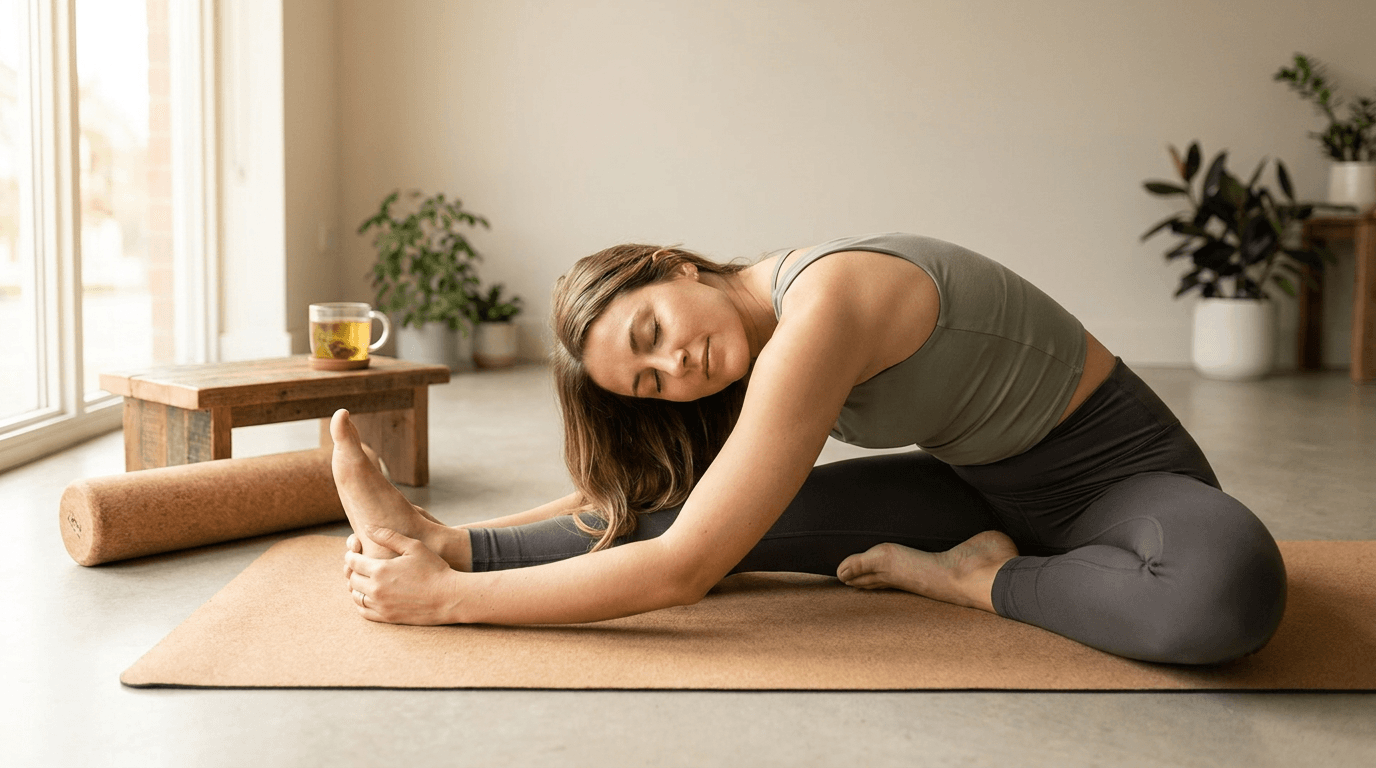
Prompt:
recovery and wellness lifestyle photograph for fitness coaching of [a serene, health-communicating recovery and wellness scene — the stretching, the mobility work, the recovery practices that communicate the coach's understanding that recovery is essential to results and that complete health is the goal: the recovery scene shows a specific wellness practice — the particular recovery or wellness activity that the coaching program includes: a person performing a deep stretch or yoga-influenced mobility position — the body in a controlled, relaxed, flexibility-demonstrating posture, the expression calm and focused, the breathing visible in the body's stillness, the flexibility and the controlled position communicating the trained mobility that the coaching program develops; or a foam rolling or self-myofascial release scene — the person using recovery tools (foam roller, lacrosse ball, massage gun, stretching strap) with the deliberate, coached technique that distinguishes informed recovery from random rolling, the recovery tools visible as part of the coaching program's recovery protocol; or a post-workout recovery moment — the person sitting or lying in a recovery position, the breathing controlled, a water bottle and a recovery shake nearby, the deliberate, coached recovery period visible as a programmed element rather than merely "resting," the overall atmosphere is calm, controlled, and health-focused — the energy lower than the training scenes, the mood contemplative and restorative, the visual quality communicating that rest and recovery are not laziness but essential, coached, programmed components of the complete training system, the setting is appropriate to the recovery context — a clean, calm training space, a yoga-influenced area with mats and props, a stretching area of the gym, or a natural outdoor setting — the environment contributing to the restorative atmosphere, the overall composition communicates: this coach understands that results require recovery, the program addresses the complete picture — training, nutrition, and recovery — and the coaching philosophy values long-term health and sustainability over short-term intensity — the recovery visual as the complete-health-positioning image that differentiates the holistic coach from the workout-only provider] in a calm, wellness-focused composition, the recovery activity fills the frame — the stretch, the mobility work, the recovery practice visible and serene, the calm atmosphere dominates — the lower energy, the controlled breathing, the restorative quality, the setting contributes to the wellness mood — the clean space, the natural elements, the calming environment, the depth of field is moderately shallow — the recovery subject in focus with the environment in soft, atmospheric context, the lighting is soft, warm, and wellness-communicating — the calming illumination that matches the restorative mood: soft, warm, diffused natural light — the gentle, even, warm-toned illumination that communicates rest, recovery, and wellness, the light soft and shadow-free, the warmth communicating the nurturing, restorative quality of the recovery moment, the person catches the soft light with calm, health-communicating quality — the skin warm and relaxed, the body in its recovery posture illuminated with the gentle quality that the restorative mood requires, the expression peaceful and focused, the recovery tools catch the soft light with their specific functional quality — the foam roller, the mat, the props, the recovery implements visible in the warm, gentle illumination, the recovery environment catches the soft light with its calming character — the clean floor, the neutral walls, the natural elements contributing to the serene atmosphere, recovery and wellness palette — warm, muted, calming tones — soft skin tones in warm light — natural materials (wood, cork, natural rubber) — neutral, restful environmental tones — soft, warm, diffused natural illumination — brand-color accents in recovery tools or branded merchandise — and the warm, serene, health-communicating palette of a recovery and wellness scene in soft natural light as the color palette, the mood is restoratively calm wellness-centered holistically healthy and the specific recovery message — recovery is programmed, rest is coached, the complete health picture includes training and nutrition and recovery and mobility, this coaching approach values long-term sustainable health — the recovery visual as the holistic-positioning image that communicates the coach's complete, health-first, sustainable approach, professional wellness and lifestyle photography with soft warm natural light and moderately shallow depth of field, composed as a calm recovery scene with the wellness activity and the serene atmosphere central, the restorative quality and the complete-health positioning and the coached-recovery approach as the recovery focal points, warm calming wellness palette, no text overlays, no watermarks
Best for: Instagram and Facebook wellness and recovery content, website holistic approach and recovery sections, Pinterest wellness and self-care content, email marketing recovery and wellness features, program landing page recovery-component sections, social media balance and sustainability content, blog and content marketing recovery education articles, brand partnership and recovery-product collaboration content, corporate wellness and sustainable-health positioning, new-client onboarding recovery-protocol materials
Template 14: The Educational Anatomy — Movement Science Illustration
This template creates the educational, science-communicating visual — the anatomy overlay, the biomechanical breakdown, the movement-science illustration that demonstrates the coach's depth of knowledge and positions them as a scientifically informed authority.
Prompt:
exercise anatomy and movement science educational illustration for fitness coaching of [a clean, visually clear, anatomically informative illustration that shows the muscular and biomechanical elements involved in a specific exercise or movement — the educational visual that communicates the coach's understanding of the science behind the training: the illustration shows a specific exercise with anatomical emphasis — the body performing a movement with the relevant musculature highlighted or visually emphasized to communicate the "why" behind the exercise selection and the "what" behind the physical sensation: a barbell squat with the quadriceps, gluteals, hamstrings, core, and erectors visually highlighted — the primary movers and the stabilizers identified, the force vectors shown, the biomechanical explanation of why the squat develops lower-body strength visible in the anatomical detail; or a pulling movement (a pull-up, a row, a deadlift) with the lats, the traps, the rhomboids, the biceps, the posterior chain highlighted — the pulling musculature identified and contextualized within the movement; or a pressing movement (a bench press, an overhead press, a push-up) with the pectorals, the anterior deltoids, the triceps highlighted; or a core and spinal stability illustration showing the transverse abdominis, the obliques, the erectors, the multifidus — the deep core stabilization system that coaches teach and that most clients do not understand, the anatomical detail is educationally clear — the muscle groups shown with enough anatomical accuracy to be informative and enough visual clarity to be understandable by a non-specialist audience, the illustration educational rather than clinical, the muscle highlighting using color-coding, opacity overlays, or visual emphasis to make the targeted muscles identifiable, the movement biomechanics may be indicated — arrows showing the direction of force, joint angles indicated, the lever systems of the body suggested — the biomechanical elements adding the "physics of movement" understanding that deepens the educational value, the coaching brand is present — the illustration styled in the coach's brand colors, the brand logo or mark visible, the visual identity consistent with the coach's overall brand aesthetic, the overall composition communicates: this coach understands the science behind the training, the programming is informed by anatomical and biomechanical knowledge, the expertise is deep enough to explain not just what to do but why it works — the educational anatomy visual as the science-authority image that positions the coach as a knowledgeable expert] in a clean, educational, anatomy-focused illustration composition, the body and the anatomical emphasis fill the frame — the exercise position and the highlighted musculature visible and clear, the educational information is readable — the muscle groups identifiable, the movement biomechanics understandable, the illustration functioning as an informative visual, the brand identity is present — the color scheme, the visual style, the brand mark consistent with the coach's identity, the composition is clean and uncluttered — the educational information presented with visual clarity, the illustration easy to read and understand at social-media scale, the visual style is modern and professional — the illustration quality communicating professional design and scientific literacy, illustration-appropriate visual quality — the clean, sharp, digitally rendered quality of modern educational illustration: clean, bright, high-contrast illustration lighting — the virtual illumination that shows the anatomical detail with maximum clarity, the body rendered with enough dimensional quality to show the muscle positioning and the movement biomechanics clearly, the highlighted muscles shown with visual emphasis — either through color differentiation (the targeted muscles in a bright, attention-drawing color against the body's neutral rendering) or through opacity overlay (the muscle structure visible through a semi-transparent body rendering) or through labeled identification (clean typographic labels connected to the relevant muscle groups), educational anatomy palette — body and skin neutral rendering — highlighted muscle groups in brand-color or anatomical-standard red-pink — force-vector arrows and biomechanical indicators in contrasting color — clean background (white, light grey, or brand-neutral) — brand-color accents — and the clean, educational, scientifically informative palette of an exercise anatomy illustration as the color palette, the mood is scientifically informed educationally clear knowledge-demonstrating and the specific educational message — the coach understands the anatomy and the biomechanics, the training is informed by science, the expertise goes deeper than exercise selection to include the understanding of why each exercise works and how the body responds — the educational anatomy visual as the science-authority image that positions the coach as a deeply knowledgeable expert whose programming is informed by anatomical and biomechanical understanding, professional educational illustration with clean rendering and clear anatomical detail, composed as an exercise-anatomy educational visual with highlighted musculature and movement biomechanics, the scientific depth and the educational clarity and the coaching authority as the educational focal points, clean educational palette with brand-color anatomical highlights, no text overlays except optional anatomical labels, no watermarks
Best for: Instagram and Facebook educational and science content (carousel slides), website methodology and expertise sections, YouTube video thumbnails for educational content, program delivery materials and exercise library, email marketing educational features, TikTok and Reels educational overlays, blog and content marketing exercise-science articles, coaching certification and education materials, client onboarding movement-education resources, social media educational carousel and save-worthy content (high save rate)
Template 15: The Social Media Promotional — Offer and Program Announcement
This template creates the promotional-ready visual canvas — the atmospheric, text-ready composition designed to carry program launches, consultation offers, challenge announcements, and promotional messaging while maintaining the coaching brand's authority and visual identity.
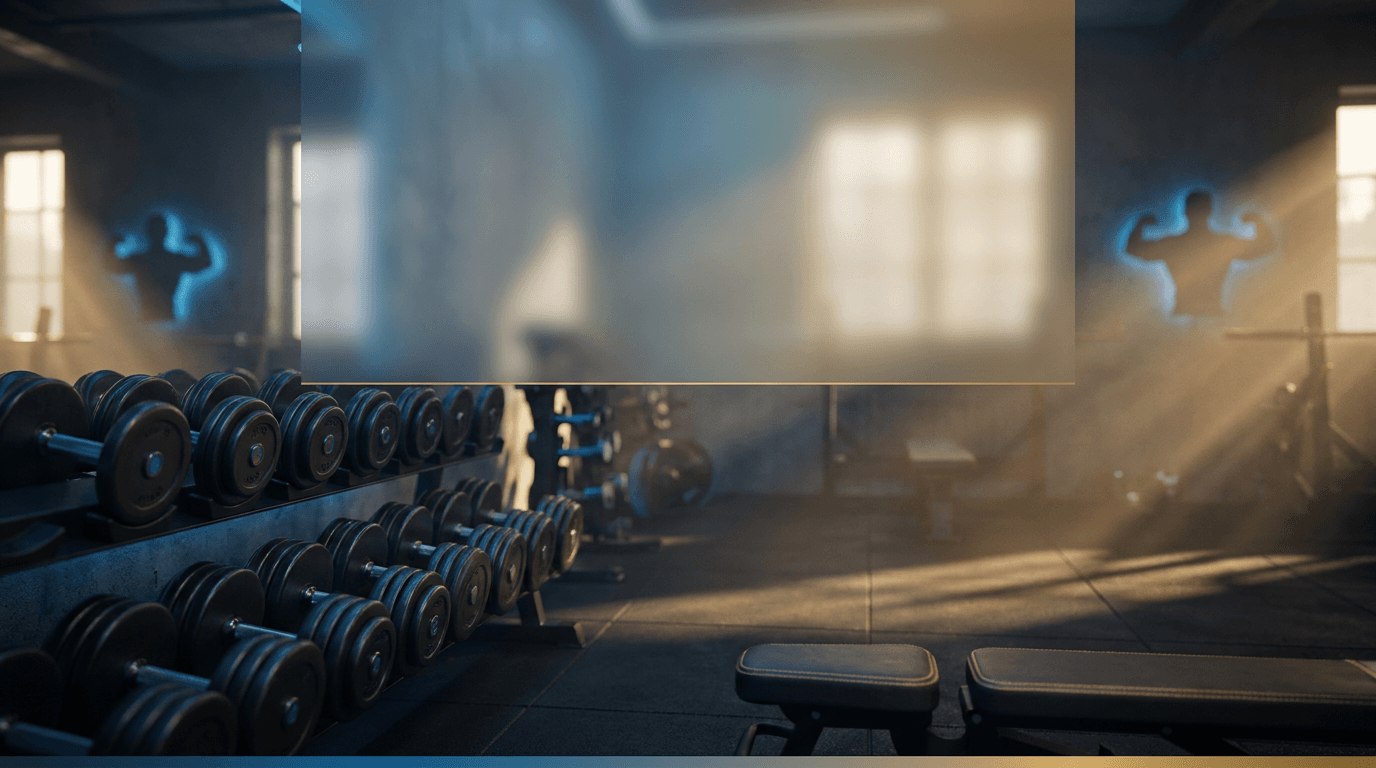
Prompt:
personal trainer and coaching program promotional announcement visual canvas of [an atmospheric, text-ready composition designed as the background for coaching-program promotions — the visual foundation that carries program launches, consultation offers, challenge announcements, seasonal promotions, and brand messaging while maintaining the coach's authority and visual identity: the image provides a dramatic, brand-consistent, text-supporting background — atmospherically layered with the visual vocabulary of coaching authority and the brand's specific identity: a background built from the coaching brand's visual world — the dramatic gym atmosphere, the training equipment in atmospheric focus, the brand colors as environmental elements, the energy and the authority of the coaching brand communicated through atmospheric visual elements rather than explicit subject matter — one or more of these themes providing the atmospheric foundation for text overlay, the brand colors are prominently integrated — the specific colors that define the coaching brand present as dominant atmospheric elements: a band or gradient of brand color, equipment in brand-coordinated colors, a brand-colored surface or backdrop, the coaching environment rendered in the brand's color palette — the brand colors providing the immediate visual identification that connects the promotional content to the coaching brand, the coaching and fitness context is present atmospherically — the gym equipment in soft focus, the training-environment textures (rubber flooring, metal equipment, mirror surfaces), the branded elements (logo, brand mark, branded merchandise) — the fitness and coaching context providing the thematic foundation without competing with the overlaid text, the composition is deliberately zoned for text — a large, clear area (center, upper third, or a deliberate negative space) where the promotional text will sit with strong legibility, the text zone large enough to accommodate a headline ("12-Week Transformation Program — Enrollment Open"), a supporting line ("Limited to 10 Clients | Starting [Date]"), a call-to-action ("DM 'READY' to Apply"), and the brand mark — the text hierarchy accommodated within the designed text zone, the overall design works across promotional types — flexible enough to support a program launch, a free consultation offer, a 30-day challenge, a seasonal special, a referral incentive, a new-service announcement, or any coaching-business communication — the atmospheric foundation adapting to any promotional message, the overall composition communicates: this is an official communication from a professional coaching brand, the visual quality matches the coaching quality, the promotion is worth attention — the promotional canvas as the brand-consistent, authority-maintaining visual foundation for business communication] in a text-ready, atmospherically-zoned promotional composition, the composition is structured for text overlay — clear text zones and atmospheric visual zones, the brand colors dominate — the coaching brand's specific palette providing immediate visual identification, the coaching context is atmospheric — gym elements and training-environment textures in supportive, non-competing atmospheric zones, the text zone is clearly defined — large, consistent, high-legibility area for promotional content, the depth of field is atmospheric — elements in moderate-to-deep soft focus preventing background competition with overlaid text, the lighting is dramatic and brand-consistent — the atmospheric quality that maintains authority: dramatic, moody, brand-consistent atmospheric lighting — the gym-influenced, authority-maintaining illumination that provides atmospheric depth while supporting text legibility, the brand elements catch the dramatic light with their identifying quality — the brand colors vivid in the atmospheric rendering, the coaching-environment elements atmospheric but recognizable, the text zone receiving predictable, consistent illumination that ensures text legibility, promotional palette — the coach's specific brand colors as the dominant chromatic identity (specify: [your brand colors]) — gym and training-environment tones in atmospheric rendering — text-zone areas in consistent tonality for overlay legibility — dramatic, atmospheric, brand-consistent lighting — and the branded, authority-maintaining, promotion-ready palette of a coaching-brand announcement canvas as the color palette, the mood is professionally branded promotionally urgent authority-maintaining and the specific promotional message — this is a program or an offer worth your attention, from a coaching professional you can trust, the visual authority supports the promotional message — the promotional canvas as the text-ready, brand-consistent, authority-maintaining visual foundation for every coaching-business promotion and announcement, professional atmospheric photography with dramatic brand-consistent lighting and atmospheric depth of field in a text-zone-structured composition, designed for multi-purpose promotional text overlay, the text readability and the brand authority and the promotional versatility as the promotional focal points, brand-color dominant palette in dramatic coaching atmosphere, no text overlays in this base image (text to be added for specific promotions), no watermarks
Best for: Instagram and Facebook program launch and offer posts, paid advertising promotional creative backgrounds, email marketing promotional headers, website promotional banners, YouTube community tab and post imagery, program enrollment and landing page promotional visuals, seasonal and challenge campaign graphics, referral program and incentive announcements, event and workshop promotional materials, cross-platform promotional consistency
How to Customize These Prompts for Your Specific Coaching Practice
The templates produce compelling coaching-industry content, but the most effective imagery reflects your actual coaching practice — your specific training specialty, your real physique and presentation, your brand identity, your facility, your client demographic, and the particular expertise that differentiates you.
Specify your training specialty and niche precisely. If you are a strength and conditioning coach who specializes in powerlifting programming for intermediate lifters, the visual content should reflect barbell training, platform work, competition movements, and the specific equipment and environment of strength-focused coaching. If you are an online coach specializing in body recomposition for busy professionals aged 30-50, the visual content should reflect time-efficient training, home or commercial gym environments, and the physique and lifestyle of your specific demographic. The more precisely you define your niche in the prompt, the more specifically relevant the generated content becomes.
Replace generic coach descriptions with your actual physical presentation. Your physique, your appearance, your personal brand presentation are specific to you. Describe your actual build (athletic, lean, muscular, strong, functionally fit), your typical training attire (specific colors, specific brands, specific style), your hair and grooming, and any distinguishing elements of your personal presentation. The AI generation produces more useful results when the coach described in the prompt resembles the actual coach who will use the content.
Define your brand colors and visual identity exactly. Your brand colors are your visual signature. Replace "[your brand colors]" with your exact palette: "matte black with electric blue accents" or "charcoal grey with gold" or "white with forest green." Include the application: "black compression shirt with electric blue logo on the left chest, black shorts with blue stripe." The specificity produces content that is immediately recognizable as your brand.
Match the facility to your actual training environment. If you train clients in a CrossFit box, describe the rig, the rubber flooring, the chalk-dusty barbells, the open warehouse space. If you train in a private studio, describe the clean design, the curated equipment, the controlled environment. If you train online clients who work out in home gyms, describe the garage setup, the minimal-but-quality equipment, the real-world home training environment. Your visual content should look like the space your clients actually train in.
For authority portraits and team images, photograph yourself. Use the AI-generated portraits as lighting, composition, and atmospheric references, then invest in a professional photography session that captures your real face, your real body, your real expression, your real brand. The Image Inpainting tool can enhance the quality and atmospheric character of your actual photographs while preserving the authentic face that clients will see on their first consultation. Authenticity in coaching authority portraits is non-negotiable — the client needs to see the real person they will be trusting with their body and their goals.
Document real client transformations with permission. Use the transformation template (Template 2) as the visual standard for your real client documentation. Establish a consistent documentation protocol: same wall, same lighting, same distance, same clothing instruction, same angle. Get written permission from every client whose transformation you photograph. Real, honestly documented, permission-granted client transformations are the single most valuable visual asset in your entire marketing system. No AI-generated image can replace the credibility of a real person's documented change.
Platform-Specific Deployment for Coaching Businesses
Each platform where coaching services are discovered and evaluated has specific content expectations, audience behaviors, and format requirements.
Instagram is the primary platform for most personal trainers and coaches. The Instagram grid is the coach's primary storefront. The content mix should maintain approximately 30% educational and technique content (Templates 4, 14 — the highest-save, most algorithmically favored content type for fitness accounts), 25% transformation and results evidence (Templates 2, 12 — the highest-conversion content), 15% motivational and mindset content (Template 8 — the highest-share content), 15% coaching experience and behind-the-scenes content (Templates 3, 5, 6, 13 — the trust-building content), 10% community and group content (Template 9 — the belonging content), and 5% promotional content (Template 15 — the conversion content). Use 4:5 for feed posts, 9:16 for Stories and Reels, 1:1 for maximum compatibility. For Instagram-specific strategies, additional guidance covers platform optimization.
TikTok is the highest-reach platform for fitness content discovery. TikTok's algorithm rewards engaging, educational, and transformation fitness content with disproportionate distribution compared to follower count. Templates 4 (form demonstrations), 2 (transformation reveals), 8 (motivational moments), and 11 (outdoor training) produce content optimized for TikTok's vertical, full-screen, attention-grabbing format. Use 9:16 exclusively for TikTok.
YouTube serves the long-form educational and authority-building function. YouTube is where coaches build the deepest authority through long-form educational content, program reviews, client case studies, and training vlogs. Templates 1 (authority portrait for channel branding), 4 and 14 (educational content thumbnails), 2 (transformation case study thumbnails), 5 (facility and environment B-roll), and 8 (motivational thumbnails) serve YouTube's specific content needs. Use 16:9 for all YouTube content.
LinkedIn serves the corporate wellness, executive coaching, and B2B market. Coaches who serve corporate clients, executive wellness, or the business-professional demographic should maintain a LinkedIn presence with authority portraits (Template 1), methodology frameworks (Template 7), results evidence (Template 2), and professional-positioning content (Templates 5, 12). LinkedIn's professional context rewards more polished, more business-oriented visual content than Instagram's fitness-native audience.
Google Business Profile serves the local in-person coaching market. For trainers with a physical location, the GBP listing is essential for local discovery. Include authority portrait (Template 1), facility imagery (Template 5), coaching-session documentation (Template 3), and transformation evidence (Template 2). Use 1:1 or 4:3 aspect ratios.
The coaching website is the conversion hub. The website should deploy Template 1 (authority portrait for the hero section and about page), Templates 2 and 12 (transformation evidence for the results section), Templates 3 and 5 (coaching experience for the services section), Template 7 (methodology for the approach section), Templates 6 and 13 (holistic approach for the philosophy section), Template 9 (community for group program sections), and Template 15 (promotional for program enrollment). The website's visual quality establishes the professional standard against which all other content is measured.
Email marketing drives program enrollment and client retention. Weekly or biweekly emails should feature Templates 4 and 14 for educational value, Templates 2 for client success stories, Templates 8 for motivational engagement, and Template 15 for program launches and promotional announcements. Visual consistency in email marketing maintains the coaching relationship and the brand authority between in-person sessions.
Common Mistakes in Personal Trainer Visual Identity
Personal trainer and coaching visual identity fails in specific, identifiable ways that directly impact client acquisition, pricing power, authority perception, and long-term business growth.
Confusing "being fit on camera" with "building coaching authority." The most common visual identity mistake in the personal training industry is treating the content as a showcase of the trainer's own physique and workouts rather than as a demonstration of coaching expertise and client results. Posting your own workouts shows that you are fit. Posting your coaching sessions, your client transformations, your educational content, and your methodology shows that you are a coach. The former attracts followers who admire; the latter attracts clients who buy. Build the content around your coaching, not your training.
Inconsistent visual quality that undermines perceived professionalism. A coach who posts a professionally shot authority portrait one day and a poorly lit, shaky, gym-mirror selfie the next creates a confusing quality impression. The visual quality should be consistent across every post — the lighting approach, the color treatment, the composition quality, the overall production value should be recognizable and reliable. Consistency signals professionalism; inconsistency signals amateur.
Using transformations without credibility conventions. Client transformations that use dramatically different lighting, different posing, different camera angles, or visible manipulation (tanning, pumping, dehydration) between the before and the after undermine rather than build credibility. Savvy fitness consumers can identify misleading transformation photography, and the credibility damage of being perceived as dishonest is catastrophic. Follow the conventions: same lighting, same angle, same clothing style, same background, honest timeline disclosure.
Neglecting the educational content that builds deepest authority. Workout demonstrations are common. Exercise-science education — the anatomy, the biomechanics, the programming rationale, the evidence-based explanation of why training works — is less common and dramatically more valuable for authority building. The coach who can explain the science is perceived as more knowledgeable, more trustworthy, and more worth the premium price. Templates 4, 7, 12, and 14 specifically address this educational authority gap.
Failing to document the coaching interaction. Many trainers have extensive content of themselves training and almost no content of themselves coaching. The in-session coaching photograph (Template 3) — the hands-on cue, the focused observation, the professional interaction with a client — is the service-experience image that shows the potential client what they are actually paying for. Without it, the potential client sees a fit person but does not see a coach.
Over-reliance on motivational quotes over substantive content. Motivational content has its place (Template 8) — it drives engagement, sharing, and emotional connection. But a feed dominated by motivational quote graphics with no educational substance, no transformation evidence, no coaching documentation, and no methodological content communicates "influencer" rather than "coach." The balance should be heavily weighted toward substantive content (education, results, coaching documentation) with motivational content as the engagement driver, not the identity.
Ignoring the nutrition and recovery components. Coaches who post exclusively training content miss the opportunity to position themselves as complete health professionals. Templates 6 (nutrition) and 13 (recovery) address the holistic positioning that communicates "I coach the full picture — training, nutrition, and recovery — because that is what produces results." The holistic positioning justifies higher pricing and differentiates from trainers who only address the gym component.
Building a Complete Coaching Visual Identity System
A successful coaching visual identity is a cohesive system that establishes authority, documents results, demonstrates expertise, and builds the trust that converts followers into paying clients.
Establish your authority positioning before building content. Define the core positioning decisions: your niche (who you serve and what you help them achieve), your methodology (how you achieve results and why your approach is different), your brand personality (the specific character of your professional presence — intense and performance-focused, warm and supportive, scientific and methodical, energetic and motivational), your visual aesthetic (dark and dramatic, bright and energetic, clean and clinical, warm and lifestyle-oriented), and your brand colors (the specific palette that will appear in every piece of content). Document these decisions and apply them rigorously to every visual asset.
Build a content calendar that balances all authority elements. A coaching visual identity is not built through one content type alone. The authority requires all elements working together: the portraits establish the person, the transformations prove the results, the coaching sessions show the service, the education demonstrates the depth, the nutrition and recovery show the completeness, the group content shows the community, the motivational content creates the emotional connection, and the promotional content drives the conversion. Build a content calendar that ensures all elements are represented across a monthly cycle.
Invest in a professional photography foundation session. A single professional photography session — two to three hours with a photographer who understands fitness and coaching visual identity — can produce the authority portrait, several coaching-session compositions, facility imagery, equipment shots, and environmental content that will serve as the visual foundation for months. Schedule this session when you are in peak physical condition, your facility is clean and well-organized, and your branded attire is available. Use the AI-generated templates from this post as shot-list references for the photographer.
Create multi-format versions of every key visual. Every important image should exist in 1:1 (Instagram, Facebook, profile), 4:5 (Instagram feed maximum), 9:16 (Stories, Reels, TikTok), 16:9 (website banners, YouTube), 4:3 (Google Business Profile), and print-ready format. A single strong authority portrait reformatted for every platform maintains visual consistency across the digital ecosystem.
Develop video content as the primary engagement driver. Video content has become the dominant engagement format across all platforms for fitness coaching. The Cinematic Video Generator creates atmospheric video content from training sequences and coaching moments. The Text2Shorts tool produces promotional short-form content for Instagram Reels, TikTok, and YouTube Shorts. The AI Clipping tool extracts the most compelling moments from longer coaching sessions and training footage. The AI Music Generator creates energetic audio for training montages and calming audio for recovery and wellness content. Visual consistency between still and video content reinforces the brand identity across formats.
Track which visual content types drive actual client inquiries. Not all engagement is equal. Track which content types — which templates, which visual approaches, which subject matter — generate the inquiries, the consultation bookings, and the program sign-ups that represent actual business growth. In most coaching businesses, transformation evidence and educational content drive the most conversions, while motivational content drives the most engagement. Both are valuable, but understanding the difference allows you to optimize your content production for business outcomes.
How Miraflow AI Supports Your Coaching Visual Identity Workflow
Every prompt in this post can be generated inside Miraflow AI. Open the AI Image Generator, paste your customized prompt with your specific training specialty, brand colors, facility type, coaching methodology, physique description, and brand personality, select the appropriate aspect ratio, and generate. Multiple aspect ratios including 1:1, 4:5, 16:9, 9:16, and 5:4 are available, covering every deployment from Instagram feed to website hero to YouTube thumbnail to print material.
For the most effective coaching visual identity workflow, these AI-generated images serve as visual direction, mood boards, quality benchmarks, and supplementary atmospheric content for your complete visual system. They establish the lighting approach, the compositional style, the color treatment, the atmospheric quality, and the authority positioning that your real photography should achieve. When you invest in a professional photography session, share these generated references with your photographer as the visual standard the session should target. When your team documents coaching sessions and client transformations, use these references as the quality benchmark that guides the documentation effort.
For your real coaching photography and existing visual content that needs targeted enhancement — improving the lighting quality of a coaching-session photo, adjusting the color balance for brand consistency, extending a composition's background for a wider format, removing an unwanted background element from an otherwise strong authority portrait, or enhancing the atmospheric quality of a gym-environment shot — the Image Inpainting tool allows precise editing of specific image regions while preserving the authentic photographic content. This tool is particularly valuable for coaches because the most credible content is the real photography — your actual face, your actual clients, your actual facility — and the enhancement brings the quality up to the authority standard without replacing the authentic content.
The recommended workflow operates in three phases. The conceptual phase uses these AI prompts to generate visual direction for every content type — establishing the authority positioning, the lighting quality, the compositional approach, and the atmospheric standard before any production begins. The production phase creates your actual brand content — the professional photography session for authority portraits and facility imagery, the ongoing documentation of coaching sessions and client transformations, the real-content production informed by the generated visual direction. The enhancement phase uses inpainting to bring your production materials to the highest standard — adjusting atmosphere, correcting color, optimizing composition, and maintaining brand consistency while preserving the authentic faces, real bodies, and genuine moments that coaching authority demands.
For coaches building a complete visual ecosystem including motion and audio content, Miraflow's suite extends the capability. The Cinematic Video Generator creates atmospheric video content from training sequences and coaching moments. The Text2Shorts tool produces promotional short-form content for social platforms. The AI Music Generator creates energetic audio for training montages and calming audio for recovery content. The AI Clipping tool extracts compelling moments from longer content. The YouTube Thumbnail Maker creates thumbnails for educational and training video content. Together, these tools allow a coaching business to produce a complete visual and motion identity system that maintains authority and brand consistency across every platform and format.
FAQ
Can AI-generated images replace real photos of me and my clients?
No — and this distinction is more important in coaching than in almost any other industry. Your face is your brand. Your clients' real transformations are your proof. AI-generated images should serve as visual direction, atmospheric content, quality benchmarks, and supplementary visuals (motivational backgrounds, conceptual imagery, educational illustrations, promotional canvases), not as replacements for the authentic photography that builds genuine trust. Use the AI-generated authority portrait as the reference for your real professional photoshoot. Use the AI-generated transformation template as the standard for your real client documentation. The Image Inpainting tool can enhance the quality of your real photography to match the atmospheric standard of the generated references while preserving the authentic faces and bodies that coaching authority requires.
What is the single most important visual content type for a personal trainer?
It depends on your business stage. For a new coach building initial credibility, the authority portrait (Template 1) is the foundation — you need the professional visual anchor that establishes "this is a professional coach" before anything else. For an established coach seeking to convert followers into clients, client transformation evidence (Template 2) is the most powerful conversion tool. For a coach building long-term authority and audience growth, educational content (Templates 4, 14) drives the highest-quality engagement and attracts the most committed potential clients. All three are essential; the priority depends on what your business needs now.
How should I photograph client transformations credibly?
Establish a consistent protocol and apply it to every client who consents to documentation. Use the same location (a clean, neutral wall in your facility), the same lighting (the facility's consistent overhead lighting plus any natural light), the same camera position (mark the floor for tripod placement), and the same instructions to the client (same clothing style, same posture, same angle). Shoot at the beginning of the coaching engagement and at regular intervals (8 weeks, 12 weeks, 16 weeks, 6 months, 1 year). Disclose the timeline honestly. Do not manipulate the photography conditions between the before and the after. Credible, honestly documented transformations build more trust than dramatic but questionable transformations.
How do I balance showing my physique with showing my coaching?
The general guidance is that your physique should be visible but not the focus. Your physique is a credential — it proves you practice what you preach — but your coaching is the service. Use the authority portrait (Template 1) and the exercise demonstration (Template 4) to show your physique within a professional context. Use the coaching session (Template 3) and the client transformation (Template 2) to show your coaching. The ratio should be heavily weighted toward coaching content over physique content — approximately 70% coaching-focused content to 30% physique-visible content. The exception is if you are a physique or bodybuilding coach, where your own physique is more directly relevant to your niche.
What platforms should I prioritize as a personal trainer?
For in-person trainers serving a local market: Instagram (brand building and community), Google Business Profile (local discovery), your website (conversion hub), and Facebook (local community and advertising). For online coaches: Instagram (primary discovery and trust building), TikTok (highest-reach content discovery), YouTube (deepest authority building), your website (conversion hub), and email (client relationship and sales). For coaches serving corporate or executive clients: LinkedIn (B2B credibility), your website (professional authority), and Instagram (supplementary brand building). For all coaches, the website is the conversion hub where visual authority must be strongest.
How often should I post visual content?
Consistency matters more than frequency. A coach who posts three high-quality, on-brand, authority-building pieces of content per week will outperform a coach who posts daily low-quality, inconsistent content. The recommended minimum for Instagram is four to five posts per week (a mix of feed posts, Stories, and Reels). For YouTube, one to two videos per week. For TikTok, three to five posts per week. For email, one to two per week. Build the production cadence that your capacity allows and maintain it reliably — the consistency of the cadence is the signal of professionalism.
Conclusion
The expertise is real. The certification is earned. The continuing education is current. The programming is scientifically informed, individually designed, progressively structured, and refined through years of professional practice. The client results are documented: the weight lost, the strength gained, the body composition changed, the movement quality improved, the confidence built, the health markers normalized. The coaching is excellent. The coach is qualified. The outcomes are genuine. And none of it matters if the potential client never sees it — if the visual presence that would communicate this expertise, this authority, this proven track record is absent, amateur, inconsistent, or indistinguishable from the thousands of other profiles in the infinite scroll.
This is not a superficial concern. The visual identity is not vanity. The authority portrait is not ego. The transformation documentation is not bragging. The professional visual presentation is the mechanism through which the coaching expertise reaches the people who need it. Every person who scrolls past a coach's profile because the visual quality failed to communicate the authority that the coach actually possesses is a person who might have hired that coach, might have transformed under that coach's guidance, might have become the next documented success story — but did not, because the three-to-seven-second visual evaluation failed to communicate what is true. The visual identity does not replace the expertise. The visual identity gives the expertise its chance.
The 15 templates in this post address the complete authority-building visual identity system a personal trainer or coaching business needs: the commanding authority portrait that establishes the coach as a credible professional, the client transformation documentation that provides irrefutable conversion evidence, the in-session coaching shot that demonstrates the service experience, the exercise demonstration that proves technical mastery, the training environment atmosphere that communicates professional positioning, the nutrition lifestyle imagery that establishes holistic authority, the program framework visual that makes methodology visible, the motivational campaign image that drives emotional engagement, the group training energy that communicates community, the equipment spotlight that signals professional investment, the outdoor environment that demonstrates versatility, the results dashboard that visualizes data-driven coaching, the recovery and wellness imagery that positions complete health authority, the educational anatomy illustration that demonstrates scientific depth, and the promotional canvas that converts attention into action.
Copy the templates that serve your coaching practice. Customize them with your actual training specialty, your real brand colors, your specific facility, your genuine client demographic, your authentic coaching methodology, and the particular expertise that makes you the right coach for the right client. Generate them inside Miraflow AI to establish your visual direction, use them as references when you invest in the real photography that captures your real face, your real coaching, your real facility, and your real client results. Enhance your production photography with the Image Inpainting tool to achieve the authority-grade atmospheric quality that the generated references establish.
The barbell is loaded. The client is positioned. The coaching cue is delivered. The rep is completed. The progress is documented. The transformation is underway. The only question is whether the potential client — the one scrolling right now, the one who needs exactly what you provide, the one whose transformation is waiting to begin — will see the visual evidence that this is the coach, this is the program, this is the beginning of the change. Build the visual authority that gives your coaching its audience. The expertise is already there. Make it visible.