YouTube Memberships vs. Patreon vs. Sponsorships: Which Pays More in 2026?

Written by
Jay Kim
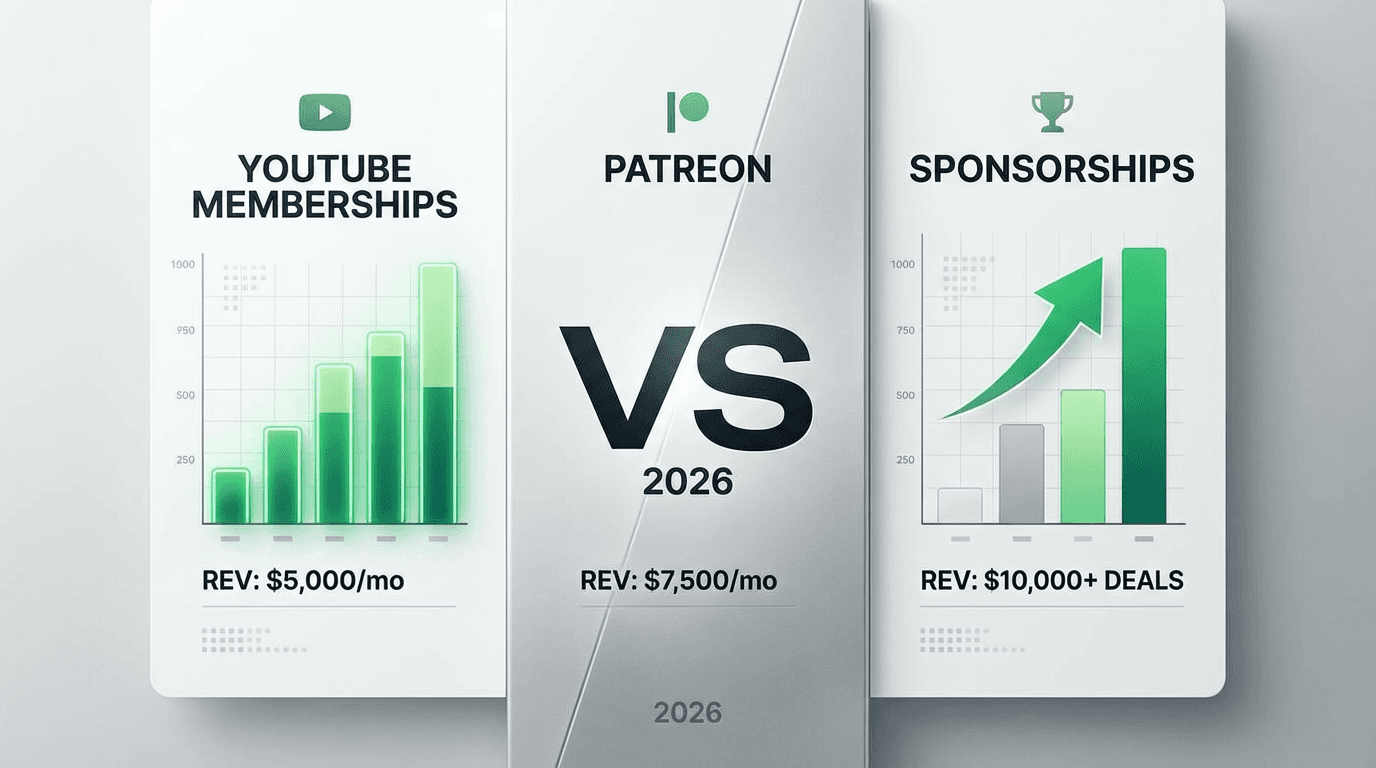
YouTube Memberships take 30% but convert 3-5x more fans. Patreon keeps fees at 10% but requires external sign-ups. Sponsorships pay 5-10x more than AdSense with no platform cut. This 2026 comparison breaks down exactly what creators earn from each revenue stream — with real numbers by channel size, fee structures, niche-specific strategies, and a proven framework for stacking all three into maximum income.
Every creator reaches a moment where they realize AdSense alone won't sustain a career. The monthly check from YouTube's ad revenue split, subject to CPM fluctuations, algorithm shifts, and seasonal advertising dips, simply isn't enough to build a stable business on. That's when the three most powerful alternative revenue streams come into focus: YouTube Memberships, Patreon, and brand sponsorships.
Each offers something fundamentally different. YouTube Memberships let fans pay a monthly fee without ever leaving the platform. Patreon provides a dedicated external hub for deeper fan engagement and recurring income. Sponsorships offer the highest single-deal payouts but come with the least predictability. More than half of YouTube channels earning at least $10,000 annually now generate revenue from sources beyond traditional advertising, including memberships, Super Chats, YouTube Shopping, and brand partnerships, reflecting a maturation trend where successful channels recognize that relying solely on CPM-based ad revenue creates vulnerability to advertiser spending fluctuations and algorithm changes.[6]
But which actually pays more in 2026? The answer, as with most things in the creator economy, depends on your niche, audience size, content format, and willingness to invest time in each revenue stream. This article provides the most detailed, data-backed comparison available, breaking down the real economics of each option so you can build a monetization strategy matched to your specific situation.
The 2026 Creator Revenue Landscape: Why Diversification Is No Longer Optional
Before comparing the three revenue streams head-to-head, it's essential to understand the macro context shaping creator earnings in 2026.

YouTube Premium, YouTube Music, YouTube TV, and NFL Sunday Ticket subscriptions generated approximately $20 billion in revenue for 2025, alongside $40.4 billion in ad revenue — and the platform's $60 billion revenue milestone in 2025 confirmed its position as a larger media business than Netflix.[6] Yet that massive top-line number masks an increasingly important reality: niche selection, audience geography, and content format determine whether a creator earns $1 or $50 per thousand views — a 50x variance within the same platform.[6]
Meanwhile, the influencer marketing ecosystem has exploded. In 2025, global influencer marketing spend surged to $32.55 billion, driven by a measurable shift toward ROI-first strategies, AI integration across workflows, and a strong preference for micro and mid-tier creators.[1] US influencer marketing spending alone surpassed $10 billion in 2025 — one year earlier than analysts previously expected.[2]
On the membership side, creators on Patreon earn over $2 billion annually, with overall creator earnings on the platform increasing by 150% since 2020.[1] YouTube Memberships have similarly grown, with the platform continuously expanding member-focused features and discovery tools.
The message from these numbers is unambiguous: the most successful creators in 2026 don't rely on a single revenue stream. They stack multiple monetization methods, and understanding the true economics of each is the prerequisite for stacking them effectively.
YouTube Memberships: The Frictionless Option
YouTube Memberships are the platform's built-in answer to Patreon, a subscription system that lets viewers pay a recurring monthly fee directly on YouTube in exchange for exclusive perks.

How YouTube Memberships Work
When a viewer becomes a member of your YouTube channel, they pay a recurring monthly fee in exchange for special perks you offer like exclusive badges, new emojis, members-only videos, live chats, or other exclusive content. The specific perks depend on the tier of membership and are set by the channel creator.[1]
YouTube lets you set membership prices between $0.99 and $99.99 per month. You can create up to 5 tiers, with perks from lower tiers automatically included in higher ones.[5] In practice, the most common pricing structures center around three tiers: a low-barrier entry tier ($1.99–$4.99), a mid-tier with more substantial perks ($9.99–$14.99), and a premium tier for the most dedicated fans ($24.99+).
The Revenue Split: YouTube's 30% Cut
The most significant financial consideration for YouTube Memberships is the platform's revenue share. Creators get 70% of membership revenue after applicable taxes and fees are deducted. All transaction costs (including credit card fees) are currently covered by YouTube.[9]
YouTube takes a 30% cut of the revenue generated from channel memberships. This means if a viewer pays $5 for a membership, YouTube keeps $1.50 and the creator gets $3.50.[1]
There is, however, a hidden layer of additional fees that catches many creators off guard. If a member subscribes via iOS or Android app, Apple or Google may take an additional platform fee (up to 30%) on top of YouTube's cut. Members who join through the web (desktop or mobile browser) are not subject to these additional fees. Encourage your audience to join via web when possible.[5]
Eligibility Requirements
Your channel must be part of the YouTube Partner Program (YPP). You must be at least 18 years old. You must agree to YouTube's terms and policies. You must reside in one of the locations where channel memberships are available. You must have over 1,000 subscribers. You'll need 4,000 valid public watch hours in the last 12 months or 10 million valid Shorts views in the last 90 days.[1]
YouTube Memberships: The Conversion Advantage
The most compelling argument for YouTube Memberships isn't the revenue share — it's the conversion mechanics. YouTube's higher fee (30% vs Patreon's 5–12%) is offset by significantly lower friction. Members join with one click using their existing YouTube account. Many creators find they get 3–5x more members through YouTube than Patreon simply because the barrier is lower.[5]
YouTube memberships convert better for casual supporters (10x easier to join).[8] Viewers don't need to create a new account, visit an external website, or enter separate payment information. The "Join" button sits right below the video they're already watching. This convenience factor cannot be overstated — every additional step in a conversion funnel reduces completions, and YouTube Memberships eliminate nearly all friction.
What Creators Actually Earn from YouTube Memberships
The realistic earning potential from YouTube Memberships depends heavily on your audience size and engagement. Even 50 members at $2.99 provides over $100/month in predictable recurring revenue. The key word is recurring — unlike AdSense earnings that fluctuate with views, membership income is stable and compounds as you add members over time.[5]
For context, a channel with 100,000 subscribers might convert 0.5–2% of subscribers to members. At 1% conversion with an average membership price of $4.99, that's 1,000 members generating approximately $3,493 per month after YouTube's 30% cut. A channel with 500,000 subscribers at the same conversion rate would generate approximately $17,465 per month.
These numbers become significantly more attractive when you consider that membership revenue is additive — it doesn't replace or reduce your AdSense earnings. A video that earns $500 in ad revenue still earns that $500 whether you have memberships or not.
YouTube Memberships: Strengths and Limitations
The strengths are clear: zero-friction sign-up, integrated billing, no external platform management, and the ability to offer members-only content natively within YouTube. Stable income from monthly payments means you can plan ahead and reinvest in your content. Members are your superfans — they're more likely to comment, share, and stick around. Platform integration means everything is baked into YouTube, from badges to exclusive videos. And you can create custom perks that suit your brand.[3]
The limitations are equally clear: YouTube's 30% revenue share is the highest among major membership platforms. Customization is limited compared to dedicated membership platforms. Communication tools for member engagement are basic. And YouTube retains control over the member relationship — you can't export member emails or contact members outside the platform.
Patreon: The Creator-Controlled Option
Patreon has spent over a decade establishing itself as the default external membership platform for creators. The platform now boasts more than 10 million active members and supports a network of more than 286,000 creators.[1]
How Patreon Works in 2026
Patreon is a membership platform empowering creators — from musicians and podcasters to educators and artists — to earn recurring income directly from their audience. Launched in 2013, Patreon has evolved into an all-in-one funding, publishing, and community engagement tool. Its streamlined payment systems, exclusive content hosting, and patron-focused features make it a leading choice for independent creators across 180+ countries in 2026.[6]
Creators set up membership tiers with custom pricing and perks, and fans ("patrons") pay monthly or annually for access. Creators can set their own membership prices, ranging from $1/month to $100+, with varying benefits per tier.[6] Unlike YouTube's five-tier cap, Patreon allows unlimited tiers and significantly more customization in what you offer at each level.
Patreon's Fee Structure in 2026: The 10% Standard
Patreon's fee structure underwent a significant change in 2025 that every creator needs to understand. Patreon's prices increased for creators who publish a new page after August 4, 2025. The platform consolidated its Pro (8%) and Premium (12%) plans into one standard (10%) plan.[2]
This policy is effective for creators who publish their creator page after August 4, 2025. If you are a creator who publishes your page on or before August 4, 2025, you will keep your existing platform pricing — this new plan will not apply to you.[1]
But the 10% platform fee isn't the whole story. On top of the platform fee, payment processing adds roughly three percent more. Add it up — most creators lose twelve to fifteen percent of gross revenue.[4] And the situation worsens for iOS users: Apple forced all new Patreon memberships purchased via iOS to use in-app purchases. Apple takes 30% of every iOS transaction, meaning creators receive only 70 cents for every dollar pledged.[7]
For legacy creators who established their pages before August 4, 2025, the older fee structures remain in place: the Founders plan at 5%, Pro at 8%, and Premium at 12% — making Patreon significantly cheaper than YouTube Memberships for those grandfathered creators.
What Creators Actually Earn on Patreon
Patreon earnings vary enormously by creator category and audience. Leading podcasts and video creators on Patreon collect $100,000+ monthly, but most creators earn $1,000–$5,000 per month via fan support.[6]
The top of the platform is dominated by podcasters. Revenue generated by podcasters on the Patreon direct-to-fan platform hit $629 million in 2025, a 33% year-over-year increase.[10] Some podcasters on the platform, including Joe Budden, earn as much as $1 million monthly or more, according to the company.[10]
The podcast Matt and Shane's Secret Podcast has become particularly notable. Matt and Shane's Secret Podcast has become the #1 creator on Patreon by subscriber count, boasting roughly 124,000 paying members as of 2026.[9]
For typical creators, though, the numbers are more modest. Patreon creators typically earn between $315 and $1,575 monthly.[3] This wide range reflects the reality that most Patreon creators are smaller-scale operations, and the median Patreon income is far below what headline-grabbing top earners suggest.
Patreon vs. YouTube Memberships: The Per-Member Economics
On a per-member basis, Patreon delivers more revenue to creators — but the comparison requires nuance.
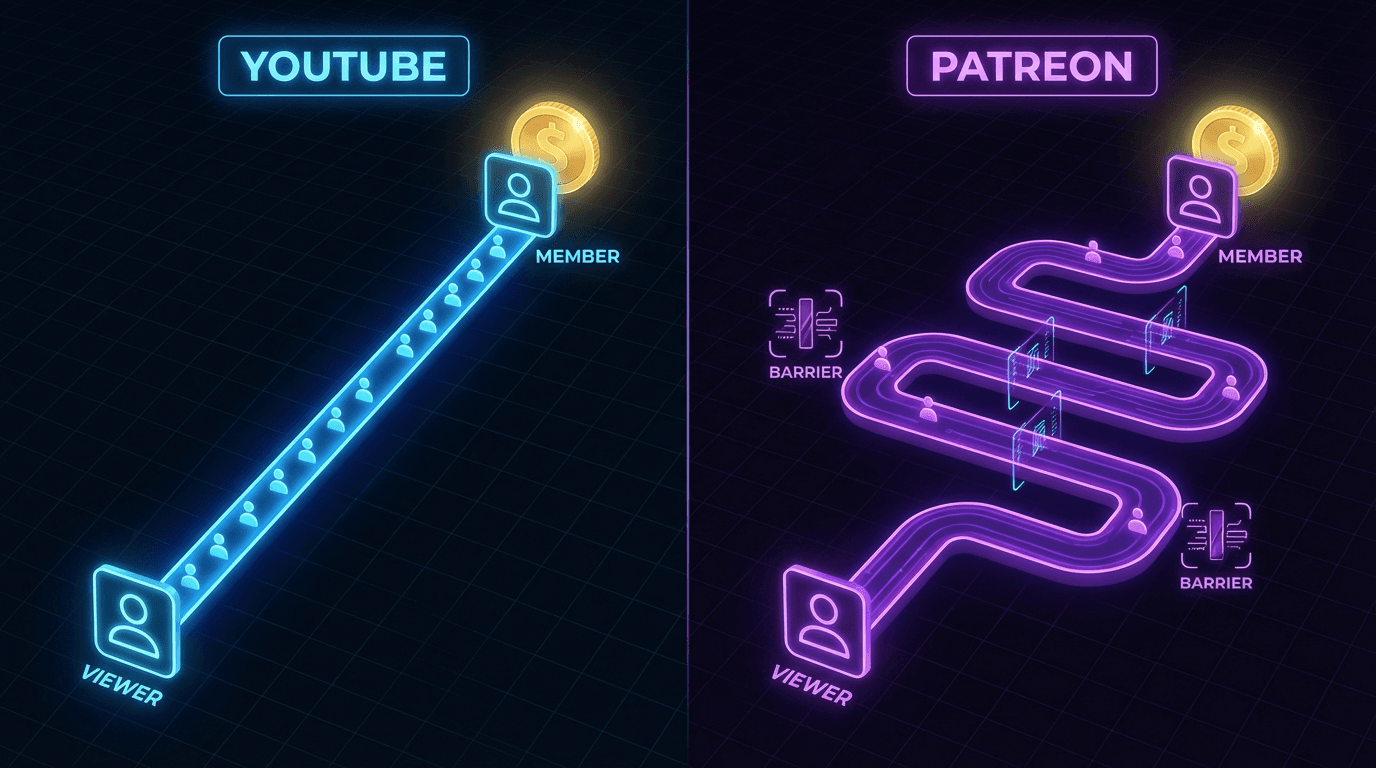
For a $5/month membership: on YouTube, creators receive approximately $3.50 after YouTube's 30% cut. On Patreon (new standard plan), creators receive approximately $4.35 after the 10% platform fee and ~3% processing fee. Patreon generally has lower fees, especially on the Pro plan (8% + processing). However, the difference in net payout per $5 is about $0.87 more on Patreon. But YouTube's ease of conversion can offset this if you get more members.[4]
This $0.87 per-member advantage for Patreon becomes meaningful at scale. At 1,000 members, it's $870 more per month from Patreon. At 5,000 members, it's $4,350 more. But this calculation only holds if you can drive equal numbers of members to both platforms — and the evidence suggests that YouTube's lower friction consistently delivers higher raw member counts.
Patreon's Unique Advantages
Where Patreon genuinely excels is in creator control and flexibility. Patreon allows unlimited membership tiers, custom perks (Discord roles, behind-the-scenes, early access), and integration with tools like Discord, WordPress, and Mailchimp. You can offer digital products, livestreams for patrons, and even physical goods.[4]
Patreon offers more customization, better community tools (messaging, Discord integration), and lower revenue share (8% vs YouTube's 30%). Patreon works better for non-video creators or those wanting full control.[8]
Critically, Patreon gives creators something YouTube never does: direct access to member contact information. This means you can build an email list, communicate directly with supporters, and maintain the relationship even if the platform changes its terms or algorithms. One of the biggest advantages of Patreon is that there are no minimum subscriber requirements.[5] Anyone can start a Patreon — you don't need 1,000 subscribers or 4,000 watch hours.
The Smart Hybrid Approach
The most successful creators in 2026 don't choose between YouTube Memberships and Patreon — they use both strategically. The verdict for most YouTube creators: use both. YouTube Memberships for in-platform conversions (low friction, discovery benefits); Patreon for dedicated fans who want deeper benefits and direct connection. Many successful creators earn from both simultaneously.[1]
Many top YouTube creators use Patreon exclusively for their highest-tier fans ($25 to $100 per month) while keeping lower-tier memberships ($2 to $10) on YouTube — this maximizes Patreon's lower fees on high-value patrons.[1]
Brand Sponsorships: The Highest-Ceiling Option
If memberships are the steady paycheck of creator monetization, sponsorships are the commission-based sales role — dramatically higher potential, but wildly inconsistent.
The Sponsorship Market in 2026
The YouTube sponsorship market has grown explosively. In 2025, sponsored YouTube videos surged 54% year-over-year, with tracked sponsorships generating over 19 billion views in the first half of the year alone. The market has matured, and so has the pricing complexity.[1]
Across respondents about influencer marketing budget allocation in 2026, 87.49% expect their influencer marketing budget to increase, while only 5.55% expect a decrease. The dominant response is a step-change investment: 72.22% of respondents expect their influencer budget to increase by 50%+.[6]
The money flowing into creator sponsorships isn't just growing — it's accelerating. Instagram and YouTube will benefit the most from brand diversification. In 2025, for the first time, over half of US marketers planned to use influencer marketing on YouTube.[2]
How Much Do Sponsorships Actually Pay?
Sponsorship rates are typically quoted as CPM (cost per 1,000 views), but the CPMs for sponsorships are dramatically higher than AdSense CPMs because the creator retains 100% of the payment — there's no YouTube revenue split.
YouTube sponsorship CPMs range from $15 to $80, sometimes higher. The comparison to display ad CPMs ($2–$5) is not apples to apples.[8]
By niche, the sponsorship CPM landscape in 2026 breaks down clearly. Finance, Business, and Investing commands $50 to $200 CPM — the highest-paying vertical on the platform. Brands selling investment apps, credit cards, tax software, and banking products compete hard for this audience because it converts on financial offers.[10] Gaming channels, by comparison, earn $3 to $12 CPM despite much larger audience sizes, because gaming viewers don't convert on financial products at anywhere near the same rate.[10]
By channel size, the rates segment as follows. YouTube influencer rates in 2026 range from $20–$200 for nano creators to $20,000+ for mega creators per sponsored video.[7] More specifically: Nano creators (1K–10K subscribers) earn $100–$500 per video, with many deals being product-only. Micro creators (10K–100K subscribers) command $500–$5,000 per video.[8] Mid-tier creators (100K–1M) earn $60 per 1K views or $5,000–$15,000 per sponsored video. Tech and finance creators can earn 2-3x these rates due to high-value audiences.[3]
Sponsorships vs. AdSense: The Revenue Multiplier
The single most important fact about sponsorships is their revenue multiplier relative to AdSense. AdSense pays based on niche × geography × engagement; sponsorships deliver 5–10× the AdSense equivalent on the same view base.[10]
AdSense revenue and sponsorship income are separate. A channel averaging 500,000 monthly views might earn $1,000–$2,500 from AdSense but $5,000–$15,000 from direct brand deals — sometimes more, depending on niche.[1]
To put this in stark terms: one $2,000 sponsorship equals 250 videos worth of AdSense revenue for many creators.[2] This is why sponsorships are frequently cited as the single most impactful revenue stream for creators who can secure them.
Sponsorship Deal Structures
Brands and creators negotiate using several compensation frameworks. Common models include: flat fee pricing, where the creator charges a predetermined fixed amount for a specific deliverable. CPM or Cost Per Mille, where brands pay based on every 1,000 views the sponsored content earns. CPV or Cost Per View, where compensation is tied directly to the number of actual video views.[7]
The type of content also dramatically affects rates. Dedicated videos can cost significantly more than partial mentions. Creators often price dedicated YouTube sponsorships at a premium because they replace regular organic content and carry a higher opportunity cost. An integrated segment places the brand within an existing video, usually as a 30 to 90 second mid-roll or pre-roll mention. Because the brand is not the sole focus, integrated content typically costs less than a full dedicated upload.[7]
Integration (sponsor segment within regular content, 60-90 seconds) typically costs 70-80% of base rate. Dedicated video (entire video about product, review, tutorial) costs 150% of base rate due to full focus and higher production.[4]
The Negotiation Reality
One of the least discussed aspects of sponsorship economics is the gap between initial offers and final deals. Brands almost always open with an offer 30 to 40 percent below their actual budget. A brand with $8,000 available for a mid-size finance channel will open at $4,800 to $5,600. This is standard practice, not a reflection of what they're willing to pay. Creators who counter with a number grounded in their average views and niche CPM consistently close at significantly higher rates than those who accept the first offer.[10]
Sponsorship Drawbacks: Inconsistency and Effort
For all their earning potential, sponsorships come with real downsides that memberships don't. Sponsorships on YouTube are the single most lucrative deal per brand, per video. But they're also the most inconsistent. You might earn $2,000 one month, and $0 the next.[6]
Sponsorships also require significant non-creative work: responding to pitches, negotiating terms, reviewing contracts, creating media kits, tracking deliverables, and managing brand relationships. For many creators, especially those who create content solo, this business development effort represents a major time investment that competes directly with content creation.
Additionally, sponsorships require disclosure. To comply with FTC guidelines, you must clearly indicate sponsored content using terms like "#ad" or "#sponsored" at the start of your video. YouTube's disclosure features, such as "includes paid promotion," also help viewers understand they are watching sponsored material.[1] Some creators worry that excessive sponsorship integrations erode audience trust, creating a tension between revenue maximization and audience relationship management.
The Head-to-Head Comparison: Which Pays More?
With all three revenue streams now detailed, we can make direct comparisons across multiple scenarios. The answer to "which pays more?" depends entirely on your specific situation.
Scenario 1: Small Creator (25,000 Subscribers, 100,000 Monthly Views)
For a small creator in a mid-CPM niche (technology, education), the earnings comparison looks roughly like this:
YouTube Memberships: At a 1% conversion rate of subscribers, approximately 250 members at an average of $4.99/month = $1,248 gross, $873 net (after YouTube's 30% cut). Monthly effort: moderate (creating members-only content, maintaining perks).
Patreon: At a 0.3% conversion rate (reflecting the higher friction of an external platform), approximately 75 patrons at an average of $7/month = $525 gross, approximately $456 net (after Patreon's 10% + processing). Monthly effort: moderate to high (creating exclusive content, managing Patreon community, cross-promoting).
Sponsorships: At this channel size, 1–2 sponsorships per month at $500–$1,500 each = $500–$3,000 gross, $500–$3,000 net (no platform cut). Monthly effort: high (pitching brands, negotiating deals, producing sponsored segments).
Winner at this scale: Sponsorships (when available), followed by YouTube Memberships.
At 25,000 subscribers, sponsorships offer the highest per-deal value but are highly inconsistent. YouTube Memberships provide the most reliable recurring income with the least effort. Patreon underperforms at this scale because converting a small YouTube audience to an external platform is difficult.
Scenario 2: Mid-Size Creator (200,000 Subscribers, 500,000 Monthly Views)
YouTube Memberships: At 1.5% conversion, approximately 3,000 members at $4.99/month = $14,970 gross, $10,479 net. This represents a substantial, predictable monthly income stream.
Patreon: At 0.5% conversion, approximately 1,000 patrons at $8/month = $8,000 gross, approximately $6,960 net. Higher per-patron value partially compensates for lower conversion.
Sponsorships: At this scale, 2–4 sponsorships per month at $3,000–$8,000 each = $6,000–$32,000 gross. Using a mid-range estimate of $15,000/month, sponsorships dominate.
Winner at this scale: Sponsorships (by total revenue), with YouTube Memberships as the most reliable recurring base.
At 200,000 subscribers, all three streams become genuinely meaningful. The optimal strategy is stacking all three: YouTube Memberships as baseline, Patreon for dedicated superfans, and sponsorships for peak earnings.
Scenario 3: Large Creator (1,000,000 Subscribers, 2,000,000 Monthly Views)
YouTube Memberships: At 1.5% conversion, approximately 15,000 members at $4.99/month = $74,850 gross, $52,395 net.
Patreon: At 0.5% conversion, approximately 5,000 patrons at $10/month = $50,000 gross, approximately $43,500 net.
Sponsorships: At this scale, multiple concurrent campaigns averaging $20,000–$50,000 per video across 4–8 sponsored videos per month = $80,000–$400,000. Using a conservative estimate of $100,000/month, sponsorships dwarf memberships.
Winner at this scale: Sponsorships (overwhelmingly), with memberships providing critical stability.
At the million-subscriber level, sponsorship revenue typically represents the largest single revenue stream. YouTube money calculators only reflect advertising revenue — they don't account for direct sponsorship deals. For most mid-tier and above YouTube creators, brand deals represent the majority of actual earnings.[1]
The Revenue Hierarchy Across Channel Sizes
Across all scenarios, a consistent pattern emerges. Sponsorships pay the most in absolute terms at every channel size — when you can get them. YouTube Memberships provide the most reliable recurring revenue per unit of effort. Patreon delivers the best per-member economics but requires more effort to drive conversions from YouTube's audience.
The key insight is that comparing the three on a purely monetary basis misses the point. They serve fundamentally different functions in a creator's revenue architecture:
Sponsorships are the high-ceiling, variable income component — the equivalent of commission or bonus income. They represent the highest revenue potential but introduce significant month-to-month volatility. Long-term partnerships pay 30-50% more than one-off sponsorships.[3]
Memberships (YouTube + Patreon combined) are the recurring revenue component — the equivalent of salary. They provide predictability, compound over time, and create financial stability that allows creators to take creative risks. Instead of relying solely on ad revenue (which can fluctuate wildly based on CPMs, views, and the algorithm), memberships give you monthly recurring revenue from fans who want more of what you do.[3]
AdSense is the baseline — present in the background, growing with viewership, requiring zero additional effort beyond creating content.
The Fee Comparison: What You Actually Keep
Understanding platform fees is essential for comparing these revenue streams accurately. Here's a clean breakdown of what each platform takes and what you keep per $100 earned.
YouTube Memberships
YouTube takes 45% of ad revenue, leaving creators with 55%. For channel memberships, YouTube takes 30%, and for Super Chat/Stickers during live streams, YouTube also takes 30%.[5]
Per $100 in membership revenue (web sign-ups): you keep $70. YouTube handles all payment processing — there are no additional credit card fees for web transactions.
Per $100 in membership revenue (iOS app sign-ups): the picture worsens dramatically. Apple takes up to an additional 30%, potentially reducing your take-home to $49 or less, depending on how fees are structured.
Patreon (New Standard Plan)
The standard 10% pricing plan + relevant taxes applies to any creator who publishes their Patreon page after August 4, 2025.[3]
Per $100 in patron revenue (web sign-ups, new plan): Patreon takes $10 (platform fee) + approximately $3 (processing) = you keep approximately $87.
Per $100 in patron revenue (legacy Pro plan): Patreon takes $8 + approximately $3 = you keep approximately $89.
Per $100 in patron revenue (iOS): Apple requires that all digital purchases made through the Patreon iOS app use their in-app purchase system, which comes with a 30% fee. Patreon does not charge any additional payment processing fees on iOS transactions, but their platform fee still applies.[1] You keep approximately $60.
Brand Sponsorships
Per $100 in sponsorship revenue: you keep $100. There is no platform cut. The brand pays you directly (via wire transfer, PayPal, or through an agency). If you use an agent or management company, they typically take 10–20%, reducing your net to $80–$90.
The Fee Comparison Summary
From highest creator take-home to lowest, the ranking is: Sponsorships (direct deals) at ~100%, Patreon (legacy plans, web) at ~89%, Patreon (standard plan, web) at ~87%, YouTube Memberships (web) at ~70%, and any membership platform via iOS at ~49–60%.
The fee differential between Patreon and YouTube Memberships is substantial at scale. Patreon charges 8-12% commission versus YouTube's 30%, making it significantly more cost-effective for creators.[7] However, this fee advantage must be weighed against conversion rates — a platform where you keep more per member but attract far fewer members may not actually generate more total revenue.
The Niche Factor: How Your Content Category Changes the Equation
The relative value of each revenue stream shifts dramatically depending on your content niche.

Finance, B2B Tech, and Business Creators
For high-CPM niches, sponsorships are disproportionately lucrative. Nothing moves the rate needle more dramatically than niche. A finance YouTube channel and a gaming YouTube channel can have identical subscriber counts, post identical types of engaging videos, and the finance creator will consistently earn three to five times more from sponsorship deals.[1]
YouTube finance channels routinely see $50–$200 sponsorship CPMs; gaming and entertainment sit at $3–$15.[10] For a finance creator with 100,000 views per video, a single sponsorship at $75 CPM generates $7,500 — an amount that would take months of membership revenue to match.
For finance, B2B, and business creators, sponsorships should be the primary revenue focus, with memberships serving as the stable base. Patreon works particularly well in these niches because the audience has high disposable income and is already accustomed to paying for premium financial information.
Gaming and Entertainment Creators
For low-CPM niches, the math inverts. Sponsorship CPMs are low, but view volumes are massive. A gaming creator with 2 million views per video might only command a $10 sponsorship CPM, yielding $20,000 per deal — good, but not exceptional relative to the audience size.
Memberships become proportionally more important in these niches because they're not niche-dependent — a member paying $4.99/month generates the same revenue whether they watch gaming or finance content. The 3–5x member count advantage that YouTube Memberships provide over Patreon is especially impactful in gaming and entertainment, where the audience is large, young, and unlikely to create external platform accounts.
Podcasters and Audio-First Creators
Podcasts are booming on Patreon — with revenue generated by podcasters on the direct-to-fan platform hitting $629 million in 2025. On Patreon, podcasts have become the largest content category in terms of revenue.[10]
For podcasters who also have YouTube channels, Patreon is typically the superior membership platform because podcast consumption happens across multiple apps (Spotify, Apple Podcasts, etc.), and Patreon's cross-platform nature accommodates listeners who never use YouTube. Patreon's lower fees make it the better choice if you are earning primarily from a non-YouTube audience (TikTok, Instagram, podcast listeners) who must create a new account either way.[1]
Art, Design, and Creative Niches
Visual artists, illustrators, and designers have historically found Patreon's format more hospitable than YouTube Memberships. Patreon's ability to host downloadable assets, offer physical merchandise fulfillment through integrations, and set up commission-style tiers aligns better with how creative professionals monetize. YouTube Memberships' perk system — badges, emojis, members-only videos — is less suited to delivering the assets that art patrons typically expect.
For creators producing high-quality video content and AI-generated images as part of their creative workflow, the ability to offer these as membership perks on Patreon creates a natural monetization pathway.
Building the Optimal Revenue Stack in 2026
Rather than choosing one revenue stream, the most successful 2026 creators build an integrated stack where each stream reinforces the others. Here's how to structure it based on the data.
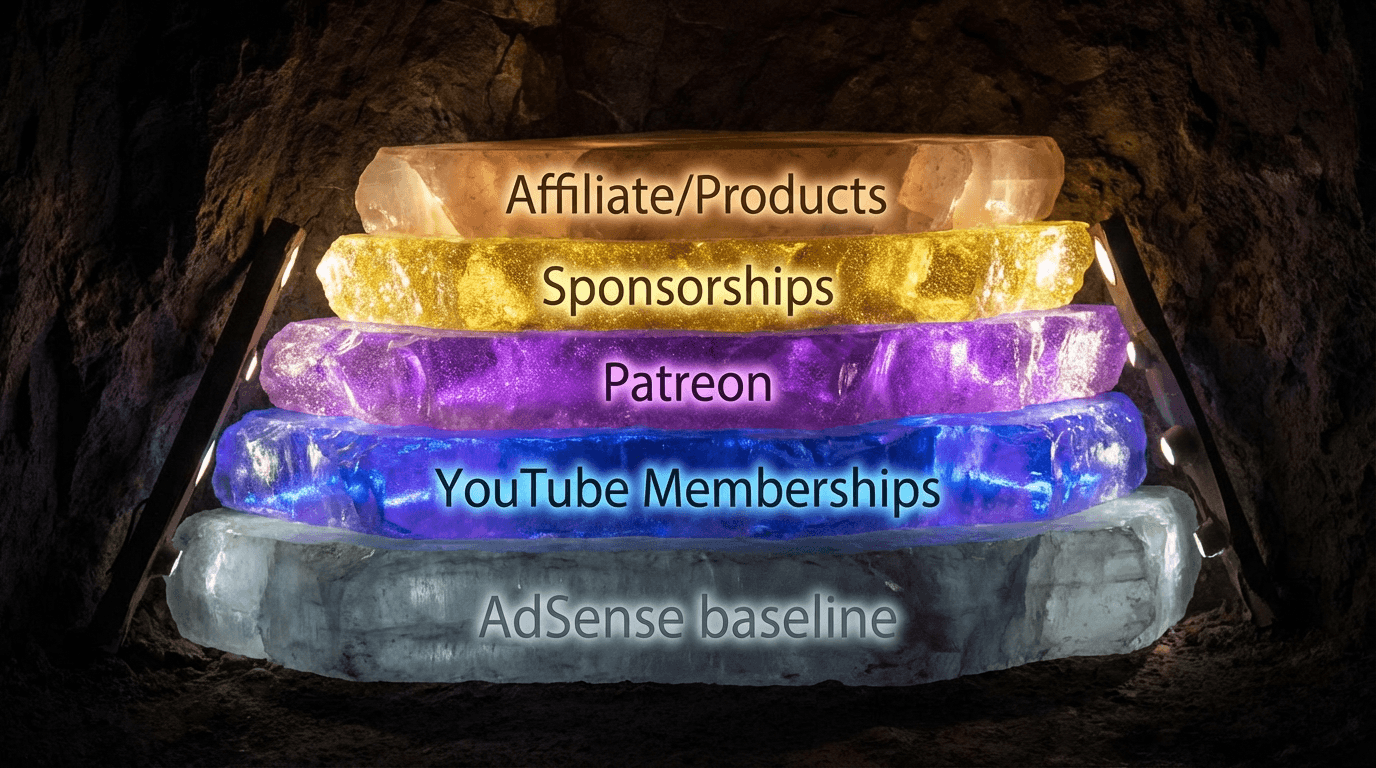
Layer 1: AdSense (Baseline Revenue)
AdSense requires zero additional effort beyond creating content. It provides the baseline income that covers minimum operating costs. Focus on maximizing AdSense through video length optimization (8+ minutes for mid-rolls), audience geography targeting (U.S. and Tier-1 countries), and Q4 content planning.
Layer 2: YouTube Memberships (Recurring Revenue Foundation)
Launch YouTube Memberships as soon as you're eligible. The zero-friction sign-up means this revenue stream starts generating income with minimal promotional effort. If eligible, launch memberships first — zero setup time and instant audience access.[8] Structure 2–3 tiers with genuine value at each level: badges and emojis at the entry tier, members-only live streams at the mid-tier, and early access to videos plus exclusive content at the premium tier.
Layer 3: Patreon (Superfan Capture)
Add Patreon for your most dedicated fans who want deeper engagement than YouTube Memberships offer. Price Patreon tiers 10-20% higher since they require external signup. Use both: YouTube for volume, Patreon for superfans and community depth.[8]
The Patreon offering should be differentiated from YouTube Memberships — not duplicated. Offer Discord community access, monthly Q&A calls, downloadable resources, and behind-the-scenes content that can't exist within YouTube's ecosystem.
Layer 4: Sponsorships (High-Ceiling Variable Income)
Pursue sponsorships once you have a consistent content schedule and demonstrable engagement metrics. Engagement beats size. A 100K channel with 7% engagement outearns 500K channels with 0.5% engagement.[2]
Start by listing your channel on sponsorship marketplaces, building a professional media kit that includes your audience demographics, average views, engagement rate, and any conversion data from previous campaigns. Once you've completed 2–3 sponsored deals, use that performance data to negotiate higher rates on subsequent campaigns.
Layer 5: Affiliate Marketing and Digital Products (Scalable Passive Income)
Beyond the three core revenue streams compared in this article, affiliate marketing and digital product sales (courses, templates, presets) provide additional income that compounds over time without requiring platform revenue shares.
The Revenue Stack in Practice
For a mid-size creator (200,000 subscribers) in a technology niche, a realistic monthly revenue stack in 2026 might look like:
AdSense: $3,000–$5,000 (baseline from 500,000 monthly views).
YouTube Memberships: $5,000–$8,000 (2,000 members at $4.99 average, after YouTube's cut).
Patreon: $2,000–$4,000 (400 patrons at $8 average, after Patreon's cut).
Sponsorships: $8,000–$20,000 (2–3 deals per month at $4,000–$7,000 each).
Affiliate Marketing: $1,000–$3,000.
Total estimated monthly income: $19,000–$40,000.
In this realistic stack, sponsorships represent 40–50% of total income, memberships (YouTube + Patreon combined) represent 25–30%, and AdSense represents 15–20%. This distribution aligns with what multiple creator economy analyses have found: AdSense is where most creators start, but it's rarely where they stay. The highest-earning YouTubers treat ads as one part of a bigger system — a foundation for visibility that supports several income streams.[8]
The 2026 Trends Shaping Each Revenue Stream
Several emerging trends are reshaping the relative attractiveness of each revenue stream heading through the remainder of 2026.

Trend 1: YouTube's Expanding Membership Features
YouTube has been steadily investing in membership tools. There is now more discoverability for YouTube channel memberships. It may help to increase membership sign-ups. This could be beneficial for smaller creators as a way to monetize.[1]
The platform has introduced gift memberships, improved analytics for membership tracking, and enhanced the visibility of membership options across the YouTube interface. These improvements are gradually increasing conversion rates and making YouTube Memberships more competitive with Patreon from a feature standpoint.
Trend 2: Patreon's Platform Evolution
Since Patreon last updated its prices six years ago, the platform has expanded beyond just payments to include media hosting, community, and discovery. Chat messages between creators and their fans are growing 63% year over year, fans viewed over 80 million hours of Patreon video, creators go live daily, and Patreon's discovery ecosystem is driving over $200 million to creators per year.[2]
Patreon is actively transforming from a simple payments processor into a full media platform, directly competing with YouTube's membership ecosystem by hosting video, building discovery features, and investing in community tools. This evolution makes Patreon increasingly viable as a standalone platform rather than just an adjunct to YouTube.
Trend 3: Sponsorship Market Maturation
Brands achieve an average $5.78 return for every dollar spent on influencer marketing, with top-performing campaigns reaching $11–$18 ROI. Performance-based compensation models at 53% adoption help align brand and creator incentives toward measurable outcomes.[8]
The shift toward performance-based sponsorship models means creators who can demonstrably drive conversions — not just views — are commanding premium rates. This favors creators in high-intent niches (finance, B2B technology, health) and those who build trackable conversion funnels (affiliate links, unique promo codes, dedicated landing pages).
Trend 4: The Micro-Creator Sponsorship Boom
Capital distribution within influencer budgets shows a clear preference for specific creator tiers. According to Digital Web Solutions, 40% of dedicated influencer marketing funds are spent specifically on micro-influencers. This signals a strategic prioritization of targeted engagement over broad celebrity reach.[3]
YouTube sponsorships command 2-5x higher rates than any other platform. Long-form video content has higher production value, longer viewer attention, and better conversion rates. YouTubers with 100K subscribers often charge $1,000-10,000 per sponsored video — far exceeding Instagram or TikTok rates for similar follower counts.[4]
This trend means that smaller creators who previously couldn't access sponsorship revenue are increasingly finding brand deals available to them — especially if they operate in commercially valuable niches and can demonstrate strong engagement.
Trend 5: The iOS Fee Impact on Memberships
Both YouTube Memberships and Patreon face a growing threat from Apple's in-app purchase requirements. Memberships are destroyed by the iOS App Store tax.[10] As more content consumption shifts to mobile, the 30% iOS surcharge increasingly erodes membership revenue for both platforms.
Smart creators are actively mitigating this by encouraging web-based sign-ups. Mentioning "join through the link in description" (pointing to a web URL) rather than "tap the Join button" (which triggers the iOS in-app purchase) can save creators thousands of dollars per month in unnecessary fees.
Frequently Asked Questions
Which pays more per member: YouTube Memberships or Patreon?
Patreon is the better choice for creators who want maximum revenue per member, full creative control, and audience independence. YouTube Memberships excels for YouTubers who want a seamless, low-friction way to monetize their existing audience without sending them off-platform.[4] Per member, Patreon delivers approximately $0.87 more per $5 membership due to its lower fees — but YouTube typically drives 3–5x more sign-ups due to lower friction.
How much do YouTube sponsorships pay per 1,000 views?
Sponsorship fees can vary significantly depending on your channel's niche, audience size, and engagement rates. As of early 2025, CPMs often range from $5 to $30 per thousand views, but highly specialized or sought-after channels may charge more.[1] Finance YouTube sponsorships pay between $50 and $200 CPM in 2026, making it the highest-paying vertical on the platform.[10]
What percentage does YouTube take from memberships?
YouTube takes 30% of all channel membership revenue. You keep 70%.[5] YouTube covers all payment processing fees for web sign-ups. Additional Apple or Google fees apply for mobile app purchases.
What percentage does Patreon take from creators in 2026?
Previously, Patreon offered tiered plans — Lite at 5%, Pro at 8%, Premium at 12%. Now all new creators pay 10% flat. Creators who had pages before August 4, 2025 keep their old rates, but only as long as their page stays published.[4] Payment processing fees of approximately 3% are charged on top of the platform fee.
Can I use both YouTube Memberships and Patreon?
Yes, and most creator consultants recommend it. Some creators use both: YouTube memberships for casual supporters and Patreon for deeper community engagement.[5] The key is differentiating your offerings so each platform provides unique value rather than identical perks.
How many subscribers do I need for YouTube Memberships?
To offer channel memberships, you need to be a member of the YouTube Partner Program with 500+ subscribers.[5] The standard requirement for full membership access is 1,000 subscribers with 4,000 watch hours in the past 12 months.
Are sponsorships better than memberships for small creators?
At very small channel sizes (under 10,000 subscribers), memberships typically generate more reliable income than sponsorships, which are difficult to secure consistently. The typical rate for nano-creators runs $100 to $1,000 per sponsorship. But this depends heavily on engagement. A channel with 10K highly engaged viewers might earn $800. A channel with 50K passive viewers earns $300.[2]
How do sponsorships compare to AdSense revenue?
Diversify revenue streams — don't rely solely on AdSense. Sponsorships often pay 10-50x more than ad revenue.[3] A single $2,000 sponsorship deal can equal months of AdSense earnings for a small creator.
Which revenue stream is the most consistent?
Memberships (both YouTube and Patreon) provide the most predictable revenue because they're recurring subscriptions. Instead of relying solely on ad revenue (which can fluctuate wildly based on CPMs, views, and the almighty algorithm), memberships give you monthly recurring revenue from fans who want more of what you do.[3] Sponsorships provide the highest peaks but the least consistency.
Do sponsorship rates vary by video length?
Videos 20+ minutes should command a 50% premium. Longer videos mean more ad placements for you, a deeper product showcase for sponsors, and higher viewer investment, all justifying premium pricing.[4]
What is the best revenue stream for full-time creators?
There is no single "best" stream. The optimal approach is stacking all available revenue sources. The strongest creators stack revenue streams: ads, sponsorships, donations, affiliate links. If you're relying on one income stream, you're just hoping YouTube doesn't change the rules tomorrow. That's risky. One algorithm shift and half your income's gone.[6]
Which Pays More?
If forced to rank them strictly by revenue potential in 2026:
Sponsorships win on raw earning power. They pay 5–10x more than AdSense per view, require no platform revenue share (when negotiated directly), and scale with audience size. For creators who can consistently secure deals, sponsorships represent the largest single revenue stream at every channel size above 50,000 subscribers.
YouTube Memberships win on efficiency and reliability. They generate predictable recurring revenue with minimal additional effort, convert at the highest rates due to zero-friction sign-up, and scale automatically as your subscriber base grows. The 30% fee is high, but the volume of conversions typically compensates.
Patreon wins on per-member economics and creator control. Lower fees mean more revenue per supporter, and the platform's flexibility enables deeper fan relationships. It's the superior choice for podcasters, creators with cross-platform audiences, and those who prioritize audience ownership.
The real answer, though, is that the creators who earn the most in 2026 don't choose between them. They build all three into a cohesive monetization strategy where sponsorships provide the peak revenue, memberships provide the stable floor, and the combination creates a business resilient enough to survive any single platform change.
References
- YouTube Channel Memberships 2026: Full Guide + Examples
- Patreon: Subscriber and Creator Statistics for 2026
- YouTube Sponsorship: Rates & What to Charge in 2026
- How Much Do Sponsors Pay Youtubers in 2026?
- Patreon vs YouTube Memberships 2026: Which Is Better ...
- Influencer Marketing in 2025: New Data Reveals What Works, What Costs, and What's Next
- A standard platform fee for new creators — effective after August 4, 2025
- Patreon Creators Statistics: Revenue + Earnings + Graphs
- How Much Do Sponsors Pay YouTubers? Complete Rate Guide 2026 - Bluehost Blog
- YouTube Sponsorship Rates 2025 Guide | InfluenceFlow
- Should I Join Patreon or YouTube Membership? | Breeze
- US influencer marketing spending will surpass $10 billion in 2025 | EMARKETER
- We’re increasing our prices for new creators. Existing creators will not see any increase. | Patreon for Creators
- YouTube Channel Memberships: The Ultimate 2025 Guide
- Patreon Statistics 2025: Insights into the Creator Economy - Skillademia
- Creator fees overview – Patreon Help Center
- Patreon vs. YouTube: Choosing the Right Platform for Your Content Monetization
- YouTube Earnings Calculator – 2025 AdSense & Sponsorship Income Estimator – ContentCreators.com
- 2026 Influencer Marketing Statistics: ROI, Trends & Platform Data
- YouTube Sponsored Video Rate Calculator - Free Tool
- Patreon vs YouTube Memberships 2026: Which Platform Pays Creators More?
- How YouTube Creator Income May Change in 2026: Trends, Drivers, and Scenarios – MilX
- Influencer Marketing Statistics 2026 • SQ Magazine
- Patreon Pricing 2026: What It Actually Costs Creators | Ruzuku
- YouTube Channel Memberships: How Much Does YouTube Take?
- 21+ Patreon Statistics For 2025: Users, Revenue, And More
- Patreon vs YouTube Memberships for Youtube creators - AIR Media-Tech
- YouTube Money Calculator 2026: Earnings by Views, Subscribers & CPM
- Influencer Marketing in 2026: Key Stats That Matter
- Patreon Pricing 2026: Plan Comparison, Transaction Fees & Alternatives - SchoolMaker
- YouTube Monetization Statistics 2026: Ad Revenue, CPM Rates & Creator Earnings - AutoFaceless Blog
- Patreon in 2026: Usage, Revenue, Valuation & Growth Statistics
- YouTube Sponsorship Rates: Learn How Much It Costs - ADOPTER Media
- Patreon vs Youtube Channel Membership - What should I choose?
- Donations, sponsorships, or ads: what pays best in 2025? – AIR Media-Tech
- Influencer Marketing Benchmark Report 2026
- What is the Founders plan? – Patreon Help Center
- How much can you earn from YouTube Memberships? - AIR Media-Tech
- 20 Latest Patreon Statistics For 2026 (Data + Trends)
- YouTube Influencer Rates Explained: A Complete Cost Guide for Brands in 2026
- Patreon vs YouTube Channel Membership: Platforms for content monetization
- How much can creators make with AdSense in 2025 – AIR Media-Tech
- Influencer share of marketing budgets 2025
- The Patreon Exodus: Why Creators Are Building Their Own Branded Apps
- How Much Does YouTube Pay Per View in 2026?
- YouTube takes not 30%, but 70% of the revenue paid to ...
- Patreon Statistics And Facts (2025)
- YouTube Sponsorship Rates for Brands 2026 | Pricing Guide
- YouTube Memberships vs Patreon: Which Platform Wins in ...
- 14 Influencer Marketing Growth Statistics for 2026
- Taxes on creator fees – Patreon Help Center
- YouTube Earnings Calculator 2025 - Calculate Your Channel Revenue | YouTube Scribe
- Analyze and manage your YouTube channel memberships program - YouTube Help
- Top 10 Patreon Earners in 2026 and Lessons for Brands
- YouTube Sponsorship Rates Explained: What Influencers Really Earn in 2025
- Patreon vs YouTube Memberships: what is better - MilX
- 47 influencer marketing statistics you need to know in 2026
- Patreon Raises Fees to 10% for New Creators in 2025
- How Much Do YouTubers Make 2025: Income Breakdown, Revenue Streams & Tips | NearStream Official
- Patreon Says Podcasters Earned $629 Million in 2025, Up 33%, as Platform’s Biggest Content Category Keeps Growing
- YouTube Sponsorship Rates: What Brands Pay Per 1,000 Views | Creators Agency
- Patreon Vs YouTube Memberships: Which Is Right For You? - YouTube
- Creator Earnings Benchmarks 2026 — Typical Rates Across Every Platform | Rowfix
- Influencer Marketing Statistics 2025: 99+ Stats & Insights You Need - Marketing LTB
- Patreon Pricing Plans — Patreon