YouTube RPM vs CPM: What Creators Actually Earn in 2026

Written by
Jay Kim
CPM tells you what advertisers pay. RPM tells you what you actually take home. This guide breaks down both metrics for 2026, provides real earning benchmarks by niche, and shows how to increase your revenue per view.
Most creators check their YouTube analytics, see a CPM number that looks promising, and assume that is what they earn per thousand views. Then they check their actual bank deposit and wonder where the money went.
The gap between CPM and RPM is where all the confusion lives. CPM is what advertisers pay. RPM is what you actually take home. These two numbers look similar in your dashboard, but they measure completely different things, and confusing them leads to bad niche decisions, unrealistic revenue expectations, and misguided content strategies.
This guide breaks down exactly what CPM and RPM mean in 2026, how one becomes the other, real earning benchmarks across major content niches, and the specific production and strategy decisions that move your RPM up over time.
What CPM Actually Means
CPM stands for cost per mille. Mille is Latin for one thousand. CPM represents the price an advertiser pays for one thousand ad impressions served on YouTube. This is the advertiser's number, not yours.
When a brand runs a YouTube ad campaign and agrees to a CPM of fifteen dollars, that brand is paying fifteen dollars every time their ad is displayed one thousand times across the platform. The creator whose video hosts that ad does not receive fifteen dollars. YouTube takes its cut, currently 45 percent of standard AdSense revenue, and passes the remaining 55 percent to the creator.
Here is the part most creators miss. Not every view on your video generates an ad impression. Some viewers use ad blockers. Some views come from embedded players or contexts where ads are not served. Some viewers are YouTube Premium subscribers. Some views are too short to trigger a mid-roll placement. The result is that your total view count and your monetized playback count are almost never the same number. In most cases, only 40 to 60 percent of total views actually generate ad impressions, and that ratio shifts based on audience geography, device type, and content category.
When your YouTube Analytics dashboard shows a CPM figure, it is reporting the average price advertisers paid per thousand monetized impressions on your channel. It tells you how valuable your audience is to advertisers. It does not tell you how much money you actually earned.
What RPM Actually Means
RPM stands for revenue per mille. It represents the amount you, the creator, actually earn for every one thousand views across all of your content. This is the creator's number.
Unlike CPM, which only counts monetized ad impressions, RPM divides your total revenue by your total view count, including views that never generated a single ad. RPM also includes revenue from YouTube Premium watch time, Super Chats, Super Stickers, channel memberships, and Super Thanks. It is not limited to ad income.
The formula is straightforward. RPM equals your total revenue divided by your total views, multiplied by one thousand. If your channel earned six hundred dollars last month and received two hundred thousand total views, your RPM is three dollars. You earned three dollars for every thousand views.
RPM will always be lower than CPM for two reasons. First, RPM includes non-monetized views in the denominator, which dilutes the per-view number. Second, YouTube's 45 percent revenue share has already been deducted from the numerator. The gap between your RPM and CPM tells you how efficiently your content is being monetized. A large gap suggests a high percentage of views are not generating ad revenue, which could be caused by audience geography, ad blocker usage, content that is flagged as limited ads, or a heavy proportion of Shorts views in your total count.
How CPM Becomes RPM: Following the Money
To understand the full journey from advertiser spending to creator earnings, it helps to trace the money through each step.
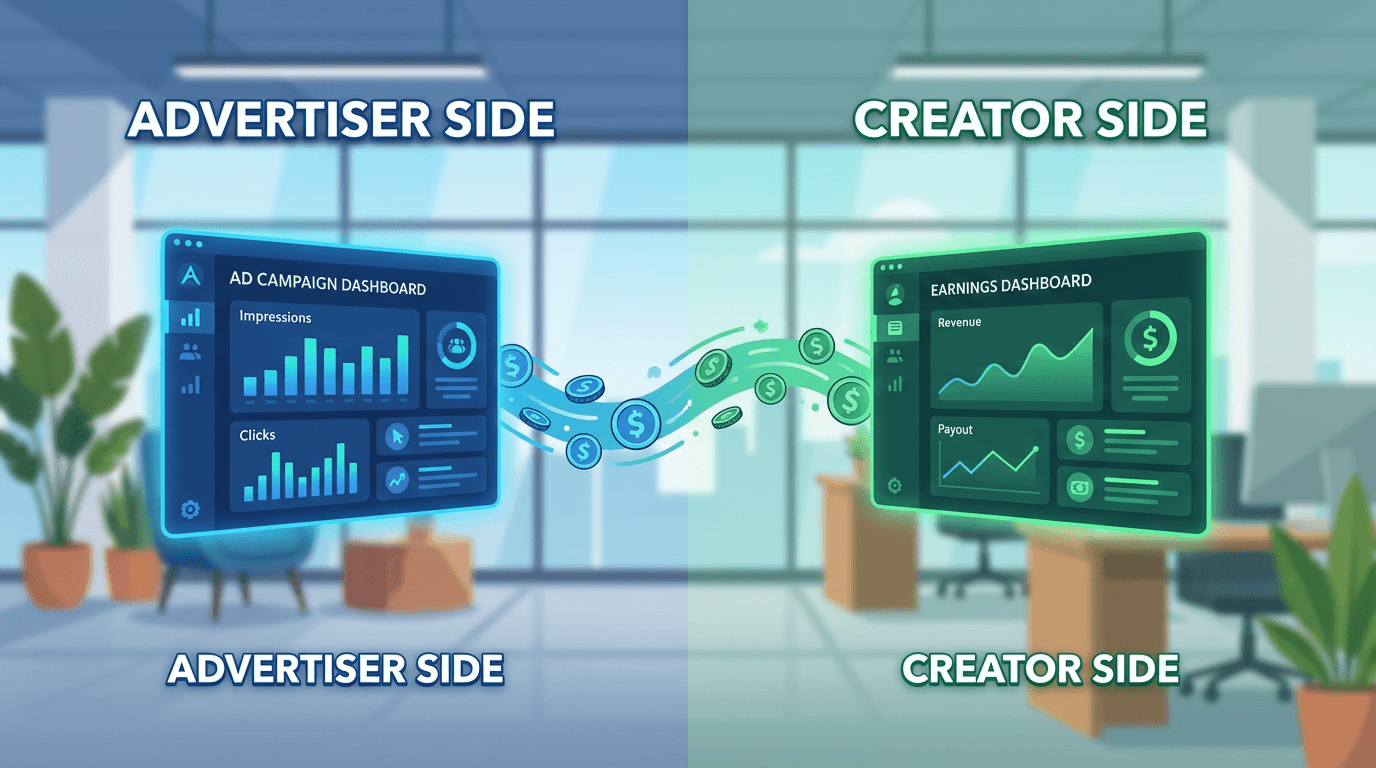
Suppose an advertiser pays a CPM of twenty dollars. YouTube takes 45 percent, leaving eleven dollars per thousand monetized impressions for the creator. But if only half of the creator's total views are monetized, that eleven dollars is spread across two thousand total views instead of one thousand. The effective RPM becomes 5.50 dollars.
This is why a channel with a high CPM can still have a low RPM. The two biggest variables are YouTube's revenue share, which is fixed and outside your control, and your monetized playback rate, which you can influence through content length, ad placement, audience targeting, and how ad-friendly your content is.
A creator who produces ten-minute videos with two mid-roll ad breaks and an audience concentrated in the United States will have a much higher monetized playback rate than a creator who produces three-minute videos with no mid-rolls and an audience concentrated in regions with lower ad demand.
There is also the Shorts factor. YouTube Shorts monetization operates through a pooled revenue model that is structurally different from long-form ad revenue. We cover this in detail in our guide on YouTube Shorts monetization in 2026. Shorts RPM is typically much lower than long-form RPM, often between 0.04 and 0.15 dollars per thousand views, because the ad format, viewer behavior, and revenue pool allocation are fundamentally different.
Average CPM and RPM by Niche in 2026
Earnings vary dramatically by content category because advertiser demand is not evenly distributed across topics. The advertisers competing for finance audiences, such as banks, investment platforms, and insurance companies, have high customer lifetime values and are willing to pay premium rates. The advertisers competing for gaming or entertainment audiences typically have lower margins and pay less per impression.

Here are realistic ranges across major niches in 2026 based on publicly reported creator data and platform trends.
Personal Finance and Investing
CPM range: 25 to 45 dollars. RPM range: 8 to 18 dollars. These channels consistently command the highest ad rates because every viewer is a potential customer for high-value financial products. Topics like credit cards, investing apps, and retirement planning attract aggressive advertiser bidding.
Business and Entrepreneurship
CPM range: 20 to 35 dollars. RPM range: 7 to 15 dollars. SaaS companies, business tools, and coaching platforms compete for this audience. Videos covering software reviews, business strategy, and productivity tools tend to sit at the higher end.
Technology Reviews and Software Tutorials
CPM range: 15 to 30 dollars. RPM range: 5 to 12 dollars. Tech content attracts a broad range of advertisers from consumer electronics brands to enterprise software companies. Product comparison and "best of" videos tend to generate the highest CPMs within this niche.
Education and How-To
CPM range: 10 to 20 dollars. RPM range: 4 to 8 dollars. This niche benefits from consistent search traffic and strong watch time, which supports higher monetized playback rates even when CPMs are moderate. If you are building a channel around evergreen content formats, education is one of the most reliable niches for steady RPM.
Health and Fitness
CPM range: 10 to 22 dollars. RPM range: 3 to 7 dollars. CPMs can be strong but RPM is sometimes pulled down by higher rates of limited ad serving on health-related topics. Supplement and fitness equipment advertisers drive the premium end.
Lifestyle, Cooking, and Home Improvement
CPM range: 8 to 15 dollars. RPM range: 3 to 6 dollars. These niches generate solid view volume and tend to have loyal audiences, which supports channel memberships and affiliate income beyond ad revenue.
Entertainment, Gaming, Music, and Vlogs
CPM range: 4 to 12 dollars. RPM range: 1.50 to 5 dollars. Lower CPMs are offset by much higher view volume. A gaming channel might earn a lower RPM but generate millions of views per month, while a finance channel earns a higher RPM on a fraction of the views.
The important takeaway is that choosing a niche purely for its CPM is a mistake if you cannot sustain consistent content production in that category. A creator who publishes weekly in a niche they genuinely understand will almost always out-earn a creator who publishes inconsistently in a high-CPM niche they struggle to produce for.
For a more detailed breakdown of Shorts-specific earnings by niche, see our guide on YouTube Shorts RPM ranges by niche.
7 Factors That Influence Your CPM
CPM is primarily determined by advertiser demand for your specific audience. That demand is shaped by several overlapping variables.
1. Audience geography
Viewers in the United States, Canada, the United Kingdom, Australia, and Western Europe generate substantially higher CPMs than viewers in South Asia, Southeast Asia, Africa, or Latin America. A channel with 80 percent US audience will see dramatically higher CPMs than a channel with the same content but 80 percent audience in lower ad-demand regions.
2. Content category
Topics that attract high-value advertisers command higher CPMs. A video titled "Best Credit Cards for Travel in 2026" will attract financial advertisers paying premium rates, while a video titled "My Morning Routine" on the same channel will attract lower-value lifestyle advertisers.
3. Seasonality
CPMs spike in Q4 (October through December) as advertisers increase spending for holiday campaigns, Black Friday, and year-end budgets. January typically sees a sharp CPM drop as budgets reset. Creators who understand this cycle can time their most important content releases to coincide with peak advertiser spending.
4. Video length and ad placement
Videos over eight minutes allow mid-roll ad placements, which create more ad inventory per view. This does not technically increase CPM per impression, but it increases total ad revenue per view, which is what matters for your earnings.
5. Audience demographics
Age and income level matter. Viewers aged 25 to 44 with higher disposable income attract more advertiser interest than younger demographics. YouTube does not give you granular control over this, but your content topic naturally attracts certain demographics.
6. Device type
Connected TV (smart TVs) tends to generate higher CPMs than mobile views in many niches because the viewing experience more closely resembles traditional TV advertising. As connected TV viewership grows on YouTube, this is becoming a more significant factor.
7. Ad format mix
Skippable ads, non-skippable ads, bumper ads, and display ads all carry different CPMs. You do not control which ad formats are served, but content that encourages longer watch sessions tends to receive a richer mix of ad formats.
6 Factors That Influence Your RPM
While CPM is largely shaped by market forces outside your control, RPM is more responsive to your content strategy and production decisions.
1. Monetized playback percentage
Every view that does not generate an ad impression dilutes your RPM. You can improve this ratio by creating content that is fully ad-friendly, by targeting audiences in high ad-demand geographies, and by structuring videos for longer watch sessions where more ads can be served.
2. Video length
Longer videos generate more ad impressions per view. A twelve-minute video with two mid-roll ads earns substantially more per view than a four-minute video with only a pre-roll. Many successful creators target the eight-to-fifteen-minute range because it is long enough for multiple ad breaks without being so long that retention collapses.
3. Audience retention
Viewers who watch longer encounter more ads. Strong opening hooks, clear narrative structure, pattern interrupts, and good pacing all keep viewers engaged through mid-roll placements rather than clicking away before ads are served. Our guide on YouTube video hooks that save the first 30 seconds covers this in detail.
4. Content mix between Shorts and long-form
Because Shorts RPM is so much lower than long-form RPM, a channel that generates a large proportion of views from Shorts will see a lower blended RPM even if its long-form CPM is strong. This does not mean you should avoid Shorts. It means you should understand that Shorts serve a subscriber acquisition function and your long-form content is where direct ad revenue concentrates.
5. Revenue diversification
RPM includes all YouTube revenue sources, not just ads. Creators who earn from channel memberships, Super Chats, or YouTube Premium watch time will see a higher RPM than creators relying exclusively on ad revenue.
6. Click-through rate and impressions
Higher CTR leads to more impressions from YouTube's recommendation engine, which leads to more views from audiences in higher-CPM demographics. A video that breaks out of your subscriber base and reaches new viewers through Browse and Suggested feeds has a chance of reaching audiences you were not previously monetizing. We break down what constitutes a good click-through rate in 2026 in a separate guide.
Why RPM Is the Only Metric You Should Track for Revenue
If you only look at one number to evaluate your channel's financial health, it should be RPM. CPM tells you what the market values your audience at. RPM tells you what actually reaches your bank account.
A creator can have a CPM of thirty dollars and still earn less per month than a creator with a CPM of ten dollars, if the second creator has a higher monetized playback rate, more mid-roll breaks, additional revenue from memberships, and a more consistent publishing schedule that generates higher total view volume.
RPM also reveals the impact of your production and content strategy over time. If you add mid-roll ads, extend your average video length, improve retention, or shift content toward higher-value topics, you will see RPM respond before you see meaningful CPM changes. RPM reflects the cumulative effect of every operational decision you make.
Tracking RPM month over month, while accounting for seasonal patterns, gives you a clear signal of whether your channel is becoming more or less efficient at converting views into revenue. A rising RPM means each view is worth more and you need fewer views to hit the same revenue targets. A falling RPM means your growth needs to accelerate just to maintain the same income. Both demand different strategic responses.
How to Increase Your RPM in 2026: 8 Practical Strategies
1. Extend video length to enable mid-roll ads
If your videos are under eight minutes, even extending to nine or ten minutes with one mid-roll break can meaningfully increase revenue per view. The key is adding length through genuine value, such as additional examples, deeper explanations, and related subtopics, not through padding that kills retention.
2. Improve audience retention
A video with 60 percent average view duration generates significantly more ad revenue per view than the same video with 35 percent retention. Invest in better opening hooks, clearer structure, and pattern interrupts that hold attention through ad placements. Strong retention also signals YouTube to recommend the video more broadly, increasing total impressions.
3. Optimize thumbnails and titles for CTR
Higher click-through rate leads to more total views, which multiplied by RPM equals total revenue. Even a one-percentage-point CTR improvement across your catalog compounds into significant revenue gains over months.
Designing thumbnails that are visually compelling and psychologically precise is a skill that takes time to develop. Creators who want to speed up that process can use the YouTube Thumbnail Maker inside Miraflow AI to generate professional thumbnails from text prompts. You describe the concept, optionally upload a reference image or your face, add text overlays, and the tool produces high-contrast designs optimized for both 16:9 video thumbnails and 9:16 Shorts thumbnails. For creators publishing multiple videos per week, removing the thumbnail bottleneck means more production time goes toward the content decisions that directly raise RPM. Our guide on generating YouTube thumbnails with AI walks through the full workflow.
4. Include high-commercial-intent topics in your content calendar
Within any content category, some topics attract higher-value advertisers than others. A tech channel can produce a video about "best laptops under 500 dollars" (high commercial intent, high CPM) alongside a video about "my desk setup tour" (lower commercial intent, lower CPM). Deliberately mixing in high-intent topics lifts your average RPM without requiring you to change niches.
5. Reduce limited ad serving
Videos flagged as "limited ads" by YouTube's automated systems earn significantly less per view. Review your content for triggers like sensitive topics, strong language, or controversial framing. Small adjustments to titles, thumbnails, and the first few minutes of content can sometimes shift a video from limited to full monetization.
6. Build toward channel memberships and Super features
Every dollar earned from memberships, Super Chats, Super Stickers, and Super Thanks adds directly to your RPM calculation. These features are especially valuable for creators with engaged audiences in moderate-CPM niches because they add a revenue layer that is completely independent of advertiser spending cycles.
7. Target audience geography through content choices
You do not directly control where your viewers are located, but your content language, topics, and cultural references naturally attract audiences from certain regions. Creators who produce English-language content focused on US and UK contexts tend to accumulate higher-CPM audiences over time.
8. Invest in production quality
Better visuals, better audio, and better pacing all contribute to retention and perceived professionalism. Higher retention means more ad impressions per view. Higher perceived quality also attracts better sponsorship deals and increases conversion rates on affiliate offers, both of which lift total earnings even if they do not show directly in RPM.
The Shorts RPM Reality in 2026
YouTube Shorts present a unique RPM challenge that every creator needs to understand clearly. Shorts are monetized through a pooled revenue model where ad revenue from the Shorts feed is distributed based on each creator's share of total Shorts views. This pooled structure produces significantly lower per-view earnings compared to direct ad placement on long-form content.
In 2026, most creators report Shorts RPM in the range of 0.04 to 0.15 dollars per thousand views, with occasional spikes during high-demand advertising periods. Some niches with premium advertiser interest see Shorts RPM as high as 0.20 to 0.30, but those are outliers. For context, if your long-form RPM is eight dollars and your Shorts RPM is 0.08, you need one hundred thousand Shorts views to earn what a single thousand long-form views would generate.
This does not mean Shorts are financially worthless. Their value lies in subscriber acquisition, channel discovery, and audience funnel building. A well-performing Short can send thousands of new viewers to your channel page, where a percentage of them subscribe and begin watching your long-form content. The direct ad revenue from that Short is almost irrelevant compared to the lifetime value of the subscribers it brings in.
The strategic implication is that Shorts production should be optimized for volume and conversion rather than per-video revenue. You want Shorts that hook viewers, go viral, and direct attention to your long-form catalog. Following YouTube Shorts best practices for structure and pacing matters more than worrying about individual Short earnings.
The production workflow matters here because you need to produce Shorts consistently without letting creation time eat into your long-form production schedule. Text2Shorts on Miraflow AI is designed specifically for this. You enter a topic, choose between animation or realistic visual styles, and the tool generates a complete short-form video with script, AI visuals, voiceover, and captions through a five-step guided workflow. Instead of spending an hour manually editing each Short, you can batch produce a full week of Shorts in one session and keep your creative energy focused on the long-form content where your actual ad revenue lives. Our guide on creating AI Shorts from a single prompt walks through both the one-click and step-by-step creation modes.
Revenue Beyond RPM: The Full Creator Income Picture
RPM only measures revenue generated through YouTube's own monetization systems. For many successful creators in 2026, YouTube ad revenue represents less than half of total income. The remaining revenue comes from sponsorships, affiliate marketing, digital products, courses, merchandise, and consulting.

Understanding this is important because it reframes how you evaluate content performance. A video with a low RPM might generate strong affiliate revenue if it reviews a product with a high-commission affiliate program. A tutorial with modest views might drive traffic to a paid course worth thousands of dollars. A channel with a small but highly engaged audience in a professional niche might earn more per video from sponsorships than a channel with ten times the views in entertainment.
This is also where production quality becomes a financial lever beyond just retention. An advertiser or sponsor evaluating a partnership does not just look at your view count. They evaluate content quality, presentation style, and audience perception. A channel that looks and sounds professional commands premium sponsorship rates even with moderate viewership.
For creators looking to elevate their visual quality without expensive equipment, tools like the Cinematic Video generator in Miraflow AI let you create hyper-realistic video clips from text prompts. These clips work well as B-roll, intro sequences, or illustrative footage in education, storytelling, or explainer content. The tool supports both 16:9 cinematic and 9:16 vertical formats, and you can browse example prompts to get started quickly.
Music quality also shapes how professional your content feels. Viewers do not consciously notice background music when it is done well, but they immediately notice when it is poorly matched or missing entirely. The AI Music Generator on Miraflow AI lets you describe the mood and style you need, choose between simple and custom modes, set duration and BPM, and generate a royalty-free track in under a minute. No licensing fees, no copyright claims, and no hours lost scrolling through generic music libraries. Our guide on free AI music generators for YouTube Shorts and Reels covers how to use AI music effectively across platforms.
5 Common Misconceptions About YouTube Earnings
Higher CPM always means more money.
As this guide has shown, CPM measures what advertisers pay, not what creators receive. A channel in a high-CPM niche with low monetized playback rates, poor retention, or inconsistent publishing can easily earn less than a channel in a moderate-CPM niche with strong fundamentals across the board.
Views are the only variable that matters.
Total revenue equals views multiplied by RPM, plus non-ad revenue. A creator who doubles their RPM effectively doubles their income without needing a single additional view. Optimizing for RPM through better retention, longer videos, smarter ad placement, and revenue diversification is often more realistic than chasing viral view counts.
All views are worth the same.
A view from a thirty-five-year-old professional in the United States watching a twelve-minute finance video generates dramatically more ad revenue than a view from a teenager in a low-CPM region watching a sixty-second gaming clip. This is not a value judgment about viewers as people. It is a statement about how advertising markets price attention.
Shorts will eventually replace long-form as a revenue source.
Despite significant investment from YouTube in Shorts monetization, the structural economics of short-form content make it unlikely that Shorts RPM will approach long-form RPM in the near future. Shorts remain a growth tool, not a primary revenue engine. According to YouTube's official monetization documentation, the revenue sharing model for Shorts operates differently from standard watch page ads.
You need millions of views to earn meaningful income.
A channel with 50,000 monthly views and an RPM of twelve dollars earns 600 dollars per month from YouTube alone, before sponsorships and affiliates. Niche channels with high RPM and loyal audiences can generate full-time income at view counts that would look modest in entertainment niches. RPM is what makes this possible.
How Miraflow AI Fits Into a Revenue-Optimized Workflow
The relationship between production efficiency and channel revenue is something most monetization guides overlook. RPM and CPM are outputs. They are the result of content strategy, audience targeting, production quality, and publishing consistency all working together. The practical bottleneck for most solo creators is that improving all of these areas simultaneously requires more time than one person has.

Miraflow AI is designed to compress the production timeline without compressing quality. Instead of becoming an expert editor, graphic designer, music producer, and cinematographer on top of being a content strategist and on-camera personality, you can use AI-powered tools to handle the most time-intensive production tasks and focus on the creative decisions that directly influence your earnings.
Here is how the tools map to revenue-relevant production tasks.
Text2Shorts handles your Shorts pipeline. Enter a topic, choose animation or realistic visuals, and the tool generates script, scenes, voiceover, and captions in a guided workflow. Maintaining a consistent Shorts cadence feeds your subscriber funnel without consuming the hours you need for high-RPM long-form videos.
YouTube Thumbnail Maker generates professional thumbnails from prompts with support for reference images, text overlays, and both horizontal and vertical formats. Thumbnail CTR is one of the most direct levers for increasing total views, and being able to generate and test multiple variations quickly supports the iterative optimization that separates growing channels from stagnant ones.
Cinematic Video produces hyper-realistic eight-second video clips from text descriptions. For creators in education, science, history, or storytelling niches, this provides B-roll and illustrative footage that makes content feel premium, which drives better retention and more attractive sponsorship positioning.
AI Music Generator creates custom royalty-free tracks matched to your video's mood. Describe the style, set the duration and tempo, and receive a unique track with no licensing concerns. Well-matched audio improves watch time, and watch time is the engine that powers both algorithmic recommendation and ad revenue.
The AI Image Generator handles everything from blog thumbnails to social media visuals to creative promotional images. It supports text-to-image, image-to-image transformation, and inpainting, which means you can generate visuals for your entire content ecosystem from one tool.
The cumulative effect is that a solo creator can operate at the production quality and publishing frequency of a small team. And because RPM is a function of quality, strategy, and consistency all compounding together, removing production bottlenecks translates directly into higher earnings per view over time.
Building a Revenue-Optimized Channel: The 2026 Playbook
Bringing everything together, here is the strategic framework for maximizing what you actually earn on YouTube this year.
Choose a niche where advertiser demand intersects with your ability to produce consistent, high-quality content over months. High CPM is meaningless if you burn out after twelve videos.
Structure long-form videos to maximize monetized playback. Aim for eight-plus minutes, include mid-roll ad breaks at natural transition points, and design your content to hold attention through those placements. The retention and pacing techniques covered in our guide on why YouTube views drop and channels slow down apply directly here.
Use Shorts strategically as a subscriber acquisition channel that feeds viewers into your long-form catalog. Produce them efficiently so they do not consume the production bandwidth you need for your revenue-generating videos.
Invest in production quality across thumbnails, audio, visuals, and pacing. Every element of perceived quality contributes to the retention and click-through rates that determine your RPM. It also makes your channel more attractive to sponsors and increases conversion on any products you sell or recommend.
Diversify revenue beyond ad dollars. Channel memberships, affiliate marketing, sponsorships, and digital products all contribute to total earnings and reduce your dependence on CPM fluctuations and seasonal ad spending cycles.
Track RPM as your primary financial metric. Check it monthly, control for seasonal patterns, and use it to evaluate whether your strategy changes are working. According to YouTube's analytics documentation, RPM is available in the Revenue tab of YouTube Studio and includes all YouTube revenue sources.
The creators who will earn the most in 2026 are not the ones obsessing over CPM dashboards. They are the ones who understand the full chain from advertiser spending to creator bank account, who optimize every link in that chain, and who use the right tools to maintain high output without sacrificing the strategic thinking that makes each video more valuable than the last.
Conclusion
CPM tells you what the market thinks your audience is worth. RPM tells you what you actually earn. The gap between them is defined by YouTube's revenue share, your monetized playback rate, your content structure, and your ability to generate revenue beyond advertising.
In 2026, the creators building sustainable income on YouTube are the ones tracking RPM as their core financial metric, designing content strategy around maximizing revenue per view rather than chasing raw view counts, and using production tools like Miraflow AI to maintain the publishing consistency and content quality that compound into real earnings over time.
The numbers will fluctuate. CPMs will spike in Q4 and dip in Q1. Algorithm changes will redistribute traffic. New competitors will enter your niche. But the fundamental relationship between content quality, audience retention, monetization efficiency, and revenue per view will remain the structural backbone of YouTube economics. Understand RPM, optimize for it deliberately, and let the CPM take care of itself.