Google Ads Online Gambling Certification Now Inside Your Account (2026)

Written by
Aerin Kim

Google Ads is rolling out in-account applications for online gambling certification, starting with some advertisers in October 2026. Here is what changed, who it affects, the documents you need, and how to apply.
If you run ads for a licensed casino, a sportsbook, a lottery reseller or a gambling affiliate site, you already know the certification form is the part of the job nobody enjoys: a separate page in the Help Center, a pile of licence PDFs, a wait with no visible status, and an ad account that sits idle in the meantime. On October 15, 2026, Google posted a policy update saying it will gradually let some advertisers apply for certain certifications directly inside their Google Ads account, and online gambling is the only certification named. Search Engine Roundtable covered it on October 16, and PPC Land published a detailed breakdown the same week.
This guide explains exactly what Google has said, what it has not said, how the new route fits with the gambling rules that tightened earlier in 2026, and how to prepare for each kind of gambling advertiser. It also covers what happens on Performance Max, Demand Gen and YouTube, which other verticals may follow, and a compliance checklist you can run before you click apply. Everything stated as fact below comes from Google's own policy pages plus at least one trade outlet; where Google has been silent, I say so and describe the situation qualitatively. The creative side of a gambling account has its own workload, so I also point to where Miraflow can help with compliant ad visuals and video.
TL;DR
- Starting in October 2026, Google is gradually introducing the ability for some advertisers to apply for online gambling certification inside Google Ads, under Admin > Policy > Account. The rollout is incremental, with no end date published.
- The Help Center application route stays available, and existing certifications and pending applications are not affected.
- The change is about where you submit the application. Google's gambling and games rules, including per-country applications, licence evidence, and landing page disclosures, still apply.
- Certification still depends on good policy health, and separate accounts are needed for online gambling and social casino.
- Prepare now by auditing licences, landing page footers, domains and account structure, so the in-account form is a copy-and-paste job when it appears.
What Google Actually Announced
Google's update says it "will gradually introduce the ability for some advertisers to apply for the following certifications" in their Google Ads account, and the list contains one item: online gambling. It adds that the feature "will be released incrementally to all advertisers over a period of time," and that advertisers who are affected can keep applying through the Google Ads Help Center or use a new Policy > Account section inside the Admin settings. Existing certifications that an advertiser holds, and pending applications, are not affected by the incremental launch.
Search Engine Roundtable added a useful observation: at the time of writing, Google's general help document for applying to advertise certain products and services had not been changed, and that document already lists online gambling among the certifiable categories. PPC Land read the notice the same way, as a change of submission channel and not a change to the underlying rules.
Several things are not in the notice, and it is worth being explicit so nobody plans around a guess:
- It does not say which advertisers are in the first phase or how Google picks them.
- It does not give a date by which every advertiser will have the option.
- It does not say whether in-account applications and Help Center applications share a review queue or review times.
- It does not say which user roles can see the Policy section, although the placement under Admin suggests administrator-level access.
- It does not say whether other certifications, such as social casino games, will be added to the same section.
Treat anything beyond the notice as unconfirmed until your own account shows the menu.
Old Flow vs New Flow
Before this change, the process ran through a form in the Google Ads Help Center. You picked the correct form for your business type, entered the website or app, listed the countries you wanted, attached evidence of licensing, and waited for an email. The new option moves that submission into the account. The practical difference is largely about context: an in-account application sits next to the account that will run the ads, which is useful because certificates apply to the specific website you submitted and the account that held it.
| Aspect | Before (form route) | New (in-account route) |
|---|---|---|
| Where you apply | Form in the Google Ads Help Center | Admin > Policy > Account in your Google Ads account, for advertisers who get access |
| Availability | Everyone | Gradual rollout from October 2026, no end date published |
| Existing certificates and pending applications | Unchanged | Not affected by the rollout |
| Licence, per-country and footer rules | Apply | Same rules, Google has not changed them |
| Help Center route | Primary route | Still available |
| Review times and queue | Not published | Not published |
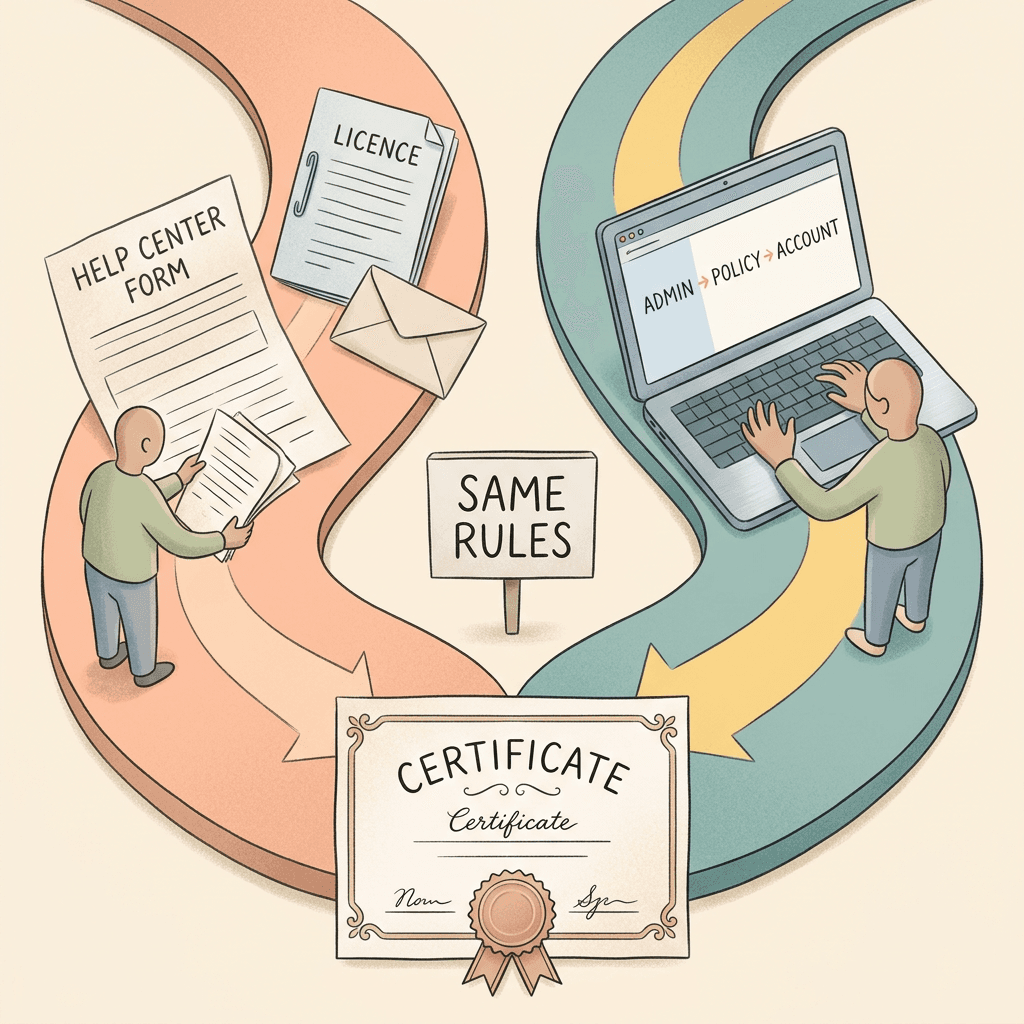
One reading of why Google would do this, which is my interpretation and not something Google stated, is that the in-account route lets Google tie the application to the account's own history. That matters because certification already depends on account standing. Google's policy says manager accounts with a large number of revoked certificates or policy violations can lose the ability to apply for new certificates, and PPC Land reports that from the January 2026 announcement, effective March 23, accounts seeking gambling certification must show good policy health. A form that lives inside the account is a natural place to check those things.
The 2026 Context: Why This Is Not the Only Change to Watch
The in-account route is the newest piece of a year of tightening gambling rules. PPC Land's timeline, which lines up with Google's policy page, runs like this.
- January 22, 2026: Google announced good policy health requirements and manager account limits for gambling certification, with free hosting and third-party subdomains barred from certification. These took effect March 23, 2026.
- July 23, 2026: Google posted a rewritten certification standard covering online gambling, online non-casino games that need certification, and social casino games.
- August 26, 2026: New application forms took effect. Advertisers targeting several countries must submit a separate application per country, and one account cannot hold both online gambling and social casino certifications.
- September 2026: Google's policy page says social casino game applications will move to the Google Ads account starting this month.
- October 15, 2026: The in-account route for online gambling was announced.
- October 21, 2026: Per a Google notice posted October 7, certified online gambling advertisers become eligible for the YouTube Masthead, which expands an allowance that previously covered sports betting.
Read in order, the pattern is a stricter standard (what you must prove), a stricter structure (how accounts must be organized), and now a more integrated process (where you submit). If you are catching up on other 2026 policy changes, our guide to Google Ads real-time policy reviews explains how fast checks can now catch problems, and the limited ad serving expansion shows how Google restricts delivery for advertisers who cannot yet be verified.
Who This Affects, Segment by Segment
The gambling and games policy distinguishes several kinds of advertiser, and the practical impact of the new route differs for each.
Online casinos and bookmakers
Google's policy allows online casinos and bookmakers, online bingo and slots, and sports betting with certification and in permitted countries. For these operators the new route is the main event. Your licence evidence is the anchor, the licensee name and licence number must appear in the footer of the destination site, and you apply per country. Running gambling ads without valid certification can leave the account barred from advertising until certification is obtained.
Online lotteries and scratch cards
Online lottery tickets and scratch cards are listed in the same online gambling category. Many countries restrict lottery advertising to state-run or state-licensed operators, so the licence documents tend to come from a national lottery authority. PPC Land notes one market development tied to October 21: Colombia begins accepting online lottery ads from entities authorized by its regulator, with certification required. Check the country table in the policy before assuming your market is open.
Gambling affiliates and aggregators
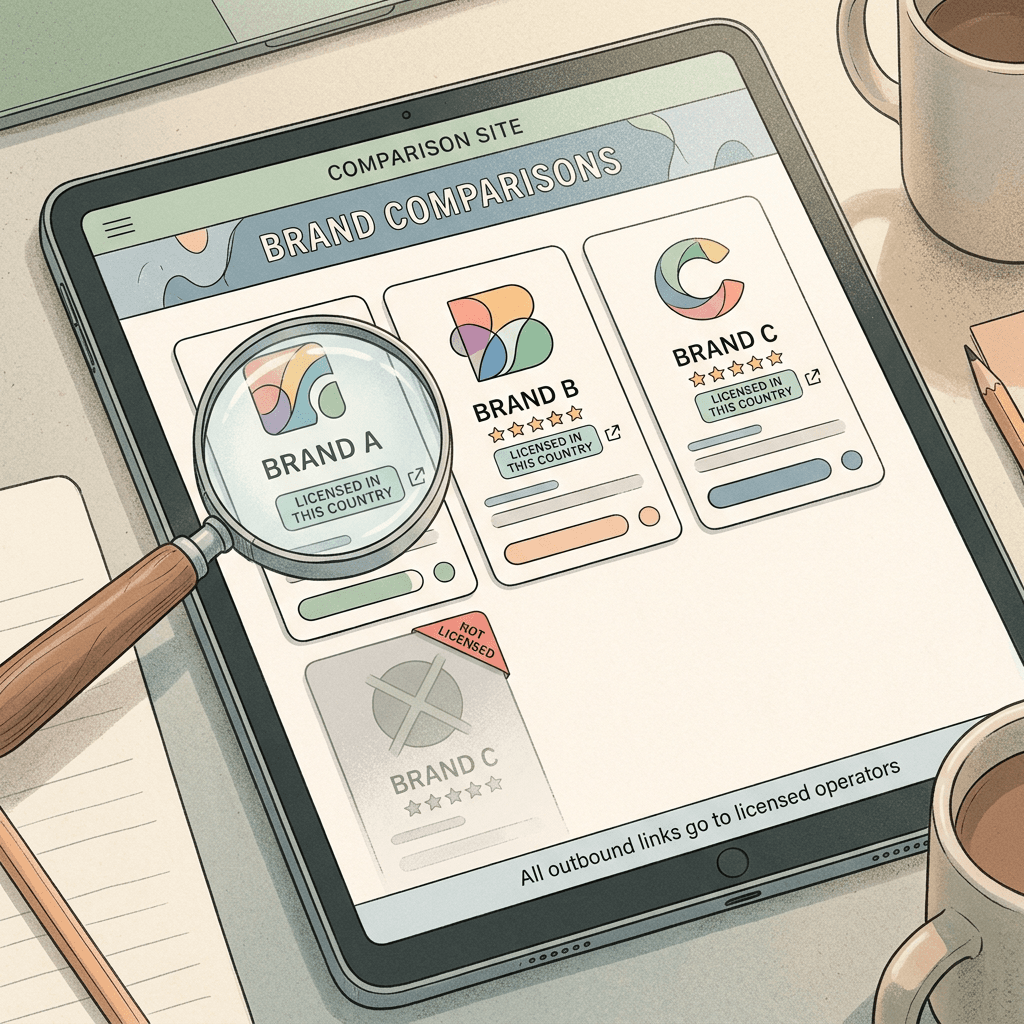
Aggregator and affiliate sites that inform users about or compare gambling services can be certified, with two firm limits: they may not offer gambling themselves or link to gambling services they own, and every promoted product must be licensed in the target country. The footer must state that all outbound links go to fully licensed entities in the targeted region, and PPC Land reports that this statement has to be prominent and applies per targeted geography. A generic line saying you are compliant is not what Google asks for.
Social casino and sweepstakes
Social casino games are simulated gambling-style games with no opportunity to win anything of value. They run through a separate application and a separate account from online gambling. Google's policy requires an adults-only disclaimer, statements that the games offer no real-money gambling or real-world prizes, disclosure of in-app purchases, and no use of real-money gambling brand logos. Countries are split into Group 1 and Group 2, and you choose one group per certification. Sweepstake casinos are expressly not treated as social casino games, so a sweepstakes operator should not assume the social casino route fits. Because the notice lists only online gambling, social casino advertisers should keep using the route Google gave them rather than looking for the new Policy section.
Daily fantasy sports, prediction markets and non-casino games
Daily fantasy sports has its own country rules, such as state licensing in the US and a ban on targeting under 18s, and prediction markets can be advertised under their own policy. Online non-casino games that award a prize for skill generally do not need gambling certification, although games that do require a licence must obtain it where permitted. The notice does not mention any of these, so I would not expect them in the first rollout.
Agencies and manager accounts
Agencies carry a hidden risk. Because a manager account with many revoked gambling certificates can be blocked from new applications, a single careless client can limit what you do for every other client. If you manage several gambling clients, review which accounts hold certificates today, which domains they cover, and whether any account has a history of violations before you start applying through a new channel.
| Advertiser type | Eligible under Google policy? | Key conditions to plan for |
|---|---|---|
| Online casino, bingo, slots | Yes, with certification in permitted countries | Local licence, licensee footer, per-country application |
| Sports betting | Yes, with certification in permitted countries | State or national licence, age limits such as 21 in the US |
| Online lottery and scratch cards | Yes, in countries that allow it | Often state-run or authorized operators only |
| Affiliates and aggregators | Yes, if they do not offer or own gambling | Only licensed products, prominent footer statement per geography |
| Social casino games | Separate certification, not covered by the new notice | Separate account, Group 1 or Group 2, no real prizes disclaimer |
| Sweepstake casinos | Not treated as social casino | Check online gambling rules for your country |
| Daily fantasy sports | Own country rules | State licence in the US, no targeting under 18 |
How to Apply Inside Google Ads, Step by Step
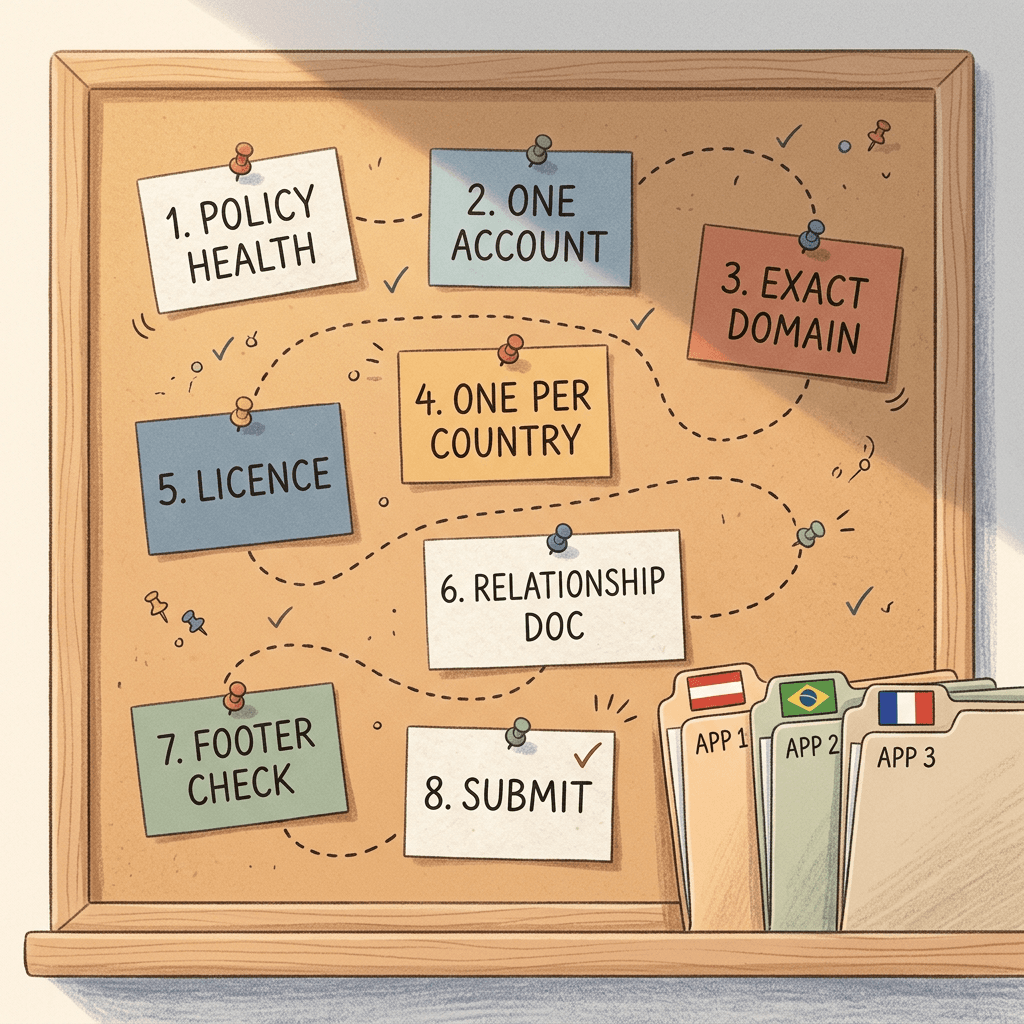
The notice names the location (Admin > Policy > Account) and nothing else, so the steps below combine that menu path with the application requirements in Google's policy. Because the feature appears gradually, you may not see it yet. If you do not, the Help Center form remains the supported route.
- Confirm eligibility for the new section. Sign in with an administrator-level user and open Admin. Look for Policy and then Account. If the option is absent, your account is not in the first phase.
- Check policy health first. Fix any open disapprovals or suspensions on the account. Gambling certification requires good policy health, and a hurried application from a messy account is a common way to lose weeks.
- Pick the account intentionally. Decide which Google Ads account will hold the certificate. Do not plan to mix online gambling and social casino certificates on one account.
- Prepare the exact domain. Certificates apply only to the website submitted. A mismatch between the approved site and the final URL in your ads is one of the fix-it scenarios Google lists. Avoid free-hosted sites and subdomains of third-party platforms, which are not eligible.
- Start one application per country. Advertisers targeting multiple countries must submit separate applications. Begin with the markets that matter most, and do not bundle countries in a single form.
- Provide licence evidence for each region. A valid local licence for every target region is the core requirement. Licensing records with regulators should be current before you submit, since outdated records can delay review.
- Add a relationship document if needed. Where the link between advertiser, licensed entity and domain is unclear, Google asks for a document describing it, such as a group structure chart or a service agreement.
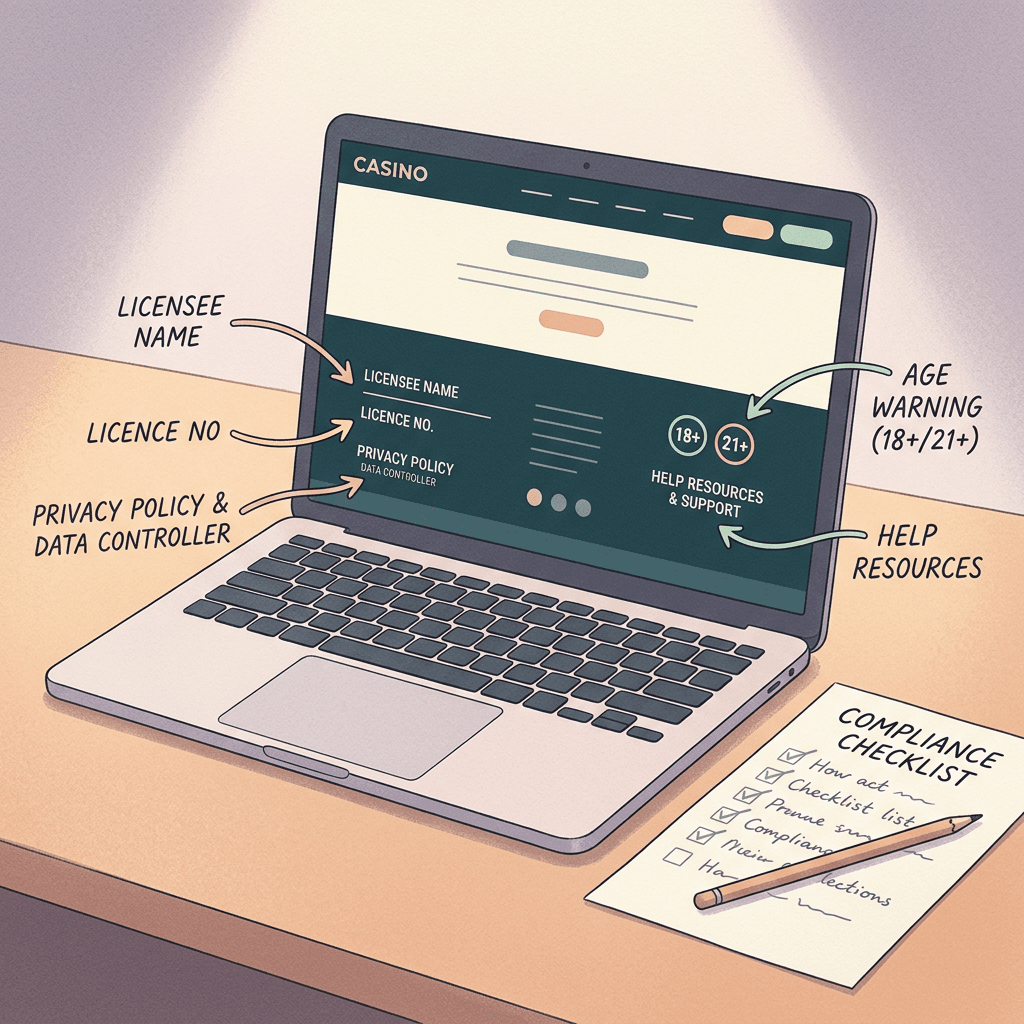
- Check the destination site against the checklist below. Age warning, addiction resources, terms and conditions, and the footer with licensee name, licence number and a privacy policy that names the data controller.
- Submit and save a record. Keep a copy of everything you submitted and the date, because you will need it when you recertify after a material change.
- Do not launch gambling ads until the certificate is active. Google can suspend accounts for running restricted ads without valid certification.
Required Documents by Business Type
The document set depends on who you are. Google states the common core as licence evidence, relationship documentation where unclear, and destination site disclosures. The table below organizes it by scenario.
| Scenario | Core documents | Site disclosures |
|---|---|---|
| Operator licensed in its own name | Licence for each target region | Licensee name, licence number, privacy policy naming the data controller, age warning, addiction resources, terms |
| Brand domain owned by a sister company | Licence plus a document describing the advertiser, licensee and domain relationship | Same as operator, with the licensee named in the footer |
| Multi-country operator | One application and one licence per country | Footer per localized site |
| Affiliate or aggregator | Evidence of the jurisdiction and the licensed products it promotes | Prominent footer statement that all outbound links go to fully licensed entities, per geography |
| Operator with a mobile app | Licence plus app store listing | Licensed domain links to the app store listing and the listing links back |
| Social casino publisher | Separate application and separate account | Adults-only disclaimer, no real-money prizes statement, in-app purchase disclosure |
Worked example 1: a multi-country sportsbook
A sportsbook licensed in two European countries and one US state wants to advertise in all three. It files three applications, one per country, each with the licence that covers that market. In the footer of each localized site it shows the licensee name, licence number and the data controller named in the privacy policy. If one entity holds the licences and a sister company owns the domain, it attaches a relationship document for the domain. If the app promotion matters, the licensed domain links to the App Store or Google Play listing and the listing links back to the domain.
Worked example 2: an affiliate comparing casinos
A review site compares casino brands for readers in a single country. It applies as a gambling-promoting content provider for that country, lists only brands licensed there, and adds a prominent footer line stating that all outbound links go to fully licensed entities in that region. If it later expands to a second country, it files a second application with a second footer statement and does not reuse the first.
Worked example 3: a social casino publisher with a sister sweepstakes product
A publisher runs a free-to-play slots app and a separate sweepstakes site. Because sweepstake casinos are not treated as social casino games, the two products need separate policy analysis. The social casino app goes in its own Google Ads account with the correct group selection, kept apart from any online gambling certificate.
Per-Country and Multi-Account Rules That Trip People Up
Google's country table is long, and the conditions differ widely. Some markets require state-run operators, some name a specific regulator such as the UK Gambling Commission or the Dutch Gambling Authority, and some are limited to specific provinces or states. Extra conditions appear as well, for example a German imprint on the destination site, a Mexican warning about minors, and French warnings on excessive gaming. In the United States, sports betting and online casino advertisers must be licensed by state entities where legal, must not target users under 21 or outside licensed states, and must include addiction warnings and help information.

Two structural rules deserve a call-out because they are easy to break by accident.
One application per country. If you are certified in one country and add a second, the second needs its own application. Targeting a mix of allowed and disallowed countries leaves ads as Eligible (limited), running only where allowed, and targeting only disallowed countries leads to disapproval.
No mixed certification types in one account. An account cannot hold both online gambling and social casino certifications, nor certificates for two different social casino groups. If your business spans those, you need separate accounts, and each account should be built so its landing pages, billing and audiences stay clean.
Common Rejection and Disapproval Reasons
Google has not published rejection statistics, so this list is built from the policy's own requirements and its stated fix paths. Each item is a place an application or an ad can fail.
- Licence mismatch. The licence does not cover the country or the activity being advertised, or it has expired or been suspended. Google also expects you to notify it immediately if a licence expires, is suspended or is terminated.
- Footer incomplete. Missing licensee name, licence number or a privacy policy naming the data controller.
- Affiliate statement missing or generic. The affiliate footer must say outbound links meet the licensing condition for each targeted geography.
- Unclear ownership. The domain, the advertiser and the licensee appear to be different parties with no explanatory document.
- Ineligible hosting. Free-hosted sites and subdomains of third-party platforms cannot be certified.
- URL mismatch. The ad's final URL differs from the website that was certified.
- Wrong form or account type. Online gambling and social casino mixed in one account, or an application sent as the wrong category.
- Unhealthy account. Open violations, or a manager account with many revoked certificates.
- Prohibited surfaces. Google's policy states gambling ads cannot run in Gmail, Shopping, reservation display ads, or Google TV and YouTube Masthead ads, with the YouTube Masthead exception for certified online gambling advertisers taking effect October 21, 2026 according to Google's notice as reported by PPC Land. Confirm the current wording before you plan Masthead inventory.
- Material changes not reported. New licences, new domains or a change of operating entity without recertifying. Google does not define "material" in the sources I reviewed, so when in doubt, update.
Google lists the standard fix paths too: apply for certification in the country, adjust location targeting to certified countries and request review, or edit landing pages or ads to comply and use the resubmit option. Our walkthrough of text disclaimers for AI Max compliance is also relevant, because required disclaimers are something automated campaign types can bury unless you plan for them.
How Certification Interacts With Performance Max, Demand Gen and YouTube
Certification decides whether you may advertise at all, and the campaign type decides where the ads can appear. Google's policy is the anchor: gambling ads cannot run in Gmail, Shopping or reservation display ads, and the policy page I reviewed lists Google TV and YouTube Masthead as excluded surfaces, with the October 21 notice adding a Masthead allowance for certified online gambling. That means a campaign type that spreads across many surfaces needs extra scrutiny.
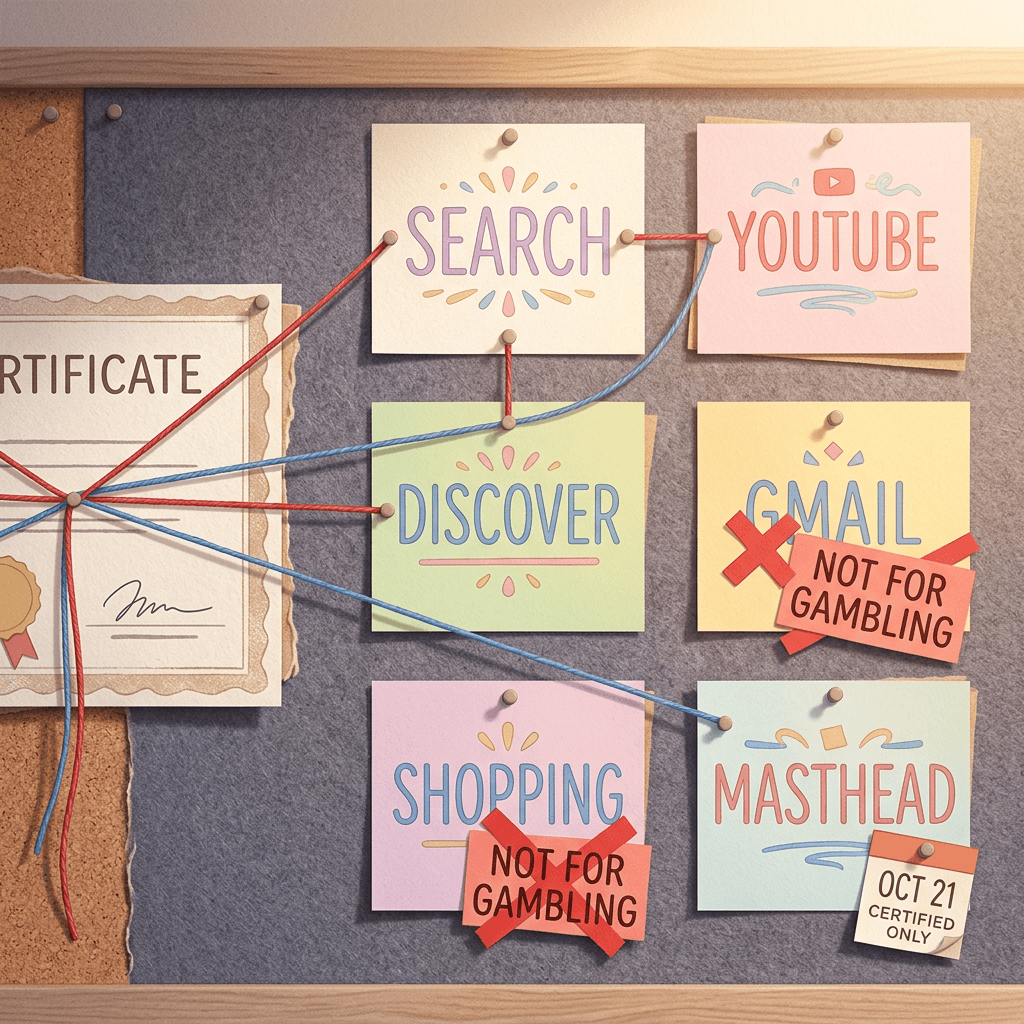
Performance Max. PMax serves across YouTube, Display, Search, Discover, Gmail and Maps from one campaign. For a gambling advertiser the question is not only "am I certified" but "which surfaces and which countries is this campaign touching". The sources I reviewed do not describe a special gambling setting for PMax, so I recommend a conservative approach: use country targeting that matches your certificates exactly, review placement reporting, and keep disclaimers inside assets instead of relying on the landing page alone. Our posts on PMax asset experiments and AI video resizing in PMax cover why auto-generated or auto-cropped video can drop the age warning or responsible gambling line that a compliant ad needs.
Demand Gen. Demand Gen serves on YouTube including Shorts, Discover and Gmail, and Gmail is a surface where gambling ads cannot run per Google's policy. A gambling advertiser using Demand Gen should confirm in a draft which surfaces are eligible for the account and country in question. The related change on Demand Gen view-through conversions matters for measurement but does not alter policy.
YouTube and Video reach. Certified advertisers can run video, subject to the policy and local law, and the Masthead allowance from October 21 is the new item. If you buy reach on YouTube, our guide to Video reach automated bidding is the companion read for cost control, and remember that the business name and logo requirement described in this YouTube asset update applies to your video campaigns as well.
Search and AI Max. Auto-upgrades and automated final URL expansion create compliance risk when only certain URLs are certified. If your account is affected by the AI Max auto-upgrade for Search, review URL controls so ads cannot land on a domain that was never submitted for certification.
What Other Verticals Are Likely to Follow
Google has not said. The notice lists only online gambling, and the surrounding sources do not name a second category, so this section is an informed guess and not a forecast anyone can rely on.
Google's help center already lists several other products and services that need approval before advertising, and country-by-country gating is a familiar pattern. Our alcohol advertising policy update shows the same kind of country-by-country gating at work. The wording of the notice, which says "the following certifications" and then lists one, suggests a list that can grow. If it does, the categories where a certificate is tied to a licence, a country and a domain are the obvious candidates, and social casino is already signposted by Google's own page saying those applications are moving to the account in September 2026.
The practical conclusion is the same whatever Google adds next: keep your evidence organized so that moving from a form to an in-account flow costs you hours, not weeks.
Compliance Checklist Before You Apply
Use this list per country and per domain.
Licence and legal
- Valid local licence for every country you target, with current details at the regulator.
- Relationship document if the advertiser, licensee and domain are different entities.
- A calendar reminder for licence renewals, plus a named person responsible for telling Google if a licence lapses.
Destination site
- Prominent age warning and addiction or help resources.
- Terms and conditions.
- Footer with licensee name, licence number and a privacy policy that identifies the data controller.
- Affiliates and aggregators: a prominent footer statement that all outbound links go to fully licensed entities in the targeted region, repeated per geography.
- App advertisers: a working link from the licensed domain to the app store listing and a link back from the listing.
- No reliance on free hosting or third-party subdomains.
Account
- Good policy health with no open suspensions.
- Online gambling and social casino kept in separate accounts.
- A manager account without a history of many revoked gambling certificates.
- Location targeting that matches the certified countries.
Ads and creative
- No targeting of minors, and age settings that match local law (for example 21 in the US for sports betting and casino).
- Responsible gambling messages included in the creative where required.
- Final URLs that match the certified website exactly.
- Written recertification process for any material change.
Making Compliant Creative Without Slowing Down
Certification gets the account approved, and the ads still have to pass review one by one. Gambling creative has a narrow lane: no minors, no implied guaranteed wins, no real-money brand logos in a social casino context, and clear age and responsible gambling messaging. That puts a premium on being able to produce many variations quickly and consistently.
Here is how a team can use Miraflow while staying inside that lane. Use the AI image generator to build clean banner visuals such as stadium scenes, abstract card tables or illustrated mascots, leaving a blank footer band where your legal line and age warning are added in your design tool. Use the cinematic AI video generator to make short YouTube spots that lean on atmosphere and a clearly adult setting, and keep the legal text as a final end card. Use the YouTube Thumbnail Maker to create the still frame for in-feed placements with a plain, factual headline. Review every generated asset against the policy before upload, because generation tools do not know your licence conditions. For localization, our guide to AI video dubbing in Asset Studio covers translating video, and the notes on Gemini Omni in Asset Studio show where Google's own generation tools fit.
A sample prompt for a compliant banner background that leaves space for required text:
Illustrated evening scene of a modern stadium exterior with warm floodlights and a calm crowd of adults walking toward the entrance, soft pastel palette, wide composition with a plain empty dark band across the bottom fifth of the frame reserved for a legal footer, no cards, no coins, no money symbols, no text, no logos.

Common Mistakes
Treating the in-account route as a shortcut. The notice changes where you apply and says nothing about lighter requirements. The licence, footer and per-country rules are the same.
Bundling countries into one application. Google requires a separate application per targeted country, so a single form that lists five markets invites a rejection or a partial approval.
Certifying one domain and advertising another. Certificates apply to the submitted website. A new campaign domain or a redirect to a different site can trigger disapproval.
Using one account for everything. Online gambling and social casino cannot share certification in one account, and different social casino groups also need separate accounts.
Forgetting recertification. Material changes require recertification, and Google treats failure to do so seriously, with suspension as a possible outcome. Since "material" is undefined in the sources I reviewed, log every change to licences, entities, domains and apps.
Hiding the responsible gambling line in a PMax or Demand Gen asset crop. Automated resizing can crop out text near an edge. Keep required messaging well inside safe zones, and review each placement preview.
Letting an affiliate footer drift. An affiliate who adds a new brand to a comparison page without checking that brand's licence in the targeted country has broken the exact condition the footer promises.
Assuming the first-phase menu means instant approval. Seeing the Policy section tells you that you can submit. Approval still depends on review, and Google has not published review times.
Ignoring account health. If the account has open policy problems, fix them before applying. A manager account tied to many revoked certificates may not be able to apply at all.
Frequently Asked Questions
What did Google change about gambling certification in October 2026?
Google said it will gradually let some advertisers apply for online gambling certification inside their Google Ads account, under Admin > Policy > Account. The Help Center application route is still available, and existing certifications and pending applications are not affected.
Is the new option available to everyone now?
No. Google says it will be released incrementally to all advertisers over time, with no published end date and no stated criteria for the first group. If you do not see the Policy section, keep using the Help Center form.
Do the gambling rules change with the new route?
The notice does not change the rules. Licence evidence, per-country applications, destination site disclosures and the policy health requirement all remain as described in Google's Gambling and games policy.
Do I need a separate application for each country?
Yes. Google's policy says advertisers targeting multiple countries must submit a separate application for each target country.
Can one account hold online gambling and social casino certification?
No. Google's policy says a single account cannot hold both certifications, and it cannot hold certifications for two different social casino groups.
Does this cover social casino games and sweepstakes?
The notice lists only online gambling. Google's policy page says social casino game applications will move to the Google Ads account starting in September 2026, and it states that sweepstake casinos are not considered social casino games.
Can gambling affiliates apply?
Aggregator and affiliate sites that inform users about or compare gambling services can be certified, provided they do not offer gambling themselves or link to services they own, and promote only products licensed in the target country with the required footer statement.
What happens if I advertise before I am certified?
Google's policy says running gambling ads without valid certification can prohibit the account from advertising until certification is obtained, and repeated or egregious violations can lead to suspension.
Can gambling ads run on YouTube?
Certified advertisers can run ads in permitted countries, subject to the policy and local law. Google posted a notice on October 7, 2026 that certified online gambling advertisers become eligible for the YouTube Masthead from October 21, 2026. The policy page also lists surfaces where gambling ads cannot run, including Gmail and Shopping.
What happens to my current certificate or pending application?
Google states that existing certifications and pending applications are not affected by the incremental launch.
Will other certifications move into the account?
Google has not said. The notice lists only online gambling, so any other category would be a guess.
Where can I make compliant gambling ad creative?
Miraflow can generate banner art, cinematic video clips and still frames you can finish with your legal footer. Start from the Miraflow home page, and review every asset against the policy before you upload it.
Conclusion
Google's October 2026 update moves one part of gambling certification, the application itself, into the Google Ads account, starting with a limited group of advertisers and reaching everyone over an unspecified period. The rules around it did not get lighter: licences per country, a separate application for each, footers that name the licensee and the data controller, strict account separation and good policy health all still apply, and the YouTube Masthead opening on October 21 adds a new surface for certified operators.
The best preparation is boring and effective. Audit your licences and domains now, fix account health, split accounts where the policy requires it, write your footers to the letter, and keep a record of every application so recertification is routine. Then build a creative library that is compliant by design, using tools like Miraflow's AI image generator, cinematic video generator and YouTube Thumbnail Maker. When the Policy section appears in your account, you will be ready to submit in an afternoon instead of rebuilding your evidence from scratch.