Kimi K2.6 Explained: Moonshot AI's Open-Source Model That Ties GPT-5.5 on Coding (April 2026)

Written by
Jay Kim

Kimi K2.6 is Moonshot AI's open-weight 1T-parameter model released April 20, 2026. It ties GPT-5.5 on SWE-Bench Pro (58.6%), leads on Humanity's Last Exam with tools (54.0%), and costs ~80% less per million tokens. Complete breakdown: benchmarks, Agent Swarm (300 sub-agents), pricing ($0.95/$4.00 per million tokens), comparisons vs GPT-5.5, Claude Opus 4.7, and Gemini 3.1 Pro.
The most important AI model released in April 2026 may not be the one with the biggest marketing budget.
Kimi K2.6 is Moonshot AI's new open-source model, released April 20, 2026. It ties GPT-5.5 on SWE-Bench Pro and costs about 80% less per million tokens.[5] Three days before OpenAI dropped GPT-5.5 to global fanfare, a Beijing-based startup quietly shipped a model that matches it on the benchmark most developers care about, and you can download the weights, self-host them, and pay a fraction of the price.
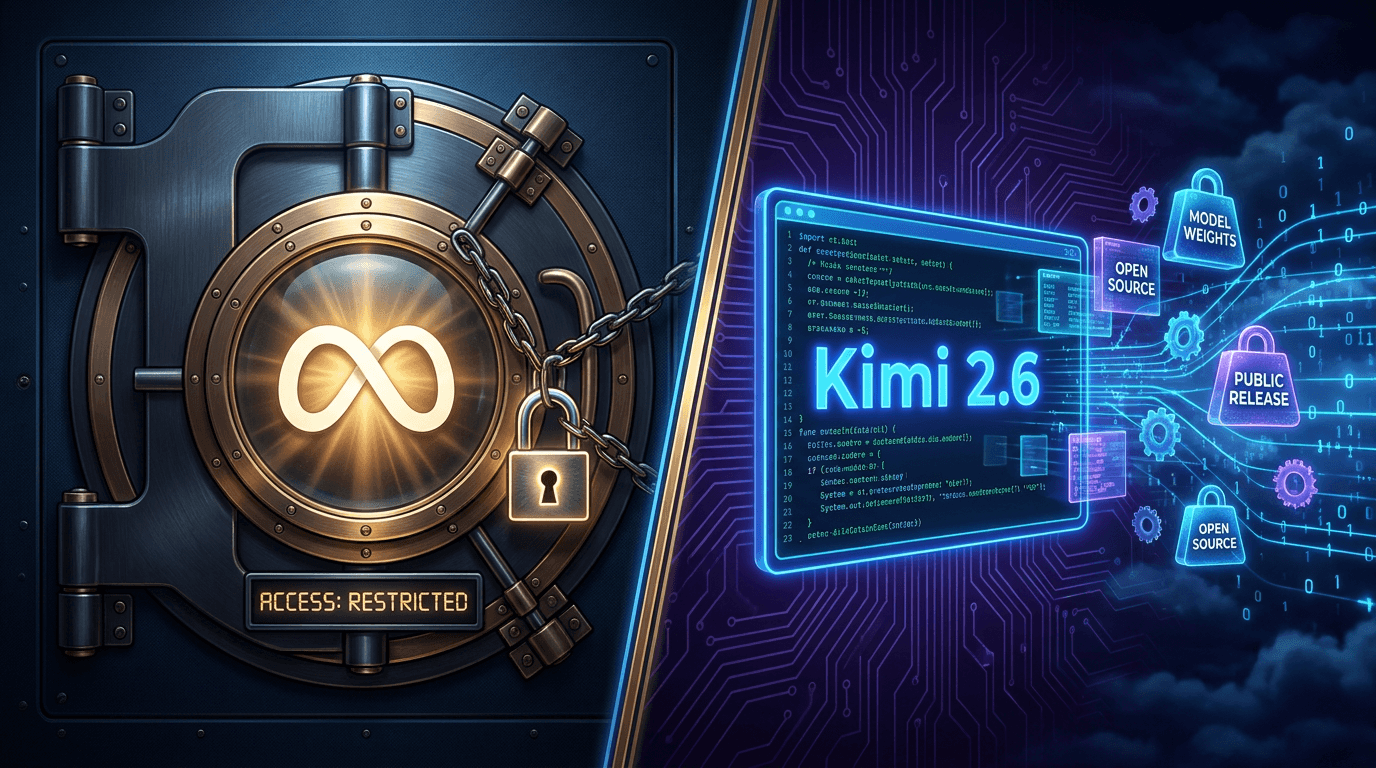
Kimi K2.6 is an open-source, native multimodal agentic model that advances practical capabilities in long-horizon coding, coding-driven design, proactive autonomous execution, and swarm-based task orchestration.[1] But the headline capability isn't any single benchmark score. The headline capability in K2.6 is not raw benchmark performance, it's sustained, autonomous execution.[3]
This article provides a complete breakdown of what Kimi K2.6 actually is, how it performs against GPT-5.5 and Claude Opus 4.7, the pricing structure that makes it a serious contender for production workloads, the Agent Swarm architecture that lets it run 300 sub-agents in parallel, and who should, and shouldn't use it.
What Is Kimi K2.6: The Essentials
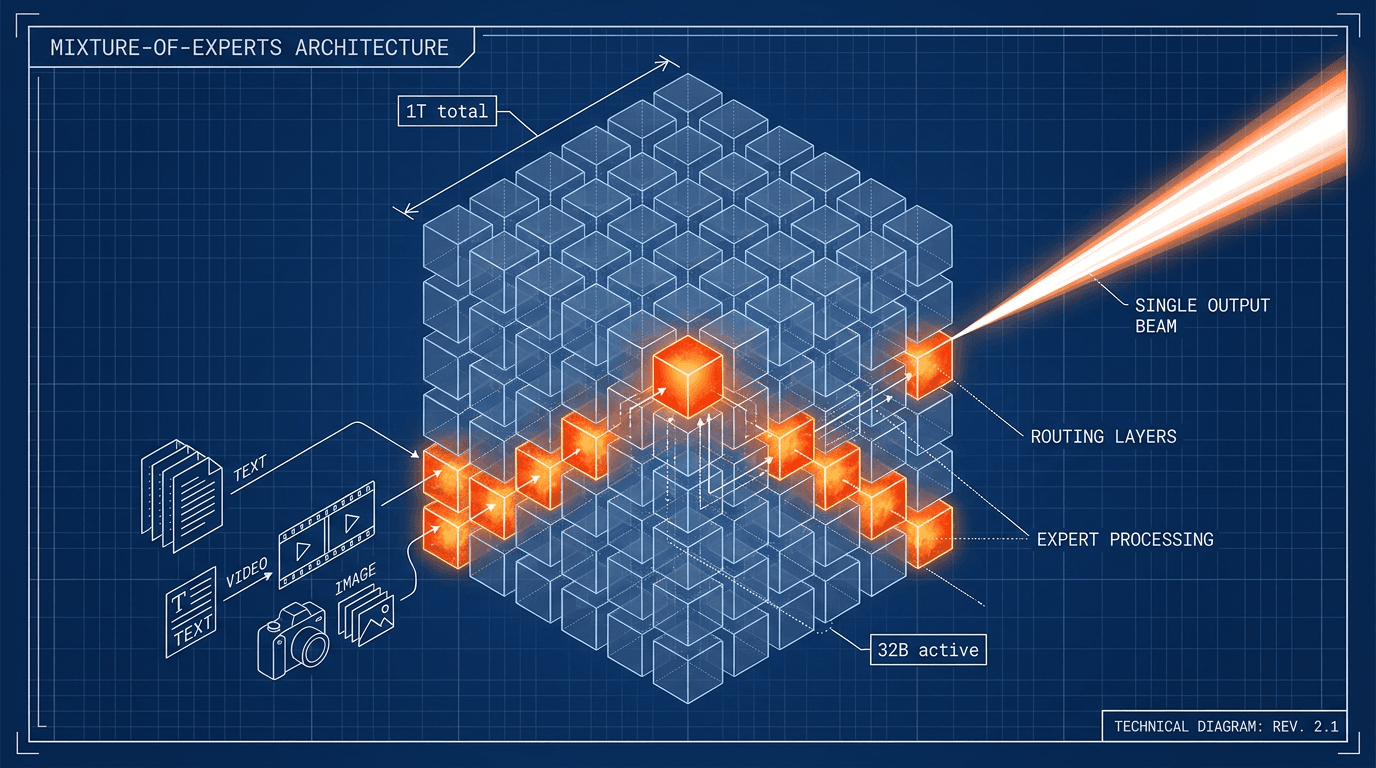
Kimi K2.6 is a 1-trillion-parameter Mixture-of-Experts model from Beijing-based Moonshot AI, released open-weight under a Modified MIT License. It activates 32 billion parameters per token during inference, supports a 262,144-token context window, and ships natively in INT4 quantization. The model handles text, images, and video in the same architecture without separate vision modules.[5]
The MoE architecture is the key to understanding both K2.6's capability and its cost structure. MoE means K2.6 only activates 32B parameters per token, so inference compute looks like a 32B model while capability looks like 1T.[4] This is the same design approach used by DeepSeek and other Chinese AI labs that have disrupted Western pricing models — achieving near-frontier capability at a fraction of the compute cost.
The architecture is unchanged, K2.6's deployment guide on Hugging Face explicitly states "Kimi-K2.6 has the same architecture as Kimi-K2.5, and the deployment method can be directly reused." The difference is in posttraining: more training compute applied to long-horizon stability, instruction following, and swarm coordination. Moonshot did not disclose exactly how much additional training was done for K2.6.[5]
Native video input is the other notable addition. K2.5 handled images; K2.6 adds video (mp4, mov, avi, webm, and others, recommended up to 2K resolution). The vision encoder is native to the model's pretraining rather than a bolt-on module.[5]
The Four Variants
Moonshot ships K2.6 as four variants accessible from kimi.com and the API. They share the same model weights but differ in decoding configuration, tool permissions, and how the thinking budget is allocated.[5]
Instant: Fast responses without a reasoning trace. Temperature runs lower, top-p is tighter, and the model skips the chain-of-thought phase entirely. The practical use case is quick lookups, short code completions, and anything where latency matters more than depth.[5]
Thinking: The deep reasoning variant that produces extended chain-of-thought traces before responding. It uses explicit chain-of-thought reasoning, which typically improves performance on math and complex reasoning tasks at the cost of higher latency and token usage.[7]
Agent: For autonomous research, document analysis, and multi-step workflows that require tool use.
Agent Swarm: The headline capability — large-scale parallel orchestration with up to 300 sub-agents.
Four variants cover different use cases: Instant for speed, Thinking for deep reasoning, Agent for autonomous research and document tasks, and Agent Swarm for large-scale parallel work.[5]
The Company Behind the Model: Moonshot AI
Moonshot AI (Chinese: 月之暗面; lit. 'Dark Side of the Moon') is an artificial intelligence company based in Beijing, China. It has been dubbed one of China's "AI Tiger" companies by investors with its focus on developing large language models. Moonshot was founded in March 2023 by Yang Zhilin, Zhou Xinyu and Wu Yuxin who were schoolmates at Tsinghua University.[1] It was launched on the 50th anniversary of Pink Floyd's The Dark Side of the Moon which was Yang's favorite album and the inspiration for the company's name.[1]

Yang has stated his goal for founding Moonshot AI is to build foundation models to achieve AGI. Yang's three milestones are long context length, multimodal world model, and a scalable general architecture capable of continuous self-improvement without human input.[1]
The company's valuation trajectory has been remarkable. Moonshot AI is seeking to raise as much as $1 billion in an expanded funding round that would value the startup at about $18 billion, more than quadrupling its valuation in just three months and underscoring growing interest in Chinese AI developers racing to rival Silicon Valley leaders.[3] Moonshot AI has raised a total funding of $1.77B over 3 rounds from 8 investors. Moonshot AI has raised a total of $1.77B over 3 rounds.[6]
After the launch, Moonshot's monthly sales exceeded its total revenue for the whole of last year, according to one of the people.[8] Moonshot was founded by former Tsinghua University professor Yang Zhilin, who previously worked on AI projects at Meta Platforms Inc. and Google.[8]
The K2 lineage tells a story of rapid iteration. In July 2025, the company released the weights for Kimi K2, a large language model with 1 trillion total parameters. The model uses a mixture-of-experts architecture, where 32 billion parameters are active during inference. K2 was trained on 15.5 trillion tokens of data and is released under a modified MIT license.[1] That was followed by K2 Thinking in November 2025, K2.5 in January 2026, and now K2.6 in April 2026, five significant releases between July 2025 and April 2026.[5]
One important piece of context: In February 2026, Anthropic accused Moonshot of violating the terms of service by using thousands of fraudulent accounts to generate millions of conversations with Claude to train its own large language models.[1] This distillation accusation, which also targeted DeepSeek and MiniMax, remains part of the backdrop to Moonshot's competitive positioning.
Benchmark Results: Where K2.6 Wins, Ties, and Trails
The Headline Numbers
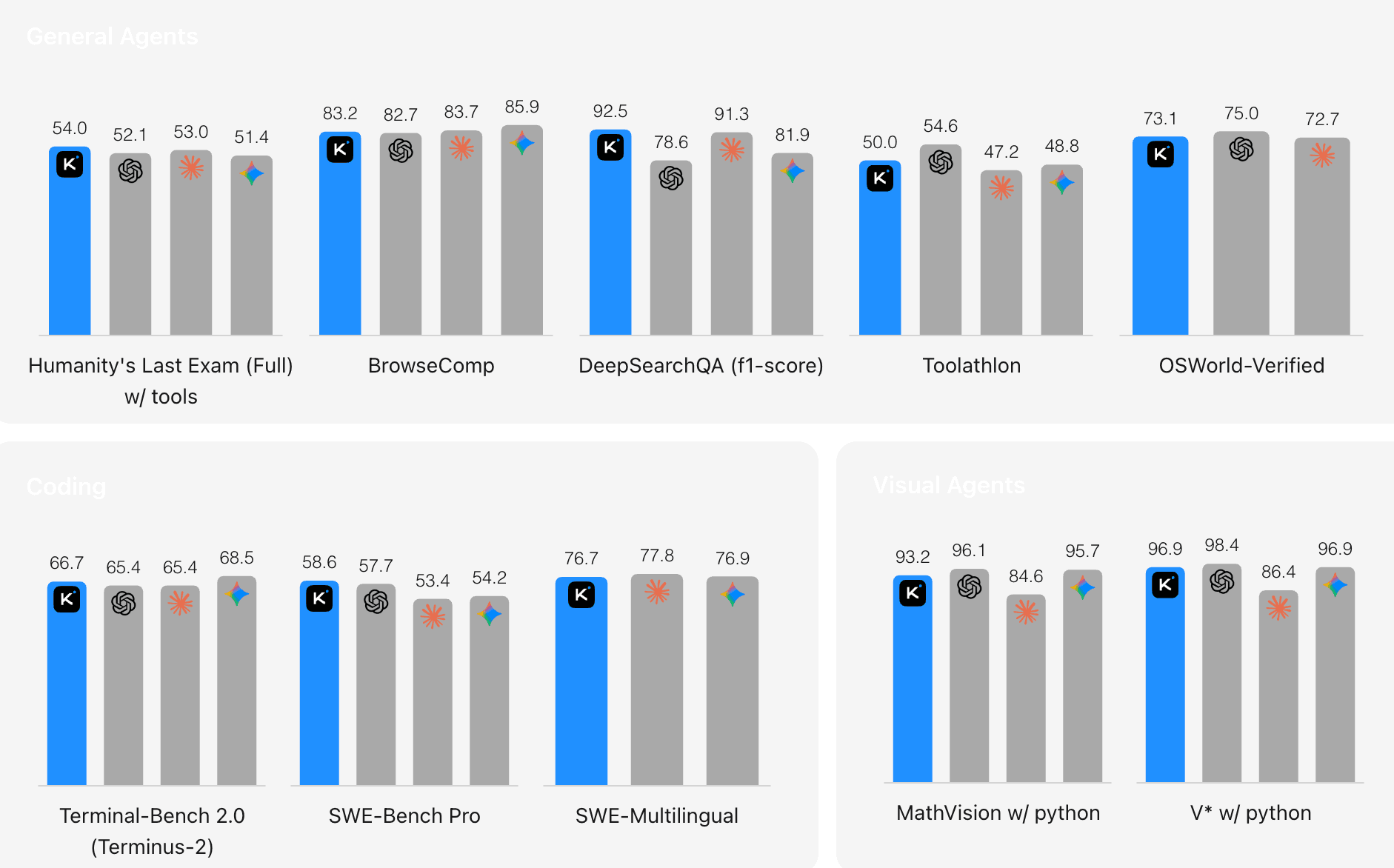
Moonshot claims open-source SOTA on HLE w/ tools 54.0, SWE-Bench Pro 58.6, SWE-bench Multilingual 76.7, BrowseComp 83.2, Toolathlon 50.0, CharXiv w/ python 86.7, and Math Vision w/ python 93.2.[6]
Where K2.6 Leads
Humanity's Last Exam (HLE) with Tools — 54.0%: Perhaps the most striking number for agentic workloads is Humanity's Last Exam (HLE-Full) with tools: K2.6 scores 54.0 — leading every model in the comparison, including GPT-5.4 (52.1), Claude Opus 4.6 (53.0), and Gemini 3.1 Pro (51.4). HLE is widely considered one of the hardest knowledge benchmarks, and the with-tools variant specifically tests how well a model can leverage external resources autonomously.[2]
SWE-Bench Pro — 58.6%: Kimi K2.6 scores 58.6 on SWE-Bench Pro, compared to 57.7 for GPT-5.4 (xhigh), 53.4 for Claude Opus 4.6 (max effort), 54.2 for Gemini 3.1 Pro (thinking high), and 50.7 for Kimi K2.5.[2] On SWE-Bench Pro coding benchmarks, Kimi K2.6 ties GPT-5.5 at 58.6.[5]
DeepSearchQA — 92.5% F1: DeepSearchQA at 92.5% F1 score versus GPT-5.4's 78.6% is the most lopsided win in the table.[1] For any workflow involving autonomous web research and information synthesis, K2.6 is in a different category.[1]
BrowseComp (Agent Swarm mode) — 86.3%: On the BrowseComp benchmark in Agent Swarm mode, K2.6 scores 86.3 compared to 78.4 for Kimi K2.5.[2]
Where K2.6 Is Competitive
SWE-Bench Verified — 80.2%: On SWE-Bench Verified it scores 80.2, sitting within a tight band of top-tier models.[2] Benchmark saturation on SWE-Bench Verified. Six models now sit within 0.8 points of each other on SWE-Bench Verified (80.0–80.8%).[5]
LiveCodeBench v6 — 89.6%: On LiveCodeBench (v6), it scores 89.6 vs. Claude Opus 4.6's 88.8.[2]
Terminal-Bench 2.0 — 66.7%: On Terminal-Bench 2.0 using the Terminus-2 agent framework, K2.6 achieves 66.7, compared to 65.4 for both GPT-5.4 and Claude Opus 4.6, and 68.5 for Gemini 3.1 Pro.[2] However, there is an important caveat here. Moonshot's table reports GPT-5.4 at 65.4% on Terminal-Bench 2.0 using the Terminus-2 harness. Other sources, including analysis from third-party leaderboards and our own Opus 4.7 review, cite GPT-5.4 at 75.1% on Terminal-Bench 2.0 with a different harness configuration.[5] The harness matters enormously — Do not use this table to draw conclusions about Terminal-Bench without running your own harness.[5]
Where K2.6 Trails
Pure Reasoning: Pure reasoning benchmarks: GPT-5.4 still leads on AIME 2026 (99.2% vs K2.6's 96.4%) and GPQA Diamond (92.8% vs 90.5%).[1] On pure single-turn reasoning tasks (AIME, GPQA Diamond without tools), GPT-5.4 and Gemini 3.1 Pro currently hold the lead.[5]
Overall Intelligence Index: On overall Intelligence Index, GPT-5.5 still leads at 60 vs K2.6 at 54. GPT-5.5 leads at 60 vs Kimi K2.6 at 54, with Claude Opus 4.7 at 57.[5] So K2.6 is not a universal frontier model. It is a specialist that happens to specialise in the thing most people use AI for, which is writing, debugging, and reasoning about code.[5]
Multimodal Performance: Its strongest category is Coding (#6), while its weakest is Multimodal & Grounded (#26). Kimi 2.6 ranks #26 out of 115 models in multimodal and grounded tasks benchmarks with an average score of 68.1.[7]
vs GPT-5.5 Overall: GPT-5.5 is clearly ahead on the provisional aggregate, 93 to 85. The gap is large enough that you do not need to squint at the spreadsheet to see the difference. GPT-5.5's sharpest advantage is in knowledge, where it averages 66.4 against 53.8. The single biggest benchmark swing on the page is HLE, 52.2% to 34.7%.[3]
The Honest Assessment
Pick GPT-5.5 if you want the stronger benchmark profile. Kimi 2.6 only becomes the better choice if coding is the priority or you want the cheaper token bill.[3]
Moonshot's Kimi K2.6 is the new leading open weights model. Kimi K2.6 lands at #4 on the Artificial Analysis Intelligence Index (54) behind only Anthropic, Google, and OpenAI (all 57).[8]
The Agent Swarm: K2.6's Defining Capability
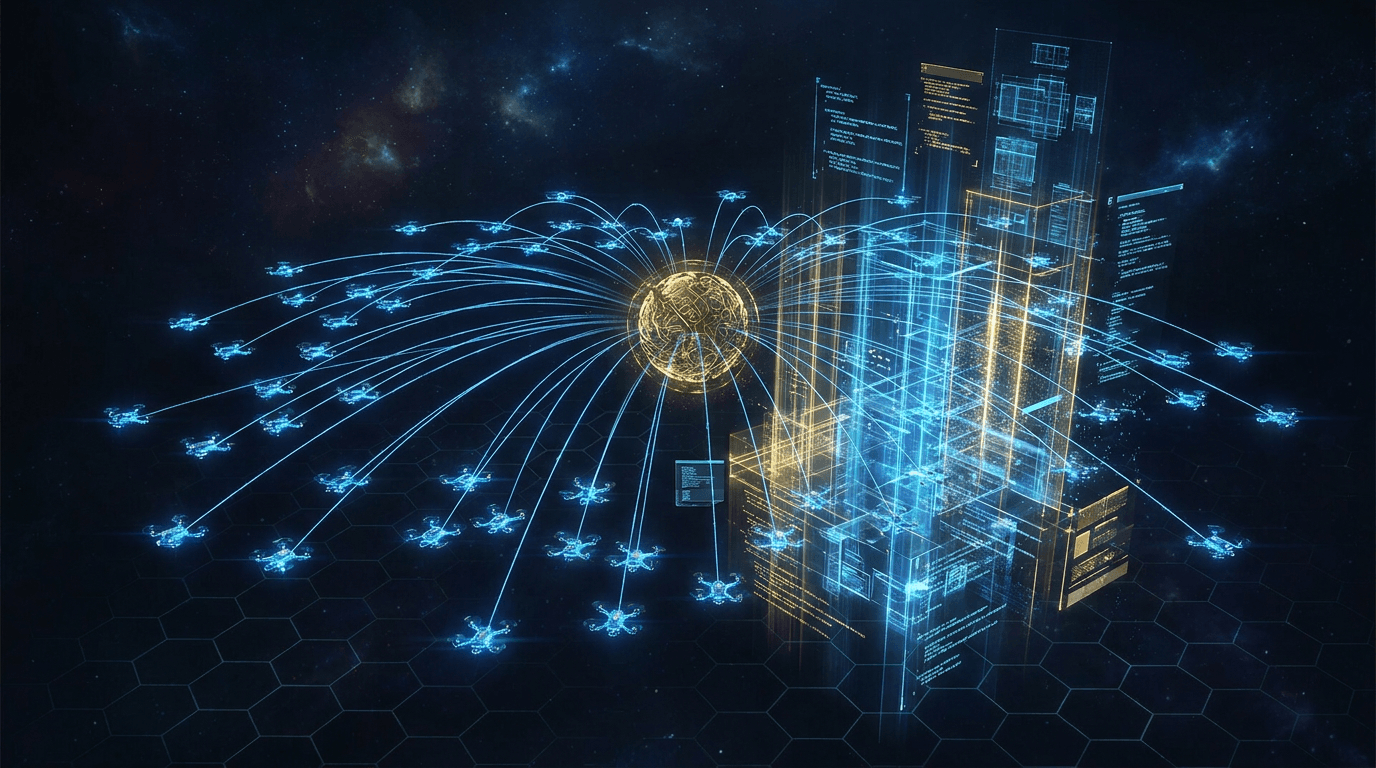
If there's a single feature that separates Kimi K2.6 from every other model on the market — open or closed — it's the Agent Swarm architecture.
Scaling horizontally to 300 sub-agents executing 4,000 coordinated steps, K2.6 can dynamically decompose tasks into parallel, domain-specialized subtasks, delivering end-to-end outputs from documents to websites to spreadsheets in a single autonomous run.[1]
The model can run 300 parallel sub-agents executing 4,000 coordinated steps — and sustain this for over 12 hours of continuous autonomous coding. K2.5 supported 100 sub-agents at 1,500 steps. K2.6 triples the agent count and nearly triples the step depth. That's not an incremental update. That's a fundamentally different operational ceiling.[1]
How It Works
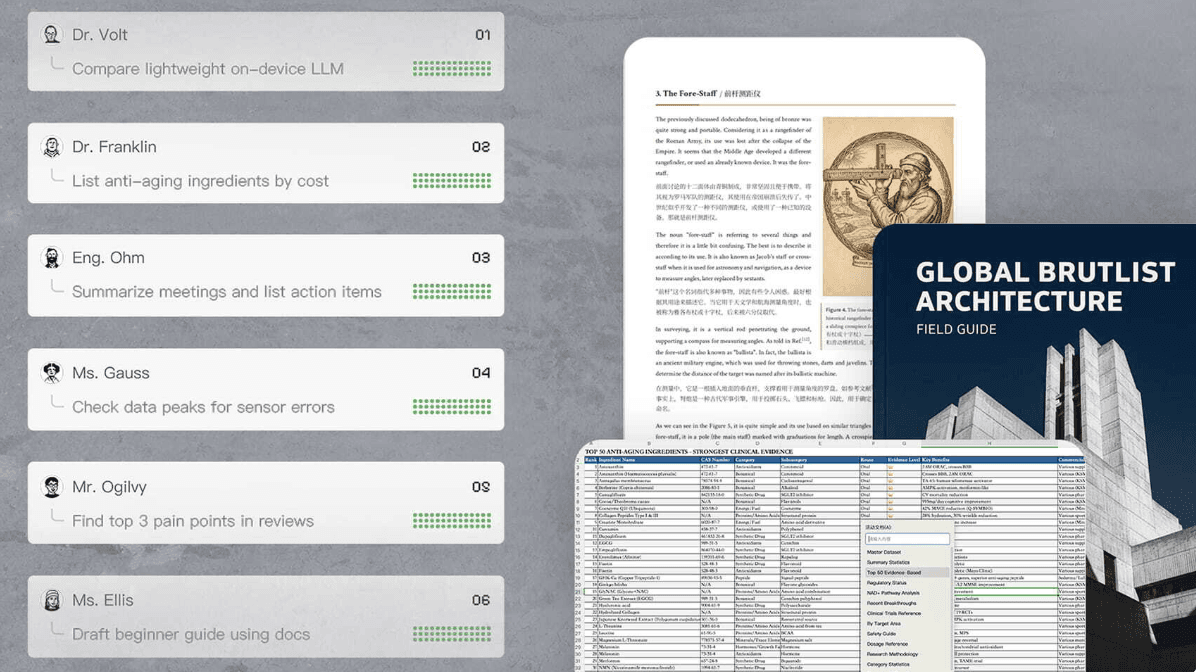
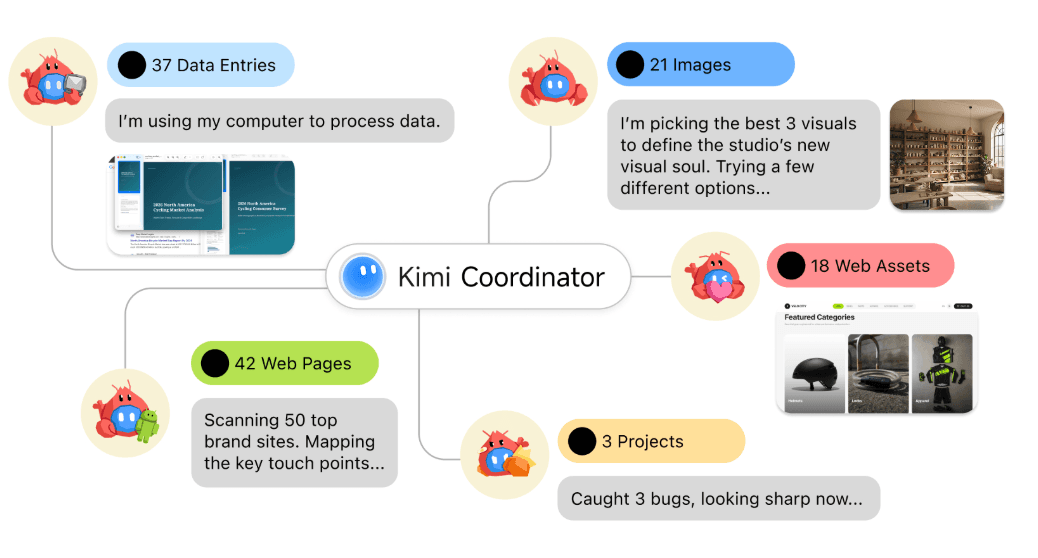
The headline feature is Agent Swarm, which can run up to 300 sub-agents at once, each taking 4,000 steps. The system automatically splits tasks into subtasks and hands them off to specialized agents. Moonshot AI says these agents combine skills like web research, document analysis, and writing, and a single run is meant to produce finished outputs, including documents, websites, slide decks, and spreadsheets.[5]
Sub-agent routing in K2.6 runs through what Moonshot describes as a shared operational space. Agents have persistent memory contexts and available toolkits defined at spawn time; the coordinator tracks skill profiles and routes work accordingly.[6]
Agent Swarm native support. No other open-weight model ships with first-party orchestration tooling at the 300-agent, 4,000-step scale.[10]
The Exchange-Core Case Study
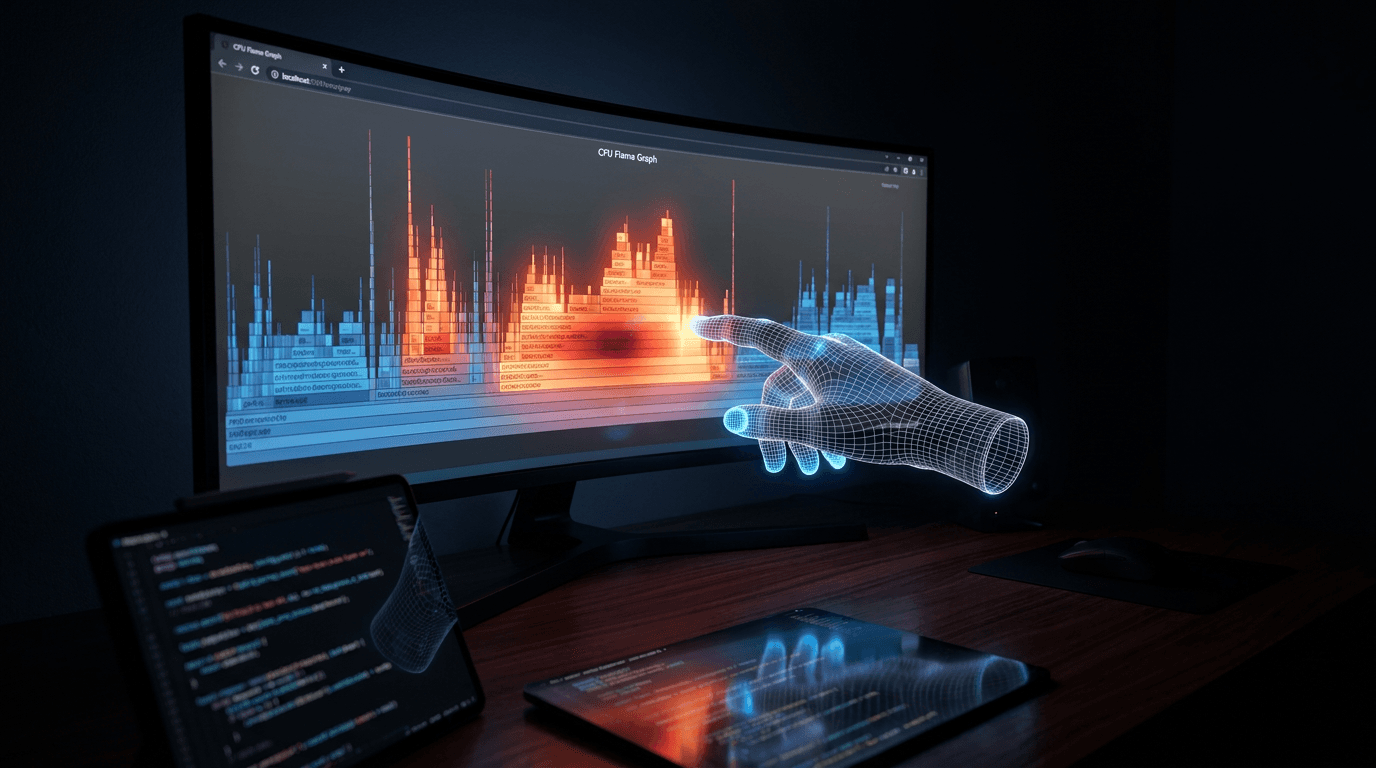
The most dramatic demonstration of K2.6's autonomous execution capabilities comes from a real-world optimization task. Kimi K2.6 autonomously overhauled exchange-core, an 8-year-old open-source financial matching engine. Over a 13-hour execution, the model iterated through 12 optimization strategies, initiating over 1,000 tool calls to precisely modify more than 4,000 lines of code. Acting as an expert systems architect, Kimi K2.6 analyzed CPU and allocation flame graphs to pinpoint hidden bottlenecks and boldly reconfigured the core thread topology (from 4ME+2RE to 2ME+1RE). Despite the engine already operating near its performance limits, Kimi K2.6 extracted a 185% medium throughput leap (from 0.43 to 1.24 MT/s) and a 133% performance throughput gain (soaring from 1.23 to 2.86 MT/s).[7]
In another demonstration, K2.6 ran continuously for 12+ hours to port and optimize a Qwen3.5-0.8B inference engine in Zig on a Mac, making 4,000+ tool calls across 14 iterations and raising throughput from roughly 15 to 193 tokens per second — about 20% faster than LM Studio on the same hardware.[4]
The Caveat on Verification
These three cases are Moonshot's own internally-run demonstrations. They are sourced from the official Kimi K2.6 technical blog. They are vendor-reported results, not independently verified by third parties. As DEV Community noted in their K2.6 analysis: no complete public patch set, raw flame graphs, or full execution logs exist for the exchange-core rewrite at the time of this writing.[6]
Claw Groups: The Multi-Agent Collaboration Preview
Perhaps the most forward-looking feature in K2.6 is Claw Groups, which ships as a research preview.
Beyond Moonshot's own swarm infrastructure, K2.6 introduces Claw Groups as a research preview — a new feature that opens the agent swarm architecture to an external, heterogeneous ecosystem. The key design principle: multiple agents and humans operate as genuine collaborators in a shared operational space. Users can onboard agents from any device, running any model, each carrying their own specialized toolkits, skills, and persistent memory contexts — whether deployed on local laptops, mobile devices, or cloud instances. At the center of this swarm, K2.6 serves as an adaptive coordinator.[2]
Moonshot has been using Claw Groups internally to run their own content production and launch campaigns, with specialized agents including Demo Makers, Benchmark Makers, Social Media Agents, and Video Makers working in parallel — with K2.6 coordinating the process. For devs thinking about multi-agent orchestration architectures, this is worth looking into: it represents a shift from 'AI does tasks for you' to 'AI coordinates a team of heterogeneous agents, some of which you built, on your behalf.'[2]
The Claw Groups feature also enables an unprecedented operational endurance claim. These workflows require AI to proactively manage schedules, execute code, and orchestrate cross-platform operations without human oversight. Moonshot's own RL infrastructure team used a K2.6-backed agent that operated autonomously for 5 days, managing monitoring, incident response, and system operations.[2]
The "Claw Groups" functionality — which enables human-machine collaboration where an autonomous run can loop in human workers for specific subtasks — is listed as a research preview at launch, not a generally available capability.[5]
Coding-Driven Design: Frontend That Doesn't Look AI-Generated
Beyond agentic coding and swarm orchestration, K2.6 makes a strong claim in a category that most AI models have struggled with: generating visually polished frontend work.
Coding-Driven Design: K2.6 is capable of transforming simple prompts and visual inputs into production-ready interfaces and lightweight full-stack workflows, generating structured layouts, interactive elements, and rich animations with deliberate aesthetic precision.[1]
Kimi K2.6 transforms simple prompts into Awwwards-level front-end interfaces. From high-impact hero sections, interactive elements, to scroll-triggered animations, every detail feels crafted rather than generated.[1]
Go beyond the surface. Kimi K2.6 makes it easier to create user authentication, interactions, and database operations for lightweight use cases, so that you can build a complete, working website, all from a single prompt.[1]
This is a real shift in what open-source models have been optimized for. The previous generation — including K2.5, Qwen variants, and DeepSeek's coding models — could write functional React. They could not, however, produce the kind of motion-rich, polished frontend output that you'd want to show a client. K2.6 is the first open-weight model where the output approaches something you'd actually ship without embarrassment.[10]
The Vercel partnership provides independent validation. K2.6 shows major gains over K2.5 on the capabilities our developers care about most: we're seeing more than 50% improvement on our Next.js benchmark, putting it among the top-performing models on the platform. Combined with its cost-performance ratio, it's a compelling option for agentic coding and front-end generation through AI Gateway.[7]
Moonshot even claims K2.6 can compete directly with Google's Gemini 3.1 Pro in frontend design. Moonshot/Kimi continues to compete at a level far above "just being open source versions of Frontier models" — they are taking on Gemini 3.1 in their home turf of frontend design, touting a 68.6% win+tie rate vs Gemini 3.1 Pro.[6]
The Skills System: Turning Documents into Reusable Capabilities
One of K2.6's most practically useful features is the ability to convert documents into reusable agent skills.
High-quality documents can now become reusable skills with Kimi K2.6, which captures how great work is structured and written. Apply these skills across future tasks to produce consistent, high-quality results without starting from scratch. Instead of repeating effort, your best work becomes something you can reuse, refine, and scale over time. When combined with Agent Swarm, these skills help produce more structured, consistent, and high-quality outputs across complex tasks.[1]
The Kilo Blog post points out that K2.6 also lets you convert files — PDFs, spreadsheets, slide decks, Word documents — into agent skills. That is: you give the swarm your company's SOP doc, and it becomes a callable capability inside your agent. This moves agent infrastructure meaningfully toward the "plug-in your institutional knowledge" workflow that Microsoft, Google, and OpenAI have all been circling for a year.[10]
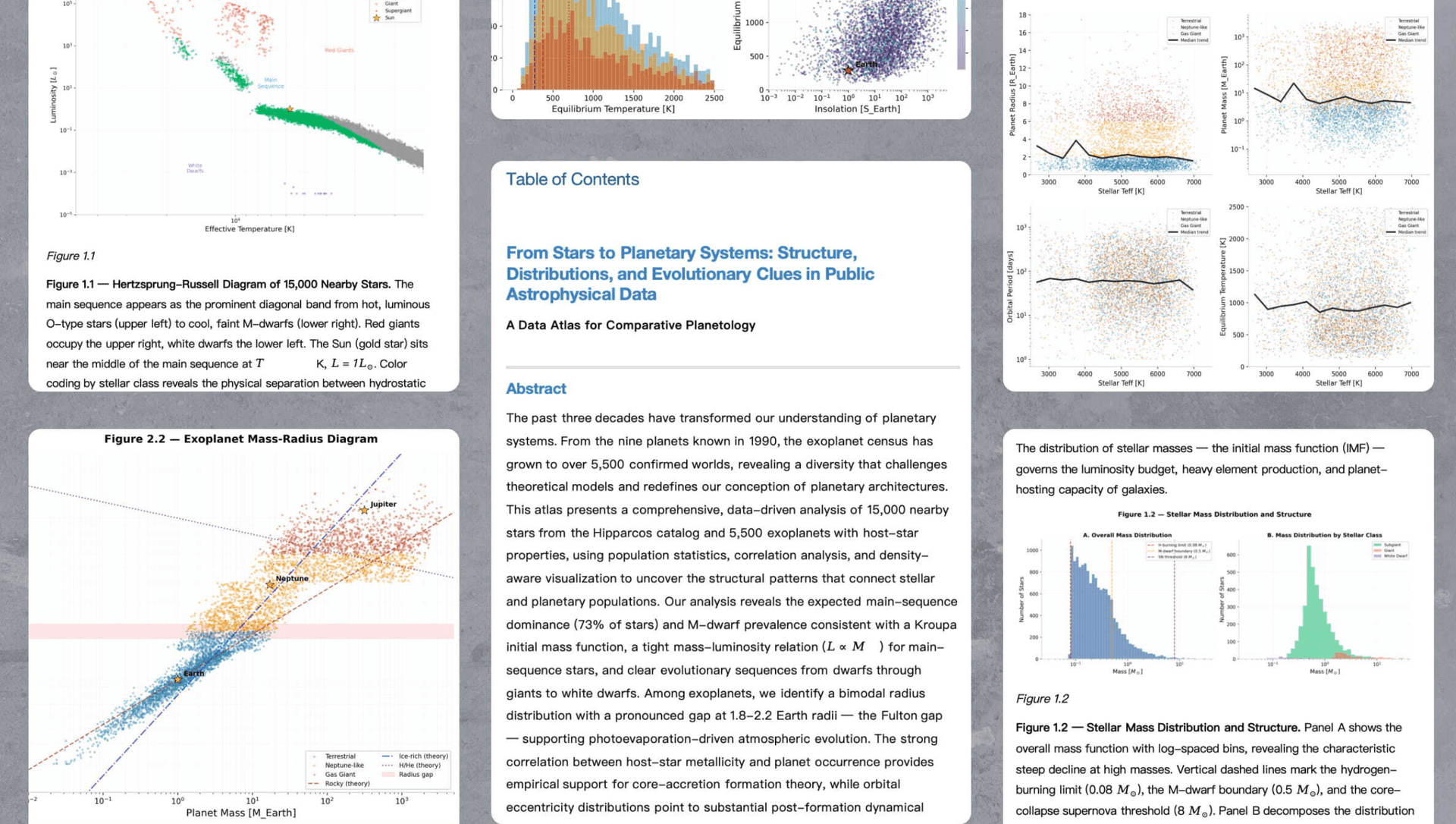
The demonstrations show scale. Designed and executed 5 quantitative strategies across 100 global semiconductor assets, deriving McKinsey-style PPT as reusable skills, and delivering detailed modeling spreadsheets and a full executive presentation. Turned a high-quality astrophysics paper with rich visual data into a reusable academic skill, deriving its reasoning flow and visualization methods, and produced a 40-page, 7,000-word research paper, a structured dataset with 20,000+ entries, and 14 astronomy-grade charts. Based on the uploaded CV, K2.6 spawned 100 sub-agents to match 100 relevant roles in California, delivering a structured dataset of opportunities and 100 fully customized resumes.[7]
Pricing: The Cost Advantage That Changes the Math
The pricing story is where K2.6 becomes genuinely disruptive.
Official API Pricing
Kimi K2.6 costs $0.95 per 1M input tokens (somewhat higher than average, median: $0.60) and $4.00 per 1M output tokens (at the higher end, median: $2.30), based on Kimi's API.[3]
Compared to GPT-5.5
GPT-5.5 is also the more expensive model on tokens at $5.00 input / $30.00 output per 1M tokens, versus $0.95 input / $4.00 output per 1M tokens for Kimi 2.6.[3]
Kimi is roughly 5x cheaper on input and over 7x cheaper on output per million tokens.[5]
Third-Party Provider Pricing
The most affordable providers for Kimi K2.6 by blended price are Parasail ($1.15 per 1M tokens), DeepInfra (FP4) ($1.44 per 1M tokens), and Fireworks ($1.71 per 1M tokens). Blended price uses a 3:1 input to output token ratio.[8]
Cached Token Savings
Cached input tokens cost $0.15 per million (versus $0.60 standard) — a 75% reduction that happens automatically with no configuration. Teams maintaining large system prompts or repeated context across sessions see this benefit immediately.[1]
Subscription Tiers
Starts at $19/month (Moderato) and gives you K2.6 inside the Kimi chat interface with agent credits, Deep Research, Kimi Code access, and Slides and Websites tools included. Higher tiers — Allegretto ($39), Allegro ($99), and Vivace ($199) — unlock Agent Swarm with up to 300 parallel subagents, more Kimi Code credits, Kimi Claw cloud deployment, and significantly larger Professional Data quotas.[4]
The Cost-Per-Task Reality
The catch: per-token cheap doesn't equal per-task cheap. Ethan Mollick's Lem Test had K2.6 generating a 74-page thinking trace to produce an okay-ish answer.[4] On reasoning-heavy workloads, the headline 88% savings compresses to something more like 60–70%. Meaningful, but it has to be calculated against actual workflow shape, not the rate card.[4]
Kimi K2.6 has significantly higher token usage than Kimi K2.5.[8] Kimi K2.6 demonstrates high token usage, but is in line with other frontier models in the same intelligence tier. To run the full Artificial Analysis Intelligence Index, Kimi K2.6 used ~160M reasoning tokens. This is slightly lower than Claude Sonnet 4.6 (~190M reasoning tokens) but much higher than GPT 5.4 (~110M reasoning tokens).[8]
Independent Benchmark Cost Comparison
In a detailed independent coding benchmark, the cost picture becomes clearer. Tier A cost-effective: Kimi K2.6 ($0.30/run), Gemini 3.1 Pro ($0.40/run). 3-4× cheaper than Opus/GPT with comparable quality within this benchmark.[8] Cost: K2.6 $0.30/run vs Opus 4.7 $1.10/run. 3.6× cheaper. In continuous production runs, that difference accumulates.[8]
For roughly 80% of standard tasks (code generation, unit tests, refactors, UI prototyping), K2.6 delivers 80–90% of Claude Code's quality at about 12% of the cost.[4]
K2.6 vs GPT-5.5: The Complete Comparison
The comparison between K2.6 and GPT-5.5 is the most commercially relevant matchup for developers choosing between open and closed models.
Where GPT-5.5 Clearly Wins
GPT-5.5 dominates the overall intelligence picture. GPT-5.5 is clearly ahead on the provisional aggregate, 93 to 85. GPT-5.5's sharpest advantage is in knowledge, where it averages 66.4 against 53.8. The single biggest benchmark swing on the page is HLE, 52.2% to 34.7%.[3]
Where K2.6 Wins or Ties
On SWE-Bench Pro coding benchmarks, Kimi K2.6 ties GPT-5.5 at 58.6.[5] Kimi 2.6 has the edge for multimodal and grounded tasks in this comparison, averaging 79.7 versus 70.4. Inside this category, MMMU-Pro w/ Python is the benchmark that creates the most daylight between them.[3]
The Practical Recommendation
Test Kimi K2.6 first when the job is low-cost coding-agent exploration, test DeepSeek V4 Flash or V4 Pro when you need a cheap callable API route today, use GPT-5.5 inside ChatGPT or Codex while its API contract is still pending, and keep Claude Opus 4.7 first when hidden defects, long context, and review cost matter more than token price.[2]
The practical rule is not "pick the model with the loudest launch week." Pick the route whose official contract matches the work, then run the same task before changing defaults.[2]
K2.6 vs Claude Opus 4.7 and Opus 4.6
Claude Opus 4.7 released the same week as K2.6 and sits above Opus 4.6; direct K2.6 vs. Opus 4.7 comparisons are not in K2.6's launch benchmarks. The practical framing: K2.6 is strong for multi-step agent tasks and cost-sensitive workloads; for one-shot complex reasoning, the current proprietary models are still ahead.[5]
Against Opus 4.6 specifically: Kimi K2.6 is the highest-ranked open weights model with an Intelligence Index score of 54. There are 234 open weights models out of 367 total evaluated.[10]
Claude Opus 4.7 remains the first route for high-risk work where a hidden bug costs more than the token bill.[2]
In the most detailed independent coding benchmark: Kimi K2.6 vs Opus 4.7 (Tier A vs Tier A): 87 vs 97. 10-point gap. In practice, both deliver correct RubyLLM, real-signature FakeChat, error rescue, multi-worker-safe session cookie, complete Gemfile. What Opus 4.7 has extra are secondary dimensions that accumulate: tests that cover error wrapping, model/provider override and explicit system prompt application; redundant rescue in the controller beyond the service; slightly better concerns separation. Perceptible differences side by side, but not tier-separated.[8]
Partner Ecosystem and Availability
Where to Access K2.6
The company removed the "Preview" label and shipped Kimi K2.6 as a generally available model across Kimi.com, the Kimi App, the official API, and the Kimi Code CLI.[8]
Moonshot's Kimi K2.6 was the clear release of the day: an open-weight 1T-parameter MoE with 32B active, 384 experts (8 routed + 1 shared), MLA attention, 256K context, native multimodality, and INT4 quantization, with day-0 support in vLLM, OpenRouter, Cloudflare Workers AI, Baseten, MLX, Hermes Agent, and OpenCode.[6]
Kimi K2.6 is available through 8 API providers: Fireworks, Parasail, Novita, Cloudflare, Together.ai (FP4), DeepInfra (FP4), SiliconFlow (FP8), and Clarifai. Each provider offers different performance characteristics and pricing.[8]
Kimi K2.6 is free to use on kimi.com and the Kimi mobile app. The API costs $0.95 per million input tokens and $4.00 per million output tokens.[5]
Self-Hosting Requirements
K2.6 weights are on Hugging Face and run on vLLM, SGLang, or KTransformers. Minimum viable hardware is 4× H100 for the INT4 variant at reduced context. Claude and GPT-5.4 are API-only — there is no self-hosted path.[5]
The full model is too large for most Macs. GGUF-quantised versions exist but still need 350 GB+ of unified memory, which means an M5 Ultra Mac Studio with 512 GB.[5]
API Compatibility
The API is fully OpenAI-compatible — swap in model: "kimi-k2.6" and you're running the latest model in any existing workflow.[4]
Provider Performance Comparison
Clarifai is the fastest at 163.6 t/s, which is 8.3x faster than DeepInfra (FP4) at 19.6 t/s.[8] The best provider for Kimi K2.6 depends on your priorities: Clarifai offers the highest output speed, Fireworks has the lowest latency, and Parasail provides the most competitive pricing.[8]
Partner Validations
Kilo Code's CEO was direct: —Scott Breitenother, Co-founder & CEO, Kilo Code.[5] We found Kimi K2.6 to be tremendously capable at handling the rigorous, day-to-day processing required to support an always-on agent like KiloClaw. Over a continuous 13-hour execution period, Kimi K2.6 independently iterated through 12 optimization strategies, made over 1,000 tool calls, and precisely modified more than 4,000 lines of code.[5]
Kimi K2.6 demonstrates significant improvements over K2.5 in internal evaluations conducted by CodeBuddy: code generation accuracy increased by 12%, long-context stability improved by 18%, and tool invocation success rate reached 96.60%. Its stronger reasoning capabilities and more consistent output quality provide robust support for ensuring a reliable user experience in CodeBuddy WorkBuddy.[7]
The License: Modified MIT with One Catch
The license is standard MIT with one modification: if you deploy K2.6 (or a derivative) in a commercial product or service that exceeds 100 million monthly active users, or that generates more than $20 million USD in monthly revenue, you must prominently display "Kimi K2" on the user interface of that product. Below those thresholds, the license functions as standard MIT — use commercially, modify, redistribute, no royalties. The thresholds affect a small fraction of potential users. Most teams, including well-funded startups, sit well below both limits.[5]
One license clause that gets overlooked: Modified MIT requires visible "Kimi K2.6" branding on products with 100M+ monthly active users or $20M+ monthly revenue. For most companies this is a non-issue. For hyperscalers planning to embed K2.6 in user-facing products, it's a legal review item.[4]
The Hallucination Story
One underreported aspect of K2.6 is its improved hallucination resistance. This score is primarily driven by a comparatively low hallucination rate of 39% (reduced from Kimi K2.5's 65%), indicating a greater capability to abstain rather than fabricate knowledge when the model is uncertain. Kimi K2.6's low hallucination rate places it similarly to other models such as Claude Opus 4.7 (36%) and MiniMax-M2.7 (34%).[8]
Dropping the hallucination rate from 65% to 39% in a single release is a substantial improvement — and it brings K2.6 into the same territory as Anthropic's flagship on this metric.
Limitations and Honest Weaknesses
Not a Universal Frontier Model
K2.6 is a capable open-weight model for teams doing long-horizon agent work who need either cost control, data sovereignty, or both. Its technical differentiation — 300-agent swarms, 12-hour autonomous runs, native multimodal — is real but specialized. It won't replace simpler coding assistants for day-to-day development work, and it won't run cheaply on consumer hardware.[5]
Weak Multimodal Performance
Kimi 2.6 ranks #26 out of 115 models in multimodal and grounded tasks benchmarks with an average score of 68.1.[7] This is a significant weakness for teams that need strong vision or grounded capabilities.
Reasoning Gap on High-Stakes Tasks
Avoid K2.6 when: the task is single-turn high-stakes reasoning where being wrong is expensive — financial trading decisions, medical interpretation, legal analysis. K2.6 lags GPT-5.4 on GPQA-Diamond (90.5% vs 92.8%) and AIME 2026 (96.4% vs 99.2%).[4]
Geopolitical and Compliance Context
Geopolitical context. Moonshot AI is a Chinese company, and K2.6's launch arrives during ongoing scrutiny of Chinese AI firms in the US market. The US House is considering legislation that could affect Chinese AI companies operating internationally. For teams with compliance requirements, the vendor jurisdiction is a relevant factor alongside technical capability.[5]
Platform Maturity
For vendor stability, both Anthropic and OpenAI have demonstrated sustained platform reliability; Moonshot's API platform is newer and has less production history at scale. For enterprise compliance and procurement risk, US-origin models (Anthropic, OpenAI) have faster security review cycles at large organizations.[5]
Token Usage
When evaluated on the Intelligence Index, Kimi K2.6 generated 170M output tokens, which is at the higher end compared to other open weight models of similar size (median: 47M).[3] High token usage on reasoning-heavy tasks can erode the cost advantage.
Benchmark Verification Caveat
One upfront caveat that matters throughout: all benchmark numbers in this article are sourced from vendor announcements. No numbers in this article come from independent third-party replication at launch. That is the norm for model releases, not an excuse — it's context for how much weight to put on any individual score.[5]
Who Should Use Kimi K2.6 (And Who Shouldn't)
Use K2.6 When:
You need cost-effective agentic coding at scale. For most readers the honest answer is: yes for coding-heavy work, no as a full ChatGPT replacement. If you live in an IDE, run autonomous coding agents, or burn through API tokens on Claude Code or Cursor, K2.6 is the most compelling cost-per-quality switch on the market right now.[5]
You need long-horizon autonomous execution. The 12-hour, 4,000-tool-call runs are a category difference. No other open-weight model has demonstrated this operational endurance.
You need data sovereignty or self-hosting. The open-weight license means you can run K2.6 on your own infrastructure — something impossible with Claude or GPT-5.5.
You're a startup watching your API budget. The cost-effective sweet spot now is Kimi K2.6 at $0.30/run or Gemini 3.1 Pro at $0.40/run. Both Tier A. 3-4× cheaper than Opus.[8]
You need autonomous web research. The DeepSearchQA F1 score of 92.5% vs GPT-5.4's 78.6% makes K2.6 the strongest option for workflows involving information gathering and synthesis.
Don't Use K2.6 When:
The task is high-stakes single-turn reasoning. Financial decisions, medical interpretation, legal analysis — stick with GPT-5.5 or Claude Opus 4.7.
You need strong multimodal/vision performance. K2.6 ranks #26 of 115 on multimodal benchmarks.
Enterprise compliance requires US-based vendors. The geopolitical context is a real procurement factor.
You need the best overall model regardless of cost. GPT-5.5 leads the overall Intelligence Index at 60 vs K2.6's 54.
The Broader Significance: Open-Source Catches Up
Chinese AI models have grown rapidly in adoption among startups, and it's not hard to see why. The pattern across the Kimi model family — K2, K2 Thinking, K2.5, and now K2.6 — shows consistent, rapid iteration with each release pushing further into territory previously held by closed US models. K2.6 is open-source, competitively priced, and capable of sustained autonomous execution at a level that closed models from OpenAI and Anthropic are still working toward.[3]
Kimi K2.6 is representative of a broader development: China's position in the global AI competition has fundamentally changed within just 18 months. As recently as mid-2024, the Chinese AI industry was considered technologically lagging behind US-based Frontier Labs. Today, models from DeepSeek, Moonshot AI, and other Chinese labs compete on equal footing with—and in some respects ahead of—the offerings from OpenAI, Anthropic, and Google.[7]
Kimi K2.6 shows how quickly open-weight frontier models are catching up to closed-source leaders, especially in coding, tool use, and long-horizon agent workflows. It is not better at everything, but it is strong enough to be part of the serious comparison now, not just the budget alternative. Western labs face rising pressure. While premium models excel in multimodal performance, polish, and enterprise reliability, they must now justify higher prices with a superior overall product, as open models are no longer inherently second-tier.[4]
What's Next: The Road to K3
The Reddit leak that preceded K2.6 also referenced Kimi K3, reportedly targeting 3-4 trillion parameters to match the scale of frontier American models. The K2.6 GA release lends that rumor more weight: the 12-hour execution envelope and 300-agent swarm are capabilities that scale cleanly into a larger base model, and Moonshot would not invest in the execution-layer infrastructure unless a bigger model was coming to exploit it.[8]
K2.6 is not the endpoint. It is the harness being built so that when K3 lands, it has somewhere to run.[8]
Frequently Asked Questions
What is Kimi K2.6?
Kimi K2.6 is a 1-trillion-parameter open-weight Mixture-of-Experts model released by Moonshot AI on April 20, 2026. It has 32 billion active parameters per forward pass, a 256K context window, and is optimized for long-horizon agentic tasks.[4]
When was Kimi K2.6 released?
Moonshot rolled it out to all subscribers on April 13, 2026, after a closed beta that ran for approximately one week.[10] The full open-weight release with Hugging Face weights followed on April 20, 2026.
Is Kimi K2.6 free?
Kimi K2.6 is free to use on kimi.com and the Kimi mobile app. The API costs $0.95 per million input tokens and $4.00 per million output tokens.[5] The weights are free to download from Hugging Face under a Modified MIT License.
Is Kimi K2.6 better than GPT-5.5?
Pick GPT-5.5 if you want the stronger benchmark profile. Kimi 2.6 only becomes the better choice if coding is the priority or you want the cheaper token bill.[3]
How does K2.6 compare to Claude Opus 4.7?
The practical framing: K2.6 is strong for multi-step agent tasks and cost-sensitive workloads; for one-shot complex reasoning, the current proprietary models are still ahead.[5]
What is the context window?
Kimi 2.6 has a context window of 256K, which determines how much text it can process in a single interaction.[7]
Can I run it locally?
K2.6 weights are on Hugging Face and run on vLLM, SGLang, or KTransformers. Minimum viable hardware is 4× H100 for the INT4 variant at reduced context.[5]
What is Agent Swarm?
Agent Swarm can run up to 300 sub-agents at once, each taking 4,000 steps. The system automatically splits tasks into subtasks and hands them off to specialized agents.[5]
What is Claw Groups?
The Claw Groups feature (currently research preview) extends this further: it allows humans and agents from heterogeneous sources — any model, any device — to participate in the same swarm, with K2.6 coordinating across the mixed pool.[6]
Who is Moonshot AI?
Moonshot AI is an artificial intelligence company based in Beijing, China. It has been dubbed one of China's "AI Tiger" companies by investors with its focus on developing large language models. Moonshot was founded in March 2023 by Yang Zhilin, Zhou Xinyu and Wu Yuxin who were schoolmates at Tsinghua University.[1]
What license does K2.6 use?
The license is standard MIT with one modification: if you deploy K2.6 (or a derivative) in a commercial product or service that exceeds 100 million monthly active users, or that generates more than $20 million USD in monthly revenue, you must prominently display "Kimi K2" on the user interface of that product. Below those thresholds, the license functions as standard MIT — use commercially, modify, redistribute, no royalties.[5]
Conclusion
Kimi K2.6 is the most capable open-weight model available as of April 2026. It ties GPT-5.5 on SWE-Bench Pro at 58.6%, leads all frontier models on Humanity's Last Exam with tools at 54.0%, and delivers these results at roughly one-fifth the token cost. The Agent Swarm architecture — 300 sub-agents, 4,000 coordinated steps, 12+ hours of continuous autonomous execution — has no equivalent in any other model, open or closed.
It is not, however, a universal frontier model. GPT-5.5 leads on overall intelligence (60 vs 54 on the Artificial Analysis Index), Claude Opus 4.7 leads on high-stakes code quality and reasoning, and Gemini 3.1 Pro offers even cheaper pricing with a 2M context window. K2.6's multimodal performance is mediocre, its pure reasoning trails the top proprietary models, and the geopolitical context of a Chinese-origin model matters for enterprise procurement decisions.
That makes this a router design problem, not a leaderboard problem.[2] The teams that will benefit most from K2.6 are those already running agentic coding pipelines who need to reduce costs without sacrificing code quality, those who need data sovereignty through self-hosting, and those building multi-agent systems where K2.6's native swarm infrastructure eliminates the need for custom orchestration.
The interesting question about Kimi K2.6 is not what it does, it is what kind of model it is clearly being built to host.[8] With K3 rumored at 3-4 trillion parameters, K2.6's Agent Swarm, Claw Groups, and Skills infrastructure look less like features and more like scaffolding for something considerably larger.
For now, K2.6 has firmly established that the open-weight frontier is no longer a tier below the proprietary frontier, at least not on the tasks that matter most for software engineers and autonomous agent builders.
References
- moonshotai/Kimi-K2.6 · Hugging Face
- Kimi K2.6 - API Pricing & Providers | OpenRouter
- Kimi K2.6 vs GPT-5.4 vs Claude Opus: Who Wins? (2026)
- Kimi K2.6 | Leading Open-Source Model in Coding & Agent
- Moonshot AI - Wikipedia
- Kimi K2.6: Pricing, Benchmarks & Performance
- Moonshot AI Releases Kimi K2.6 with Long-Horizon Coding, Agent Swarm Scaling to 300 Sub-Agents and 4,000 Coordinated Steps - MarkTechPost
- Kimi K2.6 Pricing for API and Membership
- Kimi K2.6 vs DeepSeek V4 vs GPT-5.5 vs Claude Opus 4.7: Which Should You Test First? | LaoZhang AI Blog
- Moonshot AI 2026 Company Profile: Valuation, Funding & Investors | PitchBook
- Kimi K2.6 - Kimi API Platform
- Kimi AI with K2.6 | Better Coding, Smarter Agents
- Moonshot AI Releases Kimi K2.6, Beats Top US Models On Some Benchmarks
- Kimi K2.5 - API Pricing & Providers | OpenRouter
- Kimi K2.6 - Intelligence, Performance & Price Analysis
- GPT-5.5 vs Kimi 2.6: AI Benchmark Comparison 2026 | BenchLM.ai
- China AI start-up Moonshot snags funds at US$18 billion valuation | South China Morning Post
- Kimi AI Pricing 2026: Plans, Membership Cost & API Token Rates
- Kimi K2.6 Tested: Does It Beat Claude and GPT-5? | Lorka AI
- Moonshot AI Releases Kimi K2.6 with 256K Context and 300-Agent Swarms
- Alibaba-backed startup Moonshot AI's valuation is up $500 million, sources say, after its rivals IPO in Hong Kong
- Kimi K2.6 & Kimi Code Review: Saving 88% Coding Costs? | by Ewan Mak | Apr, 2026 | Medium
- Kimi K2.6 Has Arrived: An Open-Weight Powerhouse for Agentic Work
- Kimi K2.6: The Open-Source AI Tying GPT-5.5 on Coding
- What Is Kimi K2.6? Moonshot AI's Open-Weight Agent Model Explained - Verdent Guides
- Multi-modal Model Kimi K2.6 Pricing - Kimi API Platform
- Kimi K2.6 vs Claude Opus 4.6 vs GPT-5.4: Agentic Coding Benchmarks (2026) - Verdent Guides
- Open-weight Kimi K2.6 takes on GPT-5.4 and Claude Opus 4.6 with agent swarms
- Moonshot AI chases $1B at $18B valuation, hot on heels of $10B round — TFN
- AINewsAINewsAINews Moonshot Kimi K2.6: the world's leading Open Model refreshes to catch up to Opus 4.6 (ahead of DeepSeek v4?)
- Four Giants, One Winner: Kimi K2.5 vs GPT-5.2 vs Claude Opus 4.5 vs Gemini 3 Pro Comparison | by Cogni Down Under | Medium
- Kimi K2.6 Agent Swarm: 300 Sub-Agents and 4,000 Steps Explained - Verdent Guides
- Moonshot AI - 2026 Funding Rounds & List of Investors - Tracxn
- Kimi K2.6 Review: Better Reasoning, 100-Agent Swarms (2026) | eesel AI
- Kimi 2.6 Benchmarks 2026: Scores, Rankings & Performance | BenchLM.ai
- Kimi K2.6 Tech Blog: Advancing Open-Source Coding
- Kimi K2.5 - Intelligence, Performance & Price Analysis
- Kimi K2.6 vs DeepSeek V2 vs GPT-5.5 vs Claude Opus 4.7: Which Should You Test First? | LaoZhang AI Blog
- Kimi K2.6 – The AI agent swarm from China: When 300 agents think together
- Moonshot AI (Business/Productivity Software) 2026 Company Profile: Valuation, Funding & Investors | PitchBook
- Kimi K2.6 Officially Released: The Agentic Coding Era Enters Production
- Kimi K2.6: The new leading open weights model
- Meet Kimi K2.6: Advancing Open-Source Coding - Announcement - Kimi Forum
- Kimi K2.6: API Provider Performance Benchmarking & Price Analysis | Artificial Analysis
- LLM Coding Benchmark (April 2026): GPT 5.5, DeepSeek v4, Kimi v2.6, MiMo, and the State of the Art – AkitaOnRails.com
- Kimi - Apps on Google Play
- China AI Startup Moonshot Snags Funds at $18 Billion Valuation
- Moonshot AI Kimi K2.6 now available on Workers AI · Changelog
- Kimi API Pricing Calculator & Cost Guide (Apr 2026)
- China's Moonshot AI raises US$500 million in latest funding round: report
- moonshotai/Kimi-K2-Thinking · Hugging Face
- Kimi Code K2.6 Preview: What Developers Need to Know (2026)
- Kimi K2.5 Pricing 2026: Plans, API Costs & Free Tier Explained | NxCode
- Kimi K2.6 vs Claude Opus 4.6 (Non-reasoning, High Effort): Model Comparison
- Meet Kimi K2.6: Moonshot AI's Open-Source Bet on Long-Horizon Agentic Coding - Kingy AI
- China AI Startup Moonshot Seeks $10 Billion Value in New Funding