Wan 2.7 vs Veo 3.1: Which AI Video Model Is Actually Better in 2026

Written by
Jay Kim
Wan 2.7 vs Veo 3.1 compared feature by feature for creators in 2026. Control, quality, pricing, audio, open source vs closed source, and which model fits your workflow.
If you are a creator choosing between AI video tools in 2026, you have probably already narrowed your shortlist down to two names: Wan 2.7 from Alibaba's Tongyi Lab and Veo 3.1 from Google DeepMind. These are the two most discussed AI video generation models of the year, and for good reason. Both represent genuine leaps over everything that came before them, but they take fundamentally different approaches to solving the same problem.
Wan 2.7 is the open-source powerhouse that gives creators full control over every aspect of the generation pipeline, from first and last frame control to instruction-based editing to combined subject and voice referencing. Veo 3.1 is Google's closed, cloud-native model that prioritizes cinematic realism and native audio generation with the kind of polish that comes from training on one of the largest video datasets ever assembled.
The question is not which one is better in the abstract. The question is which one is better for your specific workflow, your budget, your content format, and your technical comfort level. This comparison breaks down every meaningful difference between the two models so you can make an informed decision instead of chasing hype.
Whether you create YouTube content, social media videos, product demos, or cinematic short films, understanding the strengths and tradeoffs of both models is essential if you want to build an efficient content pipeline alongside tools like Miraflow AI.
A Quick Overview: What Each Model Actually Is
Before diving into the feature-by-feature comparison, it helps to understand the fundamentals of each model and where they come from.
Wan 2.7
Wan 2.7 is the latest evolution of Alibaba's open-source AI video generation model, built on a 27-billion-parameter Mixture-of-Experts (MoE) architecture where only 14 billion parameters are active per inference pass.[1] It was released in March and April 2026 and includes features like first and last frame control, 9-grid image-to-video, instruction-based video editing, combined subject and voice referencing, and a thinking mode that plans composition before generating.[2]
Wan 2.7 generates 1080P videos up to 15 seconds, supports 16:9, 9:16, and 1:1 aspect ratios, and is available as open-source weights under a permissive license as well as through cloud APIs from Together AI and Alibaba's DashScope platform.[3]
If you want a deeper dive into Wan 2.7 on its own, we covered it comprehensively in our guide on What Is Wan 2.7: Everything Creators Need to Know in 2026.
Veo 3.1
Veo 3.1 is Google DeepMind's latest video generation model, building on the foundation laid by Veo 3 which was first announced at Google I/O 2025.[4] Veo 3 was the first model to generate video with built-in dialogue, sound effects, and ambient audio in a single pass, which was a breakthrough moment for AI video.[5]
Veo 3.1, released in early 2026, pushes this further with improved resolution support up to 4K, extended generation lengths, better prompt adherence for complex multi-element scenes, and refined audio-visual synchronization. It is available through Google's AI Studio, the Vertex AI platform, and the consumer-facing VideoFX tool.[6]
Veo 3.1 is a closed-source, API-only model. You cannot download the weights, run it locally, or fine-tune it. All generation happens through Google's cloud infrastructure.
Architecture: How They Are Built Differently
The architectural differences between these two models explain most of the practical differences creators experience when using them.
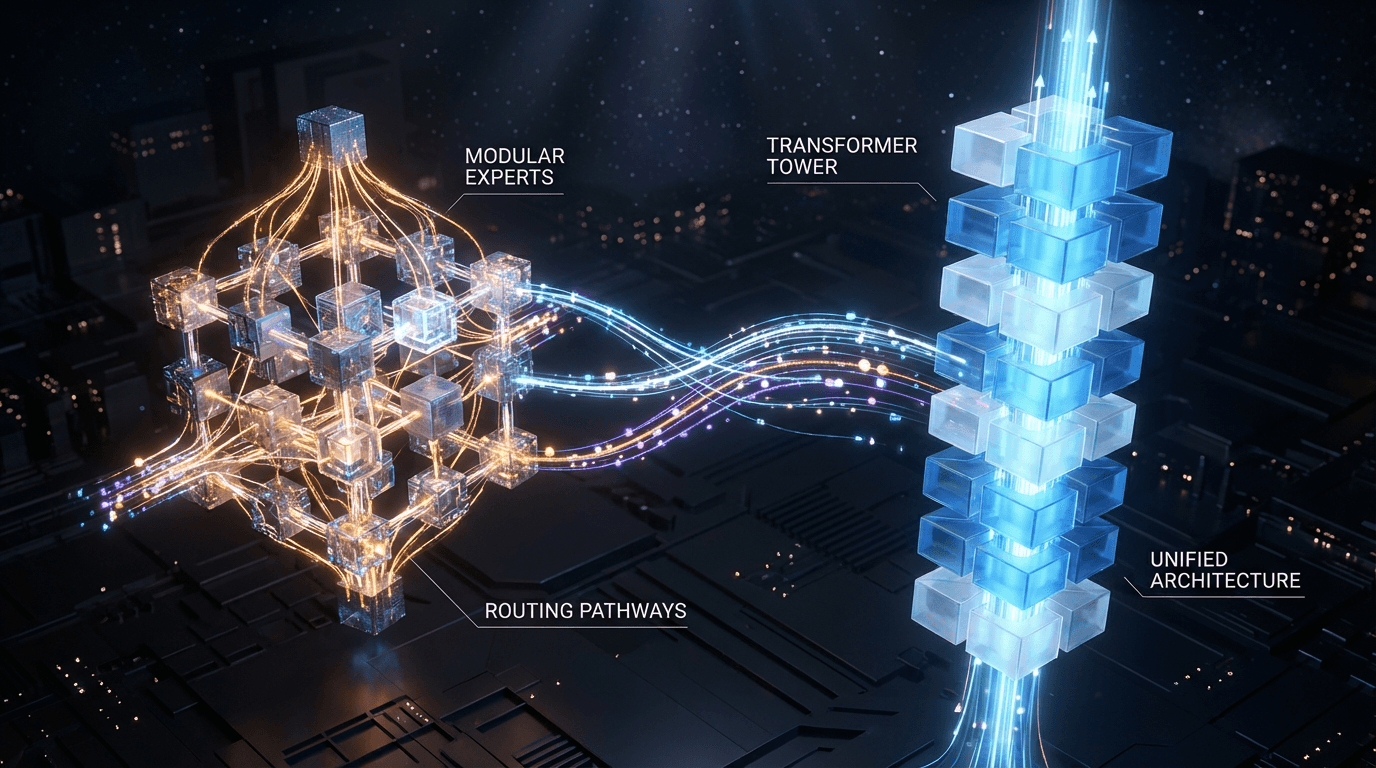
Wan 2.7 runs on a Diffusion Transformer (DiT) architecture with a Mixture-of-Experts routing system. The model has specialized expert networks that handle different phases of the denoising process, where high-noise experts manage initial composition and layout while low-noise experts handle fine detail and texture refinement.[7] This specialization is what gives Wan 2.7 its notable control over composition and its ability to follow structured inputs like the 9-grid layout and first/last frame references.
Veo 3.1 is built on Google's proprietary transformer architecture that integrates video and audio generation into a unified pipeline. Google has not published the full architectural details, but based on their published research and the capabilities of the model, Veo 3.1 uses a latent diffusion framework with a significantly larger training dataset than any open-source competitor, including licensed footage from partnerships with content creators and studios.[5]
The key architectural distinction is this: Wan 2.7 optimizes for control and modularity, giving you multiple input surfaces to steer generation, while Veo 3.1 optimizes for end-to-end quality and realism, using a massive training corpus to produce outputs that require less manual steering to look cinematic.
This is not a minor difference. It shapes every aspect of how you interact with each model, from how you write prompts to how you plan your content pipeline.
For creators exploring AI-powered content creation pipelines, understanding these architectural choices helps you pick the right tool for each stage of production. The Cinematic Video Generator in Miraflow AI, for instance, abstracts away architectural complexity and lets you generate professional video clips directly from text prompts without needing to understand the underlying model.
Feature-by-Feature Comparison
This is where the comparison gets practical. Let's walk through the features that matter most to creators and see how each model handles them.

Video Quality and Resolution
Veo 3.1 has a clear advantage in raw visual fidelity. It supports output resolutions up to 4K, and even at lower resolutions, the per-frame quality consistently looks closer to professionally shot footage than any other AI video model currently available. The lighting, skin textures, fabric movement, and environmental details all benefit from Google's enormous training dataset.[6]
Wan 2.7 generates at 1080P, which is excellent for most use cases including YouTube, social media, and web content. The visual quality is strong and has improved significantly over Wan 2.6, but in a side-by-side comparison at the pixel level, Veo 3.1 produces slightly more photorealistic results, particularly in complex scenes with multiple light sources, reflective surfaces, and subtle material textures.[8]
That said, 1080P is the delivery standard for the vast majority of online video content. Unless you are producing content for large-screen display, digital cinema, or high-end advertising where 4K is a genuine requirement, Wan 2.7's 1080P output is more than sufficient.
Video Duration
Wan 2.7 supports video generation from 2 to 15 seconds in a single generation call.[3] This is a significant improvement over Wan 2.6 and makes it practical for generating complete short-form clips, product shots, and scene segments.
Veo 3.1 extends generation further, supporting clips of approximately 8 to 25 seconds depending on resolution and complexity settings. At lower resolutions, longer durations are possible, while 4K output is currently limited to shorter durations.[6]
For creators producing YouTube Shorts, both models comfortably cover the typical 15 to 60 second range when combined with basic editing and clip concatenation. Veo 3.1's longer single-generation duration gives it an edge for creators who want to minimize the number of separate clips they need to stitch together.
Audio Generation
This is an area where Veo 3.1 established the standard and continues to lead. When Veo 3 launched, it was the first AI video model to generate dialogue, sound effects, and ambient audio natively as part of the video generation process.[5] Veo 3.1 refines this further with improved audio-visual sync, better voice quality, and more natural-sounding ambient environments.
Wan 2.7 also generates audio natively, including background music, ambient sound, and character vocals with lip-synced dialogue.[9] The quality is good and the lip-sync accuracy has improved significantly over Wan 2.6. However, in direct comparison, Veo 3.1's audio output sounds more naturalistic, particularly when it comes to dialogue delivery and the spatial quality of ambient sound effects.
If audio quality is your primary concern, and you need dialogue-heavy content where the voice quality directly impacts viewer perception, Veo 3.1 currently produces better results. If your content relies more on background music, ambient sound, or voiceover that you will add separately, the gap narrows considerably.
For standalone audio needs, the AI Music Generator in Miraflow AI lets you create custom background tracks by describing the style, mood, and instruments you want, which pairs well with either video model.
First and Last Frame Control
Wan 2.7 offers dedicated first and last frame (FLF2V) control that lets you define both the starting composition and the ending composition, with the model generating all motion and transitions between them.[10] This is one of Wan 2.7's most powerful features for directed content creation, because it lets you storyboard with precision and dramatically reduces the trial-and-error typically associated with text-to-video generation.
Veo 3.1 supports image-to-video generation where you provide a starting frame, and it also accepts reference images for style and composition guidance. However, it does not currently offer the same explicit first-and-last-frame workflow that Wan 2.7 provides. You can guide the endpoint through careful prompting and negative prompts, but you cannot lock it the way Wan 2.7 allows.
For creators who need precise control over shot composition, this is a significant advantage for Wan 2.7. If you are building a storyboard-driven project where every shot needs to start and end in specific positions, Wan 2.7 gives you that control natively.
9-Grid Image-to-Video
This feature is unique to Wan 2.7. The 9-grid layout accepts a 3x3 arrangement of images and converts them into a single continuous video with smooth transitions between each scene.[11] The grid reads left-to-right, top-to-bottom, and each panel becomes a distinct scene or moment in the output video.[8]

Veo 3.1 has no equivalent feature. You generate single continuous clips from text, image, or reference video inputs. Multi-scene generation requires multiple separate generation calls and manual editing.
For creators producing multi-scene narratives, product demonstrations, or tutorial content where you need several distinct visual moments in a single output, the 9-grid feature is a workflow advantage that Veo 3.1 simply cannot match.
Instruction-Based Video Editing
Wan 2.7 introduced instruction-based video editing that lets you modify an existing generated clip using natural language commands. You can change backgrounds, adjust colors, modify lighting, add environmental effects, and alter specific elements without regenerating the entire clip from scratch.[12]
Veo 3.1 does not currently offer post-generation editing through text commands. If a generated clip needs changes, the standard workflow is to adjust your prompt and regenerate. Google has demonstrated research prototypes with editing capabilities, but these are not yet available in the production version of Veo 3.1.
This is a meaningful workflow difference. When you are producing content at volume, the ability to make targeted edits to existing clips instead of regenerating from scratch saves significant time and compute cost. If you generate 50 clips for a project and 30 of them need minor adjustments, Wan 2.7's editing capability is substantially more efficient than Veo 3.1's regeneration-only approach.
Subject and Voice Reference
Wan 2.7 provides combined subject and voice reference in a single workflow. You upload a reference image of a character and a voice sample, and the model generates video where that character appears with consistent visual identity and speaks with the referenced voice, complete with synchronized lip movements.[13] This is the first open-source model to combine both visual and audio character consistency in one architecture.[14]
Veo 3.1 supports character consistency through prompt-based description and reference imagery, and its voice generation is handled through integration with Google's broader AI audio ecosystem. The character consistency in Veo 3.1 is strong, particularly for maintaining faces across longer clips, but the combined subject-plus-voice workflow in a single generation pass is not as tightly integrated as Wan 2.7's dedicated reference system.
For creators building recurring characters, AI spokespersons, or branded content where the same person needs to appear and sound identical across dozens of videos, Wan 2.7's dedicated reference system offers more direct control. If you are already creating AI avatar content, the AI Actor Videos feature in Miraflow AI provides 100+ AI avatars with authentic expressions and perfect lip-sync, which can complement either model in your workflow.
Thinking Mode
Wan 2.7's Thinking Mode has the model analyze the prompt, plan spatial relationships and composition, and reason about the scene before generating the output.[2] This produces noticeably better results for complex multi-element prompts where spatial accuracy matters.

Veo 3.1 does not advertise an explicit thinking mode, but Google's model achieves strong spatial coherence through its training approach and architecture. In practice, Veo 3.1 handles complex prompts well without requiring a separate reasoning step, though it can still struggle with highly specific spatial arrangements that Wan 2.7's thinking mode handles more reliably.
Color and Text Control
Wan 2.7 supports HEX code color specification for precise brand-accurate visuals, and its text rendering handles 3,000+ tokens with support for 12 languages, including tables and formulas.[15]
Veo 3.1 handles color well through natural language description but does not support direct HEX code input. Its text rendering in video is competent but does not match Wan 2.7's dedicated text rendering capabilities, particularly for multi-language or long-form text content.
For marketers and brand teams who need exact color matching and readable text in generated content, Wan 2.7's precision controls are a clear advantage. If you are building branded thumbnails alongside your video content, the YouTube Thumbnail Maker in Miraflow AI lets you add exact brand colors and bold text overlays to your images, complementing the precision that Wan 2.7 offers in video.
Pricing and Access: The Economics That Actually Matter
For many creators, especially those producing content at scale, the cost structure of each model is just as important as the feature set.

Wan 2.7 Pricing
Wan 2.7 is available through multiple access points with different pricing structures. On Together AI, the text-to-video endpoint starts at $0.10 per second of generated video.[3] On Alibaba's DashScope platform, pricing follows a credit-based system that is competitive with other cloud AI services.
The most significant economic advantage of Wan 2.7 is its open-source availability. Because the model weights are publicly available, you can run it locally on your own hardware or on rented GPU instances. For creators and teams generating hundreds or thousands of clips per month, local deployment eliminates per-generation API costs entirely, and the economics improve dramatically at scale.[10]
Running Wan 2.7 locally requires a capable GPU setup, but the 14-billion active parameter count during inference means it is more accessible than the full 27-billion parameter count might suggest.
Veo 3.1 Pricing
Veo 3.1 is accessible through Google AI Studio, Vertex AI, and the consumer-facing VideoFX application. Google AI Studio offers a free tier with limited generations for experimentation, while Vertex AI pricing follows a per-generation model that scales with resolution and duration.[6]
Veo 3.1 is notably more expensive per generation than Wan 2.7 API pricing, and there is no option for local deployment since the model is entirely closed-source. For high-volume workflows, this cost difference becomes significant. A creator generating 100 video clips per week will spend substantially more on Veo 3.1 than on Wan 2.7, even when using Wan 2.7 through cloud APIs.
The Real Cost Comparison
Here is how the economics play out in practical terms. If you are generating 10 or fewer clips per week for social media or occasional content, the cost difference between the two models is negligible and you should choose based on features and quality. If you are generating 50 to 100+ clips per week for campaigns, channels, or product content, Wan 2.7's lower API pricing and local deployment option create substantial monthly savings that compound over time. If you are a developer building AI video into a product, Wan 2.7's open-source license and self-hosted option give you cost predictability that closed APIs cannot match.
For creators managing budgets carefully, it is worth combining specialized tools strategically. Using the Text2Shorts generator in Miraflow AI for complete YouTube Shorts production, the AI Image Generator for thumbnails and promotional visuals, and dedicated video models like Wan 2.7 or Veo 3.1 for cinematic clips gives you a balanced pipeline where you allocate expensive per-generation credits only where they add the most value.
Open Source vs Closed Source: Why This Matters More Than You Think
The open-source versus closed-source distinction between Wan 2.7 and Veo 3.1 is not just a philosophical difference. It has practical implications that affect your workflow, your costs, your creative freedom, and your long-term strategy.
Wan 2.7 is fully open source, giving developers, researchers, and creators complete access to the model weights, architecture, and training methodology. This transparency has made it one of the most popular AI video models on GitHub, with over 15,000 stars and an active community of contributors.[1] The Apache 2.0 license means you can use, modify, fine-tune, and commercially deploy the model without licensing restrictions.
This matters for several reasons. You can fine-tune Wan 2.7 on your own data to specialize it for your specific content style, product category, or brand aesthetic. You can run it in air-gapped environments if you handle sensitive content that cannot leave your infrastructure. You can build custom integrations and workflows around it that are not possible with a cloud-only API. And critically, you are not dependent on a single provider's pricing decisions, feature changes, or content policies.
Veo 3.1 is entirely closed-source. You access it through Google's platforms, subject to Google's terms of service, content policies, pricing structure, and availability decisions. The trade-off is that Google handles all infrastructure, scaling, and model updates transparently. You do not need to manage GPU instances, monitor model versions, or deal with the operational complexity of self-hosting a large AI model.
For individual creators who want to generate content without technical overhead, Veo 3.1's managed cloud approach is simpler. For teams, agencies, and developers who need flexibility, cost control, and customization, Wan 2.7's open-source approach is significantly more attractive.
Content Safety and Moderation
Both models implement content safety measures, but they take different approaches.
Veo 3.1 uses Google's comprehensive content safety pipeline, which includes built-in filters for harmful content, SynthID watermarking that embeds an invisible digital watermark in every generated frame, and compliance with Google's AI Principles.[5] The moderation is strict and sometimes overly conservative, which can be frustrating for creators working on edgy or boundary-pushing creative content, but it provides strong protections against misuse.
Wan 2.7, as an open-source model, puts more responsibility on the user and platform operator. When accessed through cloud APIs like Together AI or DashScope, moderation is applied by the platform. When run locally, the creator has full control over content generation without external content filters. This is both a strength and a responsibility. It provides maximum creative freedom but requires creators and deployers to implement their own responsible use practices.
Who Should Choose Wan 2.7
Wan 2.7 is the better choice for creators who need maximum control over the generation process, who produce content at high volume, who want to minimize per-generation costs, or who need to customize the model for specific use cases.
Specifically, Wan 2.7 makes the most sense if you are building storyboard-driven content where first and last frame control eliminates guesswork. It excels when you need to create multi-scene videos efficiently using the 9-grid feature. It is ideal if you regularly need to make targeted edits to generated clips without starting over, if you are building a recurring character with consistent visual identity and voice, if you generate 50 or more clips per week and cost per generation matters to your budget, if you are a developer integrating AI video into a product or platform, or if you need HEX-accurate colors and readable text in generated content for brand work.
If you are building faceless YouTube channels where AI-generated visuals are your primary content format, Wan 2.7's combination of control features and economics makes it particularly well-suited for sustained content production.
Who Should Choose Veo 3.1
Veo 3.1 is the better choice for creators who prioritize raw visual quality and audio realism above all else, who want the simplest possible workflow without technical complexity, or who need the highest production value for client-facing or premium content.
Specifically, Veo 3.1 makes the most sense if you need 4K resolution output for large-screen display or high-end production. It is the better option when dialogue-heavy content requires the most natural-sounding AI voice generation, when you want a single-generation workflow that produces video with fully synchronized audio without any additional processing, when you prefer a managed cloud experience with no infrastructure management, when you produce lower volumes of premium content where per-generation cost is less important than per-clip quality, or when you need built-in content safety and watermarking for compliance reasons.
When to Use Both Together
The most effective approach for many professional creators in 2026 is not choosing one model exclusively but using both strategically based on the specific needs of each project.
Use Veo 3.1 for hero content, flagship videos, key promotional clips, and any content where maximum visual quality and audio realism justify the higher per-generation cost. Use Wan 2.7 for volume content, iterative production, storyboard-driven sequences, content that needs frequent revision, and projects where creative control matters more than raw visual fidelity.
This combined approach lets you allocate your budget efficiently. You spend premium rates on the content that benefits most from Veo 3.1's quality ceiling, and you use Wan 2.7's economics and control features for everything else.
The same principle applies to the rest of your content pipeline. You might use the Cinematic Video Generator in Miraflow AI for quick cinematic clips, the AI Image Generator for thumbnails and social graphics, the YouTube Thumbnail Maker for channel art, and the AI Music Generator for background tracks, deploying each tool where it delivers the most value.
Practical Prompt Tips for Both Models
Both models respond well to detailed, specific prompts, but there are differences in how they interpret and execute instructions that are worth understanding.
Prompting Wan 2.7 Effectively
Wan 2.7 rewards structured prompts because of its control-oriented architecture. Be explicit about camera movement type and speed, specify lighting conditions and time of day, describe the scene composition in spatial terms (foreground, midground, background), use HEX codes for any colors that need to be exact, and when using thinking mode, provide enough detail for the reasoning step to plan the scene effectively.
Wan 2.7 follows technical direction well. Terms like "tracking shot," "rack focus," "dolly zoom," and "crane shot" are interpreted accurately. The more cinematographic vocabulary you include, the more directed the output feels.
Prompting Veo 3.1 Effectively
Veo 3.1 excels with descriptive, atmospheric prompts that paint a vivid picture of the scene you want. It responds particularly well to mood and tone descriptions, narrative context, and sensory details. Rather than specifying exact camera mechanics, describe the feeling you want the shot to convey, and Veo 3.1's training will typically select appropriate cinematography automatically.
For audio, include explicit instructions about what you want to hear. Describe dialogue content, ambient sound characteristics, and music style if you want the audio output to match your vision. Veo 3.1's native audio generation is powerful but needs clear direction to produce specific results.
Both prompting approaches benefit from iteration. Neither model produces perfect results on every first attempt, but both reach usable outputs faster when prompts are specific and intentional.
If you are also crafting prompts for thumbnails, the techniques are similar. Specific, descriptive prompts consistently outperform vague ones. You can explore proven examples in 10 AI prompts for YouTube thumbnails that stop the scroll and 10 AI prompts for YouTube Shorts thumbnails.
Generated Video Comparison (Wan 2.7 vs Veo 3.1) with Same Prompt
City Skyline
prompt: A dramatic aerial tracking shot descending through golden hour clouds over a futuristic city skyline, camera slowly pushing forward revealing glass towers reflecting warm sunset light, volumetric fog between buildings, birds flying past in slow motion, cinematic color grading with warm amber and deep teal tones, 1080P, hyper-realistic, professional cinematography
Wan 2.7
Veo 3.1
Product Showcase
Prompt: A dramatic aerial tracking shot descending through golden hour clouds over a futuristic city skyline, camera slowly pushing forward revealing glass towers reflecting warm sunset light, volumetric fog between buildings, birds flying past in slow motion, cinematic color grading with warm amber and deep teal tones, 1080P, hyper-realistic, professional cinematography
Wan 2.7
Veo 3.1
Action and Motion Scene
Prompt: A professional dancer in a flowing white dress performs a spinning leap in an empty industrial warehouse, camera tracks laterally at high speed following the movement, dramatic side lighting with dust particles floating in visible light beams, the fabric of the dress trails and flows through the air in slow motion, concrete floor and exposed brick walls in the background, cinematic dramatic lighting, desaturated color palette with high contrast, photorealistic
Wan 2.7
Veo 3.1
Character Walking Scene
Prompt: A young woman with shoulder-length dark hair wearing a camel-colored wool coat walks toward the camera on a rain-soaked Tokyo street at night, neon signs reflecting in puddles on the pavement, shallow depth of field with colorful bokeh lights in the background, camera tracks backward at walking speed maintaining medium shot framing, gentle rain falling through the light, cinematic color grading with cyan and magenta tones, hyper-realistic
Wan 2.7
Veo 3.1
Common Mistakes When Comparing AI Video Models
Creators frequently fall into several traps when evaluating AI video models against each other, and being aware of these pitfalls will help you make a better decision.
Comparing single generations instead of workflows is the most common mistake. Any model can produce one stunning clip and one terrible clip. The real comparison is about consistency, control, iteration speed, and cost over hundreds of generations. Wan 2.7's editing and control features may produce a better average output across a project, even if Veo 3.1 wins on peak visual quality for any single clip.
Ignoring total cost of ownership is another frequent oversight. The per-generation price is only part of the equation. Factor in the cost of failed generations, the time spent on regeneration, the post-production editing needed, and the infrastructure costs for local deployment. A model that costs less per generation but requires three times as many regenerations to get a usable result may actually cost more in practice.
Overlooking aspect ratio and format needs can also lead to poor choices. Both models support standard aspect ratios, but if you primarily produce vertical content for YouTube Shorts and TikTok, make sure you test both models specifically in 9:16 mode, because quality and composition can vary meaningfully between landscape and portrait outputs.
Assuming the comparison is static is perhaps the most important mistake to avoid. Both Alibaba and Google are shipping updates frequently. Wan 3.0 with 60 billion parameters is expected mid-2026.[14] Google will continue iterating on Veo. Any comparison written today captures a snapshot, not a permanent ranking.
The Verdict: Which Model Wins in 2026
There is no single winner. There is a winner for each use case.
Wan 2.7 wins on creative control, workflow flexibility, cost efficiency at scale, open-source customization, and the breadth of its production features including first/last frame control, 9-grid input, instruction-based editing, and combined subject/voice referencing. It is the best choice for creators who want to direct their AI-generated content with precision and who produce content at volume.
Veo 3.1 wins on raw visual quality, native audio realism, ease of use, managed infrastructure, and content safety guardrails. It is the best choice for creators who prioritize production value above all else and who produce lower volumes of premium content where per-clip quality is the primary metric.
Both models are genuinely excellent, and both represent capabilities that would have seemed impossible just two years ago. The fact that creators now have to choose between two models this strong is itself a sign of how rapidly AI video generation has matured.
For creators building complete content pipelines, the smart move is to understand both models, use each where it excels, and complement them with specialized tools like Miraflow AI for thumbnails, shorts, music, and the other content elements that surround every video you publish.
Conclusion
The Wan 2.7 versus Veo 3.1 comparison in 2026 is not about finding a single model that does everything best. It is about understanding the tradeoffs and building a workflow that uses each tool where it adds the most value.
Wan 2.7 gives you control, flexibility, open-source freedom, and economics that favor high-volume production. Veo 3.1 gives you visual polish, audio realism, and a managed experience that minimizes technical overhead. Both models can produce stunning content in the right hands with the right prompts.
The creators who will thrive in 2026 are not the ones who pick a single model and use it for everything. They are the ones who build intelligent workflows, combining the control of Wan 2.7, the polish of Veo 3.1, and the complementary capabilities of platforms like Miraflow AI that handle everything from AI image generation to YouTube Shorts creation to thumbnail design to music production.
Start building your AI content pipeline today. Explore Miraflow AI to see how all the pieces fit together.
Frequently Asked Questions
Is Wan 2.7 better than Veo 3.1?
Neither model is universally better. Wan 2.7 excels at creative control, workflow flexibility, and cost efficiency with features like first/last frame control, 9-grid input, and instruction-based editing. Veo 3.1 excels at raw visual quality, native audio realism, and ease of use. The best choice depends on your specific content needs, budget, and technical comfort level.
Can Wan 2.7 generate 4K video?
Wan 2.7 currently generates video at 1080P resolution. Veo 3.1 supports up to 4K output. However, 1080P is the standard delivery resolution for most online video platforms, and 4K is only a meaningful advantage for large-screen display or high-end production work.
Is Veo 3.1 free to use?
Veo 3.1 offers limited free access through Google AI Studio and the VideoFX consumer tool. For production-scale usage, it requires paid access through Vertex AI with per-generation pricing that is higher than Wan 2.7's API rates.
Can I run Veo 3.1 locally?
No. Veo 3.1 is a closed-source model available only through Google's cloud platforms. Wan 2.7 is open source and can be run locally on your own hardware, which is one of its key advantages for cost efficiency and customization.
Which model has better audio generation?
Veo 3.1 currently leads in native audio quality, particularly for dialogue generation and ambient sound realism. Wan 2.7 generates native audio including lip-synced speech and background music, but Veo 3.1's audio output sounds more naturalistic in direct comparison.
Which model is better for YouTube Shorts?
Both models support 9:16 vertical video. Wan 2.7's 15-second generation ceiling and control features make it excellent for precise short-form content. Veo 3.1's longer generation length and audio quality give it an edge for Shorts that rely on dialogue or narration. For creators focused on Shorts production, combining either model with a dedicated tool like Miraflow AI's Text2Shorts generator is the most efficient approach.
Can I fine-tune Wan 2.7 for my brand?
Yes. Because Wan 2.7 is open source, you can fine-tune it on your own data to specialize it for your brand aesthetic, product category, or content style. This is not possible with Veo 3.1.
Which model generates video faster?
Generation speed depends on the platform and hardware. On cloud APIs, both models produce clips in roughly comparable timeframes for similar durations. Wan 2.7's thinking mode adds additional processing time for complex prompts. Running Wan 2.7 locally on high-end GPU hardware can be faster than cloud APIs for high-volume batches.
Will Wan 2.7 or Veo 3.1 replace human video editors?
Neither model replaces professional video editing in 2026. Both are powerful generation tools that produce raw clips, but assembling those clips into polished final content still requires editorial judgment, sequencing, pacing, and the kind of creative decision-making that human editors provide. These models dramatically accelerate the production process but function as tools within a larger workflow.
What is coming after Wan 2.7 and Veo 3.1?
Alibaba has pre-announced Wan 3.0 with 60 billion parameters targeting 4K resolution and 30-second generation, expected mid-2026. Google has not publicly announced Veo 4 but continues to iterate on the Veo platform with regular capability updates. Both model families will continue to improve rapidly.
- About Wan 2.7 - The Open-Source AI Video Generation Model
- Alibaba Launches Wan 2.7: Breakthrough AI Image & Video Generation Model with Thinking Mode | FinancialContent
- Wan 2.7 now available on Together AI
- Veo - Google DeepMind
- Veo 3 - Google Blog
- Veo - Google DeepMind Models
- Run Wan 2.7 Video in the Browser - Floyo
- Wan 2.7 Review: Overhyped or the Best AI Video Model of 2026?
- Wan 2.7 - AI Video Generator with First & Last Frame Control | Dzine
- What Is the Wan 2.7 AI Video Model? Features, Release Timeline, and Comparison | MindStudio
- WAN 2.7 vs WAN 2.6: Feature Diff & Upgrade Decision | WaveSpeedAI Blog
- Wan 2.7 vs Wan 2.6: What Actually Changed | Seedance 2.0 AI
- Wan27ai
- How to Use Wan 2.7 in 2026: Complete Guide - Alici.AI
- Alibaba Launches Wan 2.7 | MarketScreener