AI Prompts for Music Artist & Album Cover Art: 15 Visual Identity Templates (Copy & Paste)

Written by
Jay Kim
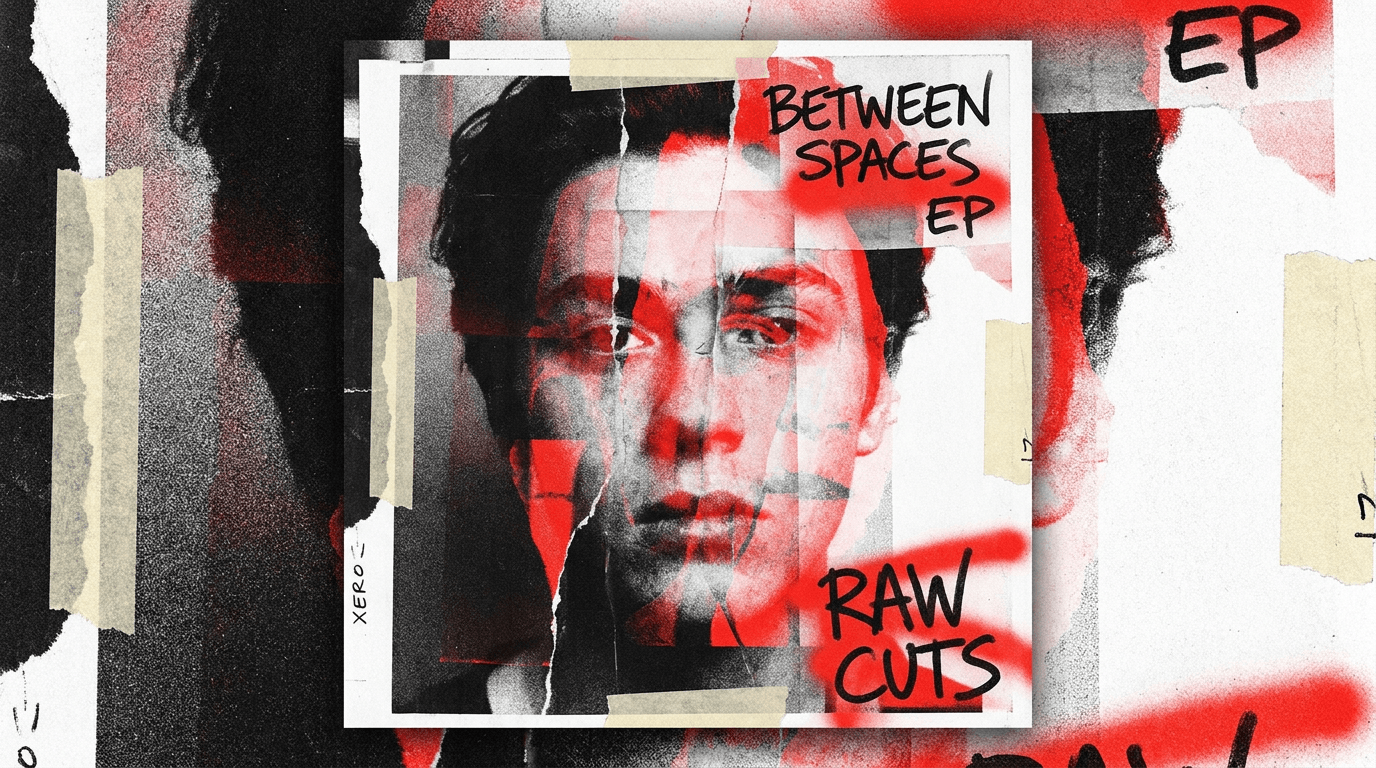
15 copy-paste AI prompts for music artist and album cover visual identity. Cinematic artist portraits, album cover concept art, single release artwork, vinyl displays, concert visuals, lyric video backgrounds, merchandise presentations, social media announcements, EP covers, music video reference frames, press kit portraits, genre-defining aesthetics, studio atmosphere shots, fan engagement visuals, and streaming platform profile imagery designed for independent musicians, bands, producers, DJs, labels, managers, and any creative professional building a music artist's visual world from discovery to fandom.
15 copy-paste AI prompts for music artist and album cover visual identity. Cinematic artist portrait compositions, album cover concept art, single artwork release visuals, vinyl and physical media display shots, concert and tour promotional imagery, lyric video and visualizer backgrounds, merchandise and apparel design visuals, social media announcement graphics, EP and mixtape cover designs, music video still and reference frames, press kit and editorial portraits, genre-defining aesthetic compositions, behind-the-scenes studio atmosphere shots, fan engagement and community visuals, and streaming platform profile and banner imagery designed for independent musicians, singer-songwriters, bands, producers, DJs, hip-hop artists, electronic music producers, R&B vocalists, rock groups, pop artists, country musicians, jazz ensembles, classical performers, music labels, artist managers, music marketing agencies, band photographers, graphic designers working with musicians, A&R teams, music publicists, booking agents, festival organizers, and any creative professional building or supporting a music artist's visual world.
The album cover is the face of the sound. Before a single note reaches the listener's ear, the visual identity arrives — a square image on a streaming platform, a rectangle on a social media banner, a full-bleed photograph in a press feature, a projected visual at a live show. This visual impression is the listener's first interpretation of the music itself. It sets the emotional temperature. It signals the genre. It communicates the artist's creative intelligence, their aesthetic sensibility, their cultural positioning, and the specific emotional territory the music occupies. In the streaming era, where the listener encounters thousands of album thumbnails scrolling through playlists and discovery feeds, the visual identity is not supplementary to the music — it is the gateway through which the music is found, chosen, and given the chance to be heard.
This reality has fundamentally changed what visual identity means for music artists. In the vinyl era, the album cover was experienced at twelve inches square — a physical object held in the hands, studied while the music played, displayed on a shelf as a declaration of taste. In the CD era, the format shrank but the physical artifact remained. In the streaming era, the album cover exists primarily as a thumbnail — a square between one and three centimeters on a phone screen, competing against dozens of adjacent thumbnails for the listener's attention. The cover must work at this scale: legible, striking, emotionally communicative, and genre-appropriate in an image smaller than a postage stamp. Simultaneously, that same cover must expand to full resolution for the album page, for social media sharing, for press features, for vinyl pressings that have returned as a premium physical format, and for projection at live events where it may fill a wall sixty feet wide. The visual identity must be powerful at every scale, from thumbnail to arena.
If you have worked with AI prompts for product photography, brand content, or social media visuals, the methodology will be familiar. Copy the prompt, adjust the details to match your specific artistic identity — your genre, your sonic palette, your visual references, your color world, your emotional territory, your cultural context, your aesthetic lineage, your personal mythology — generate, and deploy. What distinguishes these prompts from general visual content is that every element has been engineered specifically for the music context: the cinematic artist portraits that establish persona and mystique, the album cover compositions that translate sonic experience into visual language, the single artwork visuals that build anticipation for each release, the physical media presentations that honor the vinyl and collectible format, the concert and tour graphics that bridge recorded music and live experience, the lyric video backgrounds that create visual environments for the words, the merchandise visuals that extend the album world into wearable and ownable objects, the social media announcements that build narrative around release campaigns, the press and editorial imagery that gives journalists and curators the visual material they need, the genre-specific compositions that position the artist within their musical tradition while establishing individual identity, the studio atmosphere shots that invite the listener into the creative process, the fan engagement visuals that strengthen the artist-community bond, and the streaming platform imagery that optimizes for the specific contexts where most music is now discovered and consumed. These are not generic art prompts applied to music. They are visual identity systems designed to solve the specific challenge of making sound visible — of creating the image that makes a stranger press play.
A note on artist representation in AI-generated imagery: These prompts are designed to create visual worlds, atmospheric compositions, conceptual art, and environmental imagery rather than generating photorealistic likenesses of real individuals. For artist portraits, the prompts create stylized, atmospheric, and compositionally rich imagery that can serve as visual references, mood boards, and conceptual directions. Photorealistic artist portraits for press, social media, and official use should be created through real photography sessions with the actual artist. AI-generated imagery is most powerful in the music context when it creates the visual world the artist inhabits — the colors, textures, environments, and atmospheric compositions that become the artist's visual signature — rather than attempting to replace the authentic human presence that fans connect with.
Why Visual Identity Is the Primary Discovery Mechanism for Music Artists
The relationship between visual identity and music discovery operates through mechanisms that have intensified dramatically in the streaming era. Understanding how listeners find, evaluate, and choose music reveals why visual identity has become arguably the most important non-sonic element of an artist's career.
Streaming platforms are visual environments first. Spotify, Apple Music, YouTube Music, Tidal, Amazon Music, and every other streaming platform present music through visual interfaces. The listener scrolling through a playlist sees a column of album thumbnails before they hear a single note. The listener browsing a genre page sees a grid of cover art competing for attention. The listener checking their Discover Weekly sees thirty thumbnails representing thirty potential listening choices. In every one of these interactions, the visual impression determines whether the listener pauses, taps, and gives the music a chance. The album cover that fails as a thumbnail — that is murky, illegible, generic, or visually indistinguishable from adjacent thumbnails — fails at the point of discovery regardless of the music's quality.
Social media discovery is image-driven. When a music journalist, a playlist curator, an influencer, or a fan shares music on Instagram, Twitter, TikTok, or any social platform, they share the visual alongside the sonic. The album cover appears in the post, the story, the share card, the tweet embed. The visual quality and distinctiveness of that cover determines whether the social sharing generates curiosity and clicks or scrolls past unnoticed. Artists with striking, shareable visual identities receive amplified social distribution because the images themselves are interesting enough to stop the scroll — independent of whether the viewer has heard the music.
Visual identity signals genre, mood, and cultural positioning before listening. Listeners use visual cues to make rapid genre assessments. They have learned, through thousands of encounters, the visual languages of different genres: the specific photographic treatment, color palette, typography style, and compositional approach that signals hip-hop versus indie rock versus electronic versus country versus R&B versus jazz versus classical. A listener browsing for new ambient electronic music will respond to visual cues (ethereal color palettes, abstract landscapes, minimal typography) and will not click on imagery that signals a different genre (bold typography, urban photography, high-contrast portraits). The visual identity must speak the genre's visual language fluently enough to attract the right listeners while being distinctive enough to stand apart from every other artist in that genre.
The visual identity extends across the entire artist ecosystem. The album cover is the visual identity's nucleus, but the system extends to every touchpoint: streaming platform profile photos and banners, social media profiles and content, concert posters and tour visuals, merchandise and apparel, lyric videos and visualizers, press photos and editorial features, music video aesthetic direction, website and EPK design, vinyl and physical media packaging, and the artist's overall aesthetic world across every platform and format. Visual consistency across all of these touchpoints creates the cohesive artist brand that listeners recognize, trust, and feel connected to. Inconsistency — a different visual language on every platform, disconnected aesthetics between album covers and social media, a live show visual world that has nothing to do with the album imagery — fragments the artist's identity and weakens the fan connection.
Physical media has returned as a premium format requiring premium visuals. Vinyl sales have grown substantially, driven by collectors, audiophiles, and fans who want a physical relationship with the music they love. Vinyl is a visual format — the twelve-inch cover, the gatefold interior, the inner sleeve artwork, the colored vinyl itself visible through die-cut packaging. The vinyl buyer is investing in the visual and tactile experience as much as the audio, and the visual quality of the vinyl release must justify the premium price. Similarly, limited-edition CDs, cassettes, and box sets have become collector items where the visual and physical design is a significant part of the product's value.
Music journalism and playlist curation are influenced by visual professionalism. Journalists, bloggers, playlist curators, and radio programmers receive hundreds of submissions daily. The visual quality of the submission — the press photo, the album cover, the EPK design — creates an immediate professional impression that influences whether the music receives attention. A submission with a compelling, professional-quality visual package signals an artist who is serious, invested, and ready for coverage. A submission with amateur or generic visuals suggests an artist who has not yet reached the professional standard that justifies editorial attention. This gatekeeping effect means that visual quality directly influences media coverage, playlist placement, and the downstream discovery those channels enable.
Live show visual production has become expected across all venue sizes. The visual component of live performance — projected imagery, LED screens, lighting design coordinated with visual content, stage backdrop imagery — has expanded from arena-scale production to club shows, theater tours, and festival sets. Artists at every level are expected to have visual content that accompanies their live performance, and that visual content should be consistent with the recorded music's visual identity. The album's visual world should be translatable to the stage, creating the immersive experience that audiences increasingly expect.
The Visual Language of Music Artist Identity
Music visual identity operates through a sophisticated visual language that has evolved over decades of album cover art, music photography, and the interplay between sonic and visual culture. Understanding this language — its conventions, its genre-specific dialects, and its opportunities for innovation — is essential for creating visual identity that communicates effectively.
Color palette is the most immediate sonic-to-visual translation. Before composition, before typography, before imagery, the color palette of a visual identity communicates the emotional temperature of the music. Warm, saturated colors (deep reds, burnt oranges, rich golds) signal warmth, soul, analog richness, and emotional intensity — the territory of R&B, soul, classic rock, and warm electronic production. Cool, desaturated colors (pale blues, silver greys, muted violets) signal atmospheric distance, introspection, and sonic space — the territory of ambient, shoegaze, dream pop, and melancholic indie. High-contrast black and white signals rawness, authenticity, immediacy, and a refusal of ornamentation — the territory of punk, post-punk, certain hip-hop traditions, and any genre that values unprocessed directness. Neon and fluorescent colors signal energy, futurism, nightlife, and synthetic production — the territory of electronic dance music, hyperpop, and high-energy pop. The color palette must be chosen to match the emotional world of the music, and once established, it should remain consistent across the release cycle.
Photographic treatment establishes the era and production philosophy. The way an image is processed — its grain, its contrast curve, its color grading, its focus quality — communicates the temporal and production context of the music. Heavy film grain, warm color shifts, and soft focus signal analog warmth and vintage production — appropriate for artists whose sound references earlier decades or who record to tape. Clean, razor-sharp, high-resolution imagery signals modern production precision — appropriate for polished pop, contemporary R&B, and production-forward electronic music. Glitchy, distorted, deliberately degraded imagery signals experimental tendencies, post-internet aesthetics, and a rejection of commercial polish — appropriate for experimental electronic, art pop, and underground genres. The photographic treatment is not neutral decoration; it is a production philosophy statement.
Typography carries genre information with extreme efficiency. In the thumbnail-scale reality of streaming, the artist name and album title typography may be the most legible element of the cover. The typography choice communicates genre instantly: serif fonts signal tradition, sophistication, and genres with historical depth (classical, jazz, certain country and folk traditions). Sans-serif fonts signal modernity, cleanliness, and contemporary positioning (pop, electronic, modern indie). Hand-drawn or irregular lettering signals DIY authenticity, punk ethos, and independent spirit. Bold, heavy type signals confidence, impact, and volume (hip-hop, rock, metal). Thin, light type signals delicacy, space, and restraint (ambient, minimalist, certain singer-songwriter traditions). Display and decorative fonts signal specific cultural references that genre-literate audiences read immediately. The typography must be legible at thumbnail scale while carrying the genre and personality information that helps the right listeners find the music.
Compositional approach signals artistic ambition and genre tradition. Centered, symmetrical compositions signal formality, tradition, and deliberate positioning — the approach of artists making a definitive statement. Off-center, asymmetric compositions signal dynamism, modernity, and rule-breaking — the approach of artists who want to communicate creative restlessness. Minimal compositions with vast negative space signal confidence, sophistication, and the "less is more" philosophy — the approach of artists whose restraint is itself a statement. Dense, maximalist compositions filled with detail signal abundance, energy, and the "more is more" philosophy — the approach of artists whose creative excess is the point. The compositional approach should match both the sonic density of the music (minimal compositions for minimal music, dense compositions for layered production) and the artist's positioning within their genre's tradition.
Environmental and atmospheric imagery creates the sonic world visually. The most powerful album covers and artist visuals create a visual environment that the listener can imaginatively inhabit — a world that feels like the music sounds. Desert landscapes for sparse, expansive Americana. Urban night scenes for nocturnal R&B and electronic music. Dense forests for atmospheric folk and black metal. Brutalist architecture for industrial and post-punk. Ocean and sky for ambient and new age. The environment is not a literal illustration of lyrical content but a visual space that shares the emotional and atmospheric qualities of the sound — a place you could step into and the music would already be playing.
The artist's physical presence or deliberate absence communicates persona. Some genres and artistic traditions expect the artist's image prominently — hip-hop, pop, country, and R&B often feature the artist's face and body as the primary visual subject, their physical presentation (styling, expression, body language, setting) communicating persona and character. Other genres and traditions value the artist's absence — electronic music, ambient, post-rock, and certain indie traditions often present abstract, environmental, or conceptual imagery without the artist's image, the anonymity itself part of the artistic statement (the music speaks, not the face). The decision to show or not show the artist is itself a meaningful creative choice that should be consistent with the genre tradition and the specific persona being constructed.
Cultural references and visual lineage create context. Every album cover exists within a visual lineage — the history of cover art in its genre, the visual precedents set by canonical albums, the contemporary visual conversation among current artists. A cover that references (consciously or unconsciously) the visual language of a canonical album creates associative context — the viewer links the new work with the referenced tradition. This referencing can be powerful (positioning the new artist within a respected lineage) or dangerous (appearing derivative rather than original). The most effective visual identities are visually literate — aware of the genre's visual history and making informed choices about which traditions to honor, which to subvert, and which to reject entirely.
Consistency across the release cycle creates narrative and brand. A single album cover is a statement. A series of visually consistent releases — singles, EPs, albums, deluxe editions — with a coherent visual language across the release cycle creates a narrative and a brand. The release cycle's visual consistency (same color palette evolving across releases, same photographic treatment applied to different subjects, same typographic system across all formats) allows fans to recognize a new release instantly and creates the cumulative visual identity that transcends any individual cover.
15 AI Prompt Templates for Music Artist & Album Cover Visual Identity
Each template includes a content concept, the full copy-paste prompt, and deployment guidance. All prompts are formatted for the Miraflow AI Image Generator and compatible with any high-quality text-to-image tool. Adjust the bracketed descriptive elements in each prompt to match your specific genre, sonic character, visual references, artist persona, color world, and aesthetic direction. Generate at 1:1 for album covers and streaming thumbnails, 16:9 for YouTube banners and desktop headers, 9:16 for Stories and vertical social content, 4:5 for Instagram feed posts, 3:2 for press and editorial formats, and 2:3 for poster art.
Template 1: The Cinematic Artist Portrait — Persona Establishment
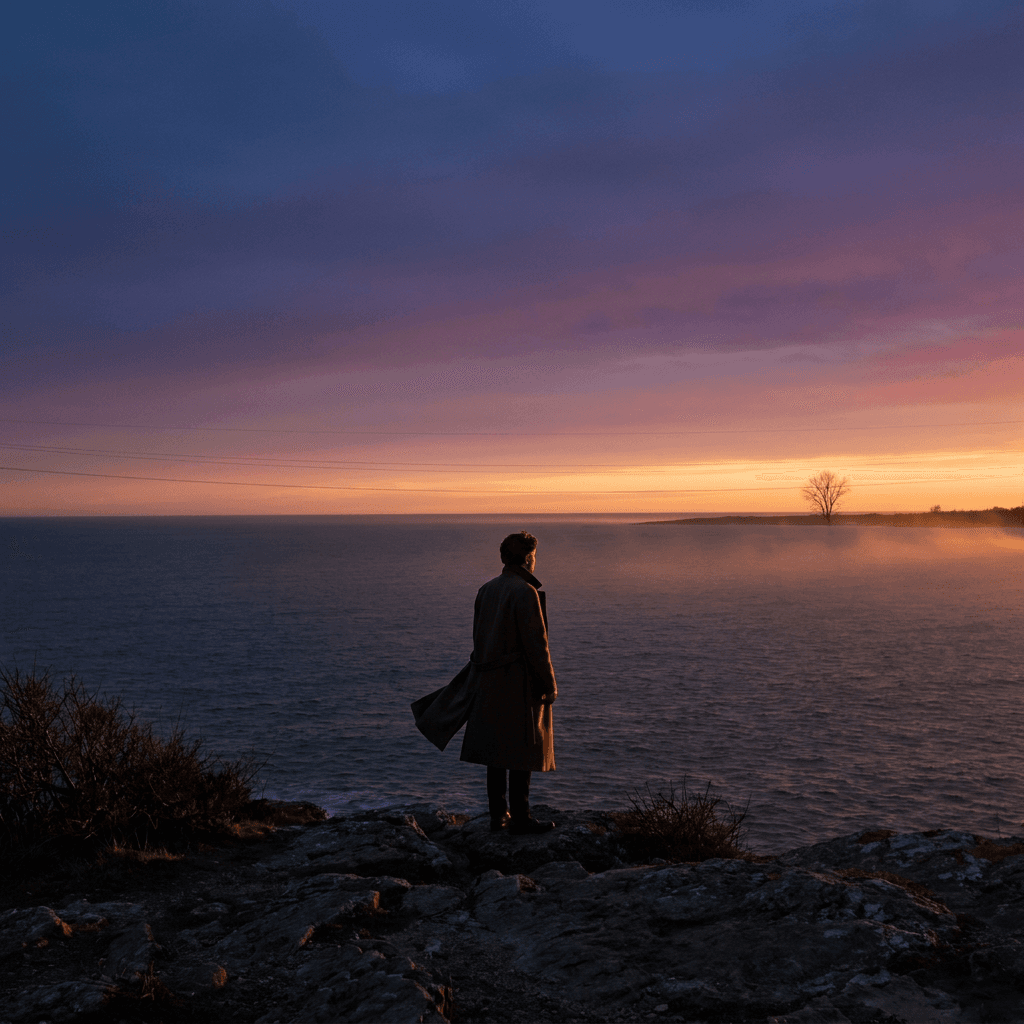
This is the foundational visual identity image — the atmospheric portrait that establishes the artist's persona, mood, and visual world. This is not a headshot but a cinematic composition that places a figure within an environment and an atmosphere, creating the artist's visual mythology.
Prompt:
cinematic atmospheric artist portrait of [a solitary figure standing in a vast, desolate landscape at the edge of twilight — the figure positioned in the lower third of the frame, small against the immense environment, their silhouette defined by the last light of a fading sky: the figure wears a long, dark overcoat that moves slightly in an ambient wind, their posture contemplative — not performing for the camera but existing within the landscape, looking away or into the distance, the face partially obscured by shadow or angle or the natural fall of hair, the identity suggested rather than revealed, the mysterious anonymity that creates intrigue rather than familiarity, the landscape is expansive and emotionally charged — a flat, endless plain stretching to a distant horizon where the sky meets the earth in a thin line of amber light, or a rocky coastal cliff with dark ocean extending to infinity below, or a desert terrain with cracked earth stretching in every direction under a massive sky, the environment is real but heightened — the kind of landscape that exists at the intersection of reality and dream, a place that feels like the sonic territory of atmospheric, emotionally expansive music, the sky dominates the upper two-thirds of the frame — a dramatic gradient from deep indigo or midnight blue at the top through layers of violet, rose, burnt amber, and the last pale gold of the disappearing sun at the horizon, the sky is the composition's emotional canvas, its color gradient communicating the transitional, liminal quality of the moment between day and night, between one state and another, a few atmospheric elements add dimension to the landscape — distant power lines or a single bare tree on the horizon creating a thin, elegant line against the sky, or low-lying mist or dust catching the last light with luminous warmth, or the suggestion of a distant road disappearing into the horizon — small elements that add narrative depth without cluttering the vast space, the ground beneath and around the figure is textured and real — the cracked earth of a dry plain, the rough stone of a cliff edge, the sparse brush of a desert — the surface quality communicating the physical reality of the environment, the artist has walked here, the wind is real, the cold is approaching, the overall composition communicates: this artist exists in an expansive emotional landscape, the music comes from somewhere vast and deep and emotionally complex, the figure is both small against the immensity and powerful in their presence within it — the cinematic portrait as the first visual impression of an artist's creative world] in a widescreen cinematic composition at the golden-hour-to-blue-hour transition, the photograph is composed with deliberate cinematic aspect awareness — even in a 1:1 square crop the horizontal sweep of the landscape and the vertical drama of the sky should be felt, the figure is positioned using the rule of thirds — placed at one of the lower intersection points, small enough to feel the scale of the environment but detailed enough to read as a specific, intentional presence, the landscape extends in all directions from the figure — the vast horizontal sweep of the terrain creating the expansive feeling that matches the emotional scale of the music, the sky fills the majority of the frame — its gradient the dominant visual element, the color transition from warm horizon to cool zenith creating the emotional palette that defines the image, the horizon line is low — emphasizing the sky's drama and the figure's smallness against the cosmic scale, or the horizon is at the figure's level — emphasizing the landscape's extension and the figure's journey through it, the atmospheric elements (power lines, tree, mist, road) create subtle compositional guides — leading lines or isolated focal points that give the eye pathways through the vast space, the depth of field is deep — everything from the foreground texture to the distant horizon in focus, the vast depth communicating the real, physical scale of the environment, the lighting is the transitional magic of golden hour fading to blue hour — the specific 15-20 minute window where warm and cool light coexist in the sky, the figure catches the last directional golden light from the horizon — a warm edge light that defines the silhouette against the darker environment, the coat and hair catching the amber light with warm, cinematic glow, the shadow side of the figure falls into cool, deep shadow — the face and body detail reduced to suggestion, the anonymity maintained by the light's selectivity, the landscape catches the transitional light with atmospheric variation — warm where the light touches the ground near the horizon, cool and shadowed in the foreground, the tonal transition across the terrain mirroring the sky's gradient, the sky catches and displays the full spectrum of the golden-to-blue transition — the warm amber and rose of the sun's departure blending through violet into the approaching indigo of night, each color zone distinct but continuous, the gradient unbroken and painterly, any mist or atmospheric haze catches the warm light from below with luminous, almost supernatural glow — the particulate matter in the air becoming visible, golden, ethereal, the overall light quality communicates the cinematic — not the flat illumination of casual photography but the dramatic, transitional, emotionally heightened light of cinematography that makes every frame feel like a moment of significance, deep indigo to midnight blue upper sky — transitional violet and dusty rose mid-sky — amber and pale gold at horizon — warm golden edge light on figure — deep cool shadow in figure and foreground — warm earth tones of landscape (desert tan, stone grey, dried grass amber) — and the cinematic golden-to-blue-hour palette of a vast landscape portrait at the transitional moment between warm light and approaching dark as the color palette, the mood is cinematically vast emotionally expansive contemplatively powerful and the specific artist-portrait message — this is the visual world of the music, this artist creates from a place of emotional depth and atmospheric beauty, the scale of the landscape is the scale of the artistic ambition, the solitary figure in the vast space is the romantic archetype of the artist who goes to the edge to bring back something true — the cinematic portrait as the persona-establishment visual that creates the first impression of the artist's creative identity, professional cinematic and fine-art photography with natural transitional golden-to-blue hour light and deep depth of field showing figure within vast landscape, composed with deliberate cinematic framing placing a contemplative figure in the lower third against dramatic sky and expansive terrain, the atmospheric scale and the light transition and the figure's mysterious presence as the persona focal points, cinematic transitional warm-to-cool palette, no text overlays, no watermarks
Best for: Streaming platform artist profile image and header, social media profile and banner across all platforms, press kit primary artist image, website homepage hero, album inner artwork and booklet, concert visual projected backdrop, tour poster background, editorial feature accompaniment
Template 2: The Album Cover Concept — Abstract Sonic Translation
This template creates the conceptual album cover composition — an abstract or semi-abstract visual that translates the sonic and emotional experience of the music into a visual form. This is the image designed specifically for the 1:1 album cover format, optimized for both thumbnail legibility and full-resolution detail.
Prompt:
abstract album cover concept art of [a visual that translates sonic experience into form and color — the image creating the feeling of the music before the music is heard: a composition built from layered textures and gradients that evoke a specific sonic world — for atmospheric, textural, emotionally complex music: layers of translucent color wash over each other like geological strata or sound waves visualized — deep, saturated fields of color (a profound midnight blue, a bleeding dark crimson, a luminous amber, a bruised violet) overlapping and interacting at their edges, the colors bleeding into each other where they meet with the organic imprecision of watercolor or the gradual diffusion of dye in water, the color layers create depth — some advancing toward the viewer with their warmth and saturation, others receding into darkness, the overall effect dimensional rather than flat, the visual equivalent of the layered sonic depth that characterizes textured music production, within or emerging from the color fields, subtle textural elements add physical dimension: the grain of analog film or the noise of high-ISO digital capture creating a fine, overall texture that prevents the colors from feeling digitally smooth, the texture adding the warmth and materiality of physical media, a subtle geometric element floats within the composition — perhaps a thin circle or arc of pale light, a single horizontal line, a small cluster of dots arranged in a constellation-like pattern, or a fragmented geometric form partially obscured by the color layers — the geometric element providing the visual's single point of sharp focus amid the ambient color, the compositional anchor that the eye rests on, the element's precision contrasting with the organic gradients around it, the borders between color zones are organic and living — not hard-edged transitions but gradual bleeds, soft boundaries, the edges where one color becomes another through intermediate tones, the transition quality itself emotional and musical (the way a chord change moves through intermediate harmonics), the corners and edges of the square format are considered — the composition respects the 1:1 boundary, the color placement working within the square to create internal balance, the lower portion grounded with darker, denser color, the upper portion opening into lighter or more luminous space (or reversed: heavy above, light below, the inversion itself a statement), the overall composition has a focal zone — not necessarily a central point but an area where the visual energy concentrates, where the brightest color or the sharpest element draws the eye, this focal zone is the visual equivalent of the music's emotional center, the place where the sound is most intense or most beautiful, the full composition achieves the album-cover quality of visual completeness — it is not a detail from a larger image but a self-contained visual world that works within its square boundary, every edge and corner considered, every color relationship intentional, the image as complete and composed as a musical work] in a precisely composed 1:1 album-cover composition designed for both thumbnail impact and full-resolution detail, the composition functions at multiple scales — at thumbnail size (the primary streaming encounter) the overall color impression and the contrast between zones is legible and striking, at mid-size (album page, social media post) the textural detail and geometric element become visible, at full resolution (vinyl cover, projected visual, digital zoom) the fine grain texture and the subtle color transitions within each zone reveal themselves, the color zones are arranged with deliberate compositional balance — the visual weight distributed to create a sense of internal equilibrium or intentional tension (the equilibrium of a resolved chord, the tension of a suspended harmony), the geometric element is positioned for maximum compositional impact — perhaps at a rule-of-thirds intersection, or precisely centered (the centered placement itself bold and confident), or at the golden ratio point within the square, the textures layer at different scales — the broad color washes at the largest scale, the grain and noise at the finest scale, perhaps a mid-scale texture (cloud-like formations, fabric-like wrinkling, water-surface rippling) creating intermediate visual interest, the borders of the square are clean — the composition works within its boundary, the colors meeting the edges with intentional relationships (bleeding off the edge, fading to dark at the edge, or maintaining full intensity to the crop), the depth of field concept translates to focal sharpness — the geometric element is the sharpest visual zone, the textures around it in soft ambient resolution, the color field edges in the softest resolution, creating a focus hierarchy that guides the eye, the lighting concept is internal — the image generates its own light: the luminous colors glow from within rather than being illuminated by an external source, the brightest zone radiates outward, the darkest zones absorb, the luminosity creating the sense that the image is a light source rather than a lit object, the color emission is layered — lighter, more luminous colors appear to float above darker, more absorbent colors, the luminous hierarchy creating the dimensional depth that makes the flat image feel three-dimensional, the geometric element catches or emits the brightest, most focused light — a thin line of white or pale gold, a circle of soft glow, the sharpest and most luminous point in the composition, the overall luminous quality communicates the self-generated energy of music — sound creates its own light, the composition radiates rather than reflects, deep saturated primary color palette specific to the sonic character — midnight blue and dark crimson and luminous amber and bruised violet (or genre-appropriate palette: neon cyan and hot pink for electronic, muted sage and warm grey for indie folk, pure black and stark white for minimal, rich gold and deep brown for soul) — with pale geometric accent — fine grain texture warmth — and the internally luminous self-lit palette of an abstract sonic translation designed as a 1:1 album cover as the color palette, the mood is sonically deep emotionally resonant abstractly beautiful and the specific album-cover message — this image is the music made visible, the colors are the harmonic palette, the textures are the sonic texture, the depth is the production depth, the geometric element is the melodic focus within the atmospheric whole — the album cover as the visual translation that prepares the listener for the sonic experience and remains in their mind as the image of the sound, professional fine-art and graphic-design composition with internal luminosity and layered textural depth in a precisely composed 1:1 square format, designed for multi-scale legibility from streaming thumbnail to vinyl cover, the color resonance and the textural warmth and the compositional completeness as the sonic-visual focal points, deep saturated internally-lit color with geometric precision accent, no text overlays, no watermarks
Best for: Album cover art (the primary use — this is the album's visual face), streaming platform album artwork across all services, vinyl cover art at 12-inch scale, CD cover and digital download artwork, social media album announcement posts, playlist cover art, music video title card and end card, projected album artwork at live shows
Template 3: The Single Artwork — Release Anticipation Visual
This template creates the single-release artwork — the smaller-scale, more focused visual that accompanies individual single releases and builds anticipation across the album rollout. Single artwork should be visually connected to the album's visual world while being distinct enough to represent an individual song.

Prompt:
focused single release artwork of [a concentrated, high-impact visual composition for an individual song release — more immediate and focused than the album cover's expansive complexity, this single artwork distills one emotional moment or visual idea from the album's larger world: a single striking visual element dominates the frame — perhaps a close-up of a natural phenomenon rendered in the album's color palette: a single wave cresting and breaking, frozen at the peak of its arc, the water surface rendered in deep teal and luminous white foam against a dark background, the wave's form simultaneously powerful and fragile, caught in the instant before it falls — or a single flower in extreme close-up, its petals revealing their cellular texture and internal color gradients, the familiar form made alien and beautiful through proximity — or an object suspended in space: a glass sphere catching and refracting colored light, a vintage microphone floating in darkness, a key or a clock or a symbolic object rendered with hyperreal clarity against an ambiguous depth, the single element fills the square frame with confidence — this is not a zoomed-in detail but a deliberate close-focus composition, the element large and commanding, the surrounding space serving it rather than competing, the color palette is drawn from the album's visual world but focused on a narrower range — perhaps two or three colors from the album's larger palette, the reduced palette creating the more focused emotional register of a single song versus a full album's range, the texture quality matches the album's aesthetic language — if the album cover uses film grain, the single artwork uses the same grain; if the album is digitally clean, the single maintains that cleanliness — the textural consistency connecting this release to the album's visual world, a subtle element connects this single artwork to the album cover — perhaps the same geometric shape appears here in a different context, or the same texture treatment, or the same particular color combination — the visual thread that tells the attentive fan "this belongs to the album," the composition is bold enough to work as a standalone image — a listener who encounters the single without knowing the album still finds a complete, compelling visual — while rewarding the fan who recognizes its relationship to the larger visual system, the square format is maximized — the element positioned for impact within the 1:1 boundary, the negative space (if any) as intentional as the positive, every pixel of the square considered and designed] in a bold, focused 1:1 single-artwork composition, the composition is simpler and more immediate than the album cover — where the album cover builds complexity and layers, the single artwork achieves impact through focus and boldness, fewer elements, stronger presence, the single visual element commands the frame — centered or powerfully positioned, its scale within the square communicating confidence and focus, the surrounding space is minimal or dark — the element emerging from or floating within a reduced environment that concentrates attention, the connection to the album's visual language is visible but not heavy-handed — a shared color, a repeated texture, a geometric echo — the thread subtle enough to reward attention without requiring explanation, the square format is tight — no wasted space, the composition cropped and scaled for maximum impact within the boundary, the depth of field is determined by the element — if it is a physical object, a shallow depth of field creates the intimate close-focus quality; if it is abstract, the focal concept translates to the sharpest visual zone within the composition, the lighting is dramatic and focused — a single, strong light source (or the internal luminosity approach from Template 2) creating high contrast between the lit element and the surrounding darkness, the dramatic light creates the visual impact that single artwork needs to cut through the streaming interface — this image must be striking enough to make a listener pause and tap, the single element catches the light with maximum visual information — the wave's water surface reflecting and refracting, the flower's petals revealing translucent cellular structure, the glass sphere splitting light into prismatic color — the close proximity revealing detail that rewards attention, the surrounding darkness or reduced space absorbs light — the contrast between the lit element and the dark environment creating the figure-ground separation that makes the element pop at thumbnail scale, focused palette drawn from album color world — two or three colors maximum: the dominant color of the element and its lighting (deep teal and luminous white, or rich crimson and warm gold, or electric blue and cool silver) against deep dark or contrasting background — consistent grain or texture treatment from album aesthetic — and the concentrated, high-contrast palette of a single release artwork that connects to the album's visual world while achieving standalone impact as the color palette, the mood is intensely focused immediately striking boldly singular and the specific single-release message — this is one moment from a larger story, one emotional concentrate from the album's range, one song made visible — the single artwork as the release-anticipation visual that drives streams, shares, and playlist additions through immediate visual impact, professional graphic design and fine-art photography composition with dramatic focused lighting and bold single-element framing in 1:1 square format, designed for streaming thumbnail impact with rewarding detail at full resolution, the element's visual intensity and the dark-ground contrast and the album-world connection as the single-release focal points, concentrated high-contrast palette, no text overlays, no watermarks
Best for: Single release artwork for streaming platforms, social media single announcement and release-day posts, playlist submission cover art, pre-save campaign visuals, single-release email marketing header, radio submission artwork, social media story and TikTok content for single promotion, lyric video title frame
Template 4: The Vinyl and Physical Media — Premium Format Display
This template showcases the physical music product — the vinyl record, the CD, the cassette, the box set — as a premium, collectible object with tactile and visual value that justifies the physical format in the streaming age.
Prompt:
premium vinyl record display photograph of [a vinyl record and its cover presented as a beautiful physical object — the album artwork realized in the 12-inch format with the tactile and visual richness that makes vinyl a collector's medium: the vinyl LP is partially removed from its sleeve — the black disc emerging from the album cover, the record pulled about one-third out to show both the cover art at full impact and the disc surface with its fine groove pattern catching the light, the vinyl itself is pristine — the black surface reflecting the light with the characteristic vinyl sheen, the groove pattern visible as fine concentric circles that spiral from the outer edge toward the label, the grooves catching the light at slightly different angles creating the subtle rainbow-prismatic effect that polished vinyl produces, the center label is visible — designed with the album's visual identity: the artist name, the album title, the track listing for this side, the label logo, all printed on the label with typographic care that matches the cover design, the album cover is displayed in its full 12-inch glory — the artwork printed on quality cardboard, the colors rich and saturated in the large format, the cover art's detail visible at this generous scale in ways that streaming thumbnails cannot convey, the cover has the subtle texture of quality printing — a matte or soft-touch laminate, or the slight sheen of a gloss finish, or the textured stock of a specialty printing — the physical surface quality visible in the way the cover catches the light, additional physical elements enrich the presentation: the inner sleeve partially visible behind the record — perhaps a printed inner sleeve with lyrics, credits, or additional artwork, the edge of the printed paper visible as a detail element, the gatefold interior (if applicable) open and visible — showing expanded artwork, liner notes, photographs, the full visual experience of the physical package, perhaps a download card or an insert — a small printed card, a poster fold, a sticker sheet — the physical extras that make vinyl releases events rather than simple purchases, the surface beneath the vinyl is considered — a clean, dark surface (black or very dark grey) that provides maximum contrast for the cover art, or a warm wood surface (a record console or shelf) that provides the lifestyle context of vinyl listening, the setting may subtly suggest the vinyl-listening environment — the edge of a turntable visible, or a shelf of other records in soft background, or the warm ambient quality of a room where music is listened to with intention, the overall composition communicates: this is a physical object worth owning, the visual and tactile experience of this record justifies its physical existence, the artwork was designed for this format and achieves its full impact here, this is music as a beautiful, holdable, displayable artifact] in a clean, elevated physical-media composition, the photograph is taken from a slightly elevated angle — approximately 20-30 degrees — showing the cover face, the emerging disc, and the surface beneath, the angle that a person would see looking down at a record they are about to play or have just removed from the shelf, the composition is centered on the record package — the 12-inch cover as the visual anchor, the emerging disc adding dynamic diagonal movement, the overall arrangement balanced and intentional, the cover art is the hero — displayed at maximum size and clarity within the frame, the artwork's full impact visible in the large format, the vinyl disc creates visual interest through its material contrast — the black, reflective, grooved surface against the printed cover, the industrial precision of the disc against the artistic expression of the cover, the physical extras (inner sleeve, insert, download card) are secondary elements — visible as evidence of the complete package without competing with the cover and disc, the surface and any background elements provide context without dominance — the dark surface making the cover art pop, or the wood surface and turntable edge creating the lifestyle suggestion, the depth of field is moderately shallow — the cover and disc in sharp focus with the background and foreground in gentle blur, the material details (cover texture, groove pattern, label printing) visible in the focused zone, the lighting is warm and directional — the quality of vinyl-listening ambient light: warm, slightly dramatic, the mood lighting of an intentional listening session, a primary directional light from one side creates the modeling that shows the three-dimensional qualities of the record package — the disc's slight warp or thickness, the cover's cardboard edge, the inner sleeve's paper edge — the physical dimensionality of real objects, the vinyl surface catches the directional light with its characteristic response — the broad, curved reflection of the polished surface, the groove pattern visible as fine textural lines within the reflection, the prismatic color catching at the edge where the light angle shifts, the cover art catches the light with its print quality — the inks rich and saturated under the warm illumination, the cover surface (matte or gloss) responding with its specific finish character, any foil stamping or embossing catching directional highlights, the label catches the light with its printed paper quality — the typography and design legible, the label area a designed focal point on the disc, the cardboard edge of the cover catches the light with its cross-section — the thickness of the cover stock visible, communicating the weight and quality of the physical product, warm ambient tones — rich, saturated cover art colors as the chromatic centerpiece — black vinyl with prismatic groove highlights — warm label printing — dark or warm wood surface — warm directional amber or tungsten lighting — soft background in warm listening-environment tones — and the warm, rich, tactile palette of a premium vinyl record display in intimate directional light as the color palette, the mood is tactilely premium physically beautiful collectibly valuable and the specific vinyl-display message — this record is a beautiful object, the artwork achieves its full impact at 12 inches, the physical experience of holding and playing this record is part of the artistic experience, this is worth owning in a format you can touch — the vinyl photograph as the physical-format-value communication that drives pre-orders, collector purchases, and the premium pricing that physical media supports, professional product and still-life photography with warm directional studio light and moderately shallow depth of field keeping the record package in tactile detailed focus, composed as a slightly elevated vinyl display with cover art and emerging disc on a contextual surface, the cover art impact and the vinyl materiality and the physical package completeness as the collector-value focal points, warm rich tones with vinyl black and prismatic accents, no text overlays, no additional watermarks
Best for: Vinyl pre-order announcement and sales imagery, physical media marketing across all channels, record store and distributor marketing materials, social media vinyl release and collector content, website merch store product imagery, email marketing vinyl and physical release campaigns, unboxing and collector content for social media, Record Store Day and special release promotion, crowdfunding campaign product visualization
Template 5: The Concert Visual — Live Performance Atmosphere
This template creates the visual imagery associated with live performance — the atmospheric, high-energy visual that communicates the concert experience and serves as tour promotion, stage backdrop, and live-show visual content.
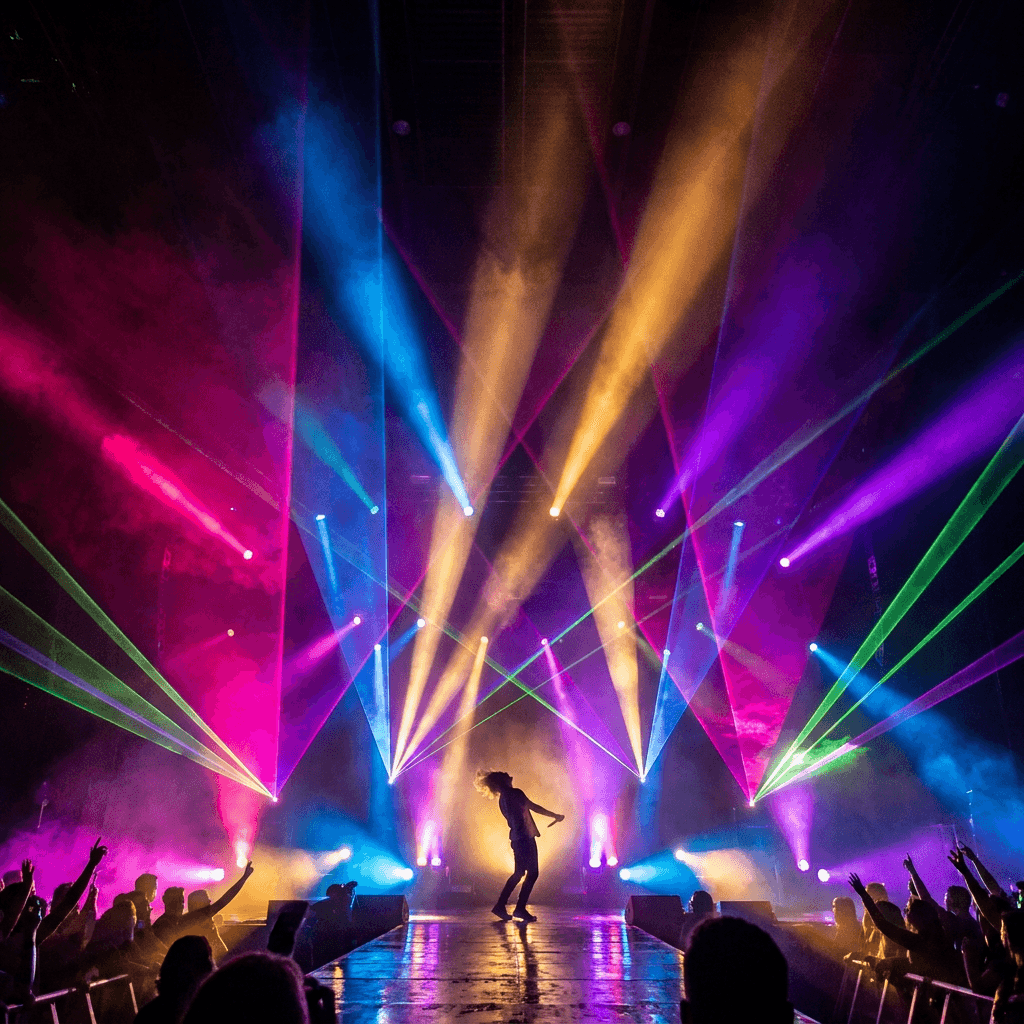
Prompt:
high-energy concert atmosphere visual of [a dramatic live-performance environment rendered as a visual composition — the energy, light, and atmosphere of a concert captured as a designed image rather than a documentary photograph: a stage-like environment saturated with dramatic lighting — powerful beams of colored light cutting through atmospheric haze from above and behind, the light beams visible as volumetric shafts where they pass through the smoke or fog that fills the performance space, the light is the composition's primary element — not illuminating a subject but being the subject itself: thick beams in saturated concert-lighting colors (deep magenta, electric blue, amber gold, rich violet, laser green — the specific saturated colors of professional concert lighting) creating a three-dimensional light architecture within the haze-filled space, the beams cross and intersect at angles — creating geometric patterns in the air, the intersections brighter where two colors meet and mix, the light painting the haze with visible color, the silhouette of a figure is suggested at the center-base of the composition — a performer's form visible as a dark shape against the bright backlight, the figure small relative to the massive light display, the scale communicating the power of the live experience where the individual becomes a vehicle for something larger, the figure's posture suggests the peak of performance — head back, arms extended, the body language of someone at the climactic moment of a song, surrendered to the music and the energy of the space, the stage surface catches the light with reflective quality — wet or polished, the colors of the overhead lights reflecting in the floor surface, creating a mirror-world below that doubles the visual impact, the suggestion of audience is at the very bottom of the frame — the silhouetted tops of heads and raised hands, the edge of the crowd visible as a dark, irregular border, the human mass that completes the live-performance circuit between artist and listener, the atmospheric haze fills the entire space — the medium through which light becomes visible, the density varying from thick near the stage to thinner at the edges, the haze creating the depth and dimension that makes the light architectural rather than flat, the overall composition communicates: this is what the live experience looks like from within — the overwhelming, immersive, transformative environment where music becomes a physical force in space, the light and the haze and the sound and the crowd creating a shared experience that transcends individual listening] in a dramatic, immersive concert-visual composition, the photograph is composed from within the experience — the viewpoint is inside the light-filled, haze-saturated space, not observing from outside, the immersion creating the visceral quality that concert visuals require, the light beams create the composition's structure — their angles forming the visual architecture, their intersections creating focal points, their color combinations creating the palette hierarchy, the figure silhouette is the human anchor — positioned at the base-center or slightly off-center, the darkest element against the brightest light, the figure-ground reversal (dark subject against bright background) creating the dramatic impact of backlit performance, the stage floor reflection extends the light downward — the mirror effect creating vertical symmetry that doubles the visual drama, the audience suggestion at the bottom edge grounds the image — this is not an empty light show but a filled, energized performance space with human presence, the haze provides the volumetric medium — the depth of the space visible through the light's behavior in the fog, near beams appearing brighter and more defined, distant beams appearing softer and more diffused, the atmospheric perspective creating real spatial depth, the depth of field is deep — the full space from audience edge through stage to the light sources above in focus, the depth communicating the scale of the performance environment, the lighting is the image itself — this is not a scene illuminated by concert lighting but a composition of light: the light beams in multiple saturated colors are the visual content, each beam a line of pure color, the beam colors mix where they intersect — magenta and blue creating violet, amber and blue creating warm white, the color mixing following additive light principles with the vivid, saturated results of theatrical lighting in atmospheric haze, the haze glows with the accumulated light — the overall space suffused with warm, colored luminosity, the haze acting as a volumetric canvas that holds and displays the light, the figure silhouette is defined entirely by backlight — no front illumination, the form rendered as a dark shape against the luminous background, the edges catching thin color lines from the angled beams, the stage floor catches and reflects the light with wet or polished surface response — each reflected beam a reversed color line, the reflections slightly softer and more diffused than the direct beams above, the audience area catches scattered light — the tops of heads and raised hands catching highlights from the overhead beams, the edge of the human mass glowing with reflected concert color, saturated concert-lighting colors as the primary palette — deep magenta, electric blue, amber gold, rich violet, laser green — against dark haze-filled space — figure silhouette in near-black — stage floor reflections in mirrored concert colors — audience edge in scattered light — and the vivid, saturated, high-energy palette of volumetric concert lighting in atmospheric haze as the color palette, the mood is viscerally energetic immersively dramatic transformatively powerful and the specific concert-visual message — this is the live experience, the overwhelming sensory environment where music becomes physical, the shared energy between performer and audience in a space made sacred by light and sound and presence — the concert visual as the live-experience communication that drives ticket sales, tour anticipation, and the desire to be in the room where this happens, professional concert and event photography composition with dramatic volumetric stage lighting in atmospheric haze, deep depth of field showing the full performance space from audience through stage to light sources, composed as an immersive concert perspective with backlit figure silhouette and architectural light beams, the volumetric light drama and the performance energy and the immersive atmosphere as the live-experience focal points, saturated concert colors against dark atmospheric depth, no text overlays, no watermarks
Best for: Tour announcement and concert promotion, social media tour date and ticket-sale posts, website live-performance section, streaming platform concert documentation, festival and venue marketing materials, projected stage backdrop and visual content, tour poster and promotional materials, email marketing tour and concert campaigns, music video live-performance sequences, Spotify Canvas and animated streaming visuals
Template 6: The Lyric Video Background — Textural Atmosphere for Words
This template creates the atmospheric visual environment designed to sit behind text — the lyric video background, the visualizer canvas, or the typographic accompaniment that provides visual texture for the song's words without competing with their legibility.
Prompt:
atmospheric lyric video background of [a slow-moving, textural visual environment designed to support overlaid text — a visual atmosphere that creates mood and motion without visual distraction: a deep, moody gradient field that shifts slowly between the album's key colors — a background that lives and breathes with subtle motion-suggestive texture rather than sitting flat and static: the base is a rich, deep color (a midnight indigo, a dark forest green, a deep burgundy, a charcoal that approaches but never reaches black) providing the darkness that makes overlaid white or light text legible, the color shifts gradually across the frame — not a simple flat field but a living gradient that transitions from the base dark at the edges toward a slightly lighter, more luminous zone in the center or lower third, the gradient suggesting depth and atmosphere without creating visual complexity, within the gradient, subtle textural elements create the sense of motion and life: a very fine grain texture across the entire field, the analog-feeling warmth that prevents the dark color from looking digitally dead, the grain slightly animated in implication — the static image suggesting the gentle movement of film grain that would accompany a video version, soft, very slow-moving atmospheric elements within the gradient — cloud-like forms of slightly lighter or differently-colored tone that drift through the dark field, their edges completely soft, their contrast against the background minimal enough to never compete with overlaid text, the forms organic and unpredictable — the suggestion of slow-moving fog, of deep water currents, of atmospheric pressure systems seen from space, the atmospheric movement adds the temporal quality that distinguishes a visualizer background from a static image, small, very subtle light elements — tiny particles or very faint light points drifting through the field, like distant stars or dust motes in a dark room, their brightness minimal and their size tiny, adding the finest layer of visual interest without distraction, the overall visual field is designed for text overlay — the center and primary text zones are darker and more uniform, providing legibility backgrounds, the edges and corners can be slightly more active with texture and gradient, the non-text zones contributing atmosphere while the text zones prioritize readability, the composition has no focal point — by design, there is nothing to look at, nothing to focus on, the eye should rest on the text that will be overlaid, the background providing mood and atmosphere without drawing attention away from the words, the overall visual communicates: this is an environment, a mood space, a textural atmosphere that makes the song's words feel like they exist in a physical space rather than floating on a void — the background as the visual air that the lyrics breathe] in a dark, textural background composition designed for text overlay compatibility, the composition is deliberately unfocused and non-hierarchical — no element dominates, no area draws the eye, the visual field is an even, atmospheric environment that supports rather than competes with overlaid content, the gradient provides subtle visual interest — the slow transition from dark edge to slightly lighter center creating the gentle dimensionality that prevents flatness without creating distraction, the textural grain covers the full frame evenly — the fine, consistent texture adding warmth and materiality to every area, the cloud-like atmospheric elements drift at different depths — some in the foreground (closer, slightly more visible), some deep in the background (barely perceptible), the layered depth creating subtle three-dimensionality, the text-zone priority is maintained throughout — the visual activity level never exceeds the threshold where text legibility would be compromised, the entire frame is designed to be readable when text is overlaid, the depth of field concept is ambient — nothing is in sharp focus, the entire field in gentle, atmospheric softness, the unfocused quality itself contributing to the background's non-competing nature, the lighting is internal and ambient — no directional source, the colors generate their own soft luminosity, the center slightly brighter than the edges, the overall field dim enough to support light-colored text with strong contrast, the base dark color provides the essential text-readability contrast — dark enough for white text to read clearly, rich enough in color to communicate mood rather than simple blackness, the gradient zone is subtly warmer or more luminous — the gentle brightening providing the sense that the visual field has depth and atmosphere, the atmospheric cloud forms catch and hold slightly more light — their visibility the result of slight luminosity differences rather than hard edges, the grain texture is evenly illuminated — fine and consistent, the baseline visual texture that everything else sits upon, the particle or light-point elements are the brightest individual items — tiny but visible, their small brightness adding sparkle without distraction, deep moody base color as the dominant palette — midnight indigo or dark forest green or deep burgundy or rich charcoal — with the subtlest gradient toward slightly lighter or warmer in the center — atmospheric cloud forms in barely-visible shifts of the base color — fine grain texture in the base color range — tiny light particles in pale gold or soft white — and the deep, moody, dark, text-supporting palette of a lyric video background atmosphere in internal ambient luminosity as the color palette, the mood is atmospherically deep subtly living moodily textural and the specific lyric-background message — this visual environment gives the words a world to exist in, the mood supports the lyrics' emotional content, the texture adds life without distraction, the darkness provides the contrast that makes the words visible — the lyric background as the textual-support visual that turns lyrics into a visual experience, professional motion-graphics and visual-design composition with internal ambient luminosity and deliberately unfocused atmospheric texture, designed for text overlay compatibility with dark contrast zones and subtle visual interest, composed as an even atmospheric field with no focal hierarchy, the text-readability and the mood-atmosphere and the subtle living texture as the background-design focal points, deep moody tones with minimal contrast and fine ambient texture, no text overlays in this base image, no watermarks
Best for: Lyric video background (the primary use — combined with animated text for lyric videos), Spotify Canvas and streaming platform animated background, visualizer video for audio-only streaming, social media lyric-quote posts (adding text overlays to sections of this background), website audio player background, live-show lyric projection backdrop, ambient video loop for listening events, podcast visual accompaniment for music discussion
Template 7: The Merchandise Visual — Wearable Brand Extension
This template creates the visual imagery for artist merchandise — presenting apparel, accessories, and physical goods as extensions of the artist's visual world rather than simply products with a logo printed on them.
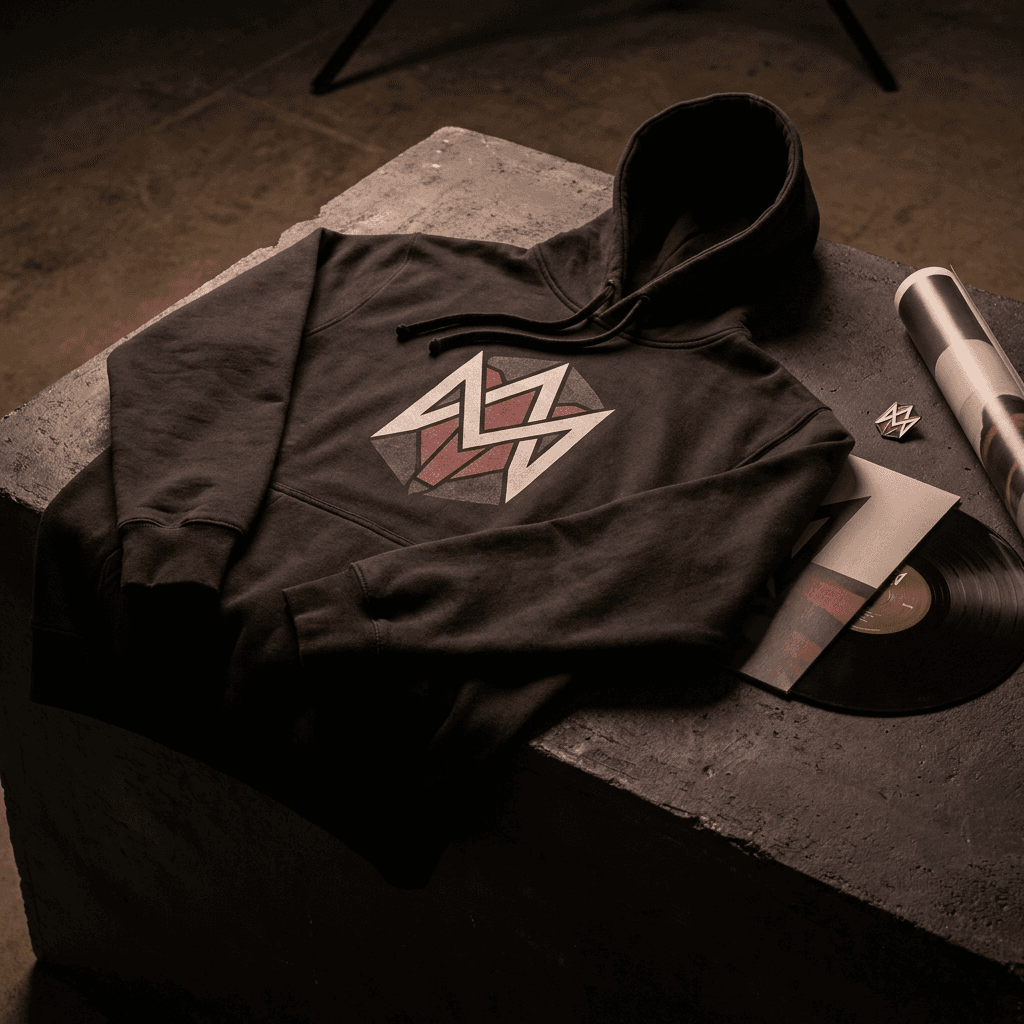
Prompt:
atmospheric artist merchandise photograph of [a piece of artist merchandise presented as a desirable, aesthetically compelling object within the artist's visual world — not a flat product shot but a lifestyle-adjacent presentation that makes the merchandise feel like a piece of the artist's universe: a premium black or dark-toned garment — a heavyweight cotton t-shirt, a hoodie, or a crewneck sweatshirt — displayed with the intentional styling of fashion photography rather than the flatness of screen-printing catalog imagery, the garment is laid flat or draped over a surface or partially hung with deliberate, editorial folds and creases that show the fabric weight and quality — the heavy cotton or fleece catching the light with its textile surface response, the drape communicating quality material, the print or design on the garment is the album's visual identity translated to wearable form — perhaps a graphic that uses the album's central visual element (the geometric shape from Template 2, or a photographic element from the album world) rendered in a limited color palette appropriate for garment printing (single-color, two-color, or the rich but constrained palette that distinguishes premium merch from disposable tour shirts), the design is positioned on the garment as a design decision — centered chest, oversized back print, small left-chest detail, or an all-over print — the placement intentional and the scale considered for the garment's proportions, the styling context places the garment in the artist's visual world — the surface beneath and the environment around the garment echo the album's aesthetic: if the album world is urban and nocturnal, the merch is shot on a dark concrete surface with neon light reflections; if the album world is natural and atmospheric, the merch is shot on a raw wood surface with soft, warm natural light; if the album world is minimal and modern, the merch is shot on a clean, architectural surface with precise studio lighting, additional merchandise items may accompany the garment — a vinyl record positioned nearby, a poster rolled or unrolled, an enamel pin on the garment surface, a tote bag with coordinating design — the collection of items communicating the complete merch offering as a curated set rather than isolated products, the garment's physical qualities are visible — the weight of the fabric (the way it folds shows fabric weight: heavyweight cotton folds in thick, deliberate creases, lightweight cotton in thinner, more numerous folds), the quality of the printing (the ink sitting on or in the fabric, the print's edge quality, the color saturation), the construction details (the ribbing at the neck, the stitching quality, the tag if designed), the overall presentation communicates: this merchandise is not a disposable souvenir but a quality garment with a designed graphic that extends the album's visual world into wearable form — buying this is buying a piece of the artist's aesthetic, wearing it is participating in their visual identity] in a styled editorial merchandise composition, the photograph is taken from a slightly overhead angle — approximately 30-45 degrees for laid-flat garments, or at garment-level for draped or hung presentations — the perspective that shows the garment's shape, the print design, and the fabric quality simultaneously, the composition balances the garment and its context — the merchandise is the clear subject but the environment tells the story: the surface material, the lighting quality, the accompanying items all contributing to the world-building that connects the merch to the album, the print design is prominently displayed — the graphic visible, legible, and impactful within the garment composition, the design's connection to the album artwork recognizable to fans, the fabric quality is communicated through the fold and drape — the garment positioned to show both the printed area and the fabric body, the textile quality as visible as the graphic quality, the accompanying items (vinyl, poster, pin) create the merch-collection context — each item visible and desirable, the collection communicating the breadth of the merchandise offering, the depth of field is moderate — the garment and its print in sharp focus with the environment in complementary atmospheric blur, the print detail and fabric texture visible in the focused zone, the lighting matches the album's visual temperature — warm and amber for warm-toned albums, cool and silver for cool-toned albums, dramatic and high-contrast for intense albums — the lighting quality connecting the merch presentation to the album's established visual world, the garment fabric catches the light with textile quality — the cotton or fleece surface absorbing and reflecting light with its specific material response, the fabric weight communicated through shadow density in the folds, the print catches the light with its ink quality — screen-printed or DTG-printed graphics responding to light differently than the fabric around them, the ink's presence on the surface visible as a subtle textural difference, the surface beneath catches the light with its world-building material response — concrete with urban roughness, wood with natural warmth, clean surface with architectural precision — each surface reinforcing the album's visual territory, genre and album-world-specific palette applied to merchandise context — garment in black or dark base tone — print in album-derived color palette (limited to printable range) — surface and environment in album-world materials and tones — warm or cool lighting matching album visual temperature — and the styled, editorial, album-world-connected palette of a premium artist merchandise presentation as the color palette, the mood is desirably styled aesthetically integrated quality-communicating and the specific merchandise message — this garment is a quality product and a piece of the artist's world, wearing it is a choice about who you are and what you listen to, the design connects you to the music and the community, the quality justifies the price — the merchandise photograph as the lifestyle-aspirational visual that drives merch sales and extends the album's visual identity into the physical world, professional fashion and product photography with album-world-matched lighting and moderate depth of field keeping the garment in textile-detail focus, composed as a styled editorial merchandise presentation with fabric quality and print design prominence, the print design impact and the fabric quality and the album-world integration as the merchandise-value focal points, album-derived palette on garment and environment, no text overlays outside the garment design, no watermarks
Best for: Online merch store product imagery (Bandcamp, Shopify, Big Cartel), social media merch announcement and drop posts, email marketing merch launch campaigns, concert venue merch display reference, pre-order campaign visuals for merch bundles, fan engagement and community content around merchandise, influencer and press seeding materials, crowdfunding campaign reward tier imagery
Template 8: The Social Media Announcement — Release Campaign Visual
This template creates the announcement visual — the social media post designed to communicate release information (dates, titles, tracklists) while maintaining the visual identity's atmospheric quality. This is the image designed to carry text overlays while remaining visually compelling.
Prompt:
atmospheric release announcement visual of [a moody, text-ready composition designed as the visual canvas for a music release announcement — an album release date post, a single drop announcement, a tracklist reveal, or a tour date announcement: the image provides the atmospheric foundation over which text and information will be overlaid, designed to make the text feel like it belongs in the artist's visual world rather than floating on a generic background, the composition divides into zones — clear, relatively simple zones where text will be placed (the upper half, or the center, or a wide vertical strip) and more visually active zones where the atmospheric imagery provides the emotional context, the text zones have consistent, readable backgrounds — not solid black or white but the album's dark or light base color with enough uniformity to support text legibility: a deep, even gradient, a slightly textured but uniform dark field, a very soft-focus atmospheric area — the zones where text will sit prioritizing readability while maintaining mood, the atmospheric zones carry the visual identity — the album's visual language expressed through color, texture, and atmospheric elements: perhaps the lower third of the frame features a blurred landscape or urban horizon in the album's palette, or the edges of the frame feature the album's textural elements (the grain, the color, the geometric forms) more intensely while the center remains clear for text, or a dramatic sky or water surface fills the background with the atmospheric quality established in the album art, the composition may include a small but impactful visual element — the album cover itself at a reduced size positioned in one corner or the lower center, the cover art serving as a visual anchor that connects the announcement to the established album identity, or the album's geometric element or a symbolic visual placed as a designed element within the announcement layout, the overall frame is designed as a layout — an art-directed canvas where visual atmosphere and text space coexist, the image already looking like a designed announcement even before text is added, the aspect ratio flexibility is built in — the composition works whether cropped to 1:1 for Instagram feed, 4:5 for maximum feed height, 9:16 for Stories, or 16:9 for Twitter/X banners, the key atmospheric elements and the text zones positioned to survive multiple crops, the overall design communicates: this is an official communication from the artist's world, the visual quality signals importance and professionalism, the atmosphere maintains the emotional continuity of the visual identity, the announcement is not just information but an aesthetic event] in a deliberately designed text-ready announcement composition, the composition is consciously zoned — designated text areas and designated atmospheric areas working together, the balance between readable space and visual interest calibrated for announcement effectiveness, the text zones are spacious — enough room for a release title, a date, and supporting information (tracklist, pre-save link prompt, "out now" or "coming soon") with comfortable breathing room between text elements, the atmospheric zones carry the visual weight — the colors, textures, and imagery that make this announcement recognizable as belonging to this artist's visual world, if the album cover is included as an element, it is positioned strategically — prominent enough to anchor the announcement but not so large that it overwhelms the text information, the multi-crop flexibility means key elements avoid the edges and the extreme center — the critical content (both visual and where text will be placed) occupies the safe zone that survives cropping across formats, the depth of field is atmospheric — the background elements in soft, moody blur, any included album cover or visual element in moderate focus, the overall field supporting text without visual competition, the lighting maintains the album's established temperature — the announcement visual matching the album's warm or cool or dramatic quality, the consistency reinforcing brand recognition, the text zones catch even, manageable light — not bright enough to blow out light text or dark enough to swallow dark text, the sweet spot of contrast that makes both white and off-white text readable, the atmospheric zones catch more dynamic light — the visual interest concentrated where it does not interfere with text, the album-world atmosphere expressed through the more active lighting in the non-text areas, any included album art or visual element catches appropriate light — the miniature cover illuminated consistently with its original presentation, recognizable and clear at reduced size, album-world color palette applied to a text-supporting layout — dark or deep base color in text zones for light-text readability — atmospheric album colors in active zones — album cover or geometric element in recognizable album palette — and the designed, text-ready, atmospherically consistent palette of a music release announcement visual as the color palette, the mood is officially atmospheric designedly professional announcement-ready and the specific social-media-announcement message — this is important news from an artist you follow, the visual quality signals that this release matters, the atmosphere maintains the emotional world of the music, pay attention to what this says — the announcement visual as the information-delivery canvas that maintains visual identity while communicating release details effectively, professional graphic design and art direction with album-world-consistent lighting and atmospheric depth of field in a text-zone-conscious composition, designed for multi-platform multi-crop deployment with text overlay compatibility, the text readability and the atmospheric continuity and the multi-format flexibility as the announcement-design focal points, album-derived palette with text-supporting contrast, no text overlays in this base image (text will be added by the artist or designer), no watermarks
Best for: Social media album release date announcements, single drop announcements, tracklist reveal posts, pre-save campaign posts, tour date and ticket sale announcements, email marketing release campaign headers, streaming platform editorial pitch visuals, press release header imagery, website homepage announcement banners, countdown content across platforms
Template 9: The EP and Mixtape Cover — Smaller Project Identity
This template creates visual identity for shorter-form releases — EPs, mixtapes, demos, and compilations — that need their own identity while existing within or alongside the artist's larger visual world. EP and mixtape covers can take more risks and explore more experimental directions than full album covers.
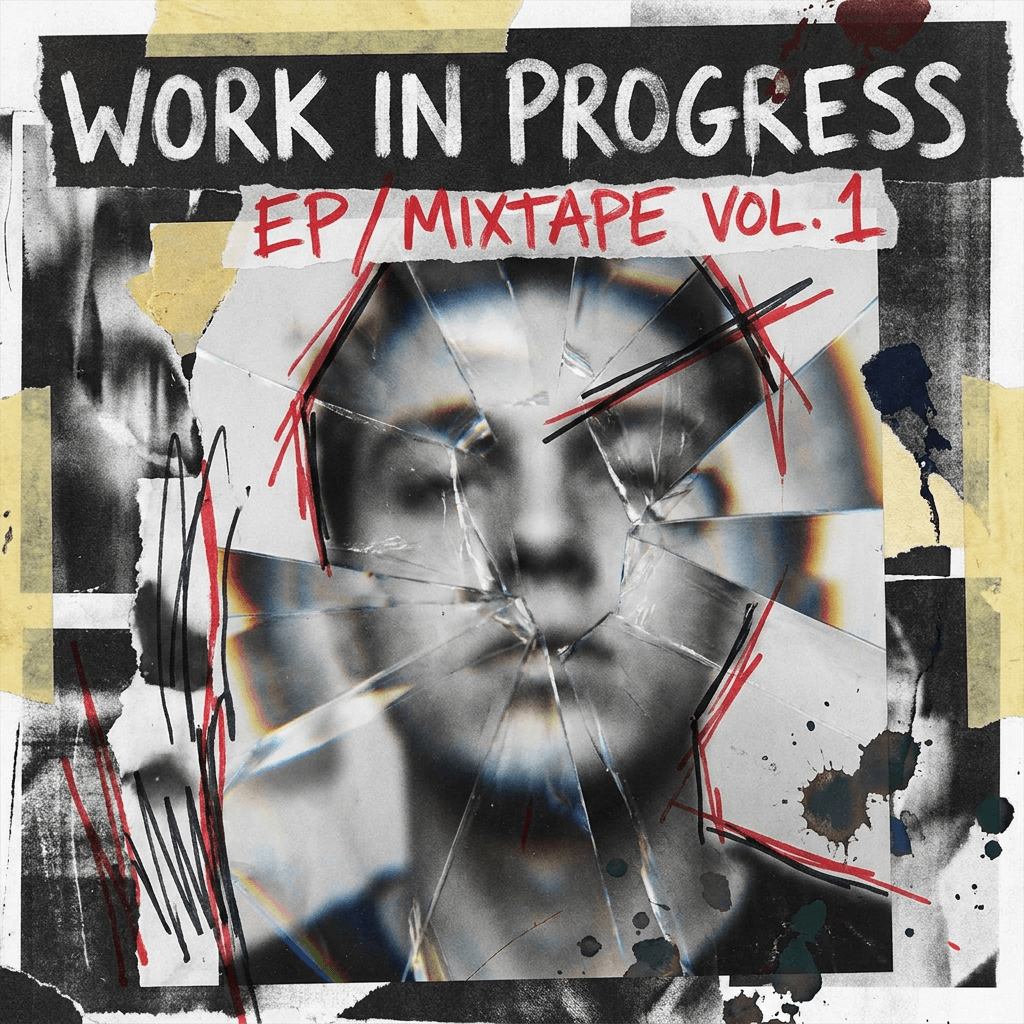
Prompt:
experimental EP or mixtape cover artwork of [a visually bold, more experimental composition for a shorter-form release — the visual identity of an EP or mixtape that takes creative risks the full album might not: a photographic or mixed-media composition that feels more immediate, more raw, more process-visible than the polished completeness of a full album cover — perhaps a heavily manipulated photograph: a real image that has been distorted, multiplied, color-shifted, or layered with graphic elements until it exists somewhere between photography and graphic art — a portrait or landscape shot through a prism creating multiple overlapping fractured images, or a photograph printed and then physically damaged (crumpled, torn, painted over, xeroxed multiple times) and then re-photographed, or a collage of photographic and graphic elements layered with deliberate roughness — the raw edges, the visible construction, the process of making the image visible in the finished work, the mixed-media quality communicates the EP or mixtape's position — more experimental, less polished, more immediate than a full album, the format inviting creative risk and process visibility, the color treatment is bolder or stranger than the full album might allow — a severe monochrome with a single accent color (all desaturated except for vivid red), or an inverted color palette (complementary negatives), or an extreme color push that distorts naturalistic color into something alien and arresting, the experimental color reinforcing the short-form release's creative freedom, a raw, handmade quality is visible — torn paper edges, visible tape or adhesive, marker or paint marks, the fingerprints of physical creation that digital-first design avoids, the handmade elements communicating authenticity, urgency, and the creative restlessness that drives EP and mixtape releases between albums, text or typographic elements may be integrated into the image itself — hand-lettered, spray-painted, typed on a typewriter and scanned, or digitally rendered in a deliberately rough way — the title treatment part of the visual composition rather than a separate overlay, the texture of the typography matching the texture of the imagery, the composition is energetic and slightly unresolved — unlike the album cover's completeness, the EP cover has edges that feel like they continue beyond the frame, processes that feel interrupted rather than finished, the visual equivalent of the EP as a work-in-progress snapshot, a creative dispatch from between albums, the overall visual communicates: this is something urgent and experimental, made between the big statements, a creative document that captures where the artist is right now rather than the considered, definitive statement of an album — the EP cover as visual evidence of ongoing creative work] in a raw, experimental 1:1 cover composition, the composition breaks rules that the album cover follows — the framing may be off-center or aggressive, the edges may be rough, the balance may be deliberately uneven, the visual tension communicating the EP's creative restlessness, the mixed-media elements layer with visible construction — the seams between photographic and graphic elements visible, the process of combination part of the aesthetic, the deliberate roughness communicating authenticity over polish, the experimental color treatment is consistent across the composition — the severe monochrome or the inverted palette or the extreme color push applied as a total treatment that unifies the diverse elements, the handmade elements add the human mark — the imperfect, irregular, handcrafted quality that digital tools specifically avoid, the human touch as a statement against the smoothness of digital production, the typography (if integrated) sits within the image as a visual element — not floating above the composition but woven into it, the letter forms interacting with the imagery, the text as art, the square format is used aggressively — elements pushed to edges, the boundary of the frame interacted with rather than respected, the format treated as a constraint to push against rather than a container to fill neatly, the depth of field concept is layered — some elements in front (overlaid, pasted), some behind, the layers creating a three-dimensional collage depth that is different from the atmospheric depth of the album cover, the lighting varies across elements — the photographic base catching one kind of light, the overlaid elements catching another, the mixed lighting itself evidence of mixed sources and mixed processes, the experimental color catches light with its altered response — monochrome elements absorbing or reflecting within their limited range, extreme color-pushed elements glowing with unnatural vibrancy, the contrast between different color treatments within the composition creating visual energy, the handmade elements catch light with their physical texture — the torn paper edge casting a tiny shadow, the tape reflecting with its transparent surface, the marker or paint sitting on the surface with ink or pigment texture, bold experimental palette — severe monochrome with vivid single accent, or inverted complementary negatives, or extreme color-pushed distortion — mixed media textures in varied tonal responses — handmade elements in raw physical-material tones — and the raw, experimental, process-visible palette of an EP or mixtape cover that takes visual risks the album would not as the color palette, the mood is urgently experimental creatively raw immediately vital and the specific EP-mixtape message — this is art made in the spaces between albums, urgent and unpolished and alive, more experimental because the format allows it, a creative document that captures motion rather than position — the EP cover as the visual evidence of ongoing creative process and the freedom of shorter-form release, professional experimental and mixed-media art composition with varied lighting and layered depth in a raw, boundary-pushing 1:1 square format, designed for immediate visual impact with the deliberate roughness of experimental process, the mixed-media construction and the experimental color and the handmade mark as the creative-vitality focal points, raw experimental palette with process-visible textures, no watermarks
Best for: EP and mixtape release cover art, streaming platform artwork for shorter-form releases, social media EP and mixtape announcement content, Bandcamp and independent release platform artwork, SoundCloud and mixtape platform cover imagery, press kit shorter-release visual materials, playlist and curated compilation artwork, creative-process and behind-the-scenes content extension
Template 10: The Music Video Reference Frame — Cinematic Still Direction
This template creates the cinematic still image that serves as a music video visual reference, thumbnail, and conceptual direction — the single frame that communicates the visual world of a music video, used for planning, promotion, and platform representation.
Prompt:
cinematic music video still frame of [a dramatically composed, narratively suggestive frame from a cinematic visual story — the kind of image that feels pulled from the midpoint of a music video, loaded with narrative implication and visual atmosphere: a scene that suggests both a before and an after — the viewer encounters this frame and immediately asks what happened and what happens next: a figure standing at the end of a long, empty hallway in a building from another era — art deco or mid-century or industrial, the architecture beautiful and slightly decayed, the walls and ceiling showing their age while retaining their designed grandeur, the hallway lit from a distant window at the far end, the light creating a long gradient from bright distance to shadowed foreground, the figure positioned at a narrative decision point — about to walk forward or having just stopped, the body language poised between movement and stillness, the posture telling a story that the single frame cannot complete, the hallway itself is a character — the architecture communicating history and atmosphere, the perspective lines of the walls and floor converging toward the distant light source, the compositional depth pulling the viewer into the frame along the same axis the figure contemplates, objects or details within the hallway add narrative texture — a chair against the wall with a garment draped over it, a mirror reflecting something we cannot see from this angle, a door slightly ajar on one side with light leaking through the gap, a shadow cast on the wall from something beyond the frame — each detail a narrative seed that the viewer's imagination germinates, the color grading is cinematic and deliberate — a specific color treatment that would be consistent across a full music video: perhaps a desaturated warm palette with lifted blacks (the analog-film-meets-modern-cinema look), or a teal-and-orange complementary push (the classic cinematic grade), or a monochromatic cool blue-grey with a single warm accent (the neon-sign or candle flame that provides the composition's only warmth), the anamorphic or widescreen quality — even in a square or vertical crop, the compositional logic suggests a widescreen cinematic frame: the horizontal sweep of the hallway, the horizontal light gradient, the widescreen proportions of the architectural space, the grade and the framing and the light quality communicating "this is cinema," the atmospheric quality is elevated beyond documentary — the light slightly too beautiful, the decay slightly too artful, the composition slightly too perfect — the heightened reality of a music video's visual world where everything is real but better, more beautiful, more emotionally charged, the overall frame communicates: this is a moment from a visual story that accompanies music, the image has the narrative quality of cinema, the atmosphere has the emotional quality of a song, the viewer wants to see what happens next and hear what this looks like as sound] in a cinematically composed reference-frame composition, the composition uses cinematic language — the framing, the lighting, the color grading, and the compositional geometry all communicating "this is from a film or a music video" rather than a still photograph, the depth composition is pronounced — the hallway or environment creating strong perspective that pulls the viewer through the frame, the depth creating the immersive quality that music videos use to create world-entry, the figure is positioned for narrative impact — at the vanishing point, or at a rule-of-thirds intersection, or framed by the architecture, the figure's position within the space telling the story through placement, the narrative details are positioned for discovery — the draped garment, the ajar door, the cast shadow — each visible but not dominant, the viewer finding them on longer examination, the overall frame is balanced but dynamic — the cinematic balance that holds visual interest through tension rather than symmetry, the asymmetric elements creating the sense that the frame is a moment extracted from motion, the depth of field is cinematic — a medium depth that keeps the figure in focus while allowing the distant light source and the nearest foreground elements to soften, the cinematic rack-focus quality that distinguishes movie frames from still photography, the lighting is cinematic lighting — the motivated, source-visible illumination of narrative filmmaking: the distant window providing the key light, practical lights in the hallway providing fill, the natural fall-off of light through the space creating the gradient that is the frame's primary atmospheric element, the distant window light creates the backlit or partially backlit figure — the rim light and the silhouette quality that cinematic lighting uses for dramatic figure presentation, the hallway's architecture catches the light with dimensional quality — the walls and ceiling modeling the light's direction, the architectural details casting shadows that add depth, the decay and age of the surfaces visible in the way old plaster or worn wood responds to raking light, the narrative details catch specific light — the garment draped over the chair catching a highlight, the door gap leaking its warm light into the hallway, the mirror (if present) reflecting a different light quality than its surroundings — each lit detail a visual story point, the color grading unifies the frame — the cinematic color treatment applied as a total look: the desaturated warmth or the teal-orange push or the monochromatic cool applied across every element, the grade creating the movie-like quality that separates this from ungraded reality, cinematic color grade specific to genre and mood — desaturated warm with lifted blacks, or teal-and-orange complementary, or cool monochrome with single warm accent — warm distant window light — deep shadow tones — architectural surface colors modulated by the grade — figure in silhouette or partial illumination — and the cinematic, graded, narrative palette of a music video reference frame as the color palette, the mood is narratively charged cinematically atmospheric story-rich and the specific music-video-still message — this is a frame from a visual story, it implies a before and an after, the cinematic quality communicates the artistic ambition of the music video, the atmosphere communicates the emotional world of the song — the reference frame as the music video planning tool, the YouTube thumbnail, the social media teaser, and the visual promise of the cinematic experience the music video delivers, professional cinematic photography with motivated narrative lighting and cinematic depth of field in a frame composed with film-language geometry, composed as a single narrative-rich frame from a cinematic music video with figure in architectural environment, the narrative tension and the cinematic lighting and the color-grade specificity as the music-video focal points, cinematic grade palette with architectural and figure tones, no text overlays, no watermarks
Best for: Music video conceptual development and visual reference, YouTube music video thumbnail, social media music video teaser content, press and editorial music video feature imagery, website music video section, behind-the-scenes and making-of content pairing, streaming platform music video promotion, music video premiere and release announcement
Template 11: The Press Kit Portrait — Editorial and Media Image
This template creates the press-ready portrait — the image designed for editorial features, magazine layouts, blog posts, playlist descriptions, and the professional media contexts where the artist's image represents them to industry and audience.
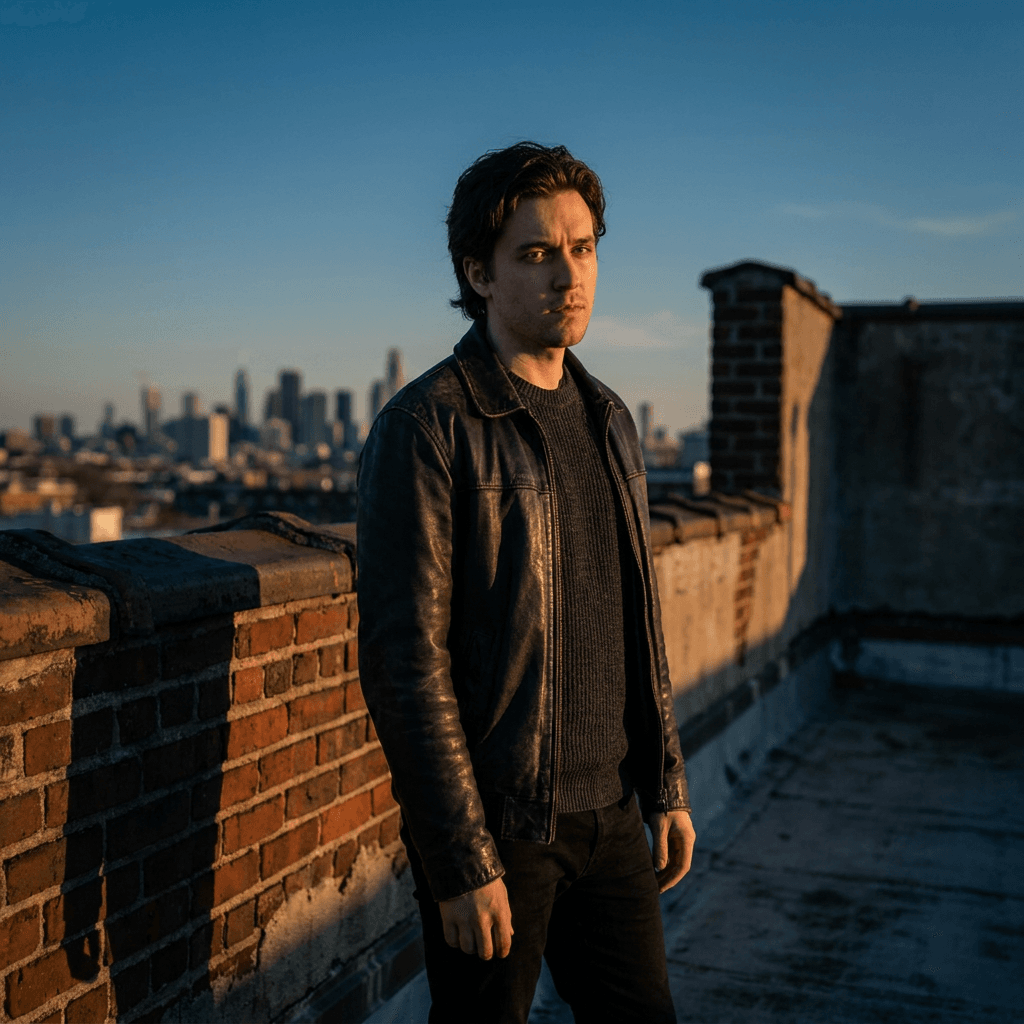
Prompt:
editorial press portrait of [a figure composed for editorial reproduction — the kind of image that communicates artistic seriousness and visual sophistication in the context of a magazine feature, a blog profile, a playlist description, or a festival lineup poster: a three-quarter or full-body portrait in a considered environment — not the casual headshot of a social media profile but the composed, intentional, art-directed image that editorial contexts require: the figure is positioned in a space that communicates their artistic world without being the explicit stage or studio — perhaps an urban architectural setting (a concrete stairwell, a doorway with interesting light, a rooftop with cityscape beyond), or a natural environment (an open field, a forest edge, a shoreline), or an interior space with character (a vintage-furnished room, an empty gallery, a window-lit corridor) — the environment adding context and depth without overwhelming the figure as the subject, the figure's styling is deliberate and editorial — the clothing and personal presentation communicating the artist's aesthetic identity: the specific choices of garment, color, silhouette, and detail that make this person recognizable as this artist rather than a generic portrait subject, the styling consistent with the album's visual world (dark and angular for intense, atmospheric music; natural and relaxed for organic, acoustic music; bold and graphic for high-energy, contemporary music), the posture and expression are editorial-natural — not the frozen smile of a publicity headshot but the engaged, present, slightly serious expression of someone who makes art, the kind of expression that communicates creative intelligence and emotional depth, the body language confident but not posed — the figure existing in the space rather than performing for the camera, the gaze may be direct (meeting the viewer's eye, communicating presence and confidence) or averted (looking at something beyond the frame, communicating the introspective quality of a creative mind at work) — either choice deliberate and consistent with the artist's persona, the environment provides visual context without visual noise — the background elements controlled and intentional: architectural lines, natural forms, or interior details that add depth without distraction, the focused depth of field keeping the environment present but secondary, the overall image is reproducible — designed to maintain its quality and impact when cropped for different editorial formats (vertical magazine page, horizontal blog header, square social media, wide banner), the critical content (the figure's face and upper body) positioned in the safe zone that survives aggressive cropping, the overall portrait communicates: this is an artist to take seriously, the visual sophistication of the portrait reflects the artistic sophistication of the music, this image works in Pitchfork and the New York Times and a Spotify playlist description and a festival poster because it has the quality and intentionality that all of those contexts demand] in a composed, editorial portrait composition, the composition uses editorial portrait conventions — the figure positioned with intentional placement within the frame, the environment providing depth and context, the overall image reading as "art-directed" rather than "snapshot," the figure occupies the primary visual position — large enough for facial expression and styling to be readable, positioned for impact within the frame (centered for formal directness, off-center for dynamic editorial quality), the environment extends behind and around — providing the depth, the texture, and the context that distinguish an editorial portrait from a headshot, the space around the figure communicating the artist's world and the scale of their creative environment, the compositional safe zone ensures crop-flexibility — the figure's face and core body positioned away from edges, the horizontal, vertical, and square crops all yielding strong, balanced images, secondary environmental elements fill the crop variations — the architecture or nature or interior providing interesting content in every format, the depth of field is editorial-moderate — the figure in crisp focus from face through hands and clothing, the environment falling into gentle but recognizable blur, enough environmental detail readable to communicate context while the focus priority remains the artist, the lighting is the editorial portrait standard — sophisticated, flattering, and character-specific: the light quality matches the artist's visual identity while meeting the universal portrait requirement of flattering facial illumination, natural or natural-quality light from one side — entering from a window, reflecting from a wall, filling an open-shade environment — creating the soft directional modeling that defines the face's structure and the clothing's texture, the primary light models the face with gentle sculpting — the eye-side lit, the far side in graduated shadow, the contrast ratio balanced for editorial reproduction (not so contrasty that details are lost in print, not so flat that the face loses dimension), the clothing catches the light with its specific material response — the texture and color of each garment visible, the styling readable as editorial presentation, the environment catches the light with its specific quality — the concrete or wood or foliage responding with material texture, the light's behavior in the space consistent with the light quality on the figure, the skin tones are the critical color reference — rendered with the warmth and accuracy that editorial portraiture requires, the flesh tones natural and flattering under the chosen light, editorial lighting quality with natural or natural-emulating direction — warm or cool consistent with artist aesthetic — environment in genre-appropriate tones — styling colors specific to artist identity — balanced shadow and highlight for editorial reproduction — and the sophisticated, flattering, editorially reproducible portrait palette as the color palette, the mood is artistically serious editorially composed creatively present and the specific press-portrait message — this artist is ready for editorial coverage, the portrait quality matches the publication quality, the image works across all editorial contexts from print magazine to digital blog to streaming platform, this is a professional who takes their visual presentation as seriously as their music — the press portrait as the editorial-readiness visual that opens doors to media coverage and professional visibility, professional editorial portrait photography with sophisticated directional light and editorial depth of field keeping the figure in crisp detailed focus with the environment in contextual supporting blur, composed as an art-directed editorial portrait with figure positioning and environmental context for multi-format crop flexibility, the facial quality and the styling communication and the editorial-reproduction readiness as the press-portrait focal points, tonally balanced palette with skin-tone accuracy, no text overlays, no watermarks
Best for: Press kit primary and secondary artist images, editorial feature accompaniment, magazine and blog profile imagery, streaming platform artist page photos, festival and event lineup promotional imagery, booking agent and venue promotional materials, social media profile and avatar image, email marketing artist-story content, Wikipedia and biographical reference imagery, award show and nomination materials
Template 12: The Genre-Defining Aesthetic — Visual Tradition and Innovation
This template creates imagery that specifically positions the artist within their genre's visual tradition while establishing individual identity — the visual that simultaneously communicates "I belong to this genre" and "I am uniquely myself within it."
Prompt:
genre-defining aesthetic composition of [a visual that speaks the specific visual language of a genre while establishing individual artistic identity — the image that genre-literate listeners immediately recognize as belonging to their music while finding something new and distinctive: FOR ATMOSPHERIC ELECTRONIC or AMBIENT — an otherworldly landscape that exists somewhere between photograph and digital creation: a vast, impossible natural scene — a glacial lake reflecting a sky that contains too many colors, a desert of fine white sand under aurora-like atmospheric lights in impossible hues, a mountainscape where the peaks dissolve into cloud formations that become geometric — the landscape real enough to feel environmental but altered enough to feel dreamlike, the palette cool and ethereal (ice blue, pale violet, silver-white, with a single warm accent — a distant amber glow at the horizon), the scale vast and the human presence absent — the music and the visual both coming from a place beyond the human, the sonic-visual match: the atmospheric patience of the landscape mirrors the long, evolving, textured sound of the music, the visual space is the sonic space, FOR HIP-HOP or R&B — an urban visual with cultural specificity and cinematic confidence: a nighttime urban scene with the rich visual texture of a city after dark — neon signs and streetlights creating colored light on wet surfaces, the pavement reflecting the night in liquid color, architectural forms (buildings, walls, gates, fire escapes) creating strong geometric compositions, the palette warm and rich (deep amber, neon rose, cool teal, dark shadow) with the visual density and color richness that hip-hop and R&B visual culture has established, the scene may include culturally specific elements — a particular type of architecture, a recognizable urban form, the visual vocabulary of a specific city or neighborhood — the cultural specificity communicating authenticity, a figure may be present — positioned with the confident visual ownership of space that hip-hop portraiture communicates, the posture and placement claiming the environment, FOR INDIE ROCK or ALTERNATIVE — a visually literate, aesthetically self-aware composition with analog warmth: a scene processed with the visual markers of analog photography — film grain, slightly shifted color, the specific warm-cool balance of expired film stock, the slightly imperfect focus quality of vintage lenses — the analog treatment communicating the genre's value of authenticity and its aesthetic lineage in the pre-digital visual tradition, the subject may be mundane but rendered with attention (a gas station at dusk, a living room with afternoon light, a parking lot, a bedroom) — the everyday elevated through photographic attention, the palette warm and slightly faded (the sun-bleached quality that indie visual culture has adopted from 1970s photographic color), FOR JAZZ or SOUL — a composition rich with the warmth, texture, and sophisticated visual depth of analog recording culture: warm tones (deep amber, rich brown, cream, warm black), textural elements (vinyl, fabric, wood, brass), the close-up intimacy of a detail composition — hands on an instrument, the bell of a horn catching warm light, a microphone in a room with visible acoustic treatment — the visual specificity of the music-making environment, the warmth and grain of medium-format film, the sophisticated intimacy of the Blue Note or Impulse! cover art tradition updated for the present — choose the genre version appropriate to the artist's music and describe with full visual specificity] in a genre-specific compositional style that references the tradition while establishing individual voice, the composition follows the genre's established visual conventions while introducing at least one distinctive element — the convention providing accessibility for genre listeners, the distinctive element providing identity, the genre-specific elements are deployed with literacy — the visual markers of the genre used correctly and completely, demonstrating the artist's awareness of and respect for the visual tradition they enter, the individual-identity elements distinguish this composition from any other artist in the genre — a specific color accent that is uniquely this artist's, a compositional approach that departs from convention in one clear way, a subject choice that is recognizably personal rather than generic, the format works for the genre's primary consumption contexts — if the genre lives on vinyl, the composition works at 12 inches; if the genre lives on streaming playlists, the composition works at thumbnail scale; if the genre lives on social media, the composition works in multiple aspect ratios, the depth of field matches the genre's visual standard — deep for landscape-based genres, shallow for portrait and detail-based genres, atmospheric for mood-driven genres, the lighting matches the genre's established visual temperature — cool and ethereal for atmospheric electronic, warm and rich for R&B and soul, warm-analog for indie, dramatic and intimate for jazz, genre-specific palette executed with individual distinction — the genre's traditional colors used with a specific, individual inflection: the electronic artist's particular shade of blue, the hip-hop artist's particular neon accent, the indie artist's particular film-stock warmth, the jazz artist's particular amber tone — the palette generic enough to communicate genre and specific enough to communicate identity — and the genre-literate, individually-distinctive palette of an artist establishing their visual place within a tradition as the color palette, the mood is genre-authentic individually distinctive visually literate and the specific genre-positioning message — this artist belongs to this tradition and brings something new to it, genre listeners will recognize the visual language immediately and find something they have not seen before, the visual identity honors the genre's history while claiming individual space — the genre-defining visual as the tradition-and-innovation statement that positions the artist for genre-specific discovery and audience recognition, professional photography or art composition in genre-appropriate style with genre-standard lighting and depth of field, composed in the genre's visual tradition with individual distinctive elements, the genre authenticity and the individual identity and the visual literacy as the positioning focal points, genre-specific palette with individual inflection, no text overlays, no watermarks
Best for: Album and single artwork in genre-specific positioning, streaming platform genre playlist consideration, social media genre-community content, press kit genre-positioning imagery, playlist curator visual assessment (curators place music partly based on visual genre-match), festival and event genre-stage visual materials, music blog and genre-publication editorial imagery, influencer and genre-community sharing content
Template 13: The Studio Atmosphere — Behind-the-Scenes Creative Process
This template creates the behind-the-scenes studio image — the atmospheric shot of the creative environment where the music is made, inviting the listener into the process and the space that shaped the sound.
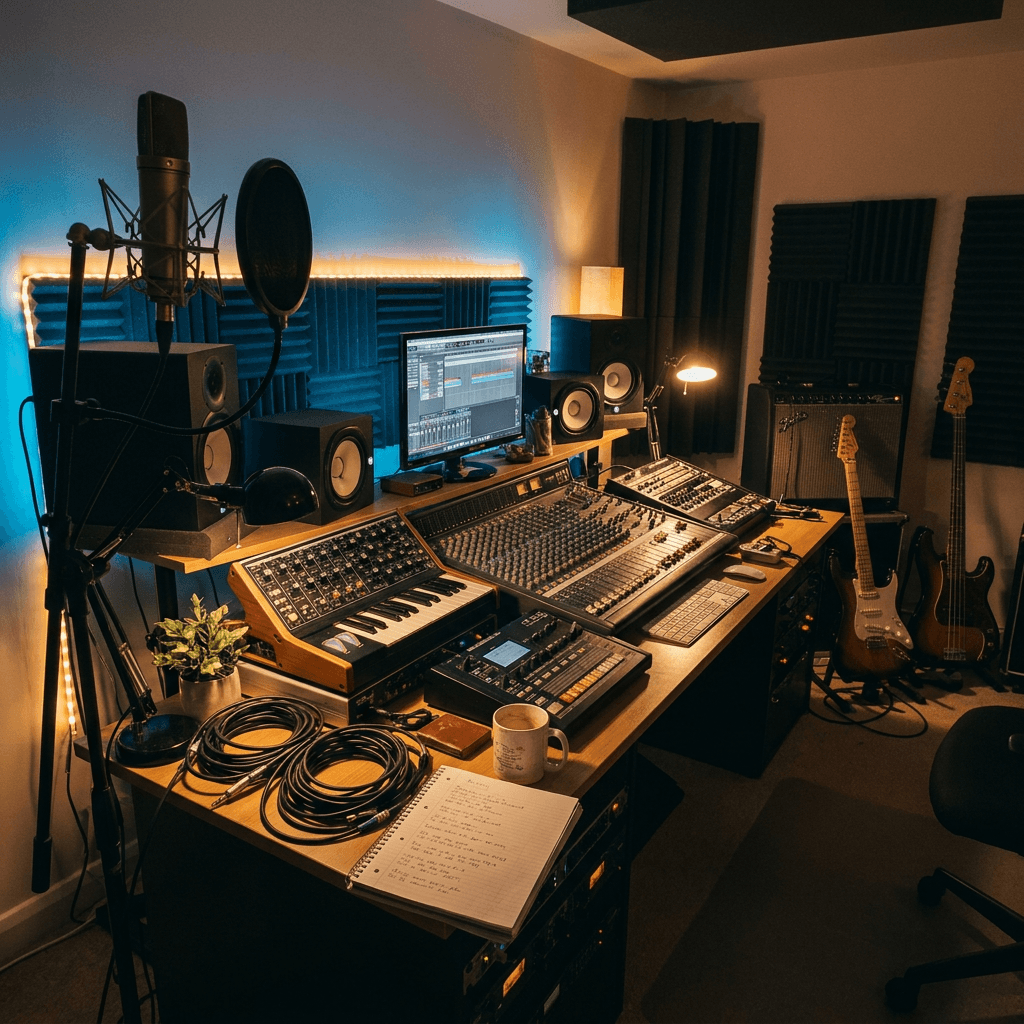
Prompt:
atmospheric recording studio photograph of [the creative space where music is made — a recording studio, a home studio, a rehearsal space, or a production environment rendered with the warm, intimate, atmospheric quality that makes the creative process feel visible and inviting: the studio environment is mid-session — not the clean, empty room of a real estate photograph but the lived-in, working condition of a space during active creation: a mixing desk or a desk with production equipment (synthesizers, drum machines, controllers, a computer with a DAW visible on screen) occupies the central zone of the frame, the equipment arranged in the working configuration of actual use — not the symmetrical display of a showroom but the organic arrangement of a creator who has positioned everything within reach, the desk surface shows the evidence of creative work — a notebook open with handwritten lyrics or session notes, a coffee mug (half-empty, the rim marked), a phone with its screen dark, a few cables coiled or hanging, small personal objects that make the space personal (a photograph, a small figure, a plant, an ashtray) — the accumulated evidence of hours spent in this room making music, the equipment is specific and visible — recognizable synths or instruments or monitors or microphones that musicians and producers will identify, the specificity communicating credibility and the equipment choices communicating aesthetic preferences (analog gear signals warmth and intentionality, digital controllers signal modernity and efficiency, vintage equipment signals connoisseurship), microphones stand ready — a large diaphragm condenser on a stand with a pop filter, or a ribbon mic on its mount, the microphone the visual symbol of the recording act, its presence saying "voices are captured here," studio monitors sit at ear-height behind the desk — their drivers facing the listening position, the monitors the tools through which every sound decision was made, the cones or soft-dome tweeters catching light with their material quality, instrument presence in the room adds musical identity — a guitar on a stand or leaning against an amp, a keyboard or piano visible at the room's edge, a bass in its stand, drumsticks on a surface — the instruments communicating what kind of music is made here, the room itself has acoustic character — sound-absorbing panels or blankets on walls, the specific visual quality of a treated room that communicates "serious recording happens here," the panels or treatment adding geometric visual interest to the walls, the lighting is the studio's own — dim, warm, the specific low-light environment of studios where visual distraction is minimized and sonic focus is maximized: LED strips behind monitors casting colored light (the colored LED glow that has become the visual signature of modern studio culture), desk lamps with warm bulbs, the computer screen's glow, equipment LEDs and VU meters providing tiny points of colored light — the accumulated electronic warmth of a powered-up studio, the overall scene communicates: this is where the music was born, this is the room and the equipment and the process, the creative environment is personal and intentional and lived-in, the listener is being invited into a private space that is usually heard but not seen] in a warm, intimate studio-atmosphere composition, the photograph is taken from a natural standing or sitting perspective — the viewpoint of someone entering the studio or sitting in the room observing the creative environment, the angle that makes the viewer feel present in the space, the composition shows the studio as a cohesive environment — the desk and equipment as the working center, the instruments and acoustic treatment providing the room context, the personal details adding the human element, the equipment is identifiable but not catalog-like — shown in its working context rather than isolated, the gear positioned for use rather than display, the personal elements add the human story — the notebook, the coffee, the personal objects saying "a person works here, this person has taste and habits and a creative process," the room's acoustic treatment and technical setup communicate professionalism — this is not a bedroom with a laptop but a dedicated creative space, the low, warm studio lighting is the atmospheric key — the dim, colored, electronic warmth that makes studios feel like caves of creation, the colored LED light that has become the visual shorthand for "studio session," the depth of field is atmospheric — the desk and immediate equipment in reasonable focus, the room extending into warm, equipment-lit soft focus, the intimate depth communicating the enclosed, focused space of a studio, the lighting is mixed and warm — the multiple small light sources of a working studio creating a complex, low-level illumination: LED strip casting colored wash (blue, amber, or purple depending on the setup) behind monitors — desk lamp providing warm focused task light — equipment LEDs and VU meters glowing with signal-presence — computer screen providing its own cool-white or warm-amber illumination — the accumulated light sources creating the complex, low-level, warm luminosity of a studio in session, the mixing desk or production equipment catches the multiple light sources — the surface reflecting the colored LED wash, the buttons and faders lit by the desk lamp, the screen reflecting in nearby surfaces, the microphone catches the light with its metallic surface — the mesh grille or the ribbon housing reflecting the warm room light with professional-equipment precision, the instruments catch the ambient light with their material surfaces — the guitar's lacquer, the keyboard's plastic or wood, the drum surfaces — each instrument reflecting the room's mixed light differently, the personal objects catch intimate light — the notebook pages, the coffee surface, the small objects each lit by the nearest source, the acoustic panels absorb the light — their fabric surfaces the darkest elements in the room, absorbing rather than reflecting, their sound-absorbing function visible in their light-absorbing response, warm low studio lighting — colored LED wash (blue or amber or purple) — warm desk lamp amber — cool screen glow — equipment LED jewel tones (green, red, amber of VU meters and indicators) — dark acoustic panel shadows — warm wood and metal equipment surfaces — and the complex, low-level, electronically-warm palette of a recording studio in session as the color palette, the mood is creatively intimate sonically focused warmly productive and the specific studio-atmosphere message — this is where the music comes from, this private creative space is being shared with the listener, the equipment and the environment and the personal details all contributed to the sound you hear, the creative process is visible and the space is real — the studio photograph as the behind-the-scenes invitation that deepens the listener's connection to the music and the artist's creative authenticity, professional interior and atmospheric photography with complex mixed low-level studio lighting and atmospheric depth of field in an intimate creative-space composition, the equipment specificity and the personal details and the warm electronic atmosphere as the creative-process focal points, complex warm studio-light palette, no text overlays, no watermarks
Best for: Social media behind-the-scenes and creative-process content, album inner artwork and booklet photography, website about and process sections, press kit behind-the-scenes materials, documentary and making-of content pairing, fan engagement process-sharing content, email marketing album-story and creation-process content, Patreon and fan-platform exclusive behind-the-scenes imagery, YouTube creator and production content thumbnails
Template 14: The Fan Engagement Visual — Community and Connection
This template creates imagery designed for fan engagement — the visual content that strengthens the artist-community bond through shared experience, milestone celebration, and the visual language of fandom and belonging.
Prompt:
fan community connection visual of [a visual composition designed to celebrate and strengthen the artist-fan community — an image that communicates belonging, shared experience, and the emotional connection between artist and listeners: a scene that captures the collective energy of music fandom — perhaps an atmospheric crowd scene (captured from behind, no identifiable faces) at a concert: hundreds of silhouetted hands raised against a wash of stage light, the hands varied and numerous, the collective gesture of surrender to music visible in the forest of raised arms, the stage light bathing the scene in the artist's signature color palette (the album's key color washing the crowd scene, connecting the fan moment to the album's visual identity), phone flashlights scattered through the crowd like earthbound stars, the light points creating a field of individual participation within the collective experience, OR a visual that represents fan community without a literal crowd: a collection of objects that fans would recognize — ticket stubs arranged in a pattern, wristbands from different show dates, a poster wall of different tour artwork, a shelf of vinyl records and merchandise collected over time — the accumulated evidence of fandom rendered as a beautiful composition, each object carrying memory, OR an atmospheric text-ready visual designed for milestone communication — a warm, celebratory background in the artist's palette designed to carry text announcing streaming milestones (1 million streams, 100K monthly listeners), tour achievements (sold-out shows, new cities), or community milestones (anniversary of an album release, the growth of the fan community) — the visual foundation for the "thank you" post that acknowledges the community's role in the artist's journey, the visual maintains the artist's established aesthetic — the color palette, the atmospheric quality, the textural approach all consistent with the album and single artwork, the fan engagement visual existing within the same visual world as all other artist content, the emotional quality is gratitude and shared experience — the visual communicating "we did this together, this moment belongs to all of us, the music is yours as much as it is mine," the warmth and inclusivity of the visual language reflecting the artist's relationship with their community, the overall scene communicates: the music creates a community, the community creates the experience, the relationship between artist and listener is reciprocal and valued — the fan engagement visual as the community-building content that strengthens loyalty and creates the shared visual language of belonging] in a warm, community-celebrating composition, the composition is inclusive and expansive — if a crowd scene, the crowd extends across the full frame, every raised hand included, no one at the edge excluded, the visual language of "everyone is part of this"; if a collection of objects, the arrangement is generous and abundant, the accumulation of fandom rendered as a rich visual field; if a text-ready milestone visual, the composition provides warm, spacious, celebratory atmosphere with clear zones for text overlay, the collective quality overrides the individual — no single element dominates, the power is in the accumulation and the togetherness, the artist's visual identity is present — the color palette, the atmospheric quality recognizable as belonging to this artist's visual world, the consistency connecting this fan-community content to the album artwork and the overall brand, the emotional temperature is warm — the colors, the light, and the atmosphere all communicating warmth, gratitude, and celebration, the depth of field is atmospheric and inclusive — either deep (showing the full crowd or collection with comprehensive focus) or warmly blurred (the emotional soft-focus that communicates warmth and memory), the lighting is warm and celebratory — the concert light wash or the warm ambient light of a gratitude post: warm, generous, inclusive illumination that communicates joy and connection, the crowd (if present) catches the stage light with their collective silhouette — the raised hands creating the dark, dynamic foreground against the bright colored light, the phone flashlights adding individual points of warm light within the collective dark, the fan objects (if present) catch warm ambient light with their various material surfaces — the ticket stubs with their printed paper quality, the wristbands with their fabric texture, the vinyl with its reflective surface — each object a material memory, the milestone-ready background (if that direction) provides warm, even, text-supporting illumination — the celebratory quality of the light matching the celebratory nature of the announcement, artist signature color palette applied to community context — concert light wash in album key color — warm collective tones — individual light points (phone flashlights, ambient sparkle) — or warm ambient tones for object collection or milestone background — and the warm, inclusive, celebratory palette of a fan-community visual in the artist's established color world as the color palette, the mood is warmly grateful collectively powerful community-celebrating and the specific fan-engagement message — thank you, this is ours, we built this together, the music is the center and we are all around it — the fan visual as the community-building content that transforms listeners into a community and a community into a movement, professional concert, editorial, or graphic-design photography with warm inclusive lighting and community-appropriate depth of field, composed as an expansive community celebration in the artist's visual world, the collective energy and the gratitude warmth and the brand-consistent community as the engagement focal points, warm celebratory palette in artist's signature colors, no text overlays in base image (text to be added for specific milestones), no watermarks
Best for: Social media milestone and thank-you posts (streaming milestones, follower milestones, tour wrap-ups), fan community engagement content, email marketing community-update and gratitude communications, year-in-review and anniversary content, concert and tour documentation sharing, Patreon and fan-platform community content, streaming platform playlist and editorial pitch visuals showing audience engagement, festival and venue marketing showing the artist's community, crowdfunding campaign community-evidence imagery
Template 15: The Streaming Platform Optimization — Profile and Banner Imagery
This template creates imagery specifically designed for the streaming platform profile and header contexts — the Spotify artist profile, the Apple Music page, the YouTube channel banner — where specific dimensions, focal-point positioning, and platform-responsive design determine how the artist's visual identity appears to the majority of their listeners.
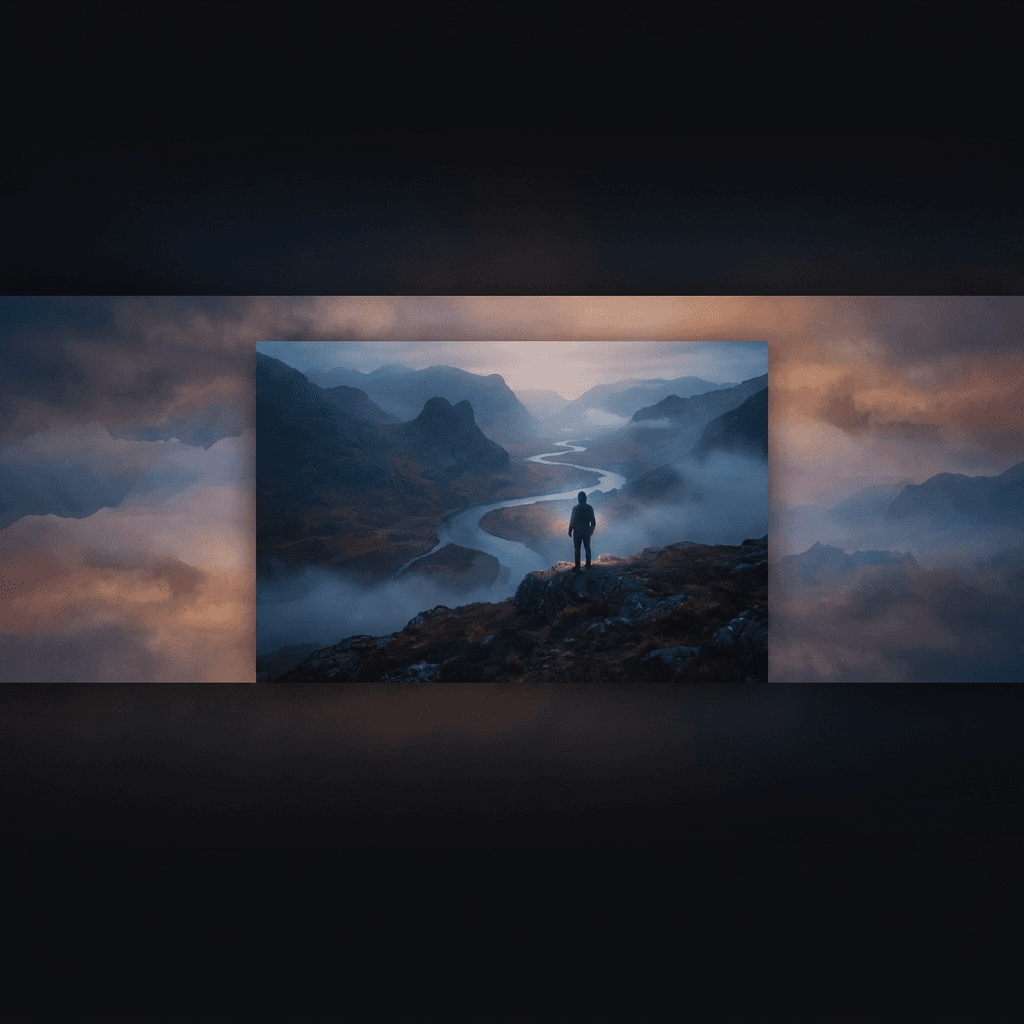
Prompt:
streaming platform optimized artist visual of [a versatile, wide-format visual composition designed specifically for the streaming platform contexts where most listeners encounter the artist — an image that maintains impact across the dramatically different dimensions and crop behaviors of Spotify, Apple Music, YouTube, and social platform headers: the composition centers on a strong visual anchor — a focused atmospheric element from the artist's visual world: the album's key landscape in a wider panoramic view, or the artist's signature environment (urban night, natural landscape, architectural space, abstract color field) extended into a wide format, or a conceptual visual that works as both the wide banner and, when cropped to its center, as a square or circular profile image, the wide format extends the visual world horizontally — the artist's atmosphere expanded to panoramic proportions: if the visual world is a landscape, the horizon extends further; if it is urban, the city extends wider; if it is abstract, the color fields and textures expand; the wider format providing the immersive quality that wraps around the edges of a streaming profile page, the center of the composition is the strongest — this is where circular profile crops will pull from, and this is where the eye settles in the wide format, the center contains the image's most impactful element (the figure if present, the landscape's focal point, the brightest or most vivid zone of the abstract composition), the sides of the composition are atmospheric extensions — strong enough to be beautiful in the wide banner format but not containing critical content that would be missed in narrower crops, the atmospheric quality — color, texture, mood — extending uniformly into the peripheral zones, the upper and lower zones are considered for overlay behavior — streaming platforms and social media headers often overlay text, buttons, and UI elements on the banner image, the critical visual content avoids the extreme top and bottom strips where interface elements may obscure the image, the color palette is true to the artist's established visual identity — the same colors, the same temperature, the same atmospheric quality as the album covers and single artwork, the visual consistency across streaming profiles reinforcing brand recognition, the overall composition reads at a glance — the wide format visible on a screen for only seconds as a listener scrolls past, the impact must be immediate: the color impression, the atmospheric quality, and the artist's visual world all communicating instantly, the resolution is generous — the image sharp enough for large desktop displays while the composition working at the reduced resolution of mobile streaming apps, the detail rewarding zoom while the composition effective at distance, the overall design communicates: this is a professionally presented artist whose visual identity extends seamlessly across every platform, the visual quality of the streaming profile matches the quality of the music, the listener's first impression (which often happens on the streaming profile page) is managed with the same care as the music itself] in a wide, platform-optimized composition designed for multi-platform deployment, the composition uses a focal-center-with-atmospheric-extensions structure — the critical content in the center third, the atmospheric content extending left and right, the composition working when displayed at full width or when the sides are cropped, the center zone is self-sufficient — if cropped to a 1:1 square or a circle (for profile image use), the center contains a complete, balanced composition with the strongest visual element, the side extensions are beautiful but expendable — the atmospheric content that enriches the wide format without containing anything that must be seen, the upper and lower safe zones are respected — critical content avoids the top 15% and bottom 15% where platform UI elements may appear, the focal content occupying the middle 70% of the vertical space, the composition works at 16:9 (YouTube), approximately 3:1 (Spotify header), and even wider ratios — the horizontal extension calculated to survive the widest platforms while the center remaining strong at every ratio, the color and atmosphere are consistent across the full width — no dramatic color changes from left to right that would make different crops look like different images, the visual identity present and consistent across every zone, the depth of field is medium-deep — the focal element in clear focus, the atmospheric extensions in gentle but not extreme softness, the overall field detailed enough to reward attention on desktop displays while reading clearly on mobile, the lighting is consistent and platform-appropriate — bright enough to read against both light and dark platform UI, with sufficient contrast to maintain impact at reduced resolution on mobile screens, the focal element catches the light with maximum impact — the brightest or most vivid element at the composition's center, drawing the eye in the wide format and providing the portrait anchor for circular crops, the atmospheric extensions catch the same quality of light — the consistency of illumination across the wide format ensuring that any crop from any zone looks like it belongs to the same image, the resolution and sharpness are optimized — the image sharp at 3840 pixels wide (the recommended maximum for most platform headers) while the composition working at the much-reduced resolutions of mobile-app display, artist's established color palette extended across wide format — strongest color and visual impact at center — atmospheric color extension to sides — consistent temperature and mood across full width — and the platform-optimized, wide-format, multi-crop-compatible palette of a streaming profile visual in the artist's established visual world as the color palette, the mood is professionally immersive platform-native visually consistent and the specific streaming-platform message — this artist manages their visual presentation across every platform with professional care, the streaming profile is the digital front door and this front door is designed — the streaming visual as the platform-optimization image that maximizes the artist's first impression in the contexts where most listeners discover and engage with their music, professional wide-format photography or art composition with consistent even lighting and medium-deep depth of field in a focal-center multi-crop-compatible wide composition, designed for deployment across all streaming and social platform header formats with profile-image crop compatibility at center, the multi-format flexibility and the atmospheric consistency and the immediate visual impact as the platform-optimization focal points, artist's established palette in consistent wide-format application, no text overlays, no watermarks
Best for: Spotify artist profile header, Apple Music artist page banner, YouTube channel banner, Twitter/X header, Facebook page cover, SoundCloud header, Bandcamp artist page header, social media profile photos (using center crop), website homepage hero banner, streaming editorial pitch visual materials, festival and event digital promotion banners
How to Customize These Prompts for Your Specific Musical Identity
The templates create compelling music visual content, but the most effective imagery reflects your actual artistic identity — your genuine sonic character, your specific visual references, your real aesthetic lineage, your cultural context, and the particular emotional territory your music occupies.
Replace generic genre descriptions with your specific sonic character. If your music is not broadly "atmospheric electronic" but specifically the intersection of Detroit techno and ambient dub with field recordings of industrial spaces, describe that specificity in the prompt. The visual should match the specific, not the general. If your music combines West African rhythmic structures with contemporary R&B production, the visual world should reflect that specific cultural synthesis. The more precisely you describe your sonic identity, the more accurately the visual will represent it.
Define your color world with sonic precision. Your color palette should be determined by your music's emotional character, not by current design trends. Listen to your music and identify its emotional temperature: is the dominant quality warmth or coolness? Brightness or shadow? Saturation or subtlety? A bass-heavy, warm, analog hip-hop production suggests amber, deep brown, warm black. A crystalline, precise, cool electronic production suggests ice blue, silver, pale white. A raw, distorted, energetic punk or noise production suggests high-contrast black and white with aggressive accent colors. Define two to four colors that represent your sound, and use those colors consistently across all fifteen template types.
Specify your visual references and lineage. Every artist's visual identity exists within a visual lineage — the album covers, the photographers, the designers, the films, and the visual artists that have shaped the genre's visual culture and the artist's personal aesthetic. Referencing specific visual precedents in your prompts (the color treatment of a specific film, the compositional approach of a specific photographer, the design philosophy of a specific era of album covers) creates more precise and culturally literate results than generic genre descriptions.
Match the photographic treatment to your production approach. If you record to analog tape and value warmth and imperfection, your visual treatment should include film grain, warm color shifts, and the slightly imperfect quality of analog photography. If you produce with cutting-edge digital tools and value precision and clarity, your visual treatment should be clean, sharp, and technologically current. If you deliberately blend analog and digital approaches in your production, your visual treatment can reflect that hybridity. The photographic treatment is a production-philosophy statement, and it should be truthful to your actual approach.
Adapt the environmental and atmospheric elements to your cultural context. The landscapes, architectures, urban scenes, and interior spaces in your visual identity should reflect your actual cultural geography and creative environment. An artist from the American Southwest should consider desert landscapes, adobe architecture, and the specific light quality of that region. An artist from a dense urban environment should consider the architectural density, the night lighting, and the street texture of their city. An artist whose music is deliberately placeless and universal should consider abstract and non-geographic environments. The visual environment should feel authentic to the artist's actual context or to the intentional universality of their artistic position.
For artist portraits, photograph yourself and enhance rather than replace. Generate AI imagery to establish your visual benchmarks — the lighting quality, the compositional approach, the atmospheric standard, the color world, the environmental setting — and then photograph yourself (or work with a photographer) in environments and lighting informed by the generated references. Use the Image Inpainting tool to enhance your real photographs to professional standard while preserving your authentic appearance and presence. Fans connect with real artists, and the authenticity of a real photograph enhanced to professional quality outperforms any AI-generated figure.
Platform-Specific Deployment for Music Artists
Each platform where music is discovered, consumed, and promoted has specific visual requirements, display behaviors, and audience expectations. Deploying the right content in the right format at the right dimensions maximizes the visual identity's impact.
Spotify optimization. Spotify's artist profile includes a header image (recommended 2660x1140 pixels, though display varies by device and is often cropped), artist photo (circular crop from a square image), and album/single artwork (1:1 at minimum 3000x3000 pixels for high resolution). The header image is the first visual impression for listeners who visit the artist page — use Template 15 for the header, Template 11 or 1 for the artist photo, and Templates 2 and 3 for album and single artwork. Spotify Canvas — the short looping video that plays behind the now-playing screen — is increasingly important for engagement. Use the Cinematic Video Generator to create Canvas-format videos from Templates 2, 3, 6, and 12. Spotify for Artists allows playlist pitch submissions where the artist photo and album artwork are the visual component of the editorial evaluation.
Apple Music optimization. Apple Music's artist page features a wide banner, an artist photo, and album artwork similar to Spotify. Apple Music's editorial team places significant weight on visual quality when considering features, playlist placements, and editorial content. The Apple Digital Masters program and Apple Music's emphasis on quality extend to visual expectations — artist imagery should meet the highest professional standard. Use the same templates as Spotify deployment with particular attention to resolution and color accuracy.
YouTube optimization. YouTube serves both as a music platform and a video platform, requiring both the channel banner (recommended 2560x1440, safe area 1546x423) and video thumbnails. The channel banner should use Template 15 with awareness of YouTube's aggressive cropping on mobile devices. Video thumbnails for music videos should use Template 10, for lyric videos Template 6 with text overlay, for live performance clips Template 5, and for behind-the-scenes content Template 13. The YouTube Thumbnail Maker optimizes thumbnails for YouTube's specific display context and click-through optimization.
Instagram and TikTok deployment. Instagram is the primary social platform for music artist visual identity. The grid serves as a visual portfolio: maintain a ratio of approximately 40% album and release artwork (Templates 2, 3, 9), 30% artist and performance imagery (Templates 1, 5, 11), 20% behind-the-scenes and process content (Templates 13, 7), and 10% community and engagement content (Templates 8, 14). Use 1:1 or 4:5 for feed posts to maximize screen impact. Stories and Reels use 9:16 vertical format. For Instagram-specific strategies, additional guidance covers platform optimization. TikTok is increasingly important for music discovery — behind-the-scenes studio content (Template 13 as reference), live performance clips (Template 5 as visual reference), and creative process documentation drive the most engagement for music artists on TikTok.
Bandcamp and independent platform deployment. Bandcamp prioritizes the album artwork and the artist photo in a more information-rich, less algorithmically-driven interface than streaming platforms. The album artwork appears at larger display sizes on Bandcamp than on Spotify, rewarding detailed, complex cover art (Templates 2, 9, 12) that reveals more at larger scale. Bandcamp's merch integration means that merchandise imagery (Template 7) is seen alongside album artwork, and the visual consistency between music and merch creates professional cohesion.
Press and media deployment. Press kits require specific image formats: high-resolution artist photos (Template 11) in both landscape and portrait orientations for different editorial layouts, album artwork in high resolution (Template 2) for publication, and additional visual materials (Templates 1, 5, 13) for feature-length editorial content. Provide images at minimum 300 DPI for print and minimum 2000 pixels wide for digital editorial. Include both color and black-and-white versions of key press images (some publications require or prefer B&W). For comprehensive press and editorial strategies, additional guidance covers professional deployment.
Live performance and tour deployment. Tour promotion uses Templates 5 and 1 for tour poster and tour announcement visuals, Template 8 for date-specific announcements with text overlay, and Template 14 for tour wrap-up and fan-community content. Stage visual content uses Templates 5, 6, 2, and 12 adapted for projection — the album's visual world translated into the immersive environment of the live show. The Cinematic Video Generator creates live-show visual loops and background content from the established visual identity.
Common Mistakes in Music Artist Visual Identity
Music visual identity fails in specific ways that directly impact discovery, audience connection, genre positioning, and the overall perception of the artist's professionalism and creative seriousness.
Using generic or stock imagery that fails to establish individual identity. The most damaging visual mistake for a music artist is imagery that could belong to any artist in the genre — the generic city night scene, the unspecified landscape, the interchangeable portrait. Visual identity must be specifically, identifiably yours. If a listener cannot look at your visual content and immediately know it is you (through color palette, compositional approach, environmental specificity, or artistic treatment), the visual identity is not doing its job.
Inconsistency across platforms and releases. An artist with a dark, moody album cover, a bright, casual Instagram grid, a different color palette on each single release, and a press photo that looks like it belongs to a different artist entirely has no visual identity — they have visual chaos. Consistency is the mechanism through which recognition is built. The color palette, the photographic treatment, the atmospheric quality, and the typographic approach should be recognizable across every platform and every release within a campaign cycle.
Ignoring thumbnail legibility for album covers. An album cover that looks beautiful at full resolution but becomes an indistinguishable dark smudge at streaming thumbnail size fails at the point of discovery. Every album cover should be evaluated at thumbnail scale — approximately 1.5cm on a phone screen — and the essential information (is this interesting? can I identify the visual mood? does the color palette register?) should be legible at that scale. High-contrast compositions, clear color distinctions, and simple focal points survive the thumbnail reduction better than complex, detailed, low-contrast imagery.
Mismatching visual genre signals and sonic genre. An electronic music artist using the visual language of country (warm earth tones, rural landscapes, traditional serif typography) confuses potential listeners and fails to reach the correct audience. An indie rock artist using the visual language of mainstream pop (glossy, high-production, heavily styled portraits) alienates the genre's audience. The visual genre signals must match the sonic genre, or the visual identity actively works against discovery by the right listeners.
Over-designing and losing emotional authenticity. Heavily designed, graphically complex visual identities that prioritize design cleverness over emotional authenticity can feel cold and disconnected. Music is fundamentally an emotional medium, and the visual identity should lead with emotion rather than design technique. The most enduring album covers and artist visuals are emotionally communicative first and technically impressive second. Prioritize the visual's emotional truth over its design complexity.
Neglecting the physical media presentation. For artists releasing vinyl, cassettes, or other physical formats, the visual identity must work in the physical context — printed on cardboard, visible through die-cut packaging, readable at arms-length rather than at screen distance. Colors shift between screen and print (screen RGB and print CMYK have different gamuts), and designs that look striking on screen may look flat or muddy in print. Design with print reproduction in mind for any visual identity that will be physically produced.
Abandoning visual identity between album cycles. The gap between albums is not a visual-identity vacation. The artist's visual presence must continue between major releases — through social media content, through single releases, through tour visuals, through behind-the-scenes content. Artists who go visually silent between albums lose the recognition and momentum that consistent visual presence builds. Templates 8, 13, 14, and social-media adaptations of Templates 1, 5, and 11 provide content for the between-album periods.
Using too many fonts or incompatible typography. Typography is one of the most powerful and most frequently misused elements of music visual identity. The artist name and album titles should use a consistent typographic system — one or at most two typefaces used consistently across all releases, all platforms, and all materials. Multiple typefaces across releases, inconsistent sizing, and decorative fonts that prioritize novelty over readability fragment the visual identity and undermine the professional impression.
Building a Complete Music Visual Identity System
A successful music visual identity is not a collection of individual images but a cohesive system that supports the entire artist lifecycle: release campaigns, tour promotion, fan engagement, press and media, and the continuous visual presence required in the always-on social media environment.
Establish the visual foundation before the release campaign begins. Before any album or EP release, establish the complete visual system: the color palette (two to four colors), the photographic treatment (grain, contrast, color grading), the typographic system (primary and secondary typefaces), the environmental/atmospheric direction (the visual world the music inhabits), and the compositional approach (the spatial and structural conventions the visual identity follows). This foundation — documented in a simple visual style guide — ensures consistency across every visual touchpoint of the release campaign.
Build the release campaign visual timeline. A typical album release campaign extends over months, from first single announcement through album release through tour and post-release. Map the visual content needs across this timeline: first single announcement and artwork (Template 3 and 8), pre-save campaign visuals (Template 8), additional single releases (Template 3 variations), album announcement (Template 8 with album cover Template 2), tracklist reveal (Template 8), album release day content (Templates 2, 4, 14), music video release (Template 10), tour announcement (Templates 5, 8), behind-the-scenes and process content throughout (Template 13), merch launch (Template 7), and fan engagement content at milestones (Template 14). Having the complete visual library prepared before the campaign begins ensures consistent quality and consistent visual identity throughout.
Create format-specific versions of key visuals. Every key visual in the system should exist in multiple format versions: 1:1 for album covers and Instagram feed, 4:5 for maximum Instagram feed impact, 9:16 for Stories, Reels, and TikTok, 16:9 for YouTube and desktop headers, 3:1 for Spotify and wide platform headers, and 2:3 for poster and print formats. Rather than cropping a single image to different formats (which often loses critical content), design each key visual with format flexibility in mind — the Template 15 approach of a strong center with atmospheric extensions that survive different crops.
Develop motion content from the static visual identity. The static visual identity should extend into motion — Spotify Canvas loops, visualizer videos, social media animated content, live show projected visuals, and music video conceptual direction. The Cinematic Video Generator creates atmospheric video content from the established visual identity. The Text2Shorts tool produces short-form promotional video for social platforms. The AI Music Generator can support visual content with custom audio beds where existing music cannot be used. The AI Clipping tool extracts optimal moments from longer video content for platform-specific deployment.
Maintain visual presence between release cycles. The between-album period requires ongoing visual content that maintains the artist's presence and visual identity without new music to anchor it. Templates 13 (studio/process), 14 (fan engagement), 5 (live performance), and social adaptations of the established visual identity provide content for these periods. Additionally, evolving the visual identity gradually between cycles — shifting the color palette, introducing new environmental elements, updating the photographic treatment — allows the visual identity to grow with the artist while maintaining recognizable consistency.
Emerging Trends in Music Visual Identity
The music visual landscape evolves continuously as technology, platform behaviors, and cultural aesthetics shift.
AI-generated and AI-assisted visual content has become standard practice. Musicians and independent artists increasingly use AI tools to create the visual content that was previously accessible only to label-supported artists with design budgets. This democratization has raised the visual quality baseline across the industry while creating new creative possibilities — visual worlds that could not have been photographed or designed are now realizable.
Motion and animated content is displacing static imagery. Spotify Canvas, Apple Music animated album art, social media video, and projected live visuals mean that static album covers are increasingly accompanied by (or evolving into) motion content. Artists who create their visual identity with motion potential — designing elements that can animate, environments that can be traversed, compositions that can evolve over time — are positioned for the motion-first future.
Visual identity is becoming more holistic and less album-centric. The single-release model (releasing individual songs rather than albums) means visual identity must work at the single-song level as well as the project level. Artists are developing visual systems that evolve across single releases — each single artwork a variation on a visual theme rather than a standalone design — creating a visual narrative that unfolds over time.
Nostalgia-inflected visual treatments continue to influence multiple genres. Film-grain aesthetics, vintage color grading, analog-photographic treatments, retro typography, and deliberate lo-fi visual qualities remain influential across genres that value authenticity and analog warmth. The visual nostalgia connects present music to the era-specific visual cultures that artists reference sonically.
Immersive and spatial visual experiences are emerging. AR filters, VR experiences, spatial audio companion visuals, and interactive visual content are beginning to extend the visual identity beyond the flat rectangle. Early-adopter artists creating immersive visual experiences — virtual spaces the listener can enter, AR-enhanced album packaging, interactive visual albums — are defining a new frontier of music visual identity.
Cultural specificity and authentic visual representation are increasingly valued. Audiences and critics increasingly value visual identities that authentically represent the artist's cultural context, geographic origin, and community rather than adopting generic, culturally neutral aesthetics. Visual identities that celebrate specific cultural visual traditions — particular to a region, a diaspora, a subculture, a community — resonate more deeply than universalized visual approaches.
Minimalism continues to contrast with maximalism across genres. The visual landscape is polarized between extremely minimal approaches (single-color fields, empty space, near-invisible typography) and extremely maximal approaches (dense collage, information overload, visual excess). Both approaches are valid genre-specifically, and the tension between them creates opportunities for artists to make strong visual statements in either direction.
How Miraflow AI Supports Your Music Visual Identity Workflow
Every prompt in this post can be generated inside Miraflow AI. Open the AI Image Generator, paste your customized prompt with your specific genre, sonic character, color world, visual references, and aesthetic direction, select the appropriate aspect ratio for your target platform, and generate. Multiple aspect ratios including 1:1, 4:5, 16:9, 9:16, and 5:4 are available, covering every deployment from album covers to streaming headers to social media posts to poster art.

For the most effective music visual identity workflow, these AI-generated images serve as conceptual direction, visual reference, and atmospheric benchmarks for your visual identity system. They establish the color world, the atmospheric quality, the compositional approach, and the emotional temperature that your complete visual identity should achieve. When you work with photographers, designers, or visual artists on your final production imagery, use these generated references as the shared visual language that ensures everyone is working toward the same creative vision.
For your real artist photographs and existing visual materials that need targeted enhancement — improving the atmospheric quality of a press photo, correcting the color grading across a set of images for visual consistency, extending a photograph's background for a wider format, removing an unwanted element from an otherwise strong composition, or enhancing the mood and atmosphere of a behind-the-scenes shot — the Image Inpainting tool allows precise editing of specific image regions while preserving the authentic photographic content. This tool is particularly valuable for music artists because authenticity is essential — fans must see the real artist and real environments, but those real elements should be presented at the highest possible atmospheric and technical quality.
The recommended workflow operates in three phases. The conceptual phase uses these AI prompts to generate visual direction for every content type — establishing the color world, the atmospheric quality, and the compositional standard before any production photography or design begins. The production phase creates your actual visual identity — photographing the real artist, designing the real album cover, creating the real merchandise designs — informed by the generated visual direction, the shared reference ensuring consistency and quality. The enhancement phase uses inpainting to bring your production materials to the highest standard — adjusting atmosphere, correcting color, and optimizing visual impact while maintaining authenticity.
For artists building a complete visual ecosystem including motion and audio content, Miraflow's suite extends the capability. The Cinematic Video Generator creates atmospheric video content — album visual accompaniments, Spotify Canvas loops, social media animated content, and live-show projected visuals. The Text2Shorts tool produces promotional short-form video content for TikTok and Reels. The AI Music Generator creates custom audio beds for visual content where the artist's released music may not be appropriate (behind-the-scenes content, promotional videos, social media where music licensing is complex). The AI Clipping tool extracts key visual moments from longer content into platform-optimized clips. The YouTube Thumbnail Maker creates thumbnails for music videos, lyric videos, and performance content. Together, these tools allow a music artist to produce a complete visual and motion identity system that maintains atmospheric and aesthetic consistency across every platform and format.
FAQ
Can I use AI-generated imagery as my official album cover?
Yes. There is no technical or industry restriction on using AI-generated imagery as album cover art. Many independent artists and some label-supported artists use AI-generated or AI-assisted artwork for releases. Streaming platforms (Spotify, Apple Music, etc.) do not currently restrict AI-generated cover art. However, be transparent with your audience about your creative process if asked, as authenticity is valued in music culture. The strongest approach is often using AI to generate the visual concept and direction, then working with a human designer or photographer to refine and finalize the artwork — combining AI's generative capability with human creative judgment.
How do I ensure my visual identity is consistent across all platforms?
Consistency comes from controlling the repeating variables: create a visual style guide that specifies your color palette (with specific hex codes or Pantone references), your typographic system (specific font names and usage rules), your photographic treatment (grain level, contrast curve, color grading specifics), and your compositional conventions. Reference this guide for every piece of visual content across every platform. The AI prompts in this post help establish these variables — once you have generated imagery that captures your visual identity, document the specific elements that make it yours and maintain those elements across all future content.
What resolution should I generate album artwork at?
Streaming platforms recommend 3000x3000 pixels for album artwork (Spotify, Apple Music, Tidal). Generate at the highest resolution available and scale as needed. For vinyl, discuss print requirements with your pressing plant — most require 300 DPI at the physical print size (typically 12.375 inches square for a 12-inch LP jacket, meaning approximately 3713x3713 pixels at 300 DPI). Always maintain your master files at the highest resolution and create platform-specific exports from those masters.
How do I create visual identity on a zero budget?
These AI prompts are specifically designed for this reality. Generate your album artwork, your streaming profile images, your social media content, and your visual direction using these templates. Photograph yourself with a smartphone using the generated imagery as your lighting and compositional reference — match the mood, the color temperature, and the framing. Use the Image Inpainting tool to enhance your smartphone photographs to professional quality. The gap between zero-budget and professional-budget visual identity has never been smaller.
Should my visual identity change with every album?
Your visual identity should evolve with each album while maintaining recognizable consistency. Think of it as the relationship between a band's sound and their individual albums — the band has a recognizable sonic identity, but each album has its own character within that identity. Maintain your core visual elements (one or two consistent colors, your typographic system, your general atmospheric quality) while evolving the specific expression with each release (shifting the color palette's accent colors, changing the environmental imagery, updating the photographic treatment). The evolution signals artistic growth while the consistency maintains recognition.
How important are physical media visuals in the streaming era?
For artists who release vinyl, cassettes, or other physical formats, the physical media visual quality is critically important — physical media buyers are investing in the visual and tactile experience, and the visual quality of the physical product directly influences purchase decisions, collector value, and the fan's relationship with the physical object. For artists who do not release physical media, the visual identity should still be designed with physical potential in mind, as vinyl and physical releases may become appropriate as the artist grows. Template 4 specifically addresses this context.
How do I create a visual identity that works for a band versus a solo artist?
The visual identity principles are the same — consistent color palette, consistent atmospheric quality, consistent compositional approach. The key difference is the physical presence question: bands have multiple members, and the visual identity must either feature them collectively (group portraits, ensemble styling) or transcend the individual faces entirely (using environmental, abstract, or conceptual imagery that represents the collective identity rather than individual likenesses). Many bands adopt visual identities that do not feature any band members, using the logo, the color palette, and the visual world as the recognizable identity elements.
How do I approach visual identity for a genre-crossing or genre-fluid artist?
Artists who work across multiple genres face the visual challenge of creating identity that does not signal a single genre too specifically. The solution is usually to develop a visual identity based on the emotional and atmospheric qualities that are consistent across your genre-fluid output rather than the genre-specific visual conventions of any single genre. Focus on color palette, photographic treatment, and compositional approach as your identity markers, and let the environmental and atmospheric elements shift with the genre of each specific release while maintaining the core visual constants.
Conclusion
The first encounter is visual. Before the frequency reaches the eardrum, before the bass note vibrates in the chest, before the melody enters the memory — the eye has already processed the image. The thumbnail on the playlist. The profile photo on the streaming page. The poster on the venue wall. The album cover shared on a social feed. The visual impression has already communicated genre, mood, aesthetic ambition, and creative seriousness. The visual has already determined whether the listener pauses, taps, and gives the music a chance. The eye makes the decision that the ear then confirms or contradicts.
This is why visual identity for music artists has moved from decoration to infrastructure. It is not the pretty wrapping around the important thing. It is the gateway to the important thing. It is the mechanism through which sound becomes discoverable in a visual medium. It is the system through which an artist's creative world — their emotional territory, their cultural context, their sonic architecture — becomes legible to a listener who has never heard a single note.
The 15 templates in this post address the complete visual identity system a music artist needs: the cinematic portrait that establishes persona, the album cover that translates sound into visual form, the single artwork that builds anticipation across a release campaign, the physical media presentation that honors the tactile format, the concert visual that communicates live-performance energy, the lyric video background that creates visual space for words, the merchandise visual that extends the album world into wearable form, the social media announcement that delivers information within the visual identity, the EP and mixtape cover that takes experimental creative risks, the music video reference frame that directs the cinematic companion, the press portrait that meets editorial standards, the genre-defining aesthetic that positions the artist within tradition while establishing individuality, the studio atmosphere that invites listeners into the creative process, the fan engagement visual that strengthens community, and the streaming platform imagery that optimizes for the contexts where most music is now discovered.
Copy the templates relevant to your artistic identity. Customize them with your specific genre, your genuine sonic character, your precise color world, your authentic cultural context, your real visual references, and the emotional territory your music inhabits. Generate them inside Miraflow AI to establish your visual direction, and use them as the shared reference when working with photographers, designers, and visual collaborators. Enhance your real photographs and production materials with the Image Inpainting tool to achieve the atmospheric quality and technical standard that the generated references establish.
The listener scrolling through a playlist sees your cover beside dozens of others. The curator evaluating submissions sees your press photo alongside hundreds. The concertgoer deciding between shows sees your poster on the same wall as every other artist's. In each of these encounters, your visual identity either stops the scroll, earns the click, and gets the listen — or it does not. The music may be extraordinary. The songwriting may be exceptional. The production may be world-class. But none of that matters if the visual identity fails to create the first impression that invites the ear to participate.
The sound deserves a visual identity as powerful as it is. These prompts help you create it.