
Training Video ROI: How to Measure and Maximize Impact in 2025

Written by
Sam Cho

Calculate training video ROI with proven formulas and benchmarks. Learn how video training saves 40-60% on costs while improving retention by 25-60% compared to traditional methods.
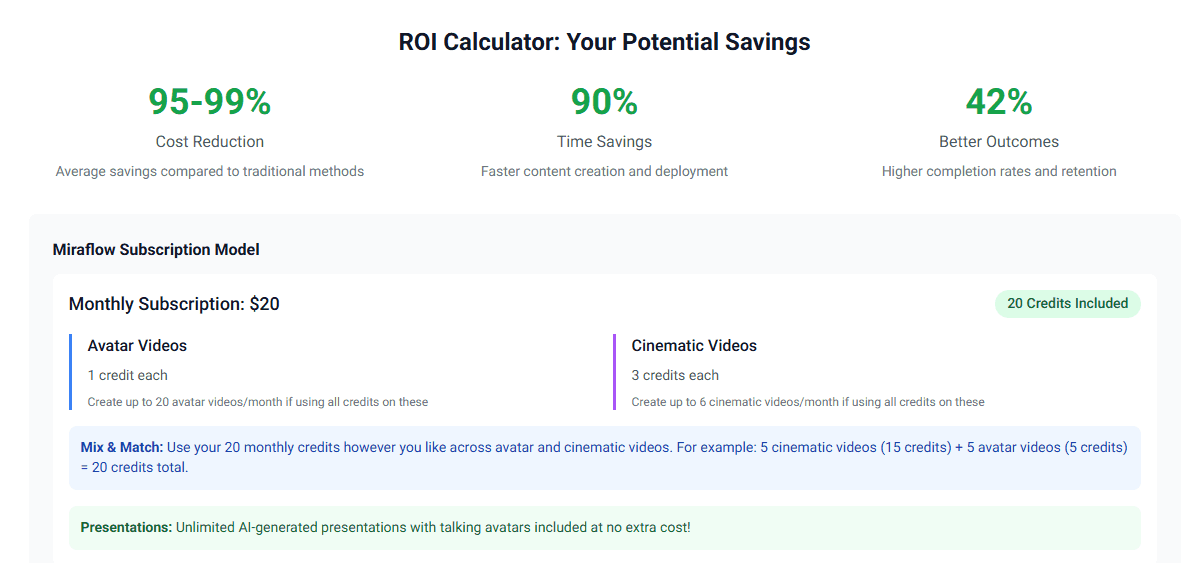
Training video ROI (return on investment) measures the financial and performance benefits gained from video-based training compared to the costs of creating and delivering that training. Organizations calculate ROI by comparing training costs, time savings, productivity improvements, and retention rates between video training and traditional instructor-led methods. Video training typically reduces costs by 40-60% while improving knowledge retention by 25-60% compared to classroom training.
Is video training worth it? Yes. Companies using video-based training report average cost savings of $1,200 per employee annually, 34% faster time-to-productivity for new hires, and 50-60% higher completion rates compared to text-based or in-person training. The initial investment in video production typically pays back within 3-6 months.
Understanding Training Video ROI
Training video ROI represents the measurable value your organization gains from investing in video-based learning compared to alternative training methods. This includes direct cost savings, productivity improvements, reduced training time, better knowledge retention, and lower employee turnover.
The business case for video training rests on several financial factors. Traditional instructor-led training incurs costs for trainer salaries, travel expenses, venue rentals, printed materials, and employee time away from work. Video training eliminates most of these recurring costs after the initial production investment.
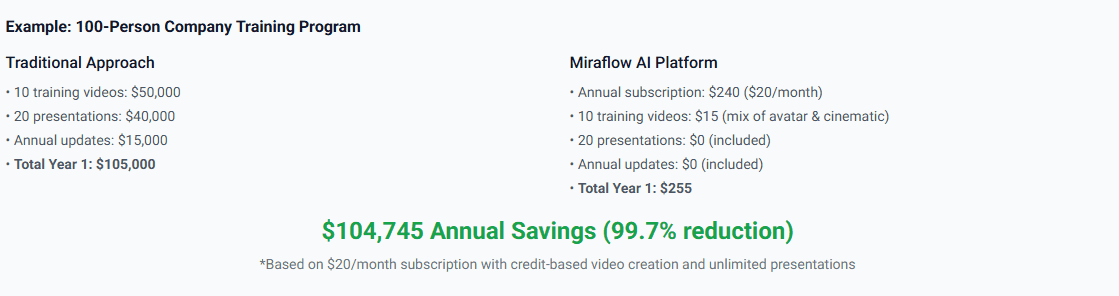
A company training 100 employees typically spends $15,000-30,000 for a two-day instructor-led session when you factor in trainer fees, employee time, travel, and materials. The same training delivered via video costs $2,000-8,000 to produce and can train unlimited employees with no additional delivery costs.
The math becomes more compelling at scale. An organization training 1,000 employees annually on the same content would spend $150,000-300,000 on repeated instructor-led sessions versus a one-time video production cost of $5,000-15,000 with AI training video generators.
Beyond direct cost savings, video training delivers measurable performance improvements. Research from the Research Institute of America found that e-learning including video increases retention rates by 25-60% compared to traditional training. Employees can pause, rewind, and review complex concepts, leading to better understanding and application.
Training videos also solve logistical challenges that impact productivity. New hires start training immediately without waiting for the next scheduled class. Remote employees receive identical training quality as headquarters staff. When products or policies change, updated videos reach all employees simultaneously instead of waiting months for trainers to visit each location.
Key Metrics for Training Video Effectiveness
Track these metrics to evaluate training video performance and calculate ROI:
Completion Rate
The percentage of assigned employees who finish the training. Video training typically achieves 80-95% completion rates compared to 40-60% for text-based e-learning and 70-85% for live training.
Measure completion rate by dividing completed learners by assigned learners. A completion rate below 75% indicates problems with accessibility, content relevance, or video length that need addressing.
Time to Completion
How long employees take to finish training from assignment to completion. Video training reduces time-to-completion by 40-60% compared to traditional methods because employees learn at their own pace and skip content they already know.
Track average completion time and compare against target timeframes. If training designed for two hours consistently takes four hours, the content is too dense or confusing.
Knowledge Retention
What percentage of training content employees remember and can apply weeks or months after completion. Test retention through follow-up assessments 30, 60, and 90 days after training.
Video training improves retention by 25-60% compared to text-based training. The combination of visual, audio, and text elements creates multiple memory pathways that strengthen recall.
Assessment Scores
Average quiz or test scores measure immediate comprehension. Track both initial scores and scores after employees review content. Video training allows instant review of specific topics where learners struggle, improving final assessment performance.
Compare assessment scores across training delivery methods. If video-trained employees score 15% higher than classroom-trained employees on the same assessment, you've quantified training effectiveness improvement.
Time to Proficiency
How quickly new hires reach full productivity in their roles. Organizations using video-based onboarding report new employees reach productivity 34% faster than those receiving only live training.
Measure time from start date to first successful completion of key job tasks: closing a sale, resolving a customer ticket independently, or shipping code without supervision. Compare video-trained cohorts against traditional training cohorts.
Training Costs Per Employee
Total training costs divided by number of trained employees. Include production costs, platform fees, employee time, and administrative overhead.
Video training typically costs $50-150 per employee for the first cohort (including production) and $5-25 per employee for subsequent cohorts (delivery only). Traditional instructor-led training costs $150-300 per employee for each session.
Employee Engagement
Track video engagement through analytics: completion rates, pause/rewind behavior, drop-off points, and repeat viewing. High engagement (80%+ watch-through rate) indicates relevant, well-paced content. Low engagement signals problems with content quality or length.
Learning management systems track which sections employees rewatch most frequently, revealing concepts that need clearer explanation.
Application Rate
What percentage of trained employees actually apply learned skills in their work. Survey managers 30 days post-training to assess whether employees demonstrate new behaviors or skills.
Video training with embedded scenarios and demonstrations typically shows higher application rates than lecture-based training because employees see exactly how to perform tasks.
Training Satisfaction
Employee satisfaction scores reveal whether training was helpful, relevant, and professionally delivered. Low satisfaction predicts poor knowledge retention and resistance to future training.
Survey participants immediately after training and again 30 days later. Immediate satisfaction measures presentation quality. Delayed satisfaction measures perceived usefulness after applying knowledge.
Calculating Training Video ROI: Formula and Examples
Calculate training video ROI using this formula:
ROI = (Benefits - Costs) / Costs x 100
Benefits include cost savings, productivity gains, and reduced turnover. Costs include production, platform fees, and employee time.
Example 1: New Hire Onboarding Videos
A company with 100 new hires annually calculates onboarding video ROI:
Costs:
- Video production (10 modules): $8,000 one-time
- Video platform subscription: $1,200 annually
- Employee time watching (8 hours at $30/hour average): $24,000
- Total first-year costs: $33,200
Benefits:
- Eliminated travel for headquarters training: $25,000 (flights, hotels for 100 employees)
- Eliminated trainer costs: $15,000 (2 full weeks of HR time)
- Reduced time-to-productivity by 10 days: $120,000 (100 employees x 10 days x $120/day productivity loss)
- Improved 90-day retention by 15%: $45,000 (15 fewer replacements at $3,000 cost per hire)
- Total first-year benefits: $205,000
ROI Calculation: ($205,000 - $33,200) / $33,200 x 100 = 517% ROI
In year two, costs drop to $25,200 (just platform and employee time) while benefits remain similar, increasing ROI to 706%.
Example 2: Compliance Training Videos
A 500-employee company creates compliance training videos for annual sexual harassment prevention:
Costs:
- Video production: $5,000 one-time
- Platform and hosting: $800 annually
- Employee time (1 hour at $35/hour average): $17,500
- Total first-year costs: $23,300
Benefits:
- Eliminated annual trainer fees: $8,000 (external consultant)
- Eliminated venue rental: $2,000 (conference room bookings)
- Reduced training time from 4 hours to 1 hour: $52,500 (500 employees x 3 hours saved x $35/hour)
- Consistent training documentation reduces legal liability: $25,000 (estimated risk reduction)
- Total first-year benefits: $87,500
ROI Calculation: ($87,500 - $23,300) / $23,300 x 100 = 275% ROI
Example 3: Product Training for Sales Team
A SaaS company with 50 sales representatives creates product training videos:
Costs:
- Video production (15 modules): $12,000 one-time
- Platform with analytics: $2,400 annually
- Employee time watching (6 hours at $45/hour): $13,500
- Total first-year costs: $27,900
Benefits:
- Eliminated quarterly in-person training: $35,000 (trainer time, travel, lost selling time)
- Faster ramp time for new reps: $90,000 (6 new reps x 2 weeks faster to quota x $2,500/week)
- Improved product knowledge test scores: $75,000 (estimated 10% increase in close rates)
- On-demand refresher training: $20,000 (estimated value of instant knowledge access)
- Total first-year benefits: $220,000
ROI Calculation: ($220,000 - $27,900) / $27,900 x 100 = 688% ROI
Simplified ROI Calculator
For a quick estimate, use these average figures:
Traditional Training Costs Per Employee:
- Instructor fees: $100-200
- Materials: $20-40
- Venue: $30-50
- Employee time (8 hours at $30/hour): $240
- Travel (if applicable): $200-500
- Total per employee: $590-1,030
Video Training Costs Per Employee (After Initial Production):
- Platform fee per user: $10-30
- Employee time (4 hours at $30/hour): $120
- Total per employee: $130-150
Savings Per Employee: $440-880 Multiply by number of employees trained annually for total savings.
Cost Savings from Training Videos vs Traditional Methods
Video training delivers cost savings across multiple categories:
Direct Cost Comparison
Instructor-Led Training Costs:
- Trainer salary or consultant fees: $1,500-5,000 per session
- Venue rental: $500-2,000 per day
- Travel and accommodation for trainer: $800-2,500
- Printed materials: $15-40 per participant
- Refreshments: $25-50 per participant
- Travel costs for participants (if required): $200-500 each
- Employee wages while in training: $240-400 per participant (full-day session)
Total cost for 30 participants: $12,000-25,000 per session
Video Training Costs:
- Initial production with AI video platforms: $2,000-8,000 one-time
- Platform subscription: $500-2,000 annually
- Employee wages while watching (4 hours): $120-160 per participant
- No travel, venue, or material costs
Total cost for 30 participants (first cohort): $5,600-12,800 Total cost for 30 participants (subsequent cohorts): $3,600-4,800
Savings per 30-person cohort: $6,400-20,200 (first time), $7,200-20,200 (repeat training)
Time Savings
Traditional training requires 1-2 full days away from work. Video training typically covers the same content in 3-5 hours of focused viewing because:
- No time wasted on group introductions and ice breakers
- No waiting for slower learners to catch up
- No tangential discussions that don't apply to all participants
- No commute time to training location
For every 30 employees trained, video saves approximately 120-240 hours of productive work time. At an average productivity value of $50/hour, that's $6,000-12,000 in preserved productivity per training session.
Scalability Savings
Traditional training costs multiply with each session. Training 300 employees requires 10 separate 30-person sessions at full cost each time.
Video training scales with minimal additional cost. The same video trains 30 employees or 3,000 employees with identical quality. Production costs are one-time; only delivery costs (platform fees and employee time) scale with audience size.
Cost per employee trained decreases with scale:
- 30 employees: $187-427 per person
- 300 employees: $19-75 per person
- 3,000 employees: $7-20 per person
Update and Revision Costs
When content changes, traditional training requires:
- Updating printed materials: $500-1,500
- Re-training instructors: $1,000-3,000
- Scheduling and delivering new sessions: $12,000-25,000
Video training updates with AI platforms cost:
- Script revisions: $200-800 (internal time)
- Video regeneration: $300-1,200
- Total update cost: $500-2,000
Updated videos deploy immediately to all employees without scheduling logistics.
Hidden Cost Savings
Video training reduces costs that are often overlooked:
Scheduling Coordination: No need to coordinate calendars for 30 people to attend training simultaneously. Saves 5-10 hours of administrative time per session.
Training Consistency: All employees receive identical information. No variance based on instructor quality, mood, or interpretation. Reduces errors from inconsistent training, saving $10,000-50,000 annually in mistakes and rework.
Documentation: Every employee's completion is automatically documented with timestamps and assessment scores. Eliminates manual tracking and reduces compliance risks. Valued at $5,000-15,000 annually for audit preparedness.
Accessibility: Employees can review training materials anytime. Reduces time supervisors spend re-explaining concepts, saving 2-5 hours per employee annually. For 100 employees at $40/hour supervisor time, that's $8,000-20,000 in saved supervisory time.
Industry Benchmarks for Training Video Performance
Compare your training video metrics against industry benchmarks to evaluate performance:
Completion Rates by Industry
- Technology/SaaS: 85-92%
- Financial services: 88-95% (compliance mandates drive higher completion)
- Healthcare: 82-90%
- Retail: 75-85%
- Manufacturing: 78-88%
- Professional services: 80-90%
If your completion rates fall below these ranges, investigate barriers like technical access issues, video length problems, or poor content relevance.
Average Training Video Length by Purpose
- Compliance training: 8-15 minutes per topic
- Product training: 5-12 minutes per feature
- Software tutorials: 3-8 minutes per task
- Onboarding videos: 6-10 minutes per module
- Safety training: 10-18 minutes per procedure
Videos exceeding these lengths show declining completion rates. Break longer topics into multiple shorter videos.
Knowledge Retention Rates
- Video training: 50-60% retention after 30 days
- Text-based e-learning: 30-40% retention after 30 days
- Instructor-led without practice: 35-45% retention after 30 days
- Video with embedded quizzes: 60-75% retention after 30 days
Adding interactive elements like knowledge checks every 5-7 minutes improves retention by 15-25%.
Time-to-Proficiency Improvements
Organizations using video training report:
- New hire onboarding: 25-35% faster time-to-productivity
- Software training: 30-40% faster competency achievement
- Compliance certification: 20-30% faster completion
- Sales product training: 30-45% faster quota attainment
Cost Per Training Hour Delivered
- Instructor-led training: $150-400 per participant hour
- Live webinar training: $75-150 per participant hour
- Video training (first cohort): $50-120 per participant hour
- Video training (subsequent cohorts): $15-40 per participant hour
Engagement Metrics
High-performing training videos show:
- 80-95% watch-through rate (percentage who finish once started)
- 15-25% of viewers rewatch at least one section
- 70-85% pass initial assessment without review
- 4.2-4.7 out of 5.0 satisfaction rating
ROI Achievement Timeline
- Small organizations (under 100 employees): 6-12 months to positive ROI
- Mid-size organizations (100-500 employees): 3-6 months to positive ROI
- Large organizations (500+ employees): 1-3 months to positive ROI
Faster ROI in larger organizations reflects greater scale benefits and higher training frequency.
Optimizing Training Videos for Better ROI
Improve training video ROI by optimizing these factors:
Reduce Production Costs Without Sacrificing Quality
Use AI video platforms instead of traditional production. Creating employee onboarding videos with AI costs $2,000-8,000 versus $15,000-50,000 for professional studio production.
Start with existing content. Convert PowerPoint presentations, training manuals, and documentation into video scripts rather than writing from scratch. This reduces development time by 40-60%.
Create modular content that you can reuse across multiple training programs. A 5-minute video explaining company benefits works in both new hire onboarding and annual enrollment training.
Increase Completion Rates
Keep videos under 10 minutes. Completion rates drop significantly for videos over 12 minutes. Break longer topics into multiple short videos rather than one long session.
Add progress indicators. Showing "Module 3 of 8" helps learners understand how much training remains, increasing completion likelihood.
Make training mobile-friendly. Employees who can watch during commutes or downtime show 30% higher completion rates than those restricted to desktop viewing.
Send reminder emails. Automated reminders 3 and 7 days after assignment increase completion rates by 15-25%.
Improve Knowledge Retention
Include knowledge checks every 5-7 minutes. Brief quizzes or reflection questions improve retention by 15-25% compared to passive watching.
Show real scenarios instead of just explaining concepts. Demonstrations of correct and incorrect behaviors create stronger memory associations than abstract explanations.
Provide job aids and reference materials. Downloadable checklists, templates, or quick reference guides that employees can use during work reinforce training concepts.
Encourage managers to discuss training content in team meetings. Social reinforcement of learned concepts improves application rates by 35-50%.
Reduce Time-to-Completion
Eliminate unnecessary content. Every minute of training has a cost (employee time). Remove tangential information that doesn't directly support learning objectives.
Create role-specific versions. Sales reps don't need the same product details as engineers. Targeted content reduces training time while improving relevance.
Allow skipping of known material. If employees can test out of sections they already understand, you reduce time spent on redundant training.
Optimize video pacing. Professional narration at 150-160 words per minute maintains comprehension while moving efficiently through content.
Maximize Content Reusability
Design training modules that work across multiple contexts. A video on "Effective Email Communication" serves new hire onboarding, ongoing professional development, and leadership training.
Create multilingual versions of successful training videos. The same content training US employees can train global offices with translated versions at minimal additional cost.
Update videos incrementally rather than recreating from scratch. When policies change, regenerate only affected sections while keeping still-relevant content unchanged.
Build a training video library organized by topic, role, and skill level. Employees self-serve relevant training without waiting for scheduled sessions.
Improve Assessment Effectiveness
Use scenario-based questions that test application, not just recall. "What would you do if a customer requests a refund?" reveals deeper understanding than "What is our refund policy?"
Require 80-90% assessment scores before issuing completion credit. Lower thresholds allow employees to pass without truly understanding material.
Allow multiple attempts with required review between tries. Forcing employees to rewatch missed content before retaking assessments improves final retention.
Track assessment performance by video module. Consistently low scores on specific sections indicate content that needs clearer explanation.
Measure and Act on Analytics
Review drop-off points in videos. If 40% of viewers abandon at the 7-minute mark, investigate whether content becomes too complex, pacing slows, or information loses relevance.
Compare completion rates across different delivery methods. If mobile viewers complete at higher rates than desktop viewers, optimize for mobile viewing first.
Track time-to-completion by cohort. If newer employees take twice as long as experienced employees on the same training, consider creating beginner and advanced versions.
Survey non-completers about barriers. The reason people abandon training (technical issues, irrelevant content, poor timing) determines the appropriate fix.
Calculate and Communicate ROI Regularly
Document cost savings quarterly. Track eliminated travel, reduced instructor fees, and preserved productivity from shorter training times.
Measure performance improvements. Compare sales numbers, customer satisfaction scores, or error rates between video-trained and traditionally-trained cohorts.
Report retention improvements to leadership. When video training reduces turnover by even 5%, the savings in replacement costs justify continued investment.
Share success stories from managers. Specific examples of employees applying video training skills builds organizational support for continued investment.
Ready to maximize your training ROI with video-based learning? Miraflow AI helps organizations reduce training costs by 40-60% while improving knowledge retention and completion rates through AI-powered training video creation.