Why are my videos getting 0 views

Written by
Jay Kim

If your videos are getting 0 views, it’s usually not about quality. This guide explains the real reasons videos fail to get distributed—and how to fix it.
Publishing a YouTube Short and seeing 0 views is one of the most frustrating experiences for creators. The video looks fine, the idea feels solid, yet nothing happens. No impressions, and no feedback.
This situation feels random, but it usually isn’t.
When a Short gets zero or near-zero views, the issue is rarely about creativity or storytelling. It is almost always about distribution eligibility—whether YouTube even decides to test your video in the Shorts feed.
This guide explains what “0 views” actually means on YouTube Shorts, why it happens, and how creators can fix the underlying problems instead of guessing.
What “0 Views” Actually Means on YouTube Shorts
A YouTube Short with 0 views does not mean the platform rejected your content.
It means:
- The video never entered (or barely entered) YouTube’s initial test pool
- The system did not find enough signals to continue distribution
- Viewers never got the chance to react in the first place
This is a pre-retention issue, not a hook issue.
Before YouTube evaluates whether viewers like your Short, it first decides whether the Short is eligible to be shown at all.

How YouTube Shorts Distribution Works
YouTube Shorts follow a staged process:
- Eligibility check
Format, aspect ratio, duration, and basic signals are evaluated. - Initial test distribution
The Short is shown to a small audience. - Behavior-based expansion
If signals are strong enough, distribution increases.
Most Shorts that get 0 views fail before step 2 or stall immediately during it.
Common Reasons YouTube Shorts Get 0 Views
1. The Video Is Not Recognized as a True Short
YouTube is strict about Shorts format.
Common issues:
- Aspect ratio not fully 9:16
- Horizontal or square videos with black bars
- Incorrect resolution scaling
- Duration outside Shorts expectations
Even small formatting issues can prevent Shorts feed distribution.
2. Weak First Frame
This is even before the important first 3 seconds.
It is about the very first frame:
- Is the subject readable instantly?
- Is the visual clear without sound?
- Does the frame look intentional or accidental?
If the first frame appears blank, cluttered, or ambiguous, YouTube may not push the video far enough to collect data.
3. Reused or Low-Originality Signals
Shorts that look heavily recycled often struggle with distribution:
- Slight edits of previously uploaded Shorts
- Compilations with minimal transformation
YouTube prioritizes fresh, original content for Shorts discovery.
4. Inconsistent Publishing Patterns
Uploading randomly makes it harder for the system to understand:
- Who your content is for
- When to test your videos
- What audience responds best
Creators with consistent output give the system more data to work with.
5. Good Idea, Poor Execution Speed
Many Shorts fail not because the idea is bad, but because:
- The visual pacing is too slow
- The opening context takes too long
- The structure feels unclear to the system
Even strong ideas can stall if execution does not match Shorts-native patterns.

Why “Good Content” Still Gets 0 Views
This is the hardest truth for creators to accept.
YouTube Shorts do not reward effort.
They respond to behavior and signals.
A well-edited, thoughtful Short can still get 0 views if:
- It does not pass eligibility checks cleanly
- It does not generate immediate signals
- The system lacks confidence in where to place it
This is why guessing or perfecting a single Short is rarely effective.
How to Fix 0 Views: Think in Systems, Not Singles
The fastest way to escape the 0-view loop is iteration, not perfection.
Creators who grow on Shorts usually:
- Test many ideas quickly
- Learn from patterns, not individual failures
- Reduce the cost of experimentation
This is where prompt-first workflows change everything.

How Miraflow AI Helps Solve the 0-Views Problem
One of the biggest blockers to fixing 0 views is editing friction.
Traditional workflows require:
- Writing scripts
- Planning scenes
- Editing manually
- Re-exporting after each change
That makes testing expensive.
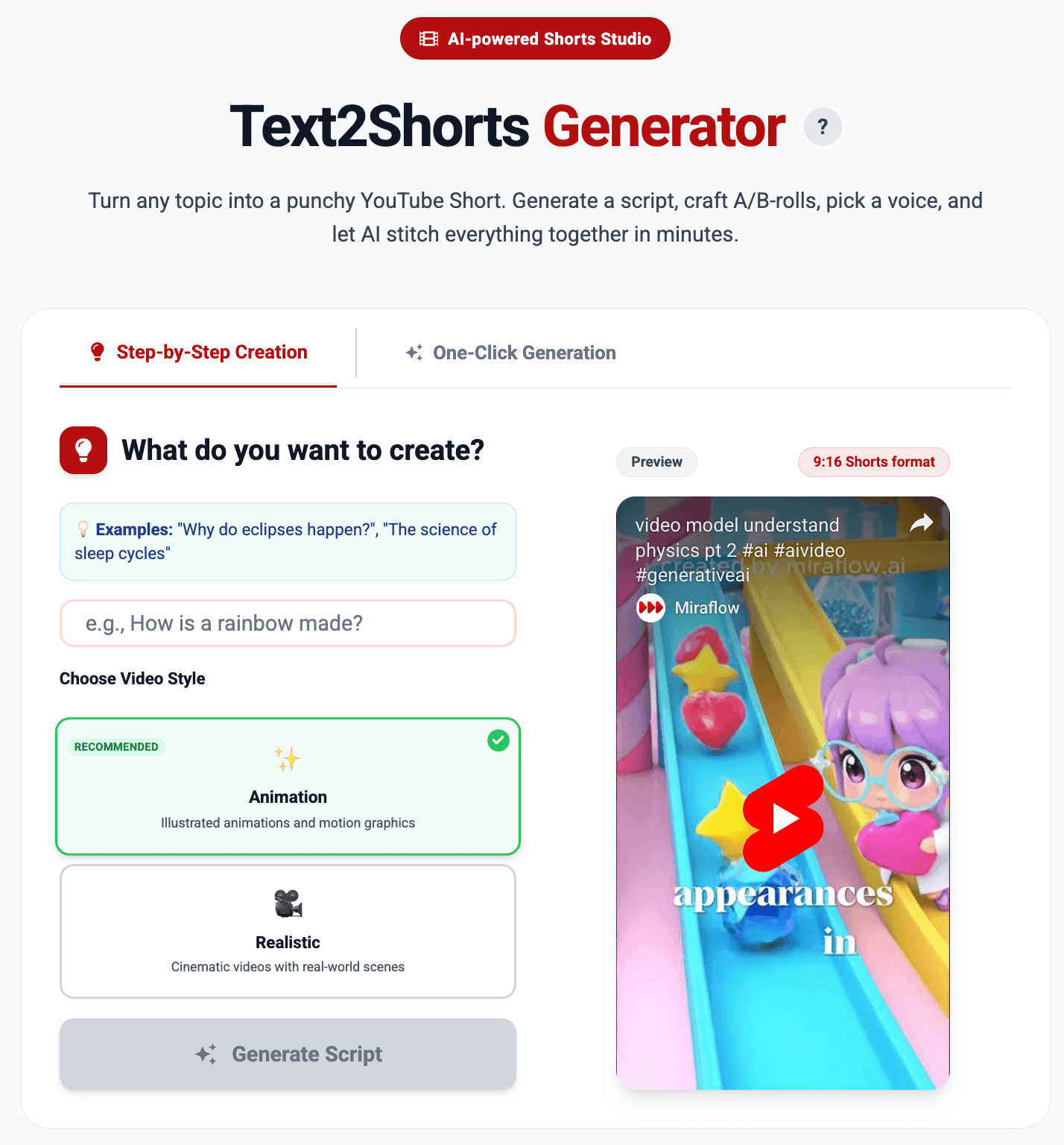
Miraflow AI’s Text2Shorts approach removes that friction.
With Text2Shorts:
- You enter a single topic
- The system generates a full vertical Short automatically
- Structure, pacing, and formatting are handled for you
- You regenerate by adjusting the idea, not rebuilding the video, while you can still edit specific details of the video.
This makes it practical to:
- Test multiple Shorts per day
- Compare openings quickly
- Learn what the algorithm responds to
If you want a full walkthrough of how Text2Shorts works step by step, this guide explains the process in detail:
👉 From Prompt to Reel: Text2Shorts AI Shorts
0 Views vs Early Drop-Off
If your Short:
- Gets impressions but loses viewers immediately → retention problem
- Gets almost no impressions at all → distribution problem
These are different issues.

If you want to understand why viewers swipe away after the Short starts, read:
👉 Why The First 3 Seconds of Youtube Shorts Matter
Together, these two problems explain nearly all Shorts performance issues.
A Better Mindset for Shorts Growth
Instead of asking:
“Why did this Short fail?”
Ask:
“What signal did the system not receive?”
Shorts growth improves when creators:
- Detach emotionally from single uploads
- Treat each Short as a test
- Focus on speed and learning
When execution becomes easier, learning accelerates.
Final Thoughts
YouTube Shorts with 0 views are not broken.
They are unproven.
Most creators struggle not because they lack ideas, but because testing ideas costs too much time and effort. When that cost drops, improvement becomes inevitable.
If you want to experiment faster and turn ideas into Shorts without editing overhead, explore how Miraflow AI’s Text2Shorts transforms single topics into complete vertical videos.
Sometimes the fix for 0 views is not better content, it’s a better way to create.