10 AI Shorts Formats That Actually Go Viral in 2026

Written by
Jay Kim

AI is changing how viral short-form content is made. Discover 10 proven Shorts, Reels, and TikTok formats that work in 2026—and how to reuse them with AI.
Short-form video isn’t new anymore, but the way creators get viral reach is changing.
In 2026, YouTube Shorts, Instagram Reels, and TikTok all reward content that:
- Hooks viewers in the first 1–3 seconds
- Delivers value or emotion fast
- Feels native to the vertical feed (not just chopped-up old content)
At the same time, AI tools now make it possible to turn a single idea into multiple high-quality Shorts in minutes, instead of spending hours scripting, filming, and editing.
But even with powerful AI, one question doesn’t go away:
What kind of short-form videos actually go viral today?
This guide breaks down 10 AI-friendly Shorts formats that are performing well across platforms in 2025–2026, why they work, and how you can structure them so AI tools can do most of the heavy lifting.
If you’re new to AI-generated Shorts, you might also want to read this deep dive first: From Prompt to Reel: Text2Shorts AI Shorts
Why “Format” Matters More Than Ever
Most viral Shorts aren’t completely random. They follow repeatable formats:
- 3 tips in 30 seconds
- Before/after transformation
- POV story
- “You’re doing it wrong” breakdown
- Reaction or duet
These formats line up with what platforms prioritize:
- Strong hooks early
- Clear payoff in under ~30 seconds
- Loopable or rewatchable structure
The good news is: AI is very good at formats.
If you give it a clear structure, it can:
- Generate scripts
- Create visuals (with tools like Veo-style models)
- Help you iterate hooks and endings quickly
Let’s walk through 10 formats you can reuse all year.
1. “3 Quick Tips in 30 Seconds”
Best for: Educational content, creators in any niche (AI, fitness, productivity, design, etc.)
This is the classic micro-listicle: fast, skimmable, and easy to repeat, similar to why listicle blog posts work so well.
Structure:
- Hook: “3 quick ways to ___”
- Tips 1–3: 1 sentence each
- Mini payoff: recap or mini challenge
Why it works:
- Clear value promise (“3 quick ways…”)
- Easy to consume and share
- Easy to scale with AI: you only change the topic and tips
AI-friendly prompt idea:
“Script a 30-second vertical short that starts with: ‘Here are 3 quick ways to improve your [topic].’ Keep each tip to one sentence, punchy and practical, no fluff.”

2. Before/After Transformation
Best for: Design, editing, AI art/video, fitness, business, productivity, branding
Transformation content taps into curiosity + satisfaction. People love seeing the contrast between “then” and “now.”
Examples:
- Room makeover
- Face/portrait edit (e.g., AI enhancements)
- Brand/website redesign
- Portfolio glow-up
Structure:
- Hook: show either before or after immediately
- Quick explanation of what changed
- Reveal the contrast clearly (side-by-side, swipe, or cut)
- Optional CTA: “Want to see more transformations like this? Follow.”
AI-friendly angle:
- Use AI video or image tools to generate the “after” version
- Use inpainting/editing models for subtle but impressive changes (color, style, environment)
3. POV Story in 30–45 Seconds
Best for: Personal brands, storytelling, education, “learned this the hard way”
POV (point-of-view) videos create emotional connection, especially when the hook references a specific moment or feeling.
Structure:
- Hook: “POV: You finally decide to… / The moment you realize…”
- Scene 1–2: Show the situation / problem
- Mini twist or lesson at the end
Why it works:
- Leans into relatability & emotion (proven drivers of virality)
- Great for voiceover + B-roll / AI-generated visuals
- AI can help generate multiple variations of the same story: different angles, different emotions
AI-friendly prompt idea:
“Write a first-person POV short script about [situation]. Max 45 seconds. Start immediately in the moment, avoid backstory, end with a small twist or realization.”
4. “You’re Doing It Wrong” (Myth or Mistake Breakdown)
Best for: Tech, AI, marketing, design, finance, creator advice
This format calls out a common mistake, which triggers curiosity and self-checking.
Structure:
- Hook: “You’re doing [X] wrong.” or “Stop doing this with [tool].”
- Show the wrong way (very briefly)
- Show the correct way
- Short explanation of why
Why it works:
- Strong pattern interrupt → people don’t want to be “wrong”
- Highly shareable in communities (“this is you lol”)
- Educational and satisfying in a tiny package
AI angle:
- AI can generate multiple mistake → fix sequences for the same tool or topic
- You can test several openings around the same core idea (“3 mistakes you’re making…”, “Stop doing this…”, etc.)
5. Ultra-Short Tutorials (One Micro-Skill Per Short)
Best for: Software demos, AI workflows, editing tricks, coding, design, shortcuts
Instead of trying to teach everything in one minute, you focus on one micro-skill per Short.
Examples:
- “How to remove background in 3 taps.”
- “One prompt that fixes your AI image lighting.”
- “One setting that doubles your audio quality.”
Structure:
- Hook: “Here’s one shortcut that ___.”
- Demo: 1–2 steps, very tight
- Result: quick reveal
- Optional CTA: “Save this for later.”
Why it works:
- High utility, low time cost
- Fits perfectly into 15–30 seconds (the sweet spot many guides recommend for retention)
AI angle:
- Use AI video tools to generate clean visual explanations or overlays
- Use AI voice to keep delivery consistent across many tutorials
6. “I Tried X for 7 Days” Micro Case Study
Best for: Productivity, health, creator tools, AI workflows, business experiments
People love “experiments” because they combine story + result.
Structure:
- Hook: “I tried [habit/tool] for 7 days, here’s what happened.”
- Rapid montage or summary of the week
- Key outcome / metric
- Lesson or takeaway
Why it works:
- Built-in narrative arc (start → middle → result)
- Easy to serialize (“Day 7”, “1 week later”, “30 days later”)
- Good for both Shorts feed and search when tied to specific tools/trends
AI angle:
- AI can help script the summary and pick visual beats
- You can reuse one script template for many different experiments
7. Reaction / Duet with Commentary
Best for: Niche commentary, education, trend analysis, industry news
Reaction-style content remains one of the most common short-form formats, especially on TikTok and Reels.
Structure:
- Hook: start on the interesting frame of the original content
- Your face / overlay reacting + adding context
- Short takeaway: why this matters, what people should do with it
Why it works:
- Leverages existing trends and content
- Adds your voice / expertise
- Easy to produce at scale once you have a good setup
AI angle:
- AI can generate concise commentary scripts from long articles or videos
- You can use AI captions & formatting to speed up editing
8. “Top 3 in X Seconds” Countdown
Best for: Tools, apps, features, mistakes, ideas
This is the countdown version of a listicle: “Top 3 AI tools for X”, “3 habits that…”, “3 mistakes that…”
Structure:
- Hook: “Top 3 [X] you should try in 2026.”
- Count from 3 → 1 (or 1 → 3), 1 sentence each
- Optional CTA: “Comment which one you’re going to try.”
Why it works:
- Clear structure, quick payoff
- Encourages saves (people want to remember the names)
- Supports both organic and search-based discovery (especially if tied to keywords like “YouTube Shorts”, “AI tools”, etc.)
AI angle:
- AI can help compile candidate items and draft versions
- You can generate multiple “Top 3” Shorts from one long list
9. Comment-Reply Shorts
Best for: Any creator with an audience (even small), education, Q&A
Platforms increasingly highlight “reply with video” features; short-form Q&A keeps viewers engaged and encourages comments.
Structure:
- Show/mention the comment or question
- Answer in 1–3 clear points
- Optional: “Ask me more questions like this in the comments.”
Why it works:
- Highly relevant → you’re literally answering your audience
- Feels personal and conversational
- People are more likely to comment if they know it might turn into content
AI angle:
- AI can summarize repeated questions into clearer prompts
- AI can help you outline answers quickly so you can record or generate visuals fast
10. Pattern-Break “Wait, What?” Micro Twist
Best for: Entertainment, storytelling, clever educational content
Pattern-break Shorts start like one type of video and flip expectations at the end or halfway through. Think “story with an unexpected conclusion” or “seems like a meme, turns out educational.”
Structure:
- Familiar setup (trend, meme, aesthetic shot)
- Hard twist: surprising fact, flip in tone, reveal
- Mini explanation or punchline
Why it works:
- High replay & share potential because of surprise
- Works well with sound trends and memes
- Aligns with platforms’ focus on engagement and watch time
AI angle:
- AI can help you brainstorm twist ideas for the same opening
- You can test several variants quickly to see which twist lands best
How AI Makes These Formats Repeatable (Instead of One-Offs)
All 10 formats above share a pattern:
- They are structural.
- They can be templated.
- They can be repeated with different topics.
That’s exactly where AI tools shine in 2026:
- Text-based tools can turn a topic into a structured script that fits a chosen format (tips, transformation, POV, etc.)
- Text-to-video models like Veo-style systems can generate vertical 9:16 clips from prompts, keeping characters and style consistent across segments.
- Image models can provide thumbnails and support visuals that match your brand.
So instead of asking, “What should I post today?” you can:
- Choose 1–2 formats from this list
- List 10–20 topics in your niche
- Use AI to generate scripts & visuals per format
- Batch a week or month of Shorts, Reels, and TikToks at once
You’re not guessing at virality, you’re systematically testing proven formats with AI doing the heavy lifting.
Using Miraflow AI to Turn Formats into a System
All of these formats become much more powerful when you plug them into a repeatable workflow instead of treating them as one-off experiments.
With Miraflow AI, you can:
- Use Text2Shorts to turn a single topic into a structured script that already follows a proven format (3 tips, before/after, POV, countdown, etc.).
- Generate matching vertical visuals directly in the browser using Veo3 / Veo3.1 inside Miraflow AI, ideal for cinematic, concept-driven Shorts without manual filming.
- Create thumbnails and supporting images with Nano Banana Pro so each Short has a clean, on-brand visual identity across YouTube Shorts, Reels, and TikTok.
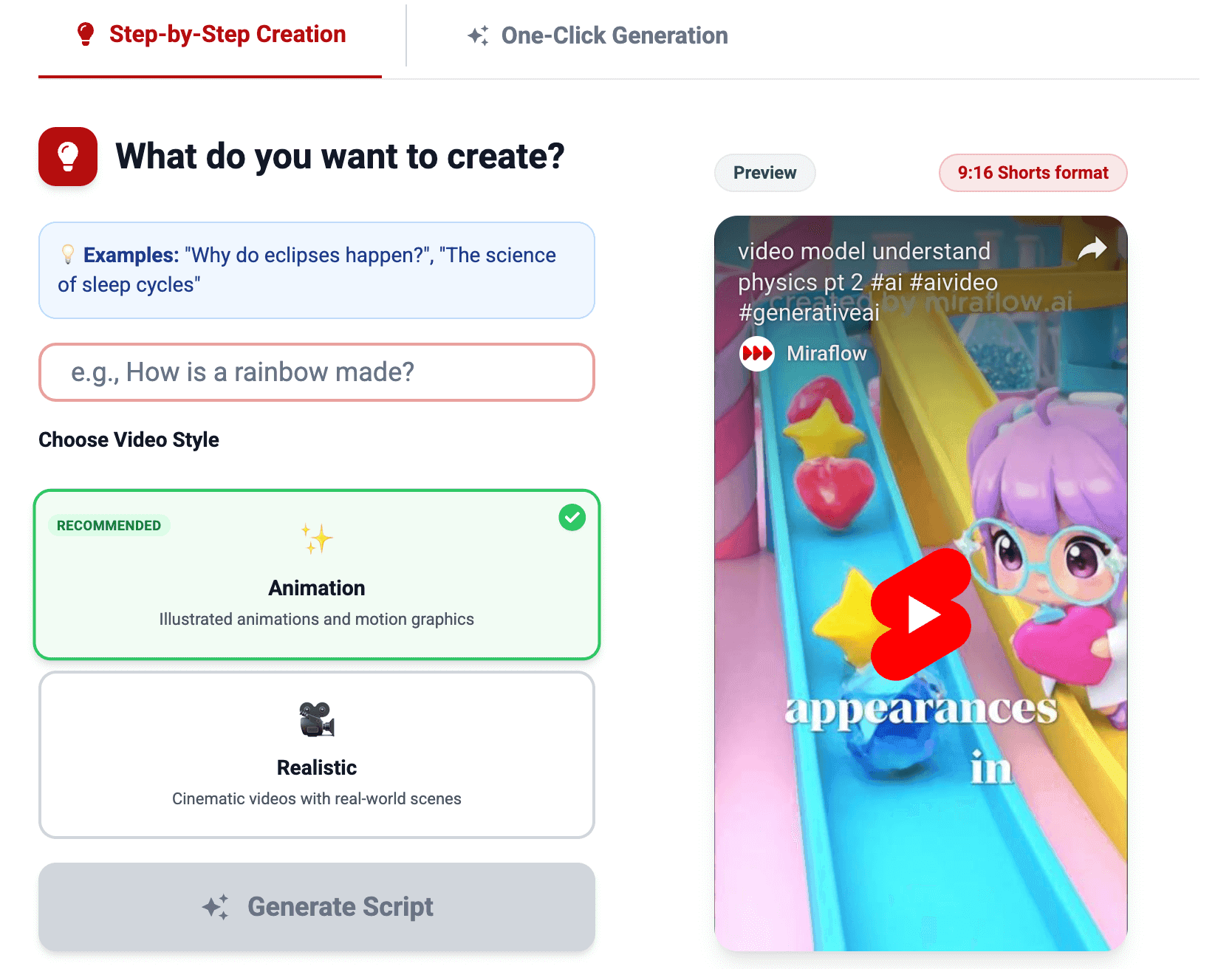
A typical workflow looks like this:
- Pick one of the formats in this post (for example, “3 Quick Tips in 30 Seconds” or “Top 3 in X Seconds”).
- Enter your topic into Text2Shorts and let it generate a hook, structure, and draft script automatically, and edit some part based on the format.
- Refine more wording if needed, then generate visuals with Veo3 / Veo3.1 inside Miraflow.
- Use Nano Banana Pro to quickly design a thumbnail or cover image that matches the style of your short.
- Publish, check performance, and reuse the same format for the next topic.
If you want a full walkthrough of how Text2Shorts works from prompt to finished vertical video, check out this guide:
👉 From Prompt to Reel: Text2Shorts AI Shorts
Conclusion
There’s no guaranteed “viral button” for Shorts, Reels, or TikTok. But in 2026, the videos that consistently perform:
- Use clear, repeatable formats
- Lean into strong hooks + fast payoff
- Tap into emotion, curiosity, or utility
- And increasingly, are built with AI-assisted workflows behind the scenes
Start by picking just one or two formats from this list and commit to them for a few weeks.
Once they feel natural, layer in more.
If you want to go deeper on the visual side, these guides will help:
- Veo3 / Veo3.1 cinematic videos: How to Use Veo3 / Veo3.1 for Free in Miraflow – step-by-step guide to generating high-quality AI clips directly in your browser.
- Image prompts & transformations: The Ultimate Nano Banana Prompt Guide: Viral Prompts That Actually Work – a full collection of Nano Banana use cases and copy-paste prompts you can reuse for thumbnails, covers, and supporting visuals.
Start with one or two formats from this list, plug them into your Miraflow workflow, and let AI handle the heavy lifting while you focus on ideas, formats, and learning from real results.