YouTube Shorts Fund 2026: How Much Shorts Actually Pay Now (New Data)

Written by
Jay Kim
The YouTube Shorts Fund ended in 2023. Here is how the new revenue model works in 2026, what Shorts actually pay per 1,000 views, and how to maximize earnings.
If you have been uploading YouTube Shorts consistently and expecting meaningful ad revenue, you have probably noticed that the numbers in your YouTube Studio dashboard look disappointingly small compared to what long-form creators earn. You are not alone in this, and the confusion around Shorts payments has only grown since YouTube replaced the original Shorts Fund with a completely different monetization model.
This guide breaks down exactly how much YouTube Shorts pay in 2026, using verified data from creator reports, platform analytics, and YouTube's own monetization policies. It covers the revenue sharing model, real RPM numbers by niche, what affects your payout, the YPP requirements, and practical strategies to maximize what you earn from every Short you publish.
The YouTube Shorts Fund Is Gone: Here Is What Replaced It
One of the most common misconceptions in creator communities is that the YouTube Shorts Fund still exists. The $100M Shorts Fund ended in 2023.[4] It was replaced by YPP ad revenue sharing, which is more predictable and scales with your views.[4]
The original Shorts Fund operated between 2021 and 2022. YouTube set aside a $100M fund to pay bonuses ranging from $100 to $10,000 per month to top Shorts creators.[8] The problem with that model was that it was a fixed pool. YouTube selected which creators received bonuses, and it had nothing to do with ad performance or consistent viewership.

YouTube changed from the Shorts Fund to ad revenue sharing to create a more sustainable model. The Shorts Fund was a fixed pool of money, which limited its long-term potential. Ad revenue sharing ties creator earnings directly to ad performance.[6]
In 2026, Shorts monetization runs entirely through the YouTube Partner Program. Creators who qualify for the YouTube Partner Program can earn money from Shorts through a revenue-sharing model that pays out from ads shown between videos in the Shorts feed.[3]
This shift means your earnings are now tied directly to how many people watch your Shorts, what country they are in, what niche you operate in, and whether your Shorts use licensed music. Understanding each of these variables is what separates creators who earn meaningful Shorts revenue from those who wonder why their paycheck looks so thin.
If you are building a Shorts-focused channel and want to understand the algorithm side of this, the how the YouTube algorithm works in 2026 guide covers how YouTube distributes Shorts through the feed and what signals it prioritizes.
How YouTube Shorts Revenue Sharing Actually Works in 2026
The Shorts revenue model is fundamentally different from how long-form videos earn money, and understanding the mechanics is essential for setting realistic expectations.
There are four steps to how Shorts ad revenue sharing works. Each month, revenue from ads running between videos in the Shorts Feed gets added together and used to both reward creators and help cover costs of music licensing.[4]

Here is the step-by-step breakdown:
Step 1: YouTube pools all Shorts ad revenue. Unlike long-form where ads run directly on your specific video, Shorts ad revenue from the entire Shorts feed is pooled into a regional fund.[3] That fund is distributed to all creators based on their share of total Shorts views that month.[3]
Step 2: Music licensing takes its share. If a monetizing creator uploads a Short without any music, all of the revenue associated with it goes into the Creator Pool.[4] If a monetizing creator uploads a Short with 1 track, half of the revenue associated with its engaged views would be allocated to the Creator Pool, and the other half used to cover the costs of music licensing.[4] If the Short features 2 music tracks, then one third of the revenue associated with its engaged views would be allocated to the Creator Pool.[4]
Step 3: The Creator Pool is allocated by engaged views. Revenue is distributed to monetizing creators based on their share of total engaged views from monetizing creators' Shorts in each country. For example, if a creator gets 5% of all eligible engaged Shorts views uploaded by monetizing creators, they'll be allocated 5% of the revenue in the Creator Pool.[4]
Step 4: YouTube applies the 45/55 revenue split. Monetizing creators will keep 45% of their allocated revenue, regardless if music was used or not.[4]
This last point catches many new creators off guard. For long-form videos, creators receive 55% of ad revenue and YouTube keeps 45%. For Shorts, this is reversed, with creators keeping only 45% and YouTube keeping 55%.[3]
The pooled model means that your individual Shorts do not have ads attached directly to them. You don't earn from ads watching your Short. You earn a percentage of a massive shared pool.[3] This is fundamentally different from the per-video ad placement model on long-form content and is one of the main reasons Shorts RPM is so much lower.
How Much Do YouTube Shorts Actually Pay Per 1,000 Views in 2026
Now for the numbers everyone searches for. The data across multiple verified sources in 2026 paints a consistent picture.
Earnings vary, but many creators make between $0.03 and $0.10 per 1,000 views. For example, a Short with 1 million views might earn between $30 and $100. Rates are on the rise as advertisers invest more in short videos.[8]
The global average YouTube Shorts RPM sits between $0.03 and $0.07 per 1,000 views after YouTube's 55% platform cut. Specialized niches like finance and technology can reach $0.10 to $0.35 per 1,000 views when targeting US audiences.[6]
To put that in practical terms, a case study published by TubeBuddy in January 2026 showed one channel earned $32 from exactly 1 million YouTube Shorts views. That is $0.032 per 1,000 views, consistent with the $0.03 to $0.08 range creators report across the platform.[3]
For a real-world reference from a well-known creator channel, on the vidIQ channel, a Short with 468,500 views earned $16.61. RPM has since increased by 150%, bringing their current rate to around $0.10 per 1,000 views. Most channels still fall in the $0.03 to $0.06 range depending on niche, audience location, and content type.[8]
Compare that with long-form content. On average, Shorts creators are earning anywhere between 3 cents and 7 cents RPM. By contrast, YouTube creators who make long-form videos typically make anywhere between $1 to $30 RPM.[3]
If you are planning content around revenue projections, the YouTube Shorts revenue calculator 2026 post walks through exact earnings at different view thresholds from 100K to 10M views.
YouTube Shorts RPM by Niche: Why Your Topic Matters More Than Your Views
One of the biggest factors determining your Shorts revenue is the niche you create in, because advertiser demand varies enormously across content categories.
Topic affects revenue, with finance Shorts earning 10x more Revenue Per Mille than comedy or lifestyle.[7]
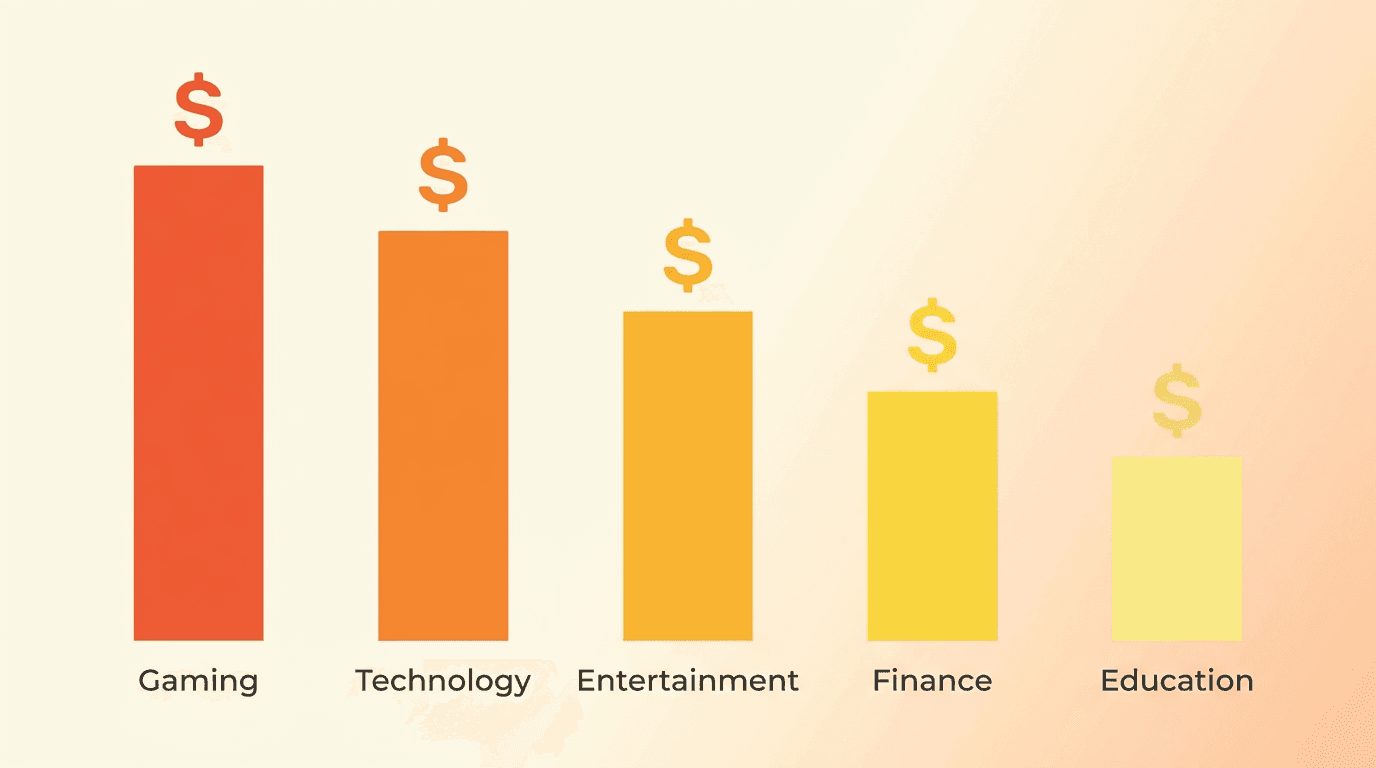
Here is what the niche breakdown looks like in 2026 based on verified creator data:
Finance and Investing: The YouTube Shorts RPM for the finance niche averages $0.05 to $0.30.[8] This is the highest-paying Shorts niche because financial services advertisers pay premium rates for audiences with purchase intent.
Technology and Software: RPM in the $0.05 to $0.15 range for US-focused audiences. B2B and SaaS advertisers drive higher CPMs in this category.
Education and Tutorials: Educational videos have a much higher CPM ($10 to $25) as compared to the entertainment niche ($2 to $8).[2] While those CPM figures refer to long-form, the same niche premium applies to Shorts at a smaller scale.
Entertainment and Comedy: This is where most Shorts creators land, and unfortunately, it is also where RPM is lowest. General entertainment Shorts typically earn $0.01 to $0.04 per 1,000 views because advertisers pay less for broad, low-intent audiences.
Gaming: RPM tends to sit in the $0.02 to $0.05 range. Finance Shorts with CPMs reaching $4.50 per thousand impressions dramatically outperform gaming and entertainment content at $1.20 to $2.00 CPM.[10]
The practical takeaway is that two creators with identical view counts can see wildly different revenue depending on their niche. If you are choosing a content focus for a new Shorts channel, the faceless YouTube Shorts AI niches 2026 guide covers 10 niches ranked by both growth potential and monetization rates.
How Audience Location Changes Your Shorts Earnings
Where your viewers are located has just as much impact on your earnings as your niche, sometimes even more.
YouTube pays based on viewer location, not creator location.[3] A Lahore-based creator with 75% US audience earns full US RPM rates.[3]
Geographic targeting multiplies these numbers. US, UK, Canada, and Australia audiences deliver 5 to 10x higher RPMs than developing markets. Two creators with identical 10 million views can see income gaps of $4,000+ based solely on audience location.[10]
75% of all YouTube Shorts views come from outside the creator's country.[7] This means that even if you are based in a high-CPM country like the US, a large portion of your Shorts audience may be international, which pulls your effective RPM down.
This geographic distribution is one reason why Shorts RPM feels so low for many creators. Your content might be reaching millions of people, but if those viewers are concentrated in lower-CPM regions, the revenue per view drops significantly. The YouTube CPM rates by niche 2026 guide provides a detailed country-by-country breakdown of how location affects earnings.
YouTube Partner Program Requirements for Shorts Monetization in 2026
Before you can earn a single dollar from Shorts ad revenue, you need to qualify for the YouTube Partner Program. Here are the exact thresholds in 2026.
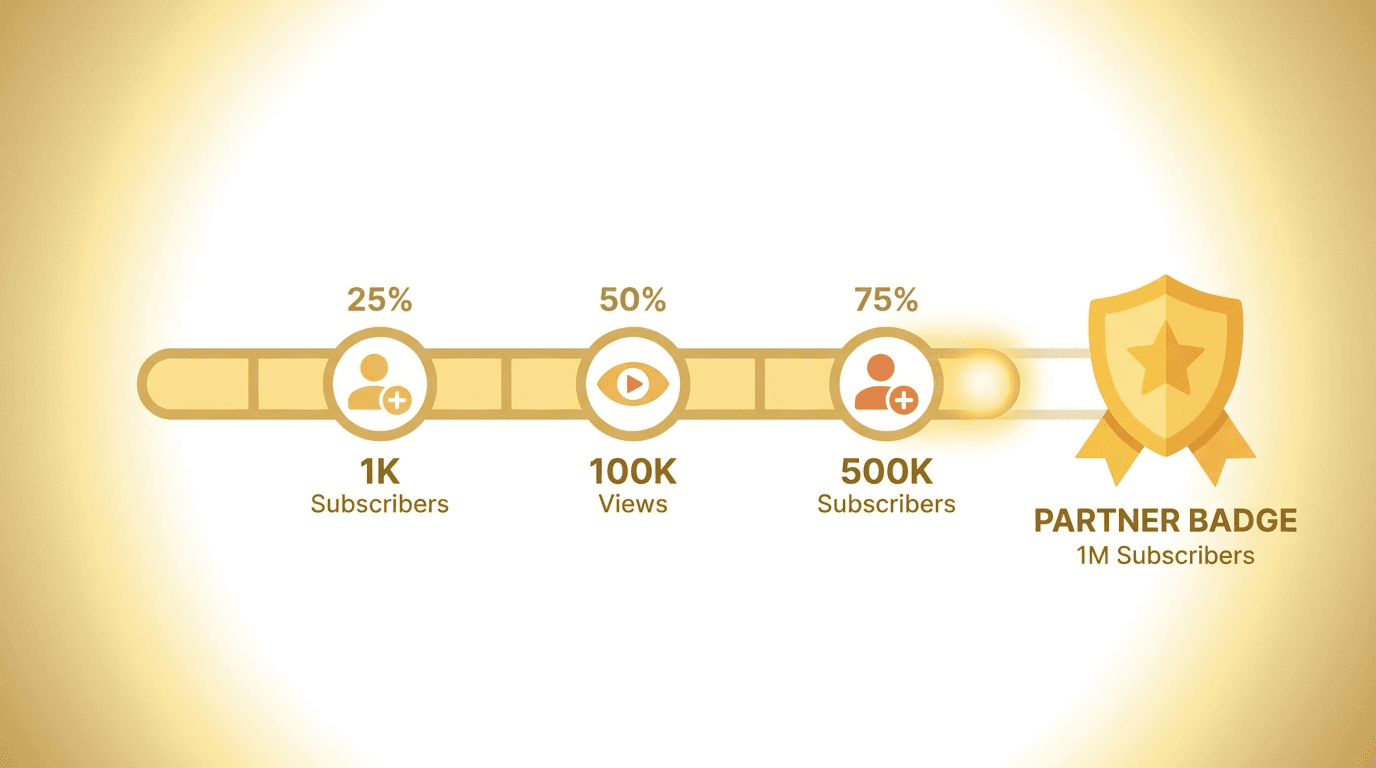
Full YPP (Ad Revenue Sharing):
To earn ad revenue from Shorts through the YouTube Partner Program, you need to meet one of two thresholds. The Shorts path requires 1,000 subscribers plus 10 million valid Shorts views in the last 90 days. The long-form path requires 1,000 subscribers plus 4,000 valid public watch hours in the last 12 months.[8]
Early Access Tier (Fan Funding Only):
For the fan-funding options, having 500 subscribers with 3 million Shorts views or 3,000 watch hours is enough.[8] This tier gives you access to Super Thanks, Super Chat, Super Stickers, and Channel Memberships, but does not include ad revenue from Shorts.
Once accepted, you still need to enable the Shorts monetization module manually in YouTube Studio. It is not automatic.[8] This is a step many new creators miss, so make sure you navigate to the Earn tab in YouTube Studio and accept the Shorts Monetization Module after being approved.
The 10 million Shorts views threshold in 90 days sounds steep, but for creators posting consistently in high-reach niches, it is actually achievable faster than the 4,000 watch hours path. The YouTube Shorts best practices 2026 guide covers the strategies that help new channels hit these milestones efficiently.
The Music Licensing Factor Most Creators Overlook
One of the least understood aspects of Shorts monetization is how music usage directly reduces your earnings.
A short video with a trending copyrighted song might get more views, but it will also make less revenue per view. Shorts using original audio or voiceover will often keep more of their monetizable revenue because there's no external licensing fee to pay.[9]

The math is straightforward. If your Short uses no music, 100% of the revenue associated with your views goes into the Creator Pool. If you use one licensed track, only 50% goes to the Creator Pool. If you use two tracks, only 33% goes to the Creator Pool. You keep 45% of whatever is allocated to you regardless of music usage[4], but the allocation itself is smaller when music is involved.
Creators often notice that they earn a higher RPM on short videos that use original or non-copyrighted sounds compared to those that are full of music, even if the latter get more views. This is one reason why urging creators to chase "viral sounds equals loads of cash" can lead to disappointment rather than a higher income.[9]
This creates an important strategic consideration. Using trending music can boost your views and discovery, but it also reduces your per-view revenue. The most revenue-efficient approach is to use original audio, voiceover narration, or AI-generated music that does not trigger Content ID claims.
The AI Music Generator on Miraflow AI lets you create unique background tracks from text descriptions. You can specify mood, instruments, BPM, and duration in Custom Mode, generating tracks that are fully original and avoid any music licensing deductions from your Shorts revenue. For prompt ideas, the AI music prompts for YouTube, Reels, and TikTok guide has templates organized by content type.
3-Minute Shorts: Does Longer Mean More Money?
YouTube expanded the maximum Shorts length to 3 minutes in late 2024, and many creators wonder whether longer Shorts earn more.
As of 2026, YouTube Shorts can be up to 3 minutes long, as long as the video is vertical or square and was uploaded after October 15, 2024.[3]
However, length alone does not increase your RPM. Shorts monetization is based on your share of total Shorts views, so videos that generate more views earn more. Shorter Shorts tend to accumulate views faster due to higher completion and replay rates.[5]
YouTube Shorts now go up to 3 minutes, but the best-performing videos still fall between 20 to 45 seconds.[3] The reason is simple: retention and completion rate matter far more than duration. A 30-second Short that 90% of viewers watch to the end will perform better algorithmically than a 2-minute Short where 60% of viewers swipe away before finishing.
There is one important caveat for longer Shorts. Any Short that is over one minute in duration with an active Content ID claim of any type will be blocked globally on YouTube. The video will not be playable or recommended on YouTube, and will not be eligible for monetization.[1] This means that if you create Shorts longer than 60 seconds, you need to be especially careful about music licensing and copyright.
The best approach is to let your content determine the length. Some topics genuinely need 90 seconds to deliver value. Others work best at 25 seconds. The should you post daily Shorts in 2026 guide covers the optimal balance between posting frequency and content quality that the algorithm rewards.
Why Shorts Are a Growth Engine, Not a Cash Machine
Here is the reality that experienced YouTube creators understand: ad revenue alone from Shorts is usually not enough to build on. The creators who earn meaningful income use Shorts as a growth engine and stack other monetization on top.[8]
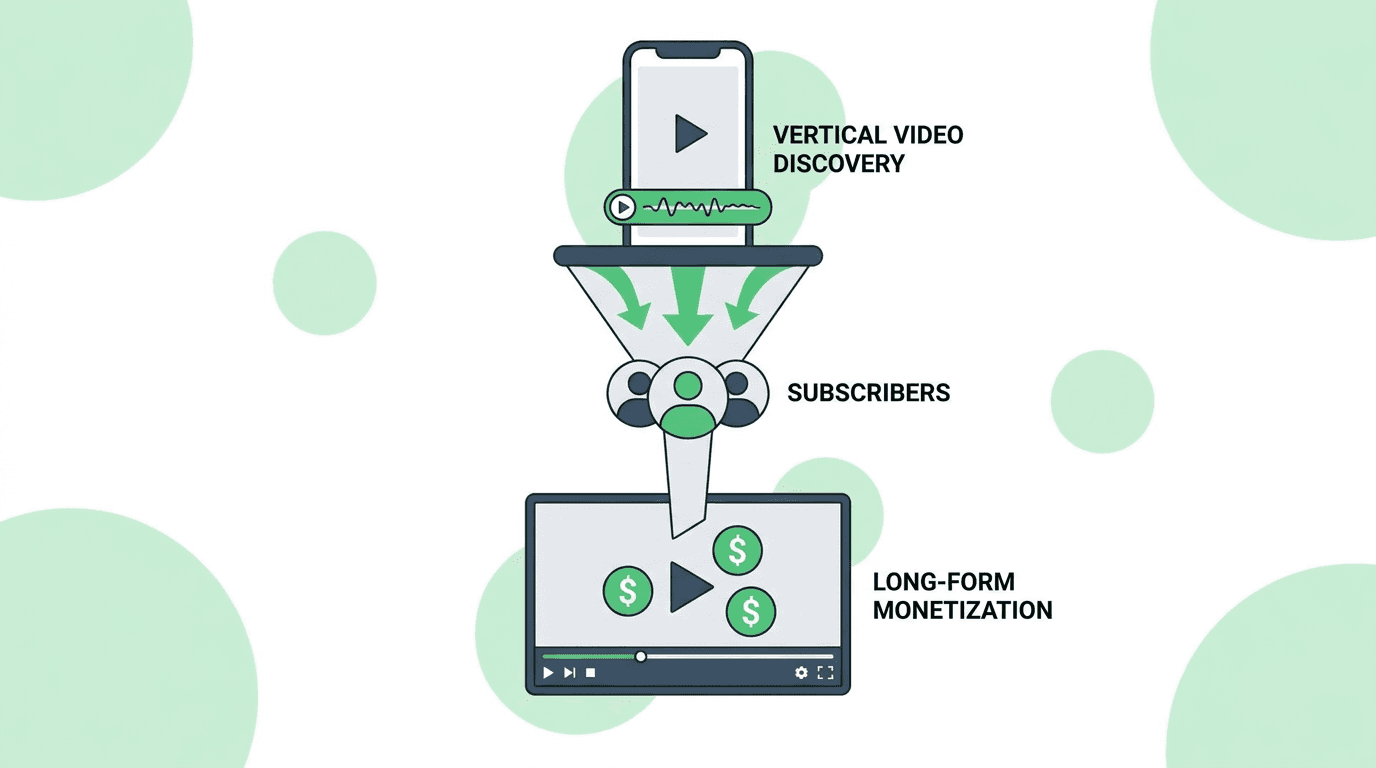
Only 8% of Shorts creators rely on ads as their primary source of income.[7] The other 92% use Shorts strategically to drive subscriber growth, build audience awareness, and funnel viewers toward higher-revenue content and income streams.
On average, YouTube Shorts generate 16.9 new subscribers per 10,000 views. For creators with over one million subscribers, the rate jumps to 29.2 new subscribers per 10,000 Shorts views compared to just 11 per 10,000 views on regular long-form videos. A single Short with 100,000 views can deliver approximately 169 new subscribers.[6]
Channels using Shorts plus long-form in tandem grow 41% faster than long-form-only channels.[3] This is the compound growth effect that makes Shorts valuable beyond their direct ad revenue.
The strategy that the highest-earning YouTube creators use in 2026 is to publish Shorts that grow their subscriber base, then direct those subscribers toward long-form content where RPM is 50 to 100 times higher. A viral Short can drive thousands of channel subscribers who then watch your long-form videos which pay 5 to 10x more per view. No other short-form platform creates this compound growth effect.[4]
The Shorts Revenue Pool Is Growing: What Changed in 2025 and 2026
While individual Shorts RPM is still low compared to long-form, the overall revenue pool has grown substantially.
YouTube expanded Shorts to three minutes, increased ad loads in the Shorts feed, and grew the creator revenue pool significantly. Shorts revenue share now accounts for 18% of total creator earnings on YouTube, up from just 4% in 2024.[6]
YouTube's increased ad load in the Shorts feed has boosted average RPM by 15 to 25% compared to 2024 levels.[6]
YouTube ad revenue hit $11.38 billion in Q4 2025 alone, with Shorts now generating more revenue per watch hour than traditional long-form content in the US.[2] That last point is notable because it means the Shorts format is actually highly valuable to YouTube's advertising business, even though individual creator payouts remain modest.
YouTube's total creator monetization ecosystem grew 23% year-over-year in 2026, with average CPM rising from $4.82 to $6.15 across niches. This broader platform growth lifts the Shorts revenue pool as well, since Shorts ads are part of YouTube's overall advertising infrastructure.[6]
The trajectory is clear: Shorts RPM is rising, even if slowly. Rates are on the rise as advertisers invest more in short videos.[8] Creators who build strong Shorts channels now are positioned to benefit as the revenue pool continues to expand.
7 Strategies to Maximize Your YouTube Shorts Revenue in 2026
Based on how the revenue model works, here are the practical strategies that actually move the needle on Shorts earnings.
1. Choose a High-CPM Niche
For creators just starting out, choosing the right niche from day one matters more than any other decision.[10] Finance, technology, business, education, and health optimization content attracts higher-paying advertisers, which translates to higher RPM even in Shorts.
2. Target Tier-1 Audiences
Create content that appeals to viewers in the US, UK, Canada, Australia, and Western Europe. A video with mostly US or German traffic might earn $10+ RPM. The same video with views from India or Indonesia could bring in less than $1.[1] While those figures refer to long-form, the same geographic premium applies proportionally to Shorts.
3. Use Original Audio Instead of Licensed Music
Since licensed music reduces the amount that enters the Creator Pool, using original voiceover, sound effects, or AI-generated music keeps more revenue allocated to your Shorts. The guide to generating copyright-free music for YouTube covers exactly how to create unique background tracks for your content.
4. Combine Shorts with Long-Form Content
Shorts speed up channel growth, increase your visibility, and drive traffic to videos that do earn high CPMs.[3] Use each Short as a teaser or a standalone piece that makes viewers curious enough to check out your longer content.
5. Focus on Retention Over Views
Shorts reward retention, rewatch rate, and velocity, not duration.[3] A 30-second Short with 95% retention will outperform a 3-minute Short with 40% retention in algorithmic distribution. The YouTube Shorts analytics 2026 guide shows exactly how to read your retention graphs and optimize for the metrics that matter.
6. Diversify Revenue Beyond Ad Sharing
76% of top-earning Shorts creators make more from brand deals than ad revenue.[10] Additional revenue streams to consider include Super Thanks (viewer tips), channel memberships, affiliate marketing, merchandise, and direct brand sponsorships. Ad revenue should be treated as one component of a larger monetization strategy.
7. Post Consistently Without Sacrificing Quality
Consistency in posting YouTube Shorts helps drive growth, with 6 months of regular posting leading to a 44% increase in channel growth.[7] But consistency should be measured in weeks and months, not in cramming 10 Shorts per day. The how the YouTube Shorts algorithm responds to daily uploads guide explains what the algorithm rewards and where daily posting starts to backfire.
How to Create Revenue-Optimized Shorts with AI Tools
Producing Shorts that are both engaging and revenue-optimized requires quality visuals, original audio, strong scripting, and attention-grabbing thumbnails. AI tools have made this production pipeline dramatically faster.

For the video itself, Text2Shorts on Miraflow AI generates complete vertical videos from a single topic. The workflow takes you through script generation, scene visual editing, voice selection, and final video assembly, all in the 9:16 Shorts format. You can choose between animation and realistic visual styles, and you have full editorial control over every step.
For thumbnails that drive CTR in the Shorts feed, the YouTube Thumbnail Maker generates professional thumbnails with templates designed for both 16:9 videos and 9:16 Shorts. Strong thumbnails improve your click-through rate, which directly affects how many views your Shorts accumulate and how much of the revenue pool you capture.
For background music that avoids licensing deductions, the AI Music Generator creates unique tracks from descriptive prompts. In Custom Mode, you can control the mood, tempo, key, and structure to create a soundtrack that perfectly matches each Short without touching your revenue allocation. The AI music for YouTube guide covers how to generate copyright-free tracks in seconds.
For visual assets and scene imagery, the AI Image Generator supports multiple aspect ratios including 9:16, making it easy to create vertical visuals for Shorts. And when you need cinematic video clips, the Cinematic Video Generator produces hyper-realistic 8-second clips from text prompts that can be used as B-roll or standalone visual sequences.
The entire pipeline from idea to finished Short, thumbnail, and background music can be built inside Miraflow AI without switching between multiple tools.
YouTube Shorts Earnings at Every View Level
Here is a realistic earnings table based on the 2026 data, using the most commonly reported RPM range of $0.03 to $0.07 per 1,000 views for general content:
10,000 views: $0.30 to $0.70
100,000 views: $3 to $7
500,000 views: $15 to $35
1 million views: $30 to $70
5 million views: $150 to $350
10 million views: $300 to $700
For high-CPM niches like finance or technology targeting US audiences, multiply those numbers by 2x to 5x. Specialized niches like finance and technology can reach $0.10 to $0.35 per 1,000 views when targeting US audiences.[6]
These numbers make it clear why Shorts ad revenue alone is not a sustainable income strategy for most creators. But when combined with subscriber growth that drives long-form viewership, brand deals, and other monetization channels, the total economic value of a strong Shorts strategy is far higher than the direct ad payout suggests.
The YouTube Shorts monetization 2026 guide provides more detailed earnings projections by subscriber tier and niche category.
What YouTube Shorts Revenue Will Look Like by Late 2026
The trajectory of Shorts monetization is moving in a positive direction. The rapid growth reflects both YouTube's increased investment in Shorts monetization and creators' strategic shift toward the format. The trajectory suggests Shorts could represent a quarter or more of total creator revenue within the next two years.[6]
As YouTube introduces more ad formats within the Shorts feed, longer Shorts will have more monetization opportunities.[5] YouTube has also been testing additional ad placements and interactive ad formats specifically for the Shorts feed, which could further increase the total revenue pool.
Channels in AI tools, personal finance, and health optimization are experiencing the fastest growth rates at 5.4 to 6.8% monthly subscriber increases.[6] These niches also tend to carry higher CPMs, which makes them doubly attractive for creators building revenue-focused Shorts channels.
The YouTube CTR benchmarks 2026 guide covers how to optimize your content for the metrics that drive both algorithmic distribution and revenue growth.
Conclusion
YouTube Shorts pay significantly less per view than long-form content in 2026. The global average RPM sits between $0.03 and $0.07 per 1,000 views, with finance and technology niches reaching up to $0.35 for US-targeted audiences. The original $100M Shorts Fund is gone, replaced by the YPP ad revenue sharing model where creators keep 45% of their allocated pool revenue.
But raw RPM only tells part of the story. Shorts generate subscribers faster than any other YouTube format, they drive viewers to higher-paying long-form content, and they create the visibility that attracts brand deals and sponsorships. The creators who treat Shorts as a growth and discovery tool, rather than a primary revenue stream, are the ones building sustainable YouTube businesses in 2026.
The revenue pool is growing. Ad loads in the Shorts feed have increased. RPMs have risen 15 to 25% compared to 2024. And with Shorts now representing 18% of total creator earnings on YouTube, up from just 4% in 2024, the format is becoming an increasingly meaningful part of the creator economy.
Choose a niche with strong advertiser demand. Target audiences in high-CPM countries. Use original audio to keep more of your revenue allocation. Post consistently. And build a content funnel that turns Shorts viewers into long-form subscribers. That is how creators are earning real money from Shorts in 2026.
Frequently Asked Questions
Is the YouTube Shorts Fund still available in 2026?
No. The original $100M YouTube Shorts Fund ended in 2023. It has been fully replaced by YPP ad revenue sharing, where creators earn a percentage of pooled Shorts ad revenue based on their share of total engaged views each month.
How much does YouTube pay per 1,000 Shorts views in 2026?
Most creators earn between $0.03 and $0.10 per 1,000 views from Shorts. The exact amount depends on your niche, audience location, and whether your Shorts use licensed music. Finance and technology creators targeting US audiences can earn up to $0.35 per 1,000 views.
How many Shorts views do I need to earn $100?
At the average RPM of $0.03 per 1,000 views, you would need approximately 3.3 million Shorts views to earn $100 in ad revenue. At a higher RPM of $0.07, you would need about 1.4 million views. Niche and audience location significantly affect these numbers.
What are the YouTube Shorts monetization requirements in 2026?
To earn ad revenue from Shorts, you need 1,000 subscribers and either 10 million Shorts views in 90 days or 4,000 watch hours in 12 months. A lower tier at 500 subscribers with 3 million Shorts views or 3,000 watch hours gives access to fan-funding features like Super Thanks and Channel Memberships, but does not include ad revenue sharing.
Does using music in Shorts reduce my earnings?
Yes. When your Short uses licensed music, the revenue associated with those views gets split between the Creator Pool and music licensing before you receive your 45% share. A Short with one music track sends only half of its associated revenue to the Creator Pool. Using original audio, voiceover, or AI-generated music avoids this deduction entirely.
Why are Shorts RPM so much lower than long-form?
Three main factors explain the gap: Shorts use a pooled revenue model instead of direct per-video ad placement, the creator share is 45% instead of 55%, and the rapid-scrolling Shorts viewing experience generates lower ad engagement than long-form content where viewers spend minutes watching.
Can Shorts help me earn more from long-form videos?
Yes. Channels using both Shorts and long-form content grow 41% faster than long-form-only channels. Shorts generate 16.9 new subscribers per 10,000 views on average, and those subscribers then watch your higher-RPM long-form content. This compound growth effect is why most successful YouTube creators use Shorts as a subscriber acquisition funnel.
Are YouTube Shorts still worth making if the pay is so low?
Absolutely. The direct ad revenue from Shorts is modest, but the strategic value is enormous. Shorts drive subscriber growth, increase channel visibility, attract brand sponsorships, and funnel traffic to long-form content where RPM can be 50 to 100 times higher. The creators building sustainable YouTube businesses in 2026 almost universally include Shorts in their content strategy.
References
- YouTube CPM & RPM Rates in 2026: Averages by Niche and Country – MilX
- Understand three-minute YouTube Shorts - YouTube Help
- YouTube Shorts Statistics 2026: Views, Revenue, Engagement Data | ShortsIntel
- YouTube CPM & RPM Rates 2026: Average, Niches, Countries & More – Lenos
- YouTube monetization requirements for 2026 – MilX
- YouTube Income Per 1,000 Views 2026: Every Niche, Every Country, Shorts vs Long-Form
- YouTube Shorts Monetization: Requirements & Pay (2026) - Shopify
- YouTube Shorts RPM: what to expect in 2026 – AIR Media-Tech
- How Long Can YouTube Shorts Be in 2026? Full Guide & Rules
- How Much YouTube ACTUALLY Pays for Shorts in 2026? - YouTube
- 19 Most Profitable YouTube Niches 2026 (Real RPM Data) | OutlierKit
- YouTube Shorts monetization policies - YouTube Help
- YouTube Shorts Monetization 2026: How Much Shorts Pay + How to Earn More | Ssemble
- YouTube advertising data and insights for 2026 – MilX
- How Long Can YouTube Shorts Be? 2026 Length Guide
- YouTube Shorts Statistics 2026: 2B Users, 200B Daily Views & Creator Monetization Data - AutoFaceless Blog
- YouTube CPM Rates by Niche 2026: How Much Do YouTubers Actually Earn?
- YouTube Shorts Monetization Requirements: Your 202 |...
- How Long can YouTube Shorts be ? (2026)
- YouTube Shorts Statistics 2026: Usage, Growth, And Monetization Data
- YouTube Shorts Monetization in 2026: The Complete Revenue Guide
- How Long Can YouTube Shorts Be? Guide for 2026
- YouTube Shorts Monetization in 2026: Requirements, RPM, and How Much You Get Paid
- YouTube RPM Finance Niche 2026: Complete Earnings Guide with Real Data
- YouTube Shorts Monetization in 2026: What Creators Need to Know
- YouTube Shorts RPM in 2026: How Much Creators Really Earn - Mediacube
- How Much Do YouTube Shorts Make for Creators? Tips for Monetization in 2026
- YouTube Shorts Monetization 2026: Creators Need to Know
- YouTube Monetization Requirements in 2026 (Complete Guide)
- YouTube Earnings Calculator (2026): Check Your Channel Income (Updated RPM)
- Most Profitable AI YouTube Shorts Niches in 2026 (RPM Data Included)
- YouTube Shorts Monetization 2026: Real Earnings, Requirements & Tips - VidTube AI Studio
- YouTube Shorts Update 2026: Every Major Change Explained