20 AI Día de los Muertos Prompts for Catrina Portraits, Ofrendas, and Reels (Copy & Paste 2026)

Written by
Aerin Kim
20 copy-paste AI Día de los Muertos prompts for Catrina portraits, ofrenda scenes, papel picado, pan de muerto shots, and Reels, plus a guide to doing it respectfully.
If you want to make Día de los Muertos AI art this year, the biggest problem is that most generic prompts for "day of the dead" produce a sugar skull wearing a sombrero in front of a cartoon graveyard, which is exactly the stereotype that Mexican families and artists are tired of seeing. The holiday is a remembrance of specific people, with specific flowers, foods, candles, and photographs placed on an ofrenda, and the AI images that perform best (and get shared rather than criticized) are the ones that get those details right.
Searches for Día de los Muertos ideas start climbing through October and peak right around November 1 and 2, so this is the window to build your catrina portraits, ofrenda scenes, bakery photos, and Reels. This guide gives you 20 copy-paste prompts grouped into six categories, a short, researched explanation of what each real element means, and a section on how to do all of it respectfully. You can run every prompt in the AI Image Generator on Miraflow, then animate your favorites with Text2Shorts or the cinematic video generator.
TL;DR: Use real ofrenda details (cempasúchil marigolds, papel picado, pan de muerto, copal, candles, photographs) instead of generic skull imagery. Treat La Catrina as a specific historical character, not a costume. Keep the people you depict varied in gender and age, avoid sombrero and cartel stereotypes, and post it as remembrance rather than as "Mexican Halloween." If you are looking for spooky season content instead, the AI Halloween prompts pack is the right place to start.
What Día de los Muertos Actually Is (and Why Your Prompts Should Reflect It)
Día de los Muertos is a Mexican tradition of welcoming back the spirits of deceased family members and friends, usually celebrated around November 1 and 2, with preparations beginning in the days before. In many communities November 1 is associated with children who have died (often called angelitos) and November 2 with adults, though the exact customs vary a great deal by region and by family. UNESCO recognizes the Indigenous festivity dedicated to the dead in Mexico as part of the intangible cultural heritage of humanity, which is a good reminder that this is a living cultural practice and not an aesthetic trend.
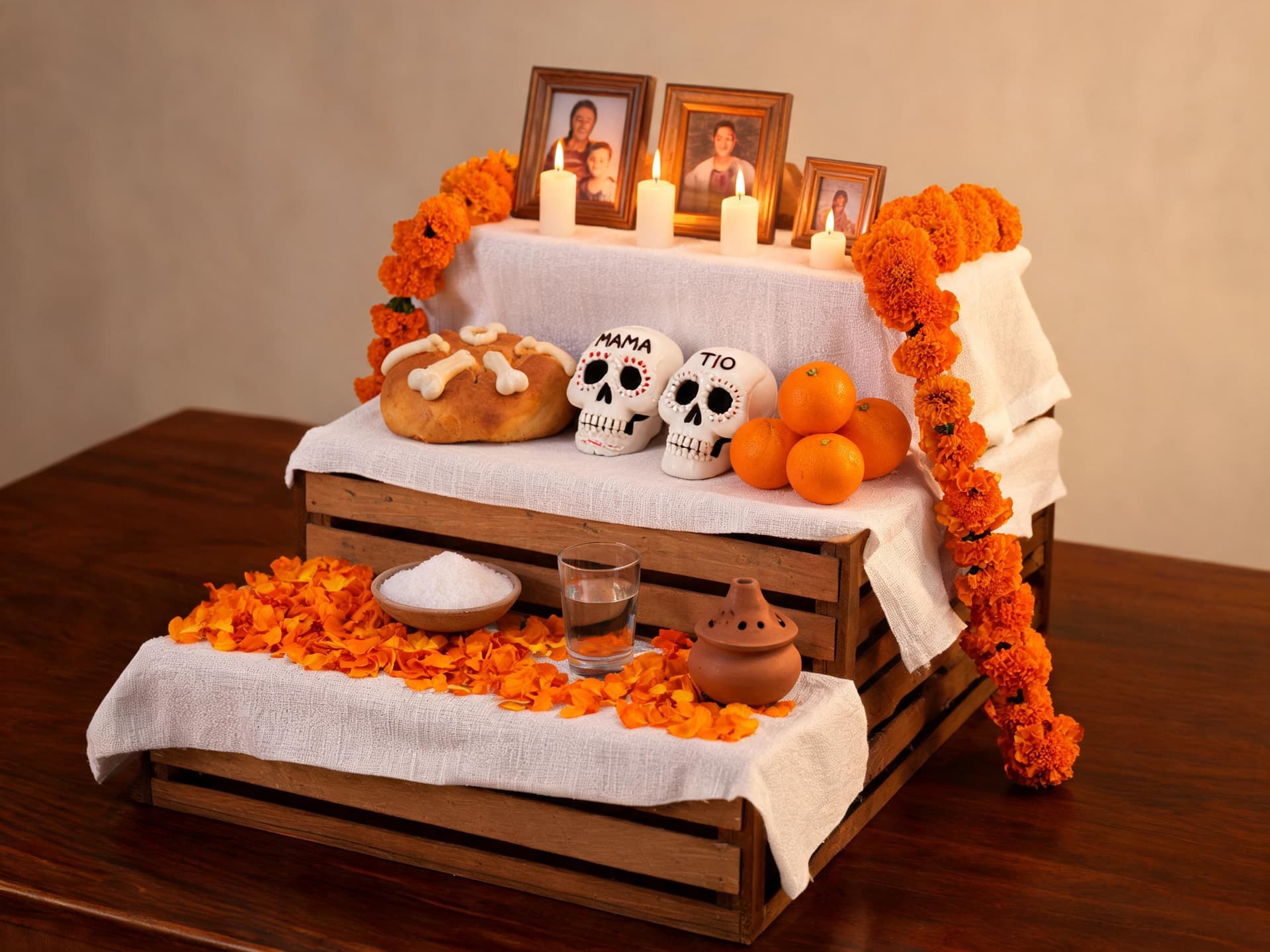
The centerpiece is the ofrenda, a home altar built to welcome the dead. Rather than a somber memorial, it works as a welcome table. Families put out the foods, drinks, and small objects their relative loved in life, because the belief is that the spirits return to enjoy them. That is why a convincing AI ofrenda image has a cup of coffee, a plate of mole, a pack of someone's favorite candy, or a pair of reading glasses on it, rather than a pile of random skulls.
The elements worth getting right
Knowing these elements lets you write prompts that name them precisely, which is what separates a believable image from a clip-art collage.
- Cempasúchil (Mexican marigold): The orange and gold flower is the signature of the holiday. Petals are often scattered in a path from the door to the altar so the spirits can find their way, and the strong scent is traditionally said to guide them. The name comes from Nahuatl and is commonly translated as "flower of twenty."
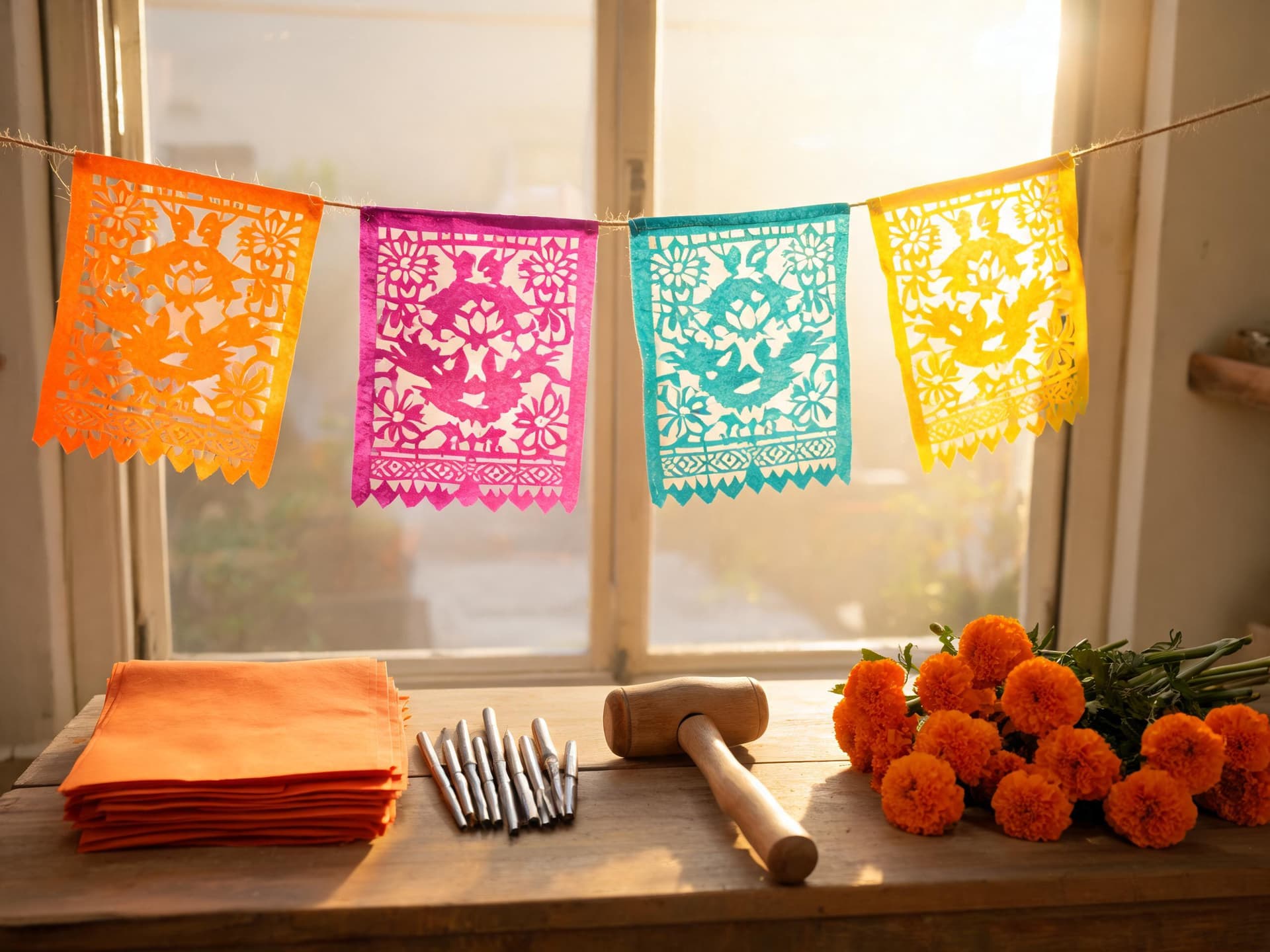
- Papel picado: Tissue paper cut into lace-like patterns and strung in banners. On an ofrenda it is commonly associated with the element of air and with the fragile line between life and death. In AI prompts, ask for crisp, geometric cut-outs rather than a blurry pattern.
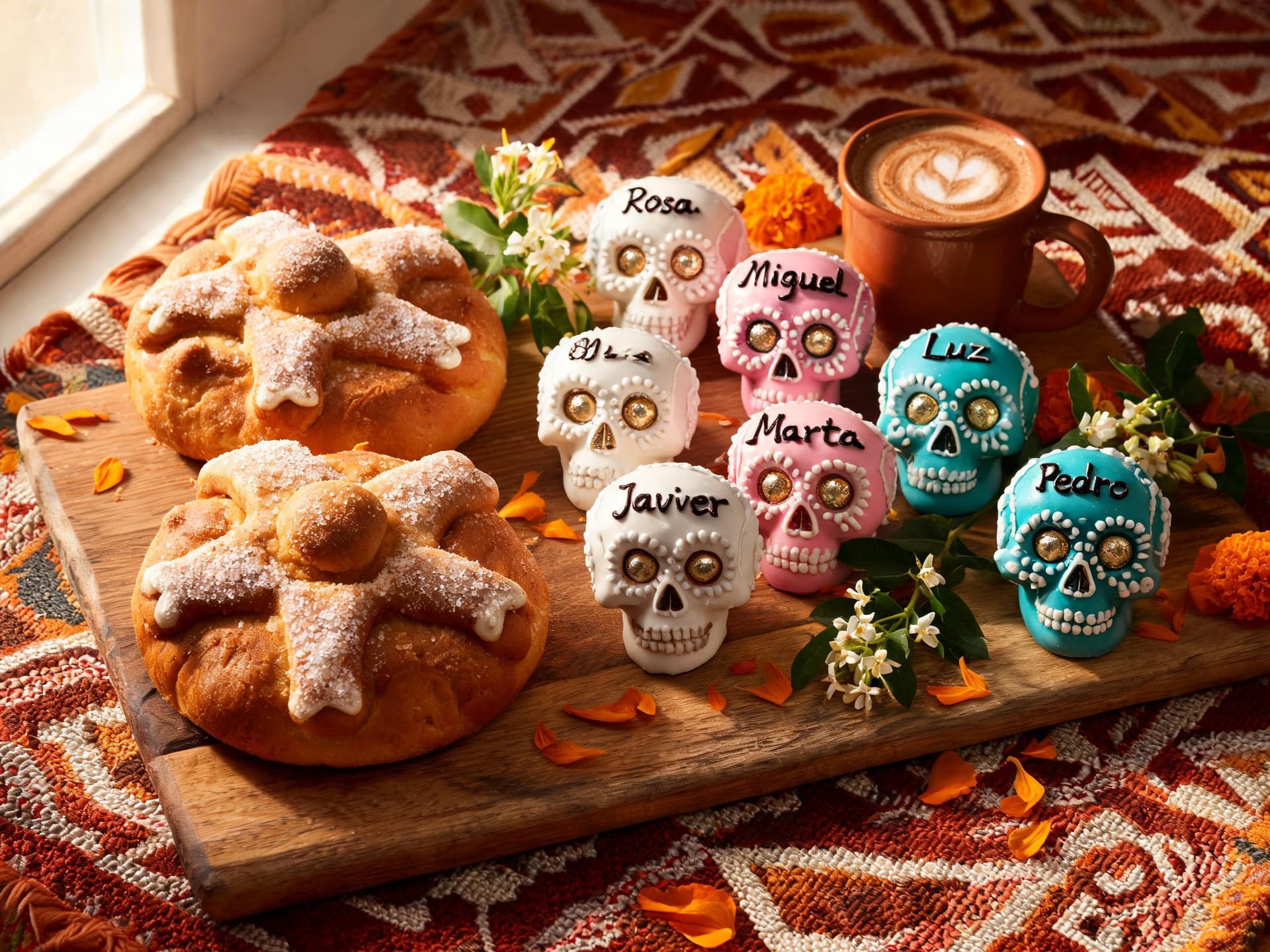
- Pan de muerto: A sweet, round bread, often flavored with orange blossom or anise and dusted with sugar. The raised knob on top and the crossed strips are commonly explained as a skull and bones, and some families shape it differently by region.
- Calaveras de azúcar: Sugar skulls, often with a name written on the forehead in icing so a specific person is remembered. They are made in molds and decorated with foil, icing, and color. A real sugar skull has a name on it, not a random grin.
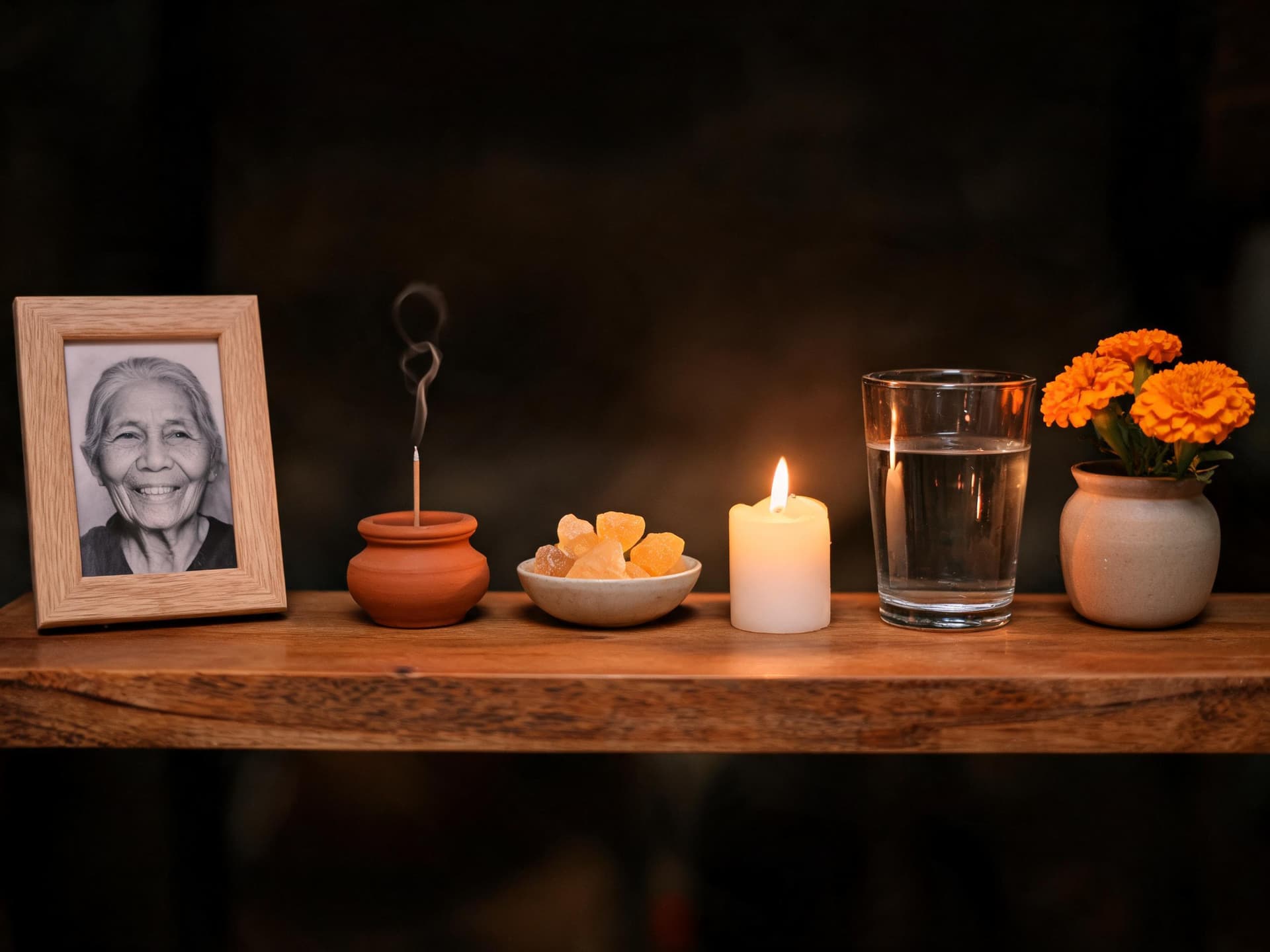
- Copal: A tree resin burned as incense, used to purify and to carry prayers upward. It appears as a small clay incense burner (an incensario) with a thin ribbon of smoke.
- Candles, water, salt, and photographs: Candles light the path, water refreshes tired travelers, salt is often included for purification, and photographs identify who is being welcomed.
- Levels: Ofrendas can be built with two, three, or seven levels. Two levels are often explained as earth and sky, three as sky, earth, and the underworld, and seven as the steps a soul takes toward rest. Practices differ, so treat any single explanation as one family's tradition.
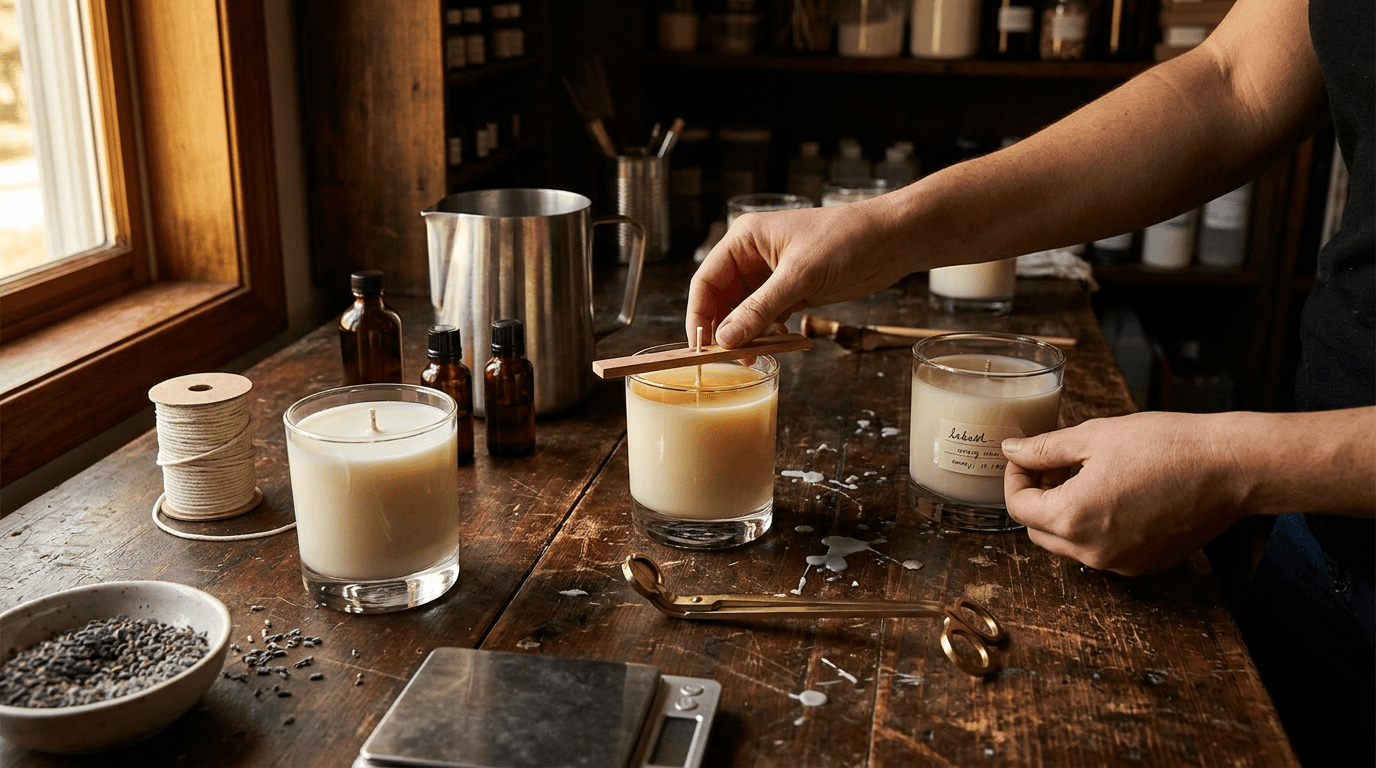
For a deeper look at product-style tabletop prompts that you can reuse for ofrenda scenes, the candle and home fragrance photography pack covers how to control flame glow and wax texture, both of which matter a lot in an ofrenda.
The Real Story of La Catrina
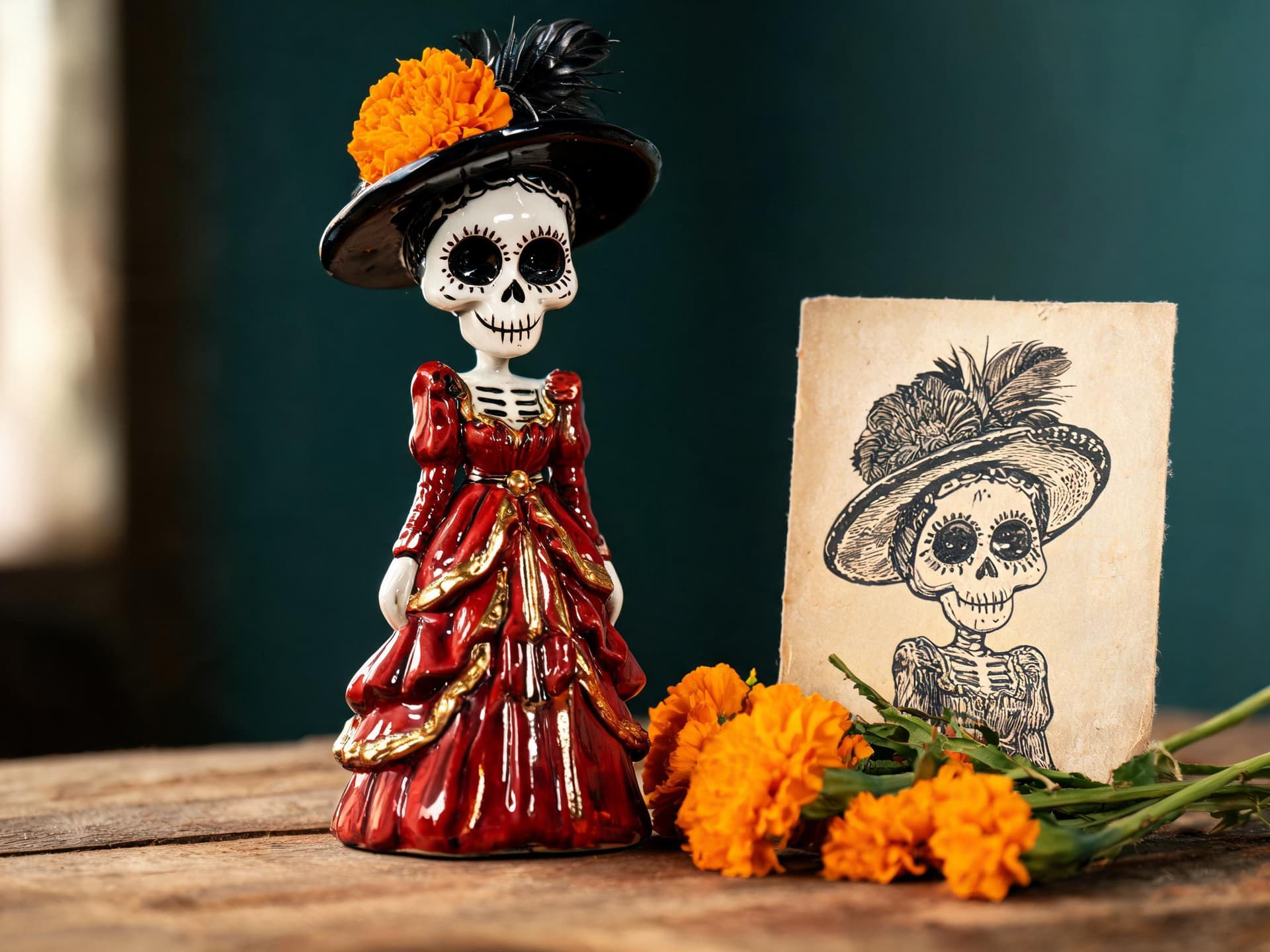
La Catrina is probably the most recognized image tied to the holiday, but she did not start as part of the traditional ofrenda at all. The original figure is a zinc etching by the Mexican printmaker José Guadalupe Posada, made around 1910 to 1913 (sources vary on the exact year) and titled La Calavera Garbancera. It showed a skeleton wearing an elaborate European-style hat and was a piece of social satire aimed at people who denied their Indigenous roots and tried to pass as European elites. "Garbancera" referred to a person who sold chickpeas and put on airs.
The name and the body came later. The muralist Diego Rivera placed the skeleton in his large fresco Sueño de una tarde dominical en la Alameda Central (Dream of a Sunday Afternoon in the Alameda Central), painted in the mid-1940s and now housed in the Museo Mural Diego Rivera in Mexico City. In it, the skeleton wears a full gown and a feathered boa, stands at the center of a crowd of figures from Mexican history, and holds hands with Posada on one side and a young Rivera on the other. Rivera is the one who gave her the name La Catrina, from "catrín," a word for a fashionable, well-dressed man. Over the following decades she became a central symbol of the holiday, even though she began as a joke about vanity.
That history is useful for prompt writing in two ways. First, the visual vocabulary is specific: a wide ornate hat with feathers or flowers, Edwardian-era clothing, an elegant posture, and a skull face rather than a mask. Second, because her origin is satire about class and identity, the most respectful use is an elegant, dignified portrait rather than a joke costume. The male counterpart is often called a Catrín, and many modern artists paint Catrinas and Catrines of every age and body type.
Doing This Respectfully (Read Before You Post)
This holiday belongs to a living culture, and a few simple habits keep your content on the right side of it.
- Call it remembrance, not "Mexican Halloween." Halloween (October 31) and Día de los Muertos are separate holidays with different origins and tone. Día de los Muertos is a celebration of love and memory, and the mood is warm, colorful, and tender, not frightening.
- Honor, don't costume. If you share Catrina face paint on yourself or a synthetic AI character, treat it like portraiture of a respected figure. Skip jokes, gore, and "scary" framing.
- Avoid stereotype shortcuts. Sombreros, fake mustaches, cactus backdrops, and cartel imagery are all lazy associations that have nothing to do with the holiday. The tradition is rooted in Mexico and is observed in many forms across Latin America and the diaspora.
- Be specific about who is remembered. The strongest images include a photo frame, a name, and objects tied to a person. If you are making content for your own family, use your own real details.
- Credit and support. If you sell products inspired by the holiday, consider working with or buying from Mexican and Mexican American artists, bakers, and papel picado makers, and name your sources when you can.
- Check your Spanish. AI text rendering often mangles accents. Spell it "Día de los Muertos" or "Día de Muertos," and confirm any caption on the image before posting. When in doubt, leave text off the image and add it in your caption.
A related tip for small businesses: pair your seasonal content with the real tradition rather than a "sale" framing. A bakery that explains what pan de muerto means will earn more trust than one that posts a skull with a discount code.
1) Catrina and Catrín Portrait Prompts
Use these for profile images, posters, and social posts. They are written to keep the face dignified and the costume historically grounded. Every prompt describes a synthetic, non-identifiable person. Mix the genders, ages, and skin tones when you generate a set so your feed reflects the real range of people who celebrate.
1. Classic Catrina Portrait With a Marigold Hat
A formal studio-style portrait of La Catrina in the Rivera tradition, with a floral hat and a fine lace collar.
A photorealistic studio portrait of an elegant woman in a classic Catrina look, skull-style face paint done as fine black line work and soft white base with delicate teal and gold detail, wearing a wide-brimmed black hat decorated with orange cempasúchil marigolds, deep red roses, and a few dark feathers, high lace collar, dark velvet dress. Seated pose, calm dignified expression, soft key light from the left with a gentle fill, shallow depth of field, deep teal backdrop, 85mm lens, rich skin texture, no cartoon style, no sombrero, no garbled text.
2. Catrín Gentleman in a Top Hat
The Catrín, a dapper figure in early 1900s clothing, painted with the same care as the Catrina.
A photorealistic portrait of a distinguished middle-aged man in a Catrín look, skull-inspired face paint with clean white base and fine black linework, an old-fashioned black top hat with a single orange marigold tucked into the band, high-collared white shirt, silk cravat, and dark wool coat with a marigold boutonniere. Straight-on three-quarter pose, soft window light from the right, dark charcoal backdrop with warm candle glow in the distance, shallow depth of field, 85mm lens, sharp fabric texture, respectful and dignified mood, no mustache cliché, no logos, no extra fingers.
3. Grandparents as Catrina and Catrín
A warm couple portrait that works for family remembrance posts.
A photorealistic double portrait of an elderly couple, a woman and a man in their seventies, both in subtle Catrina and Catrín face paint with fine white and black detail, soft marigold crowns, seated close together on a wooden bench with warm candlelight on their faces, loving relaxed expressions, orange papel picado hanging softly out of focus behind them. Warm golden light from a candle at frame left, medium shot, shallow depth of field, natural skin texture and silver hair visible, tender documentary feel, no mask look, no warped hands, no text.
4. Posada-Style Engraving Portrait
For a nod to the original etching, use a printmaking look instead of a photo.
A black ink engraving in the style of early twentieth-century Mexican printmaking, a skeleton figure in an ornate wide hat with large feathers and a long dress, standing in a three-quarter pose against a plain cream paper background, bold cross-hatching, fine zinc-plate line texture, slight ink bleed at the edges, faded newsprint look with visible paper grain. Simple composition, strong contrast, no color except the cream paper tone, no modern elements, no text or signature, no watermark.
5. Mural-Style Catrina With a Feathered Boa
A painterly scene that echoes the Rivera mural without copying it.
A richly painted mural-style illustration of a tall skeletal Catrina in a long gown and a feathered boa strolling through a sunlit park filled with diverse strolling families, jacaranda trees, and a bandstand, warm earth colors with rich ochre, terracotta, and deep green, flat but detailed folk-art composition, visible brushwork on a plaster-like wall texture. Show figures of different ages and skin tones, wide composition, no real people or celebrities, no text, no watermark.
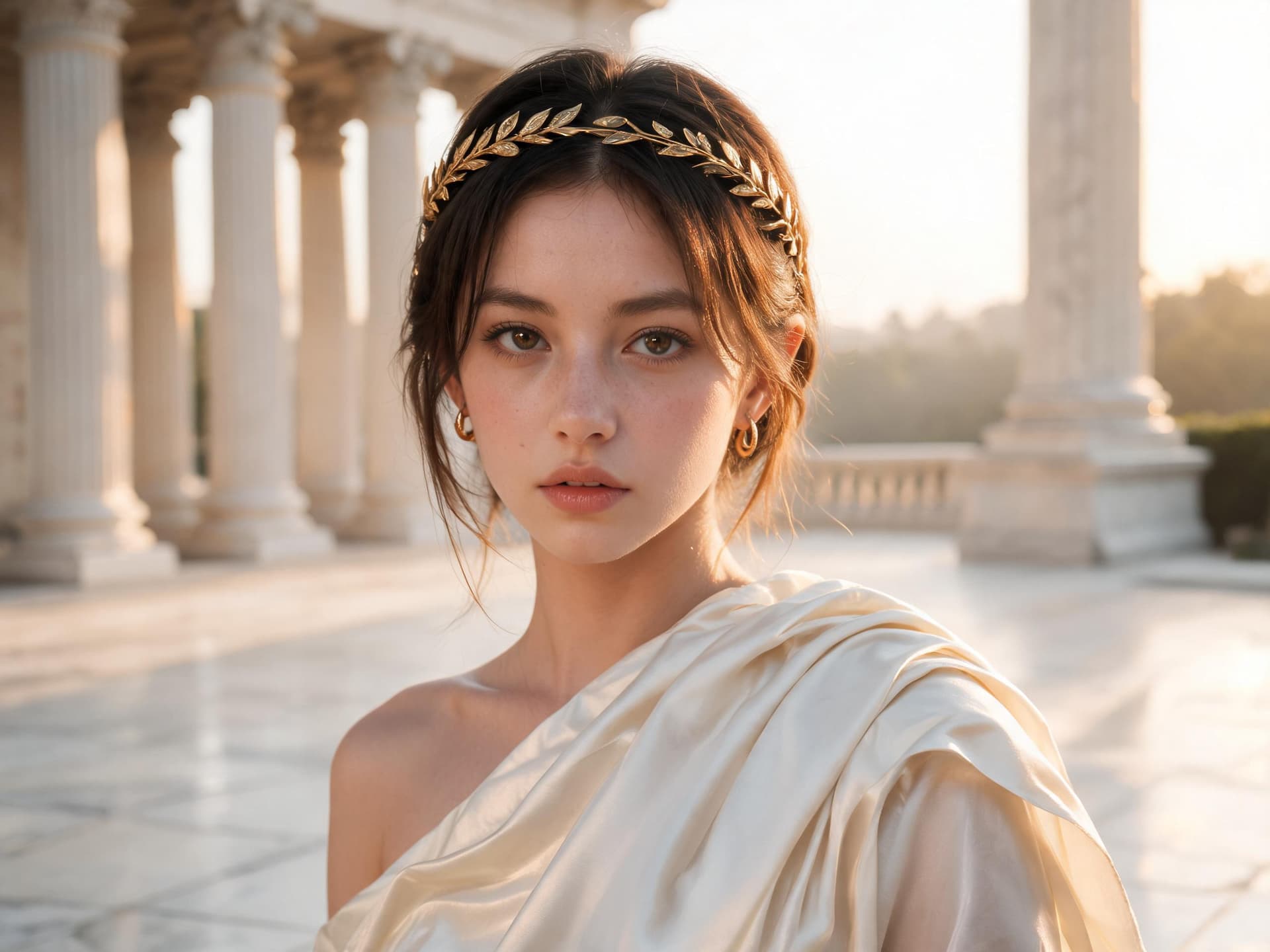
If you want to turn one of these into a profile-picture set, the Greek god and goddess portrait pack shows how to keep a recognizable face consistent across a batch of images.
2) Ofrenda Tabletop Scene Prompts
These prompts focus on the small details that make an altar believable. Think of them as product photography for memory.
6. Three-Level Ofrenda With Marigolds
A tabletop view of the full altar, with each tier built the way a family would.
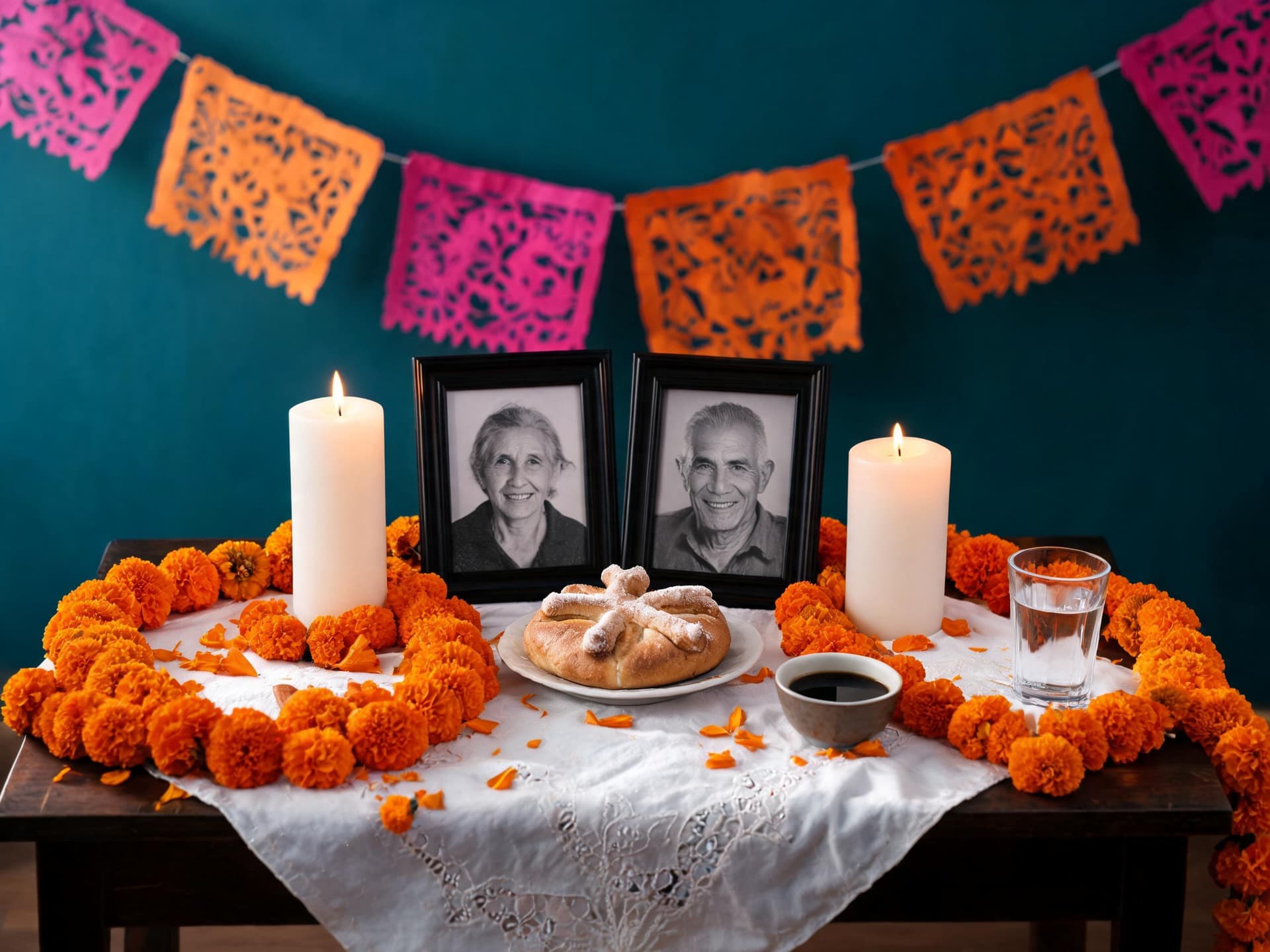
A photorealistic three-tiered ofrenda on a wooden table against a deep blue wall, covered with an embroidered white cloth, marigold garlands, framed black and white family photographs, tall white and orange candles, a plate of pan de muerto, a small cup of coffee, a bowl of fruit, sugar skulls with names written in icing, a clay copal burner with a thin ribbon of smoke, and orange papel picado hanging across the top. Warm candlelight with soft ambient fill, medium wide shot with sharp foreground and soft background, rich texture on petals, wax, and paper, no people, no garbled text, no watermark.
7. Close-Up of a Photo Frame and Candle
A tight detail shot that works as a cover image.
A macro photograph of a small wooden-framed black and white portrait of a smiling grandmother in her sixties, a lit white candle beside it, and a few marigold petals scattered on an embroidered tablecloth, a tiny glass of water and a small bowl of salt just visible behind. Shallow depth of field with the frame in sharp focus, warm candlelight from the right, soft bokeh of orange flowers behind, intimate and tender mood, realistic paper and glass texture, no text on the photo, no warped face, no watermark.
8. A Pet Ofrenda
Many families remember pets, and this is a popular and gentle search topic.
A photorealistic small tabletop ofrenda for a beloved dog, with a framed photo of a golden retriever, a stainless steel bowl with a few biscuits, a worn chew toy, a leash looped over the frame, orange marigold petals, and a small flickering candle on a woven mat. Soft window light from the left, shallow depth of field, close composition, natural wood and fabric textures, warm and affectionate tone, no extra animals, no text, no logos.
9. A Marigold Path to the Door
A scene that shows the guiding path described in tradition.
A photorealistic doorway at dusk with a winding path of orange cempasúchil petals leading from the front door of a small whitewashed home to a candlelit ofrenda inside, glowing candles on the threshold, papel picado softly moving, warm interior light spilling onto the petals. Low camera angle along the petal path, deep depth of field, golden hour sky, rich earthen textures, no people in frame, no text, no watermark.
For more ideas on lighting tabletop objects, the miniature diorama prompt pack is a great companion.
3) Papel Picado and Marigold Pattern Prompts
These are for backgrounds, covers, and pattern fills you can reuse as overlays in a Reel or a story.
10. Papel Picado Banner Background
A sharp, colorful pattern that stays crisp in vertical and horizontal crops.
A photorealistic row of papel picado banners in vivid orange, magenta, turquoise, and yellow tissue paper strung across a clear blue sky, each flag cut with crisp geometric patterns of flowers, doves, and lace-like borders, light shining through the paper so the colors glow, slight breeze creating gentle waves. Low angle looking up, shallow depth of field on the nearest banner, clean negative space in the lower third for a title, no readable text on the banners, no blur, no watermark.
11. Marigold Flat Lay Border
A frame of flowers around empty space that you can drop a name or message into.
A top-down flat lay of fresh cempasúchil marigolds forming a full border around a plain cream linen center, with a few green leaves, scattered petals, and two tiny white candles in the corners. Soft diffused daylight from above, high-detail petal texture and subtle shadows, a clean empty center for text, warm, balanced color, no printed text, no artificial plastic look, no watermark.
12. Vertical Phone Wallpaper With Candles
A moody, readable wallpaper that fits a lock screen.
A vertical phone wallpaper showing a tight cluster of orange marigolds in a glass jar with three lit candles in front, a faint trail of petals on a dark wooden surface, deep indigo background fading to black at the top for clock space. Warm candle light from the lower right, soft bokeh in the background, realistic wax and petal texture, calm and respectful mood, no text, no skulls, no watermark.
4) Food and Pan de Muerto Product Shots for Small Businesses
If you run a bakery, café, or shop, these prompts give you seasonal photos that reflect real tradition. The bakery and dessert shop pack pairs well with this section.
13. Pan de Muerto on a Rustic Table
The hero shot every bakery needs this time of year.
A photorealistic close-up of freshly baked pan de muerto on a rustic wooden board, golden-brown round loaves with crossed strips and a small knob on top, dusted with sugar, a few orange blossom sprigs and marigold petals nearby, steam gently rising. Soft side window light from the left, shallow depth of field, macro texture on the crust and sugar crystals, warm earthy palette, no labels, no extra loaves with strange shapes, no watermark.
14. Calaveras de Azúcar Product Lineup
Handmade sugar skulls, each with a different design and name.
A photorealistic product shot of six hand-decorated sugar skulls arranged on a white ceramic tray, each decorated with colorful icing flowers, foil eyes, and a different short name written on the forehead in neat icing script, such as Rosa, Miguel, and Lupita. Soft overhead light, close crop with crisp icing texture, plain light gray background, sharp shadows, no random text, no melted frosting, no watermark.
15. Pan de Muerto and Hot Chocolate Scene
A cozy lifestyle image for cafes.
A cozy overhead view of a ceramic cup of Mexican hot chocolate with frothy top beside a plate of pan de muerto, a cinnamon stick, a small candle in a glass, and a few marigold petals on a patterned tablecloth. Warm afternoon window light, shallow depth of field, steam visible from the cup, rich textures of bread and froth, no logos, no text, no watermark.
16. Gift Box and Packaging Mockup
For small shops that sell seasonal gift sets.
A photorealistic craft gift box open on a wooden surface, filled with pan de muerto, a small bag of sugar skulls, a tiny jar of cajeta, and a bundle of cinnamon sticks, tissue paper in marigold orange and deep magenta around them, a plain unlabelled kraft tag tied with twine. Soft diffused studio light, shallow depth of field, a clean light neutral background, accurate textures of paper and bread, no brand names, no printed text, no watermark.
The same seasonal approach works for flowers: the florist and plant shop prompt pack shows how to stage fresh marigold arrangements, and the Etsy listing photo prompts are useful for handmade shops selling papel picado and ceramics.
5) Video and Reels Concepts
Short vertical videos are where this topic grows fastest in October. Write these as scene descriptions you can paste into the cinematic AI video generator or use as a storyboard in Text2Shorts. For a broader look at seasonal clips, see the Halloween video prompts pack.
17. Slow Push-In on an Ofrenda
A calm opener for a remembrance Reel.
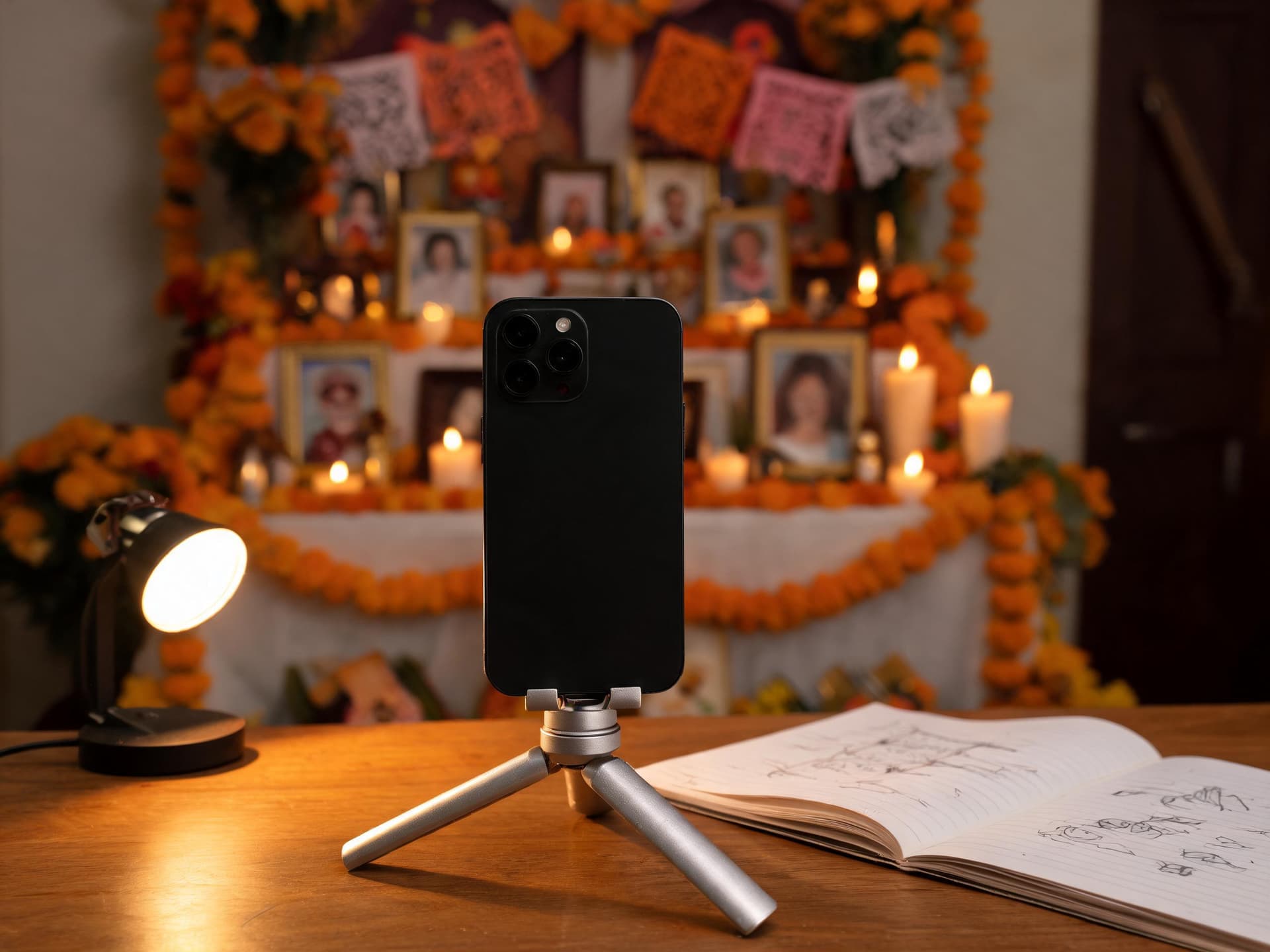
A slow cinematic push-in on a candlelit ofrenda in a small home, marigold garlands, framed photos, and papel picado gently swaying in a soft breeze, candle flames flickering naturally, warm golden light, shallow depth of field shifting focus from the foreground candles to the framed photographs, 9:16 vertical, 8 seconds, calm ambient mood, no people, no text overlays, no sudden movements.
18. Petals Falling on the Path
A short loop that works well as a background clip.
An overhead slow-motion shot of orange cempasúchil petals falling onto a path of petals already laid on dark wooden floorboards toward a glowing candle, soft warm light, shallow depth of field, tiny dust motes in the air, gentle camera drift forward, 9:16 vertical, 6 seconds, seamless loop, no hands, no text, no flicker artifacts.
19. Hands Cutting Papel Picado
A craft clip with a clear start, middle, and end.
A close-up of an artisan's hands using a small chisel to cut a pattern into a stack of orange tissue paper on a wooden workbench, delicate flower motifs appearing, then the paper is lifted and unfolded to reveal the finished lace-like banner glowing in window light. Natural warm light from the left, steady handheld feel, 9:16 vertical, 10 seconds, realistic hands with correct fingers, no text, no logos.
Once you have a clip you like, add a soundtrack from the Miraflow AI music generator with a prompt like "gentle acoustic guitar and soft strings, slow tempo, warm and nostalgic, instrumental" and keep it quiet enough that the visuals lead. If you are posting regularly, the no-copyright background music guide explains how to handle licensing so your clips stay safe.
6) Thumbnail Prompts
20. YouTube Thumbnail for a Catrina Tutorial or Ofrenda Walkthrough
A high-contrast cover that still looks respectful.
A YouTube thumbnail composition in 16:9, a warm close-up of a Catrina-style portrait on the right third with delicate face paint and a marigold crown, a candlelit ofrenda softly blurred on the left, deep teal and orange color contrast, large clear empty space on the left for a short headline, bright rim light on the face, high contrast, clean edges, no clutter, no extra text, no watermark.
You can build the final layout in the YouTube Thumbnail Maker on Miraflow by uploading this image and adding a short headline. For more layout ideas, see the color-block YouTube thumbnail prompts.

How to Customize These Prompts
A few changes make each prompt your own and make the result more accurate.
- Name the specific people and objects. Replace the generic photo with details: "framed photograph of a man in a straw hat holding a fishing rod," "a plate of tamales," "a tin of his favorite butter cookies." Real ofrendas are personal.
- Change the region. Different regions have different traditions. In Michoacán, for example, the island of Janitzio is known for its night vigils, while Oaxaca is known for elaborate sand tapestries and comparsas, and Mexico City is known for its large public parades and altars. Name the place, then research it before you write the prompt.
- Adjust the light. Candlelight gives warmth and mood, window light gives a clean product look, and golden hour gives a documentary feel. Specify one light source and its direction.
- Vary the people. If you generate several Catrinas and Catrines, deliberately change age, gender, body type, and skin tone so the set does not repeat one idealized face.
- Swap the format. Add "9:16 vertical" for Reels and Stories, "16:9" for thumbnails, or "square crop with space for text" for posts.
- Use image-to-image. Upload a real photo of your own ofrenda or product and ask the AI to refine the lighting or background. The AI Image Generator supports image editing and inpainting, so you can replace one object, such as swapping a prop, without regenerating the whole scene.
Common Mistakes to Avoid
- Treating it as Halloween. Gore, blood, and horror music clash with the tone. Keep the palette warm and the mood tender.
- Using random skulls. A skull with no purpose reads as clip art. Use a sugar skull with a name, or a Catrina portrait with historical costume.
- Garbled Spanish text. AI image models often misspell words or drop accents. Leave text out of the image and add it in your caption or in the editor.
- Stereotype props. Skip sombreros, ponchos, cacti, and mustaches. They have no connection to the holiday.
- Too many objects. An ofrenda crowded with random items looks fake. Pick six or seven with clear meaning: a photo, a candle, marigolds, pan de muerto, a drink, papel picado, and copal.
- Using a real person's likeness without permission. Do not recreate a real deceased person's face from a photo unless you are the family and you are comfortable with the result. Keep portraits synthetic for public content.
- Posting too late. Search interest builds through October. If you wait until November 1, you lose the weeks when people are planning altars, bakery orders, and events. A good schedule is a bakery and papel picado post in mid-October, ofrenda scenes in the last week of October, and a remembrance Reel on November 1 and 2.
- Skipping disclosure. If your image is AI-generated and you use it commercially, say so in the caption.
Make It All in One Place With Miraflow
You can run this whole workflow from start to finish in one browser tab. Generate your portraits, ofrenda scenes, and food shots in the Miraflow AI image generator, then open Text2Shorts to turn a short script into a vertical video. For a more cinematic look, the cinematic video tool can animate one of your still scenes, and the thumbnail maker can build a clean cover for a longer walkthrough. Add a gentle soundtrack with the AI music generator, and if you already have a long video of a market or workshop, AI Clipping can cut it into several captioned Shorts.
Everything is available from the Miraflow home page, so you can keep the entire Día de los Muertos campaign in one place. If you want more seasonal ideas for October, the fall aesthetic photo prompts and the TikTok video background prompts are good next reads.
Frequently Asked Questions
What is the difference between a Catrina and a sugar skull?
A sugar skull (calavera de azúcar) is an edible or decorative skull often placed on an ofrenda, usually with a name on it. La Catrina is a specific character: an elegant skeleton in a wide hat and fancy dress who began as Posada's etching and was named and popularized by Diego Rivera's mural. They both belong to the visual world of the holiday, but they are different things.
When is Día de los Muertos?
It is celebrated on November 1 and 2, with preparations beginning in late October. In many communities November 1 honors children who have died and November 2 honors adults, though customs vary by region and family.
Is Día de los Muertos the same as Halloween?
No. Halloween is on October 31 and centers on costumes and scares, while Día de los Muertos is a remembrance holiday that welcomes the dead with flowers, food, and photographs. The two are separate traditions.
Is it disrespectful to use Catrina face paint or AI Catrina art?
It depends on how you do it. Respectful portraits that treat La Catrina as a dignified, historically grounded figure, credit the tradition, and avoid jokes or stereotypes are generally welcomed. Using the imagery as a joke costume or a horror element is the part that draws criticism.
What flowers and foods should I include in an ofrenda image?
Cempasúchil marigolds are the signature flower, often with cockscomb and white flowers, and pan de muerto, fruit, a drink, and the favorite foods of the person being remembered are the classic offerings. Add candles, papel picado, copal, and photographs for a believable scene.
How many levels does an ofrenda have?
Many have two, three, or seven levels, depending on region and family. Three levels are commonly explained as sky, earth, and underworld, and seven as steps of the soul's journey. There is no single correct number.
Can small businesses use these prompts for marketing?
Yes. The food and product prompts are designed for bakeries, cafes, and shops. Keep the tone respectful, explain the tradition in your caption, and consider supporting Mexican and Mexican American makers.
Can I use these prompts in other AI tools?
Yes, they work in most image generators, but results are most consistent when you name specific objects, a light source, and a camera distance. You can run them directly in the Miraflow image generator with no setup.
How do I stop the AI from misspelling text on sugar skulls?
Leave names off the generated image, or ask for a blank forehead and add the name afterward in an editor. Short, common names are more reliable than long ones, and you should always read the result before posting.
Conclusion
Día de los Muertos content works best when it reflects the real tradition: marigolds that guide the spirits, papel picado that flutters between worlds, pan de muerto and sugar skulls with names, and a Catrina whose story goes back to Posada's satire and Rivera's mural. These 20 prompts give you portraits, ofrenda scenes, patterns, food shots, Reels, and thumbnails that use those details on purpose, and the respectful-use habits above keep your work warm, accurate, and welcome in the communities that celebrate the holiday.
Start with one ofrenda scene and one portrait, post them in mid-October, then follow with your food and video content as November 1 approaches. You can generate all of it in Miraflow, from the first image to the finished Reel and soundtrack.