Google Ads Smart Bidding Learning: The New 7-Day Limit Explained (2026)

Written by
Aerin Kim

Google rewrote its Smart Bidding learning page with a 7-day cap on Learning status. See what triggers it, what does not, and how to plan budget, target and goal changes.
If you have ever changed a Google Ads budget, watched the status flip to Learning, and then spent two weeks afraid to touch anything, there is a good chance you were following a rule that Google's own documentation does not support. On October 21, 2026, Barry Schwartz reported at Search Engine Roundtable that Google rewrote its Smart Bidding learning help page, renaming the old "Duration of the learning period for campaigns and what affects it" article to "About Smart Bidding learning." The new version puts a hard ceiling on the visible Learning status, lists exactly three things that trigger it, and says plainly that budget, target, creative and targeting edits do not.
That matters because a lot of account management habits were built on folklore: never touch a campaign for two weeks after a change, never move a budget more than 20 percent at a time, never adjust a target during a promotion. Some of those habits protect you from real problems, and some quietly cost you weeks of sales because you waited for a status label that was never going to block you anyway.
This guide walks through what changed on the page, what actually triggers Learning now, how the visible status differs from the time it takes performance to settle, and how to plan changes around that difference. It includes comparison tables, a worked example of how long to wait for different conversion cycles, a change-planning checklist you can copy into your own process, a holiday calendar for the weeks before Black Friday on November 27, 2026, and the mistakes I would expect to see first. I read Google's live help page and the Search Engine Roundtable report, and I flag one place where the trade coverage and Google's page disagree. If you also need fresh ad creative while you wait out a ramp-up, the Miraflow AI image generator and the rest of Miraflow are where I would build it, and I cover that near the end.
TL;DR
- Google renamed its learning page to "About Smart Bidding learning." The page states that the Learning status never lasts more than 7 days.
- Learning status is described as a signal of a recent configuration change. Ads keep serving and Smart Bidding keeps optimizing while it shows.
- Three things trigger it: a new or reactivated bid strategy, a change in the strategy's composition (campaigns, ad groups or keywords added or removed), and a significant change to the conversion goals or actions being optimized. Google also says a new portfolio bid strategy counts as a structural change.
- Budget, target, creative and targeting changes do not trigger Learning and do not remove historical data, according to the page. Budget and target changes take effect in the next auction.
- Separately from the label, performance can take 1 to 2 conversion cycles to stabilize. Google suggests evaluating over 2 conversion cycles or a 2 week window, whichever is longer.
- The page gives no minimum conversion count. Some trade coverage mentions a calibration benchmark of roughly 50 conversion events or three conversion cycles, which I could not find on the live page. Treat that figure as unconfirmed.
- Google's advice during any ramp-up: one consistent primary conversion goal, enough daily budget, consolidated campaigns, and no repeated target changes within one conversion cycle unless there is a clear business need.
What Google changed on the page
The old article was framed around a duration question: how long does the learning period last, and what extends it. That framing encouraged advertisers to treat Learning as a countdown, and to treat anything that might restart the countdown as dangerous. The rewritten page, as I read it, is framed around a different question: what is the Learning status telling you, and what should you do about it.
Here is the comparison that I would keep open in a tab when you plan changes. The "old" column reflects the folklore and the earlier page framing as reported by trade outlets, not a verbatim copy of the previous text, which I could not retrieve. The "new" column reflects Google's live page as I read it on October 23, 2026.
| Topic | Old framing and folklore | Google's page now (Oct 2026) |
|---|---|---|
| Page title | Duration of the learning period for campaigns and what affects it | About Smart Bidding learning |
| How long Learning lasts | Treated as a variable countdown, with widely repeated advice to wait two weeks | The Learning status never lasts more than 7 days |
| What the label means | Often read as the system being broken or paused | A signal of a recent configuration change; ads keep serving and Smart Bidding keeps optimizing |
| Triggers | Almost any edit was feared, including budgets and targets | New or reactivated strategy, composition change, or significant conversion goal change |
| Budget, target, creative, targeting edits | Believed to reset learning, often capped at 20 percent budget moves | Do not trigger Learning or remove historical data; budget and target changes apply in the next auction |
| Time to stable performance | Mixed into the learning duration | Separate: typically 1 to 2 conversion cycles to converge |
| How to evaluate | Wait a fixed two weeks | Evaluate over 2 conversion cycles or a 2 week window, whichever is longer, allowing for conversion delay |
| Conversion minimum | Trade coverage mentions roughly 50 events or three cycles | No minimum conversion count on the live page |
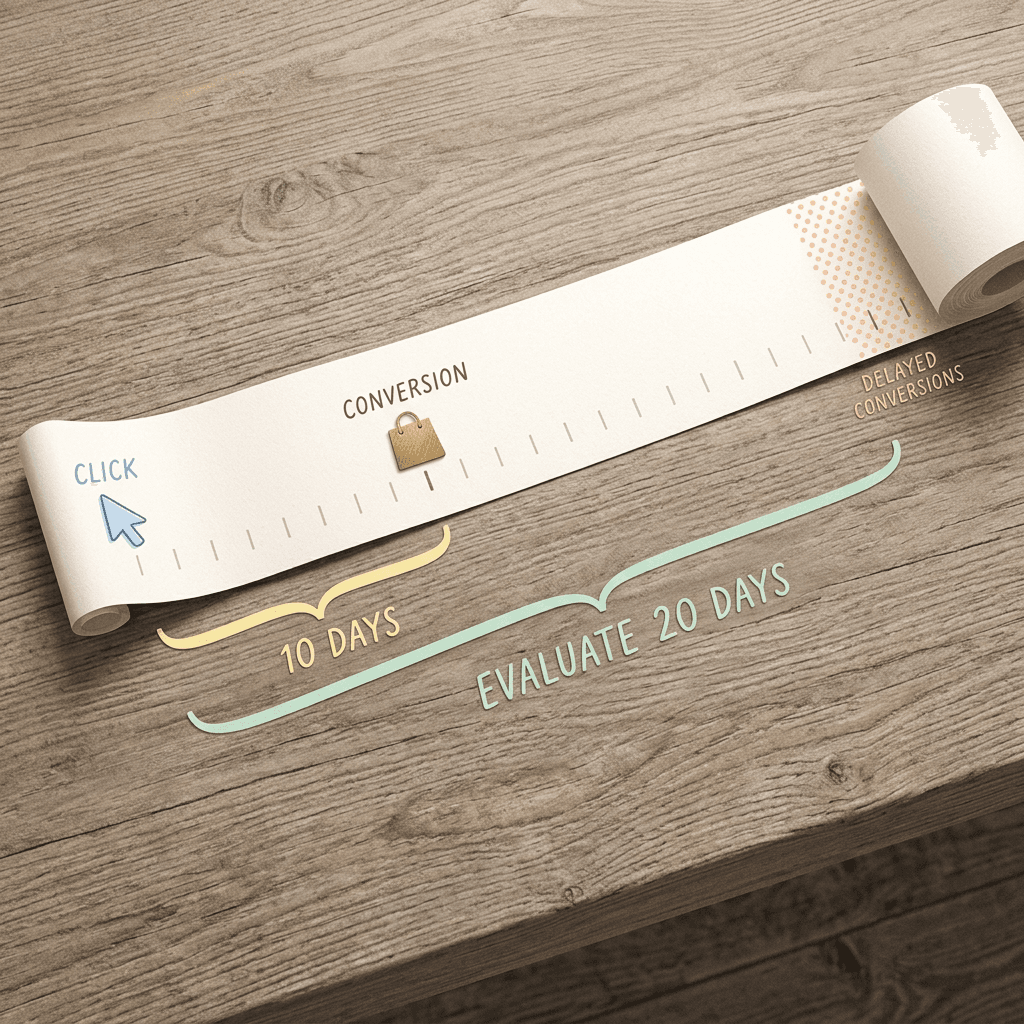
The most useful change is the separation of two ideas that used to be blurred together. The visible Learning status is a label with a ceiling of 7 days. Stabilization of actual performance, meaning the cost per conversion or return on ad spend settling around your goal, depends on how long it takes for a click to turn into a conversion. Google calls that span the conversion cycle and defines it as the length of time it takes for a click to result in a conversion. A campaign can stop showing Learning after a few days and still be a week or more away from numbers you should judge.

Where the sources differ
Search Engine Roundtable summarized the rewrite as adding a seven day limit, clarifying triggers and non-triggers, separating status from stabilization, and adding operational advice and an FAQ. All of that matches the live page. The one discrepancy is the calibration figure. Some coverage of Google's learning guidance describes a benchmark of up to roughly 50 conversion events or three conversion cycles. The live page I read says performance typically converges within 1 to 2 conversion cycles, suggests evaluating over 2 conversion cycles or a 2 week window (whichever is longer), and gives no minimum number of conversions at all.
When a trade report and Google's own page disagree, the page wins. I would plan around 1 to 2 cycles for convergence and 2 cycles or 2 weeks for evaluation, and I would treat the 50 events and three cycles benchmark as something Google may have used in earlier wording. If your account is in a lower volume tier, though, being conservative costs you very little, which I cover in the planning section.
What actually triggers Learning now
Google's page lists three causes. It helps to read them as changes to what the bid strategy is, rather than changes to how the bid strategy is set.
| Change you make | Triggers Learning? | What to expect |
|---|---|---|
| Create or reactivate a bid strategy | Yes | Learning label for up to 7 days; existing conversion history means it never starts from scratch |
| Add or remove campaigns, ad groups or keywords in a strategy | Yes (composition change) | Label can appear; plan for noisy data until the cycle completes |
| Apply a new portfolio bid strategy | Yes (structural change) | Up to 7 days of Learning; ramp-up is faster when campaigns have conversion history |
| Significantly change the conversion goals or actions optimized | Yes | Highest impact, since the target now measures something different |
| Change the daily budget | No | Applies immediately; keep it high enough to capture conversions |
| Change the target ROAS or target CPA | No | Applies in the next auction; performance converges over the conversion cycle |
| Change ads, assets or creative | No | No label; judge creative on its own results |
| Change location, audience or other targeting | No | No label; historical data is kept |
A new or reactivated strategy
Creating a bid strategy, switching a campaign to Target ROAS or Target CPA for the first time, or re-enabling a paused strategy puts the strategy in the new or reactivated bucket. The page adds an important reassurance: if you have past conversion data in your account, Smart Bidding never starts from scratch. A campaign that switches from Maximize conversions to Target CPA keeps the conversion history it already earned, so the Learning label overstates how much is being relearned.
A change in composition
Composition means which campaigns, ad groups or keywords sit under the strategy. Adding a campaign to a portfolio strategy, removing one, or adding a large batch of keywords to a campaign that has its own strategy changes what the model is optimizing across. Google also says that creating or applying a new portfolio bid strategy is a structural change that can show Learning for up to 7 days, although ramp-up is faster when the campaigns involved already have conversion history.
The practical edge case here is the keyword import. Adding 15 keywords to a campaign that already has 300 may not read as a major composition change in practice, while restructuring an ad group into three new ones probably will. Google does not publish a threshold, so I would treat anything that reshuffles the keyword or ad group structure as a composition change and plan for the label to appear.
A significant change to conversion goals
If you change which conversion actions the strategy optimizes toward, for example promoting a lead qualified action to primary and demoting a form submit, or switching an ecommerce account from purchase count to purchase value, the strategy has a new definition of success. This is the trigger with the biggest real effect, because the target now measures something different and the history may be on a different scale. Google's best practice is to optimize to a single, consistent primary conversion goal precisely so you do not have to do this often.

What does not trigger Learning
The page says budget, target, creative and targeting changes do not trigger Learning status and do not remove your historical data. The targeting examples Google gives include location and audience. Budget and target changes take effect in the next auction. The page's own example is a Target ROAS change from 500 percent to 400 percent, which applies immediately, with performance converging over the conversion cycle and no Learning label attached.
That last clause is the part people miss. No label does not mean no effect. Lowering a target ROAS makes the system willing to spend more per unit of conversion value, so volume and cost can move within days even though the status column stays quiet. The page recommends avoiding multiple target changes within a single conversion cycle unless there is a clear business need, and the reason is measurement. If you change the target on Monday and again on Thursday, and the cycle is ten days long, you cannot tell which change produced the result.
The old folklore, tested against the new page
The two week hands-off rule
The popular version says that after any change you should leave the campaign alone for two weeks. The new page contradicts the first half of that, because most changes do not trigger Learning at all, and it softens the second half, because the longest Learning status can last is 7 days. What survives is the evaluation advice: Google suggests judging performance over 2 conversion cycles or 2 weeks, whichever is longer. Notice the verb. That is a window for evaluating, not a freeze on acting. You can keep working on creative, negative keywords outside the bid strategy's structure, and landing pages. The part to protect is the strategy configuration itself, namely its goals, its composition and its targets.
The 20 percent budget rule
The rule says to move budgets by no more than 20 percent at a time, or you will reset learning. I could not find that figure on Google's current page, and the page now says directly that budget changes do not trigger Learning and take effect immediately. My reading is that the 20 percent habit is a community rule of thumb that has survived long after any specific Google source for it. There are still sound reasons for gradual budget moves: a very large cut can leave the strategy unable to capture conversions, which Google specifically warns about when it tells advertisers to keep budgets high enough, and a very large increase can spend into poorer auctions before you notice. Those are performance reasons rather than learning reasons, and they argue for watching the account, not for a fixed percentage.
The never change a target during a promotion rule
The honest version of this rule is narrower. A target change is fast to apply and does not trigger Learning, which makes it the right tool for a promotion, as long as you make one deliberate change and leave a full cycle to read it. What hurts promotions is changing the target three times in a week because the first two changes seemed not to work yet.
Learning means broken
The page says plainly that campaigns keep bidding and serving normally during Learning. New campaigns without history may fluctuate for a short time. The label is an informational flag that something structural changed, rather than a pause button.
How to read the status column
The page points to bid strategy status as the place to see whether a campaign is still learning. In practice I would read the status in three steps.
- Check the date of your last structural change. If the label appears and your last structural change was within 7 days, the label is doing what Google says it does and there is nothing to fix.
- If the label appears and you cannot remember a structural change, look at the change history for the three trigger types: a reactivated strategy, a campaign or ad group moved in or out of a portfolio, a conversion action promoted or demoted. Teammates, scripts, automated recommendations and account level conversion goal edits all show up there.
- If no label appears but performance has moved, assume you are in the stabilization phase from a non-triggering change such as a budget increase or a target cut. The status column will not explain this, so annotate the date yourself.

Other statuses can appear next to or instead of Learning, for example ones that point to a limited budget or a misconfigured strategy. Those describe a different kind of problem, and Google documents them on a separate bid strategy status page. A rule I use: Learning is the one status that asks you to wait, while the others usually ask you to fix something.
Status versus stabilization, with a worked example
Google says performance typically converges within 1 to 2 conversion cycles and that evaluation should look at 2 conversion cycles or a 2 week window, whichever is longer. The arithmetic depends entirely on how long your customers take to convert. The numbers below are my own illustration using Google's rule, not figures Google published.
| Typical click to conversion time (conversion cycle) | Expected convergence (1 to 2 cycles) | Two cycles | Evaluation window (longer of 2 cycles or 14 days) |
|---|---|---|---|
| 2 days | 2 to 4 days | 4 days | 14 days |
| 7 days | 7 to 14 days | 14 days | 14 days |
| 10 days | 10 to 20 days | 20 days | 20 days |
| 21 days | 21 to 42 days | 42 days | 42 days |
Take the first row. A store whose buyers usually purchase within a day or two of clicking has a cycle of about 2 days, so convergence is expected within roughly 2 to 4 days, and two cycles is only 4 days. Because the rule says whichever is longer, the 2 week window governs and you evaluate over 14 days. For a B2B lead generation account with a 21 day cycle, convergence could take 21 to 42 days, and two cycles is 42 days, which is much longer than the 2 week window, so the evaluation window is 42 days. In that account the Learning label will disappear within a week while the real answer is more than a month away.
Conversion delay and what it does to early reports
Google's page says to account for conversion delay when evaluating. Conversions are credited back to the click date, so the last several days of any report will understate results until the delayed conversions arrive. If you read a campaign on day 5 and compare it to the pre-change period, you are comparing a mature period to an immature one. A simple fix is to exclude the most recent days equal to your typical lag, or to compare against the same window from a previous, fully matured period.
Low volume accounts
The page gives no minimum conversion count, but it does say that very restrictive settings such as tight targets, low budgets and narrow targeting can slow ramp-up. For an account with a handful of conversions a month, the practical consequence is that every change takes longer to read, and consolidation matters more. Google's own advice is to consolidate campaigns and ad groups so conversion data is pooled rather than split across many small campaigns.

Planning changes around the three triggers
The most useful way to apply the new page is to sort every change you want to make into two piles. Pile one is structural: the three triggers. Pile two is everything else. Structural changes need a calendar. Everything else needs a log.
Batch structural changes together
Because the Learning status is capped at 7 days and fires on structural change, three structural edits spread over three weeks give you three separate periods of noisy data. Batching them into one session gives you one. If you plan to restructure campaigns, move to a new portfolio strategy and promote a new conversion action, do them on the same day, annotate it, and then leave the strategy configuration alone for a full evaluation window.
Separate structural changes from tests
If you are running an experiment, such as the multi-campaign Search experiments I covered in Google Ads Search experiments and multi-campaign ROI testing, a structural change inside the control or trial arm contaminates the comparison. Make structural edits before the experiment begins, not during it.
Treat target changes as a single move per cycle
Google's own wording is to avoid multiple target changes within a single conversion cycle unless there is a clear business need. My reading is that a good reason exists, such as a margin change, a stock shortage or a promotion that changes the value of a conversion, and a bad reason is impatience. If the cycle is 7 days, a target change on Monday has a read date a week later. The article on Google's target bid strategy update goes deeper on how targets behave.
Keep conversion goals boring
Goal changes are the trigger that hurts most and the one you control most. Decide once which action is primary, give it a consistent value, and put everything else on secondary goals. Google says Smart Bidding optimizes exclusively toward your primary conversion goal, and that clicks, cost per click and click through rate may fluctuate, so do not expect secondary metrics to improve after a Learning period ends. If you want a healthier signal, the Google Ads data strength and uplift metric explainer covers how to check whether your conversion data is good enough to optimize against.

A change-planning checklist you can copy
Use this before touching a Smart Bidding campaign.
- Write down the change and classify it: new or reactivated strategy, composition change, conversion goal change, or none of these.
- If it is none of these, apply it and add a dated annotation. Expect an effect without a Learning label.
- If it is structural, check whether another structural change is waiting. Batch them into one session.
- Check that no experiment, promotion or seasonal peak falls inside the next 7 days.
- Look up your conversion cycle and calculate the evaluation window using the longer of 2 cycles or 14 days.
- Confirm there is a single, consistent primary conversion goal and that daily budgets are high enough to capture conversions.
- Set a read date on the calendar and decide in advance which metric you will judge.
- Do not make a second target change before the read date unless there is a clear business reason.
- After the read date, compare against a matured period, not the immature recent days.
A holiday calendar for the next five weeks
Black Friday falls on November 27, 2026, and Cyber Monday on November 30. Working back from those dates with the 7 day ceiling and a typical 1 to 2 cycle convergence gives a simple schedule. These dates are my planning suggestion, not Google guidance.
- Week of October 26: make any structural changes, such as new portfolio strategies, campaign merges or conversion goal promotions. A 7 day Learning label would clear by early November.
- Week of November 2: evaluate. For a short cycle store this is already enough time to read results; for a longer cycle account it is the start of the convergence period.
- Week of November 9: final structural edits only if needed. Anything later risks overlapping with peak traffic.
- Week of November 16: freeze structure and conversion goals. Target and budget edits remain possible because they do not trigger Learning, but make them deliberately and one at a time.
- Week of November 23: budgets and targets only, with a clear reason for each. Read results daily and annotate everything.
If your cycle is longer than a week, move every date earlier by about the length of one cycle.
Using the window for creative
Because creative changes do not trigger Learning, the weeks around a structural change are a safe time to refresh ads and assets. A refreshed set of product images, Shorts or banners can go live without resetting anything. The Miraflow AI Black Friday prompt guide for product photos and sale ads is a good starting point for the visuals.
How different accounts should apply this
Ecommerce with fast conversions
A store with a cycle of one to three days gets the most freedom. The Learning label clears quickly, evaluation windows are short, and the 2 week floor dominates. This account can run weekly target adjustments, so long as each is a single, deliberate move.
Lead generation with long sales cycles
For leads that take weeks to qualify, the visible label tells you almost nothing about stability. Feed qualified lead outcomes back as conversions, keep one primary action, and evaluate over 2 cycles. Changes should be rare, large enough to matter and logged carefully.
Agencies managing many accounts
The most common source of accidental Learning in agency work is a shared change: a portfolio strategy applied to several accounts, a script that toggles campaigns, or a bulk upload of conversion actions. Put a rule in your process that anything touching strategy membership needs a dated annotation and a named owner.
Seasonal and promotional campaigns
Promotions change the value of a conversion, not the identity of the strategy. A promotional target change is the right tool, and a temporary campaign with its own new strategy is the wrong one if it can be avoided, because a new strategy shows Learning and runs without its own history. If you do need a new strategy, launch it a full week before the promotion, not on the first day.
Common mistakes
- Waiting out a label that does not matter. If your last change was a budget edit, no Learning status will appear, and waiting for one to clear wastes days.
- Changing the primary conversion action casually. Swapping which conversion is primary is the one goal change Google specifically calls out, and it also changes what your target means.
- Stacking target changes inside one cycle. Three target edits in a week make it impossible to attribute any result.
- Judging on immature data. Reading day 4 of a campaign with a 10 day cycle compares a partial picture to a complete one.
- Splitting a small account into many campaigns. Google recommends consolidation to pool conversion data, and a split account slows every change.
- Cutting the budget so hard that conversions stop. Google advises budgets that are sufficient to capture conversions, and a starved strategy has nothing to learn from.
- Treating secondary metrics as success measures. Per Google, Smart Bidding optimizes exclusively toward the primary goal, so clicks, cost per click and click through rate may move without that meaning anything.
- Treating the 7 day figure as a performance guarantee. The label can disappear while real performance is still settling.
Where Miraflow fits into a ramp-up
Smart Bidding ramp-ups are the one stretch of a campaign where you cannot change the strategy but you can change almost everything the shopper actually sees. That makes them a good time to build new assets. With Miraflow AI you can generate product and lifestyle images in the AI image generator, turn a product idea into vertical video with Text2Shorts, and produce short cinematic product clips with the cinematic video generator. If you run Display or Demand Gen alongside Search, the AI prompts for Google Ads display banners post has ready-to-use templates. Creative edits do not trigger Learning, so they are a way to keep improving results while the bidding side settles.
Frequently Asked Questions
What did Google change about Smart Bidding learning in 2026?
Google renamed its older learning period help article to "About Smart Bidding learning" and rewrote it. The page now says the Learning status never lasts more than 7 days, lists three triggers, says budget, target, creative and targeting changes do not trigger it, and adds best practices and an FAQ.
How long does Smart Bidding Learning last?
The visible Learning status never lasts more than 7 days according to Google's page. Performance may take longer to stabilize, typically 1 to 2 conversion cycles depending on conversion volume, cycle length and campaign settings.
What triggers the Learning status?
A new or reactivated bid strategy, a change in the strategy's composition such as adding or removing campaigns, ad groups or keywords, or a significant change in the conversion goals or actions being optimized. Applying a new portfolio bid strategy is also a structural change.
Does changing my budget trigger Learning?
No, according to Google's page. Budget changes take effect immediately and do not trigger Learning status. They can still affect performance, so keep budgets high enough for the strategy to capture conversions.
Does changing my target ROAS or target CPA trigger Learning?
No. Target changes apply in the next auction and performance converges over the conversion cycle. Google advises avoiding multiple target changes within a single conversion cycle unless there is a clear business need.
Is the 20 percent budget rule real?
I could not find it on Google's current page. It looks like community folklore. Gradual budget changes can still be sensible for performance reasons, but a budget edit does not reset learning.
Do I need 50 conversions for Smart Bidding to work?
The live page gives no minimum conversion count. Some trade coverage references roughly 50 conversion events or three conversion cycles, but I could not confirm that on Google's current page. More data generally helps, and Google recommends consolidating campaigns to pool it.
Does Smart Bidding start from scratch when I switch strategies?
Not if you have past conversion data. Google says that with existing history, Smart Bidding never starts from scratch.
How should I evaluate performance after a change?
Allow 1 to 2 conversion cycles to converge, then evaluate over 2 conversion cycles or a 2 week window, whichever is longer, allowing for conversion delay.
Can I keep serving ads while the campaign is learning?
Yes. Campaigns keep bidding and serving normally during Learning status.
Will secondary metrics improve after Learning ends?
Not necessarily. Google says Smart Bidding optimizes exclusively toward the primary conversion goal, so clicks, cost per click and click through rate may fluctuate.
Where can I read Google's own page?
It is titled About Smart Bidding learning in the Google Ads Help Center. Because Google edits help pages often, check the live text before you rely on any figure here.
Conclusion
The rewritten Smart Bidding learning page replaces a countdown mindset with a simple model. Three structural changes can raise the Learning label, which lasts at most 7 days, while budgets, targets, creative and targeting move freely and take effect in the next auction. Behind the label sits a slower process, performance stabilizing over 1 to 2 conversion cycles, and your evaluation window is the longer of 2 cycles or 2 weeks.
The practical habits follow from that: batch structural changes, keep one primary conversion goal, make one deliberate target move per cycle, judge results on matured data, and keep creative moving while bidding settles. Keep the one open question in mind as well, the roughly 50 conversion benchmark that some coverage mentions and the live page does not. Check Google's page again before your next big change, and plan your holiday edits with the five week calendar above in mind. For related reading, see how channel prioritization and budget controls work, see how customer lifecycle goals change bidding and what changed in AI Max reporting, then build your next round of assets in Miraflow.