Turn Any Blog Post Into a Viral YouTube Short in 3 Minutes

Written by
Jay Kim

Every blog post you have written is a video waiting to happen. Here is the exact 3-minute workflow to turn any blog post into a YouTube Short using AI — no camera, no editing skills, no production budget required.
You spent three hours writing a blog post. You researched, structured, rewrote the intro twice, and finally hit publish. Then — silence. A handful of page views. Maybe a share or two. Meanwhile, a 45-second video on the same topic is racking up thousands of views on LinkedIn and Instagram Reels.[7]
This is the reality most content marketers are living in right now. Written content is still valuable, but video is where attention lives.[7]
Here is the uncomfortable truth: the average blog post receives 1,500–3,000 page views over its entire lifetime if it ranks well on Google. A single viral Short on YouTube or TikTok can reach 500,000–5,000,000 views in a week. The disparity in reach is enormous, and writers who exclusively publish text are leaving most of their potential audience unreached.[6]
The good news? Every blog post you have ever written contains one or more compelling short videos. In 2026, the gap between written content and published video has essentially closed. Bloggers, essayists, and content writers can now convert a blog post into a polished 60-second Short using AI tools — no camera, no editing software, no technical knowledge required.[6]
This article shows you exactly how to turn any blog post into a YouTube Short in three minutes or less, why this workflow is the highest-ROI content move you can make in 2026, and which AI tools make the process nearly automatic.
Why Your Blog Posts Are Underperforming — And Video Is the Fix
The landscape for written content has changed dramatically. The single biggest driver of organic traffic loss in 2026 is AI-powered search cannibalization. Google's AI Overviews now synthesize answers from multiple sources and display them at the very top of search results — before any organic listings. When someone searches for a "how-to" query, Google's AI generates a complete answer on the spot. The user reads it, gets what they need, and never clicks through to any website.[3]
Lots of businesses who have spent a ton of time publishing articles or blogs saw a huge decline in traffic.[1] Here is the uncomfortable truth most SEO reports still avoid: organic traffic is a misleading success metric in 2026. Zero-click searches now reach 60–70% of all queries, meaning the majority of people who find your content never visit your site at all.[8]

This is not a death sentence for blogging. It is a signal to diversify. In 2026, it's less about search engine optimization and more about search everywhere optimization.[2] The blogs you have already written contain proven ideas, validated topics, and structured arguments. The problem is not the content itself — the format is. Different audiences consume content differently. Some people read. Many more watch. And the platforms that dominate attention today — TikTok, Instagram Reels, YouTube Shorts, LinkedIn — are built entirely around video.[7]
The data makes the case unambiguous. Video content continues to dominate the digital landscape. In 2026, videos account for over 82% of all internet traffic. Repurposing blog posts and articles into video format can significantly boost engagement and reach. Platforms like YouTube, TikTok, and Instagram Reels are essential for content distribution.[4]
91% of businesses use video as a marketing tool in 2026. 93% view it as an important part of their strategy.[9] The top 3 ROI-driving content formats, according to marketers, are all video-based: short-form video (49%), long-form video (29%), and live-streaming video (25%).[9]
Short-form video delivers the highest ROI of any content format: videos under 60 seconds generate 2.5x more engagement per impression than any other content type.[2] And YouTube Shorts, specifically, is the largest short-form platform in the world. YouTube Shorts now generates over 200 billion views per day. They're no longer just an experiment or a TikTok alternative. Shorts are a major discovery channel, a traffic driver for creators, and a growing revenue source for brands.[1]
The implication is clear: every blog post sitting in your archive is an untapped video asset. Your blog archive holds untapped value. Those high-performing posts earned traffic, backlinks, and trust. But most sit idle now. The smartest move in 2026 is to repurpose blog content video-first. You transform static text into visual experiences that audiences actually watch and share.[8]
The Content Flywheel: Why Blog-to-Short Is the Highest-ROI Move
Repurposing a blog post into a YouTube Short is not recycling old content. When you repurpose a blog post into a video, you are not recycling old content. You are unlocking it for a completely different audience who would never have found it otherwise.[7]

Writing a 1,500-word blog post takes 2–4 hours. Repurposing that post into three to five Shorts takes 30–45 additional minutes[6] with AI tools. The ROI math is compelling: for a small fraction of the original creation time, you multiply your reach across entirely new platforms and audiences.
According to marketers, the top 3 ROI-driving content formats are all video-based: short-form video (49%), long-form video (29%), and live-streaming video (25%). This ranking makes video repurposing the highest-impact repurposing activity available — transforming blog posts, podcasts, and long-form content into short-form video clips delivers the strongest return across all content formats.[1]
Companies implementing AI-driven content repurposing are reducing production costs by up to 65%. AI tools handle the mechanical aspects of repurposing — reformatting, resizing, transcribing, summarizing, and adapting tone — while humans focus on strategy and quality control. This cost reduction makes multi-platform content distribution accessible to solo creators and small teams who previously couldn't afford the production overhead.[1]
The flywheel effect is what makes this approach so powerful. Embed the YouTube Short into your blog post as supplemental content. This increases time-on-page for the blog (good for SEO) and drives YouTube views from existing blog traffic. Both signals improve ranking on their respective platforms.[6]
Google increasingly surfaces YouTube videos in search results for informational queries. A short video about the same topic as your blog post can rank in Google search independently, driving additional traffic to both the video and your blog.[6] This means a single blog post, repurposed into a Short, can generate three distinct traffic streams: the original blog SEO traffic, YouTube Shorts algorithmic distribution, and Google video search results.
When one blog post becomes a YouTube video, five social clips, an email newsletter, and a podcast segment, the original $1 investment generates returns across six channels instead of one — dramatically improving the content marketing ROI equation.[1]
Businesses that repurpose blog posts into videos see a 50% increase in engagement.[5] Pages with video are about 53× more likely to rank on the first page of Google search results. Companies that use video in their marketing generate about 41% more web traffic from search than those that don't.[6]
For creators building a content pillar strategy, every blog post is the seed content that branches into an entire ecosystem of short-form videos, each capable of reaching audiences that would never have discovered the original article.
How to Pick Which Blog Posts to Repurpose First
Not every blog post is equally suited for video conversion, and starting with the right posts dramatically improves your results.
Open Google Analytics or your blog's dashboard and identify your top 10 posts by pageviews and time-on-page. Posts that already engage readers will translate to higher retention on video. Sort by social shares as a secondary metric — posts with high shares already have proven emotional or informational value.[6]

Start with your top-performing posts. If a blog post already proved it resonates with your audience in written form, it will likely work just as well as a video. You are not guessing anymore. You have data.[7]
Repurposing is most valuable when the content stays relevant over time. A post about "how to write better headlines" will be just as useful six months from now.[7] Trend pieces have a shorter shelf life, so prioritize evergreen content that will continue delivering value as a Short months after you publish it.
Blog posts that have strong subheadings and logical flow are the easiest to convert. The structure you already built — introduction, three main points, conclusion — becomes the storyboard for your video.[7]
Certain blog formats convert exceptionally well to Shorts. Listicles are perfect for blog-to-video conversion. Each list item becomes a chapter with visuals, narration, and on-screen text. Viewers skip to the sections they care about. This mirrors how people scan blog posts.[8] How-to guides, data-driven posts, and posts built around a single surprising insight all translate naturally into the 60-second Short format.
Blog posts packed with statistics make great short explainers. Pull three to five data points. Animate them with charts and motion graphics. Narrate the "so what" behind each number. A 2,000-word research post becomes a 90-second video.[8]
The selection process should take five minutes: scan your analytics, pick posts that already perform well, prioritize evergreen content with clear structure, and start with the format that most naturally compresses into 60 seconds. For your first batch, aim for five posts — enough to establish the workflow and gather data on what resonates in video form.
The 3-Minute Blog-to-Short Workflow
The entire process from blog post to published YouTube Short can be completed in three minutes once you know the steps. Here is the exact workflow.

Minute 1: Extract the Core Insight and Write the Script
Read each post and circle the one sentence that is most surprising, most actionable, or most counterintuitive. That sentence becomes the core of your Short script.[6]
A 2,000-word blog post contains far too much information for a 60-second video. The goal is not to summarize the entire post — it is to extract the single most compelling idea and build a Short around that one idea. Think of the Short as a movie trailer for the blog post, not a condensed version of it.
Build your script: a strong hook question or statement (first 10 seconds), brief context (20 seconds), your key insight delivered clearly (25 seconds), and a call to action directing viewers to the full blog post (15 seconds).[6]
Read aloud before finalizing — spoken narration needs shorter sentences than written prose.[6] Blog writing tends toward complex sentences with multiple clauses. Video narration demands punchy, direct sentences of 8–12 words. If a sentence takes more than one breath to say, split it.
You can also skip this manual step entirely. AI script generators — including tools like Miraflow's Text2Shorts — can analyze your blog post and extract the strongest hook, key insight, and call to action automatically. Paste in your blog text or URL, and the AI returns a video-ready script in seconds.
Minute 2: Generate the Video with AI
Take your existing blog post, feed it into an AI-powered tool, make a few creative choices, and get a publish-ready branded video in minutes.[7]
These tools do not just slap text on a background. They analyze the structure of your content, identify key narrative moments, source relevant visuals, apply motion and transitions, add voiceover, and deliver a finished video ready for social media.[7]
The AI video generation step works differently depending on which tool you use, but the general process is similar across platforms. Paste your script (or blog URL), select a voice style, choose your visual theme, and hit generate. The production step should take under five minutes once your script is ready.[6] With practice and the right tool, this compresses to under two minutes.
Miraflow's Text2Shorts is purpose-built for this workflow. Enter your topic, key points from the blog, or paste the full blog text. The platform generates a complete Short with visuals, voiceover, captions, and music — all in vertical 9:16 format ready for YouTube Shorts. For creators who want original background music that avoids licensing revenue splits, Miraflow's music generator creates tracks matched to your content's tone and pacing.
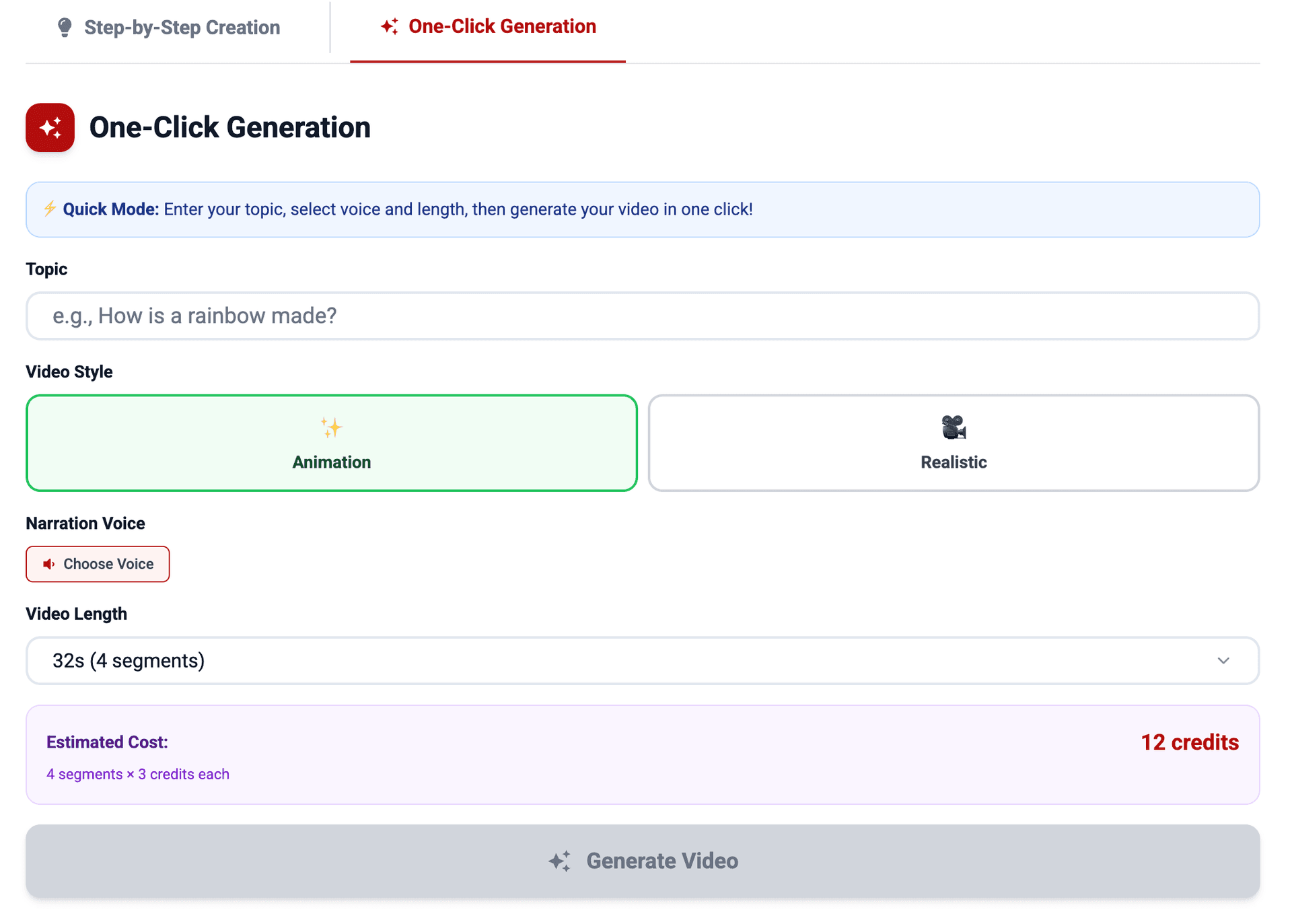
Watch the preview. The AI selects footage matching your script's topic. A blog post about morning productivity gets footage of sunrise, coffee, and focused desk work. Swap any clip that misses the mark. Confirm caption style and background music level.[6]
The key insight about AI video generation in 2026 is this: The quality gap has closed dramatically in the last year. The voiceovers sound natural. The visuals are contextually relevant. The pacing feels intentional. More importantly, your audience on short-form video doesn't expect cinematic production.[9]
Minute 3: Optimize and Publish
Export in 9:16. Write a Short title that includes your target keyword. Add the blog post URL in the description. Post to YouTube Shorts, TikTok, and Instagram Reels simultaneously.[6]
The title of your Short should follow the same keyword strategy as your blog post, but compressed for the Shorts format. If your blog post targets "how to write better email subject lines," your Short title might be "The Email Subject Line Trick That Doubles Open Rates." Clear, specific, and keyword-rich.
Then embed the YouTube Short into your original blog post. Add a line under the embed: "Watch the 60-second summary above or read the full guide below." This creates a content flywheel where each platform drives traffic to the others.[6]
That is the complete workflow: extract the hook, generate the video, optimize and publish. Three steps. Three minutes. One blog post becomes a Short that reaches an audience your blog alone never could.
Optimizing Your Blog-to-Short for the YouTube Algorithm
Creating the Short is only half the equation. The other half is ensuring the algorithm picks it up and distributes it to the right viewers.
The algorithm tests every Short with a small seed audience first. If that group does not engage strongly enough (low retention, high swipe-away rate), the algorithm stops pushing it further. To fix this, focus on a stronger hook in the first 1-3 seconds and make sure your content matches what your seed audience expects from your channel.[1]

The hook is everything. Grab attention in the first two seconds. If you don't hook people right away, they'll just swipe past.[2] 71% of viewers decide within the first few seconds whether a video is worth continuing — making strong hooks essential for performance.[8]
When repurposing blog posts, the hook should be the most surprising or counterintuitive claim from the article. If your blog post is about email marketing and contains the insight that "80% of emails are opened because of the subject line alone," that statistic — delivered visually with bold text on screen and confident narration — is your opening frame. Not a greeting. Not a channel introduction. The insight itself.
Creators should aim for high completion rates, especially under ~20 seconds. Avoid dead time at the start or middle of the Short. Keep structure tight: hook → value → payoff, with minimal fluff.[8] This structure maps perfectly to the blog-to-Short workflow: the hook is your extracted key insight, the value is the brief context, and the payoff is the actionable takeaway.
Data shows that over 70% of all Shorts are longer than 15 seconds. The highest-performing videos, averaging 1.7 million views, sit right in the 50 to 60-second range. Viewers want a highly valuable story, just told quickly.[10] This is exactly the length a well-extracted blog insight naturally fills.
For search discoverability, with a dedicated Shorts filter in search, it now makes sense to create Shorts that answer clear questions ("How to…", "Why this happens…").[8] Blog posts are often already structured around searchable questions — "How to Improve Your LinkedIn Profile" or "Why Your Landing Pages Aren't Converting." These titles translate directly into search-optimized Shorts titles.
The algorithm now leans hard on viewer satisfaction: retention, watch time, replays, and how people behave after your Short (do they keep watching, subscribe, or just swipe away).[2] The Shorts you create from blog posts should leave viewers satisfied — feeling they learned something valuable — and curious enough to explore your channel for more.
Using a consistent thumbnail style across your blog-repurposed Shorts creates visual brand recognition. When viewers who enjoyed one Short see another with the same visual identity, they are more likely to watch, and the algorithm rewards that pattern.
Why 80% of Viewers Prefer Video Over Text
The consumer preference data makes the case for repurposing overwhelming.

80% of individuals prefer video content over written text. The majority of consumers worldwide are visual learners, and 8 in 10 people prefer to watch a video instead of reading a blog. Short-form videos are just as informative as written guides but faster to consume. When given a choice between watching a video or reading text to learn about a product or service, only 28% preferred text.[1]
90% of information transmitted to the brain is visual, and visuals are processed 60,000X faster than text. Viewers retain 95% of a video's message as compared to 10% if reading text.[2]
91.8% of internet users worldwide watch digital videos every week, making video the dominant content format online. The average person watches 17 hours of online video per week — roughly 2.5 hours per day.[3]
51% of people say that the optimal length for an effective video is 30-60 seconds. 91% said lengths less than two minutes.[9] This means the format you are creating — a 60-second Short extracted from a blog post — matches exactly what viewers say they want.
Vertical (9:16) videos on mobile devices achieve completion rates of approximately 76%, compared to just 54% for horizontal videos.[7] Since YouTube Shorts are natively vertical, blog content repurposed into this format automatically benefits from higher completion rates than traditional horizontal video.
Over 73% of consumers prefer short-form videos to search for products or services.[1] 57% of Gen Z prefer short videos to learn about products and services.[1] If your blog posts serve an informational or educational purpose — which most do — the audience that would consume that information through video is significantly larger than the audience reading your blog.
The people who read your blog and the people who watch YouTube Shorts are often entirely different audiences. Blog readers and video viewers are often different people with different content consumption habits.[6] Repurposing does not cannibalize your existing audience — it expands your total addressable audience to include the billions of people who consume information primarily through video.
The AI Tool Landscape for Blog-to-Short Conversion
The ecosystem of tools that convert blog content into short-form video has matured rapidly in 2026. Understanding the categories helps you choose the right approach for your workflow.
URL-to-Video Tools
Several platforms accept a blog URL and automatically generate a video from the content. Synthesia converts blog to video by allowing users to paste the link to their blog post, and press "Generate." Synthesia will turn the blog post into a video script, and then an AI video.[2] InVideo lets you turn a blog into a video with AI-generated visuals without switching between multiple tools.[4]
These tools work by scraping the blog post, identifying key sections, generating a script from the text, sourcing matching visuals, and assembling the final video with voiceover and captions. The AI reads your content and breaks it into logical scenes based on narrative structure. It identifies the key moments that need visual emphasis. It sources or generates visuals that match the context of each scene.[7]
Text-to-Shorts Generators
For more control over the output, text-to-shorts tools let you paste a script or topic rather than a URL. Miraflow's Text2Shorts takes a topic, key points, or script and produces a complete vertical video with visuals, voiceover, captions, and music. This approach gives you the flexibility to extract and refine the most compelling angle from your blog post before generating the video, rather than relying on AI to choose the angle for you.
Tools like PostEverywhere, InVideo AI, and Fliki can generate complete videos from a text prompt — including visuals, voiceover, captions, and music.[6]
Script Generators
If you prefer to generate the video yourself using a separate editor, script-first tools like RightBlogger focus specifically on the script conversion step. If you've got a great piece of content that's gone down well with readers, it makes sense to repurpose it into an engaging video for your YouTube channel. With AI tools, it's quick and easy to turn that blog post into a script.[5]
End-to-End Platforms
The most efficient approach for creators who want a complete workflow is a platform that handles everything from script to published video. Miraflow offers this end-to-end capability: text-to-shorts for video generation, AI thumbnail generation for click-worthy visuals, AI image creation for custom graphics, cinematic video for higher-production content, and music creation for original audio that avoids licensing revenue splits.
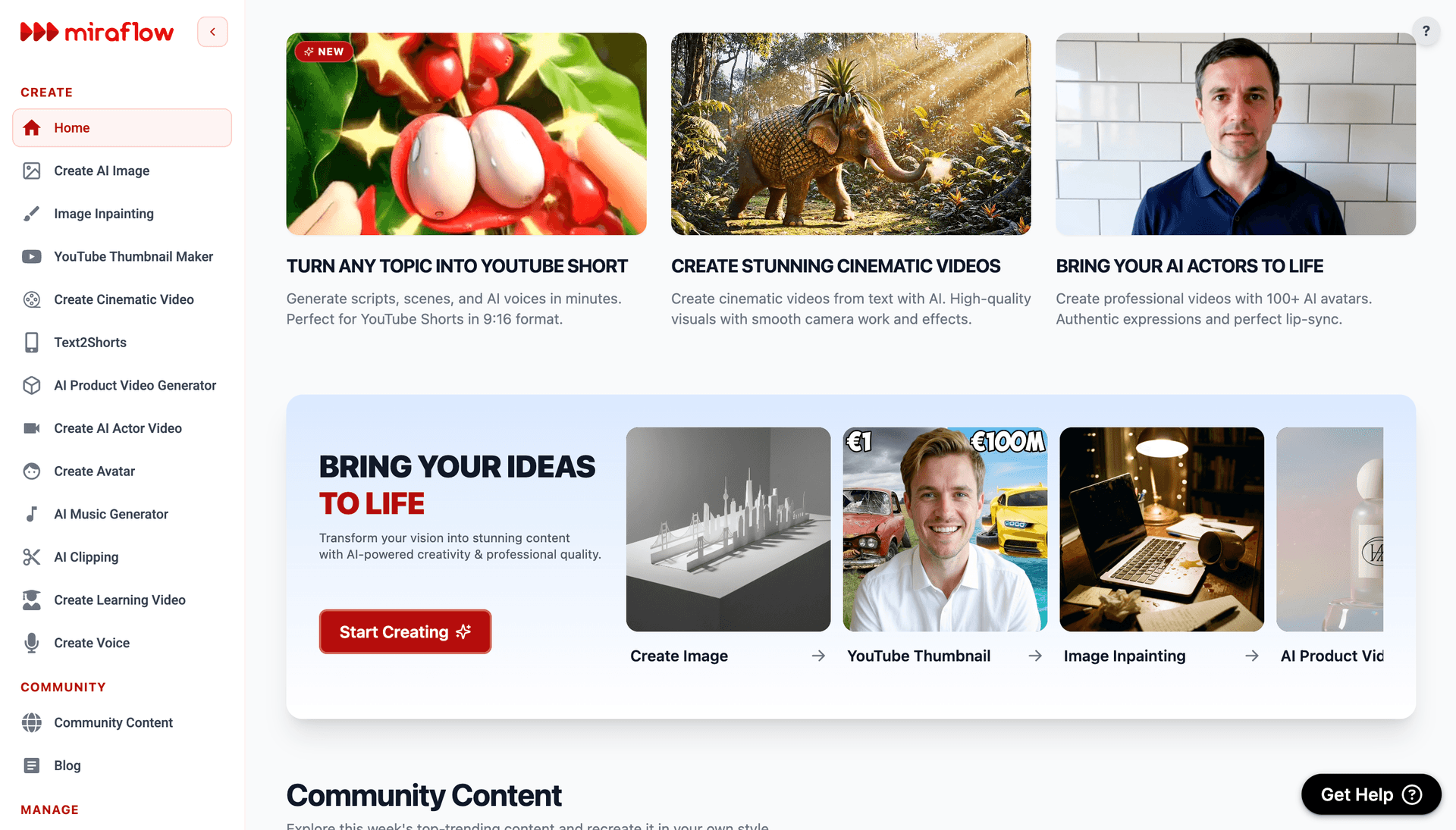
The choice of tool depends on your volume requirements, budget, and how much creative control you want. For occasional repurposing — converting one or two posts per month — a URL-to-video tool works fine. For systematic repurposing at scale — converting every blog post as part of your publishing workflow — an end-to-end platform like Miraflow saves significantly more time.
From One Blog Post to Five Shorts: The Multiplication Strategy
A single blog post typically contains far more material than one Short can cover. The multiplication strategy extracts multiple Shorts from a single post, dramatically increasing the content output from work you have already done.
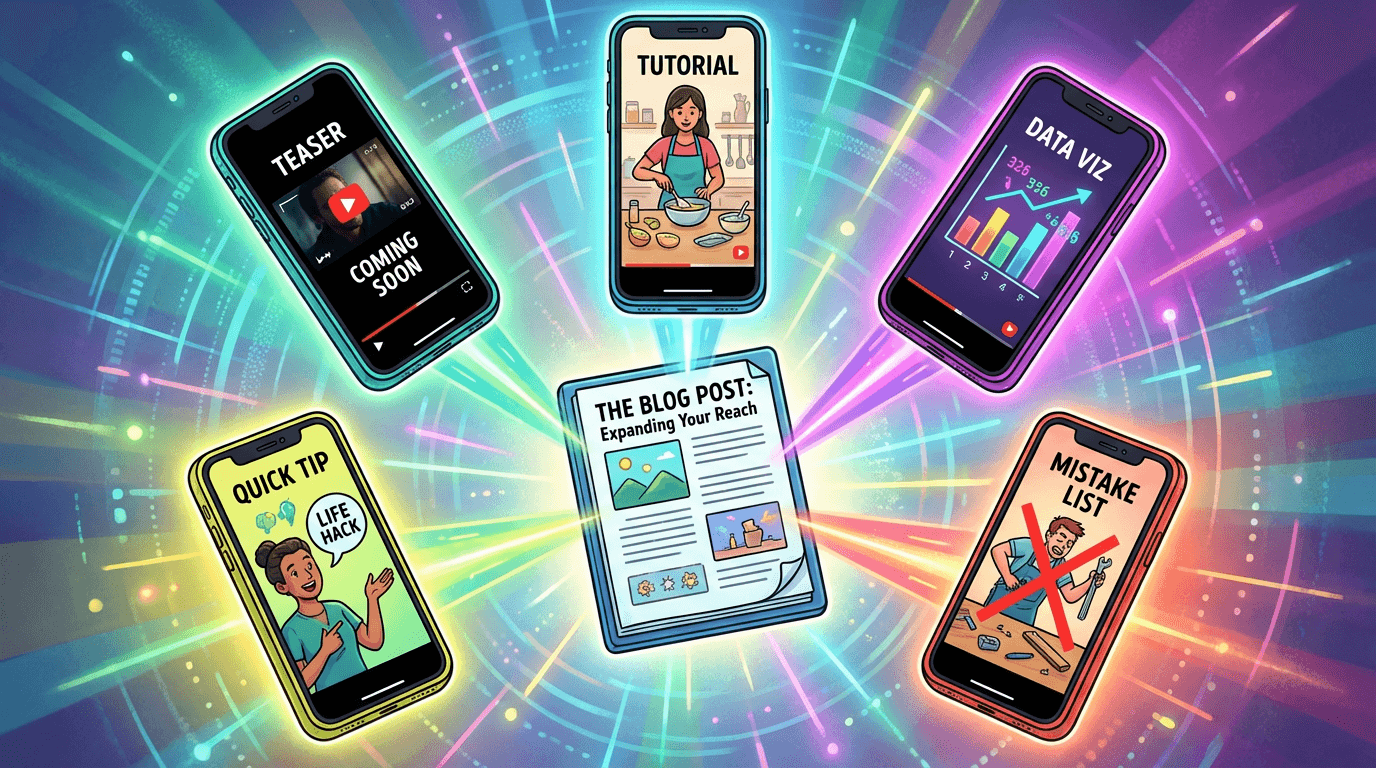
A 2,000-word blog post contains enough material for a week of LinkedIn posts, a carousel, and several short video clips.[3]
Here is how to extract five Shorts from one blog post:
Short 1: The Core Insight. This is the single most surprising or valuable takeaway from the post. It follows the standard hook → context → payoff structure described above.
Short 2: The Data Point. If your blog contains any statistics or data, pull one compelling number and build a Short around it. "Did you know that [statistic]? Here's why that matters…" Data-driven Shorts consistently perform well because they deliver instant, verifiable value.
Short 3: The Common Mistake. Most blog posts address a problem or correct a misconception. Frame that as a "3 mistakes people make about [topic]" Short. These formats exploit fear of doing something wrong. A Short titled around "3 resume mistakes," "2 gym mistakes," or "1 skincare ingredient combo to avoid" creates instant relevance. The viewer thinks, "I need to check whether I'm messing this up." That is a better hook than generic advice.[8]
Short 4: The Quick Tutorial. If your blog post contains a how-to section, compress the steps into a 60-second visual tutorial. Quick tutorials are still one of the safest bets because they earn attention through usefulness, not luck. A Short that shows one Canva trick, one Excel shortcut, one AI workflow, one skincare tip, or one travel hack can work because the viewer instantly understands the value. The trick is to keep the scope tiny. One video, one point, one payoff. Broader teaching usually performs worse because Shorts is built for compression, not lectures.[8]
Short 5: The Teaser. Create a Short that explicitly teases the full blog post. "I just wrote about [topic] and discovered [surprising finding]. The full breakdown is in my bio." This Short is designed to drive traffic back to your blog, completing the flywheel.
Create a monthly repurposing session: spend three hours on the last Friday of each month converting your best five posts into Shorts — batch production is significantly more efficient than one-off repurposing.[6]
Using Miraflow's Text2Shorts, you can generate each of these five Shorts from the same blog post in a single session, with each Short targeting a different angle and hook. Combined with AI-generated thumbnails that maintain visual consistency across your channel, five Shorts per blog post becomes a sustainable weekly output.
Cross-Platform Distribution: Same Short, Five Platforms
One of the most powerful aspects of blog-to-Short repurposing is that the same video works across multiple platforms with minimal adjustment.

Post to YouTube Shorts, TikTok, and Instagram Reels simultaneously.[6] The 9:16 vertical format is native to all three platforms. While optimal posting strategies vary slightly by platform, the core video content — visuals, narration, captions — remains identical.
For maximum impact, most successful creators operate across all three platforms simultaneously — repurposing optimized content to capture each platform's unique advantages while building diversified audience bases that reduce platform dependency risk.[8]
Content that would reach 500 people as a blog post alone reaches 5,000–15,000 people across formats and platforms.[1] This reach multiplication is the fundamental economic argument for blog-to-Short repurposing. The content creation effort happened once (the blog post). The AI conversion adds minimal marginal time. But the distribution surface multiplies by five or more platforms.
For each platform, adjust only what is necessary: hashtags specific to TikTok's discovery algorithm, a slightly different description for Instagram Reels, and keyword-optimized title and description for YouTube Shorts' search functionality. The video itself stays the same.
Less one-way broadcasting, more interactive video (polls, quizzes, embedded CTAs). Less platform-first thinking, more omnichannel repurposing where one long-form video becomes 5-10 short-form clips.[6]
The SEO Superpower: Video Embedded in Blog Posts
Embedding the YouTube Short you create back into the original blog post creates a powerful SEO feedback loop.
Adding video to a landing page can boost conversion rates by up to 86%.[6] Video content keeps visitors on a website longer, reducing bounce rates. Research suggests the bounce rate for video blogs is 34% lower, on average, than in other areas of a website.[8]

With quality video content, you increase the chances of having Google feature your videos in search results. Content appearing prominently in search engine results pages (SERPs) has a better chance of showing up for your target audience, even for highly competitive keywords. Even sites with low domain rating have a chance to rank for competitive or branded keywords.[8]
YouTube content now ranks in traditional Google search results. And according to some SEOs, embedding YouTube videos into blog posts can improve those[5] rankings further. This means the Short you create from your blog post does not just compete for attention on YouTube — it actively improves the search visibility of the blog post it was extracted from.
Users typically spend 88% more time on websites that feature video content.[9] Longer dwell time signals to Google that the page is valuable, which can improve rankings. The embedded Short also provides a second content format on the same page, serving different learning preferences and potentially reducing bounce rate.
Video content now outperforms traditional blog posts for engagement and visibility across many verticals. AI has yet to convincingly replicate the authenticity of a real person speaking on camera, and with AI systems now indexing video transcripts for search, video has become an even more valuable tool for building authority and reaching new audiences. Users spend more time on pages with videos, boosting dwell time and improving website rankings.[6]
This is the true power of the blog-to-Short workflow: it does not replace your blog strategy. It amplifies it. The blog feeds the Short. The Short feeds the blog. Both rank independently in different search contexts. And both drive traffic to each other.
YouTube's AI Content Policies: What Repurposed Content Needs to Know
Creating Shorts from blog posts using AI tools is explicitly permitted by YouTube. But there are boundaries you must understand.
"You'll be able to create a Short using your own likeness, produce games with a simple text prompt, and experiment with music. Throughout this evolution, AI will remain a tool for expression, not a replacement," YouTube CEO Neal Mohan said earlier this year.[3]
YouTube's crackdown targets fully automated, low-value content — not AI-assisted creation based on original material. Your blog posts are original content. Using AI to convert them into video format is the kind of AI-assisted workflow YouTube actively encourages through its own native creation tools.
YouTube now mandates disclosure labels for AI-generated or AI-altered content. Over 1 million channels use AI tools for video production daily.[5] The platform is not anti-AI. It distinguishes between creators who use AI as a production tool while providing genuine expertise and creators who use AI to generate mass-produced content with no human value added.
Your blog posts — written from your expertise, based on your research, informed by your experience — provide the human value. The AI tool simply changes the format. This is the exact workflow YouTube endorses: human creativity and expertise, AI-assisted production.
The practical guideline is straightforward: review every AI-generated Short before publishing. Ensure the visuals match your content. Verify the script accurately represents your blog's insights. Add your personal perspective through voice narration or editorial choices. The AI handles production. You provide the expertise and quality control.
Building the System: From One-Off to Automated Workflow
The three-minute blog-to-Short workflow described above works for individual conversions. But the real power emerges when you systematize the process.
The smartest way to approach this is to build it as a repeatable system, not a one-off experiment. Go through your last 20 to 30 posts. Tag the ones that are list-based, how-to, or evergreen. Note which ones performed best in terms of traffic and engagement. These become your first batch.[7]
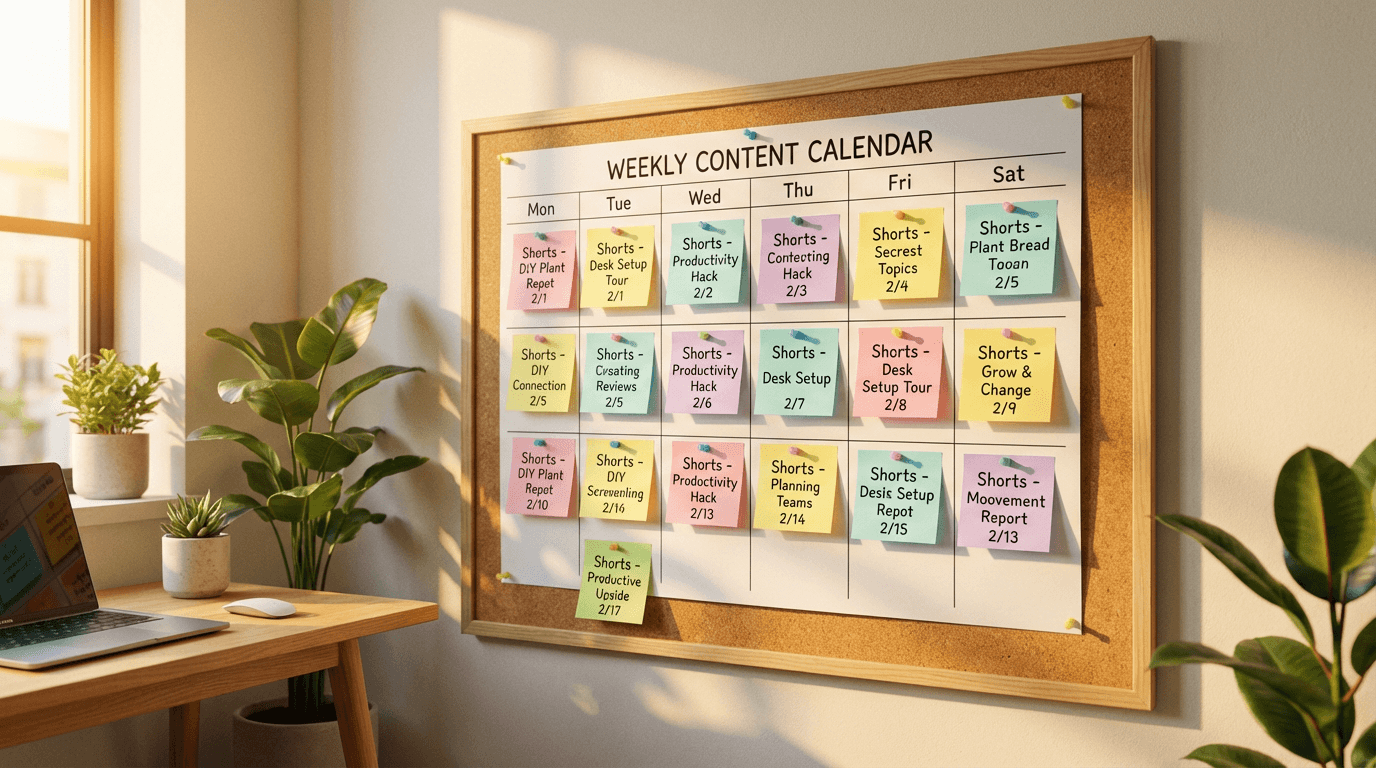
Here is a sustainable weekly workflow:
Monday: Select and Script. Review your blog analytics from the previous week. Identify the top-performing post. Extract three hooks from that post. Use an AI script generator to create three Short scripts — one for each hook.
Tuesday: Generate and Review. Run each script through Miraflow's Text2Shorts. Review each generated video. Swap any visuals that don't match. Adjust pacing if needed. Generate thumbnails for each Short. Total time: 15–20 minutes for three Shorts.
Wednesday–Friday: Publish. Release one Short per day across YouTube Shorts, TikTok, and Instagram Reels. Embed each Short into the corresponding blog post. Monitor early engagement signals.
Monthly: Batch Legacy Content. Once per month, go through your blog archive and identify older posts that never received video treatment. Convert your top five archive posts into Shorts in a single batch session. This gradually builds a video library from your entire content history.
For most solo creators, 3–7 Shorts per week is a good balance. Consistency matters more than posting 5 times a day and burning out. Focus on learning from each Short instead of spamming the feed.[2]
This systematic approach ensures you never run out of content ideas — your blog archive provides an indefinite supply — while maintaining the consistency that the YouTube algorithm rewards.
What the Numbers Look Like: Blog-Only vs. Blog + Shorts
Consider two hypothetical content creators in the same niche. Creator A publishes a weekly blog post and promotes it through SEO and social media text posts. Creator B publishes the same weekly blog post, then converts it into three YouTube Shorts using AI tools.
After six months, the math diverges dramatically.
Creator A's blog post averages 2,000 pageviews over its lifetime, driven by SEO traffic that is increasingly eroded by AI Overviews and zero-click search results.
Creator B's blog post averages the same 2,000 pageviews — plus three Shorts that collectively average 15,000–50,000 views on YouTube alone, with additional views on TikTok and Instagram Reels. Some of those Shorts break through algorithmically and reach hundreds of thousands of views. The Short embedded in the blog post increases dwell time and reduces bounce rate, marginally improving the blog's SEO performance. The YouTube channel built through Shorts establishes a subscriber base that receives notifications for future content.
A massive 74% of all Shorts views come from non-subscribers. Even better, channels that post both Shorts and long-form videos grow 41% faster than those that only stick to long videos.[10]
The compounding effect is what makes this strategy transformational. Each Short grows the channel. A larger channel means more initial distribution for every subsequent Short. More Shorts views drive traffic to the blog. Improved blog metrics strengthen SEO. The flywheel accelerates.
Content marketing delivers $3 in ROI for every $1 invested, compared to just $1.80 for paid advertising. Repurposing amplifies this ROI by extracting additional value from existing content investments.[1]
Common Mistakes to Avoid
The blog-to-Short workflow is straightforward, but several common mistakes can undermine your results.
Mistake 1: Trying to summarize the entire blog post. A 2,000-word post compressed into 60 seconds becomes an incomprehensible rush of information. Extract one idea, not the whole article. The Short should make viewers want to read the full post — not substitute for it.
Mistake 2: Using the blog's introduction as the hook. Blog introductions are written for readers who chose to click and are willing to invest time. Short viewers are swiping through a feed and will leave in one second if you don't capture attention. The hook must be the most surprising or valuable element, not a preamble.
Mistake 3: Ignoring captions. Many platforms autoplay short videos without sound; captions/visual cues become vital.[5] 63% of branded content on mobile feeds is optimized for silent viewing with captions and graphics.[10] Every blog-to-Short conversion must include prominent, readable captions.
Mistake 4: Publishing without a call to action. If you want the flywheel to work, every Short needs to direct viewers somewhere — your channel, the full blog post, or the next Short in the series. A Short without a CTA is a dead end that generates views but not growth.
Mistake 5: Not tracking which blog posts produce the best-performing Shorts. Data-driven creators consistently outperform those who rely on intuition alone. YouTube Studio provides detailed analytics for Shorts, including average view duration, traffic sources, and audience retention curves. Reviewing these metrics weekly helps you identify what resonates and double down on winning formats.[3]
The Broader Content Repurposing Ecosystem
Blog-to-Short is the single highest-leverage repurposing workflow, but it sits within a broader content ecosystem. Once you have the workflow established, the same blog post can generate content across even more formats.
A detailed blog post is one of the most versatile starting points. You can pull out key insights for LinkedIn posts, break down the argument into an X thread, rewrite the takeaways into an email newsletter, turn data points into infographics, or adapt the core message into a short video script. This way, you can easily extract five or more smaller pieces.[4]
From ONE YouTube video, you can create: 3–5 Shorts, 3–5 Reels/TikToks, 1 long-form blog post, 1–2 emails, 10+ quotes or captions, 1 community discussion post.[6] The blog-to-Short workflow also works in reverse: a successful Short can signal which topics deserve deeper blog coverage. The data flows both directions.
Miraflow supports this ecosystem with tools for short-form video, AI images (useful for social media graphics derived from the same blog content), cinematic video for longer-form repurposing, and music for adding original audio to any video format. The goal is to extract maximum value from every piece of content you create.
The brands winning in 2026 are not creating the most new content. They are extracting maximum value from what they already have.[8]
Conclusion
Every blog post you have written — and every blog post you will write — is a video waiting to happen. The gap between written word and published video has collapsed. AI tools can convert your blog's best ideas into polished YouTube Shorts in three minutes, no camera or editing experience needed.
YouTube Shorts now generates over 200 billion views per day.[1] Your blog post, no matter how well-optimized for SEO, reaches a fraction of the audience a single Short can access through YouTube's algorithmic distribution. The viewers who watch Shorts and the readers who find your blog are largely different people. Repurposing reaches both.
The workflow is three minutes: extract the core insight and write the hook, generate the video with an AI tool like Miraflow's Text2Shorts, and publish across platforms while embedding back into the original blog post. The flywheel effect — where blog feeds Short, Short feeds blog, and both drive discovery — compounds over time.
The creators winning right now aren't necessarily the most talented. They're the most efficient. They've built systems. They repurpose ruthlessly. They let smart tools do the heavy lifting so they can focus on the ideas.[9]
Your blog archive is not a graveyard. It is a goldmine. Start with your top-performing post. Convert it into a Short today. See what happens when your best ideas reach an audience 100× larger than your blog alone can deliver.
Frequently Asked Questions
Can I really turn a blog post into a YouTube Short in 3 minutes?
Yes. The production step should take under five minutes once your script is ready.[6] With AI tools that accept blog text or URLs and generate complete videos automatically, the entire process from blog post to published Short compresses to three minutes with practice. The key is having a systematic workflow: extract one key insight, generate the video with AI, and publish.
Which blog posts work best as YouTube Shorts?
Your top posts by pageviews and time-on-page will translate to higher retention on video. Posts with high shares already have proven emotional or informational value.[6] Listicles are perfect for blog-to-video conversion. Each list item becomes a chapter with visuals, narration, and on-screen text.[8] How-to guides, data-driven posts, and articles built around a single counterintuitive insight are all strong candidates.
Will repurposing my blog post as a Short hurt my SEO?
No — it helps. Embedding the YouTube Short into your blog post increases time-on-page for the blog (good for SEO) and drives YouTube views from existing blog traffic. Both signals improve ranking on their respective platforms.[6] Pages with video are about 53× more likely to rank on the first page of Google search results. Companies that use video in their marketing generate about 41% more web traffic from search.[6]
How many Shorts can I make from a single blog post?
A typical 1,500–2,000-word blog post contains enough material for three to five distinct Shorts, each focusing on a different angle: the core insight, a data point, a common mistake, a quick tutorial, and a teaser that drives traffic back to the full post. A 2,000-word blog post contains enough material for a week of LinkedIn posts, a carousel, and several short video clips.[3]
Do I need to appear on camera?
No. AI video generation tools create complete Shorts with stock visuals, AI-generated scenes, voiceover narration, captions, and music. You don't need a studio. You don't need a ring light. You don't need to show your face. You just need a workflow.[9]
What is the ideal length for a blog-repurposed Short?
Over 70% of all Shorts are longer than 15 seconds. The highest-performing videos, averaging 1.7 million views, sit right in the 50 to 60-second range. Viewers want a highly valuable story, just told quickly.[10] For blog repurposing, the 50–60 second range is ideal — long enough to deliver genuine value from your blog's content, short enough to maintain high completion rates.
Does YouTube allow AI-generated Shorts?
Yes, with important caveats. YouTube now mandates disclosure labels for AI-generated or AI-altered content. Over 1 million channels use AI tools for video production daily.[5] The key is that your content provides genuine human value. Blog posts written from your expertise, converted to video using AI production tools, meet YouTube's standards for AI-assisted content.
Should I post the same Short on TikTok and Instagram Reels?
Yes. For maximum impact, most successful creators operate across all three platforms simultaneously — repurposing optimized content to capture each platform's unique advantages while building diversified audience bases that reduce platform dependency risk.[8] The 9:16 format works natively across all major short-form platforms.
How does this compare to hiring a video editor?
Companies implementing AI-driven content repurposing are reducing production costs by up to 65%.[1] A professional video editor charges $50–$200+ per Short. AI tools cost $10–$50 per month for unlimited or high-volume generation. For solo creators and small businesses, AI tools deliver comparable output quality at a fraction of the cost, especially for the volume of content the Shorts algorithm rewards.
What about using copyrighted music in my blog-repurposed Shorts?
Using licensed music splits your revenue with the rights holders. Original audio keeps the full creator share. AI music creation tools generate original background tracks that enhance your Shorts without triggering licensing revenue splits, maximizing your earnings from every view.
References
- How to Turn a Blog Post Into a Short Video Using AI in 2026 — FluxNote
- Blog To Branded Video Fast Content Repurposing — Boston Institute of Analytics
- Content Repurposing Statistics 2026 — AutoFaceless
- Video Marketing Statistics 2026 — Digital Applied
- YouTube Shorts Statistics 2026 — Loopex Digital
- YouTube Shorts Statistics 2026 — DemandSage
- 20 Best AI Short-Form Video Tools in 2026 — PostEverywhere
- Cool Stats And Facts About YouTube — GrowViews
- How Does the YouTube Shorts Algorithm Work in 2026? — vidIQ
- YouTube Shorts Algorithm Update: January 2026 — Miraflow