YouTube Shorts vs Long Form: Which One Grows Your Channel Faster in 2026

Written by
Jay Kim
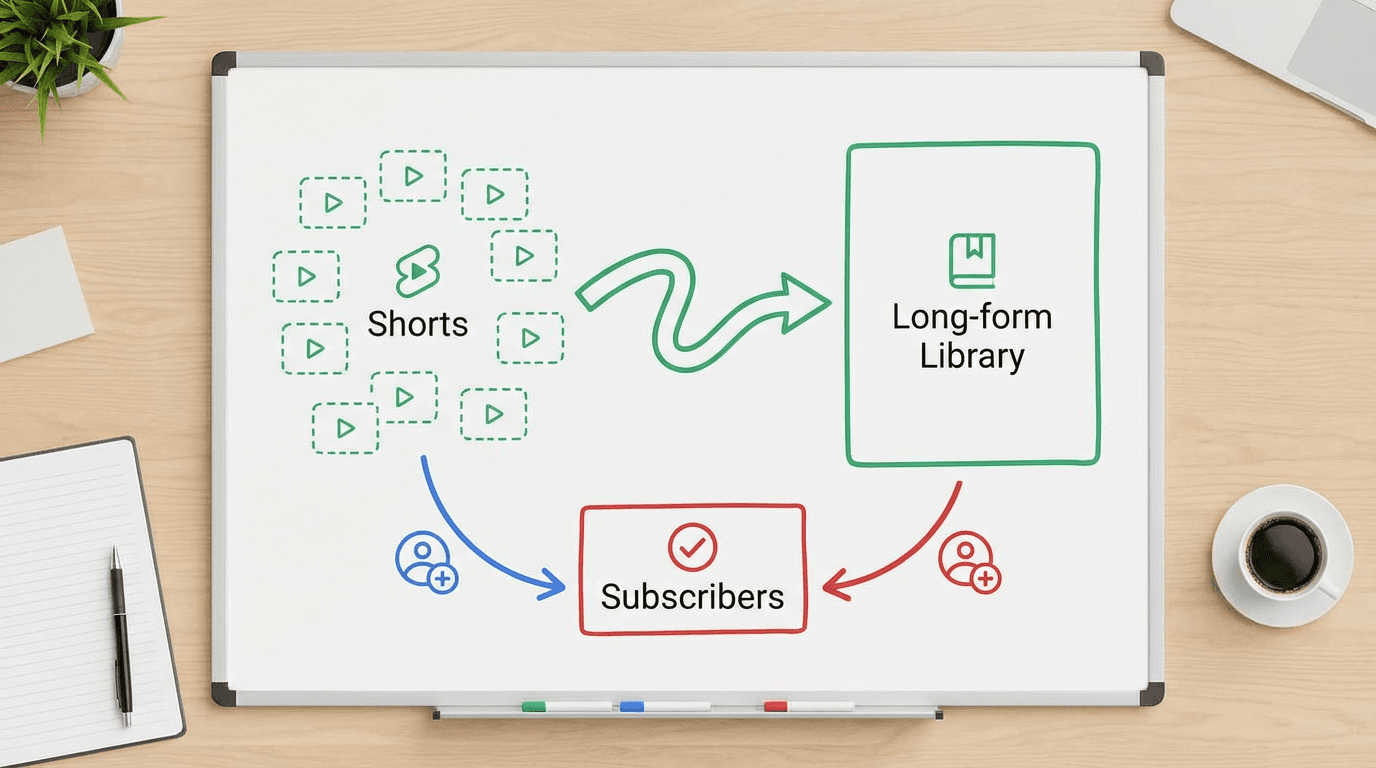
YouTube Shorts and long-form video grow channels differently in 2026. Here is which format is faster for subscribers, which builds more revenue, and why the best strategy uses both.
If you are starting a YouTube channel in 2026 and trying to figure out whether to focus on Shorts or long-form video, you are asking a question that matters a lot more than most creators realize. The answer you choose shapes everything: your production workflow, your monetization timeline, the quality of your subscriber base, and how sustainable your channel is two years from now.
The honest answer is that Shorts and long-form video grow your channel in fundamentally different ways, and the one that grows it faster depends entirely on what you mean by growth and what you are building toward. Subscriber count, watch time, revenue, audience loyalty, and brand authority all develop differently depending on which format you prioritize.
This guide breaks down exactly how each format grows a channel in 2026, where each one has a genuine structural advantage, which combination tends to work best for different goals, and how to build a content strategy around whichever format fits your situation.
Why This Question Is More Complicated Than It Looks
Most content you will find on this topic gives you a clean answer: Shorts grow your subscriber count faster, long-form builds a more loyal audience. That is partially true but incomplete enough to be misleading when you are making actual decisions about where to invest your time.
The reality is more layered. Shorts do tend to accelerate subscriber acquisition for channels in the early growth phase, but those subscribers behave differently from subscribers acquired through long-form video. Long-form video builds deeper audience relationships and higher revenue per viewer, but it takes longer to find traction and requires more production investment per piece of content.

Neither format is simply better. They are different tools with different strengths, and the creators building the most durable channels in 2026 are the ones who understand those differences clearly enough to use each one intentionally.
How YouTube Shorts Grows a Channel
The growth mechanism for YouTube Shorts is primarily feed-based discovery. The Shorts feed shows your content to people who have never encountered your channel before, and when a Short earns strong watch-through rates and positive viewer signals, the algorithm pushes it to progressively larger audiences.
This creates a specific kind of growth pattern. Subscriber counts can rise quickly when a Short breaks out, because the platform is distributing your content to a massive pool of potential new followers. A single Short that connects with a broad audience can add thousands of subscribers in a matter of days, which is a timeline that long-form video rarely matches.
However, the nature of that subscriber growth matters significantly for what comes next.
Shorts subscribers are often broad rather than deep When someone subscribes after watching a Short, they have typically spent between 15 and 60 seconds with your content. The emotional investment is lower than it would be after watching a 12-minute video that walked them through a full process or told them a complete story. This means Shorts-acquired subscribers are, on average, less likely to watch your next video, less likely to engage consistently, and less likely to become the kind of loyal audience member who supports channel monetization through memberships, merchandise, or affiliate links.

This is not a reason to avoid Shorts. It is a reason to understand what Shorts subscribers represent and to have a plan for converting them into more engaged audience members over time. If you want to understand more about why Shorts viewers often do not become active subscribers, why YouTube Shorts get views but no subscribers covers the specific mechanics behind that pattern.
Shorts produce rapid but often shallow audience signals The behavioral data YouTube collects from Shorts is compressed. A 30-second watch-through tells the algorithm something about viewer satisfaction but does not reveal nearly as much about the viewer's interests, depth of engagement, or long-term content preferences as a 10-minute video would. This affects how accurately the algorithm can match your future content to the right audiences.
Shorts excel at early channel momentum For a brand-new channel with zero subscribers, Shorts offer something long-form video almost never does at that stage: immediate reach. The Shorts feed actively distributes content to non-subscribers, which means a new channel can start accumulating real views and followers within the first week of posting. Long-form videos from new channels typically receive almost no organic reach until the channel has established enough of an algorithm track record to earn recommendation placement.
How Long-Form Video Grows a Channel
Long-form video grows a channel through a different set of mechanisms, and the growth tends to be slower to start but significantly more durable once it takes hold.
Search is the primary growth engine for long-form Long-form videos rank in YouTube search and Google search at much higher rates than Shorts, because the search algorithm gives more weight to content that provides comprehensive coverage of a topic. A well-produced 10-minute video on a specific question can rank at the top of search results and receive consistent daily traffic for years, without any ongoing effort beyond the initial publication.
This search-driven growth compounds over time. Each new video that ranks for its target query adds to a library of permanently discoverable content, and the total daily search traffic to an established long-form channel can far exceed what the Shorts feed generates for a channel of similar size.
Long-form builds deeper audience relationships A viewer who watches 10 to 15 minutes of your content has spent real time with you. They have heard your voice, followed your reasoning, and trusted you enough to stay engaged through a complete piece of content. That experience creates a different kind of relationship than a 30-second Short creates. Long-form viewers are more likely to return for the next video, more likely to subscribe with genuine intent, and more likely to engage in comments, become channel members, or follow you to other platforms.

Long-form has higher revenue per viewer YouTube's advertising system pays significantly more per view on long-form content than on Shorts, because long-form videos can host multiple mid-roll ads and the audience is more engaged with the content they are watching. The RPM difference between Shorts and long-form videos is substantial across almost every niche. Creators who want to build significant ad revenue from YouTube need long-form video in their strategy regardless of how many Shorts they produce.
For a realistic picture of what Shorts actually pay compared to long-form revenue, YouTube Shorts monetization in 2026 covers the current payment structures in detail.
Long-form is harder to start but harder to displace Getting a new long-form channel off the ground is genuinely challenging. The algorithm does not distribute new long-form content to non-subscribers without an established track record, and building that track record requires consistent publishing over months before meaningful organic reach develops. But once a long-form channel earns search rankings and recommendation placement, those positions are relatively stable and not easily disrupted by algorithm changes the way feed-based Shorts distribution can be.
The Subscriber Quality Difference: Why It Matters More Than You Think
This is where most creators who focus purely on subscriber count as a growth metric miss something important. The number in your subscriber count and the actual value of your subscriber base are two different things.
A channel with 50,000 subscribers who were acquired primarily through viral Shorts will typically have significantly lower video view rates, lower watch time per video, and lower revenue per subscriber than a channel with 20,000 subscribers who were acquired primarily through long-form search-driven content.
This matters for several practical reasons. YouTube's algorithm uses your subscriber engagement rate as a signal for how much to distribute your new content. A channel whose subscribers consistently watch new uploads gets stronger initial distribution for each new video. A channel whose subscribers rarely watch new content gets weaker initial distribution even for good videos, because the algorithm reads the low subscriber engagement as evidence that the content is not reliably satisfying to the people most familiar with it.
For channels building toward brand deals, sponsorships, or direct audience monetization, subscriber quality also directly affects earnings potential. A sponsor paying for an integration wants to know how many of your subscribers will actually watch the video and see their product, not just how many people once clicked a subscribe button after a 20-second Short.
The 2026 Reality: What Is Actually Working Right Now
The YouTube landscape in 2026 has some specific characteristics that affect how the Shorts vs long-form question plays out in practice.
Shorts reach has become more competitive As more creators have invested in Shorts production, the feed has become significantly more crowded. The average watch-through rate needed to earn expanded algorithmic distribution is higher than it was two years ago because the algorithm has more content to choose from. This does not mean Shorts are less effective, but it does mean that low-effort Shorts no longer earn the distribution that they might have in an earlier, less saturated environment.
Long-form search remains less saturated in most niches Despite the growth in YouTube's overall content library, genuinely comprehensive long-form videos on specific niche topics remain relatively uncommon because they require significantly more production effort than Shorts. This means that in many niches, a well-produced long-form video can still earn strong search rankings without having to compete against a massive volume of similar content.
The algorithm actively connects Shorts viewers to long-form content YouTube has made it increasingly clear that it wants creators to use both formats together, and the algorithm reflects this preference. When a viewer discovers a channel through a Short and the channel also has relevant long-form content, the algorithm surfaces that long-form content to the Shorts viewer through channel page visits, notifications, and recommended videos. Channels that use both formats together tend to see stronger overall recommendation placement than channels that use only one.
Understanding how these algorithmic changes affect distribution across both formats is covered in the YouTube Shorts algorithm update for January 2026, which explains the specific signal changes that affect how both content types are distributed.
Which Format Grows Subscriber Count Faster
For raw subscriber count, Shorts have a clear structural advantage in 2026, especially for new and small channels. The feed-based discovery mechanism means your content reaches non-subscribers from day one, and the lower barrier to watching a 30-second video means more people will give a new channel a chance through Shorts than through a long-form video.
A new channel that publishes consistently strong Shorts can reasonably expect to see subscriber growth within the first month. A new channel that publishes only long-form video will often see very slow subscriber growth for the first three to six months while the algorithm builds enough data to start recommending the content organically.
However, the subscriber count advantage for Shorts comes with the engagement quality caveat discussed earlier. If your goal is the fastest path to a specific subscriber number, Shorts win clearly. If your goal is to reach 1,000 subscribers as quickly as possible to unlock YouTube Partner Program eligibility, Shorts are the more efficient path. For a complete picture of what the YPP eligibility requirements look like and how Shorts fit into the path toward them, YouTube Shorts best practices for 2026 covers the current requirements in detail.
Which Format Builds a More Valuable Channel Faster
If you define channel value by watch time, revenue per subscriber, audience loyalty, and long-term sustainability, long-form video builds those dimensions more efficiently than Shorts, even accounting for the slower initial growth.
A channel that builds its core audience through long-form content develops viewers who are genuinely invested in the creator's perspective, who return for new uploads, and who engage in the ways that translate to real monetization. These channels also tend to have better performance on the metrics that unlock higher-tier monetization options like channel memberships and Super Thanks, because the audience engagement depth is higher.
The YouTube Shorts RPM guide for 2026 shows the per-view earnings difference between Shorts and long-form video across different niches, and the gap is significant enough that a channel earning primarily from Shorts needs substantially more views than a long-form channel to generate the same revenue.
The Combined Strategy: Why Most Successful Channels Use Both
The most consistent finding from looking at how successful YouTube channels approach this question in 2026 is that the highest-performing channels are almost never exclusively one format or the other. They use Shorts and long-form video to do different jobs within a single channel strategy.

The structure that works best for most creators looks like this:
Shorts handle discovery and top-of-funnel growth Short-form content reaches the broadest possible audience, introduces new viewers to the channel's topic and voice, and generates subscriber volume that gives the channel algorithmic momentum. The Shorts are designed to be interesting and valuable on their own while also creating enough curiosity about the creator's perspective to make viewers want to see more.
Long-form handles depth, loyalty, and monetization The channel's long-form videos deliver the comprehensive coverage, deeper explanation, and genuine audience relationship-building that Shorts cannot provide in 60 seconds. This is where the channel's actual monetary value is created, through higher RPM advertising, sponsorship integrations, affiliate links in descriptions, and the audience trust that enables direct monetization products.
The two formats feed each other algorithmically When Shorts drive new subscribers to a channel that has strong long-form content, those subscribers are more likely to watch the long-form videos than subscribers who discovered the channel through a different path. And when long-form videos perform well, the algorithm often surfaces the channel's Shorts to the same audience that engaged with the long-form content, creating a virtuous cycle of cross-format discovery.
For creators wanting to understand how this kind of cross-format strategy works in practice, the new creator stack for AI Shorts, Reels, and TikTok covers how modern creators are structuring multi-format workflows efficiently.
The Production Reality: Time Investment Per Format
One factor that significantly affects which format makes sense for a given creator is production time. Long-form videos require substantially more effort per piece of content than Shorts, and for creators working without a team, this production difference is a real constraint.
A typical well-produced YouTube Short takes between 30 minutes and two hours to produce manually, depending on editing complexity. A typical well-produced long-form video takes between four and eight hours for most solo creators, sometimes significantly more for content-heavy educational or documentary-style formats.
This production time difference has real strategic implications. A creator who can produce one long-form video per week might be able to produce eight to fifteen Shorts in the same time. The volume advantage of Shorts means more algorithmic test events, more chances for breakout content, and more consistent signals that the channel is active and growing.
AI production tools have shifted this equation meaningfully. When scripting, visual generation, and video assembly can be handled within an AI workflow, the time cost per Short drops significantly, which changes the calculus for whether a combined strategy is achievable for a solo creator.
Miraflow AI's Text2Shorts handles the full Shorts production pipeline, from script generation and editing to scene visual creation and voiceover, which means a creator can produce quality Shorts at a volume that would be unsustainable with manual production alone. This makes the combined strategy, regular Shorts alongside periodic long-form content, achievable for creators who do not have large production teams.
Which Format Is Better for Specific Goals
Rather than declaring a single winner, it is more useful to map each format to the goals it serves most effectively in 2026.
If your primary goal is reaching 1,000 subscribers as fast as possible Shorts are the faster path. The feed-based discovery mechanism gives new content immediate reach that new long-form videos do not have, and the lower barrier to watching makes subscriber acquisition faster per piece of content.
If your primary goal is building YouTube ad revenue Long-form video generates significantly higher RPM than Shorts in almost every niche. A channel that wants to build meaningful ad revenue needs long-form content as its core publishing format, with Shorts potentially used to drive audience growth that benefits the long-form side.
If your primary goal is building an audience you can monetize directly Long-form video builds the audience trust and loyalty that direct monetization requires. Memberships, merchandise, courses, and coaching all perform better with audiences built through long-form content, because those viewers have invested enough time to develop genuine relationship with the creator.
If your primary goal is brand awareness and product visibility Shorts are more efficient for pure reach and product discovery. The volume of eyeballs that even modestly successful Shorts can generate makes them an effective awareness tool, particularly for brands and creators with physical or digital products to promote.
If your primary goal is long-term channel sustainability The most durable YouTube channels in 2026 are the ones with strong search-ranked long-form libraries alongside active Shorts presence. The search component provides a traffic floor that does not depend on the algorithm's current willingness to distribute your content actively, which is a form of channel stability that pure Shorts channels rarely achieve.
Common Mistakes Creators Make Choosing Between Formats
Choosing the format that feels more comfortable rather than the one that fits their goal Many creators default to Shorts because the production is less intimidating than long-form video. Others default to long-form because they are more familiar with traditional video production. Neither reason is a good basis for the decision. The choice should be driven by what the goal requires, not what the creator finds easier.
Expecting Shorts to convert directly into long-form viewership without a bridge Creators who publish both Shorts and long-form often discover that their Shorts viewers do not watch their long-form videos. This is a real pattern, but it is not inevitable. The missing piece is usually a content bridge: Shorts that explicitly tease long-form content, calls to action that direct Short viewers to the long-form library, and long-form videos that deliver on the specific interests that the Shorts were building around.
Treating long-form as the "real" content and Shorts as promotional material Some creators produce Shorts as trailers or clip highlights from long-form videos rather than as standalone valuable content. Shorts built purely as promotional trailers tend to underperform both as Shorts and as promotion, because they are not satisfying as independent viewing experiences. Strong Shorts deliver complete value on their own and happen to make viewers curious about the creator's deeper content, rather than being designed purely to funnel viewers elsewhere.
Ignoring the thumbnail strategy for long-form because they are focused on Shorts Creators who invest heavily in their Shorts content often neglect their long-form video thumbnails, even though thumbnails are one of the primary drivers of long-form click-through rate and therefore long-form search and recommendation performance. The YouTube CTR benchmarks for 2026 shows how much thumbnail quality affects click-through rate and therefore how much it affects the algorithm's decision to recommend long-form content.
The Transition Question: Should You Switch From Shorts to Long Form
Many creators who started with Shorts ask at some point whether they should transition to long-form as their primary format. The answer depends on what you are trying to achieve, but there are specific signals that suggest the transition makes sense.
Moving toward long-form becomes worth considering when your Shorts subscriber base is large enough to provide an initial audience for long-form content, when your niche has strong long-form search demand that your Shorts content has not been able to capture, or when your monetization goals require the higher RPM and deeper engagement that only long-form can deliver.
The transition works best when it is gradual rather than abrupt. Stopping Shorts entirely to focus on long-form cuts off the discovery channel that has been feeding your growth. A better approach is introducing long-form content alongside continued Shorts production, using your Shorts to drive initial viewership for the long-form videos while the long-form content begins building its own search traffic independently.
For creators who have been exclusively focused on Shorts and want to understand how to structure a 30-day plan that introduces long-form content alongside their existing Shorts strategy, the 30-day YouTube Shorts plan for 2026 provides a framework that can be adapted to include long-form content milestones.
Prompt Pack: Visual Prompts for Shorts vs Long Form Content
These prompts work for creators producing educational or strategy content about YouTube growth, or for generating section visuals in your own content about the Shorts vs long-form decision.
Shorts vs long-form comparison concept
Prompt split composition showing a vertical smartphone screen on the left displaying a short-form video and a horizontal laptop screen on the right displaying a longer video, bright clean background, minimal modern aesthetic, equal lighting on both sides, no text no logos
Subscriber growth speed concept
Prompt two identical seedlings side by side, one growing rapidly into a tall plant with many leaves and one growing slowly but with deeper visible roots, bright natural lighting, clean white background, growth metaphor composition, no text no logos
Audience quality concept visual
Prompt two groups of audience figures, one large crowd of faint silhouettes and one smaller group of bright detailed figures with engaged expressions, bright studio background, engagement and loyalty theme, clean minimal illustration style, no text no logos
Long-form search ranking visual
Prompt magnifying glass highlighting a horizontal video card at the top of a glowing search results list, bright modern background, discovery and search theme, clean minimal composition, no logos no text
Combined strategy workflow visual
Prompt overhead flat lay showing a content planning grid with both short vertical video cards and horizontal long-form video cards arranged in a structured weekly calendar pattern, warm natural lighting, organized creative workspace, no logos no text
These can all be generated inside Miraflow AI's image generator for use as section visuals or thumbnail concepts for your YouTube growth content.
How to Decide Which Format to Start With
If you are building a new channel and genuinely unsure which format to prioritize, here is a practical decision framework based on your specific situation.
Start with Shorts if: You are building a new channel with no existing audience and need to generate initial momentum quickly. You are in a niche with high feed-discovery potential where broad audiences engage with your topic. You have limited production time and need an efficient path to your first 1,000 subscribers.
Start with long-form if: You already have an audience on another platform you can drive to YouTube from day one. You are in a highly specific niche with strong search demand and relatively low video competition. Your monetization goals require the higher RPM and audience quality that long-form delivers, and you can afford the slower initial growth that comes with it.
Start with both if: You have an efficient enough production workflow to maintain quality across both formats simultaneously. Your niche has both strong feed-discovery potential for Shorts and strong search demand for long-form. You are thinking about channel growth as a multi-year strategy rather than a sprint to a specific subscriber number.
For creators using AI tools to manage production efficiency, starting with both formats simultaneously becomes much more feasible. When Shorts production is handled through an efficient AI workflow, the incremental time cost of maintaining Shorts production alongside long-form work is manageable for most creators.
How Miraflow AI Fits Into a Combined Strategy
Building a sustainable channel strategy in 2026 that uses both Shorts and long-form video effectively requires managing two distinct production workflows simultaneously. For solo creators without a team, this is where production tools make the difference between a combined strategy being achievable and being overwhelming.
Miraflow AI is designed for exactly this kind of multi-format content pipeline. The Text2Shorts feature handles Shorts production from topic to finished video in a single workflow, which means the time investment per Short is low enough to run alongside long-form production without consuming all available creative energy.
For the visual content that both formats require, the AI image generator produces original thumbnails, cover frames, and section visuals for both Shorts and long-form videos. And for channels that want to produce cinematic-quality video content for either format, the cinematic video generator creates original video clips that can be used in both short-form and longer productions.
The music side of both formats is also handled within the same platform. Original background tracks generated through Miraflow AI's music generator carry no copyright risk for either Shorts or long-form content, which matters because a copyright claim on a long-form video can strip its monetization permanently.
Conclusion
Shorts and long-form video grow YouTube channels in genuinely different ways, and the question of which one is faster depends entirely on what you mean by growth. If you want subscribers fast, Shorts have a structural advantage that long-form cannot match for new channels in 2026. If you want revenue, audience loyalty, and long-term channel stability, long-form builds those dimensions more efficiently even if the initial growth is slower.
The most sustainable answer for most creators is a combined strategy that uses each format for what it does best: Shorts for discovery and subscriber acquisition, long-form for depth, revenue, and audience relationship-building. The practical challenge is managing both production workflows efficiently enough that quality does not drop under the combined volume.
Creators who solve that production challenge, whether through AI tools, batch production workflows, or tight content focus, are the ones who end up with channels that grow fast and stay healthy. The ones who choose a single format and ignore the other tend to hit a ceiling, either growing fast but staying shallow with Shorts, or building deeply but growing slowly with long-form, when the real opportunity is the combination of both.
For a concrete look at which content structures and formats earn the strongest algorithmic distribution right now across both short and long-form content, evergreen YouTube video ideas and formats for 2026 covers the content types that hold their value longest across both formats.
FAQ
Is YouTube Shorts or long-form video better for growing a channel in 2026? Shorts grow subscriber count faster, especially for new channels, because the feed-based discovery mechanism distributes content to non-subscribers from day one. Long-form video builds a more engaged, higher-revenue audience more efficiently. Most channels benefit from using both formats for different purposes within the same strategy.
Do YouTube Shorts subscribers watch long-form videos? Shorts subscribers watch long-form videos at lower rates than subscribers acquired through long-form content. The conversion from Shorts viewer to long-form watcher requires intentional content bridges, including calls to action in Shorts that direct viewers toward the long-form library and long-form videos that deliver on the specific interests the Shorts built around.
Which format makes more money on YouTube in 2026? Long-form video generates significantly higher RPM than Shorts in almost every niche because long-form videos host multiple ads and the audience engagement depth is higher. Creators focused primarily on ad revenue should prioritize long-form, while using Shorts to grow the audience that benefits the long-form monetization.
Can a new YouTube channel grow with only Shorts in 2026? Yes, new channels can build subscriber counts through Shorts alone. However, Shorts-only channels tend to have lower audience engagement rates and lower revenue per subscriber than channels that combine Shorts with long-form content. The long-term ceiling for a Shorts-only channel is also lower than for a channel with strong long-form search rankings.
How do you use Shorts to grow your long-form channel? Publish Shorts that deliver genuine standalone value while building curiosity about your long-form perspective on the same topics. Use clear calls to action directing Shorts viewers to your channel page or specific long-form videos. Maintain consistent visual and tonal identity across both formats so viewers who discover you through Shorts recognize the connection to your long-form content immediately.
Should you repurpose long-form videos into Shorts? Clipping highlights from long-form videos can work as a Short content strategy, but the best Shorts are typically built specifically for the Short format rather than extracted from longer videos. A clip from a long-form video often lacks the deliberate hook structure that earns high watch-through rates in the Shorts feed.
How long does it take to grow a YouTube channel with Shorts vs long-form? Channels focused on Shorts typically see subscriber momentum within the first one to three months if the content quality is strong. Long-form channels typically take three to six months before earning meaningful organic search traffic, but once established, that traffic tends to be more consistent and durable than Shorts feed distribution.