AI vs Human Content: What Google Actually Prefers in 2026

Written by
Jay Kim
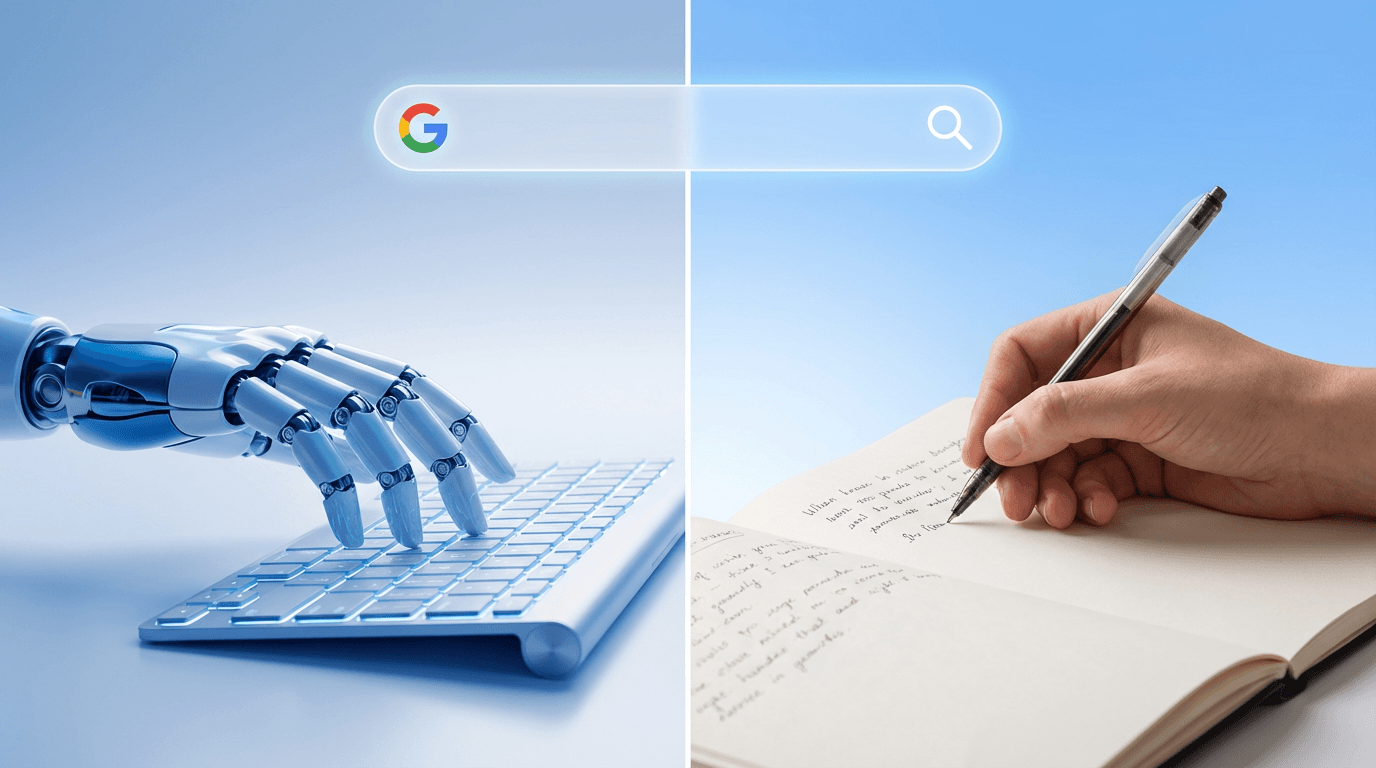
Does Google penalize AI content in 2026? This guide explains what Google actually ranks, where AI content fails, where it excels, and how to build a hybrid workflow that reaches page one.
Every creator and marketer publishing content in 2026 is asking the same question. Will Google penalize my content if I used AI to write it?
The fear is understandable. AI content tools are everywhere. Blog posts, video scripts, social captions, product descriptions. If you are creating content at any scale, AI is probably involved in your workflow somewhere. And every time Google rolls out an update, the same panic spreads across forums and social media. Is AI content safe? Should I disclose it? Will my rankings drop?
Here is the reality. Google does not care whether a human or an AI wrote your content. Google cares whether the content is helpful. That distinction changes everything about how you should think about content creation in 2026.
This guide breaks down what Google actually evaluates, where AI content consistently fails, where it excels, and how to build a content workflow that ranks regardless of how the words were produced.
What Google Has Actually Said About AI Content
Google has been remarkably clear on this topic, but the message keeps getting lost in the noise.
In early 2023, Google published official guidance stating that AI-generated content is not inherently against its guidelines. The key statement was that Google rewards high-quality content, however it is produced. This position has not changed through 2026.
What Google does penalize is content created primarily to manipulate search rankings rather than to help users. That applies equally to AI content and human content. A human writer producing thin, keyword-stuffed articles for the sole purpose of ranking is treated the same way as an AI generating hundreds of low-value pages automatically.
The distinction is not about authorship. It is about intent and quality.
Google's Search Central documentation on helpful content makes this explicit. Content should demonstrate experience, expertise, authoritativeness, and trustworthiness. It should be created for people, not for search engines. And it should provide substantial value compared to other pages in the search results.
None of those criteria mention whether a human typed every word.
The Helpful Content System in 2026
Google's helpful content system evaluates your entire site, not just individual pages. If a significant portion of your content feels unhelpful, thin, or generated without real value, it can drag down the ranking potential of your entire domain.
This is where mass-produced AI content creates problems. Not because it was made by AI, but because when creators use AI to publish hundreds of pages without editing, fact-checking, or adding original value, the site signals low quality at scale.
The helpful content system asks a series of questions that every creator should internalize before publishing anything.
Does the content provide original information, reporting, research, or analysis? Does the content provide substantial, complete, or comprehensive coverage of the topic? Does the content provide insightful analysis or interesting information beyond the obvious? If the content draws on other sources, does it add substantial value rather than simply copying or rewriting?
These questions apply to all content equally. A human-written blog post that simply rephrases the top five Google results adds no more value than an AI-generated post doing the same thing.
The advantage AI gives you is speed. The responsibility you still carry is making that speed produce something genuinely useful.
E-E-A-T in 2026: Why Experience Matters More Than Authorship
E-E-A-T stands for experience, expertise, authoritativeness, and trustworthiness. It is not a ranking factor in the traditional sense. It is a framework that Google's quality raters use to evaluate search results, and it heavily influences how Google's systems are designed to rank content.

The first E, experience, was added in late 2022 and has become increasingly important. Google wants to see evidence that the content creator has actual, firsthand experience with the topic they are writing about.
This is where the AI versus human question actually matters, but not in the way most people think.
AI cannot have experience. It cannot try a product, visit a location, run an experiment, or fail at something and learn from it. But a human using AI to write faster while injecting their own experience into the content produces something that satisfies E-E-A-T completely.
The practical takeaway is straightforward. If you are writing about YouTube growth strategies, include your own channel data, screenshots, and observations from your actual publishing experience. If you are writing about AI image generation, show your own outputs and explain what worked and what did not. If you are writing about a product, describe your hands-on usage.
AI can structure the post, draft sections, suggest frameworks, and handle formatting. But the experience layer has to come from you. That is what makes content trustworthy, and that is what Google is increasingly able to detect and reward.
Posts like the evergreen YouTube video ideas guide perform well because they combine practical frameworks with real creator insights. The structure could be AI-assisted, but the strategic knowledge behind it is what earns trust.
Where AI Content Consistently Falls Short
Understanding the weaknesses of AI content helps you avoid the patterns that Google filters out.
Generic summarization without original insight. AI is extremely good at synthesizing information from its training data. It can produce a well-organized summary of almost any topic in seconds. But summaries alone do not rank well in 2026 because Google already has dozens of summaries for every popular query. What ranks is the post that adds something those summaries miss.
Factual confidence without factual accuracy. AI models generate text that sounds authoritative regardless of whether the information is correct. They can state outdated statistics, misattribute quotes, or present plausible-sounding claims that are simply wrong. Google's systems, combined with user behavior signals, increasingly catch this. If users click your post and find inaccurate information, they leave quickly, and those engagement signals hurt your rankings.
Lack of specificity. AI content tends toward the general. It writes "many creators find that" instead of "in our test of 50 Shorts published daily over 30 days, we found that." Specificity signals experience and builds trust. Vagueness signals the opposite.
Repetitive structure across a site. When every blog post on a site follows the exact same AI-generated template, with the same introduction pattern, the same transition phrases, and the same conclusion format, it creates a detectable pattern. Google's systems can identify when content across a site shares the same structural fingerprint, which is a signal of automated mass production.
Missing the nuance of search intent. AI often produces content that technically covers a topic but misses what the searcher actually wants. If someone searches "is AI content bad for SEO," they want a direct, honest answer with evidence. An AI-generated post that spends 2,000 words giving balanced perspectives without ever committing to a clear answer fails the intent test.
Where AI Content Excels
AI is not just acceptable for content creation. For certain tasks, it produces better results than most humans working alone.

Structural organization. AI is exceptionally good at taking a messy collection of ideas and organizing them into a logical, well-structured outline. Most human writers struggle with structure, which is why so many blog posts meander between topics. AI handles this effortlessly.
First draft speed. Getting from zero to a working first draft is where most of the time goes in content creation. AI eliminates this bottleneck. A first draft that would take a human writer three hours can be generated in minutes, freeing the writer to spend that time on editing, adding examples, and injecting personal experience.
Consistency in formatting and tone. AI maintains a consistent voice and formatting standard across dozens of posts. For brands and creators publishing at scale, this consistency is valuable for both reader experience and brand identity.
Covering comprehensive subtopics. When writing a 3,000-word guide, it is easy to forget important subtopics. AI can help identify gaps in coverage by suggesting sections that a comprehensive guide should include. This results in more thorough content, which Google rewards.
Repurposing and reformatting. Turning a blog post into social media content, email newsletters, or video scripts is a task AI handles extremely well. The new creator stack guide breaks down how modern creators use AI tools to repurpose content across platforms, and this workflow relies heavily on AI's ability to reformat and adapt.
The Hybrid Approach: What Actually Ranks in 2026
The content that consistently reaches the top of Google in 2026 is neither purely AI-generated nor purely human-written. It is a hybrid.
The workflow looks like this for most successful creators and content teams.
Research and intent analysis: Human-led. Understanding what the searcher actually wants, analyzing competing content, and identifying gaps requires human judgment. AI can assist with data gathering, but the strategic decisions about what to cover and how to angle the content come from the creator.
Outline and structure: AI-assisted. Once the strategy is clear, AI can generate a comprehensive outline faster than a human can. The creator reviews, reorders, and adds sections that the AI missed based on their own experience.
First draft: AI-generated. The initial draft is produced by AI based on the approved outline. This is the fastest part of the workflow and the area where AI saves the most time.
Editing and experience injection: Human-led. This is the most important step. The creator goes through the draft and adds personal examples, real data, original screenshots, specific numbers, and honest opinions. They remove generic statements and replace them with specifics. They verify every claim and fix inaccuracies.
Visual content: AI-generated. Blog thumbnails, section images, diagrams, and social share graphics can be produced with AI image generators. The blog thumbnail generation guide explains this workflow in detail. Original visuals produced this way are unique to your content, which is better for SEO than stock photos.
Optimization and formatting: Shared. Final SEO optimization, internal linking, meta tags, and formatting can involve both human decisions and AI assistance. The human decides what to link and how to frame the meta description. AI can suggest improvements.
This hybrid approach produces content faster than a purely human workflow and higher quality than a purely AI workflow. It is the approach that Google implicitly rewards because it results in content that is comprehensive, accurate, experience-backed, and well-structured.
Content Types Where AI Performs Best
Not all content benefits equally from AI assistance. Some formats are particularly well-suited to AI-driven workflows.
Prompt libraries and template posts. Posts that provide copy-paste prompts, templates, or frameworks are ideal for AI-assisted creation. The structure is straightforward, the value is in the templates themselves, and AI can help generate a large volume of high-quality examples. Posts like the AI prompts for YouTube titles guide and the best AI prompts for YouTube thumbnails pack are examples of this format done well.
How-to guides with clear steps. Step-by-step tutorials follow a predictable structure that AI handles well. The creator adds value by ensuring the steps are accurate, complete, and based on real testing.
Comparison and listicle content. Posts that compare tools, strategies, or approaches benefit from AI's ability to organize information systematically. The creator adds value by actually testing what they are comparing.
Repurposed content. Turning existing content into new formats, such as a blog post into a video script or a video into a blog post, is a task where AI is genuinely faster and often better than manual rewriting. Tools like Text2Shorts take this even further by turning text prompts into complete short-form videos automatically.
FAQ and knowledge base content. Straightforward informational content that answers specific questions is well-suited to AI drafting with human review for accuracy.
Content Types Where Human Input Is Non-Negotiable
Some content formats require significant human involvement to rank well and serve readers.

Opinion and analysis pieces. Content that takes a position, argues for a strategy, or analyzes a trend needs a human perspective. AI can provide supporting research, but the opinion itself must be genuine and informed.
Case studies and experience reports. Posts that document real results, experiments, or processes require firsthand experience. AI cannot run your YouTube channel, test your thumbnail strategies, or measure your audience retention. This type of content is the most powerful for E-E-A-T because it is impossible to fake convincingly.
News and trend coverage. Content about recent events, algorithm updates, or industry changes requires human awareness and judgment. AI models have knowledge cutoffs and cannot report on events that happened after their training data. The YouTube Shorts algorithm update for January 2026 is an example of timely content that requires human insight.
Content in YMYL categories. Your Money or Your Life topics, such as health, finance, legal, and safety, receive extra scrutiny from Google. Content in these categories needs demonstrable expertise and accuracy that AI alone cannot guarantee.
Community and relationship-driven content. Content that builds community, responds to audience questions, or engages with reader feedback requires human interaction. AI can draft responses, but the personal connection has to be real.
How to Make AI-Assisted Content That Google Loves
If you are using AI in your content workflow, and in 2026 you probably should be, these practices ensure your content meets Google's quality standards.
Always add something the AI cannot. Before publishing any AI-assisted post, ask yourself what you added that no AI could have generated. If the answer is nothing, the post is not ready. Your experience, your data, your examples, your opinions. These are what make AI-assisted content competitive.
Fact-check everything. AI generates plausible text, not verified text. Every statistic, claim, and recommendation in your content should be verified before publishing. Inaccurate content not only hurts your rankings but damages your credibility with readers who discover the errors.
Edit for voice and specificity. AI-generated text tends to be generic and polished in a way that feels impersonal. Edit to add your natural voice. Replace vague phrases with specific details. Turn "many creators find success with" into "when we tested this approach on three different channels over two months, here is what happened."
Vary your content structure. If every post on your site follows the same format, introduce variation. Some posts should be long-form guides. Others should be prompt packs. Others should be case studies or opinion pieces. Structural variety signals that a human is making intentional editorial decisions.
Include original visual content. AI-generated images that are custom to your content are better for SEO than stock photos. They are unique, relevant, and signal effort. You can create these directly in Miraflow AI's image generator and produce visuals that match your brand and content.
Build topical authority with depth. Google rewards sites that cover a topic comprehensively across multiple posts. Instead of publishing one shallow post about YouTube thumbnails, build a cluster that includes thumbnail styles that get more views, prompt packs for thumbnails, and how-to guides for thumbnail creation. Each post reinforces the others, and the cluster signals deep expertise.
Disclose when it adds value, but do not overthink it. Google does not require you to label content as AI-generated. However, if your audience values transparency, a brief mention of your workflow can build trust. Something like "This post was drafted with AI assistance and reviewed for accuracy" is honest without being distracting.
Visual Content: Why AI-Generated Images Help Rankings
One area where AI unambiguously helps with Google rankings is visual content creation.

Google evaluates the visual quality of your pages. Posts with relevant, original images tend to outperform posts with no images or generic stock photos. This is because original images signal effort and quality, they improve user engagement metrics like time on page, and they provide additional ranking opportunities through Google Image Search.
AI image generators make it possible to create custom visuals for every blog post in minutes. Instead of searching stock photo libraries for something that loosely fits your topic, you can generate an image that is specifically designed for your content.
For blog thumbnails, the workflow is simple. Describe the image you want, generate it, and use it as your featured image. The AI thumbnail styles guide explains how visual consistency across thumbnails builds brand recognition and improves click-through rates.
For section images inside blog posts, AI-generated visuals break up long text and give readers visual anchors. Diagrams, process illustrations, and example images all add value that text alone cannot provide.
The key point for SEO is that these images should be original to your content. Google can detect stock photos that appear across thousands of websites. An AI-generated image created specifically for your post is unique, and uniqueness is a positive signal.
What Google Detects vs What It Does Not
There is a common misconception that Google has an AI content detector that identifies and penalizes AI-written text. This is not how it works.
Google does not run a binary AI detection check on your content. Instead, Google's systems evaluate quality signals that correlate with low-value content, whether that content was written by a human or an AI.
Signals that suggest low-quality content regardless of authorship:
Thin coverage that does not fully answer the search query. High bounce rates and low time on page. Lack of original information or perspective. Repetitive content patterns across the site. Missing E-E-A-T signals such as author information, experience indicators, and source citations. Poor engagement metrics compared to competing pages.
Signals that suggest high-quality content regardless of authorship:
Comprehensive coverage with original insights. Strong engagement metrics, meaning users stay and interact. Clear E-E-A-T signals including author expertise and firsthand experience. Original visual content. Natural internal linking to related, valuable content. Consistent publishing with depth in a specific topic area.
The practical implication is that spending time worrying about whether Google can detect AI writing is wasted energy. Spend that time making the content genuinely better than what currently ranks.
The Role of AI in Video Content and Repurposing
Beyond blog content, AI plays a growing role in the broader content ecosystem that influences search rankings indirectly.
Video content drives traffic from YouTube, social media, and Google's own video search results. Creators who produce both written and video content create more entry points for their audience and more signals of topical authority for Google.
AI makes video creation accessible to creators who previously could not produce video content. Cinematic AI video tools allow creators to generate professional-looking video clips from text prompts. The Veo3 prompt writing guide explains how to craft prompts that produce high-quality results.
Short-form video repurposing is particularly valuable for SEO. A blog post can be turned into multiple short-form videos for YouTube Shorts, Instagram Reels, and TikTok. Each video drives traffic back to the blog and increases the content's total reach. This repurposing workflow is exactly what tools like Text2Shorts are designed for.
The connection to Google rankings is indirect but real. More traffic to your blog from multiple sources improves engagement signals. More content across platforms builds brand recognition, which increases branded search and direct traffic. Both of these factors contribute to stronger rankings over time.
Common Mistakes That Get AI Content Filtered
Even well-intentioned creators make mistakes with AI content that hurt their rankings. Here are the patterns to avoid.
Publishing first drafts without editing. The single most common mistake. An unedited AI draft is almost always too generic to rank competitively. It needs your voice, your examples, and your expertise layered on top.
Scaling quantity without quality controls. Publishing 20 AI-generated posts per week sounds productive until Google's helpful content system flags your site for thin content. Fewer, better posts always outperform many mediocre ones.
Ignoring search intent. AI will happily write a 2,000-word essay when the searcher wants a quick answer. It will produce a listicle when the searcher wants a deep guide. Always check what is currently ranking for your target keyword and match the format.
Using AI-generated content as the only content on a new site. New domains have no established authority. Publishing only AI content on a new site without any demonstration of human expertise makes it very difficult to rank. New sites need to establish trust quickly, which means original, experience-backed content is essential early on.
Skipping visual optimization. AI makes it easier to produce great written content, but many creators forget about visuals. A text-only blog post competes poorly against posts with custom images, diagrams, and thumbnails. Use AI to generate visuals just as you use it to generate text.
Not updating content over time. AI makes it easy to create content but also makes it easy to move on to the next post without maintaining existing ones. Google favors freshness, especially for time-sensitive topics. Schedule regular updates to keep your content competitive.
The Real Test: Would You Bookmark This?
Google's internal quality guidelines include a concept that every creator should internalize. Would a user be satisfied with this page? Would they bookmark it, share it, or return to it?

This test cuts through all the noise about AI versus human content. It does not matter how the content was created. What matters is whether the end result is something a real person would find valuable enough to save.
When evaluating your content before publishing, ask yourself these questions.
Does this post answer the search query more completely than anything else on page one? Does it include at least one insight, example, or resource that the reader cannot find in competing posts? Is every claim accurate and verifiable? Does the post reflect real experience or expertise? Would I personally bookmark this if I found it while searching?
If the answer to any of these is no, the post needs more work before publishing. AI can get you 70 to 80 percent of the way there. The remaining 20 to 30 percent, the part that makes content truly bookmarkable, comes from you.
What This Means for Creators and Marketers in 2026
The AI content debate is largely settled. Google does not penalize AI-generated content. Google penalizes unhelpful content. The distinction matters because it shifts the conversation from "should I use AI" to "how do I use AI to create the most helpful content possible."
For solo creators, AI levels the playing field. You can produce content at a volume and quality that previously required a team. But the competitive advantage is no longer access to AI tools, because everyone has that. The competitive advantage is your experience, your perspective, and your ability to add something original to every piece of content you publish.
For marketing teams, AI accelerates production but does not replace editorial judgment. The teams that outperform in 2026 are the ones that use AI for speed and scale while maintaining human oversight for quality, accuracy, and strategic direction.
For anyone building a content-driven business, the message from Google is consistent. Create content that serves people first. Use whatever tools help you do that better. The content that ranks is the content that deserves to rank, and AI is simply a tool that helps you create it faster.
Conclusion
Google does not prefer human content over AI content. Google prefers helpful content over unhelpful content.
AI-generated posts that are edited, experience-backed, factually accurate, and more comprehensive than competing results rank just as well as, and sometimes better than, purely human-written posts. Purely AI-generated posts published without editing, fact-checking, or original insight get filtered out not because they were made by AI, but because they are not good enough.
The winning approach in 2026 is the hybrid workflow. AI handles structure, first drafts, and visual generation. Humans handle strategy, experience, editing, and quality control. Together, this produces content faster and better than either could alone.
Use AI to eliminate the parts of content creation that slow you down. Then invest the time you save into the parts that only you can do: adding your real experience, verifying accuracy, and making every post genuinely worth bookmarking.
The tools are available. The strategy is clear. What separates creators who rank from those who do not is execution.