YouTube Shorts vs Long-Form in 2026: Which Should You Focus On

Written by
Jay Kim
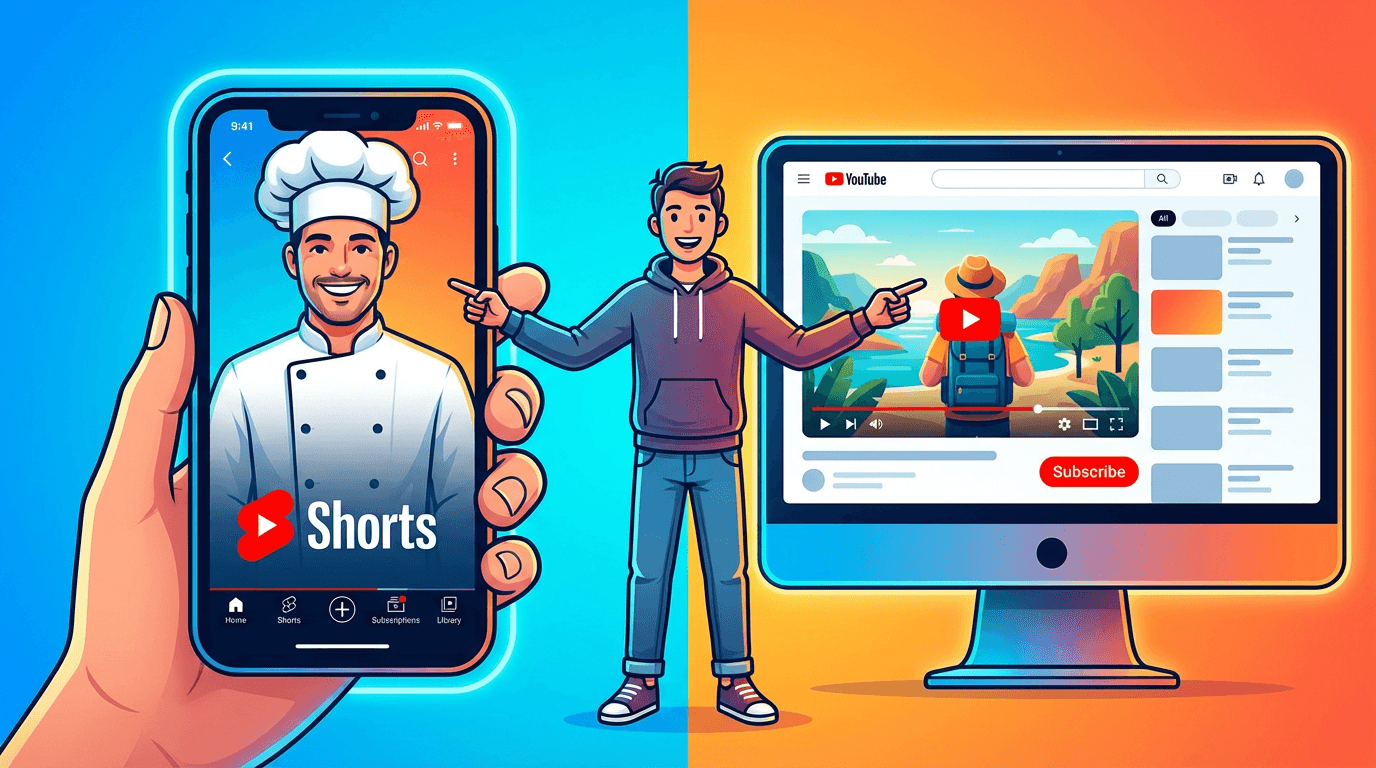
Should you focus on YouTube Shorts or long-form in 2026? This guide compares monetization, growth speed, production effort, and shows how to use both formats together.
Most creators ask this question at some point. Should you spend your time making 30-second Shorts or investing in 10-minute long-form videos? The answer feels like it should be simple, but the reality in 2026 is more nuanced than picking one side.
Some creators go all in on Shorts and build massive subscriber counts but struggle to earn meaningful revenue. Others commit to long-form and produce great content that barely anyone discovers because the algorithm never pushes it to new viewers. And a growing number of creators are realizing that the real advantage comes from understanding how both formats work together rather than treating them as competitors.
This guide breaks down exactly how Shorts and long-form compare in 2026 across discovery, monetization, audience building, production effort, and long-term channel growth. By the end, you will have a clear framework for deciding where to put your time based on your specific goals and situation.
The Core Difference Between Shorts and Long-Form in 2026
YouTube Shorts and long-form videos serve fundamentally different purposes in the YouTube ecosystem. Understanding this distinction is the foundation for making the right decision.
Shorts are a discovery tool. They live in the Shorts feed, where YouTube surfaces content to users who may have never heard of your channel. The swipe-based experience means viewers encounter your content passively. They did not search for you. They did not click a thumbnail. YouTube placed your Short in front of them based on signals like topic relevance, engagement patterns, and viewer history.
Long-form videos are a depth tool. They appear in search results, suggested videos, and the browse feed. Viewers often make an active choice to watch, either by clicking a thumbnail or following a recommendation. This active choice means higher intent, longer watch sessions, and stronger advertiser value.
Neither format is inherently better. They solve different problems. Shorts solve the problem of getting seen. Long-form solves the problem of building a loyal audience that watches, subscribes, and generates revenue.
The creators who grow fastest in 2026 tend to be the ones who understand which problem they need to solve right now and choose the format accordingly.
How YouTube Treats Shorts vs Long-Form in the Algorithm
YouTube does not use a single algorithm. It uses multiple recommendation systems, and Shorts and long-form videos flow through different ones.
The Shorts algorithm primarily looks at engagement within the Shorts feed. Metrics that matter include swipe-away rate (how quickly viewers leave), watch-through rate (whether viewers finish the Short), likes, shares, and comments. The algorithm tests each Short with a small audience first and expands distribution if the engagement signals are strong. The first 3 seconds play an outsized role because that is when most viewers decide whether to keep watching or swipe.
The long-form algorithm cares about different signals. Click-through rate on thumbnails, average view duration, average percentage viewed, session time (whether viewers keep watching more videos after yours), and overall viewer satisfaction all influence how aggressively YouTube recommends a long-form video. Understanding YouTube traffic sources helps clarify how the platform decides which videos to push through Browse, Search, and Suggested.
One important distinction in 2026 is that Shorts and long-form have increasingly separate audience pools. A subscriber gained from Shorts does not automatically become a long-form viewer. YouTube has acknowledged this by providing creators with more detailed analytics that separate Shorts performance from long-form performance. Our guide on YouTube Shorts analytics in 2026 covers how to read these graphs and understand what the numbers actually mean.
This separation has real implications. You cannot assume that building a huge Shorts audience will automatically translate into long-form success. The transition requires deliberate strategy, which we will cover later in this guide.
Monetization: Where the Money Actually Comes From
This is where the difference between Shorts and long-form becomes most dramatic.
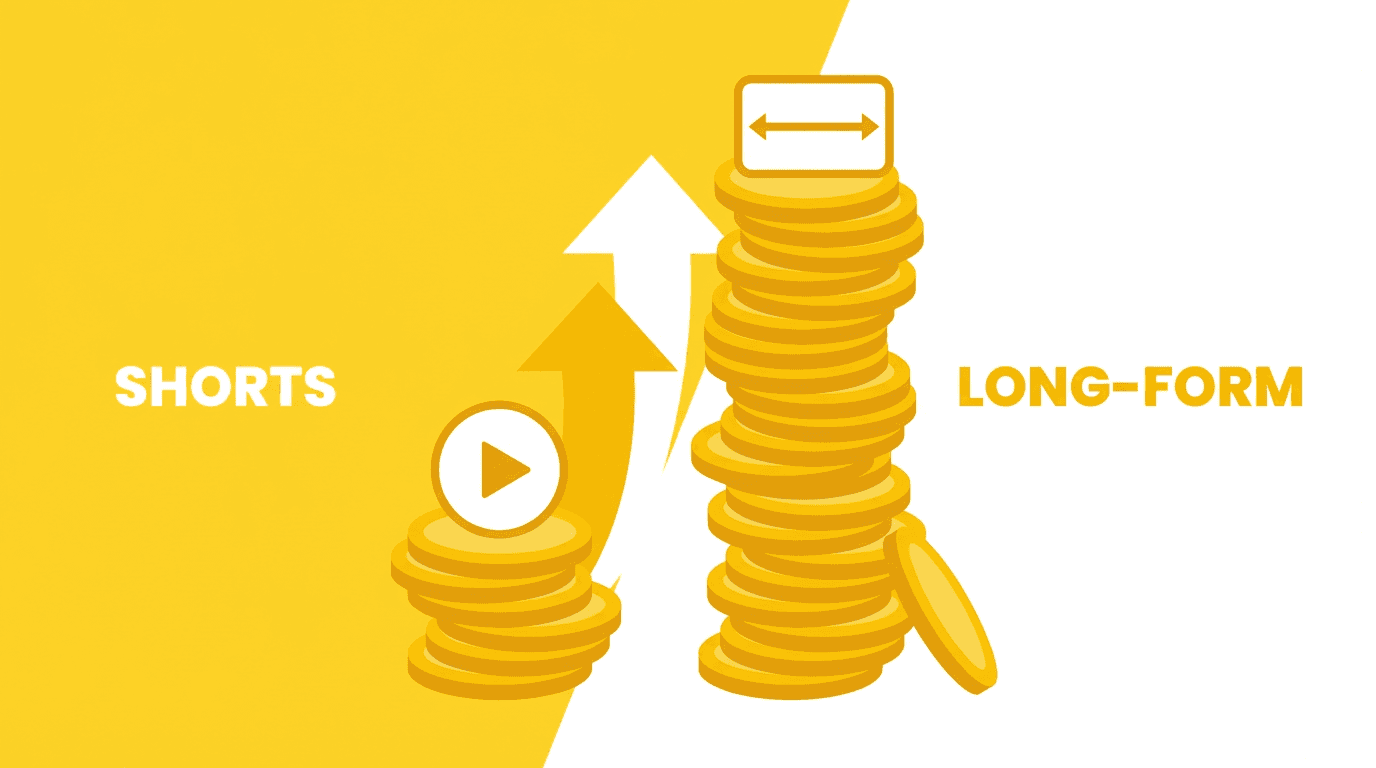
Long-form videos are monetized through ads that play before, during, or after the video. Creators earn a share of ad revenue based on CPM (cost per thousand ad impressions) and RPM (revenue per thousand views). For most niches, long-form RPM ranges from roughly $3 to $30 per 1,000 views, depending on the topic, audience geography, and time of year.
YouTube Shorts use a different monetization model. Revenue comes from a pooled ad fund. Ads run between Shorts in the feed, and the revenue is distributed based on each creator's share of total Shorts views. Creators receive 45% of allocated revenue. In practice, Shorts RPM typically ranges from about $0.01 to $0.25 per 1,000 views, which is dramatically lower than long-form.
To put this in practical terms, a long-form video with 100,000 views in a decent niche might earn $500 to $2,000 in ad revenue. A Short with 100,000 views in the same niche might earn $5 to $25. The difference is not small. It is an order of magnitude.
This does not mean Shorts are useless for revenue. Shorts can accumulate views at a much faster rate than long-form. A creator posting daily Shorts can rack up millions of views per month that a long-form creator might never reach. But even with that volume advantage, Shorts revenue alone rarely matches what consistent long-form content generates.
For a detailed breakdown of what Shorts actually pay across different niches, check our guide on YouTube Shorts monetization in 2026.
The strategic takeaway is clear. If your primary goal is ad revenue, long-form is the stronger format. If your goal is visibility and audience growth that you can monetize through other means (products, services, sponsorships, affiliate links), Shorts become much more attractive.
Discovery and Growth Speed
When it comes to getting discovered by new viewers, Shorts have a significant advantage in 2026.
The Shorts feed is designed for exploration. YouTube actively pushes Shorts to users who are not subscribed to the creator. This means a brand new channel with zero subscribers can post a Short and have it shown to thousands or even hundreds of thousands of people if the content resonates.

Long-form content has a harder path to discovery for new channels. Without existing subscribers, watch history, or search authority, a new long-form video is competing against established channels for suggested video placements and browse feed spots. It can take months of consistent publishing before YouTube's algorithm starts reliably recommending a new channel's long-form content.
This is why many creators in 2026 use Shorts as their entry point. They build initial awareness, test what topics resonate, and gather subscribers before investing the heavier production effort that long-form requires.
The speed difference is real. A creator posting daily Shorts can reach 1,000 subscribers (the threshold for monetization) significantly faster than a creator posting weekly long-form videos. Some Shorts-focused creators hit 1,000 subscribers within their first month. Most long-form-only creators take three to six months or longer to reach the same milestone.
However, speed of subscriber growth does not always equal quality of subscriber growth. This is one of the most misunderstood aspects of the Shorts vs long-form debate, and it is worth exploring in detail.
The Subscriber Quality Problem
Gaining subscribers through Shorts is faster, but those subscribers often behave differently than subscribers gained through long-form content.
When someone subscribes after watching a long-form video, they made a deliberate choice. They invested 8, 12, or 20 minutes of their time watching your content. They liked it enough to want more. These subscribers tend to return, watch future videos, and engage consistently.
When someone subscribes after watching a Short, the commitment was much smaller. They watched 30 seconds, maybe tapped the subscribe button, and moved on. Many of these subscribers do not return for future content, especially if that future content is in a different format.
This creates a pattern that frustrates many Shorts-focused creators. They see subscriber counts climb quickly but notice that their long-form videos (when they finally make them) get disappointing view counts relative to their subscriber base. Our analysis of why YouTube Shorts get views but no subscribers explains the mechanics behind this disconnect and what you can do about it.
The solution is not to avoid Shorts. It is to set expectations correctly and build a transition strategy. If you plan to eventually create long-form content, start introducing longer Shorts, use end screens to point viewers toward your longer videos, and make sure your long-form content delivers on the same topics and tone that attracted your Shorts audience.
Production Effort and Time Investment
The production requirements for Shorts and long-form are vastly different, and this difference matters more than most creators acknowledge.
A single long-form video typically requires topic research, scripting, filming or visual creation, editing, sound design, thumbnail creation, title optimization, and description writing. Even for an efficient creator, a polished 10-minute video can take anywhere from 4 to 15 hours depending on the complexity and niche.
A single Short can be produced in 15 minutes to an hour. The script is shorter, the editing is simpler, and the overall scope is much smaller. Some creators using AI-powered workflows can produce multiple Shorts per day.
This means you can test five or six Short ideas in the time it takes to produce one long-form video. That testing advantage is enormously valuable for learning what your audience responds to, what hooks work, what topics generate engagement, and what formats perform best.
For creators who are early in their journey, this speed advantage alone can justify focusing on Shorts first. You learn faster because you get more feedback loops per unit of time. Every Short is a small experiment. Post it, see how the algorithm responds, analyze the retention curve, and adjust.
The production equation has shifted even further in 2026 thanks to AI-powered content creation tools. Creators can now generate scripts, visuals, voiceovers, and complete short-form videos from a single topic using workflows like Text2Shorts, which turns a prompt into a finished vertical reel with narration and visuals handled automatically. This makes daily Shorts production sustainable even for solo creators.
Watch Time and Session Time
YouTube cares deeply about keeping viewers on the platform. This is where long-form content has a structural advantage that Shorts cannot replicate.
A 12-minute long-form video where the viewer watches 8 minutes contributes 8 minutes of watch time. A 30-second Short where the viewer watches the entire thing contributes 30 seconds. Even if a creator's Short gets 10 times the views of their long-form video, the total watch time from long-form is likely higher.
Watch time matters because it is one of the core signals YouTube uses to evaluate a channel's value to the platform. Channels that generate significant watch time tend to receive more favorable algorithmic treatment over time, especially for long-form recommendations.
Session time adds another layer. If your long-form video leads viewers to watch another video (yours or someone else's), YouTube counts that as a positive signal. Videos that start long viewing sessions get boosted in recommendations. Our guide on YouTube session time in 2026 explains how to structure content that keeps viewers watching.
Shorts contribute to session time differently. A viewer who watches multiple Shorts in a row generates session time for the Shorts feed, not for your channel specifically. This means the session time benefit of Shorts is distributed across all Shorts creators rather than concentrated on your channel.
For channels that want to build long-term algorithmic authority on YouTube, long-form content is still the stronger vehicle. Shorts help you get found. Long-form helps you build the watch time foundation that YouTube rewards with sustained recommendations.
Search Traffic and Evergreen Value
Long-form content has a major advantage that Shorts cannot match in 2026: search traffic.
YouTube is the second largest search engine in the world. When someone types a question or topic into the YouTube search bar, the results are almost entirely long-form videos. Shorts occasionally appear in search, but they are not the primary format YouTube surfaces for search queries.
This means a well-optimized long-form video can continue generating views from search traffic for months or even years after publishing. A video titled "How to Set Up a Home Studio for Under $500" can rank in search and attract viewers indefinitely as long as the content remains relevant.
Shorts, by contrast, have a much shorter lifespan. Most Shorts get the majority of their views within the first 48 to 72 hours. After that initial push, view counts taper off sharply unless the Short gets picked up by the algorithm again later.
There are exceptions. Some Shorts in highly searched niches continue to get trickles of views over time. But the pattern is clear: long-form dominates for evergreen content that compounds over time, while Shorts are better suited for trend-driven, high-volume content that captures attention in the moment.
If you want to build a library of content that works for you while you sleep, long-form is the format that makes that possible.
When Shorts Make More Sense
Despite the monetization and search advantages of long-form, there are clear situations where focusing on Shorts is the smarter choice in 2026.
If you are a brand new channel with zero audience, Shorts are the fastest path to visibility. The algorithmic barrier to entry is lower. You do not need thumbnails that compete with established creators. You do not need 10 minutes of polished content. You need 30 to 60 seconds of engaging content on a topic people care about.
If you want to test content ideas before committing heavy production effort, Shorts are ideal. You can test 20 different topics and angles in the time it would take to produce four long-form videos. The ones that perform well in Shorts are strong candidates for long-form expansion.
If your business model does not depend on ad revenue, Shorts become even more attractive. Creators who sell products, offer services, run coaching programs, or earn through affiliate links can use Shorts purely for reach and funnel viewers toward their offers. The low RPM does not matter when the Short serves as a marketing tool rather than a revenue source.
If you are in a visually driven niche where short, punchy content naturally fits (cooking, fitness, fashion, DIY, pet content, AI tools), Shorts can be your primary format without feeling forced.
And if your goal is to build a presence on multiple platforms simultaneously, Shorts content can be repurposed for Instagram Reels and TikTok with minimal changes, effectively tripling your distribution from a single piece of content.
When Long-Form Makes More Sense
Long-form content is the better focus when your goals are centered on depth, revenue, and long-term channel authority.
If you want to maximize ad revenue, long-form is not optional. The RPM gap between Shorts and long-form is so large that even modest long-form view counts will typically out-earn high Shorts view counts. A channel getting 50,000 long-form views per month in a mid-tier niche can earn more in ad revenue than a channel getting 2 million Shorts views in the same niche.
If your content naturally requires explanation, context, or narrative, long-form is the right home. Tutorial channels, educational content, documentary-style videos, in-depth reviews, and storytelling formats all need room to breathe. Compressing them into 60 seconds strips away the value.
If you want to build deep audience loyalty, long-form creates stronger bonds. Viewers who spend 15 minutes with your content feel a connection to your channel that a 30-second Short cannot replicate. That loyalty translates into higher return rates, more comments, more shares, and more willingness to support you through memberships or products.
If you want to rank in YouTube search and build a library of evergreen content, long-form is the only realistic path. Search-optimized long-form videos can drive consistent traffic for years with no additional effort after publishing.
If you are already monetized and want to grow revenue, doubling down on long-form while maintaining a Shorts presence is almost always the higher-leverage strategy.
The Hybrid Strategy: How to Use Both Formats Together
The most effective YouTube strategy in 2026 is not Shorts or long-form. It is Shorts and long-form working together deliberately.

Here is how the hybrid approach works in practice.
Use Shorts for discovery and testing. Post Shorts consistently (daily or near-daily) to build visibility, test topics, and attract new viewers. Each Short is a small experiment that tells you what your audience responds to. When a Short performs unusually well, that topic is a strong candidate for a full long-form video.
Use long-form for depth and monetization. Take the topics and angles that proved successful in Shorts and expand them into comprehensive long-form videos. These videos earn significantly more per view, build watch time, and rank in search. They become the backbone of your channel's revenue.
Use Shorts to promote long-form content. After publishing a long-form video, create a Short that teases or summarizes a key insight from it. This drives Shorts viewers toward your long-form content and bridges the gap between the two audiences.
Use long-form to build authority that benefits Shorts. As your long-form content ranks in search and builds subscriber loyalty, the subscribers you gain are more likely to engage with your Shorts as well. A strong long-form library creates a foundation that makes every piece of content, including Shorts, perform better.
This feedback loop is what separates channels that grow sustainably from channels that spike and stall.
Content Calendars That Balance Both Formats
Planning is where most creators struggle with the hybrid approach. Producing daily Shorts and weekly long-form videos sounds great in theory, but it can quickly lead to burnout if the workflow is not efficient.
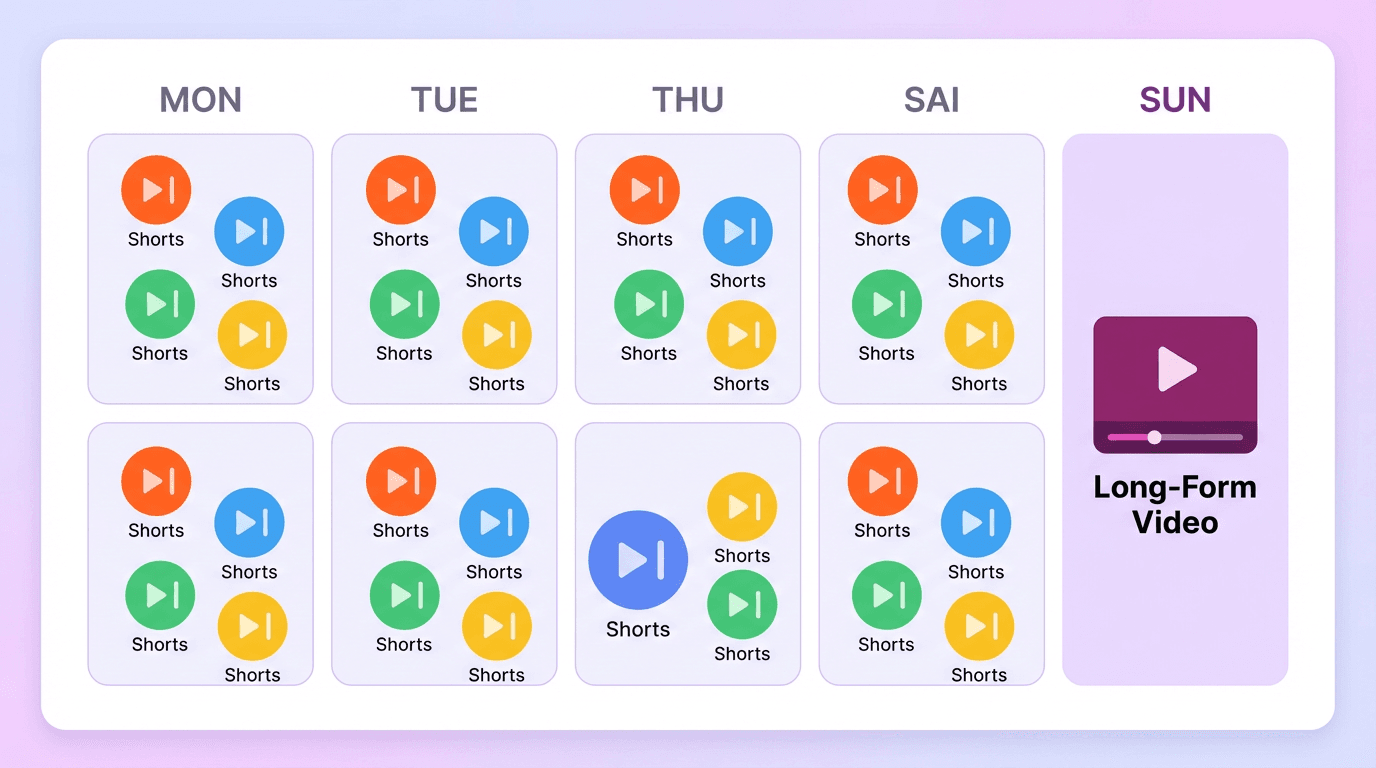
A realistic content calendar for a solo creator in 2026 might look like this.
For a Shorts-first creator building toward long-form: Post 5 to 7 Shorts per week. Publish 1 long-form video every two weeks. Use Shorts performance data to choose long-form topics. Gradually increase long-form frequency as your production process improves.
For a long-form creator adding Shorts: Publish 1 to 2 long-form videos per week. Post 3 to 5 Shorts per week, repurposing clips or key moments from long-form content. Use Shorts to drive traffic back to long-form videos.
For a balanced hybrid creator: Publish 1 long-form video per week. Post 5 Shorts per week. Alternate between original Shorts and Shorts derived from long-form content.
The key is to avoid letting one format cannibalize your energy for the other. If producing Shorts takes so much time that your long-form quality drops, you need to streamline the Shorts workflow. AI-powered tools can help significantly here. Creators can generate Shorts visuals, scripts, and background music within Miraflow AI, reducing production time per Short from an hour to minutes. The AI Music Generator can produce copyright-free background tracks, while the YouTube Thumbnail Maker handles visuals for long-form video thumbnails in a single prompt.
For a structured plan that maps out your first month, our 30-day YouTube Shorts plan for 2026 provides a day-by-day calendar designed to work alongside long-form production.
Common Mistakes When Choosing Between Shorts and Long-Form
Several patterns consistently hold creators back when they try to navigate this decision.
The first mistake is going all in on Shorts and never transitioning to long-form. Shorts are a powerful growth tool, but relying on them exclusively caps your revenue potential and makes your channel dependent on the Shorts algorithm. If YouTube changes how Shorts are distributed (which has happened before), channels without a long-form foundation are vulnerable.
The second mistake is dismissing Shorts entirely because the RPM is low. Judging Shorts purely on direct ad revenue misses the point. Shorts are a marketing channel. The ROI comes from the subscribers, brand deals, product sales, and long-form traffic they generate, not from the Shorts RPM alone.
The third mistake is producing Shorts and long-form videos that feel completely disconnected. If your Shorts are about AI tools and your long-form videos are about cooking, the audiences do not overlap. Subscribers from one format will not engage with the other. Consistency in topic and tone across both formats is essential for the hybrid strategy to work.
The fourth mistake is ignoring Shorts analytics. Many creators post Shorts and never look at the data. Understanding which Shorts had the highest watch-through rate, which topics drove the most profile visits, and which ones converted viewers to subscribers is critical for making informed decisions about long-form topics. If your analytics feel confusing, you might also want to check whether your videos are getting 0 views for fixable reasons.
The fifth mistake is not optimizing thumbnails for long-form because you are used to the Shorts workflow. Long-form success depends heavily on click-through rate, and CTR depends heavily on thumbnails. Good YouTube CTR benchmarks for 2026 give you a reference point for how your thumbnails should perform. Shorts creators who transition to long-form often underestimate how much thumbnail quality matters.
How AI Changes the Shorts vs Long-Form Decision
One of the biggest shifts in 2026 is that AI tools have dramatically reduced the production cost of both formats, but the impact on Shorts is particularly significant.
Creating a Short used to require filming, editing, adding captions, selecting music, and exporting. That process took 30 minutes to an hour per Short, which made daily posting a serious time commitment.
Now, creators can generate complete Shorts from a topic using AI workflows that handle script writing, visual generation, voice narration, and music in a single pipeline. This makes daily Shorts publishing realistic for solo creators who previously could not sustain that pace.
For long-form content, AI assists with research, scripting, B-roll generation, and thumbnail creation. These tools save time but do not eliminate the need for the creator's expertise, personality, and editorial judgment. Long-form content still requires a human touch to maintain quality, especially for building the kind of audience connection that drives loyalty.
The practical implication is that AI tools make the hybrid strategy more accessible than ever. You no longer need to choose between Shorts and long-form because you lack the bandwidth for both. With the right tools, producing five Shorts per week and one long-form video per week is achievable even as a solo creator.
A Decision Framework Based on Your Goals
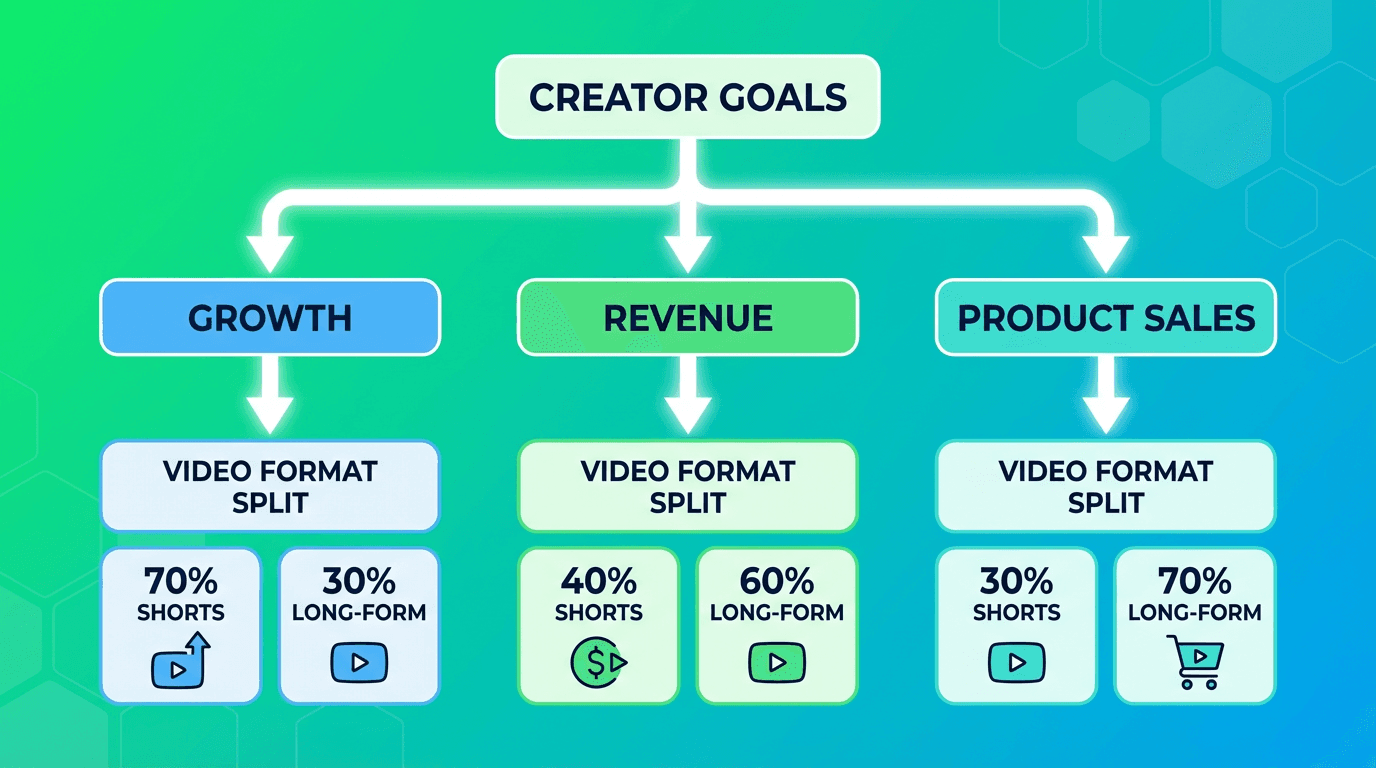
Rather than giving a single answer to the Shorts vs long-form question, here is a framework that matches your focus to your specific goals.
If your primary goal is to get discovered quickly and build an initial audience, focus 80% of your effort on Shorts and 20% on planning your long-form strategy. Post daily Shorts. Use the data to learn what resonates. Start working on your first long-form videos once you have a sense of your audience.
If your primary goal is to maximize ad revenue, focus 70% on long-form and 30% on Shorts. Your long-form videos will drive the majority of your revenue. Use Shorts as supplementary content that feeds viewers into your long-form catalog.
If your primary goal is to sell a product, service, or course, focus on whichever format converts better for your audience. For many product-based businesses, Shorts work well as top-of-funnel awareness tools. Test both and track which format drives more clicks to your offers.
If your primary goal is to build a sustainable creator career, aim for a balanced hybrid approach as quickly as possible. Start with Shorts to build momentum, then introduce long-form within the first one to two months. Long-term, a healthy channel has both formats contributing to growth.
If your primary goal is to dominate search in your niche, focus almost entirely on long-form. Search-optimized videos build compounding traffic over time. Add Shorts as a secondary distribution layer.
What the Data Actually Shows in 2026
While specific earnings and view count numbers vary by niche, audience, and content quality, some general patterns are consistent across YouTube in 2026.
- Channels that post both Shorts and long-form videos tend to grow faster in total subscribers than channels using only one format. The discovery advantage of Shorts combined with the retention advantage of long-form creates a compounding growth effect.
- Channels that post only Shorts tend to have higher subscriber counts but lower revenue per subscriber. The audience is larger but less engaged on average.
- Channels that post only long-form tend to have lower subscriber counts but higher revenue per subscriber and more consistent watch time. The audience is smaller but more committed.
The revenue sweet spot for most creators is a channel where long-form content generates the primary income and Shorts serve as the primary growth engine. This combination maximizes both reach and revenue.
YouTube itself has been signaling this direction. Recent algorithm updates have improved how Shorts viewers transition to long-form content from the same creator. The YouTube Shorts algorithm update in January 2026 included changes to how Shorts appear on channel pages and search results, making it easier for Shorts viewers to discover a creator's long-form library.
Conclusion
The Shorts vs long-form debate in 2026 is not really a debate at all. Both formats serve distinct purposes, and the most successful creators use them together strategically.
Shorts win on discovery speed, production efficiency, and multi-platform distribution. Long-form wins on monetization, search traffic, audience depth, and long-term channel authority. Neither format replaces the other.
If you are just starting out, begin with Shorts. Learn fast, build an audience, and figure out what your viewers respond to. Then introduce long-form content to deepen that relationship and unlock higher revenue.
If you already have a long-form channel, adding Shorts is one of the highest-leverage moves you can make for growth. You already have topics, expertise, and content that can be condensed into short-form clips.
The format you choose matters less than the consistency you bring to it. A creator who posts three Shorts per week and one long-form video per month will outperform a creator who makes one perfect piece of content every two months. Start with what you can sustain, then expand as your workflow becomes more efficient.
The tools exist to make both formats manageable. The strategy is clear. The only variable left is execution.
Frequently Asked Questions About YouTube Shorts vs Long-Form in 2026
Should I focus on YouTube Shorts or long-form videos in 2026?
It depends on your main goal. If you want faster discovery and quicker audience growth, YouTube Shorts usually make more sense. If you want stronger ad revenue, deeper audience loyalty, and more evergreen search traffic, long-form is usually the better focus. For many creators in 2026, the strongest strategy is not choosing only one, but using both formats together.
Are YouTube Shorts better than long-form for growing a channel?
YouTube Shorts are generally better for getting discovered quickly because the Shorts feed pushes content to people who may have never seen your channel before. Long-form is slower for discovery, especially for new creators, but it tends to build a more loyal audience over time. Shorts grow reach faster, while long-form grows depth more effectively.
Do YouTube Shorts make less money than long-form videos?
Yes, in most cases YouTube Shorts make much less money per view than long-form videos. Shorts monetization works through a pooled revenue model, while long-form videos benefit from traditional ad placements with much higher RPMs. That means long-form usually wins by a wide margin if your main goal is ad revenue.
Why do YouTube Shorts get more views but less revenue?
Shorts are built for fast distribution and broad discovery, so they often get many more impressions and views. But the monetization model is less favorable, and the viewer commitment is much lower. Long-form videos usually get fewer views, but each view is more valuable because of higher advertiser value, longer watch time, and stronger monetization mechanics.
Do Shorts subscribers watch long-form videos?
Not always. One of the biggest issues creators run into is that Shorts and long-form audiences often behave differently. A person who subscribes after watching a 30-second Short does not automatically become someone who will watch a 10-minute video. That is why creators often need a deliberate strategy to move Shorts viewers into their long-form content.
Is long-form still worth it in 2026 with how big Shorts are?
Yes, long-form is still extremely valuable in 2026. Long-form remains stronger for ad revenue, search traffic, watch time, audience loyalty, and evergreen growth. Shorts may be dominating discovery, but long-form is still the format that usually creates the strongest long-term business and channel foundation.
When should you focus more on YouTube Shorts?
Shorts make the most sense when you are a new creator, when you want to test ideas quickly, when your niche fits short punchy content, or when your business model depends more on attention than direct ad revenue. Shorts are also a strong choice when you want to grow across multiple platforms because the same content can often be repurposed for Reels and TikTok.
When should you focus more on long-form YouTube videos?
Long-form makes more sense when your goal is higher revenue, deeper education, stronger trust, better search rankings, or long-term channel authority. It is especially valuable if your content needs explanation, storytelling, context, or step-by-step teaching. Long-form is also the better format if you want content that can continue bringing in views for months or years.
Is a hybrid strategy better than only doing Shorts or only doing long-form?
For many creators, yes. A hybrid strategy lets Shorts handle discovery and topic testing, while long-form handles monetization and deeper audience building. This gives you the speed advantage of Shorts and the business advantage of long-form. Many creators in 2026 are finding that this combination is more sustainable than relying on only one format.
Can YouTube Shorts help long-form videos grow?
Yes, Shorts can help long-form growth when they are used deliberately. A Short can introduce a topic, tease a bigger idea, or bring new viewers onto your channel. But that only works well when your Shorts and long-form videos feel connected in topic and tone, and when the viewer can clearly see what to watch next.
Is it a mistake to only post YouTube Shorts?
It can be. Going all in on Shorts can grow subscribers fast, but it often limits your revenue and leaves your channel more dependent on the Shorts algorithm. Many creators eventually realize they need long-form content if they want stronger monetization and a more stable long-term content business.
What is the best content strategy for most YouTube creators in 2026?
For most creators, the best strategy is to use Shorts as the growth engine and long-form as the revenue and authority engine. Shorts help you get seen, test ideas, and attract new viewers. Long-form helps you build trust, rank in search, increase watch time, and generate more meaningful revenue. That balance is often the most practical path in 2026.