
TikTok Algorithm 2026: What Creators Need to Know

Written by
Jay Kim
TikTok's algorithm decides who sees your content before your followers ever do. This guide breaks down how the For You Page works in 2026, what signals actually matter, and what most creators get wrong about reach.
You post a TikTok. It gets 300 views. You post another one the next day using the same format, same niche, same effort. It gets 47,000 views. You have no idea what changed.
This is the experience that frustrates TikTok creators more than anything else. The algorithm feels random, unpredictable, and impossible to reverse-engineer. Some videos explode for no obvious reason. Others die quietly even when the content feels objectively better.
The algorithm is not random. It follows a set of signals and processes that, once you understand them, make the platform far more predictable. Not perfectly predictable, because audience behavior always has variance, but predictable enough to build a content strategy around.
The problem is that most advice about the TikTok algorithm is outdated, vague, or based on assumptions that were never accurate in the first place. Posting at the right time, using trending sounds, and adding the right hashtags are all things creators obsess over. None of them are what the algorithm actually prioritizes.
This guide explains how TikTok's recommendation system works in 2026, what signals drive distribution, what has changed from earlier years, and what practical decisions you can make to create content the algorithm consistently rewards.
How the TikTok Algorithm Actually Works
TikTok's algorithm is a recommendation engine. Its job is to predict which videos a specific viewer will find interesting and then serve those videos on the For You Page. Every time you open TikTok and start scrolling, the algorithm is making thousands of predictions in real time about what will keep you watching.
This is fundamentally different from a subscription-based feed. On platforms that prioritize followers, your content goes to people who already chose to see it. On TikTok, most of your views come from people who have never seen your content before. The algorithm decides whether those new viewers get your video, not your follower count.
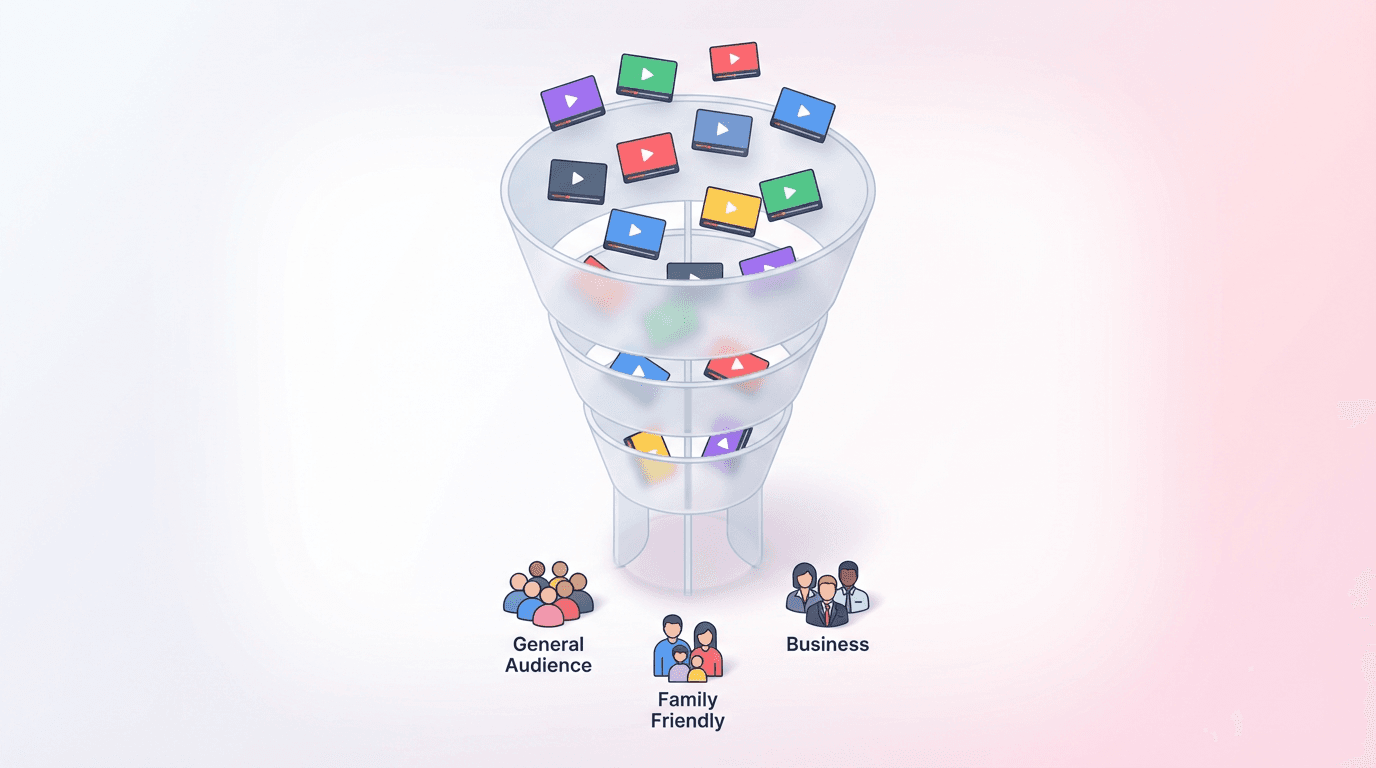
The way this works in practice is a staged distribution model. When you publish a video, TikTok shows it to a small initial group. This group is selected based on the video's content signals, your account's recent performance patterns, and predictions about which types of viewers might respond well. If that small group engages positively, TikTok expands distribution to a larger audience. If that larger audience also responds well, the video keeps scaling. If engagement drops at any stage, distribution slows or stops.
This staged model is remarkably similar to how YouTube Shorts and Instagram Reels work. The specific signals each platform weighs differ in degree, but the core mechanic of test, measure, expand or suppress is shared across all major short-form platforms. We cover how this same model works on the YouTube side in our breakdown of how the YouTube Shorts algorithm responds to daily uploads, and many of the same principles apply here.
TikTok's official documentation confirms that the For You feed recommends content based on a combination of factors including user interactions, video information, and device and account settings. Their explanation of the For You feed provides a useful baseline for understanding the recommendation system's inputs.
The Signals That Drive the For You Page
TikTok's recommendation system evaluates multiple signals when deciding whether to expand a video's reach. Understanding which signals carry the most weight helps you focus your effort on what actually matters instead of optimizing for things that barely move the needle.
The most important signal is watch time relative to video length. TikTok measures not just whether someone watched your video, but what percentage of the video they watched. A viewer who watches a 15-second video all the way through and loops it sends a much stronger signal than a viewer who watches 3 seconds of a 60-second video and swipes away. This is why completion rate is the single most influential metric on the platform.
The second most important signal is replay rate. When viewers watch your video more than once, TikTok interprets that as strong content quality. Replays are weighted heavily because they represent voluntary re-engagement. The viewer already saw the content and chose to see it again. That behavior is hard to fake and impossible to manufacture through metadata tricks.
Engagement actions make up the third tier of signals. Likes, comments, shares, saves, and follows all contribute to distribution decisions. Among these, shares carry the most weight because sharing is the highest-effort engagement action. A viewer who shares your video to a friend or reposts it is actively distributing your content on your behalf. Saves are the next strongest signal because saving indicates the viewer found enough value to want to return to the content later. Comments and likes matter but are weighted less heavily than shares and saves.
The fourth signal category is negative feedback. Swipe-away speed, marking content as not interested, and hiding a creator's content all send suppressive signals. A high early swipe-away rate, meaning viewers leave within the first one to two seconds, is one of the fastest ways to kill a video's distribution. This is the same mechanic that governs the first few seconds of YouTube Shorts, which we explore in depth in our guide on why the first 3 seconds matter. The principle translates directly to TikTok.
The fifth signal is content categorization. TikTok uses visual recognition, audio fingerprinting, text analysis, and on-screen text detection to classify what your video is about. This classification determines which audience segments see your video during the initial test phase. Accurate categorization means your video reaches viewers who are predisposed to enjoy that type of content, which improves initial engagement rates and increases the chance of broader distribution.
Content Graph vs. Social Graph: Why This Matters
One of the most important things to understand about TikTok is that it operates primarily on a content graph rather than a social graph.
A social graph platform prioritizes connections. You see content from people you follow, and your content goes to your followers first. Facebook and Twitter historically operated this way. A content graph platform prioritizes content matching. You see content that the algorithm predicts you will enjoy, regardless of whether you follow the creator.
TikTok is the purest content graph platform among the major social apps. This means that a creator with 500 followers can get more views than a creator with 500,000 followers on any given video, if the content itself performs better in testing. Follower count provides a slight advantage during the initial distribution phase because TikTok may include some of your followers in the test group, but it is not the deciding factor.
This content-first approach has two major implications for creators. The first is that every video is essentially a fresh start. Past performance helps TikTok refine its predictions about your content, but a single underperforming video does not permanently tank your reach, and a single viral video does not guarantee future success. Each video is evaluated largely on its own merits.
The second implication is that content quality and audience alignment matter more than growth hacking tactics. On a social graph platform, building a large follower base gives you a distribution advantage. On a content graph platform, the distribution advantage comes from consistently producing content that a specific audience responds to. Your energy is better spent understanding what your target audience wants to watch than trying to accumulate followers through follow-for-follow tactics or engagement pods.
Research from the Reuters Institute for the Study of Journalism has documented the broader industry shift from social graph platforms toward interest-based content graph platforms, with TikTok leading that transition and other major platforms following.
What Changed in 2026
TikTok's core recommendation architecture has remained stable, but the platform has made several adjustments that affect how creators experience distribution.
The first notable shift is increased emphasis on longer watch sessions. TikTok has been gradually rewarding content that keeps viewers on the platform longer. This does not necessarily mean longer videos perform better. A 15-second video that loops three times keeps a viewer engaged for 45 seconds, which is a stronger session signal than a 60-second video where the viewer leaves at the 20-second mark. But it does mean that content which contributes to extended browsing sessions gets a distribution advantage. Videos that lead viewers to watch more content afterward, whether from the same creator or within the same topic cluster, are rewarded.
The second shift is stronger content diversity in the For You Page. TikTok has made adjustments to reduce repetitive content and surface a wider range of creators to each viewer. For individual creators, this means competition for attention on the For You Page is higher. Your video is not just competing against similar content. It is competing against a deliberately diverse set of videos that TikTok is testing against each viewer's attention.
The third shift is more sophisticated content categorization. TikTok's ability to understand what a video is about has improved significantly. The platform now analyzes visual elements, spoken words, on-screen text, audio characteristics, and even editing patterns to classify content. This means your video's actual substance matters more than ever. You cannot trick the categorization system with misleading captions or trending sounds that do not match the content.
These changes collectively push the algorithm further toward rewarding genuine audience satisfaction. Tactics that once provided short-term boosts, like engagement bait or misleading hooks, are less effective than they were even a year ago.
How TikTok Differs from YouTube Shorts and Instagram Reels
If you are creating short-form content across multiple platforms, understanding the differences between each algorithm helps you tailor your approach instead of blindly cross-posting.
TikTok's algorithm gives the most weight to completion rate and replay behavior. YouTube Shorts weighs viewer satisfaction signals broadly, including metrics like survey responses and long-term subscriber behavior. Instagram Reels leans more heavily on social engagement and relationship signals because of its integration with the broader Instagram social graph.
On TikTok, a video from a brand new account with no followers can reach millions of viewers if the content performs well in testing. On YouTube Shorts, having an existing subscriber base provides a more noticeable initial distribution advantage. On Instagram Reels, content from accounts that viewers already interact with tends to get preferential placement.
The practical takeaway is that TikTok is the most meritocratic platform for new creators. Your content quality is evaluated almost independently of your account status. This makes it the best platform for testing content ideas quickly because the feedback loop between publishing and seeing results is shorter and less influenced by historical account performance.
For creators producing across all three platforms, the new creator stack for Shorts, Reels, and TikTok covers how to build efficient multi-platform workflows without burning out on manual editing for each one.
The Hook Problem: Why Most TikToks Fail in Two Seconds
The single biggest reason TikToks underperform is a weak opening. When a viewer's thumb is hovering over the screen and they are making split-second decisions about what to watch and what to skip, your video has roughly one to two seconds to justify its existence.
This is not an exaggeration. TikTok's swipe-away data shows that the majority of the audience decides whether to keep watching within the first moments of a video. If the opening does not create curiosity, show something visually interesting, or make a compelling statement, the viewer swipes and your video never gets a chance to demonstrate its value.
Strong hooks share common characteristics. They introduce tension, novelty, or a question that the viewer wants answered. They are visually dynamic rather than static. They get to the point immediately without preamble or setup. A video that opens with "Hey guys, so today I wanted to talk about something interesting" is already losing viewers compared to a video that opens by showing the interesting thing directly.
This hook-first approach is not just a TikTok principle. It applies across every short-form platform, and it is the single most impactful thing a creator can improve. Creators who focus on crafting better openings see more consistent distribution than creators who focus on hashtags, posting times, or trend-chasing.
Video Length Strategy for TikTok in 2026
TikTok now supports videos up to 10 minutes, but that does not mean longer videos perform better. The optimal length depends entirely on whether the content justifies the duration.
The completion rate dynamic is what governs length strategy. A 12-second video that most viewers watch to the end and replay will outperform a 3-minute video where most viewers leave after 30 seconds. The algorithm does not reward length. It rewards the relationship between length and viewer retention.
For most creators, especially those building an audience, shorter videos between 15 and 45 seconds tend to perform best because they naturally achieve higher completion rates. Every second of video is a second where a viewer might decide to swipe away. Shorter content reduces the number of opportunities for viewers to lose interest.
That said, there are formats where longer content works. Storytelling videos, tutorials with clear step-by-step value, and narrative content can hold attention for 60 seconds or more when the pacing is right. The key is that every moment of the video needs to be earning the viewer's continued attention. Dead space, unnecessary introductions, and slow pacing kill longer videos.
This same length-versus-retention tradeoff applies to YouTube Shorts as well. Our analysis of how long YouTube Shorts should be in 2026 dives deeper into the data behind optimal duration, and the principles translate directly to TikTok.
Posting Frequency and Consistency
TikTok rewards consistent posting, but the reason is more nuanced than most creators realize. Posting more often does not directly boost individual video performance. What it does is give the algorithm more data points to work with and gives you more opportunities to produce content that resonates.
Think of each TikTok as a lottery ticket with odds you can influence. Better content improves the odds per video. More videos increase the total number of chances. Consistent posting does both over time because the more you create, the faster you learn what works for your audience.
A realistic posting cadence for most creators in 2026 is three to seven videos per week. Posting less than three times per week makes it difficult to build momentum because the algorithm has fewer signals to work with and viewers have fewer opportunities to discover you. Posting more than once per day is sustainable only if content quality remains high. Five mediocre videos per day will not outperform one excellent video per day.
The sustainability question is where many creators stall. Producing multiple high-quality short-form videos per week is genuinely time-consuming when done manually. This is why more creators are incorporating AI-driven workflows into their production process. Instead of scripting, filming, editing, and captioning every video by hand, tools like Text2Shorts let you generate complete vertical videos from a single topic. That approach does not replace creative decision-making, but it removes the production bottleneck that prevents many creators from posting at the frequency the algorithm rewards. We explain how that workflow operates in our guide on creating AI Shorts from a single prompt.
Content Formats That TikTok's Algorithm Rewards
While the algorithm evaluates every video individually, certain content formats consistently perform well because they are structurally designed to achieve high completion rates and engagement.
Hook-and-reveal formats open with a surprising statement or visual and then deliver the explanation or payoff. These work because the hook creates curiosity and the viewer watches to satisfy it. The completion rate is naturally high because the value is front-loaded but the resolution requires watching to the end.
List and ranking formats work well because they create a built-in reason to keep watching. "5 things you did not know about X" gives the viewer a mental checklist, and most people will watch through all five items once they have started.
Before-and-after formats leverage the transformation effect. Showing a starting state and then revealing the end result creates visual contrast that holds attention. These formats are particularly effective for fitness, cooking, design, fashion, and any niche where visual change is dramatic.
Story-driven formats use narrative tension to maintain engagement. A short story with a setup, escalation, and resolution naturally mirrors the pacing that the algorithm rewards. Even factual or educational content can be structured as a mini-narrative instead of a straight explanation.
For creators looking for proven templates that work specifically in the short-form space, our roundup of AI Shorts formats that actually go viral in 2026 covers specific structures you can adapt for TikTok.
Sounds and Music in the TikTok Algorithm
Sounds play a unique role on TikTok compared to other platforms. TikTok was built around music and audio from the beginning, and the algorithm still uses audio signals as part of content classification and trend identification.
Using a trending sound can provide a small distribution advantage, but only when the sound is relevant to the content and used in a way that adds to the video rather than feeling forced. The algorithm can detect when a trending sound is added purely for algorithmic benefit without actually integrating into the content. This is because audio-visual coherence is part of how TikTok evaluates content quality.
Original audio can also perform well, especially for talking-head content, storytelling, and educational videos. The key is that the audio quality needs to be clean and clear. Poor audio quality increases swipe-away rates because viewers process audio discomfort faster than visual imperfection.
For creators who need background music or original tracks for their content, AI music generation has become a practical solution. Instead of searching through royalty-free libraries or risking copyright strikes with popular tracks, you can generate custom music that fits the mood and pacing of your video. Our guide on free AI music generators for Shorts, Reels, and TikTok covers how this works and how to get started.
Common Mistakes That Kill TikTok Reach
Understanding what the algorithm rewards is only half the equation. Knowing what suppresses distribution is equally important.
The first common mistake is a weak or slow hook. As covered earlier, the opening seconds determine everything. A video that begins with a blank screen, a long title card, or a slow introduction loses viewers before the content ever starts. The algorithm reads that drop-off as a negative signal and limits further distribution.
The second mistake is inconsistent content identity. The algorithm gets better at predicting your audience when your content follows recognizable patterns. If you post cooking content on Monday, gaming content on Tuesday, and fitness content on Wednesday, TikTok struggles to build a coherent viewer profile for your account. Each video ends up being tested against a fragmented audience, which reduces the accuracy of the initial distribution and lowers engagement rates.
The third mistake is engagement bait that does not deliver. Comments that say "wait for the end" or "you won't believe what happens" work only if the payoff is genuinely satisfying. When viewers watch to the end and feel misled, they react negatively. TikTok tracks not just whether someone watched, but whether they engaged positively after watching. A high completion rate followed by no likes, no shares, and immediate swiping to the next video is a signal that the content did not satisfy.
The fourth mistake is ignoring analytics. TikTok provides detailed performance data for every video, including average watch time, traffic sources, audience demographics, and retention curves. Creators who never review this data are effectively guessing about what works instead of making informed decisions. Analytics tell you exactly where viewers drop off, which videos attracted new followers, and how your content compares to your own historical average.
The fifth mistake is deleting underperforming videos. Many creators delete TikToks that do not hit their view count expectations. This is counterproductive for two reasons. First, TikTok can surface older videos days or even weeks after publishing if the algorithm finds a matching audience later. Deleting the video removes that possibility. Second, deleted videos remove data points that help you and the algorithm learn from your content history. A video that gets 200 views is still useful information. It tells you something about what did not work, which is just as valuable as knowing what did.
These same patterns show up across short-form platforms. If your content is consistently underperforming, the root causes are usually the same regardless of whether you are on TikTok, YouTube Shorts, or Reels. Our diagnostic guide for why videos get 0 views walks through the most common issues and practical fixes.
How to Read TikTok Analytics for Algorithm Optimization
TikTok's analytics dashboard gives you everything you need to understand how the algorithm is treating your content. The challenge is knowing which metrics to prioritize.
Average watch time tells you whether your content holds attention. Compare this to your video length. If you have a 30-second video with an average watch time of 8 seconds, the majority of viewers are leaving before the video is even one-third done. That retention curve is the clearest signal that either your hook or your pacing needs work.
Traffic sources tell you where your views are coming from. For You Page views mean the algorithm is actively distributing your content to new audiences. Following page views mean your existing followers are watching. If most of your views come from the Following page rather than For You, your content is not breaking out beyond your existing audience. That usually indicates a content quality or categorization issue rather than an account health problem.
Audience demographics tell you who is watching. If your target audience is 18 to 24 year old viewers interested in personal finance but your analytics show that most viewers are outside that demographic, there is a mismatch between your content signals and your intended audience. This often happens when visual style, audio choice, or language register does not match the expectations of the target group.
The video detail page shows retention graphs for individual videos. This is the most granular data available. Spikes in the retention curve show moments where viewers replayed. Drops show where viewers left. Use this data to reverse-engineer what is working within your videos at the scene level.
Hashtags, Captions, and Descriptions on TikTok
Hashtags on TikTok function similarly to how they work on YouTube Shorts. They are a categorization tool, not a distribution lever. Adding hashtags helps TikTok classify your content topic, which can improve initial audience matching. But they do not increase how aggressively the algorithm distributes your video.
Use two to four relevant, specific hashtags. Avoid generic tags like #FYP and #Viral, which provide no useful categorization signal and are used on millions of videos. Niche-specific hashtags like #BudgetMealPrep or #IndieGameDev are more useful because they help TikTok match your video with viewers who have demonstrated interest in that specific subtopic.
Captions and on-screen text play a more significant role than many creators realize. TikTok's content analysis system reads on-screen text as part of its classification process. Clear, descriptive captions improve categorization accuracy. They also serve a practical purpose for viewers watching without sound, which is a meaningful percentage of TikTok's user base.
Descriptions should be concise and keyword-aware. You do not need to write paragraphs, but a description that clearly states what the video is about helps both the algorithm and viewers who are deciding whether to watch. This is essentially the same principle behind effective titles and descriptions on YouTube, and the strategies in our YouTube Shorts titles and descriptions guide can be adapted for TikTok captions.
Cross-Posting: How to Use TikTok Content on Other Platforms
Many creators produce content for TikTok and then repurpose it on YouTube Shorts and Instagram Reels. This is a valid strategy, but there are nuances worth understanding.
Each platform has slightly different optimal specs and audience expectations. TikTok viewers are more accustomed to raw, fast-paced content with trending audio. YouTube Shorts viewers tend to respond better to slightly more polished content with original audio. Instagram Reels viewers lean toward aesthetic, lifestyle-oriented visuals with higher production value.
Cross-posting the exact same video without any adjustments is the minimum viable approach. It works for getting content onto multiple platforms quickly, but you will get better results by making small adjustments for each platform. Changing the caption, adjusting the hook slightly, or swapping the audio track can meaningfully improve performance on each individual platform.
The bigger challenge with cross-posting is maintaining a sustainable production volume. If you are trying to post on three platforms three to five times per week each, that is nine to fifteen pieces of content per week. Doing all of that manually is a full-time job. AI-powered production tools help close this gap by generating video content from text prompts, which can then be customized per platform. For creators looking at cinematic visual styles specifically, understanding how to write effective prompts for AI video models is a practical skill that translates directly into faster content production.
Building a TikTok Strategy That Works With the Algorithm
Everything covered in this guide points toward a single strategic framework. The TikTok algorithm rewards content that viewers genuinely want to watch. Every other factor, posting time, hashtags, account age, follower count, is secondary to that core principle.
A practical TikTok strategy in 2026 starts with choosing a clear content niche. The algorithm gets better at finding your audience when your content is topically consistent. This does not mean every video has to be identical, but there should be a recognizable thread connecting your content so the algorithm can build an accurate viewer profile.
Within that niche, develop two to three repeatable content formats. Formats are reusable structures that you can fill with different topics each time. A creator in the cooking niche might have a "30-second recipe" format, a "guess the ingredient" format, and a "kitchen hack" format. Each format is a template that can be produced efficiently while maintaining variety for the audience.
Focus disproportionately on hooks. The first two seconds of every video should be treated as the most important creative decision you make. Experiment with different hook styles and track which ones produce the highest average watch times. Over time, you will develop an intuition for what stops your specific audience from scrolling.
Post at least three times per week, and ideally daily. Consistency gives the algorithm more data and gives your audience more reasons to engage with your account. If production capacity is the bottleneck, use AI-assisted workflows to handle scriptwriting, visual generation, and editing so you can focus your limited time on ideation and creative direction.
Review analytics weekly. Identify your top-performing videos from each week and look for patterns. What hooks did they use? How long were they? What was the completion rate? What audio did they use? Then create more content that mirrors those patterns while experimenting with small variations.
The creators who consistently grow on TikTok in 2026 are not the ones who found a secret algorithm hack. They are the ones who understood the fundamentals, created content their audience genuinely wanted to watch, and showed up often enough for the algorithm to learn who that audience was.


