Why Your YouTube Thumbnail Is Killing Your CTR in 2026

Written by
Jay Kim
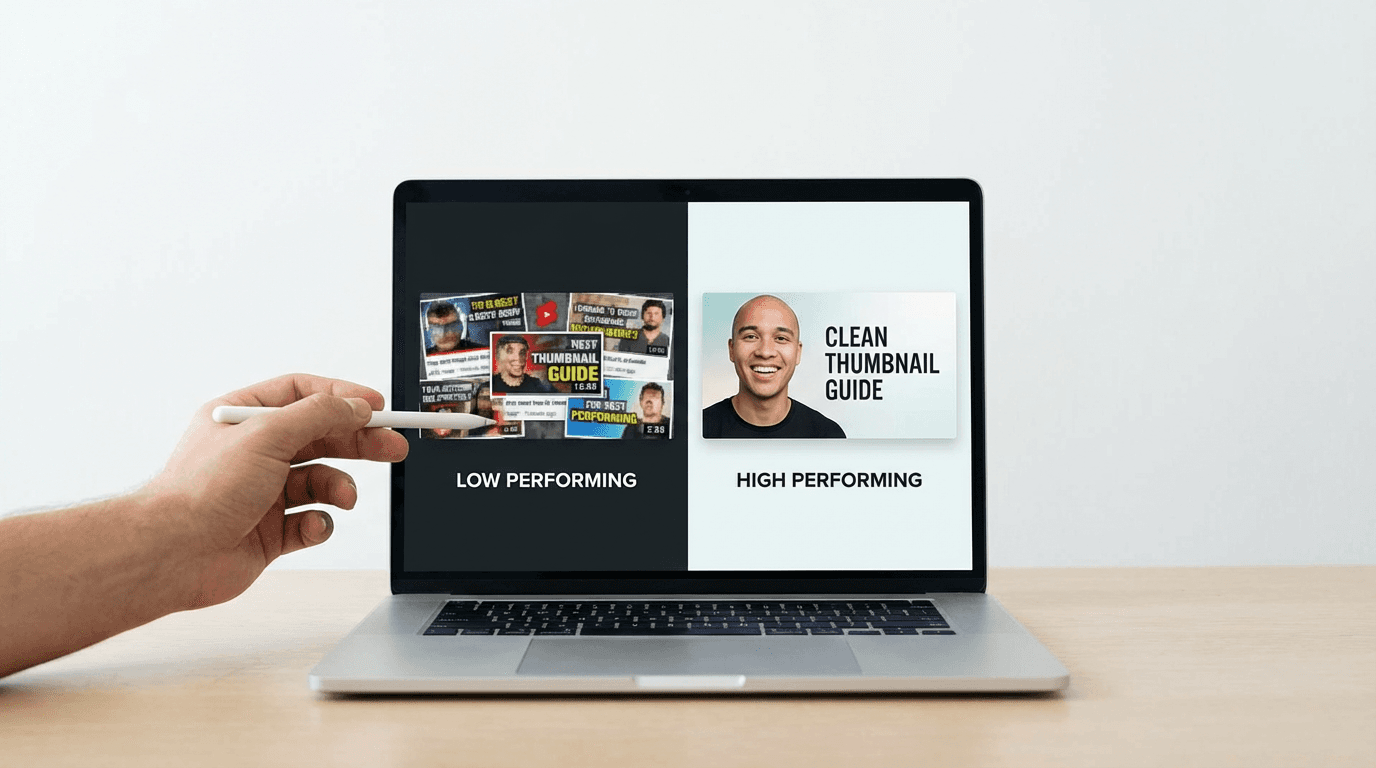
Low CTR often starts with weak packaging. Learn why your YouTube thumbnail is hurting clicks in 2026 and how to fix it with stronger design, testing, and title-thumbnail strategy.
If your YouTube videos are getting impressions but not enough clicks, your thumbnail is probably doing more damage than you think.
A lot of creators still assume low CTR means the topic was weak, the algorithm did something unfair, or the audience just was not interested. Sometimes that is true. But YouTube’s own analytics guidance frames CTR as part of appeal. In plain English, that means your packaging is the first gate. If viewers do not feel pulled in by the title-thumbnail combination, they often never reach the part of the video that would have convinced them to stay.
That is why thumbnails matter even more in 2026. The platform is more crowded, viewers are deciding faster, and YouTube now gives creators a more structured way to test titles and thumbnails directly in Studio. You can A/B test up to three versions on eligible videos, and YouTube chooses the winner by watch time, not raw CTR alone. That detail matters because the best thumbnail is not the one that gets the cheapest click. It is the one that gets the right click.
In this guide, I will break down the biggest thumbnail mistakes that silently kill CTR, how to diagnose whether your thumbnail is the real bottleneck, and how to fix it with practical thumbnail frameworks, copy-paste prompts, and a cleaner testing workflow. If you want deeper companion reads while you go, start with YouTube CTR 2026: Good Click-Through Rate and AI Thumbnails and YouTube CTR Benchmarks 2026.
Why this matters more in 2026
Thumbnail advice used to be treated like design taste. In 2026, it is much closer to performance engineering.

YouTube’s current creator guidance puts video performance into three buckets: appeal, engagement, and satisfaction. Appeal is whether people choose to watch. Engagement is whether they stick around. Satisfaction is whether they enjoyed the experience. That means bad thumbnails do not just reduce clicks. They can distort the whole performance chain. A misleading or weak thumbnail may attract the wrong viewers, lower watch quality, and reduce how well the system wants to keep showing the video.
YouTube also says titles and thumbnails should accurately represent the content, and it explicitly warns creators to avoid misleading, sensational, or overly loud packaging. It even notes that changing a title or thumbnail can help a video get more views, not because the act of editing magically reranks the video, but because viewers respond differently once the packaging changes.
That is the real 2026 mindset shift. A thumbnail is not just decoration. It is a performance lever.
If your broader packaging feels weak, YouTube Views Dropping in 2026: Why Your Channel Slows Down and YouTube Traffic Sources 2026: Browse, Search, Suggested System fit naturally here too.
What most creators misunderstand about thumbnails
The biggest misunderstanding is thinking a thumbnail’s job is to explain the whole video.
That is usually where CTR dies.

A thumbnail is supposed to do three things fast:
- stop the scroll
- signal the topic clearly
- create enough curiosity or relevance for the right viewer to click
It is not supposed to summarize every point in the video, cram in a full sentence, or visually shout every idea at once. YouTube’s own thumbnail guidance tells creators not to make the design too complex and reminds them that thumbnails appear differently across devices, which is another reason clutter hurts.
Another common misunderstanding is chasing one magic CTR number. YouTube does not give a universal “good CTR” benchmark. Instead, it advises creators to look at CTR by context, such as Home and Suggested in the first 24 hours for general audiences and the Subscriptions feed for subscribers, especially on videos with above-average impressions. That strongly suggests CTR needs to be judged by source, audience, and video type, not by one viral screenshot someone posted online.
So the better question is not, “Is my CTR bad?”
It is, “Is my thumbnail underperforming for this audience, on this traffic source, compared with my own better-packaged videos?”
10 thumbnail mistakes that kill CTR in 2026
1. Your thumbnail is too busy
If viewers need two extra seconds to decode what they are looking at, the thumbnail is already losing.
YouTube explicitly warns against overly complex thumbnail design and says too much color or composition can overwhelm viewers. This gets worse on mobile, where the image is small and the competition around it is dense.
Common signs:
- too many objects
- tiny text
- multiple focal points
- background details competing with the subject
- no clear visual hierarchy
A strong thumbnail usually has one dominant idea, not five.
If you want inspiration for cleaner image direction, AI YouTube Thumbnail Styles for More Views in 2026 and Consistent YouTube Thumbnail Style With AI are useful next reads.
2. The thumbnail and title are saying the same thing
This is one of the most common packaging mistakes on YouTube.
If the title already says “How I Grew a YouTube Channel in 30 Days,” the thumbnail does not need to repeat the same sentence in smaller text. The better move is usually complement, not duplication. Let the title handle specificity and let the thumbnail create contrast, emotion, or tension.
YouTube’s title guidance also emphasizes being succinct and putting important words near the beginning. That same discipline helps with thumbnail thinking. When both elements fight to say everything, neither one lands cleanly.
A better combo looks like this:
- Title: How I Grew a YouTube Channel in 30 Days
- Thumbnail angle: one chart, one facial reaction, one number, one moment of surprise
Not because bigger emotion is always better, but because it makes the package faster to understand.
3. Your thumbnail promises a different video than the one viewers get
This is one of the most expensive CTR mistakes because it can briefly raise clicks while quietly damaging the rest of the performance funnel.
YouTube repeatedly says your title and thumbnail should accurately represent the content. It also says misleading, clickbaity, or sensational packaging can turn viewers away and may even create policy problems in some cases. More importantly for normal creators, inaccurate packaging damages watch quality because viewers realize too quickly that the video is not what they expected.
This is why YouTube’s A/B testing system optimizes for watch time rather than CTR alone. A thumbnail that gets low-quality clicks is not the real winner.
4. There is no obvious focal point
A viewer should know what to look at immediately.
That can be:
- one face
- one object
- one result
- one contrast
- one dramatic moment
- one visual before/after
If the eye has nowhere to land, the thumbnail feels forgettable even when the colors are fine.
This is one reason many high-performing thumbnails feel simpler than amateur ones. Simplicity is not lack of effort. It is deliberate prioritization.
For more examples of what strong focal-point design looks like, YouTube Thumbnail Makeovers 2026: Before and After AI and How to Generate YouTube Thumbnails With AI can help.
5. Your text is too small, too long, or too polite
Thumbnail text still works in 2026, but only when it earns its place.
If you use text, it should usually do one of these:
- sharpen the conflict
- highlight the result
- introduce the twist
- clarify what the image alone cannot
It should not behave like a subtitle transcript.
YouTube reminds creators that thumbnails show differently across devices and that bigger, clearer assets matter. That is another reason why short, readable text wins more often than clever paragraphs.
In practice, most creators improve CTR by reducing thumbnail text, not adding more.
6. Your thumbnail style is generic for your niche
A thumbnail does not compete against all of YouTube equally. It competes against what your target viewer is already used to seeing.
YouTube advises creators to think about who the content is targeting. For subscribers, familiar elements may work better. For casual viewers, broader emotional or action-based visuals may work better. It also notes that thumbnail styles can shift over time and recommends keeping current with what works in your community.
That means a finance thumbnail, gaming thumbnail, documentary thumbnail, and beauty thumbnail should not all follow the same visual formula. The design can look high quality and still feel wrong for the audience.
7. You are optimizing for “pretty” instead of “clickable”
A lot of thumbnails fail because they look nice in a design portfolio but weak inside an actual YouTube feed.
Feed-winning thumbnails are usually built around contrast, clarity, and emotional or informational tension. That tension might come from:
- risk
- surprise
- transformation
- comparison
- urgency
- curiosity
- identity relevance
Pretty thumbnails without a strong viewing reason often get ignored.
That is why packaging matters more than decoration. YouTube itself describes titles and thumbnails as critical for communicating value, sparking intrigue, and setting clear expectations.
8. You never update old thumbnails
This is an easy win that a surprising number of creators ignore.
YouTube explicitly recommends experimenting with updating older thumbnails to increase a video’s appeal to new viewers. It also says changing a title or thumbnail can be an effective way to get more views when viewer response changes.
If an older video has:
- a good topic
- decent retention
- weak CTR
- continuing impressions
then the thumbnail may be the most efficient fix.
This is especially true for evergreen content, which is why Old YouTube Videos Getting Views Again in 2026 and Evergreen YouTube Video Ideas in 2026 are relevant here.
9. You are guessing instead of testing
This is the mistake 2026 should have eliminated by now.
YouTube’s A/B testing feature lets eligible creators test:
- title only
- thumbnail only
- title and thumbnail together
You can upload up to three variants, review the test in the Reach tab, and the platform selects the winning option based on watch time share. The feature is currently desktop-only in Studio, and YouTube notes that not every test will produce a clear winner.
That makes thumbnail improvement far less subjective than it used to be. You no longer need endless arguments about whether Version B “feels stronger.” You can test.
A useful external reference here is YouTube’s own A/B test titles and thumbnails guide.
10. Your title and thumbnail do not create a clean story together
YouTube’s own thumbnail advice literally shows examples of thumbnails and titles working together to create interest and tell a story. That is the model to follow. Your package should feel like a two-part hook, not two random assets uploaded at the same time.
A strong pairing often looks like this:
- title explains the topic
- thumbnail sharpens the emotional or visual angle
- both point toward the same viewer promise
When this harmony is missing, CTR drops even if each piece is decent on its own.
This is also why thumbnail work overlaps with hook work. If your idea is weak, a better thumbnail can only help so much. That is where YouTube Video Hooks 2026: Save the First 30 Seconds becomes part of the same conversation.
How to tell if your thumbnail is the real problem
Before redesigning everything, diagnose properly.
YouTube recommends checking the CTR on Home and Suggested in the first 24 hours for general audiences and checking the Subscriptions feed CTR for your most engaged viewers. It also suggests focusing on videos with above-average impressions when evaluating packaging performance.
A thumbnail problem is more likely when:
- impressions are decent but CTR is weak
- CTR is weak while retention is fine once people click
- subscribers click at a much better rate than non-subscribers
- your video topic is strong, but the package looks vague or cluttered
- older videos improve when packaging changes
A topic problem is more likely when:
- impressions are low from the start
- the idea is too narrow or badly framed
- retention is also weak
- viewers click but leave quickly because the value proposition is poor
YouTube’s analytics docs also recommend thinking through a funnel: appeal, engagement, satisfaction. That framework helps you avoid blaming the thumbnail for problems that really belong to the video itself.
A simple 2026 thumbnail audit checklist
Use this before publishing any long-form video.
Ask:
- Can I understand the topic in under one second?
- Is there one obvious focal point?
- Does the image still work at a very small size?
- Does the thumbnail complement the title instead of repeating it?
- Does it attract the right viewer, not just any curious viewer?
- Would this stand out next to five competitors in my niche?
- Is it accurate enough that viewers will feel the click was worth it?
- Do I have at least two alternate versions worth testing?
If you cannot answer yes to most of these, the thumbnail probably needs another pass.
For a more systemized thumbnail workflow, YouTube Thumbnail Strategy 2026, AI Prompts for YouTube Thumbnails, and Best AI Prompts for YouTube Thumbnails 2026 all fit well here.
7 thumbnail fixes that usually improve CTR
These are practical changes that tend to help without relying on fake benchmark myths.
1. Remove one element
When in doubt, simplify.
2. Increase subject contrast
Make the main subject easier to identify instantly.
3. Replace explanation with tension
Show the moment before the answer, not the whole answer.
4. Separate title and thumbnail roles
Let each asset carry a different part of the story.
5. Use larger, clearer text if text is necessary
Shorter is almost always better.
6. Match the emotional tone to the topic
Urgent, surprising, calm, premium, technical, playful, risky. Pick one.
7. Test older winners and near-winners
Evergreen videos are often the best thumbnail testing playground.
Copy-paste prompts for fixing weak thumbnails
These are designed for creators who want faster iteration, cleaner thumbnail angles, and stronger title-thumbnail fit.

Prompt 1: Diagnose why a thumbnail is underperforming
Prompt
Analyze this YouTube video packaging and tell me why the thumbnail may be hurting CTR.
I will give you:
- video topic
- current title
- current thumbnail description
- target audience
- traffic source if known
- performance notes
Then give me:
- the top 5 weaknesses
- whether the problem is clarity, curiosity, contrast, accuracy, or niche mismatch
- 3 specific thumbnail direction changes
- 3 title-thumbnail pairing improvements
Avoid generic advice.
Prompt 2: Generate three thumbnail directions for one video
Prompt
Create 3 different YouTube thumbnail concepts for this video.
Topic: [TOPIC]
Audience: [AUDIENCE]
Style: [clean / bold / cinematic / authority / documentary / playful]
Each concept should include:
- focal point
- background direction
- subject emotion or object emphasis
- optional text of 1 to 4 words
- why this version could improve CTR
Make the concepts visually clear, mobile-friendly, and built for 2026 YouTube competition.
Prompt 3: Fix title-thumbnail duplication

Prompt
Here is my YouTube title and current thumbnail idea.
Help me make them work together instead of repeating the same thing.
Title: [TITLE]
Thumbnail concept: [THUMBNAIL IDEA]
Give me:
- 5 improved thumbnail angles
- 5 improved titles if needed
- the best 3 title-thumbnail pairings
- which pairing is most likely to attract the right viewer without feeling misleading
Prompt 4: Create an A/B test plan
Prompt
Build a YouTube thumbnail A/B test plan for this video.
I want 3 thumbnail variants that differ meaningfully.
Video topic: [TOPIC]
Audience: [AUDIENCE]
Current hook: [HOOK]
Goal: [more CTR / better quality clicks / more search clicks / more suggested traffic]
For each version, give:
- concept direction
- focal point
- text if any
- emotional angle
- what viewer type it is designed to attract
Make the variants distinct enough for a meaningful A/B test.
Prompt 5: Refresh an old video thumbnail

Prompt
This is an older YouTube video that still gets impressions but the CTR feels weak.
Help me redesign the thumbnail for 2026.
Topic: [TOPIC]
Audience: [AUDIENCE]
Current title: [TITLE]
Current thumbnail: [DESCRIPTION]
Give me:
- 3 new thumbnail concepts
- 1 safer version
- 1 more curiosity-driven version
- 1 more authority-driven version
- the biggest mistake the old thumbnail is making
A practical thumbnail workflow using Miraflow AI
If you are trying to improve CTR consistently, the goal is not to design one lucky thumbnail. The goal is to build a repeatable packaging system.
A practical workflow looks like this:
- define the video promise
- decide the viewer segment
- write the title first or at least the angle
- generate 2 to 3 thumbnail directions
- compare them at small size
- choose one clean focal point
- publish
- review CTR by source
- test a second version if the video deserves it
You can do the image-generation side of that workflow inside Miraflow AI, especially with the YouTube Thumbnail Maker and the broader AI Image Generator. If you are building a full content pipeline rather than just one thumbnail at a time, Text2Shorts also fits the bigger idea-to-script-to-visual workflow naturally.
For creators who want more thumbnail-specific inspiration, YouTube Thumbnail Maker API Tutorial and How to Generate Blog Thumbnails With AI for Free are also helpful.
FAQ
Why is my YouTube CTR low even when the video is good?
Because viewers judge the package before they judge the content. YouTube’s analytics guidance treats CTR as part of appeal, which means your title and thumbnail have to make the right viewer want to click in the first place. If the video performs well after the click, but not enough people click, packaging is a likely bottleneck.
What is a good YouTube CTR in 2026?
There is no official universal number from YouTube that works for every creator, niche, or traffic source. YouTube instead recommends checking CTR by context, such as Home and Suggested for general audiences and the Subscriptions feed for subscribers, especially in the first 24 hours and on videos with above-average impressions.
Can changing a thumbnail help an old video?
Yes. YouTube explicitly says experimenting with updated thumbnails on older videos can increase appeal to new viewers, and it also says changing a thumbnail can be an effective way to get more views when viewer interaction changes.
Does YouTube care more about CTR or watch time?
It cares about more than one signal. YouTube’s recommendation guidance centers on appeal, engagement, and satisfaction. Its A/B testing feature for titles and thumbnails selects the winner by watch time share, which shows that getting the right click matters more than maximizing raw CTR in isolation.
Should I use text on thumbnails in 2026?
Sometimes, yes. But only when it adds clarity or tension fast. If the text is long, tiny, or repetitive with the title, it often weakens the thumbnail instead of improving it. YouTube also notes that thumbnails appear differently across devices, so readability matters.
Can I A/B test YouTube thumbnails now?
Yes, on eligible videos in YouTube Studio on desktop. YouTube says creators can test up to three different titles, thumbnails, or combined versions, and review the experiment through the Reach tab.
Conclusion
If your YouTube thumbnail is killing your CTR in 2026, the fix is usually not louder colors, more arrows, or more text.
The real fix is better packaging discipline.
A strong thumbnail gives the right viewer a fast reason to click. It makes the topic clear, creates tension or relevance, and matches the promise of the video well enough that the click turns into real watch time. That is also why misleading thumbnails usually fail in the long run. They may generate curiosity for a moment, but they weaken the viewer experience YouTube is actually trying to reward.
So if your videos are getting shown but not clicked, stop guessing. Simplify the thumbnail. Improve the title-thumbnail story. Check CTR by source. Update old thumbnails with life left in them. Use A/B tests where available. And build a repeatable packaging system instead of designing every thumbnail like a one-off poster.
That is how you stop thumbnails from quietly strangling otherwise good videos.