23 AI Halloween Music Prompts for Spooky Background Songs (Copy & Paste 2026)

Written by
Aerin Kim
Copy-paste AI Halloween music prompts for horror Shorts underscores, haunted-house and narration beds, trick-or-treat tunes, party tracks, synthwave trailers, and lyric songs, with BPM, key, and duration settings.
Halloween is eleven days away, and the music problem shows up the moment you open your editor. The free spooky tracks in every app have been on ten thousand other Shorts, the royalty-free library has three decent options and all of them are the same cello drone, and the one track that fits your edit exactly is either claimed by Content ID or locked behind a license you did not plan to buy. If you make horror Shorts, true-crime narration, a kids' trick-or-treat video, a party reel, or a lyric song for October, the fastest fix is to generate the music to fit the edit instead of hunting for a track that almost fits.
This post gives you 23 copy-paste AI Halloween music prompts, grouped into five categories: horror underscores for Shorts and TikTok, haunted-house and narration beds, kid-friendly and party tracks, synthwave and retro horror trailers, and full Halloween songs with [Verse], [Chorus], and [Bridge] lyrics. Every prompt includes suggested BPM, key, and duration settings written for the controls in the AI Music Generator on Miraflow, and the musical details (tritones, Phrygian and Locrian modes, col legno strings, celesta, theremin, prepared piano) are real, so the results sound like intentional scores instead of generic spooky wallpaper.
TL;DR: How to Use These Halloween Music Prompts
- Open the Miraflow AI Music Generator. Use Simple mode for background music (paste the prompt, turn Instrumental on, generate) and Custom mode for songs with lyrics, where you also get duration, BPM, key / scale, and a seed.
- Copy the prompt in the blockquote, then set the BPM, key, and duration listed under it. Where a prompt names a mode such as Phrygian or Locrian, pick the closest minor key in the key / scale control and leave the mode name in the prompt text so the model still leans toward that color.
- Generation typically takes under a minute, and the result lands in My Music where you can play, download, and reuse it.
- Pair the audio with visuals from Text2Shorts, the AI image generator, or the YouTube Thumbnail Maker. The pairing section further down covers which prompt goes with which format.
Why Spooky Music Is Worth Generating Right Now
Halloween is one of the few moments where an entire feed moves toward one aesthetic, and sound is half of that aesthetic. A fog-and-pumpkin clip with a stock piano loop feels flat in a way viewers notice even if they cannot say why. A low cello drone sitting a tritone away from a glassy tone makes the same clip feel unsafe, and that unresolved feeling is what holds a viewer through the first few seconds of a Short.
There is also a practical reason that has nothing to do with taste. Music that you generate for one specific video does not have a history of being used on thousands of other uploads, which is the main way a track gets a matching claim. Our guide to AI music for YouTube and copyright-free tracks explains where that advantage holds and where it does not, and the monetization section below covers the rules that matter before you publish.
The last reason is speed. If you already made your visuals from our AI Halloween video prompts for Shorts and TikTok, the music is the last missing piece, and generating a 20 to 40 second underscore takes about as long as scrolling a stock library for the same length of time.
The Settings That Actually Change the Result
Before the prompts, here is what each control in Miraflow's music generator does for spooky music specifically, because the same words with a different BPM or key produce a very different track.
Simple vs Custom mode. Simple mode takes a description and an Instrumental toggle. It is the right choice for every underscore, ambience, stinger, and bed in this post. Custom mode adds lyrics structure, duration, BPM, key / scale, the AI reasoning toggle, and the seed. Use it for anything with vocals, anything that must hit a specific length, and any time you want a tempo that lines up with your edit.
Instrumental. Turn it on for every background track. Horror beds with accidental vocals are one of the fastest ways to ruin a narration or a jump scare, and an instrumental toggle is more reliable than writing no vocals in the description alone (do both anyway).
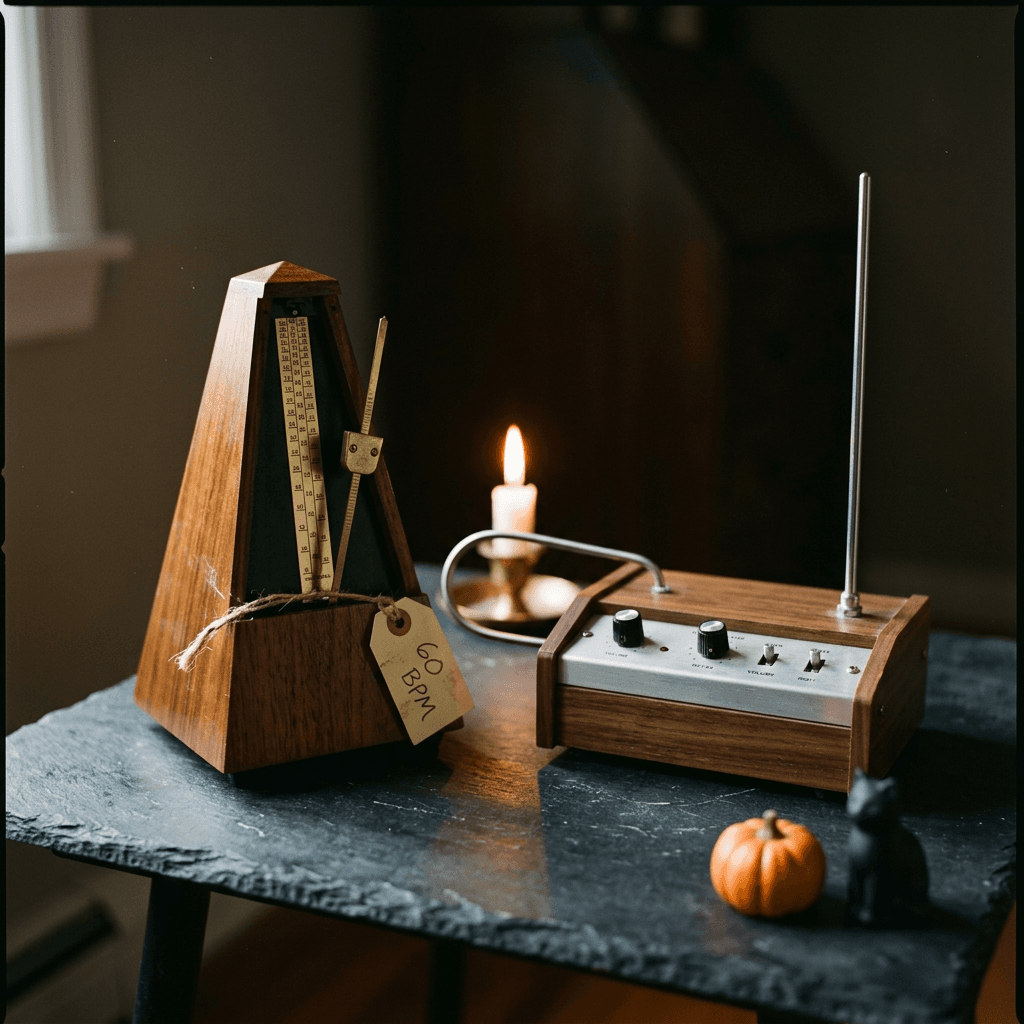
BPM. Tempo is the control that most changes mood. A resting heartbeat is roughly 60 to 80 beats per minute, which is why 60 BPM with a soft thump reads as dread and 120 BPM reads as a party. As a quick sync rule, one bar of 4/4 at 120 BPM lasts two seconds, so four bars is eight seconds, which is a clean length for a Shorts hook. At 60 BPM one beat is exactly one second, which makes cutting to the beat trivial.
Key / scale. Minor keys carry most horror, but the mode matters. A tritone (the interval of six semitones, such as C to F sharp, historically nicknamed the devil in music) sounds unresolved because it sits halfway between two octave-related notes. Phrygian has a flat second (E to F in E Phrygian) that adds menace. Locrian is the darkest of the standard modes because both its second and fifth are flat, so its tonic chord is diminished and never feels at home. If the control only offers major and minor, choose minor and name the mode in the prompt.
Duration. Match it to the use. Stingers want the shortest length the control allows, Shorts underscores want 20 to 40 seconds, narration beds want two minutes or more, and songs want long enough to fit your [Verse], [Chorus], and [Bridge] sections.
Seed. The seed is an advanced option. Keep the seed when you like a result and want to tweak one word, and change it when you want a different take of the same idea. A good habit is to generate three seeds of each prompt and keep the best, then note the seed so you can reproduce it later.
| Use case | Suggested BPM | Key / scale | Duration | Mode |
|---|---|---|---|---|
| Horror Shorts underscore | 60 to 76 | D, E, or B minor (tritone, Phrygian, Locrian) | 15 to 40 sec | Simple, Instrumental on |
| Haunted-house ambience | 50 to 54 | D or F sharp minor | 60 sec to 3 min | Simple, Instrumental on |
| Music box lullaby | 84 (3/4 waltz) | A minor | 45 to 60 sec | Simple, Instrumental on |
| Narration bed | 64 to 70 | D or E minor | 2 min or more | Simple, Instrumental on |
| Trick-or-treat and kid tunes | 104 to 112 | G minor, C major, D major | 90 sec | Simple or Custom |
| Party dance track | 126 | F sharp minor | 2 min | Simple, Instrumental on |
| Synthwave and retro horror | 92 to 108 (100 in 5/4) | A, C, or D minor | 45 to 90 sec | Simple, Instrumental on |
| Trailer stinger | 80 | D minor | Shortest available | Simple, Instrumental on |
| Lyric songs | 60 to 168 | E minor, B minor, C major, D sharp minor | 2 to 3 min | Custom, Instrumental off |
1) Horror Underscores for Shorts and TikTok
These five prompts are built for 15 to 40 second vertical videos where the first second decides whether the viewer stays. All five should be generated with Instrumental on. They deliberately avoid melodies and drums so that your visuals and any sound effects stay in charge.
1. Tritone Drone Hook
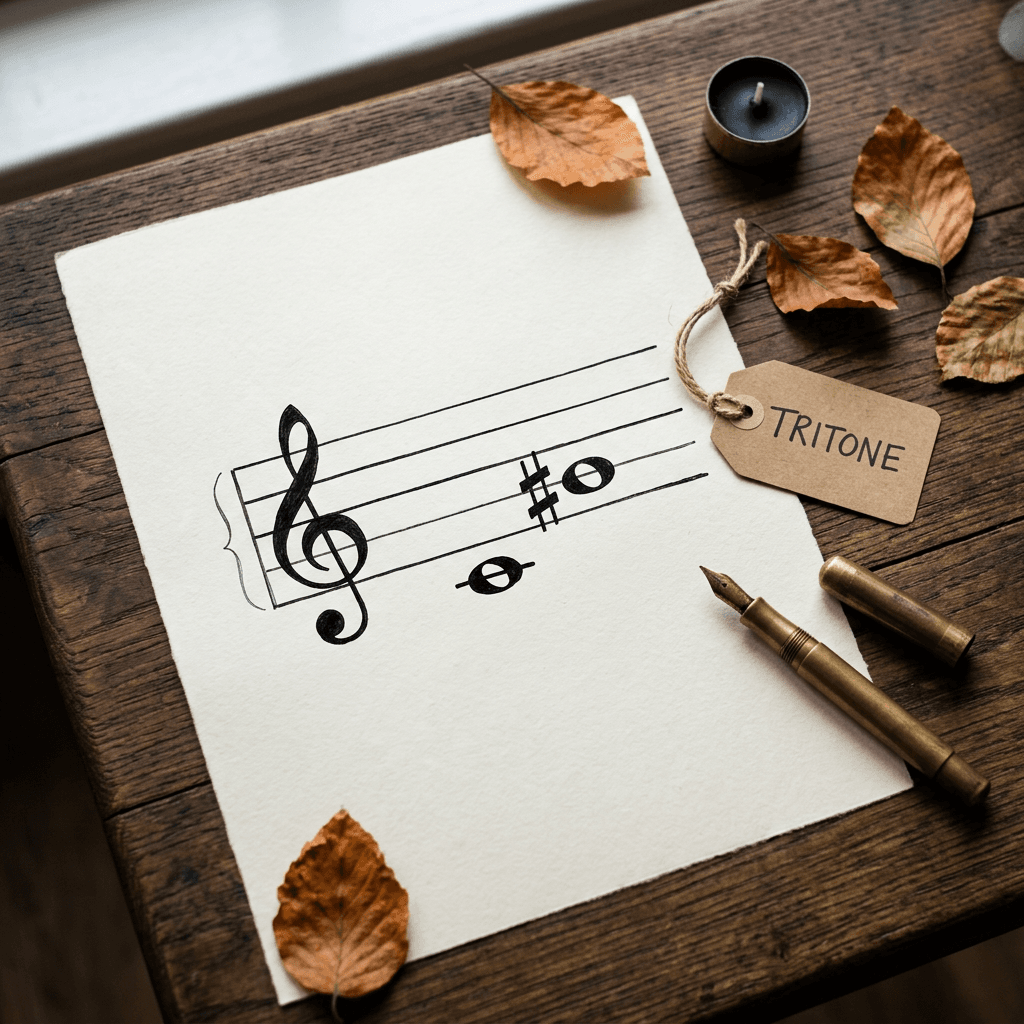
A low drone and a tone a tritone above it is the simplest horror sound there is, and it works because nothing in it resolves. Use it under a slow push-in on a doorway, a mirror, or a jack-o'-lantern.
Instrumental horror underscore for a 20 second vertical video hook. A single low cello drone on D held under a thin bowed glass-harmonica tone on A flat, a tritone apart so the interval never resolves. Sparse and slow, around 60 BPM, with a faint sub-bass pulse like a distant heartbeat. A metallic scrape swells over the last four seconds and stops without resolving. Dry, close, intimate mix, no melody, no drums, no vocals.
Settings: Simple mode, Instrumental on, 60 BPM, D minor, 20 to 30 seconds.
2. Col Legno Tension Bed
Col legno means the player taps or strikes the strings with the wood of the bow instead of the hair, which gives a dry, bony clatter that reads as skeletons or something skittering in the walls.
Instrumental string tension bed using col legno, the wood of the bow tapping the strings in an irregular, unpredictable pattern, over sustained sul ponticello violins that sound thin and glassy, with a low viola tremolo underneath. Pitch center on E with a flat second (F natural) for Phrygian menace. Around 72 BPM feel, no percussion, no melody, lots of silence between events, 30 seconds.
Settings: Instrumental on, 72 BPM, E minor, 30 seconds.
3. Heartbeat Riser With a Hard Cut
Jump-scare edits live or die on contrast. This prompt builds for ten seconds, drops to silence, then hits once, so you can line the cut up with the reveal frame.
Instrumental jump-scare build. Start with a soft heartbeat thump at 60 BPM, then add high tremolo strings and a rising Shepard-tone style glissando that seems to climb forever for ten seconds. At 0:10 everything stops for one full second of silence, then a single deep impact boom with a long reverb tail. No melody, no vocals, no drums besides the heartbeat and the final hit.
Settings: Instrumental on, 60 BPM, C minor, 15 seconds. One beat equals one second at this tempo, so the silence lands on beat 11.
4. Prepared Piano Creep
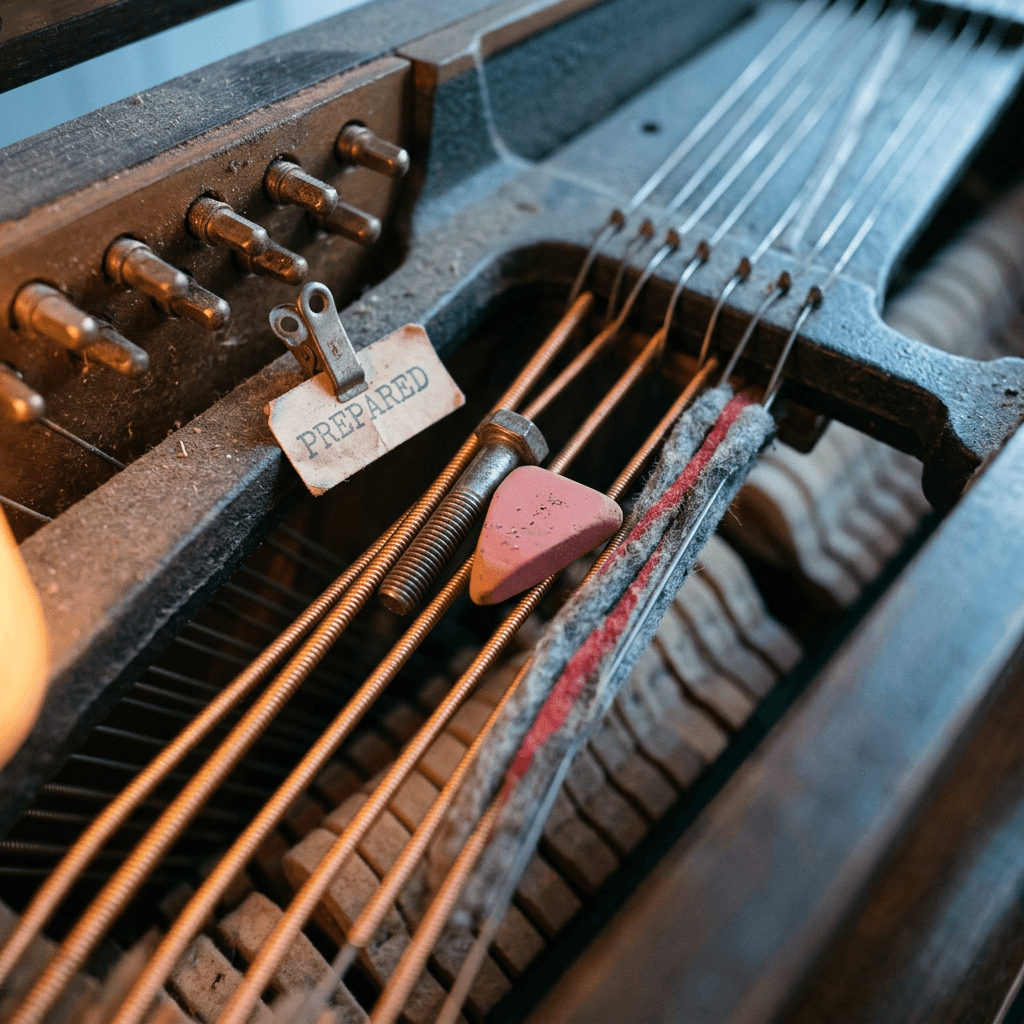
Prepared piano is a real technique where bolts, rubber, or felt are placed on the strings, so notes sound dull, buzzy, and percussive. It sounds like a haunted object instead of a concert instrument.
Prepared piano horror motif, an upright piano with bolts and rubber wedged between the strings so the notes sound dull, buzzing, and percussive. A sparse repeating three-note figure in the low register in B flat minor, upper notes slightly out of tune like an old honky-tonk, room noise and a distant waterphone shimmer. 66 BPM, no drums, no vocals, 40 seconds.
Settings: Instrumental on, 66 BPM, B flat minor, 40 seconds.
5. Locrian Mirror Reveal
Locrian is rarely used on purpose, which is exactly why it sounds wrong in a satisfying way. The tritone between B and F in B Locrian gives the celesta figure its uneasy lift.
Slow-reveal suspense loop for a mirror scare. A thin celesta plays a four-note rising figure on B, C, E, F in B Locrian, with the B to F tritone left hanging, over a low pedal drone on B and a faint breathy pad. Around 76 BPM, soft and spacious, no drums, no vocals, built to loop cleanly with no big ending.
Settings: Instrumental on, 76 BPM, B minor, 30 seconds.
2) Haunted-House Ambience and Narration Beds
These five are longer and flatter than the underscores. The goal is a texture that sits under a voice or fills a long scene without drawing attention to itself. If you read stories aloud, our AI Halloween thumbnail prompts cover the video cover, and these cover what plays underneath.
6. Haunted Mansion Pipe Organ
Haunted mansion ambience for a long scene, a distant pipe organ playing slow minor chords with the swell box half open, old wooden floor creaks, wind through a broken window, and an occasional low harpsichord note. Big stone-hall reverb, no drums, no vocals. D minor, around 54 BPM, slow and spacious, built to loop.
Settings: Instrumental on, 54 BPM, D minor, 60 to 90 seconds.
7. Creepy Music Box Waltz
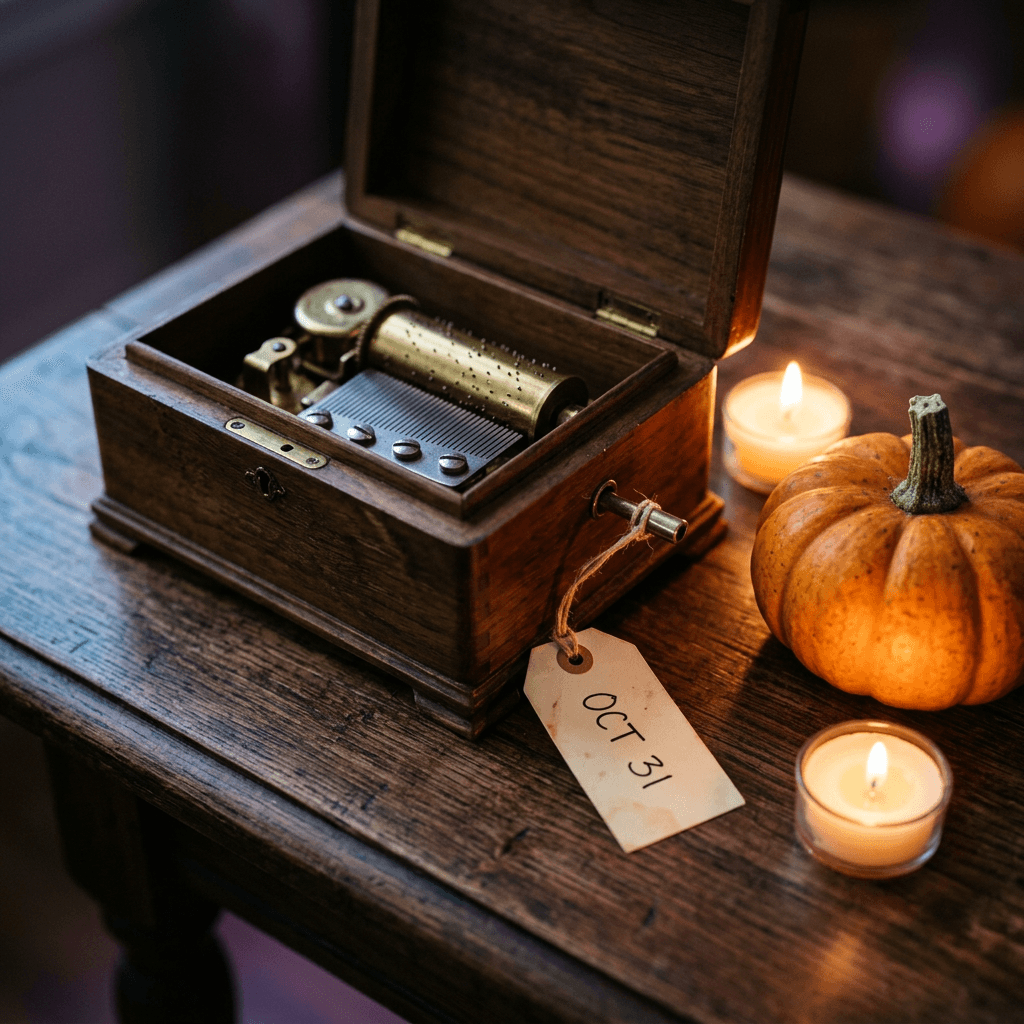
A music box is a mechanical comb struck by pins on a rotating cylinder, so its timbre is bright and brittle. Playing a childlike waltz in a minor key, slightly out of tune, is the classic horror move.
Creepy music box lullaby, a small cylinder music box with a slightly out-of-tune comb playing a simple waltz melody in 3/4 time at 84 BPM in A minor. One occasional wrong note, faint tape hiss, and at the end the mechanism winds down and the tempo slows to a stop. No vocals, no other instruments, intimate and close.
Settings: Instrumental on, 84 BPM, A minor, 45 to 60 seconds.
8. True-Crime Narration Bed
Narration beds work by staying out of the voice's way. Keep the midrange sparse, avoid melodies, and keep the dynamics flat so you are not riding the fader.
Documentary true-crime narration bed. A felted piano playing slow sustained D minor chords, a soft analog synth pad, and a faint ticking pulse at 70 BPM. No lead melody, no drums, no vocals, sparse midrange so a spoken voice can sit on top, steady dynamics with no big swells, serious and understated mood. Long and evenly paced.
Settings: Instrumental on, 70 BPM, D minor, two minutes or more. When you mix, keep the music roughly 15 to 20 dB below your voice.
9. Scary-Story Campfire Bed
Scary story campfire narration bed. A solo nylon-string guitar plays a slow figure in E Phrygian, with E, F, G, A, B, C, D as the available notes, fingers half muting the strings, over a bowed double bass note held low. Crackling fire, a distant owl, subtle wind. 64 BPM, no drums, no vocals, mood slowly tightening in the last third, 2 minutes.
Settings: Instrumental on, 64 BPM, E minor, 2 minutes.
10. Graveyard Fog Ambient Loop
Beatless ambient graveyard fog texture. Tape-warped choir pads, bowed glass bowls, a distant waterphone, and a slow evolving low drone in F sharp minor. No rhythm, no melody, no drums, no vocals, gentle movement over time, designed to loop seamlessly under a long video or a stream.
Settings: Instrumental on, 50 BPM (nominal), F sharp minor, 2 to 3 minutes.
3) Kid-Friendly, Trick-or-Treat, and Party Tracks
Not every Halloween video should be scary. School projects, family channels, pet videos, and costume reels all want music that is spooky in costume only. These four prompts use major keys and bright instruments so nothing feels threatening. They pair well with our AI pet Halloween costume prompts and AI pumpkin carving prompts.
11. Trick-or-Treat Tune
Playful trick-or-treat instrumental for kids, bouncy and friendly. Pizzicato strings, glockenspiel and xylophone playing a simple catchy melody, a bouncing tuba bass, finger snaps, light sleigh-bell shakers. Starts in G minor for a mild spooky feel then opens up to a bright B flat major section. 112 BPM, no vocals, cheerful and cartoonish, 90 seconds.
Settings: Instrumental on, 112 BPM, G minor, 90 seconds.
12. Friendly Ghost Lullaby
Gentle Halloween lullaby for a friendly ghost story. Celesta and soft harp playing a slow rocking melody in D major in 6/8, a warm string pad, a single breathy flute for the ghost, twinkling bell tones. 60 BPM, sleepy and comforting, no drums, no vocals, 90 seconds.
Settings: Instrumental on, 60 BPM, D major, 90 seconds.
13. Halloween Party Dance Track
House music sits comfortably at 120 to 128 BPM, so 126 BPM keeps the energy up without sounding frantic. Use it behind a costume transition or a party montage.
Halloween party dance track, four-on-the-floor house at 126 BPM in F sharp minor. Rolling off-beat bass, claps on beats 2 and 4, a detuned church-bell lead playing a minor-key hook, a spooky filtered organ stab on the offbeats, and a build and drop every 16 bars. Instrumental, no vocals, club-ready, 2 minutes.
Settings: Instrumental on, 126 BPM, F sharp minor, 2 minutes. If you are also making the invite, our Halloween party invitation and flyer prompts cover the matching visuals.
14. Skeleton Swing Shuffle
Spooky cartoon swing at 150 BPM in D minor. Walking upright bass, brushed snare, muted trumpet and clarinet trading phrases, xylophone hits that sound like rattling bones, a short piano stab on the offbeat. Playful, lightly mischievous, old animated-short feel, instrumental, no vocals, 75 seconds.
Settings: Instrumental on, 150 BPM, D minor, 75 seconds.
4) Synthwave, Retro Horror, and Trailer Stingers
Synthwave and its darker cousins are a good match for Halloween because the sound is already nostalgic and slightly menacing. These five prompts avoid naming any artist or film, which keeps them both safer to use and more flexible.
15. 1980s Slasher Synth Score
Odd meters give a theme a lurching, uneasy feel. A five-beat piano ostinato is one of the most recognizable devices in the genre, and it works because it never settles into a march.
1980s slasher-film synth score. A minimalist repeating piano-like ostinato in 5/4 time, cold analog bass, a hollow string-machine pad, sparse electronic percussion with a gated snare, and occasional stinger notes on a detuned lead. A minor, around 100 BPM, tense, steady, instrumental, no vocals, 60 seconds.
Settings: Instrumental on, 100 BPM, A minor, 60 seconds.
16. Dark Synthwave Night Drive
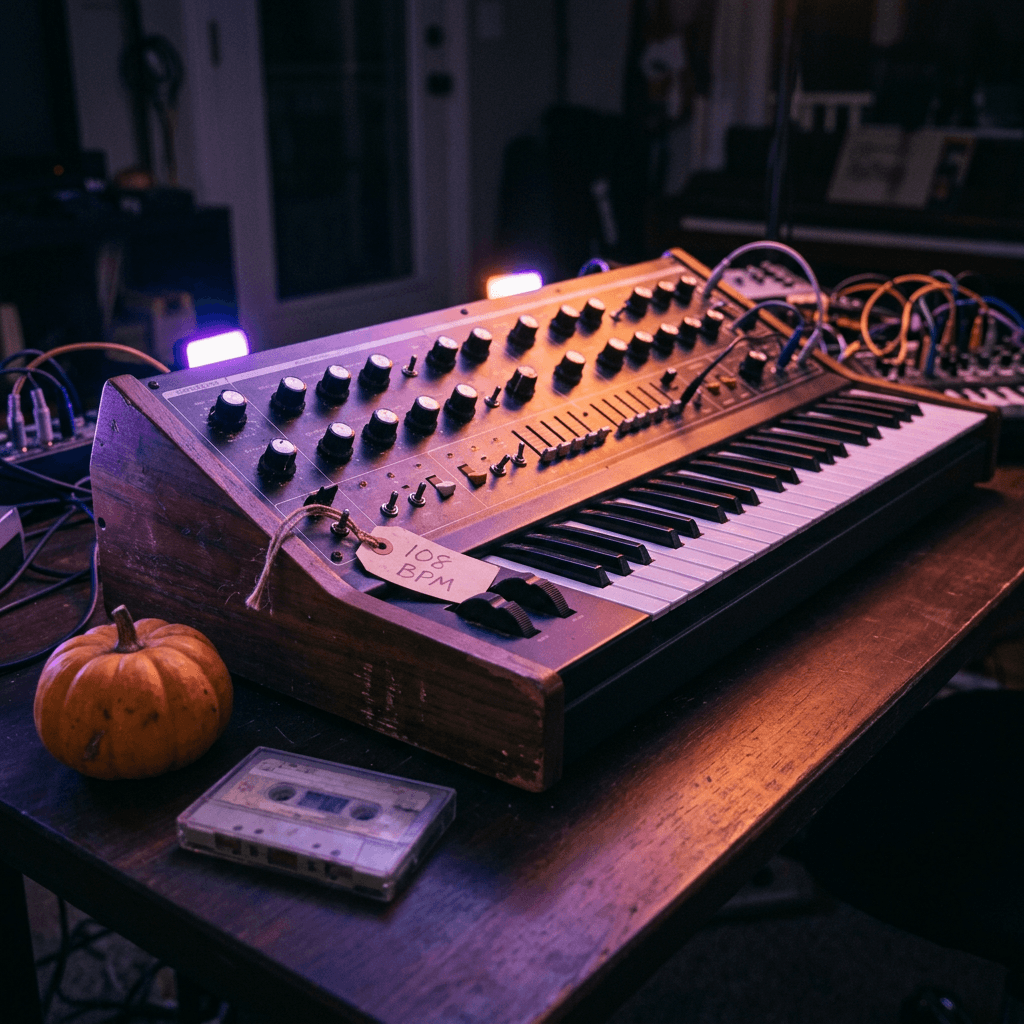
Dark synthwave night drive for a Halloween montage. Driving arpeggiated saw bass, gated reverb snare, sidechained pads pumping with the kick, neon-lit lead melody in D minor, a final eerie chord that holds into a long fade. 108 BPM, retro 1980s horror-comedy mood, instrumental, no vocals, 90 seconds.
Settings: Instrumental on, 108 BPM, D minor, 90 seconds.
17. 1950s B-Movie Theremin
The theremin is played without touching it, by moving the hands near two antennas that control pitch and volume. Its wide vibrato and sliding pitch are why it became shorthand for the alien and the uncanny.
Retro 1950s monster-movie score. A solo theremin with wide vibrato gliding over tremolo strings and a rolling timpani, short brass stabs, vintage mono tape sound with slight wow and flutter. C minor, around 92 BPM, ending on a dramatic diminished chord. Instrumental, no vocals, 45 seconds.
Settings: Instrumental on, 92 BPM, C minor, 45 seconds.
18. Horror Trailer Stinger (6 Seconds)
A stinger is a short, loud musical punctuation that marks a title card or a reveal. Generate several seeds and keep the one whose attack lands cleanest.
Horror movie trailer stinger, 6 seconds. One beat of near silence, then a deep brass braam and a cluster of screeching violins sliding upward, one hard hit on the downbeat at 80 BPM, short reverse reverb swell before the hit, then a clean cut with no tail. Instrumental, no vocals, no melody.
Settings: Instrumental on, 80 BPM, D minor, the shortest duration the control allows (trim in your editor if it runs long).
19. 30-Second Trailer Build
30 second horror trailer build. Starts with a slow ticking clock and a lone music box in A minor, adds low taiko-style drum hits at 90 BPM, a growing low brass drone, rising string tremolo and a pitched riser that reaches a peak at 0:26 and then drops to silence for the last two seconds. Instrumental, no vocals, cinematic and tense.
Settings: Instrumental on, 90 BPM, A minor, 30 seconds.
5) Halloween Songs With Lyrics
These four prompts use Custom mode. Paste the style prompt into the description, then paste the lyrics into the lyrics box with the section tags on their own lines. In the lyrics blockquotes below, a slash marks a line break, so replace each slash with a new line when you paste. Leave Instrumental off.
Two practical notes. First, if the model mispronounces an unusual word in a test run, respell it the way it sounds. Second, keep each line to a similar syllable count, because AI vocals follow the meter and lines of wildly different lengths get rushed or stretched.
20. Pop-Punk Halloween Anthem
Style prompt:
Energetic pop-punk Halloween anthem, fast palm-muted guitars, driving punk drums, melodic bass, gang vocals on the chorus, bright and rebellious. 168 BPM, E minor, a lead vocalist with a raspy but friendly tone. Big chorus, a half-time bridge before the last chorus.
Lyrics:
[Verse] Streetlights flicker and the porch lights glow / pillowcase heavy and I've got places to go / skeleton sneakers on a sidewalk race / every house on the block has a different face / [Chorus] It's Halloween, let the night go wild / every ghost in town is a kid with a smile / turn it up loud till the pumpkins shake / it's Halloween, we are wide awake / [Bridge] Quiet for a second, hear the wind in the trees / one more knock and a handful of sweets / [Chorus] It's Halloween, let the night go wild / every ghost in town is a kid with a smile
Settings: Custom mode, Instrumental off, 168 BPM, E minor, 2 to 2 and a half minutes.
21. Kid-Friendly Sing-Along
Friendly Halloween sing-along for children, acoustic guitar strumming, hand claps, glockenspiel, a warm lead vocal singing clearly and slowly, a small group of kids singing the chorus. 104 BPM, C major, very easy melody, simple repetition, happy and cozy, not scary.
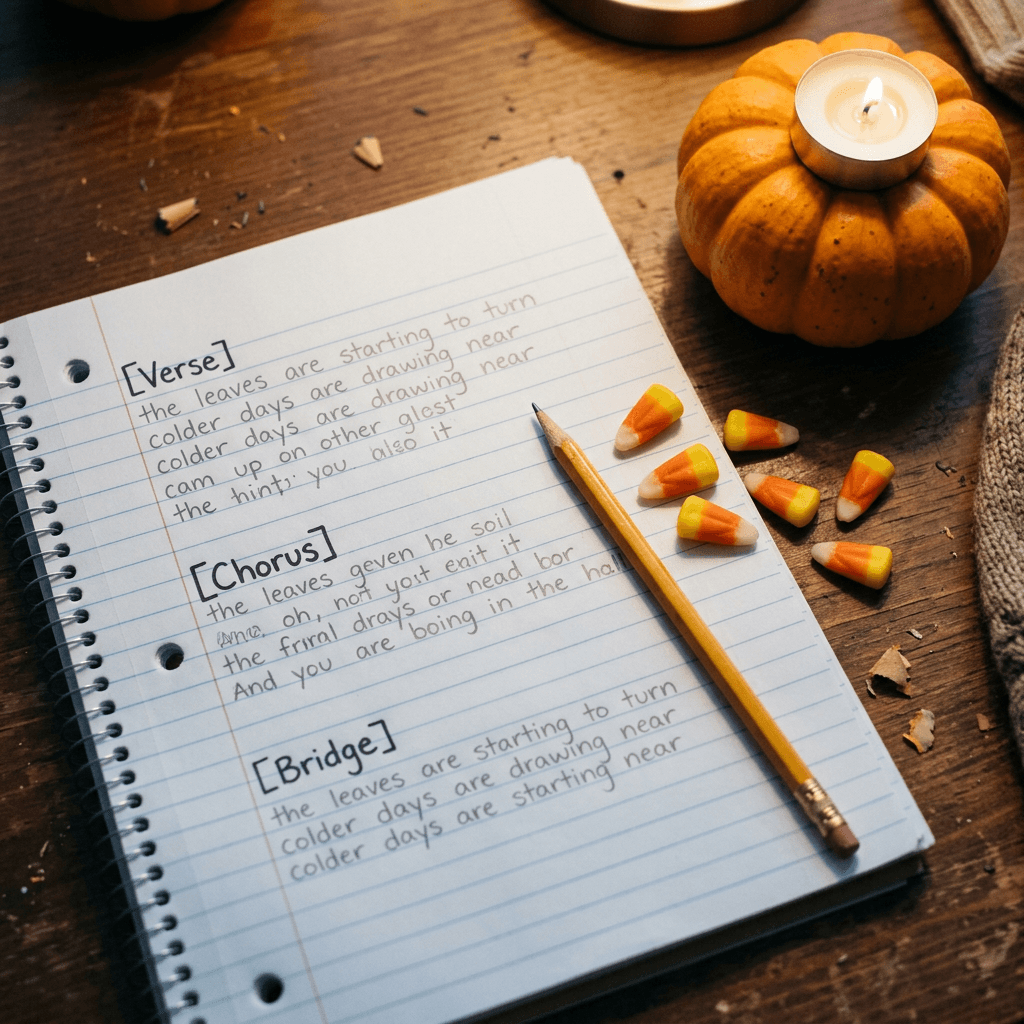
[Verse] Little ghost on the garden wall / wearing a sheet that's way too tall / pumpkin grin and a candle light / glowing softly in the night / [Chorus] Trick or treat, trick or treat / knock on the door and say hello / trick or treat, trick or treat / candy for you and candy for me / [Verse] Bat in a hat on a broomstick ride / waves to the cat who is by his side / everyone's laughing, everyone's here / the friendliest night of the year / [Chorus] Trick or treat, trick or treat / knock on the door and say hello / [Bridge] Count to three and we shout it loud / happy Halloween to the crowd
Settings: Custom mode, Instrumental off, 104 BPM, C major, about 2 minutes.
22. Gothic Ballad
6/8 time has a rocking, swaying pulse that suits a lament. A slow tempo with a cello line gives the song a sense of weight.
Gothic Halloween ballad in 6/8 at 60 BPM, B minor. A solo piano, a low cello, soft cathedral reverb, a restrained husky lead vocal singing close to the microphone, building slowly to a wide chorus with layered harmonies and a light timpani roll. Haunting, elegant, melancholic, no electronic elements.
[Verse] A lantern in the mist where the old roads meet / the gate swings open on the quiet street / every name on the stone is a story I know / and the wind keeps humming where the lilies grow / [Chorus] Stay with me, lantern, stay till the dawn / the night is long but I'm not gone / every candle in the window is a promise to keep / I'll be watching over you in your sleep / [Bridge] When the church bell tolls and the shadows lean / there is nothing here to fear, only things unseen / [Chorus] Stay with me, lantern, stay till the dawn / the night is long but I'm not gone
Settings: Custom mode, Instrumental off, 60 BPM, B minor, 2 and a half to 3 minutes.
23. Dark Trap Halloween Hook
Trap tempos are usually written around 130 to 150 BPM but felt at half time, with heavy 808 bass and fast hi-hat rolls. The result is a slow, heavy swing on top of a quick tick.
Dark trap Halloween track, heavy 808 sub-bass, sharp snare on beat 3 in half time, rapid hi-hat rolls, a detuned music box melody and a distant choir pad, deep ominous rap vocal with clear diction, spooky and confident. 140 BPM, D sharp minor, space left for the vocal.
[Verse] Moon on the roof and the fog on the lawn / every light's out and the cold air's drawn / bones in the closet, I'm calm in the dark / the whole street holds its breath when I walk through the park / [Chorus] Midnight, midnight, the pumpkins glow / everybody's whispering and nobody knows / midnight, midnight, hear the bell / the night is mine and I know it well
Settings: Custom mode, Instrumental off, 140 BPM, D sharp minor, 90 seconds to 2 minutes.
How to Customize These Prompts
The 23 prompts are a starting point. Here is how to bend them toward your own edit without writing them again from scratch.
Swap the mode before the instrument. If a prompt feels too dramatic, move it from Locrian or Phrygian to natural minor (Aeolian). If it feels too cute, drop one of the bright instruments, such as the glockenspiel or xylophone, and add a low drone. The mode and the instrument list are the two levers with the biggest effect on mood.
Double or halve the tempo. If a 126 BPM party track feels too busy for your clip, ask for 63 BPM with a half-time feel and the same chords. If a 60 BPM bed is too slow, 120 BPM at half-time gives a faster hi-hat pulse over the same slow harmonic movement.
Describe the ending. Models tend to resolve tracks neatly unless told otherwise. Tell it to stop on silence, to hold the last chord, or to loop with no ending. For Shorts that loop, write built to loop cleanly with no ending.
Layer, do not stack. Generate the bed, the stinger, and the ambience as three separate tracks and mix them in your editor, instead of asking for everything in one prompt. A single dense prompt tends to make a muddy track, and separate tracks let you pull the stinger forward at the reveal.
Use the same seed to iterate. When one prompt is almost right, keep the seed and change a single phrase. When you want variety for a series, change the seed and keep the prompt, which gives you siblings with the same character.
Match your cuts to the grid. At 120 BPM each beat is 0.5 seconds, so a 15-second Short is 30 beats or 7.5 bars of 4/4. Choose a BPM that divides cleanly into your clip length and your hook lands on a downbeat.
How to Pair These Tracks With Visuals
The audio only does half the job. A few pairings that work well:
- Horror Shorts (prompts 1 to 5): Build the clip in Text2Shorts, then drop the generated underscore under it. For motion-heavy shots, our AI Halloween video prompts work with the Cinematic AI Video Generator, and the tension bed gives each shot a consistent sonic world.
- Narration beds (prompts 6 to 10): Use a still image from the AI image generator as a slow Ken Burns background for a long story, and consider podcast-style cover art if you publish the story as a series.
- Kid-friendly and party tracks (prompts 11 to 14): Pair with costume portraits from our AI Halloween costume and Ghostface prompts or phone-friendly art from the Halloween wallpaper prompts.
- Trailer stingers and synthwave (prompts 15 to 19): These fit a title-card edit well, with a thumbnail built in the YouTube Thumbnail Maker to match the same color palette.
- Songs (prompts 20 to 23): Treat the song like a release. Make cover art with the ideas in our music artist and album cover art prompts, then cut vertical clips from the full song with AI Clipping so the chorus becomes its own Short.
If you want the visual prompts to be as specific as these music prompts, our guide on how to write AI prompts for visual content uses the same idea of naming light, material, and a clear subject in one sentence.
Copyright, Licensing, and Monetization Notes
This is not legal advice, but there are a few points that every creator should check before posting AI-generated Halloween music.
The license of the tool decides what you can do. Our post on AI music and YouTube copyright makes the point that AI output is not automatically copyright-free, and that you should rely on the license of the generator and keep records of what you made. Our longer guide on no-copyright background music for any video length covers the practical side of picking a length and reusing tracks.
Monetization is about rights and originality. YouTube cares whether you have the right to use the music and whether the video as a whole is original and not repetitive. Our breakdown of what AI content is allowed and what gets demonetized and the post on whether AI Shorts can be monetized explain how a unique voice, a varied track, and real editing choices matter more than the tool.
Do not name real songs or artists in your prompt. Describing a style (1980s slasher synth, 1950s theremin) is fine. Asking for a specific artist or song invites a track that is too close to something real, which is exactly the kind of upload that gets claimed.
If you do get a claim, you have options. YouTube now lets creators replace a claimed song with an AI instrumental, which our guide to the YouTube AI instrumental and Content ID tool walks through. Instagram has a similar option for published Reels, covered in our Instagram Replace Audio guide. For the wider industry picture, see what Suno's BMG deal means for AI music creators.
Vary your tracks. Reusing the same generated bed under every video is a repetition signal. Change the seed, the key, or the instrument list for each upload.
Common Mistakes When Prompting Halloween Music
- Stacking too many instruments. A prompt with twelve instruments produces a crowded track. For underscores, pick three or four and describe their roles.
- Leaving the Instrumental toggle off for a bed. Even if you wrote no vocals in the text, turn the toggle on. Spoken-word beds with a stray hummed vocal compete with narration.
- Writing a melody under a voiceover. A memorable tune in the 200 Hz to 3 kHz range fights speech. For narration, ask for pads, pulses, and drones, and put any melody in a different register.
- Setting a BPM that fights your edit. A 126 BPM track under a slow push-in feels rushed. Pick the tempo from the clip speed, then adjust the prompt.
- Ignoring the first second. A Short's first second is where viewers decide to stay. Ask for the signature sound, such as the drone or the first music box note, to start at 0:00 instead of fading in.
- Mixing a bed too loud. If you can follow the music words better than the voice, it is too loud. About 15 to 20 dB below the voice is a safe starting point for a beat-free bed.
- Naming real songs or artists. It risks a claim and it also narrows the model toward one reference. Describe the instruments, tempo, and mood instead.
- Giving lyrics lines with uneven length. If one line has fourteen syllables and the next has five, the vocal rushes. Keep the lines close in length and test one section first.
- Expecting one generation to be perfect. Generate three seeds, keep the best, and write down the seed.
Make Halloween Music Inside Miraflow
The AI Music Generator on Miraflow is built for this workflow. In Simple mode you paste a description, turn on Instrumental, and generate, which suits every underscore, bed, and stinger in this post. In Custom mode you add lyrics with [Intro], [Verse], [Chorus], [Bridge], and [Outro] structure tags, and set duration, BPM, key / scale, the AI reasoning toggle, and a seed. Generated tracks appear in My Music where you can play, download, and reuse them, and a typical generation takes under a minute.
Because Miraflow also covers the rest of the pipeline (idea, script, visual, video, thumbnail, music), you can generate the track, build the vertical clip in Text2Shorts, make the cover in the YouTube Thumbnail Maker, and keep the whole Halloween project in one browser tab. You can start from the Miraflow home page and move between tools from there. If you want a second angle on AI songs in general, our posts on ElevenLabs Music v2 prompts and Google's Lyria 3.5 show how other models approach the same problem, and most of the descriptions in this post will also translate to them.
If your Halloween plans include a Día de los Muertos video afterward, that holiday has its own guide, our Día de los Muertos prompts for Catrina portraits and ofrendas, and it uses a different musical palette (guitarrón, trumpets, marimba) than the spooky sounds here. For the growth side of the season, our guide to finding viral sounds on the YouTube Shorts Trends page is a useful complement.
Frequently Asked Questions
What is the best BPM for spooky background music?
It depends on the effect. Dread and suspense usually sit at 50 to 76 BPM, where a pulse feels like a heartbeat. Cozy and kid-friendly Halloween tunes work at 100 to 120 BPM. Party and dance tracks sit around 120 to 128 BPM, and pop-punk songs run 160 to 180 BPM. Pick from the clip speed first, then adjust.
What musical key sounds the scariest?
There is no single scary key, but minor keys, the flat second of Phrygian, and the diminished tonic of Locrian carry the most dread. A tritone, such as C against F sharp, is the interval most associated with tension because it does not resolve. In Miraflow's key control, choose the closest minor key and name the mode in the prompt.
Can I use AI Halloween music in monetized YouTube videos?
Generally yes if the tool's license allows commercial use and the video is original and not repetitive, but check the terms of the generator you use and keep a record of your generations. Our guides on AI content monetization and AI music copyright cover the details.
How do I make a track loop for a Short?
Ask for a loop in the prompt, avoid a clear ending, and use a texture with no strong downbeat on the last beat. Then check the loop point in your editor. Beatless ambient tracks such as the graveyard fog prompt loop most reliably.
How long should a Halloween Short soundtrack be?
Match the clip. A hook underscore is 15 to 30 seconds, a standard Short is up to 60 seconds, and narration beds are two minutes or longer so you do not need to loop. For a stinger, use the shortest duration available and trim.
Do I need to write lyrics myself?
No. You can write a few lines and let the model finish, or paste full lyrics. Use [Verse], [Chorus], and [Bridge] tags on their own lines so the song has a shape, and keep line lengths similar.
Why does my instrumental still have vocals or humming?
Turn the Instrumental toggle on and also write no vocals in the prompt. If wordless humming still appears, remove words like choir or lullaby and replace them with instrument names.
Can I generate music in other genres for Halloween?
Yes. Any genre works if you describe the instruments, tempo, mode, and mood. For genre blends, see our ElevenLabs Music v2 genre-switching prompts.
Conclusion
Halloween music is a small detail that makes a large difference. A drone a tritone apart, a music box a little out of tune, or a 5/4 synth ostinato gives your video a recognizable sound, and with the prompts above you can have three or four tracks ready in an hour. Start with one underscore for your next horror Short, one narration bed if you tell stories, and one song if you want something to share, then pair each with visuals from Miraflow.
Open the AI Music Generator, paste your first prompt, set the BPM and key from the list, and generate three seeds. Pick the best, write down the seed, and post it before October 31.