25 AI Couple Halloween Costume Prompts to Try on Your Own Photo (Copy & Paste 2026)

Written by
Aerin Kim
Not sure what to wear on October 31? Try 25 copy-and-paste AI prompts that put couples and best-friend duos in Halloween costumes on their own photo, plus no-costume portrait setups.
It is the week before Halloween, you and your partner have agreed to go as a pair, and you have spent forty minutes scrolling costume listings that look great on a stranger and tell you nothing about how they will look on the two of you. Will the colors fight each other in photos? Will anyone at the party understand the joke from across the room? Will the zombie prom look read as funny or just messy? Couples costume searches climb every October, and nearly every result still shows models you have never met.
AI can answer those questions in a few minutes. Upload one clear photo of the two of you to an image-to-image tool, describe each person's costume by position, and you get a realistic preview of the pair in costume, on your own faces, before you spend money or glue anything together. If you never planned to dress up at all, the same method produces a shareable couple Halloween portrait with no costume: a pumpkin patch shot, a haunted doorway flash photo, a photo booth strip.
Halloween 2026 falls on Saturday, October 31, so there is less than two weeks left to order, sew or hot glue something. This guide gives you 25 copy-and-paste AI couple Halloween costume prompts written for couples and best-friend duos, a section on keeping both faces recognizable, a DIY tip for every costume, and ways to turn the finished photos into Reels, Shorts and thumbnails.
TL;DR: How to Use These Prompts
- Open Miraflow's AI Image Generator, switch to image-to-image, and upload either one clear photo of both people or one photo of each person.
- Paste any prompt below. Each one describes the costumes by position, the person on the left and the person on the right, and ends with a line telling the model to keep both real faces, skin tones, hairstyles and body proportions.
- Generate three versions of your two or three favorite ideas, send them to your partner or group chat, and keep the one people recognize in about three seconds.
- Use the DIY tip under each prompt as your shopping list, since most of these costumes come from a thrift store, a hardware aisle or a craft store.
- Prefer no costume? Section 5 has five photoshoot setups, including a pumpkin patch portrait, a haunted doorway flash photo and a four-frame photo booth strip.
- Turn the best result into a vertical clip with Text2Shorts or the cinematic video generator.
This pack is built for pairs, so it does not repeat the rest of Miraflow's Halloween coverage. Solo costume looks and the Ghostface Y2K trend are in the AI Halloween portrait prompts, costumed dogs and cats are in the AI pet Halloween costume prompts, moving clips are in the AI Halloween video prompts, and party graphics are in the Halloween invitation and flyer prompts. For everyday romantic photos beyond October, the AI couple selfie prompts are the best companion read.
Two Ways Couples Use AI for Halloween
Most people arrive at this topic with one of two goals, and the right prompt depends on which one you have.
Use 1: Preview a costume before you buy or build it
Buying a couples costume is a guess made from product photos of someone else. With Halloween on a Saturday this year, an online order has a limited window to ship, and a homemade costume has an even smaller window to go wrong. A preview on your own photo answers four practical questions before you commit.
- Does it read? If a friend who has not seen the prompt can name the costume in a few seconds, it will work across a noisy room.
- Do the colors work together? Two costumes in similar mid-tones tend to merge into one blob in photos, while a light and dark pairing separates cleanly.
- Does it suit your faces and hair? A tall collar, a wide hat or a heavy wig changes how a face looks, and you can see that before you buy it.
- Is it photogenic? Some costumes look funny in person and flat on camera, and a quick generation shows which side of that line yours falls on.
Here is how that can play out. Say you are torn between salt and pepper shakers and an angel and devil pair. Generating both shows that the shakers read from across a room because one of you is in white and the other in black, while the angel and devil only read up close, where the halo and horns become visible. You can then decide whether you want a costume that works at ten feet or one that works in a photo.
A preview is a visual brief, not a fit guide. The generated fabric will always hang better than a real polyester bargain, so use it to judge the idea, the palette and the silhouette, then use the DIY tip to plan the real version.
Use 2: Make a Halloween couple portrait with no costume
Plenty of couples never dress up. The party is casual, the budget is better spent elsewhere, one partner would rather skip the costume, or you live in different cities and want one shared photo that looks like it was taken on the same night. In those cases the costume is replaced by a setting and a mood: a pumpkin patch at golden hour, a flash-lit porch with cobwebs, a photo booth strip. These portraits also work as a seasonal profile photo, a holiday card, or the opening frame of a Reel, and they pair well with the looks from the AI fall aesthetic photo prompts.
How to Get Both Faces to Stay Recognizable
Two faces in one image is a harder job than one. The model has to hold two sets of features at once, and when it is stretched it tends to average them, so one person picks up the other's jawline or both end up with the same nose. Five habits prevent most of that, and every prompt in this post already builds them in.
- Start from one photo of both of you when you have one. A shoulder-to-shoulder photo taken at arm's length shows both faces in the same light and at the same scale, so the model never has to reconcile two different pictures. If you only have separate photos, upload both and say which is which, for example, the first photo shows the person on the left and the second photo shows the person on the right.
- Name each person by position. The phrases the person on the left and the person on the right keep the prompt gender neutral, work for every kind of pair, and give the model a clear anchor for attaching each costume to the right face. Keep the same order in every prompt.
- Describe one person completely, then the other. Models leak details across subjects, so a hat meant for one person shows up on both. Finish the left person's outfit and makeup in full sentences before you start the right person's, and avoid shared phrases like both wear black when you want contrast.
- Add an identity line. This is the sentence that does the most work for face accuracy, and it appears near the end of every prompt in this post:
Keep both people's real faces, face shapes, skin tones, hairstyles, ages and body proportions exactly as in the uploaded photo, with the person on the left staying on the left and the person on the right staying on the right.
- Give the scene one light and one lens. Name a single main light source and its direction so both faces are lit the same way, and ask for a 35mm or 50mm lens at f/2.8 to f/4 so both faces sit in the plane of focus. A very wide lens at close range stretches the nearer face, and a very shallow aperture can leave one face soft.
For a deeper walk-through of why single-light, camera-literate prompts look more like real photos, see the guide to making AI images look like real photos.
What a good source photo looks like
The photo you upload sets the ceiling for everything else, so a minute spent on it pays back across all 25 prompts.
| Check | Do this | Avoid this |
|---|---|---|
| Both faces | Both faces fully visible, eyes open, looking toward the camera | One face turned away or partly hidden behind the other person's head |
| Distance | Stand shoulder to shoulder so both faces are the same distance from the lens | One person closer to the camera, which makes that face look larger in the result |
| Light | Soft window light or open shade falling on both faces from the same side | Mixed light, such as a lamp on one face and a screen glow on the other |
| Headwear and eyewear | Hair visible, and glasses only if you want them in the costume | Sunglasses, hats and masks that hide features the model needs to copy |
| Sharpness | A recent, sharp, waist-up photo taken at arm's length or on a tripod | Tiny faces in a wide group shot, or heavily filtered photos with smoothed skin |
| Expression | A relaxed, natural smile or a neutral face | Extreme expressions, or one person blinking mid-shot |
If you want to build a whole series with the same two faces, such as a different costume every night until Halloween, the guide to making consistent AI characters across multiple images explains how to reuse the same reference so the faces stay stable.
The skeleton behind every prompt
Once you know the structure you can write your own variations for any costume idea.
- Lead line: what the uploaded photo shows and what you want, such as a realistic zombie prom couple portrait.
- Person on the left: garment, color, fabric, makeup and props.
- Person on the right: the same level of detail, written as its own sentences.
- Setting: a place with two or three concrete objects.
- Light: one main source and its direction.
- Camera: shot size, lens and aperture.
- Identity line and failure modes: keep the real faces, then rule out merged faces, plastic skin, extra fingers and garbled text.
1) Classic Horror Duos
Classic horror pairs are the safest place to start because the costume language is already shared: pallor, velvet, torn fabric, stitched seams. They also photograph well in dim, directional light, which is the kind of lighting image models render most convincingly. The risk is overdoing it, so each prompt keeps makeup subtle enough that your real faces stay readable.
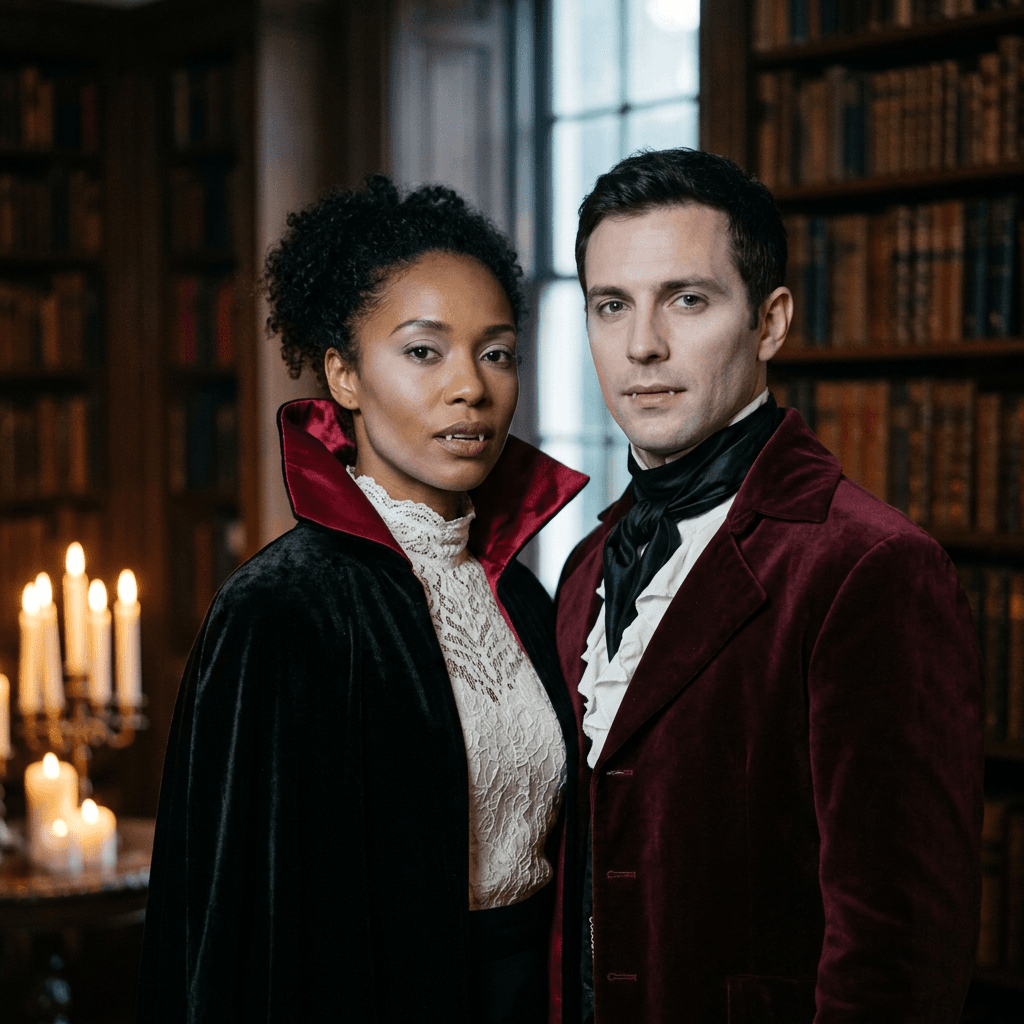
1. Vampire Couple in a Candlelit Library
Two aristocratic vampires in velvet and lace are the signature horror pair, and they look elegant rather than cheesy when the drama comes from fabric and candlelight.
Transform the uploaded photo of two people into a realistic gothic vampire couple portrait. The person on the left wears a floor-length black velvet cape with a tall stiff collar lined in deep crimson satin over a high-necked white lace blouse. The person on the right wears a fitted burgundy velvet frock coat with a white ruffled shirt and a black silk cravat. Both have subtle pale makeup that fades into their real skin tone at the jawline and small, tasteful fangs. They stand close together in an old library with dark wood shelves and leather-bound books, lit by a cluster of candles on a table at the left that casts warm flickering light across both faces from the same side, with faint cool moonlight from a tall window behind. Medium shot at eye level on a 50mm lens at f/2.8, both faces sharp, velvet with a realistic nap and satin with a soft sheen. Keep both people's real faces, skin tones, hairstyles, ages and body proportions exactly as in the uploaded photo, with the person on the left staying on the left. Natural skin texture with visible pores, no plastic or airbrushed skin, no merged faces, no extra or warped fingers, no garbled text, no watermark.
DIY version: A cape is a rectangle of black velvet or satin with a gathered neckline, and a stiff collar comes from a strip of sew-in interfacing or craft foam sandwiched inside the fabric. Costume fangs that fit over your teeth are sold in most Halloween aisles, and a thrifted white dress shirt with a lace jabot pinned at the neck covers the ruffles.
2. Zombie Prom Couple
Torn formalwear, a wilted corsage and a gym full of drooping streamers make this the funniest horror pair, and it works for best friends as easily as for couples.
Transform the uploaded photo of two people into a realistic zombie prom couple portrait. The person on the left wears a slightly torn black tuxedo jacket with a wilted white carnation boutonniere and a crooked bow tie, with gray-green makeup shading under the eyes and cheekbones that fades into their real skin tone at the jawline. The person on the right wears a faded teal satin prom outfit with a ripped hem, a dried-flower corsage on the wrist, the same subtle gray-green shading, a few painted scratches and smudged eyeliner. They pose arm in arm in a high school gym decorated with drooping paper streamers, a balloon arch and string lights, lit by a direct on-camera flash that gives crisp highlights and a small hard shadow on the backdrop. Medium shot on a 35mm lens at f/4, both faces sharp, balloons and streamers softly blurred behind. Keep both people's real faces, skin tones, hairstyles, ages and body proportions exactly as in the uploaded photo, with the person on the left staying on the left. Natural skin texture with visible pores, no merged faces, no extra or warped fingers, no garbled text, no watermark.
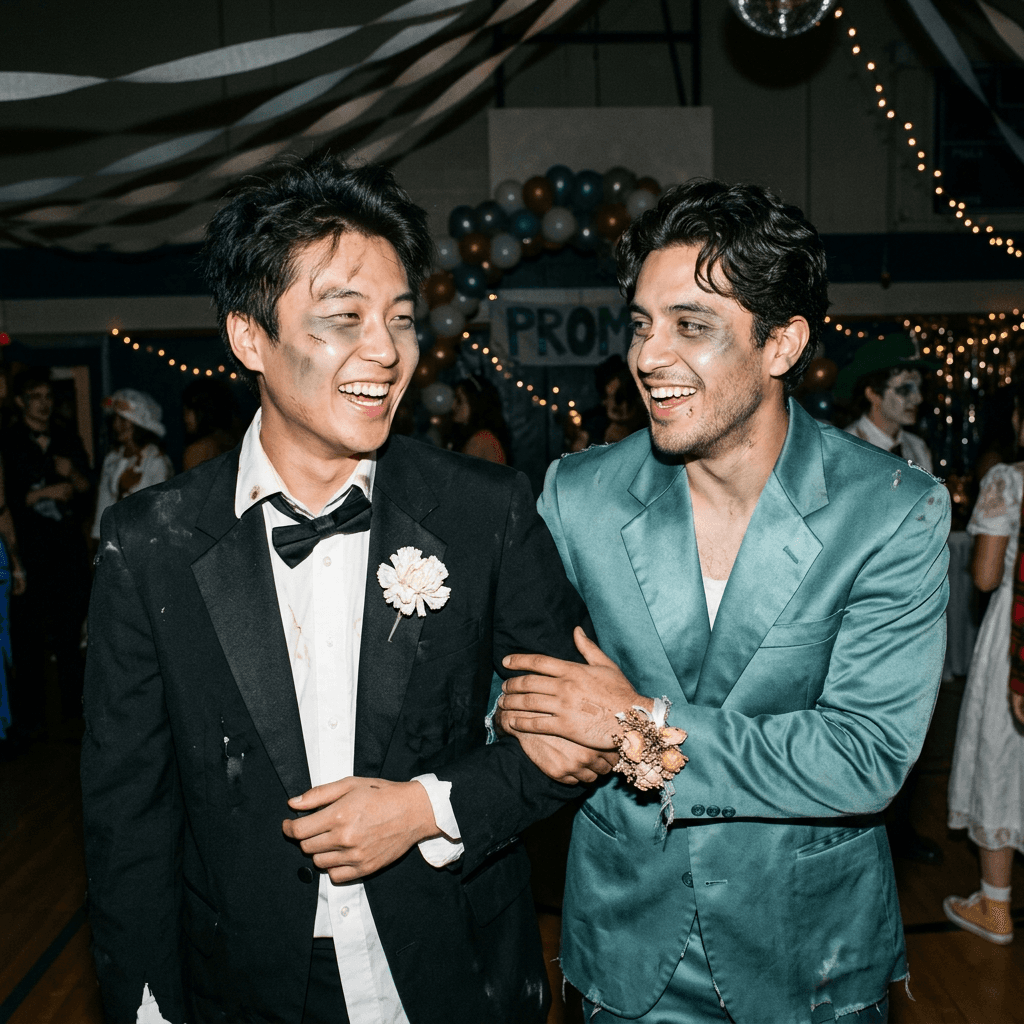
DIY version: Thrifted formalwear is the whole costume. Soak a white shirt in cold black tea for yellowed aging, nick the hem with scissors and sandpaper, and dab gray-green cream makeup on with a sponge, testing any makeup on your inner wrist the day before. Dried or silk flowers on an elastic band make the corsage.
3. Stitched Monster and Mad Inventor
A patchwork creation and its creator is a gothic classic that works especially well when there is a height difference between the two of you.
Transform the uploaded photo of two people into a realistic portrait of a stitched monster and a mad inventor. The person on the left wears a long dark green knit coat made of mismatched patches in different greens with thick black thread stitches across the seams, a flat-topped dark hat, subtle green-tinted makeup and a thin painted scar across the forehead. The person on the right wears a rumpled white lab coat over a leather apron, brass goggles pushed up on the forehead, and heavy rubber gloves, with one hand resting on the other person's shoulder. They stand in a stone laboratory with copper pipes, glass flasks of glowing liquid and a tall coil emitting a small blue arc, lit mainly by a cool teal glow from the flasks on the left with a warm lamp bounce on the right. Medium shot on a 35mm lens at f/2.8, both faces sharp, wool patches and leather showing real texture. Keep both people's real faces, skin tones, hairstyles, ages and body proportions exactly as in the uploaded photo, with the person on the left staying on the left. Natural skin texture with visible pores, no merged faces, no extra or warped fingers, no garbled text, no watermark.
DIY version: Sew or fabric-glue patches of several greens onto an old cardigan, then draw stitch lines with black yarn or a thick marker. Clear safety goggles from a hardware store with the frame sprayed brass-gold make the inventor's goggles, and any white button-up shirt works as the lab coat.
4. Witch and Warlock Coven
Two spellcasters in a misty forest is a pairing built around deep greens and purples, with a single lantern doing most of the lighting work, which suits anyone who wants to look mysterious rather than silly.
Transform the uploaded photo of two people into a realistic witch and warlock coven portrait. The person on the left wears a long black hooded cloak lined in deep green with a bronze clasp, holding a glowing lantern in one hand with the fingers relaxed and anatomically correct. The person on the right wears a tall pointed black felt hat with a dark purple band and a long charcoal coat with embroidered sleeves, a pendant on a leather cord and a small bundle of dried herbs tucked into the belt, holding a gnarled wooden staff. They stand in a misty forest clearing at dusk with bare trees and low fog, lit mainly by the warm lantern at waist height on the left, which throws amber light upward onto both faces, with cool blue twilight behind them. Medium-wide shot on a 35mm lens at f/2.8, both faces sharp and the fog softly layered behind. Keep both people's real faces, skin tones, hairstyles, ages and body proportions exactly as in the uploaded photo, with the person on the left staying on the left. Natural skin texture with visible pores, no merged faces, no extra or warped fingers, no garbled text, no watermark.
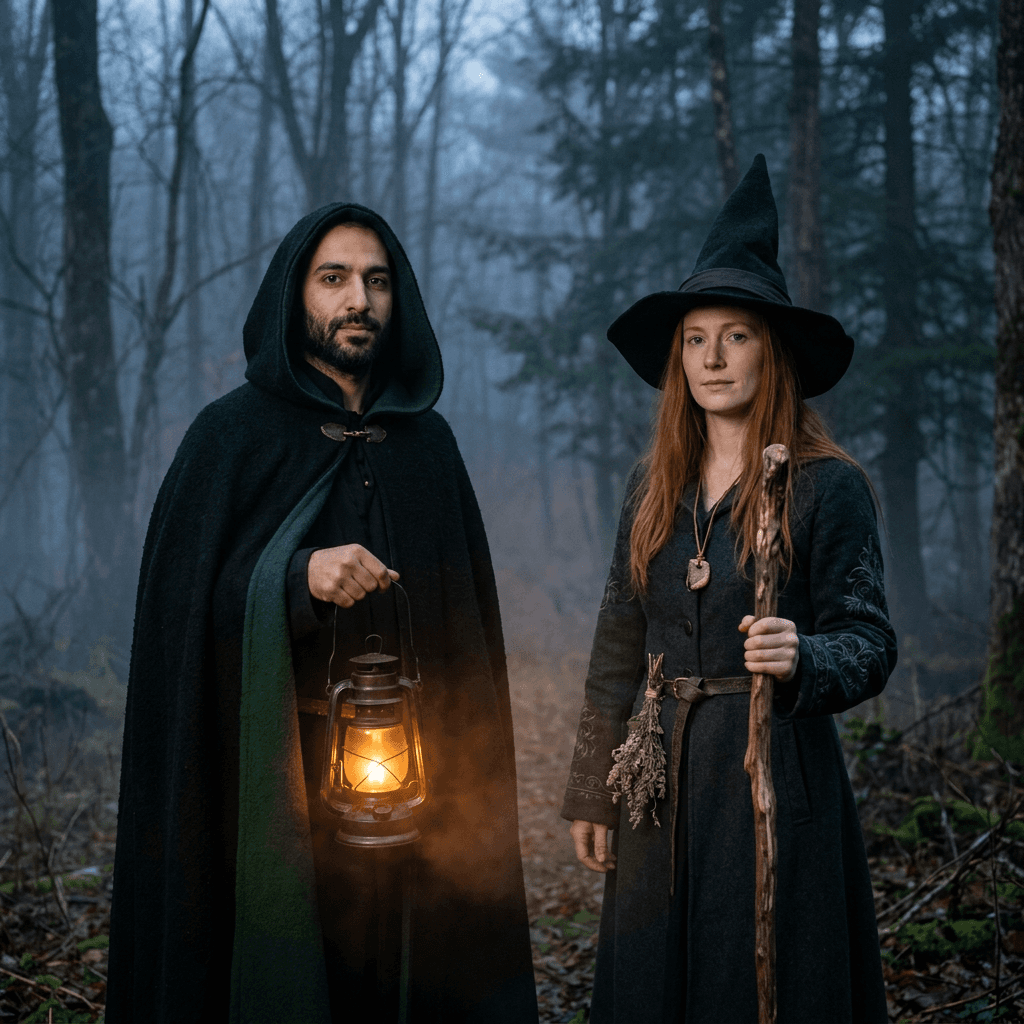
DIY version: A witch hat is a cone of black poster board or felt hot-glued to a brim cut from craft foam, and a hooded cloak can be a black bedsheet or fabric sold by the yard with a drawstring neckline. Use a flameless LED lantern rather than a real candle near fabric.
5. Mummy and Tomb Explorer
A bandaged mummy and the khaki-clad explorer who woke it is a story the whole party gets instantly, and the explorer half is nearly free if you own a button-up shirt.
Transform the uploaded photo of two people into a realistic mummy and tomb explorer portrait. The person on the left is wrapped in overlapping strips of aged cream linen gauze with frayed edges across the torso, arms and head, leaving the eyes, nose and mouth uncovered so the face stays clearly visible. The person on the right wears a rolled-sleeve khaki shirt, a wide-brimmed canvas hat, a leather satchel across the chest and dusty boots, holding a flashlight that points down the corridor. They stand in a narrow stone tomb corridor with carved sandstone walls bearing simple geometric reliefs, lit by warm torch-colored light from the left and a pool of cool flashlight light on the floor. Medium shot on a 35mm lens at f/4, both faces sharp, visible linen weave and fabric dust. Keep both people's real faces, skin tones, hairstyles, ages and body proportions exactly as in the uploaded photo, with the person on the left staying on the left. Natural skin texture with visible pores, no merged faces, no extra or warped fingers, no garbled text, no watermark.
DIY version: Tear a white bedsheet or muslin into two-inch strips and tea-dye them cream, then pin them over leggings and a long-sleeve tee with safety pins or fashion tape so nothing shifts, and keep elbows and knees loose enough to bend.
2) Iconic Pairs and Opposites
Pairs and opposites work because of the relationship rather than the details. Nobody asks what you are when one of you is dressed head to toe in white, the other in black, and you stand shoulder to shoulder. They are also the best fit for best-friend duos since the concept carries no romantic framing. When you preview these, check how each half reads when the two of you stand apart, because at a party you will spend a lot of time on opposite sides of the room.
6. Salt and Pepper Shakers
The classic pair works at ten feet because the contrast is built into the colors, and it is a favorite for best friends.
Transform the uploaded photo of two people into a realistic salt and pepper shaker duo portrait. The person on the left wears an oversized white cylindrical shaker costume of smooth matte fabric with a rounded silver cap-shaped hat punched with small round holes and a single capital letter S on the front, with the face clearly visible below the cap. The person on the right wears the matching black shaker with a silver cap and a single capital letter P. They stand shoulder to shoulder in a bright retro kitchen with a black-and-white checkered floor and pale yellow cabinets, lit by soft daylight from a large window at the left. Full-length shot on a 35mm lens at f/4, both faces sharp, visible fabric seams and the brushed silver cap catching a highlight. Keep both people's real faces, skin tones, hairstyles, ages and body proportions exactly as in the uploaded photo, with the person on the left staying on the left. Natural skin texture with visible pores, no merged faces, no extra or warped fingers, no brand names, no other text, no watermark.
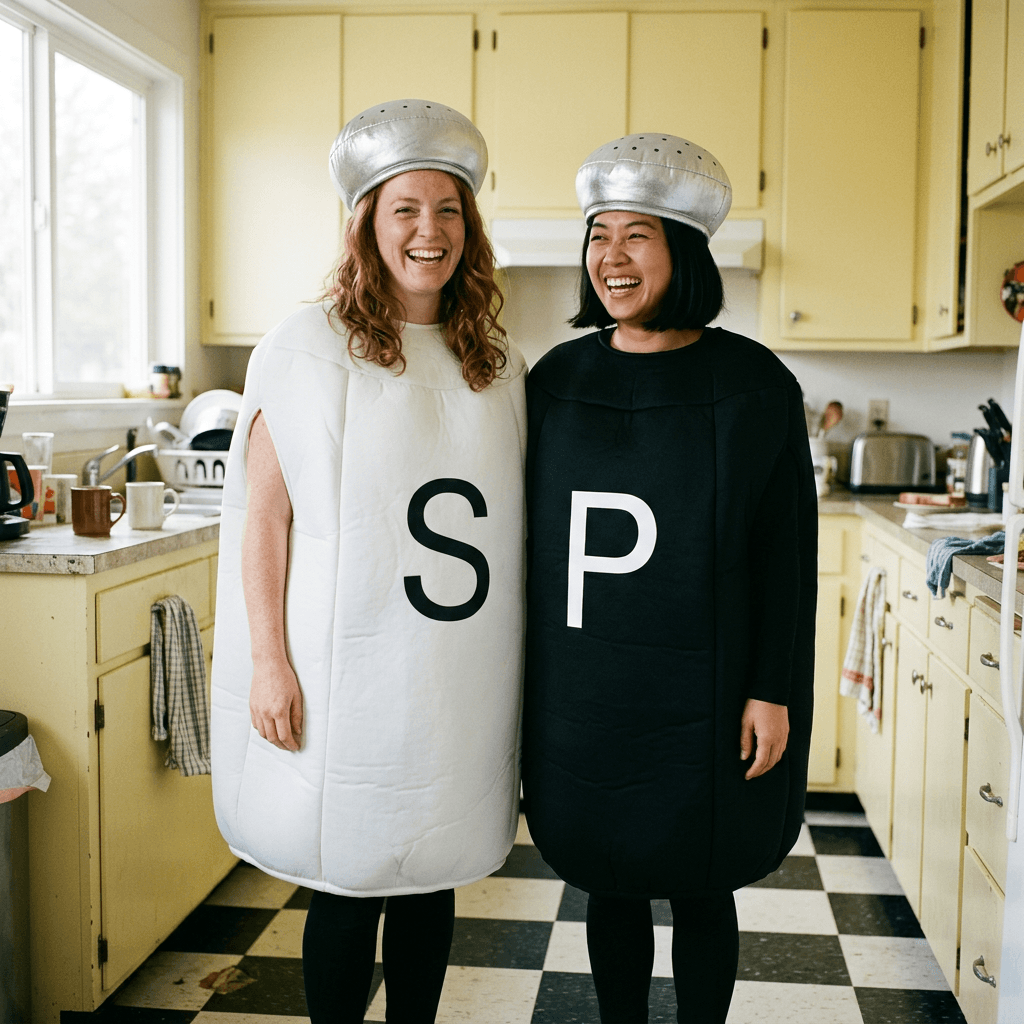
DIY version: Cut the bottom out of a pop-up laundry hamper, cover it in white or black fabric, add suspender straps, and make the silver cap from poster board wrapped in foil with holes punched by a pencil. The fastest version is a white hoodie and a black hoodie with foil-covered hats.
7. Angel and Devil
A halo and horns carry the whole idea, and the pairing is a good excuse for a playful, mischievous pose.
Transform the uploaded photo of two people into a realistic angel and devil duo portrait. The person on the left wears a flowing white satin top with feather-trimmed shoulders, soft white feathered wings and a thin gold halo on a headband, with a gentle innocent expression. The person on the right wears a fitted black and crimson jacket, small red horns on a headband, a pointed tail curling out from behind, and subtle red eyeliner, with a sly smirk. They stand shoulder to shoulder in a studio against a gray backdrop, lit by a soft white key light from the left and a red-gelled rim light from the right so each side glows in its own color. Medium shot on a 50mm lens at f/4, both faces sharp, satin sheen and feather detail visible. Keep both people's real faces, skin tones, hairstyles, ages and body proportions exactly as in the uploaded photo, with the person on the left staying on the left. Natural skin texture with visible pores, no merged faces, no extra or warped fingers, no garbled text, no watermark.
DIY version: A gold pipe cleaner or craft wire twisted into a ring on a headband makes the halo, and horns and wings are sold at most party stores. Wear all white on one side and all black with a single red accent on the other so the contrast is obvious in photos.
8. Sun and Moon
This pairing photographs beautifully because warm yellow and deep navy are complementary colors, and the headpieces make each person instantly readable.
Transform the uploaded photo of two people into a realistic sun and moon duo portrait. The person on the left wears a bright marigold satin top with a sunburst headpiece of gold felt rays radiating around the head and a dusting of gold shimmer on the cheekbones. The person on the right wears a deep navy velvet top with a silver crescent moon headpiece, scattered silver star sequins on the shoulders and pale silver eye makeup. They stand shoulder to shoulder against a painted twilight backdrop that fades from warm orange on the left to deep blue with tiny stars on the right, lit by a soft warm light from the left and a cool blue light from the right. Medium shot on a 50mm lens at f/4, both faces sharp, velvet and felt showing real texture. Keep both people's real faces, skin tones, hairstyles, ages and body proportions exactly as in the uploaded photo, with the person on the left staying on the left. Natural skin texture with visible pores, no merged faces, no extra or warped fingers, no garbled text, no watermark.
DIY version: Glue triangular rays cut from yellow and orange felt around a headband for the sun, and cut a crescent from silver cardstock for the moon. Wear a yellow top and a navy top, and add star stickers or sequins with fabric glue.
9. Peanut Butter and Jelly
A sweet, easy pair that works for couples, best friends and siblings, and the jars make the colors do the talking.
Transform the uploaded photo of two people into a realistic peanut butter and jelly jar duo portrait. The person on the left wears a rounded light-brown jar costume with a plain tan lid-shaped hat and a blank cream paper label bearing the letters PB, with the face visible above the label. The person on the right wears a rounded deep purple jar costume with a plain dark purple lid-shaped hat and a cream paper label bearing the letter J. They stand side by side in a bright diner-style kitchen with red vinyl stools and a counter, lit by soft window light from the left with a gentle fill from the right. Full-length shot on a 35mm lens at f/4, both faces sharp, visible fabric texture and a glossy sheen on the lids. Keep both people's real faces, skin tones, hairstyles, ages and body proportions exactly as in the uploaded photo, with the person on the left staying on the left. Natural skin texture with visible pores, no merged faces, no extra or warped fingers, no real brand labels, no other text, no watermark.
DIY version: Tan and purple sweatshirts with a white paper oval label pinned on the chest are the simplest route, and a round oatmeal canister lid or a shallow bowl covered in felt works as the lid hat. Skip real brand labels so the costume stays generic.
10. Plug and Socket
A pun costume that stays clean and friendly, because the cord does all the joking.
Transform the uploaded photo of two people into a realistic plug and socket duo portrait. The person on the left wears a rounded gray shell tunic with two flat silver prongs rising from the top of a headband and a black rope cord looping from the tunic to the other person's hand. The person on the right wears a pale ivory rectangular wall plate costume with two dark outlet slots and a single central screw, with the face visible above it. They stand side by side holding the cord between them in a cozy living room with warm lamplight from the left and a window glowing blue behind. Full-length shot on a 35mm lens at f/4, both faces sharp, visible painted cardboard edges and the rope texture. Keep both people's real faces, skin tones, hairstyles, ages and body proportions exactly as in the uploaded photo, with the person on the left staying on the left. Natural skin texture with visible pores, no merged faces, no extra or warped fingers, no garbled text, no watermark.
DIY version: Paint cardboard for the plate and tunic, cut the prongs from silver poster board on a headband, and use a length of black rope as the cord, never a real power cable.
3) Archetype Duos (No Trademarked Characters)
Archetype duos borrow the feel of a decade, a genre or a job without naming a specific film or character. That is a practical choice more than a legal footnote: image tools can refuse or distort trademarked characters, and a generic archetype gives you full control over colors and props, which also makes the costume easier to shop for. The table in the mistakes section shows how to translate a famous character idea into a generic description.
11. 1920s Speakeasy Pair
Pinstripes and beads are among the easiest vintage looks to build from a thrift store.
Transform the uploaded photo of two people into a realistic 1920s speakeasy portrait. The person on the left wears a gray pinstripe three-piece suit with a pocket watch chain, a wide-brimmed black fedora and a loosened tie. The person on the right wears a champagne beaded drop-waist dress with long fringe, a triple strand of long pearls and a feathered headband. They lean together at a dark wood bar in a dim speakeasy with brass lamps and shelves of unlabeled bottles, lit mainly by a green-shaded banker's lamp on the bar at the left that casts warm amber light on both faces. Medium shot on a 50mm lens at f/2, both faces sharp, subtle film grain, a gentle warm vintage color grade. Keep both people's real faces, skin tones, hairstyles, ages and body proportions exactly as in the uploaded photo, with the person on the left staying on the left. Natural skin texture with visible pores, no merged faces, no extra or warped fingers, no readable bottle labels, no garbled text, no watermark.
DIY version: A thrifted pinstripe vest or suit, suspenders and a fedora cover one half, while a fringed or sequined slip dress, a long pearl necklace and a feather on a headband cover the other. The outfits can be swapped freely between the two of you.
12. Retro Astronaut Duo
White jumpsuits and a round helmet give you a clean, graphic look that reads well in photos.
Transform the uploaded photo of two people into a realistic retro astronaut duo portrait. Both wear white 1960s-inspired space suits with silver zippers, orange piping and plain solid-color shoulder patches with no flags or logos. The person on the left holds a clear round helmet under one arm with the face fully visible. The person on the right wears the helmet with the visor raised so the face is fully visible, and holds a small silver canister in one hand with relaxed fingers. They stand in a retro-futuristic set with a round porthole showing a starfield, a bank of analog gauges and chunky toggle switches, lit by a soft overhead studio softbox with a cool white fill from the right. Medium shot on a 35mm lens at f/4, both faces sharp, visible fabric weave and glossy helmet reflections. Keep both people's real faces, skin tones, hairstyles, ages and body proportions exactly as in the uploaded photo, with the person on the left staying on the left. Natural skin texture with visible pores, no merged faces, no extra or warped fingers, no flags, no logos, no garbled text, no watermark.

DIY version: White painter's coveralls from a hardware store are the base, with colored tape for stripes and plain fabric patches. A white bike helmet works as a safe helmet, and a cardboard box covered in foil makes a backpack. Leave off agency logos and flags.
13. 80s Aerobics Duo
Neon spandex, leg warmers and terry cloth headbands make this the most colorful pair on the list, and it photographs like a vintage fitness video.
Transform the uploaded photo of two people into a realistic 1980s aerobics class portrait. The person on the left wears a neon pink striped sleeveless unitard with a bright yellow headband, white leg warmers and a matching wristband. The person on the right wears electric blue high-cut shorts and a neon-patterned tank top, a terry cloth headband, striped tube socks and white sneakers. They strike matching poses with arms raised and open hands, anatomically correct, in a wood-floored dance studio with a wall of mirrors, lit by soft fluorescent overhead light with a slight film halation glow. Full-length shot on a 35mm lens at f/4 with the look of 1980s 35mm film, both faces sharp, fine grain, saturated but natural color. Keep both people's real faces, skin tones, hairstyles, ages and body proportions exactly as in the uploaded photo, with the person on the left staying on the left. Natural skin texture with visible pores, no merged faces, no extra or warped fingers, no garbled text, no watermark.
DIY version: Thrifted spandex or leotards over leggings, scrunchies, and a dollar-store headband are enough. Leg warmers are easy to make by cutting the sleeves off an old knit sweater. For more era-specific looks, see the ChatGPT 80s photo trend prompts.
14. Dusty Western Duo
A sheriff and an outlaw give you a dramatic standoff-style pose without any props that look like weapons.
Transform the uploaded photo of two people into a realistic Western duo portrait. The person on the left plays the sheriff in a tan canvas duster coat, a brown leather vest, a wide-brimmed hat and a simple tin star badge, with thumbs hooked in the belt. The person on the right plays the outlaw in a dark flat-brimmed hat, a red bandana pulled down around the neck, a patterned wool poncho and worn leather chaps. They face the camera side by side on the dusty main street of an old wooden frontier town at golden hour, with low sun from behind and to the right creating a warm rim light on the hats and floating dust in the air. Medium-wide shot on a 35mm lens at f/4, both faces sharp, leather and canvas showing realistic wear. Keep both people's real faces, skin tones, hairstyles, ages and body proportions exactly as in the uploaded photo, with the person on the left staying on the left. Natural skin texture with visible pores, no merged faces, no extra or warped fingers, no weapons, no garbled text, no watermark.
DIY version: Denim, boots and a bandana from your closet, a thrifted hat, and a badge cut from cardboard and wrapped in foil will carry this one. Add a leather-look belt and a fringed vest from a thrift store if you want more silhouette.
15. Pirate Captains at Sea
Two captains sharing one deck makes a more interesting photo than a captain and a deckhand, and it gives both of you a hat to show off.
Transform the uploaded photo of two people into a realistic pirate captain duo portrait. The person on the left wears a long navy captain's coat with brass buttons and gold braid, a black tricorn hat with a feather and a white ruffled shirt, holding a brass spyglass. The person on the right wears a deep red frock coat with a wide black belt, a leather shoulder strap and a bandana under a black bicorn hat, with a gold hoop earring and a small brass compass on a chain. They stand on a wooden ship deck at sunset with coiled ropes, rigging and a canvas sail behind, lit by low golden sun from the left with a soft sea mist. Medium shot on a 35mm lens at f/4, both faces sharp, wool coats and weathered wood showing real texture. Keep both people's real faces, skin tones, hairstyles, ages and body proportions exactly as in the uploaded photo, with the person on the left staying on the left. Natural skin texture with visible pores, no merged faces, no extra or warped fingers, no garbled text, no watermark.
DIY version: A long blazer or cardigan with gold buttons sewn on, a tricorn cut from black craft foam, and a scarf tied as a sash are the main pieces. A wrapped paper tube with a gold-painted end makes a convincing spyglass.
4) Cozy and Funny DIY-Friendly Pairs
These five are the costumes most people can finish in an evening with a bedsheet, a cardboard box or a thrifted flannel. The AI preview helps most here because homemade costumes succeed or fail on proportion and paint color, and it is cheaper to find that out on screen than after the spray paint has dried.
16. Cardboard Box Robot Pair
Two homemade robots with dials and blinking lights have a charm that a store-bought costume cannot match.
Transform the uploaded photo of two people into a realistic cardboard box robot duo portrait. The person on the left wears a boxy robot torso made from a cardboard box painted brushed silver, with bottle-cap dials, a row of colorful buttons and a small square screen opening on the chest, and flexible silver dryer-vent tubing for arms, with the face visible through an opening at the top. The person on the right wears a slightly smaller copper-painted box robot with a panel of switches and a round antenna made from a spring on a headband. Visible tape seams, foil tape edges and hand-painted brush strokes show the handmade charm. They stand in a bright garage workshop with a craft table and scattered tools, lit by warm window light from the left. Full-length shot on a 35mm lens at f/4, both faces sharp. Keep both people's real faces, skin tones, hairstyles, ages and body proportions exactly as in the uploaded photo, with the person on the left staying on the left. Natural skin texture with visible pores, no merged faces, no extra or warped fingers, no garbled text, no watermark.
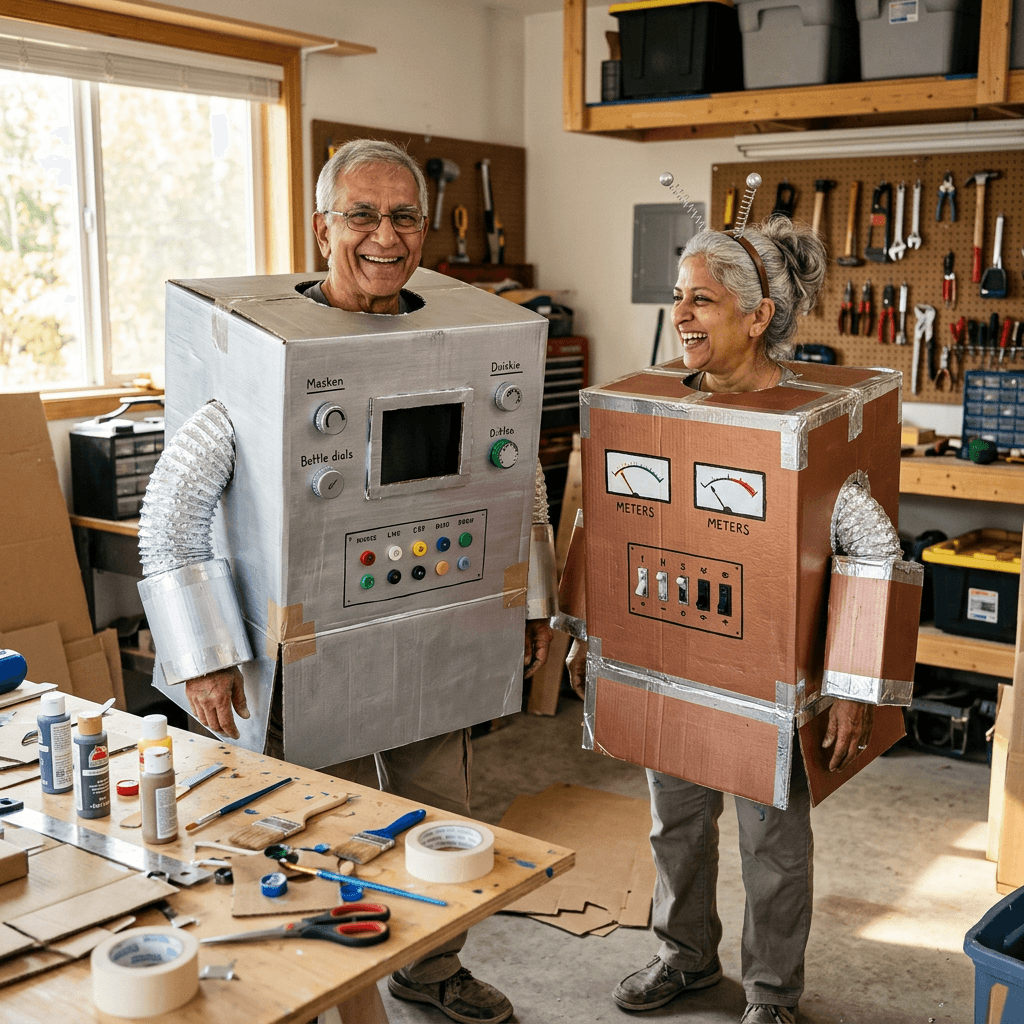
DIY version: Use two shoulder-width boxes with head and arm holes cut out, silver spray paint applied outdoors, bottle caps for dials, aluminum dryer-vent hose for arms, foil tape for edges, and battery-powered LED tap lights for blinking buttons.
17. Matching Ghost Sheets With Sunglasses
The coolest ghosts at the party leave their faces visible and add a pair of dark sunglasses.
Transform the uploaded photo of two people into a realistic matching ghost portrait. Both wear a white cotton bedsheet draped over the head and shoulders like a hood and falling to the ground in soft folds, with a large oval opening that leaves each face fully visible, and both wear round black sunglasses. The person on the left holds a small orange trick-or-treat bucket and the person on the right holds a carved mini pumpkin with a glowing candle-style light. They stand on a suburban front porch at dusk with three carved pumpkins and a warm porch light above the door at the right, with a deep blue sky behind. Medium shot on a 35mm lens at f/2.8, both faces sharp, cotton showing a realistic weave and folds. Keep both people's real faces, skin tones, hairstyles, ages and body proportions exactly as in the uploaded photo, with the person on the left staying on the left. Natural skin texture with visible pores, no merged faces, no extra or warped fingers, no garbled text, no watermark.
DIY version: A queen-size white flat sheet, a hood opening cut in the center, and a hem pinned above ankle height so you can walk safely at night. If you cut eye holes instead, make them bigger than seems necessary, and add reflective tape if you will be on the street after dark.
18. Scarecrow Pair
Two scarecrows at the edge of a cornfield is the most autumn-friendly pairing on the list, and the straw makes the costume look more detailed than it is.
Transform the uploaded photo of two people into a realistic scarecrow pair portrait. The person on the left wears a patched red flannel shirt with straw poking out of the sleeves and collar, burlap-patched trousers and a floppy straw hat, with stitched smile lines and a few freckle dots painted in brown makeup. The person on the right wears patched denim overalls, a mustard bandana, straw tufts at the cuffs, and a battered brown felt hat, with matching stitched-line makeup and rosy cheek circles. They stand shoulder to shoulder in a harvested cornfield with dry stalks and a hay bale at golden hour, with low sun behind them from the right creating a rim glow on the straw. Medium shot on a 50mm lens at f/2.8, both faces sharp, visible straw, burlap weave and flannel texture. Keep both people's real faces, skin tones, hairstyles, ages and body proportions exactly as in the uploaded photo, with the person on the left staying on the left. Natural skin texture with visible pores, no merged faces, no extra or warped fingers, no garbled text, no watermark.
DIY version: Raffia from a craft store tucked into sleeves and cuffs, flannel and denim from a thrift shop, burlap squares sewn or glued on as patches, and brown eyeliner for the stitched lines complete the look.
19. Pumpkin and Farmer
One person becomes the harvest, the other becomes the person who grew it, and the contrast in shape makes it read from across a room.
Transform the uploaded photo of two people into a realistic pumpkin and farmer portrait. The person on the left wears a round padded orange pumpkin costume with subtle ribbing, a green felt stem hat topped with curling green ribbon vines, and the face visible through a wide oval opening. The person on the right wears blue denim overalls over a red plaid shirt, a straw hat and work gloves tucked in a back pocket, holding a wicker basket of tiny pumpkins. They stand in a rustic barn doorway with hay bales and strings of warm tungsten bulbs overhead, lit by the glow of the bulbs from above and daylight from the open barn door at the left. Full-length shot on a 35mm lens at f/4, both faces sharp, felt, denim and wicker showing real texture. Keep both people's real faces, skin tones, hairstyles, ages and body proportions exactly as in the uploaded photo, with the person on the left staying on the left. Natural skin texture with visible pores, no merged faces, no extra or warped fingers, no garbled text, no watermark.
DIY version: An orange sweatshirt and pants lightly padded with pillow batting or crumpled paper bags make the pumpkin, with a green beanie and a felt stem on top. The farmer needs only overalls, a plaid shirt and a straw hat.
20. Bee and Beekeeper
A garden-party pair that is easy to wear and surprisingly photogenic, because the beekeeper's hat and veil add a graphic shape.
Transform the uploaded photo of two people into a realistic bee and beekeeper portrait. The person on the left wears a yellow and black striped sweater, sheer veined wings on wire frames attached at the shoulders and a headband with two small pompom antennae. The person on the right wears a white long-sleeve work jumpsuit, a wide-brimmed straw hat with a fine mesh veil pushed up over the brim so the face is fully visible, and holds a wooden honey dipper in one hand. They stand in a sunny autumn garden with marigolds, asters and a white wooden hive box behind, lit by warm afternoon sun from behind and to the left creating a soft rim light, with a gentle fill from the right. Medium shot on an 85mm lens at f/2.8, both faces sharp and the flowers softly blurred. Keep both people's real faces, skin tones, hairstyles, ages and body proportions exactly as in the uploaded photo, with the person on the left staying on the left. Natural skin texture with visible pores, no merged faces, no extra or warped fingers, no garbled text, no watermark.
DIY version: Stretch yellow tights over bent wire hangers for wings, add a headband with pipe cleaner antennae, and wear a black and yellow striped top. White painter's coveralls and a straw hat with a tulle veil make the beekeeper.
5) No-Costume Photoshoot Setups
A costume is optional, so these five prompts treat Halloween as a photo setting: wardrobe stays ordinary, and the mood comes from location, light and framing. They also work for couples who will be in costume later and want a calmer portrait of the two of them first. For the lighting and grain techniques behind the more photographic looks, see the guides to AI flash filter prompts and film grain photo prompts.
21. Pumpkin Patch Couple Portrait
The classic autumn couple photo, with a shared warm palette doing the work a costume would.
Transform the uploaded photo of two people into a realistic pumpkin patch couple portrait. The person on the left wears a cream chunky cable-knit sweater and dark jeans. The person on the right wears a rust corduroy jacket over a mustard sweater and boots. They sit close together on a hay bale in a pumpkin patch with rows of orange pumpkins of different sizes behind them, laughing naturally at something off-camera with one pumpkin between them. Low golden-hour sun from behind and to the left creates a warm rim light on the hair, with soft fill from the open sky. Medium shot at eye level on an 85mm lens at f/2, both faces sharp, the pumpkins and a wooden fence softly blurred. Keep both people's real faces, skin tones, hairstyles, ages and body proportions exactly as in the uploaded photo, with the person on the left staying on the left. Natural skin texture with visible pores and a few flyaway hairs, no merged faces, no extra or warped fingers, no garbled text, no watermark.
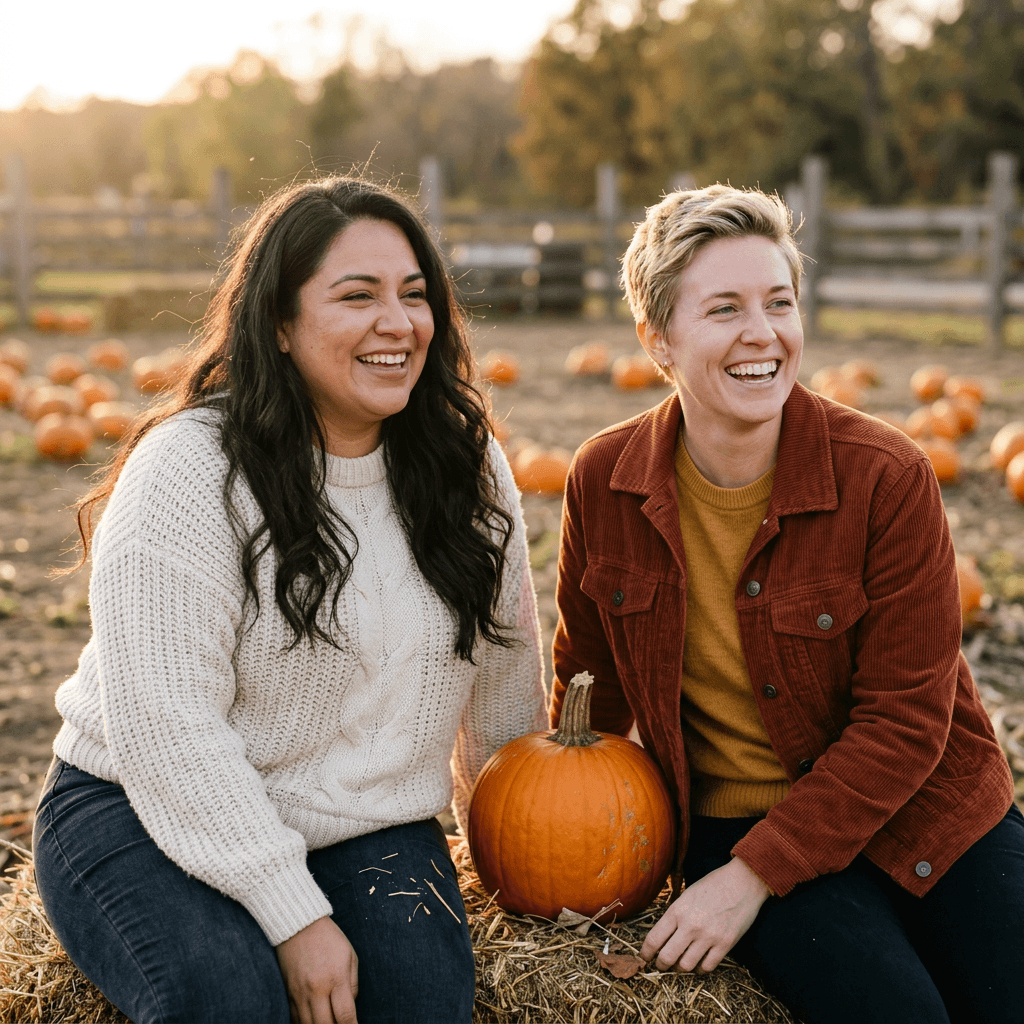
Styling tip: Pick two textures and a shared palette, such as cream and rust, and avoid logos and busy patterns. Real golden hour is the hour before sunset, so book your actual photo then if you want the same warm light.
22. Haunted House Doorway Flash Photo
A flash-lit porch with cobwebs looks like a dare that went well, and it is the easiest way to get a spooky photo with no makeup.
Transform the uploaded photo of two people into a realistic haunted house doorway flash photo. Both wear ordinary dark clothing, a black coat and jeans on the person on the left and a dark green jacket with a gray scarf on the person on the right. They stand close together on the porch of an old Victorian house with peeling gray paint, thick stretchy cobwebs across the railings, a lit jack-o'-lantern on the step and a half-open door showing darkness behind. A direct on-camera flash lights both faces evenly with crisp highlights and a hard shadow on the door, while the night around them falls to near black. The person on the left laughs nervously while the person on the right glances back at the dark doorway. Medium shot on a 28mm lens at f/2.8 in the style of a compact camera, both faces sharp, slight vignette. Keep both people's real faces, skin tones, hairstyles, ages and body proportions exactly as in the uploaded photo, with the person on the left staying on the left. Natural skin texture with visible pores, no merged faces, no extra or warped fingers, no garbled text, no watermark.
Styling tip: Dark clothing lets the flash light only the faces, and stretchy cobweb from the Halloween aisle makes a quick porch set. Only photograph at a house you own or have permission to use.
23. Four-Frame Photo Booth Strip
A vertical strip of four quick frames tells a mini story, which makes it a natural fit for a Story, a Reel cover or a printed keepsake.
Transform the uploaded photo of two people into a realistic vertical photo booth strip with four stacked frames on a single glossy strip with a white border. Both wear simple black clothing and matching black cat-ear headbands. In frame one both smile straight at the camera, in frame two they laugh with foreheads touching, in frame three both make wide-eyed scared faces looking at something off-frame, and in frame four the person on the left kisses the person on the right on the cheek. The background in each frame is a deep purple curtain. Direct flash lighting from the front gives each frame bright faces and a small shadow behind, with slightly faded warm color and visible film grain. Keep both people's real faces, skin tones, hairstyles, ages and body proportions identical in all four frames, with the person on the left staying on the left. Natural skin texture with visible pores, no merged faces, no extra or warped fingers, no text, no watermark.
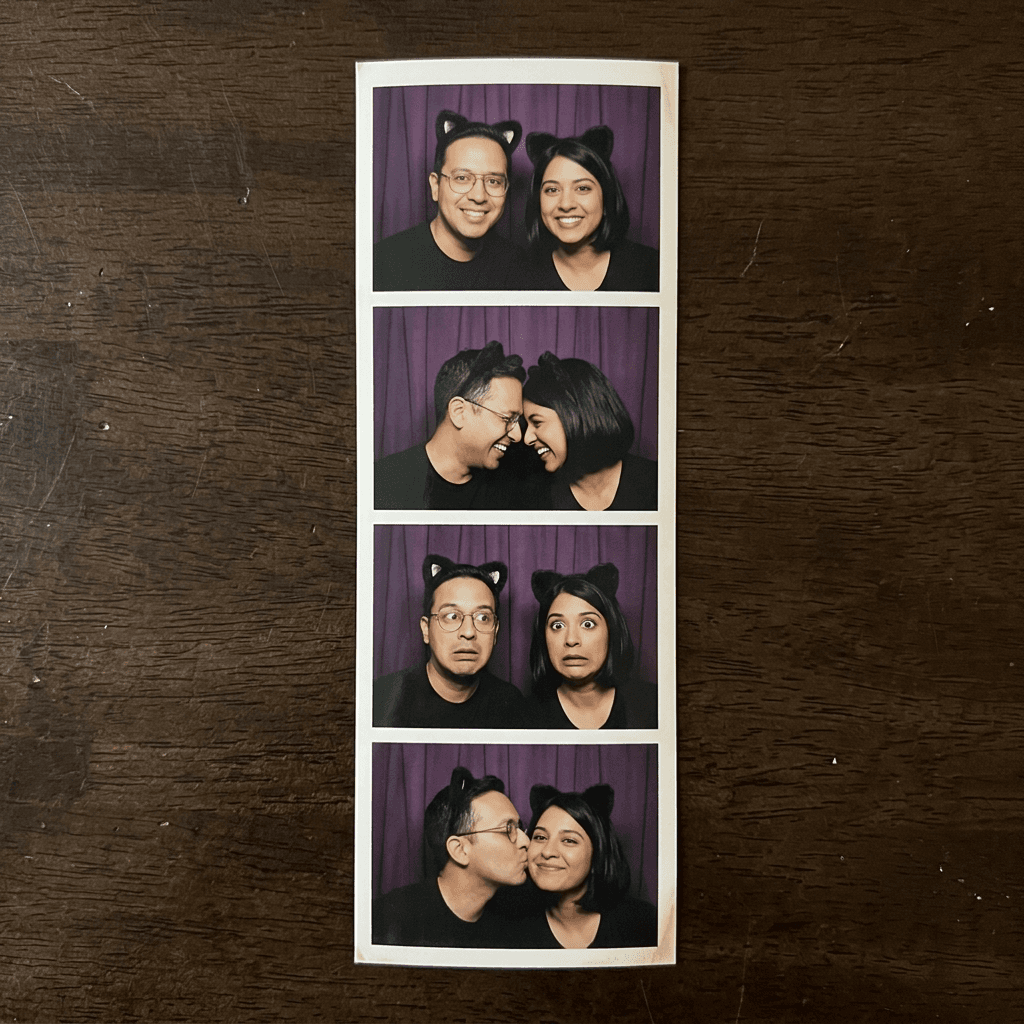
Styling tip: For best friends, swap the cheek kiss for a high five or a group hug. A real booth gives you only a moment between flashes, so plan the four poses in advance. For an instant-film border look, the Ghostface and Halloween portrait prompts include a snapshot variation.
24. Cinematic Horror Movie Poster for Two
Turn the two of you into the leads of a horror film, with the title space left empty for you to add later.
Transform the uploaded photo of two people into a realistic cinematic horror movie poster in portrait orientation. The two stand back to back in the foreground, both looking over their shoulders toward the camera with wide-eyed, wary expressions, wearing ordinary autumn clothing, a denim jacket on the person on the left and a gray hooded sweatshirt on the person on the right. A flickering orange lantern held low lights their faces from below, while behind them a looming dark farmhouse stands under a huge pale full moon with fog at their feet. Teal and orange cinematic color grade, anamorphic lens look, shallow depth of field, fine film grain. Leave the bottom third dark and completely empty for the title and credits to be added later in an editor. Keep both people's real faces, skin tones, hairstyles, ages and body proportions exactly as in the uploaded photo, with the person on the left staying on the left. Natural skin texture with visible pores, no merged faces, no extra or warped fingers, no text anywhere in the image, no watermark.
Styling tip: Plain clothing in a single muted color keeps the focus on the faces. Add the title in an editor, or use the YouTube Thumbnail Maker for bold title text. For more poster looks, try the AI movie poster prompts or the AI magazine cover prompts.
25. 2000s Digicam Flash Party Photo
The slightly overexposed, slightly messy party snapshot is a trend in itself, and cheap costume accessories are the whole outfit.
Transform the uploaded photo of two people into a realistic early-2000s digital camera party snapshot. The person on the left wears a black cat-ear headband and a plastic vampire cape over a t-shirt. The person on the right wears a witch hat that is slightly too big and a glitter bat necklace. They have their arms around each other, mid-laugh, in a crowded house party with orange string lights, paper bats on the wall and red plastic cups on a table in the background. A direct on-camera flash slightly overexposes the faces and leaves a cool blue cast in the dark background, with the soft focus, visible shadow noise and heavy JPEG compression of an old compact camera. Medium shot on a 28mm equivalent lens, both faces recognizable. Keep both people's real faces, skin tones, hairstyles, ages and body proportions exactly as in the uploaded photo, with the person on the left staying on the left. No merged faces, no extra or warped fingers, no timestamp or other text, no watermark.
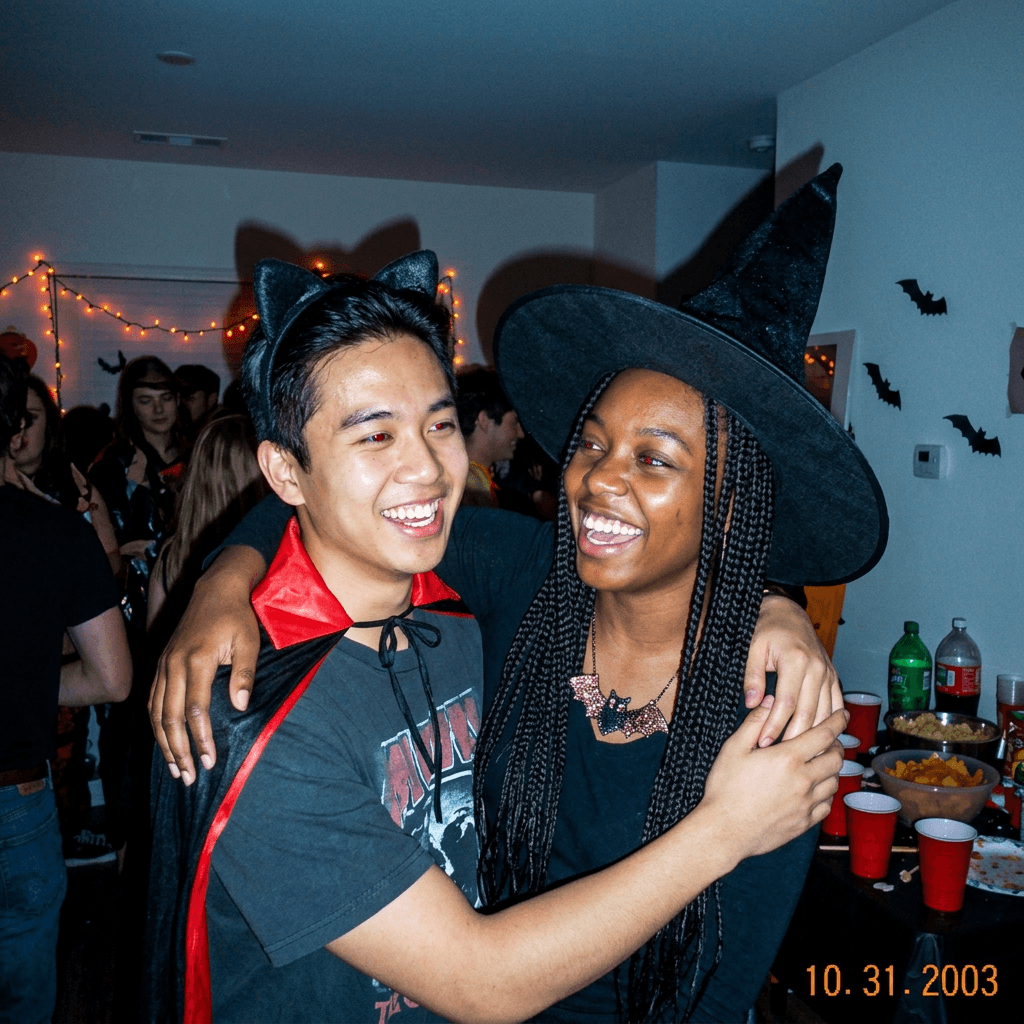
Styling tip: Use your phone's direct flash in a dim room and ask a friend to take the shot from about arm's length, which gives you the real flat, bright look. The Y2K camcorder photo prompts cover a related era if you want to push it further.
How to Use Your Previews to Actually Pick a Costume
Generating the images is the easy part. The decision is where the preview earns its keep, and a few quick tests make it much easier.
The three-second test. Show the image to someone who has not seen the prompt and ask what the two of you are. If they name it quickly, the costume will read at a party, and if they hesitate, add a clearer prop or choose a different idea.
The thumbnail test. Shrink the image to phone-thumbnail size. If you can still tell the costume from the silhouette and the colors, it will survive a dark, crowded room. Salt and pepper and sun and moon pass this test easily, while subtler pairs like the bee and beekeeper need a bold prop to hold up.
The contrast check. Light and dark pairings separate cleanly in photos, while two mid-tones can merge. If your preview looks muddy, change one outfit's color in the prompt and generate again.
The sit, eat and walk check. The preview cannot tell you that a cardboard robot cannot sit in a car or that a pumpkin costume blocks the snack table. Before you commit, think through the evening and pick the costume you can actually wear for three hours.
The shopping list. Pick the DIY tip for your favorite preview and turn it into five to ten items. Most of these costumes come from a thrift store, a hardware aisle and a craft store, which is why the ones in section 4 can be finished in a single evening.
A realistic plan for the week before Saturday, October 31:
- Today or tomorrow: upload your best photo and generate your top three ideas, three versions each.
- Within a day or two: send the previews to your partner or group chat, run the three-second test and choose.
- By the middle of the week: order anything that needs shipping and buy the craft supplies for anything you are building.
- Over the weekend before: build, sew or paint, and take a quick test photo in the real costume.
- On the night: photograph the finished costume near a window or porch light, and compare it with your AI preview for a before-and-after post.
How to Customize These Prompts
Every prompt follows the same skeleton, so changing a few words gives you a costume that fits your situation.
Same-sex couples and any pairing
The position-based phrasing ("the person on the left" and "the person on the right") never assumes a gender, so every prompt works as written for any couple. Costumes are assigned to positions, not to people, which means you can swap who wears the cape and who wears the suit without rewriting anything. If you want to name a gendered garment, write the garment itself, such as a satin gown or a tuxedo jacket, and let each person wear whichever they like.
Best friends, siblings and trios
Salt and pepper, peanut butter and jelly, sun and moon, the zombie prom and the astronaut duo all work for friends, siblings or coworkers with no romantic framing. For a trio, add a third position ("the person in the center") and keep the same structure. Three faces are noticeably harder to hold than two, so use a clear photo of all three and generate more variations. The multi-person prompt guide goes deeper on groups, and the Friendsgiving prompts are a good source of friend-group scenes for the week after Halloween.
Different skin tones, ages and body types
Tell the model explicitly to keep each person's real skin tone, especially with horror makeup. Pale vampire makeup and gray-green zombie shading are sometimes applied too heavily and can lighten or flatten a skin tone, so the prompts above ask for makeup that fades into the real skin tone at the jawline. If a result looks lighter than you, add a line such as keep the person on the right's natural skin tone visible under the makeup, matching the uploaded photo, and generate again. For lighting on deeper skin tones, ask for a soft fill light and avoid a single harsh overhead source that can leave the face too dark.
For body types, state that the costume fits the body in the photo rather than reshaping it. Words like relaxed fit, fitted or padded are more reliable than size labels, and the identity line already asks for body proportions to stay as they are. Ages work the same way, because the identity line keeps both people their real ages, so a couple in their sixties will not come back looking thirty. If either of you uses glasses, a cane, a wheelchair or a hearing aid, mention it in the prompt as something that stays, so the model does not quietly remove it.
Matching, coordinated or opposite
There are three ways to build a pair. Matching costumes, like the two ghosts, are the easiest because the same description applies to both positions. Coordinated costumes share a palette but have different roles, like the witch and warlock or the pirate captains. Opposites rely on contrast, like angel and devil or salt and pepper. For the prompts, matching pairs can reuse one costume sentence with different positions, while opposites need the most precise wording so the model does not make both people half of each.
Add a pet, a prop or another era
If your dog is part of the plan, upload a photo with them and describe the pet as a third subject, and the AI pet Halloween costume prompts have matching ideas. To turn any costume preview into a different kind of image, change the framing: a 90s yearbook photo for a school-picture joke, or a magazine cover for a faux feature. Adding a short era line such as shot on 35mm film in 1985 shifts the entire look without changing the costume.
Turn the Photo Into a Short, Reel or Thumbnail
A still is a good start, but a short vertical video usually gets more reach than a single image. Miraflow gives you several routes from the same photo.
A cinematic clip from the still. Upload your favorite result to Miraflow's cinematic video generator and describe a small movement. Small motions look more natural than big ones. A candle flickers, fog drifts, one person slowly turns toward the other and smiles. This is a reader-ready motion prompt for the vampire portrait:
Animate the uploaded photo with a slow push-in. The candle flames on the table flicker softly, a thin layer of fog drifts across the floor, and the person on the left slowly turns their head toward the person on the right, who gives a small sly smile. Keep both faces, costumes and the library exactly as in the photo, with natural motion only, no morphing, no sudden camera movement, and keep the clip short and subtle.
A story with Text2Shorts. Enter a topic such as which couple Halloween costume should we wear after testing three with AI, choose a realistic style, and Text2Shorts writes the script, builds scene visuals and adds a voice. You can edit the script and the visual prompts before the final render, so you can paste in the costume descriptions from this post. The walk-through in From Prompt to Reel shows the full process, and the AI Halloween video prompts cover spooky motion ideas.
A thumbnail for the vote. A video titled Which Costume Should We Wear works well with both faces in the frame and a big contrast between the two options. The YouTube Thumbnail Maker adds title text over a generated image, and the Halloween YouTube thumbnail prompts have layouts you can borrow.
A soundtrack. A spooky but playful instrumental raises a short clip a lot. Miraflow's AI music generator makes tracks you can use without copyright worries, and the AI Halloween music prompts have ready descriptions to paste in.
Party footage. If you film the actual night, AI Clipping can find the best moments and cut them into captioned vertical clips, which pairs well with the AI preview as an opening frame.
A simple 20-second sequence: open with the AI preview of the costume, cut to a real photo of the finished version, and end on the funniest moment from the party. If you plan to post it on Instagram, the notes in how to go viral on Instagram Reels are worth a read before you upload.
Common Mistakes With AI Couple Costume Photos
Faces drifting between the photo and the result. The most common complaint is a result that looks almost like you but not quite. Upload one sharp photo of both of you, keep the identity line in the prompt, and avoid costumes that cover the forehead, eyes or jawline. If the face changes only in one area, use inpainting in Miraflow's AI Image Generator to mask that area and regenerate it without redoing the whole image.
Both faces blending into one average face. This usually happens when the prompt uses shared descriptions, says "a couple" without positions, or packs too many details into one sentence. Describe the left person fully, then the right person fully, and leave out phrases that apply to both. If it keeps happening, try a simpler pose with more space between the faces, then fix any remaining face one at a time with inpainting.
Hands that do not look right. Arm-in-arm poses and shoulder touches ask the model to invent contact between two bodies. Describe the hand position specifically, such as "one hand resting on the other person's shoulder with relaxed fingers", and avoid poses with many overlapping hands. A quick inpainting pass on the hand is faster than regenerating.
A costume that is too busy. A prompt with a cape, a crown, a staff, a lantern, a necklace and six patches asks for more than the model can render cleanly. Keep to about three signature elements per person, such as a hat, a coat and one prop. The three-second test from earlier is the quickest way to tell if you went too far.
Trying to use trademarked characters. Image tools can block named characters, and when they do not, the result often looks off-model, with the wrong proportions or a shifted face. Generic archetypes give you more control and a better chance of a clean result. The table below shows how to translate common ideas without naming a character.
| If you are tempted by | Describe this archetype instead | Why it works |
|---|---|---|
| A famous caped superhero pair | Two caped heroes in original colors, one in teal and gold and one in plum and silver, each with a plain geometric chest emblem | Original shapes and colors avoid blocked requests and off-model logos |
| Royalty from an animated movie | A storybook princess in a pale blue ballgown with a plain silver tiara, and a prince in a navy military-style jacket with gold buttons and a red sash | Silhouette and fabric make a costume readable without any name |
| A famous magic school pair | Two apprentice magicians in long midnight-blue robes with embroidered star trim, leather satchels and wooden wands | Gives the model clear materials and colors to render |
| A famous cartoon detective duo | A trench-coated detective with a magnifying glass and an assistant in a tweed cap and wool scarf | Props carry the story and are easy to buy or make |
| A band you love | Two 1970s glam rockers in sequined jumpsuits and platform boots, one holding a homemade cardboard guitar | Evokes the era and attitude without copying a real act |
Plastic, over-smooth skin. Perfectly smooth faces are the fastest way to make a Halloween photo look AI-generated. Ask for visible pores, a few flyaway hairs and uneven makeup edges, and give the scene a real light source and lens. The prompt tricks for making AI images look like real photos cover the techniques in depth, and the film grain prompts add the texture that makes flash photos feel real.
Skin tone shifting under horror makeup. Pale or green makeup can lead the model to lighten or flatten a skin tone. State each person's natural skin tone in the prompt, ask for makeup that fades into it at the jawline, and compare the result with your original photo before choosing.
Putting words on costumes. Image models misspell text, so keep any label to one or two letters, like the S and P on the shakers, or leave it off and add text in an editor.
Choosing the first result. The first generation is rarely the best. Make three versions of each idea and compare them with your original photo, since the best one often has a small difference such as a better hat position or more natural expressions.
Make Your Couple Halloween Content With Miraflow
Everything in this post can be done in one browser tab. Miraflow's AI Image Generator handles the image-to-image costume previews, the photoshoot setups and the inpainting touch-ups. The YouTube Thumbnail Maker adds titles to wide images, Text2Shorts and the cinematic video generator turn stills into vertical clips, the music generator supplies the soundtrack, and AI Clipping cuts party footage into Shorts. You can find every tool from the Miraflow home page, and because the idea, visual, video, thumbnail and music steps all live in one place, a whole week of countdown content can be built in an evening.
Frequently Asked Questions
What are the best couple Halloween costume ideas to try with AI?
Start with pairs that read instantly, such as salt and pepper, sun and moon, angel and devil, and the zombie prom, then try one story-based pair, like the witch and warlock or the mummy and explorer, to see which suits your faces. The 25 prompts above cover classic horror, iconic opposites, generic archetypes, easy DIY pairs and no-costume photoshoots.
Can I preview a couples costume on my own photo before buying it?
Yes. Upload a clear photo of both people to an image-to-image tool, describe each costume by position, and generate a few versions. The preview shows colors, silhouette and how the costume sits with your faces and hair. It does not show fit or fabric quality, so use it to choose the idea and use the DIY tip to plan the real version.
Do I need one photo of both of us or two separate photos?
One clear photo of both people works best because both faces share the same light and scale. If you only have separate photos, upload both and say which is the person on the left and which is the person on the right. Make sure both photos are sharp and similar in lighting to reduce mismatched results.
How do I stop the AI from blending our faces together?
Describe each person fully and separately by position, avoid shared descriptions, include an identity line telling the model to keep both real faces, and use a single light source and a 35mm or 50mm lens. If one face still drifts, mask just that area and regenerate it with inpainting.
Does this work for best friends, same-sex couples or groups of three?
Yes. The prompts use position-based wording with no assumptions about gender or relationship, so they work for any pair. For three people, add a third position and use a photo showing all three clearly, but expect to generate a few more variations since three faces are harder to keep distinct.
Can I use a character name from a movie or show in the prompt?
It is better not to. Image tools can block trademarked characters or render them inconsistently, and posting such images on a brand account can create licensing trouble. Describe the archetype instead, such as a caped hero in original colors or an apprentice magician in a midnight-blue robe, as shown in the table above.
Is it okay to upload my partner's or friend's photo?
Only upload photos of people who have agreed to it. Ask first, explain that the images are for a costume preview or a Halloween post, and let them see the result before you share it publicly. Many platforms also ask you to label AI-generated content, so check the rules of the place you post.
How do I make the costume photo look real instead of AI-generated?
Describe a single light source, a specific lens and aperture, natural skin texture with visible pores, and real fabric textures. Avoid asking for flawless skin. The guide on making AI images look like real photos has more detail, and a small amount of film grain or flash can help.
How do I turn a couple costume photo into a Reel or Short?
Use Text2Shorts to build a short story from a topic, or upload a still to a cinematic video generator and describe a small movement such as a flickering candle or a slow head turn. Add music and captions in the same workflow before posting.
Do I even need a costume to join in on Halloween content?
No. Section 5 includes a pumpkin patch portrait, a haunted doorway flash photo, a photo booth strip, a horror movie poster and a 2000s party snapshot, all using everyday clothing. The mood comes from the setting, light and framing instead.
Conclusion
Couples costume shopping is a guessing game until you can see the idea on your own faces. The 25 prompts above let you preview vampires, zombies, shakers, astronauts, robots and scarecrows before you buy a single thing, and the five photoshoot setups give you a shareable Halloween portrait even if you never put on a costume. The pattern that keeps both faces recognizable is the same every time: one clear source photo, positions instead of names, a full description of each person, an identity line and one light.
With Halloween on Saturday, October 31, the practical move is to pick your top three ideas today, generate three versions of each, run the three-second test with a friend, and order or build the winner. Then open Miraflow's AI Image Generator, upload your photo and start building your Halloween duo series.