25 AI Diwali Prompts for Greeting Cards, Family Photos and Festive Posts (Copy & Paste 2026)

Written by
Aerin Kim
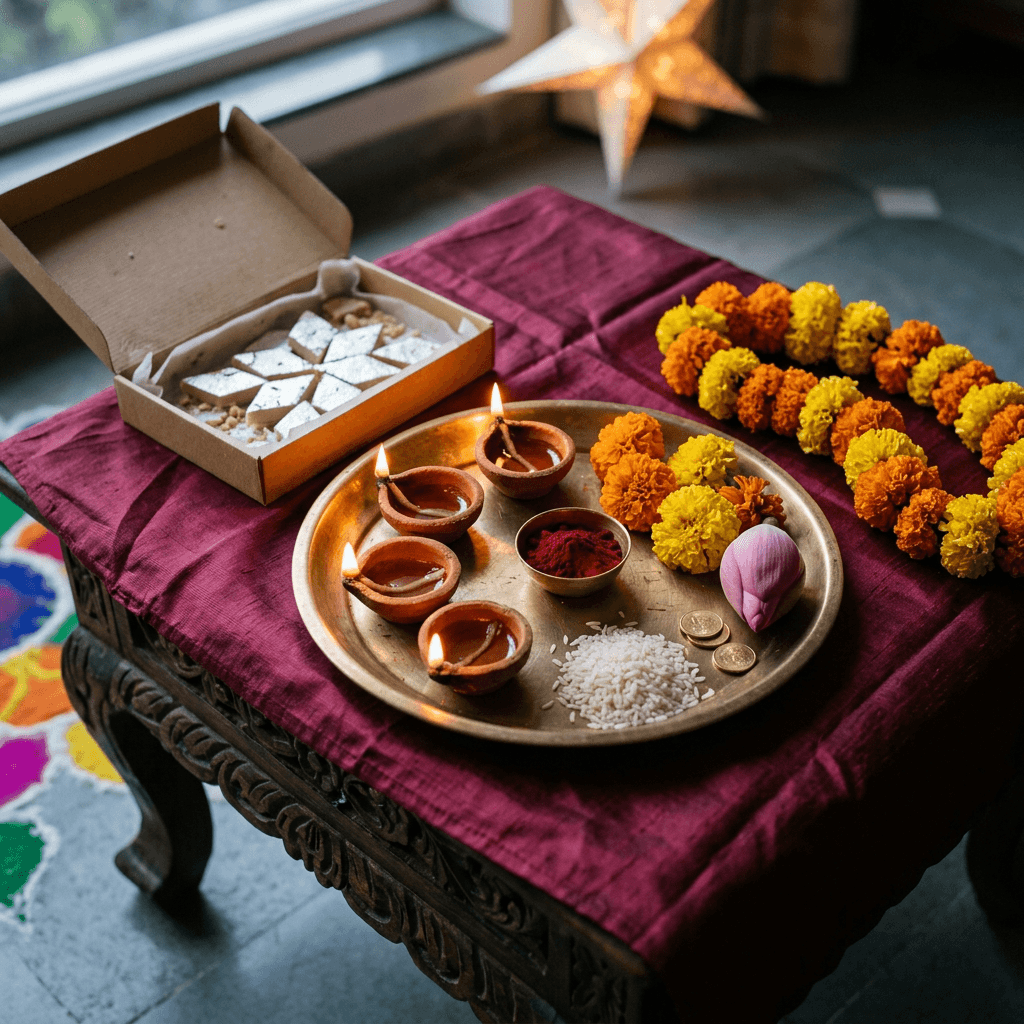
Get 25 copy-and-paste AI Diwali prompts for 2026, from greeting cards and family portraits to rangoli, mithai shots, shop offer posts and Reels, with cultural tips to get diyas and details right.
If you have ever searched for Diwali wishes images the week of the festival, you already know how it goes: the same gold-sparkle backgrounds, a cartoon diya with a flame that looks like a Western candle, and a blurry collage forwarded through forty WhatsApp groups. Creators, families and shop owners all need something fresher at exactly the same moment, and a designer or a studio shoot is hard to book when every sweet shop and jeweler wants a Diwali creative by the same Friday. This guide gives you 25 copy-and-paste AI Diwali prompts for 2026 that produce greeting cards, family photos, rangoli and decor ideas, mithai shots, shop offer posts and Reels that look like they belong to the festival instead of a generic template.
The timing is tight, because Diwali 2026 falls on Sunday, November 8, with Lakshmi Puja in the evening, and Dhanteras arrives two days earlier on Friday, November 6. The full festival runs roughly November 6 to November 10, and searches for things like Diwali wishes images, Diwali greeting cards, Diwali Instagram post ideas and Diwali AI photo prompts tend to climb in the two to three weeks before the main day. That puts the planning window right now, while you can still test a few prompts, fix the details and schedule posts instead of improvising on the evening itself.
The prompts are grouped into six categories: greeting cards and wishes images, family and portrait photos, home decor and rangoli, festive food and mithai, small business offer posts, and Reels, Shorts and video. After the prompts you will find a section on sizes for WhatsApp, Instagram and print, ways to adapt every prompt for different regions and families, eco-friendly and firecracker-free versions, and the mistakes that most often make AI Diwali images look wrong.
TL;DR: How to Use These AI Diwali Prompts
- Open Miraflow's AI Image Generator, paste a prompt, and generate a few variations. Every card and offer prompt reserves empty space for your greeting, price or headline.
- Add Happy Diwali, Shubh Deepavali or a Hindi, Marathi, Gujarati, Tamil or Telugu wish afterward in an editor with a real font. Image models often garble Devanagari and other scripts, so the wish is safest as live text.
- For family photos, upload your own picture and use image-to-image with an identity line such as keep my face, skin tone and hairstyle exactly the same. The prompts below already include it.
- Use diyas (small clay oil lamps), not candles, and describe them that way. The cultural details section explains the vocabulary that gets the props right.
- Turn the finished art into a Reel with Text2Shorts or the cinematic video generator, add a festive instrumental from Miraflow's AI music generator, and build a cover with the YouTube Thumbnail Maker.
Who These Diwali Prompts Are For and Where to Start
Diwali content is unusual because the same week produces very different needs. A family wants a photo of everyone in their festive clothes in front of the rangoli. An Instagram creator wants a Reel that does not look like the hundred other diya-and-fireworks Reels in the feed. A jeweler wants a Dhanteras offer creative. A boutique wants a festive collection post. A diaspora family in a cold November city wants a card that feels like home to relatives who are far away. The prompt numbers below are meant to be picked by job, so here is a quick way to choose.
Creators and influencers. Start with the solo portrait (prompt 8) and the decor prompts (10 to 13), then turn them into a short video with the Reel prompts (22 to 25). A Diwali Reel that opens on a real-looking flame and a clean rangoli tends to stand out in a feed full of fireworks and glitter overlays. If you also post on YouTube, the thumbnail prompt (25) works for a vlog or a recipe video, and the guide to Instagram Reels covers shows how to keep a grid consistent.
Families. Start with the greeting cards (1 to 5) for WhatsApp and the family portraits (6 to 9). Those use your own photos, so the faces stay yours and the AI only builds the festive setting around you.
Small businesses. Sweet shops, jewelers, boutiques and D2C brands should look at the mithai shots (14 to 17) and the offer posts (18 to 21), which are written with deliberate empty space for prices and headlines. The general advice in social media marketing for small businesses fits well here, because a festive week is a good moment to repeat one consistent look across posts instead of switching designs daily.
Diaspora households. Look at the customization section, which has apartment-friendly LED diya versions, cold-weather scenes and notes on keeping traditions accurate when the setting is a suburban doorway instead of a courtyard.
A Simple Five-Day Posting Plan
Diwali is a stretch of days, not a single post, and each day has its own content that fits. The table below maps the days to the prompts. Dates for the days around Diwali vary a little by regional calendar, so confirm the exact days for your community before you schedule.
| Day | What it is | Content that fits | Prompts to use |
|---|---|---|---|
| Dhanteras (Nov 6) | Traditional day for buying gold, silver and new utensils, and the start of the festival | Jewelry and utensil offers, hamper launches, shop-now Reels | 18, 19, 20 |
| Day before Diwali (around Nov 7) | Naraka Chaturdashi or Choti Diwali, when homes are cleaned, decorated and rangoli is drawn | Decor how-tos, rangoli time-lapses, toran and lantern posts | 10 to 13, 23 |
| Diwali and Lakshmi Puja (Nov 8) | Main evening with lamps, puja, sweets and family gatherings | Greeting cards, family portraits, thali and mithai shots, wishes images | 1 to 8, 14 to 17, 22, 24 |
| Day after Diwali (around Nov 9) | Govardhan Puja and, for Gujarati communities, the new year | New year wishes, thank-you posts to customers, business greetings | 5, 21 |
| Bhai Dooj (around Nov 10) | Festival of siblings, with tilak, sweets and gifts | Sibling portraits, gifting posts | 9, 19 |
A useful habit is to generate the visuals for all five days in one sitting, name the files by day, and schedule them. The festival week is busy enough that you will not want to be prompting on the night of Lakshmi Puja.
Getting the Cultural Details Right
Image models have seen millions of festive photos, but they also have seen a lot of clip art, so without guidance they will often blend traditions or invent props. Naming the correct objects in the prompt fixes most of this. Think of the list below as vocabulary you can drop into any prompt.
Diyas, not candles. A diya is a small, shallow, handmade clay (terracotta) oil lamp with a pinched spout where a twisted cotton wick rests in ghee or oil. The flame is small, steady and slightly golden. Describing it as a terracotta diya with a cotton wick and a small steady flame keeps the model away from tall white wax candles and glossy cartoon lamps. For a luxury look, mention brass or hand-painted white and gold diyas.
Rangoli. Rangoli is a floor design made at the entrance of a home, usually from colored powder, rice flour or flower petals, with symmetrical patterns such as lotus petals, peacocks, paisleys and geometric grids. In South India the daily rice-flour version is called kolam, in Bengal alpana is painted with rice paste, and in Andhra and Telangana you will hear muggu. Saying rangoli made of colored powder on a stone floor, photographed from above, gets a real floor design instead of a digital mandala.
Marigold garlands and torans. Marigold (genda) flowers in orange and saffron yellow are everywhere at Diwali, strung into garlands and into a toran, the decorative strand hung across a doorway, often with green mango leaves between the flowers. Mentioning genda flowers and mango leaves adds the right texture.
Akash kandil. These are hanging lanterns, traditionally folded paper or bamboo and often star-shaped, hung outside homes in many parts of India and especially associated with Maharashtra. Use the term akash kandil or paper star lantern, because a generic word like lantern may bring back Chinese red lanterns.
The Lakshmi Puja thali. The puja plate usually holds a lit diya, kumkum (red vermilion powder), unbroken rice, flowers such as marigold or lotus, incense and sweets, and many households place coins or a small bell beside it. A brass or steel thali with those items is a safer and more recognizable subject than an invented altar.
Mithai. Kaju katli (diamond-shaped cashew fudge, often topped with edible silver leaf), motichoor laddoo, jalebi, barfi, soan papdi and gulab jamun are the classics. Sweets are usually gifted in cardboard boxes with ribbons, or in brass and steel containers. Naming two or three specific sweets, rather than just Indian sweets, makes the image look like a real shop display.
Clothing and jewelry. Women's and men's festive wear includes the saree, lehenga, anarkali suit, kurta-pajama, sherwani, bandhgala and Nehru jacket, with silk, brocade and zari borders in jewel tones. Jewelry commonly includes jhumka earrings, bangles, maang tikka, kundan and temple jewelry. Naming the garment gets better drape and proportion than saying traditional Indian clothes.
Respectful depiction of deities. Lakshmi, Ganesha and Rama are sacred figures for the families who worship them, and image models often render their faces and details inaccurately, which can look disrespectful. For commercial ads and brand posts, a safer approach is to avoid generating deity faces and use symbols instead: a lotus, Lakshmi charan (the small footprints drawn at the threshold), gold coins, a diya, a kalash with mango leaves. If you want a deity image for personal devotion, use a photo or artwork from a source your family trusts rather than an AI render.
Regional variety. Diwali looks different from region to region. In Bengal the same night is Kali Puja. In much of South India, Naraka Chaturdashi is marked with an early-morning oil bath and a family breakfast, with Deepavali sweets and snacks. In Gujarat, the day after Diwali is the new year (Bestu Varas), and many business families perform Chopda Pujan, the worship of new account books. In Maharashtra, faral (a platter of snacks such as chakli, karanji and shankarpali) and akash kandil are central. Naming the region in a prompt makes the scene more specific and far less generic.
How to Structure a Diwali Prompt
Every prompt in this post follows the same skeleton, which makes any Diwali idea reproducible:
- Format and orientation: square for WhatsApp, 4:5 for Instagram feed, 9:16 for Stories and Reels, stated first.
- Subject with correct names: terracotta diyas with cotton wicks, genda marigold toran, kaju katli with silver leaf.
- Light: diya flames as the main light source, with a cooler fill so the picture does not turn into one orange wash.
- Materials and texture: raw silk, brushed brass, unglazed clay, powder grains, so the image reads as photographed.
- Palette: three or four named colors such as maroon, antique gold, marigold and peacock teal.
- Reserved space: a sentence saying which part of the frame stays empty for text.
- Identity line and failure modes: keep my face and skin tone for photos, and no fireworks, no garbled text, no watermark.
Light deserves extra attention, because Diwali is a festival of light and models tend to overdo it. A real diya flame is small, and its glow falls off quickly, so asking for small steady flames with soft pools of warm light on the surfaces nearby gives a believable image. Adding a cooler secondary light, such as deep indigo dusk from a window, keeps skin tones natural and stops the whole picture from going neon orange. The article on prompt tricks that make AI images look like real photos explains the lens, light and texture words behind this, and the fall aesthetic photo prompts show how a few named colors can hold an entire image together.
1) Diwali Greeting Card and Wishes Image Prompts
Greeting cards and wishes images are among the most shared Diwali content, because most families send them through WhatsApp, Instagram Stories and Facebook. The trick is the same for all five prompts below: generate the art with a calm empty area, then add Happy Diwali, Shubh Deepavali or a wish in your own language as live text. If you want to see how the same method works for print, the Christmas card prompt pack covers bleed, trim and resolution in detail.
1. Classic Diya Border Card
A ring of lit diyas around plain silk is the most recognizable Diwali card, and the calm center holds your wish.
A square Diwali greeting card background photographed from directly above, showing a ring of twelve small handmade terracotta diyas with twisted cotton wicks and small steady orange flames arranged along the border of a piece of deep maroon raw silk, with scattered marigold petals and tiny gold-foil leaves between the lamps, leaving the entire center of the frame as smooth empty maroon fabric for a message. The flames are the main light source, casting small warm pools onto the silk and glinting off the gold, with a faint cool indigo fill from the upper left so the colors do not turn orange everywhere. 50mm lens at f/4 with every diya in focus, visible silk weave and rough unglazed clay texture. Muted palette of maroon, marigold, antique gold and one touch of peacock teal. Optionally, the short words Happy Diwali in elegant gold serif lettering centered in the empty area. No Western candles, no melted wax, no text beyond the words given, no logo, no watermark.
Generate it once without the words and once with them. Short English phrases sometimes render cleanly, but check every letter, and add longer or non-English wishes as live text afterward.
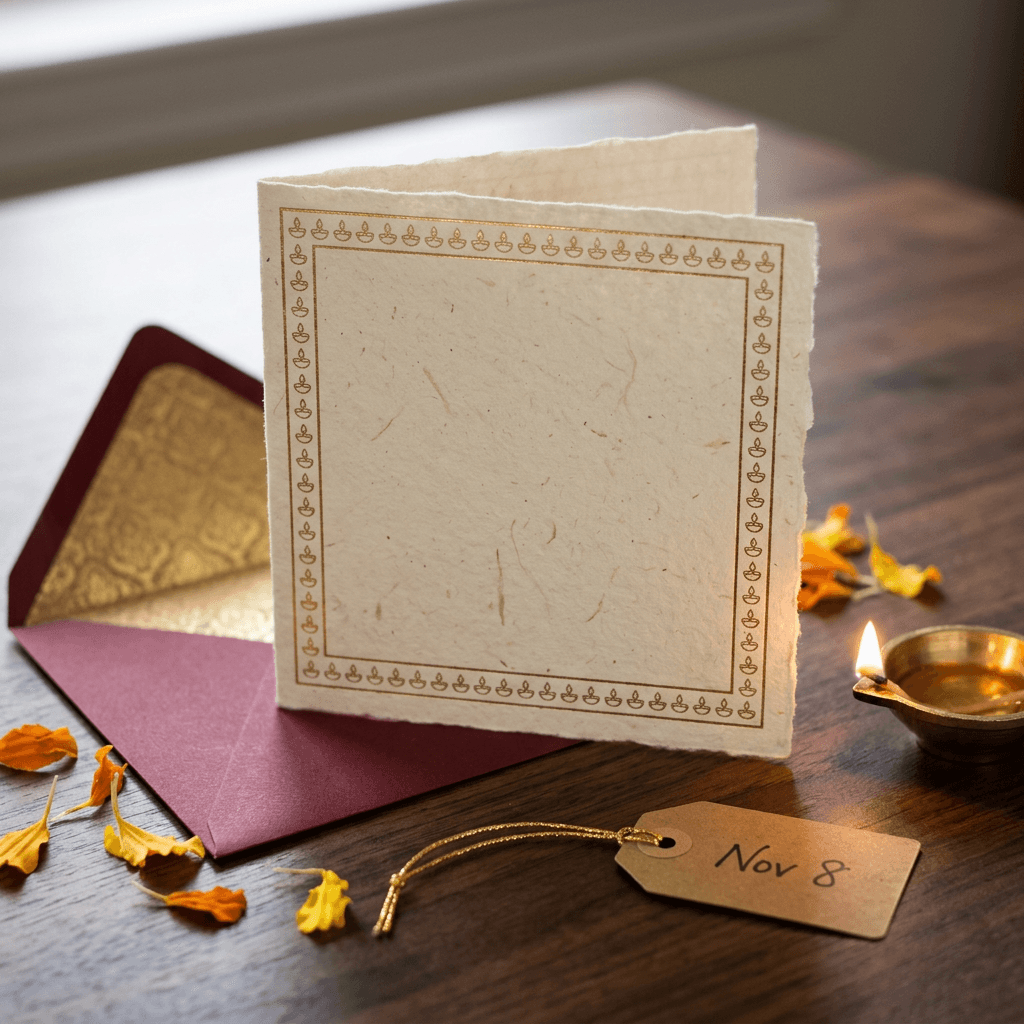
2. Marigold and Mango Leaf Garland Card
A hanging garland border gives a vertical card an instant festive frame without needing any figures.
A vertical 4:5 Diwali greeting card background in a photographic style, showing a long marigold garland hung in a graceful scalloped arc across the top edge and falling down both sides like a frame, made of orange and saffron-yellow genda flowers with fresh green mango leaves woven between them, over a plain warm cream handmade cotton paper background, with two small lit brass diyas tucked into the lower corners. Soft diffused morning window light from the upper right, 85mm lens at f/5.6 with individual petal ruffles and leaf veins sharp. The middle two thirds of the card stays empty cream paper for a message and a family name. Palette of saffron, leaf green, cream and brass. No plastic-looking flowers, no garbled text, no watermark.
This one prints well on matte stock. Swap cream for pale pink or sage if you want a softer, more modern look.
3. Rangoli Frame Card
A rangoli border turns the floor art itself into the frame, which is especially good for a card sent to relatives who miss the courtyard at home.
A square greeting card background made from a top-down photograph of a finished rangoli on a smooth dark grey stone floor, forming a decorative frame: a continuous border of symmetrical lotus petals and small dot-and-curve motifs in colored powder in magenta, saffron, turquoise, white and leaf green, with crisp fine grains visible at the edges of each shape, a few loose marigold petals at the corners, and an empty plain stone circle in the center about half the width of the card. Even soft daylight from an overhead window with no hard shadows, 35mm lens at f/8 with edge-to-edge focus. Perfect bilateral symmetry, real powder texture, not a digital mandala, no text, no watermark.
If the result looks like a flat vector graphic, add photographed on a real stone floor and visible powder grains to the prompt.
4. Lakshmi Puja Night Card With Lotus and Footprints
For the evening of Lakshmi Puja, footprints at the threshold, a lotus and coins say prosperity without drawing a deity.
A vertical 4:5 Lakshmi Puja greeting card background set at night at a home threshold, showing small rice-flour Lakshmi charan footprints with delicate dotted outlines walking from the doorway into the house across a dark slate floor toward a brass thali holding a pink lotus flower and a scatter of gold coins, with a row of five small lit terracotta diyas along the step. The lamps are the only light, giving a soft amber glow on the footprints and the lotus petals, with deep navy darkness above fading into a bokeh of distant fairy lights. 50mm lens at f/2.8 with the footprints and the nearest diya sharp. The dark upper third stays empty for a greeting. No deity figure, no face, no idol, no garbled text, no watermark.
Footprints that point into the home are the traditional way to show a welcome, so keep that direction in the prompt.
5. Layered Paper-Cut Lantern Card for Clients and Colleagues
A refined paper-cut look suits corporate greetings, because it feels festive without leaning on any one family's customs.
A horizontal 3:2 corporate Diwali card background styled as layered paper-cut art, with five stacked sheets of deep teal, burgundy, saffron and gold-foil card cut into a symmetrical arched window that frames a hanging star-shaped akash kandil lantern and rows of small diya shapes, each layer casting a soft shadow on the layer below and a warm glow shining through the cut-outs from behind. Soft studio light from the front left plus warm backlight, 60mm macro lens at f/5.6 showing the paper edges and fiber, fine gold-foil highlights. The lower third is plain burgundy paper reserved for a company name and greeting. Refined and minimal, no cartoon faces, no text, no logo, no watermark.
For a branded set, replace the colors with your brand palette and keep the same arch composition across cards, envelopes and email headers.
2) Family and Portrait Photo Prompts
These four prompts use image-to-image: you upload a clear photo of yourself or your family, and the model builds a festive setting and outfits around you, with faces as the hardest part to keep stable, so use a sharp, evenly lit photo with the face fully visible, keep the group to four people or fewer on the first try, and compare the result to the original before you post. If you want a deeper look at keeping faces stable in family images, the AI family look-alike prompt guide covers the identity wording.
Two lines are worth keeping in every photo prompt. The first is the identity line: keep every person's face, skin tone, hairstyle, facial hair and expression exactly the same as in the uploaded photo. The second is the skin tone clause, because beauty-style smoothing and brightening can quietly lighten skin in generated portraits. Naming your natural skin tone in the prompt and adding no skin lightening keeps the portrait true to you.
Outfits are where Diwali portraits become fun, and naming the garment matters. A silk saree with a contrasting zari border, a lehenga in deep jewel tones, an anarkali suit, a kurta-pajama with a Nehru jacket or a sherwani all drape differently, and the model handles each far better when you use the exact term. If the face is right but the outfit is not, mask only the clothing with inpainting in the image editor and describe the garment again instead of regenerating the whole portrait.
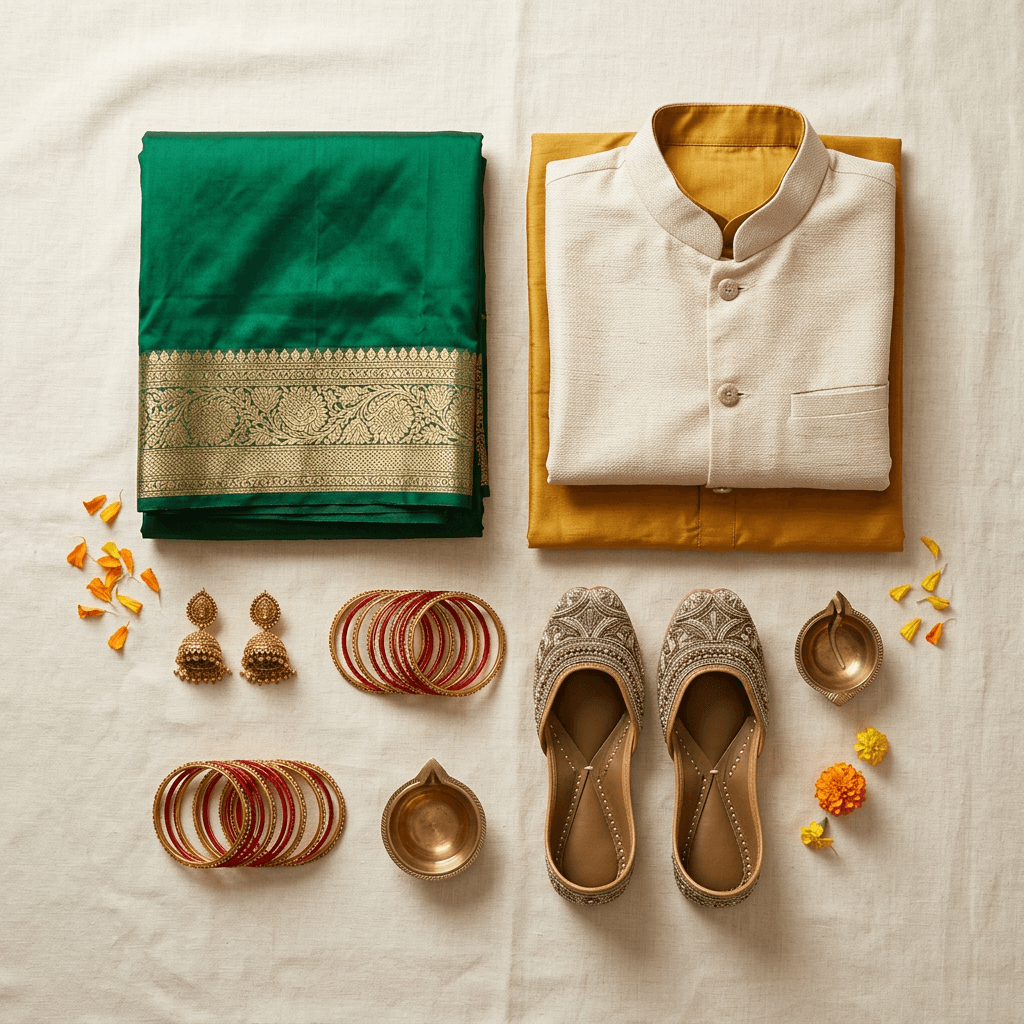
6. Family Portrait at the Rangoli Doorway
A group in coordinated festive wear in front of a decorated door is the photo most families would otherwise book a photographer for.
A warm candid family portrait for Diwali, based on the uploaded photo: keep every person's face, skin tone, hairstyle, facial hair and body proportions exactly as in the photo. Dress everyone in coordinated festive outfits in jewel tones, for example a silk saree with a contrasting border, a kurta-pajama with a Nehru jacket, an anarkali suit and a small kurta, standing and sitting close together at their front door with a fresh colored-powder rangoli on the floor in front of them, a marigold and mango leaf toran above the door and a row of lit clay diyas on the step. Golden dusk light from the left mixed with the soft warm glow of the diyas, 50mm lens at f/2.8 with everyone sharp, medium-wide framing, natural smiles, realistic skin texture with pores. The wall above the door stays clear for a greeting. No extra fingers, no distorted hands, no lightened skin, no garbled text, no watermark.
Tell the model how many people are in the photo if the count matters, for example four people, so it does not add or remove anyone.
7. Couple on the Balcony at Blue Hour
A balcony with fairy lights and a ledge of diyas suits apartment dwellers in India and in diaspora cities alike. The AI couple selfie prompt guide has more wording for keeping two faces consistent.
A romantic candid Diwali evening photo of the two people in the uploaded photos, keeping both faces, skin tones, hairstyles and expressions exactly the same as the originals. They stand close together on an apartment balcony at blue hour, one wearing a silk saree with a zari border and the other a bandhgala sherwani in deep green, laughing and looking at each other. Warm white string lights run along the railing, a row of small lit diyas sits on the ledge and a paper akash kandil hangs overhead, with softly blurred city lights beyond. Soft blue-hour light from the sky mixed with warm lamp glow, 85mm lens at f/1.8 with the faces sharp and the lights as bokeh circles, natural skin texture. No distorted hands, no extra people, no fireworks, no watermark.
Change the outfits to match what you will actually wear, and keep the description of the outfit short so the faces stay the priority.
8. Solo Creator Festive Portrait for Instagram
A clean portrait with a thali beside you is the base for a feed post, a profile photo or a Reel cover.
A polished 4:5 Instagram portrait of the person in the uploaded photo, preserving the face, skin tone, hairstyle and expression exactly, seated cross-legged on a floor cushion beside a low carved wooden table that holds a brass thali with lit diyas and marigold petals, wearing an embroidered silk kurta or a Banarasi silk saree with simple gold jhumka earrings. Soft key light from a window on the left, warm diya glow as a gentle rim light on the right, 85mm lens at f/2 with creamy bokeh of fairy lights behind. Natural unretouched skin texture, a relaxed small smile, hands resting naturally with five fingers each, and clear space on the right side of the frame for a caption. No beauty filter smoothing, no lightened skin, no garbled text, no watermark.
Generate a few variations, then pick the one where the hands and the eyes look natural and use inpainting only on the part that drifted.
9. Siblings for Bhai Dooj
Bhai Dooj, observed shortly after Diwali, celebrates the bond between siblings with a tilak applied on the forehead, sweets and gifts. It is a moment families like to photograph.
A tender candid photo of two siblings based on the uploaded photo, keeping both faces, skin tones and hairstyles exactly the same. They sit facing each other on a rug in a living room, one gently applying a red kumkum tilak to the other's forehead with a fingertip, while a brass thali with a lit diya, rice grains, a small bowl of kumkum and a plate of sweets rests between them. Both wear festive kurtas or sarees in coordinated colors, with a marigold garland on the sofa behind. Soft window light from the left and warm diya glow on the lower faces, 50mm lens at f/2.2, both faces sharp and expressive, natural skin texture. Five fingers on every hand, no distorted hands, no garbled text, no watermark.
If you are creating a post for the day, caption it with a short note in your own words, and add the wish as live text rather than letting the model write it.
3) Home Decor and Rangoli Design Ideas
Decor posts get saved and recreated, because people want to copy what they see. These four prompts produce reference images for rangoli, a doorway toran and balcony lanterns, and each is written to be a clear picture of something a reader could actually make.
10. Geometric Lotus Rangoli in Colored Powder (Top-Down)
A top-down rangoli that is still being finished shows the process, which is what makes decor posts shareable.
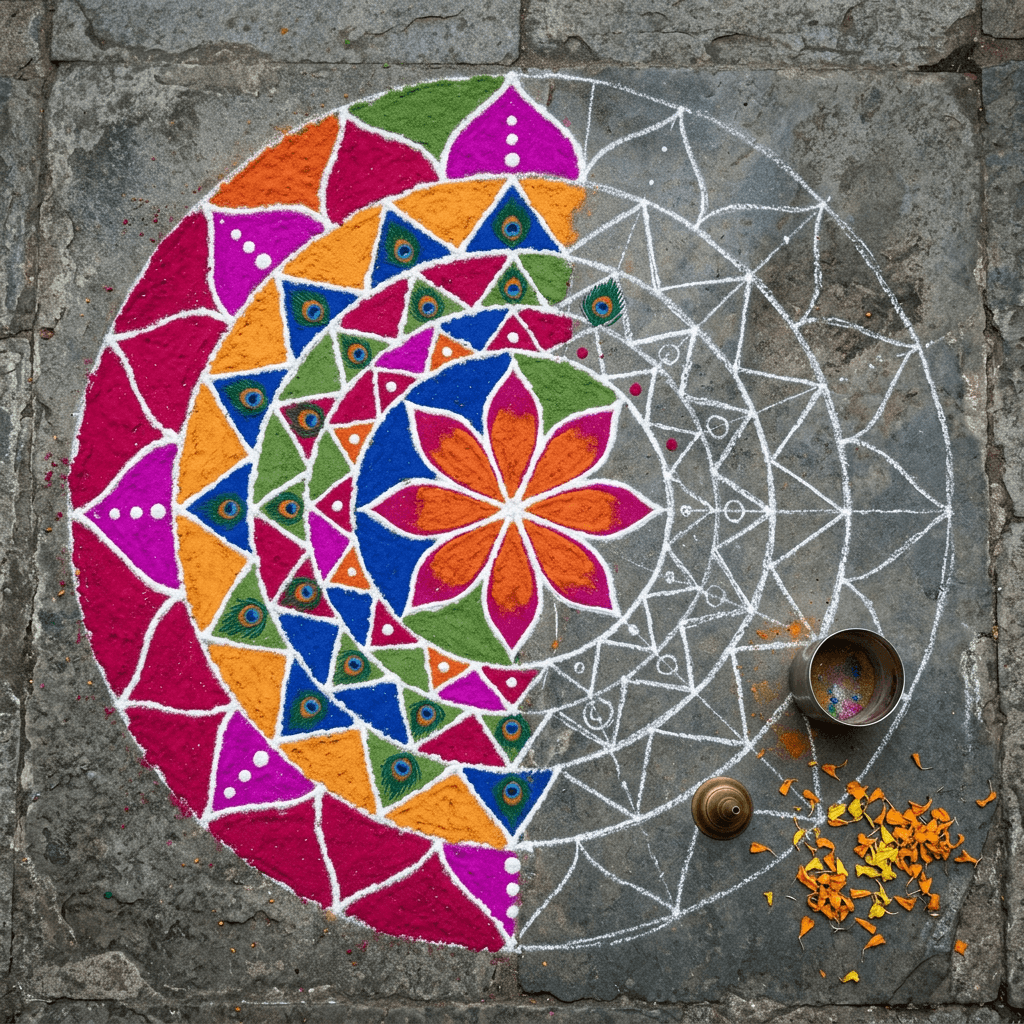
A top-down photograph of a large circular rangoli being finished on a weathered grey stone courtyard floor, a symmetrical eight-petal lotus at the center surrounded by three concentric rings of triangles, small peacock feathers and dots, filled with colored powder in magenta, saffron, royal blue, white and leaf green with crisp edges, while the last quarter of the design is still a white chalk outline so the drawing steps are visible. A steel cup of loose powder, a small brass dot-maker and a few fallen marigold petals lie beside the design. Soft overcast daylight with no hard shadows, 35mm lens at f/8 with edge-to-edge sharpness and individual powder grains visible. Precise geometry, no people, no hands, no text, no watermark.
Asking for a chalk outline on one quarter gives you a visible blueprint you can copy. For a dot-grid version, ask for evenly spaced white dots joined by flowing curves.
11. Petal Rangoli With an Urli Bowl
A flower-petal design with a bronze bowl in the center is an eco-friendly option with no powder at all.
A top-down photograph of a round bronze urli bowl filled with water at the center of a flower-petal rangoli on a stone doorstep, with floating marigold and rose petals arranged in concentric rings on the water, five small lit terracotta diyas set along the wide rim of the bowl, and the surrounding floor design made of orange, yellow, pink and white petals in a symmetrical pattern with a border of small green leaves. Soft diffused golden-hour light plus the warm glow of the flames reflecting on the water, 50mm lens at f/5.6 with petal ruffles and ripples sharp. Natural fresh flowers, no powder, no plastic petals, no people, no text, no watermark.
An urli is a wide shallow vessel traditionally used for floating flowers, so naming it keeps the model from drawing an ordinary round bowl.
12. Doorway Marigold Toran With Diyas
A decorated front door is the single most recognizable Diwali home image, and the toran is its signature detail.
A front door of a home at dusk photographed straight on at eye level, with a thick marigold toran of orange and yellow genda flowers strung in a scalloped pattern across the top of the door frame and green mango leaves between each scallop, plus garlands hanging down both sides. A carved dark teak door stands slightly open with warm interior light spilling out, a fresh small rangoli at the threshold and a pair of brass diyas with real flames on either side of the doorstep, with a small brass bell hanging in the center of the toran. Blue-hour sky light mixed with warm lamp light, 35mm lens at f/4 with the whole doorway sharp. No people, no fireworks, no garbled text, no watermark.
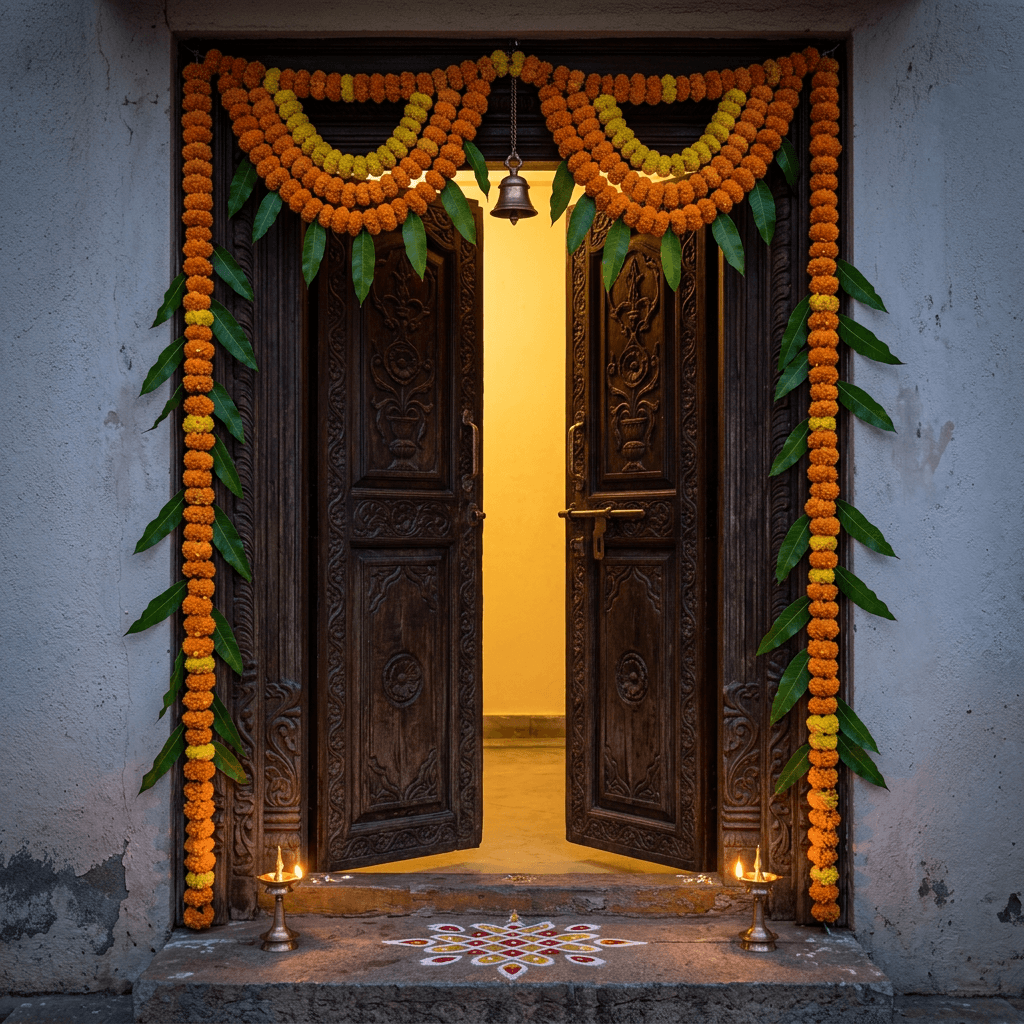
Change the door color and wall texture to match your own home, and the prompt becomes a mood board for decorating it. For brands that sell candles and home fragrance, the candle and home fragrance photography prompts have more lighting ideas for flame-lit product shots.
13. Balcony Akash Kandil Lanterns
Hanging star lanterns on a balcony railing work in an apartment, in a village house or in a suburban porch.
A city apartment balcony at dusk photographed from inside at a slight low angle, with three folded paper akash kandil star lanterns in saffron, magenta and turquoise hanging at different heights from the railing, each lit from inside with a warm bulb glow that shows the paper facets and tassels, string lights draped along the railing and a row of small diyas on the ledge, with softly blurred skyline lights beyond. 35mm lens at f/2.8 with the nearest lantern sharp and the background in bokeh. LED lights inside the lanterns rather than open flames. No fireworks, no people, no garbled text, no watermark.
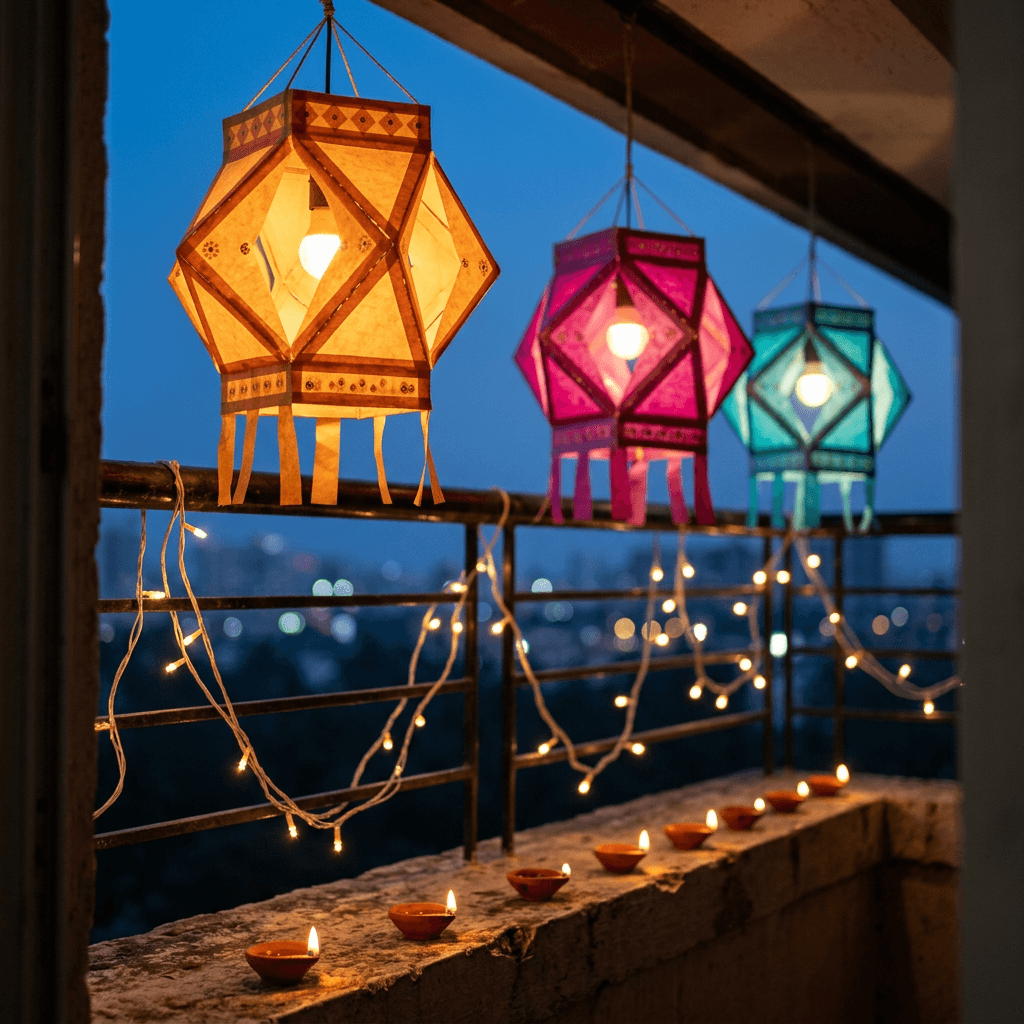
For a Story or Reel background, change the aspect ratio to 9:16 and move the lanterns to the upper half, so captions sit in the lower third.
4) Festive Food and Mithai Product Prompts
Sweets are the gift of the festival, and a good mithai photo is also a sales photo. These four prompts show boxes, close-ups, snacks and a home-cooked spread. They are written like real food photography, with specific lights, lenses and textures, and the same approach is explained in the AI food photography prompt guide.
14. Kaju Katli and Laddoo Gift Box (Overhead)
A box open from above is the standard shot for sweet shops, hampers and WhatsApp catalog images.
An overhead product photograph of an open rectangular mithai box lined with gold-patterned paper, holding two neat rows of diamond-shaped kaju katli topped with thin edible silver leaf and a row of round golden motichoor laddoos with tiny pistachio slivers, with a few pieces placed outside the box on a small brass plate, a single marigold flower and two lit small diyas at the corners, all on a deep maroon textured cloth. Soft window light from the upper left with a white card fill on the right, 50mm macro lens at f/5.6, visible silver leaf shimmer, individual boondi grains on the laddoos and the smooth sheen of the cashew. Appetizing true-to-life colors, no plastic shine, no melted look, no text, no logo, no watermark.
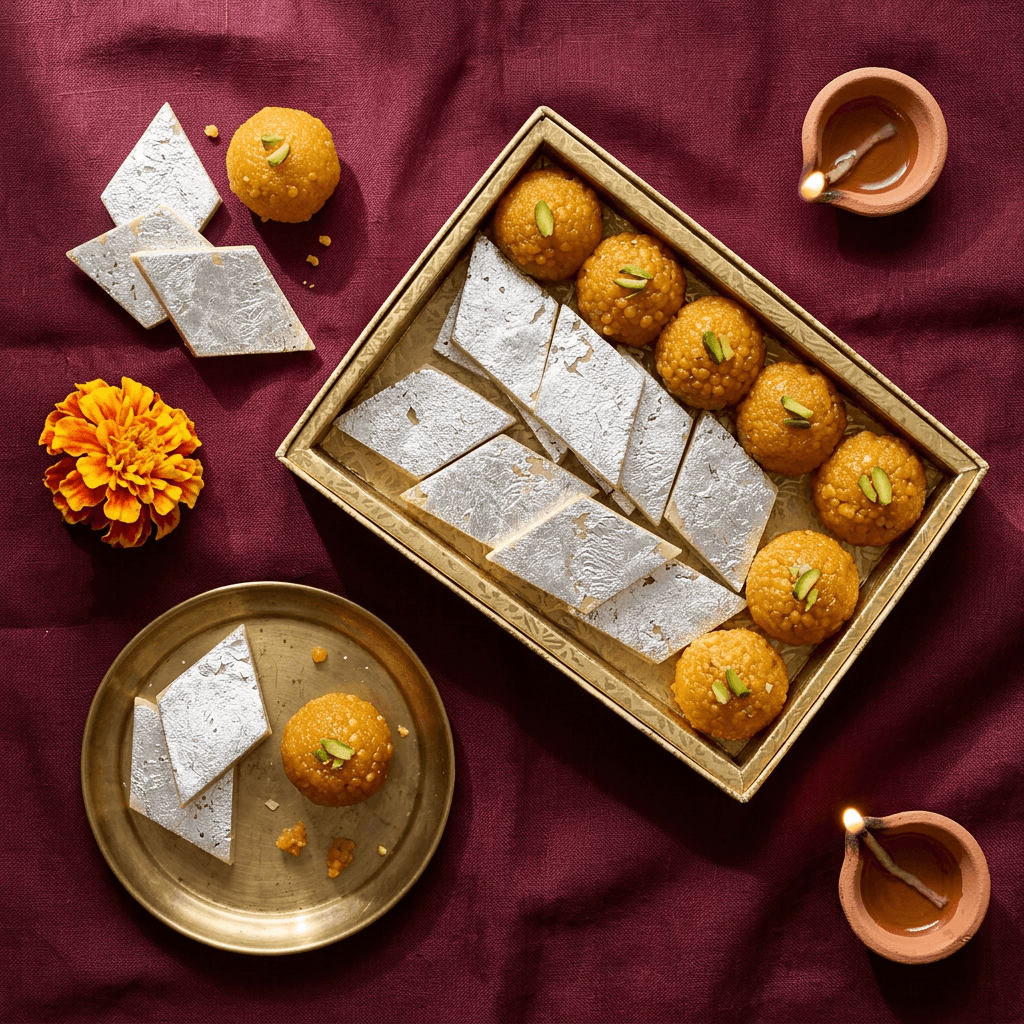
For a bakery or dessert brand that is adding Diwali boxes to its menu, the bakery and dessert shop prompt pack is a good companion.
15. Hot Jalebi Macro
Jalebi is photographed best when it still looks hot, with a glossy syrup sheen and a hint of steam.
A close macro photograph of fresh orange jalebis, crisp spiral coils glistening with sugar syrup, stacked on a round brass plate with a slow drizzle of syrup catching the light, a small steel bowl of rabri beside it, a thin curl of steam rising, a few saffron strands and chopped pistachios on top, on a worn wooden table. Warm side light from the left at golden hour, 100mm macro lens at f/3.2 with the front coil tack-sharp and the background melting into dark bokeh with the soft glow of a diya. Natural orange, not neon, no oily smear, no text, no watermark.
Asking for natural orange, not neon is the key phrase, since models like to push jalebi toward an unrealistic bright orange.
16. Diwali Faral Snack Platter
A snack tray shows the home-style side of the festival, and it suits food bloggers and cloud kitchens.
A top-down photograph of a large round steel tray of homemade Diwali snacks arranged in sections: golden chakli spirals, crescent-shaped karanji with crimped edges, diamond-cut shakarpara, namak pare, besan ladoo and a small bowl of chivda with peanuts and curry leaves, with small lit diyas between the sections, on a hand-block-printed cotton cloth in indigo and red. Soft daylight from a window on the left, 40mm lens at f/5.6 with crisp fried textures and visible flaky layers. Authentic home-style look, not a studio catalog look, no text, no logo, no watermark.
17. Family Diwali Lunch Spread
A full table says gathering and generosity, and it works as a header image for a recipe post or a Reel.
A top-down photograph of a low wooden table set for a Diwali family lunch, with steel thalis and katoris holding puri, dal, a creamy paneer dish, jeera rice, cucumber raita, a small salad, papad and warm gulab jamun in syrup, a brass jug of water, marigold petals scattered along the table and a few small diyas at the edges. Soft natural window light from the left, 35mm lens at f/5.6 with all the dishes in focus, steam rising gently from the puri. Vegetarian spread, authentic plating, realistic textures, no text, no logo, no watermark.
If your household cooks a different regional menu, swap the dishes. A Bengali spread, a Gujarati thali and a South Indian banana leaf meal all look different, and naming them gives you an image that feels like your own table.
5) Small Business Diwali Offer Post Prompts
Diwali is one of the biggest buying seasons of the year for many Indian businesses, with Dhanteras associated with buying gold, silver and new utensils, and the days around Diwali full of gifting. Small businesses rarely have a photographer on call that week, so these four prompts give you clean, premium backgrounds with deliberate negative space for the headline, price and discount badge. The pattern is the same as in the Black Friday product photo and sale ad prompts, which is useful if you plan to run another sale two weeks later.
A word on honesty before the prompts. If you sell a specific product, show your real product. AI images are best used for the background, props and styling around a real photo of your item, not to invent a necklace or a sweet that customers will not actually receive. Use image-to-image with your own product photo and ask the model to keep the product unchanged, and the result will look festive without misleading anyone. The floating product prompt guide and the studio product photo prompts cover this workflow in more detail.
18. Dhanteras Gold Jewelry Set on Silk
A gold set on emerald silk with a diya and coins is the classic Dhanteras jewelry creative, and the empty silk takes your offer.
A premium product advertisement photo of a gold temple-style necklace set with matching jhumka earrings and a maang tikka, laid out on folded deep emerald green raw silk with a small brass diya, a few gold coins and a single marigold bloom at the lower corner, leaving the right third of the frame as smooth empty silk for a headline and an offer. Soft large softbox light from the upper left with a small warm reflector card on the right, crisp specular highlights on the gold, 90mm macro lens at f/6.3 with the filigree and pearl drops sharp and the silk weave visible. Warm gold against emerald, rich but not oversaturated. No people, no brand marks, no text, no watermark.
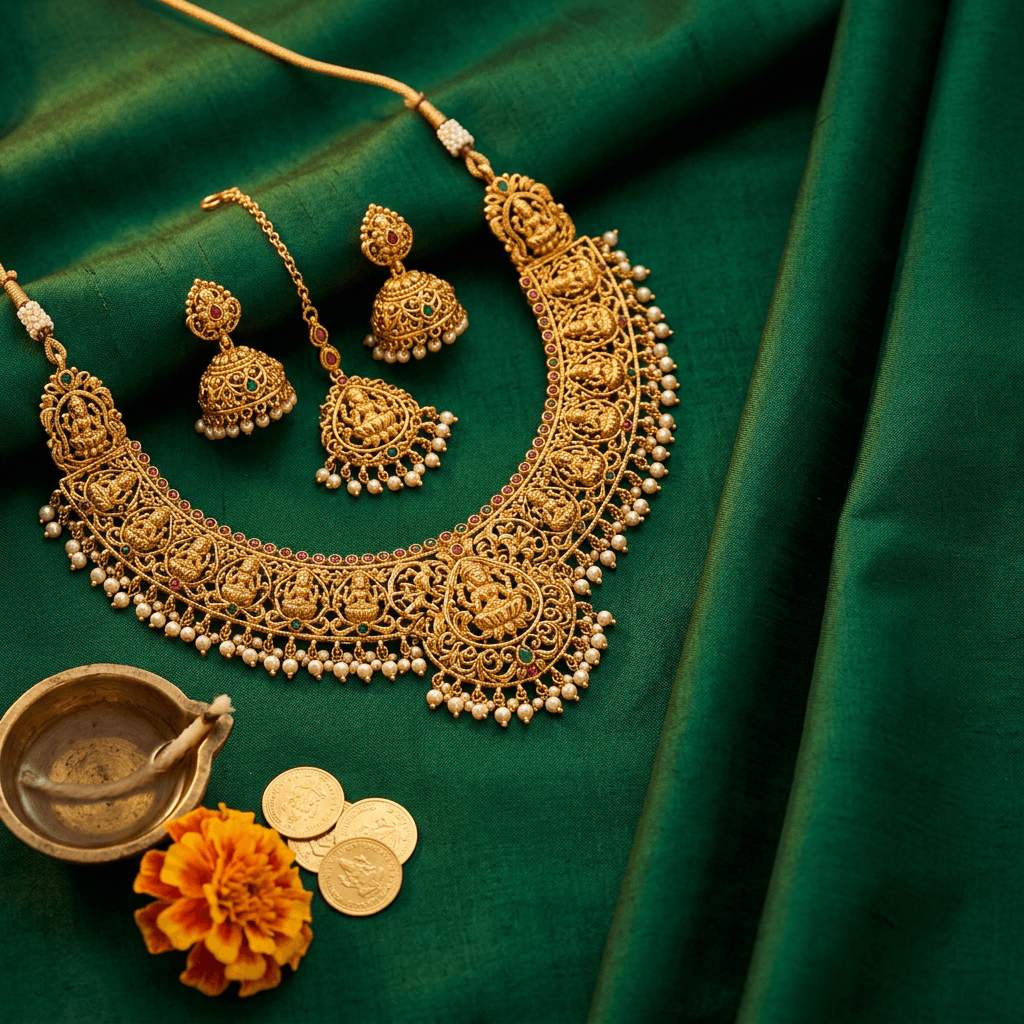
To use your own piece, upload the product photo and add keep the jewelry exactly as in the uploaded photo, with the same shape, stones and proportions, and change only the background.
19. Corporate Gift Hamper Flat Lay
Gifting is a major part of the festival, and a hamper flat lay sells both consumer and corporate boxes.
A flat lay photograph of a premium Diwali gift hamper in an open rigid box, holding an assortment of mithai in a small tray, almonds, cashews and pistachios in a brass bowl, two hand-painted terracotta diyas in white and gold, a scented candle in a brass jar and a folded handloom textile wrap, arranged on cream linen with a few marigold petals and a plain kraft tag. Soft diffused daylight from the upper left, 40mm lens at f/5.6 with the whole arrangement in focus. The top quarter of the frame stays clear linen for an offer and a headline. Refined and uncluttered, no brand names, no garbled text, no watermark.
Replace the contents with what you actually sell, and keep the list to five or six items, because crowded hampers photograph as clutter.
20. Boutique Festive Collection Display
A stack of folded silk fabrics and a hanging anarkali show a boutique's range without a model.
A boutique display photographed at eye level, with three folded silk sarees stacked on a carved wooden shelf in magenta, teal and mustard with contrasting gold zari borders, an embroidered anarkali dress hanging on a padded wooden hanger beside them with a folded dupatta draped over the shelf edge, a brass diya and a small bunch of marigolds at the front. The left half of the frame is a softly blurred cream wall, clean and uncluttered, reserved for an offer headline. Soft window light from the right with a gentle warm fill, 50mm lens at f/2.8 with the stack of sarees and the embroidery sharp. Rich fabric weave and zari shimmer, no people, no mannequin faces, no text, no logo, no watermark.
Boutiques that want model photos can look at the fashion lookbook prompts, while a handmade-goods seller will find extra ideas in the Etsy listing photo prompts.
21. Diwali Sale Creative With a Product Pedestal
A generic festive stage with a clear center works for D2C brands, from oils and spices to skincare and home goods.
A wide 16:9 Diwali sale banner background with a dark midnight blue gradient backdrop and a round matte cream stone pedestal in the center, framed by two clusters of lit terracotta diyas, marigolds and gold coins in the lower left and lower right corners, softly glowing fairy-light bokeh in the upper background, and a large open area above the pedestal for a headline and a discount badge. Warm key light from the front left on the pedestal and diyas, cool blue rim light on the backdrop, 50mm lens at f/4 with the pedestal and diyas sharp. Place the product from the uploaded photo on the pedestal exactly as it appears, keeping its shape, color and label unchanged. No extra products, no garbled text, no watermark.
Replace the pedestal color with your brand color. Keep the same layout across posts for a week so customers recognize your festive series.
6) Reels, Shorts and Video Prompts
Reels are where Diwali content spreads, and they also reward consistency of sound, pacing and cover. These four prompts cover a cinematic diya-lighting clip, a Text2Shorts story, a festive music track and a thumbnail or cover. If you are planning to sell directly from video, the guide to shoppable Reels is a helpful companion.
22. Cinematic Diya Lighting Clip
A single flame catching a wick is a simple, strong opening shot that avoids the fireworks every other Diwali Reel uses, and you can generate it in the cinematic video generator on Miraflow.
A cinematic close-up video of a hand lighting a terracotta diya on a brass thali with a long matchstick, the cotton wick catching and a small flame growing steady, a tiny wisp of smoke rising, with the camera slowly pushing in from a medium close-up to a macro shot while warm light spreads across scattered marigold petals and a colored-powder rangoli behind it. The focus then racks gently to a row of other lit diyas glowing as soft bokeh in the background. Warm flame light with deep indigo shadows, shallow depth of field, 50mm cinematic look at f/2, natural flicker, a realistic hand with five fingers. No fireworks, no text, no logo.
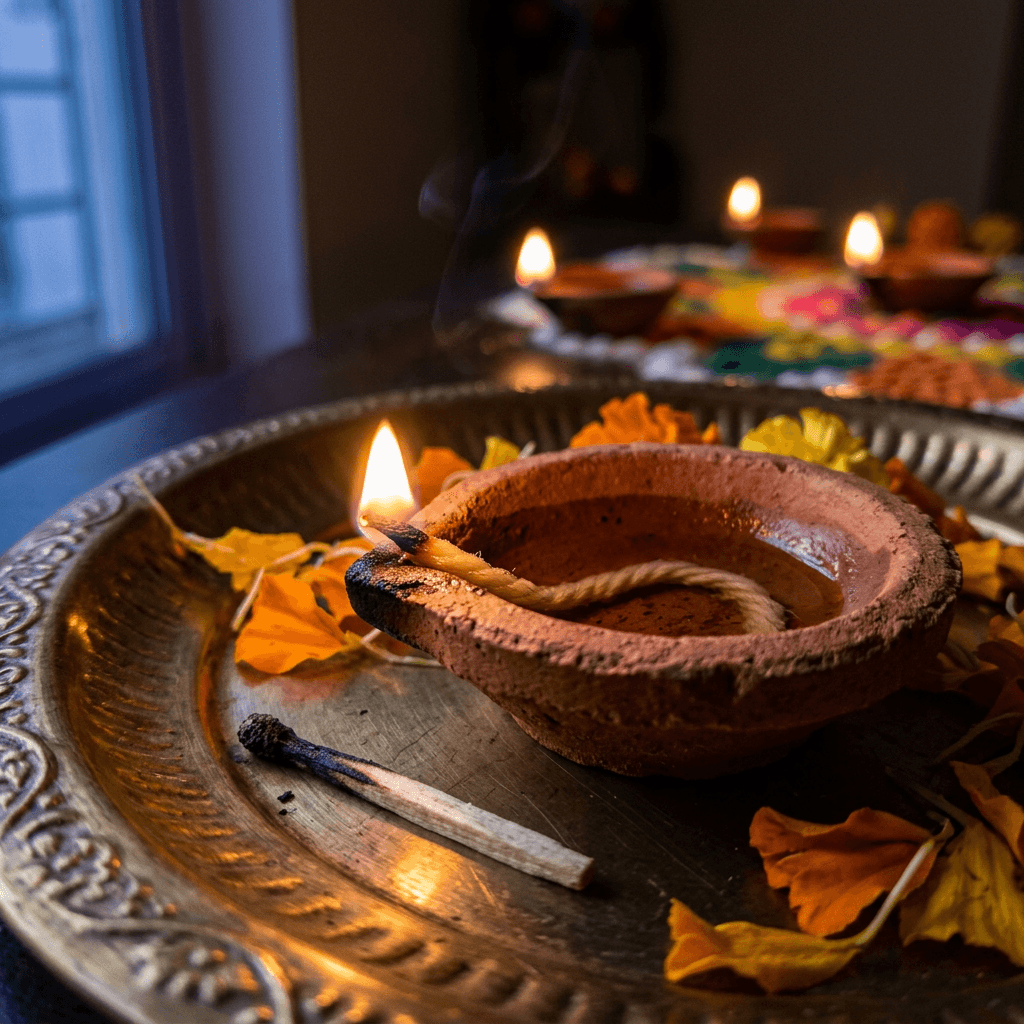
Keep clips short, around five to eight seconds, and plan to cut two or three of them together. Small movements, such as a flame, a pushing-in camera and drifting petals, look much more natural than large ones.
23. Text2Shorts Diwali Story or Decor Short
If you would rather start from a topic than from a shot, Text2Shorts writes the script, builds scene visuals and adds a voice that you can edit before rendering. The guide on going from prompt to Reel with Text2Shorts walks through the editing steps.
Create a 30 second vertical Short titled 5 Budget Diwali Decor Ideas for a Small Apartment. Open with a two-second hook of a doorway lit by terracotta diyas, then show five quick scenes: a cluster of diyas on a balcony ledge, a marigold and mango leaf toran, a flower-petal rangoli with an urli bowl, a paper akash kandil lantern, and warm LED string lights. A friendly, practical voiceover, realistic warm cinematic visuals with golden evening light, no fireworks, and an ending that invites viewers to follow for the next idea.
Other topics that work well in the same format include the story of Diwali in thirty seconds, a rangoli in four steps, and the story of why the diya is lit, told for children.
24. Festive Background Music Prompt
A short instrumental in the right instruments makes a Diwali Reel feel finished, and you can generate it in Miraflow's AI music generator. Turn on the instrumental toggle and use Custom Mode if you want to set the duration, tempo and key.
Instrumental festive Diwali background music with a warm bansuri flute melody over a soft tabla and dholak groove, shimmering sitar plucks, light temple bells and a gentle tanpura drone, joyful and uplifting, around 100 BPM, in a major key, starting soft in the intro and brightening into a fuller section, clean mix with room for a voiceover, no vocals, ending cleanly so it can loop for a short video.
For more wording and genre ideas, the AI music prompts for Reels, YouTube and TikTok guide and the Halloween music prompt pack show how to describe instruments, tempo and mood.
25. Diwali Vlog or Recipe Thumbnail
A strong cover decides whether anyone watches the Diwali video, whether it is a vlog, a mithai recipe or a decor tutorial. The YouTube Thumbnail Maker lets you add a prompt, an optional photo of yourself and big text.
A bold 16:9 YouTube thumbnail background for a Diwali video, with a brass thali of lit diyas and fresh marigolds on the left in sharp focus, a deep teal to maroon gradient backdrop with soft fairy-light bokeh behind it, a strip of colored-powder rangoli along the bottom edge, and the right half of the frame left empty for a face cutout and large text. Warm flame light on the left, cool teal rim light, 35mm lens at f/4, vivid but not oversaturated color, high contrast. No fireworks, no garbled text, no watermark.
Keep thumbnail text to three or four words such as Diwali Prep 2026, and add it in the thumbnail tool instead of the prompt. The YouTube Shorts thumbnail prompts are a good reference if the video is vertical.
Sizes and Formats for WhatsApp, Instagram and Print
A beautiful image can still look soft or get cropped in the wrong place, so decide the destination before you generate. The sizes below are the usual starting points. Generate in the closest ratio, crop in an editor, and keep text and faces away from the edges.
| Where it will be used | Aspect ratio | Pixel size | Notes |
|---|---|---|---|
| WhatsApp Status, Instagram Stories, Reels, Shorts | 9:16 | 1080 x 1920 | Keep text and faces inside the middle, away from the top and bottom edges |
| Instagram feed portrait post | 4:5 | 1080 x 1350 | Best for portraits, cards and offer posts |
| Square greeting for WhatsApp chats and Facebook | 1:1 | 1080 x 1080 | Centered subject with a calm area for the wish |
| YouTube thumbnail or wide banner | 16:9 | 1920 x 1080 | Leave one half empty for large text or a face cutout |
| Printed 5x7 greeting card (trim size) | 5:7 | 1500 x 2100 at 300 DPI | Add about 0.125 in of bleed on each side and check your printer's template |
For WhatsApp, remember that images are compressed when they are sent, so large flat color areas and fine gradients can band. A little texture, like silk weave or paper grain, hides compression better, which is another reason these prompts ask for visible materials. For print greeting cards, the trim, bleed and 300 DPI math in the Christmas card guide applies exactly the same way.
How to Customize These Diwali Prompts
Because every prompt uses the same skeleton, small swaps change the scene without breaking it.
Swap the region. Replace the toran and rangoli with the right local tradition. A Tamil home might use a rice-flour kolam with dots and loops, a Bengali home might use an alpana painted in white rice paste with Kali Puja offerings, a Gujarati home might add a Chopda Pujan plate with new account books, a Maharashtrian home might add faral and an akash kandil, and a Telugu home might use a muggu design. For a South Indian Naraka Chaturdashi post, try a copper vessel of warm sesame oil, a brass lamp and fresh flowers set out for the early morning.
Adapt for diaspora homes. In North America, the UK and many other places, Diwali falls in cool, early-dark November. Show a front door with a rangoli on the porch mat, autumn leaves at the entrance, scarves over kurtas, breath visible in the cold air and warm light from the windows. Many apartments do not allow open flames, so replace real flames with LED diyas or battery tea lights, and say so in the prompt. The fall aesthetic photo prompts have wording for the leaves and light.
Make it eco-friendly. A green Diwali look is easy to describe: unglazed clay diyas, flower and rice-flour rangoli instead of synthetic powder, natural jute and banana leaves, reusable cloth gift bags, brass and recycled paper. Add eco-friendly, natural materials, no plastic to any prompt, and the image will reflect the choices more families and brands are making.
Go firecracker-free. Many Indian cities restrict or ban firecrackers because of air quality, and plenty of families prefer quiet celebrations for pets, children and elders. Every prompt here already says no fireworks. For more light without fireworks, ask for long rows of diyas on rooftops, glowing windows in an apartment block at night, floating lanterns or fairy lights draped across a courtyard. Rules differ by city and change by year, so check local guidance before you plan an outdoor shoot.
Respect other traditions. Sikh families observe Bandi Chhor Divas, usually on the same day as Diwali, which commemorates the release of Guru Hargobind from imprisonment and is marked with lamps and illuminated gurdwaras. Keep imagery to lamps, illuminated architecture and Punjabi sweets, avoid depicting the Gurus, and let a community member review the final image. Jains observe Diwali as the day Mahavira attained nirvana, with lamps symbolizing knowledge, and many Jain households keep celebrations simple and quiet, so soft lamp light, simple rangoli and no fireworks is the right tone. When you are unsure, ask someone who celebrates.
Change the palette. Maroon, antique gold and marigold feel traditional. Deep teal, blush pink and brass feel modern. Midnight blue with gold feels premium. Three to four named colors are plenty.
Change the format. Turn square into 4:5 for the feed or 9:16 for Stories and say where the empty space goes. A card for WhatsApp needs a different layout from a Reel cover.
Wishes to Add as Live Text
Rather than ask the model to write the wish, type it in an editor with a real font. These common greetings are good starting points, and it is worth having a native speaker proofread anything that goes to print. For Hindi and Marathi, free fonts such as Noto Sans Devanagari, Hind and Mukta display the script cleanly.
- English: Happy Diwali, Shubh Deepavali, Happy Dhanteras, Happy Bhai Dooj
- Hindi: शुभ दीपावली, दीपावली की हार्दिक शुभकामनाएं
- Marathi: दिवाळीच्या हार्दिक शुभेच्छा
- Gujarati new year: સાલ મુબારક
- Bengali: শুভ দীপাবলি
- Tamil: தீபாவளி நல்வாழ்த்துகள்
- Telugu: దీపావళి శుభాకాంక్షలు
- Punjabi (Bandi Chhor Divas): ਬੰਦੀ ਛੋੜ ਦਿਵਸ ਦੀਆਂ ਵਧਾਈਆਂ
Common Mistakes With AI Diwali Images
Wrong diya shape. If the lamp looks like a tall candle or a round tea light in a glass, add terracotta diya with a pinched spout and cotton wick, and negative wording such as no Western candles. A diya is a shallow bowl with a pinched edge, not a pillar.
Garbled Devanagari or other scripts. Image models often produce shapes that look like Hindi but are not real letters, and a single wrong matra changes the meaning. Generate the image with a blank area and add the text as live text with a Devanagari font. Do the same for Tamil, Telugu, Gujarati and Bengali.
Cliched fireworks and glitter. Fireworks are the default Diwali image, and they conflict with many cities' rules and many families' wishes. Quiet diya light looks more distinctive and more current.
Over-saturated orange. Models love turning everything into one orange glow. Name a palette, ask for a cool secondary light and use phrases like natural true-to-life color to bring back realistic skin and food.
Confusing rangoli with mandala. A mandala is a circular geometric diagram, often drawn finely on paper or cloth, while rangoli is a welcoming floor design made of powder, rice flour or petals at the entrance. If you want a rangoli, specify stone floor, colored powder, visible grains and top-down photograph.
Culturally insensitive use of deities. Avoid putting a deity's face on a sale poster or an AI-generated idol in a commercial ad. Use lotus, Lakshmi charan, coins and diyas as symbols, and for personal worship use images from trusted sources.
Lightening skin tones. Generated portraits can quietly lighten and smooth skin. Include keep my natural skin tone exactly and no skin lightening in every photo prompt and compare against the original.
Showing a product that does not exist. In a business post, use a real photo of your product and let the AI build the festive background around it. A customer who receives something different from the picture is a bigger problem than a plain photo.
Posting too late. The best Diwali posts go up in the weeks before and on Dhanteras, not on the evening of Lakshmi Puja when feeds are full. Generate and schedule early, and keep a few spare variations for the main day.
Make Your Diwali Content With Miraflow
The whole workflow fits in a single browser session. The AI Image Generator on Miraflow handles text-to-image cards and product shots, image-to-image for family portraits and product styling, and inpainting touch-ups when a hand, an outfit or a single face drifts. Text2Shorts turns a topic into a vertical Short, the cinematic video tool generates a diya-lighting clip, the AI music generator adds a festive instrumental, and the YouTube Thumbnail Maker gives you a clean cover with text over the empty area. If you plan to post AI-generated pictures publicly, read the notes on Instagram's AI-generated label so you know what to disclose. You can find every tool from the Miraflow home page, so a card, a Reel and a matching soundtrack can all be ready before the weekend.
Hosting a Diwali get-together? The AI party invitation and flyer prompts use the same empty-space method for invitations and adapt easily to a Diwali evening, and a wider collection of copy-and-paste image prompts is there when you want more styles to try.
Frequently Asked Questions
When is Diwali in 2026?
Diwali 2026 falls on Sunday, November 8, with Lakshmi Puja in the evening, and Dhanteras is on Friday, November 6. The festival runs roughly November 6 to November 10, and the exact timing of puja varies by city and regional calendar.
What are the best AI prompts for Diwali photos?
The best ones name the correct props (terracotta diyas, genda marigolds, rangoli in colored powder), describe the light as small flame glow plus a cooler fill, and include an identity line when you upload your own photo. The 25 prompts above follow that structure.
How do I make a Diwali greeting card with AI?
Generate a card background with a calm empty area, such as the diya border or rangoli frame prompts, then add Happy Diwali or your wish as live text in an editor. For print, check the size and bleed with your printer.
Why does AI get Hindi text wrong in Diwali wishes images?
Image models draw text as shapes, and complex scripts such as Devanagari have many small marks that are easy to get wrong. Leave a blank band in the image and type the wish with a real font so every letter is correct.
Can I put my family into a Diwali scene?
Yes, upload a sharp, evenly lit photo, use image-to-image and add an identity line asking to keep faces, skin tones and hairstyles the same. Compare the result with the original and fix any single face or hand with inpainting.
Is it okay to generate images of Lakshmi or Ganesha?
Deities are sacred, and AI often renders their faces and attributes inaccurately, so many brands avoid it. For commercial posts, use symbols such as a lotus, Lakshmi charan footprints, coins and diyas. For personal worship, choose images from sources your family trusts.
What size should a Diwali image be for WhatsApp and Instagram?
Use 1080 by 1920 pixels (9:16) for WhatsApp Status, Stories and Reels, 1080 by 1350 (4:5) for Instagram feed posts, and 1080 by 1080 for square greetings. The sizes table above also includes a print reference.
How can a small business make a Diwali offer post with AI?
Pick a prompt with built-in empty space, such as the jewelry on silk, hamper flat lay or sale pedestal, upload your real product photo to keep the item accurate, and add the price, offer and shop name as live text afterward.
How do I show Diwali without fireworks?
Focus on diyas, rows of lamps on rooftops, fairy lights, lanterns and glowing windows at night. Add no fireworks to the prompt, since many cities restrict firecrackers and many families prefer a quiet festival.
How do I turn a Diwali image into a Reel?
Use the cinematic video generator to animate one small detail, such as a flame catching a wick, or write a topic into Text2Shorts to get a full vertical Short with script and voice. Then add a festive instrumental from the music generator and a clean cover.
Do I need to disclose AI-generated images on Instagram?
Platforms are expanding AI labeling, and the rules keep changing. Read the platform's current guidance and the disclosure guide linked above, and be transparent whenever an image could be mistaken for a real photograph of an event or product.
Conclusion
A good Diwali image gets the small things right: a terracotta diya with a real flame, a rangoli made of colored powder on a stone floor, marigolds, silk and brass, and warm light that stays believable. The 25 prompts above give you greeting cards, family and portrait photos, decor ideas, mithai shots, offer posts for small businesses, and Reel, music and thumbnail prompts that fit the festival and keep deities and traditions treated with respect.
Pick the five-day plan that suits your account, generate your visuals a week ahead, add your wishes as live text in the right script, and check the final image against your photo. Then open Miraflow's AI Image Generator, paste your first prompt and start building this year's Diwali content.