Meta Muse Spark Explained: Why Zuckerberg Ended Llama and Started Over

Written by
Jay Kim
Meta replaced its open-source Llama models with proprietary Muse Spark, rebuilt from scratch by a $14.3 billion team. Here is what changed, why it happened, and what it means for content creators.
On April 8, 2026, Meta dropped the most surprising AI announcement of the year. After spending three years building Llama into one of the most downloaded open-source model families in history, Mark Zuckerberg walked away from it. The replacement is called Muse Spark, and everything about it signals a company that decided its entire AI strategy was broken and needed to be rebuilt from the ground up.
If you are a content creator, a developer who built products on Llama, or someone trying to understand the AI landscape shifting beneath your feet right now, this post breaks down what happened, why it happened, and what it actually means for people who create content for a living.
What Is Meta Muse Spark
Muse Spark is a natively multimodal reasoning model with support for tool-use, visual chain of thought, and multi-agent orchestration.[8] Unlike anything Meta has shipped before, Muse Spark is the first step on their scaling ladder and the first product of a ground-up overhaul of their AI efforts.[8]
Meta announced Muse Spark as the first in a new series of large language models built by Meta Superintelligence Labs.[7] This initial model is small and fast by design, yet capable enough to reason through complex questions in science, math, and health.[7]
In practical terms, Muse Spark can process text, images, and speech as input and it comes with three distinct reasoning modes. The first is Instant mode for quick, casual queries with the lowest latency. The second is Thinking mode, which adds step-by-step reasoning for more complex analysis. And the third is Contemplating mode, which is Meta's most ambitious feature. Meta is also releasing Contemplating mode, which orchestrates multiple agents that reason in parallel, allowing Muse Spark to compete with the extreme reasoning modes of frontier models such as Gemini Deep Think and GPT Pro.[8]
Muse Spark powers a smarter and faster Meta AI assistant, and will be rolling out to WhatsApp, Instagram, Facebook, Messenger, and AI glasses in the coming weeks.[7]
For content creators, the multimodal capabilities are particularly interesting. The image generation tool generates images from prompts, with modes including "artistic" and "realistic" and the ability to return "square", "vertical" or "landscape" images.[6] If you are already creating thumbnails, social media visuals, or short-form content, these features directly overlap with the workflows you use every day when building content with tools like Miraflow's AI Image Generator or YouTube Thumbnail Maker.
The Llama 4 Disaster That Started Everything
To understand why Meta felt the need to burn down its own AI house and start fresh, you have to understand the Llama 4 debacle from April 2025.
Meta rolled out its much-hyped Llama 4 models in April 2025, touting big performance gains and new multimodal capabilities, but the rollout didn't go as planned. What was supposed to mark a new chapter in Meta's AI playbook got caught up in benchmark cheating accusations, sparking a wave of skepticism across the tech community.[1]
The controversy centered around a specific problem. Meta submitted a specially crafted, non-public variant of its Llama 4 AI model to an online benchmark that may have unfairly boosted its leaderboard position over rivals.[2] When independent researchers got their hands on the publicly available version of Llama 4 Maverick, they were met with lackluster results.[2]
The situation got worse when the community dug deeper. An anonymous user claiming to be a former Meta engineer posted on a Chinese forum, alleging that the team behind Llama 4 adjusted post-training datasets to get better scores, which triggered a firestorm on X and Reddit.[1]
LMArena, the benchmark platform at the center of the controversy, publicly called Meta out. LMArena stated that "Meta's interpretation of our policy did not match what we expect from model providers" and that "Meta should have made it clearer that 'Llama-4-Maverick-03-26-Experimental' was a customized model to optimize for human preference."[6]
Then, in January 2026, the confirmation that everyone had suspected came from an unexpected source. Yann LeCun, Meta's outgoing chief AI scientist and one of the pioneers credited with laying the groundwork for modern AI, acknowledged that the company's Llama 4 language model had its benchmark results manipulated before its April 2025 release. In an interview with the Financial Times, LeCun said the "results were fudged a little bit" and that the team "used different models for different benchmarks to give better results."[4]
LeCun revealed that CEO Mark Zuckerberg was "really upset and basically lost confidence in everyone who was involved" in the release, and subsequently "sidelined the entire GenAI organisation."[4]
The damage was real and measurable. When the unmodified release version of Llama 4 Maverick was added to LMArena, it ranked 32nd, with older models like Claude 3.5 Sonnet, released many months prior, ranking higher.[10]
For creators who had been using Llama-based tools in their content workflows, this was a turning point. It meant the open-source model many people relied on for everything from script writing to content ideation was built on a foundation that the company itself could no longer stand behind.
The $14.3 Billion Reboot
Zuckerberg's response to the Llama disaster was not incremental. He tore the entire AI division apart and rebuilt it around a completely new team and vision.
In June 2025, Meta spent $14.3 billion to acquire a 49% nonvoting stake in Scale AI and brought in its cofounder and CEO, Alexandr Wang, as Meta's first-ever chief AI officer.[4] Wang has been tasked with leading a newly created Meta Superintelligence Labs unit.[4]
The hiring did not stop with Wang. Wang and Zuckerberg went on a talent acquisition spree, offering AI researchers at rival AI labs pay packages that reportedly climbed into the hundreds of millions of dollars when equity was included.[4]
The roster of recruits reads like a who's who of frontier AI research. Some of the most prominent hires to join Meta Superintelligence Labs include Alexandr Wang (former CEO of Scale AI), Nat Friedman (former CEO of GitHub), Daniel Gross (former CEO of Safe Superintelligence), Joel Pobar (former technical staff member who worked on AI inference at Anthropic), Shuchao Bi (co-creator of GPT-4o mini and GPT-4o voice mode at OpenAI), Jack Rae (former principal research scientist who worked on Gemini 2.5 at Google), Shengjia Zhao (former OpenAI researcher who contributed to several of the company's biggest breakthroughs including ChatGPT, GPT-4o and o1), and Jason Wei and Hyung Won Chung (former OpenAI researchers who helped make the o3 and o1 reasoning models).[9]
OpenAI CEO Sam Altman recently claimed Meta offered his employees bonuses as high as $100 million in recruitment attempts.[10]
The investment in infrastructure matched the talent spend. In its latest earnings report, Meta said its AI-related capital expenditures in 2026 will be between $115 billion and $135 billion, or nearly twice its capex last year.[4]
And one departure spoke louder than any hire. Yann LeCun, Meta's longtime Chief AI Scientist and the company's most visible open-source advocate, left in November 2025. His departure followed organizational changes that limited his role and the team's shift toward closed-source development.[1]
Over the last nine months, Meta Superintelligence Labs rebuilt the AI stack from the ground up, moving faster than any development cycle they had run before.[7]
What Muse Spark Does Differently from Llama
The technical differences between Llama and Muse Spark are substantial and worth understanding, even if you are not an engineer. These differences directly affect what kind of content you can create and how AI tools will evolve over the next year.
Natively multimodal from the start. Muse Spark is a natively multimodal reasoning model, meaning vision was integrated from the start rather than bolted on after the fact.[7] Llama 4 had none of these as native capabilities.[7] This matters because it means the model understands images, text, and audio as a unified experience rather than treating them as separate problems stitched together.
Tiered reasoning modes instead of one-size-fits-all. The model introduces tiered reasoning modes: Instant for casual queries, Thinking for step-by-step work, and a Contemplating mode that runs multiple sub-agents in parallel. That last one is Meta's answer to Gemini Deep Think and GPT Pro's extended reasoning.[7]
Radical efficiency improvements. Meta says Muse Spark reaches Llama 4 Maverick-level capability using over ten times less compute. The mechanism they describe is "thought compression," where during reinforcement learning, the model gets penalized for excessive thinking time, forcing it to reason with fewer tokens without losing accuracy.[7]
Consumer-first design. Muse Spark excels at visual coding, letting users create custom websites and mini-games straight from a prompt. Users can ask Meta AI to build a dashboard, spin up a retro arcade game, or launch a whimsical flight simulator.[7] Meta AI can also help users discover what to wear, how to style a room, or what to buy for someone, with Shopping mode drawing from the styling inspiration and brand storytelling already happening across their apps.[7]
For content creators building YouTube Shorts, Instagram Reels, or TikTok content, these capabilities change the landscape in real ways. The multimodal understanding means AI tools will get better at understanding the visual context of your content, not just the text you type into a prompt box. If you are already using workflows like Text2Shorts or cinematic video generation, the improvements in multimodal AI will eventually trickle down into every tool in your production stack.
Benchmark Performance: Where Muse Spark Actually Stands
Numbers matter here because they tell you whether Meta actually fixed the problems that doomed Llama 4 or just wrapped a new brand around the same issues.
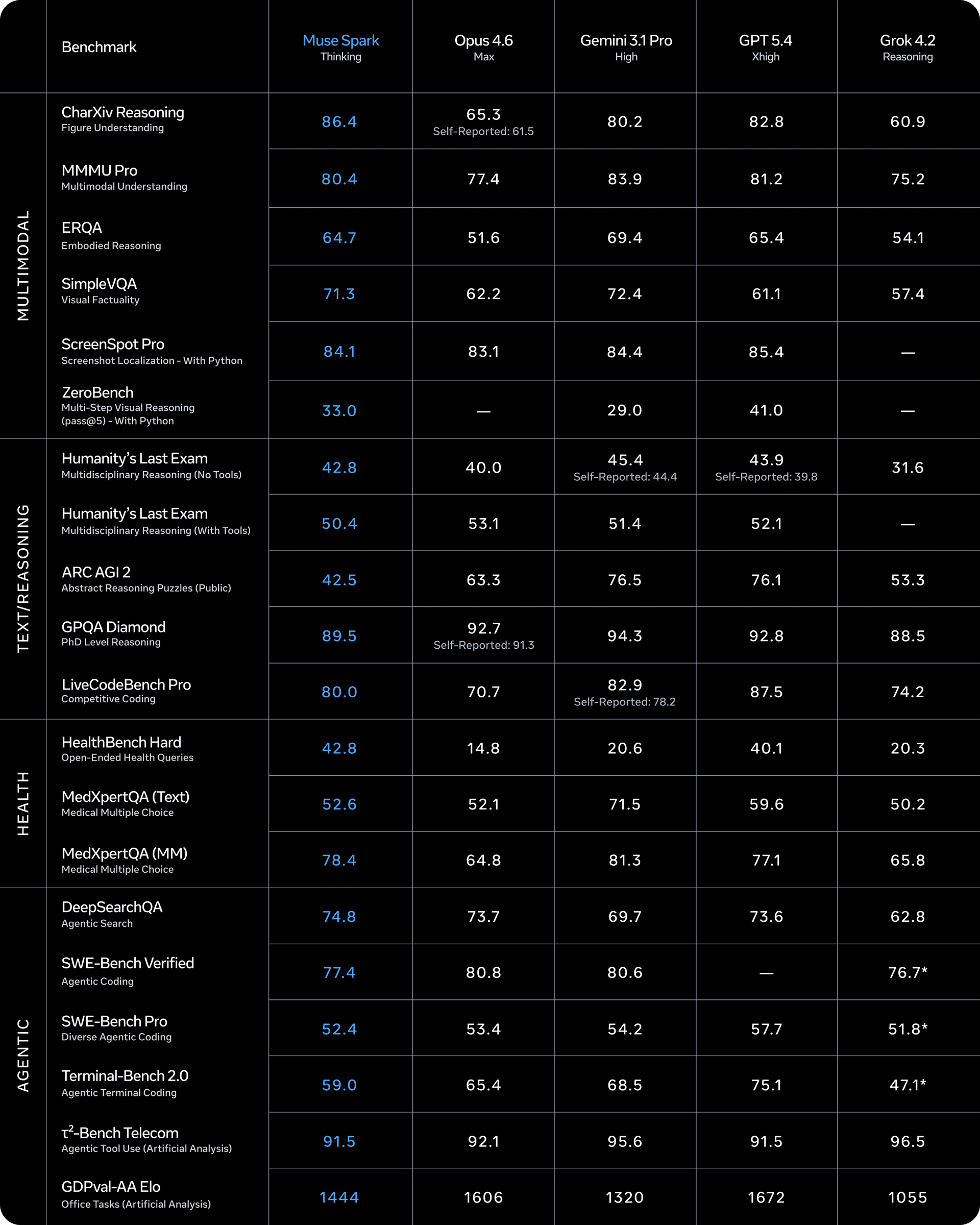
Muse Spark scores 52 on the Artificial Analysis Intelligence Index, behind only Gemini 3.1 Pro, GPT-5.4, and Claude Opus 4.6. Muse Spark is the first new release since Llama 4 in April 2025 and also Meta's first release that is not open weights.[10]
To appreciate how significant that score is, consider what came before. For context, Llama 4 Maverick and Scout scored 18 and 13 respectively on the Artificial Analysis Intelligence Index as non-reasoning models at the time of their release, while Muse Spark scores 52.[10] That represents a nearly 3x jump in a single generation.
The token efficiency story is equally compelling and has been independently verified. To complete the Artificial Analysis Intelligence Index run, Muse Spark used 58 million output tokens. Claude Opus 4.6 used 157 million. GPT-5.4 used 120 million. Muse Spark reaches roughly the same tier of performance while spending less than half the thinking time of its closest competitors.[10]
Where Muse Spark leads is specific and worth noting. On health benchmarks, Muse Spark scored 42.8 on HealthBench Hard, ahead of GPT-5.4's 40.1. On visual reasoning, it scored 80.5% on MMMU-Pro, second only to Gemini 3.1 Pro.[7]
But the model has clear weaknesses. It trails on coding (Terminal-Bench Hard, behind Claude Sonnet 4.6 and GPT-5.4), agentic tasks, and abstract reasoning (ARC-AGI-2 at 42.5 vs. 76+ for top competitors).[7]
For anyone building content around AI tools and trends, understanding these nuances gives you an edge. Most creators will never interact with Muse Spark directly through an API, but they will interact with it every time they use Instagram, Facebook, or WhatsApp in the coming months. And the strengths in visual reasoning and multimodal understanding mean the tools built on top of these models will get significantly better at tasks like generating YouTube thumbnails, creating AI images for social media, and understanding the visual structure of content that performs well.
The Open-Source Betrayal: Why Muse Spark Is Closed
This is the part of the story that has generated the most controversy and confusion across the developer and creator communities.
Perhaps the most radical move is that Muse Spark is no longer an open source model. With this, Zuckerberg breaks with the strategy that had earned Meta a loyal global developer community since early 2023.[10]
Starting over is a bold claim from a company that spent the better part of three years building Llama into one of the most widely deployed open-weight model families in the world. Llama 2 and Llama 3 had been downloaded hundreds of millions of times. Enterprises, startups, and academic researchers had built entire product lines on top of them.[6]
The announcement of Meta Muse Spark and the simultaneous end of the golden era of the Llama open-source series represents a historic U-turn by Mark Zuckerberg. Once positioning Meta as the "Robin Hood" of the AI industry by distributing world-class models for free, Meta has now chosen to follow in the footsteps of OpenAI and Google, locking its top-tier intelligence behind a paid API wall.[4]
The future of Llama itself remains uncertain. When asked, Meta merely stated that the existing Llama models would remain available as open source, but whether the Llama family will continue to be developed at all was left open.[10]
The open-source AI model that powered thousands of startups and research projects has been replaced by a closed model called Muse Spark.[2]
The new Muse Spark will be proprietary, with the company saying there is "hope to open-source future versions of the model."[4] But hope is a thin promise in the AI industry, and the developer community is rightfully skeptical.
The business logic behind the decision is straightforward, even if it stings. Meta's shift from open-source AI to proprietary models comes with business implications, as the company needs to find a path to new revenue.[7] Meta's clear advantage is the more than 3 billion people who use Facebook, Instagram and WhatsApp every month, and the business opportunity has nothing to do with trying to attract developers but rather focusing on its core market: advertising.[7]

What This Means for Content Creators in 2026
Here is where this story becomes directly relevant to anyone making YouTube Shorts, Reels, TikToks, or any other form of digital content.
Meta AI will be embedded in every creation surface. Muse Spark will power a smarter and faster Meta AI, and over time unlock new features that cite recommendations and content people share across Instagram, Facebook, and Threads.[7] This means the AI behind your Instagram caption suggestions, Reel recommendations, and ad targeting will be fundamentally more capable than what existed before.
Image generation on Meta platforms will improve significantly. With Muse Spark's native multimodal capabilities, expect AI image tools within Instagram and Facebook to become much more competitive with standalone generators. However, for professional content creation workflows where you need precise control over thumbnails, aspect ratios, text overlays, and consistent branding, dedicated tools like Miraflow's Thumbnail Maker and AI Image Generator still provide the specialized features that a general-purpose chat AI cannot match.
Short-form video content remains the dominant format. Meta is expected to overtake Google as the company with the most net ad revenue in 2026.[8] That spending follows eyeballs, and eyeballs continue to be glued to short-form video on Reels, Shorts, and TikTok. If you are not already producing short-form video content, Muse Spark is yet another signal that the platforms are investing billions to make this the primary content format for the foreseeable future.
The opportunity here is clear for anyone who understands the YouTube Shorts algorithm or has been studying how the TikTok algorithm works in 2026. AI models like Muse Spark are making content discovery smarter, which means the quality bar for what gets recommended is rising. Creators who rely on generic templates will struggle, while those who build consistent quality workflows will be rewarded.
How to Adapt Your Content Workflow Right Now
The AI model powering Meta's platforms has changed, but your content strategy does not need to panic-pivot. Here is what actually matters for your day-to-day workflow.

Keep your content creation stack platform-agnostic. The fact that Meta moved from Llama to Muse Spark in a single year tells you something important about building dependencies on a single platform's AI tools. Using browser-based tools like Miraflow that work independently of any one platform's AI means your workflow does not break when platforms make changes.
Double down on visual quality. Muse Spark's strength in visual reasoning means Meta's algorithms will get better at evaluating the visual quality of content. This is already the direction things have been moving, as covered in posts about why your YouTube thumbnail is killing your CTR and AI thumbnail styles that get more views. Invest time in learning how to create better visuals, whether that means mastering AI prompts for thumbnails or understanding the rules for effective YouTube thumbnails.
Use AI music responsibly. As AI models become more capable, the question of what counts as original content becomes more important. If you are using AI-generated music in your videos, make sure you understand the monetization rules for AI music in 2026 and how to generate no-copyright music that keeps your channel safe. Miraflow's AI Music Generator is designed specifically for creator-safe music that avoids Content ID issues.
Understand the multi-platform monetization landscape. Muse Spark is a Meta product, but your content should live across multiple platforms. The differences between YouTube Shorts RPM, TikTok RPM, and Reels monetization mean that a cross-platform strategy remains the smartest approach for maximizing revenue.
Batch-produce content efficiently. With AI tools improving across the board, the creators who win are the ones who can produce consistent, high-quality content at scale. Workflows that turn a single topic into YouTube Shorts, thumbnails, and music tracks in one sitting are the most efficient way to stay ahead of algorithms that reward consistent publishing. The 30-day YouTube Shorts plan is a good framework if you are looking for a structured approach.
The Bigger Picture: What the Muse Spark Shift Tells Us About AI in 2026
Muse Spark is not just a model launch. It represents a fundamental shift in how the world's largest social media company thinks about AI, and there are patterns here that every creator should pay attention to.
The first pattern is that open-source AI has limits. Meta was the loudest advocate for open AI development, and it walked away the moment it felt it was losing the race. This does not mean open-source AI tools will disappear, but it does mean that the most cutting-edge capabilities will increasingly sit behind proprietary walls.
The second pattern is that efficiency matters more than raw power. Meta said in a technical blog that improved AI training techniques along with rebuilt technology infrastructure has enabled the company to create smaller AI models that are as capable as its older midsize Llama 4 variant for "an order of magnitude less compute."[4] This is a direct reflection of the industry's pivot from "bigger is always better" to "smarter and smaller wins." It is also why specialized creative tools that focus on specific tasks like thumbnail creation, short-form video, or music generation can often outperform general-purpose AI models on those specific tasks.
The third pattern is that consumer AI and creator AI are converging. Roughly three billion daily active users touch Meta's products, and Muse Spark powers Meta AI across them. Every prompt, every caption suggestion, every smart reply, every image generation across meta.ai, Instagram, WhatsApp, and Facebook is a query served at Meta's cost.[10] The AI that recommends content to viewers is increasingly the same AI that helps creators make content. Understanding how these systems work gives you an advantage, which is why staying current with topics like the YouTube algorithm in 2026, Instagram Reels algorithm, and viral content strategies matters more than ever.
What Comes Next for Meta AI
The next generation is already in development.[7] Looking ahead, Zuckerberg wrote on Threads that Meta plans to release increasingly advanced models that push the frontier of intelligence and capabilities, including new open source models.[2] He added that "We are building products that don't just answer your questions but act as agents that do things for you."[2]

Muse Spark is expected to replace Meta Platforms' existing Llama-based chatbots across WhatsApp, Instagram, Facebook and smart glasses in the coming weeks.[9]
The agentic future that Zuckerberg describes, where AI does not just answer questions but takes actions on your behalf, has massive implications for content creators. Imagine an AI that does not just help you write a YouTube Shorts script, but actually produces the video, generates the thumbnail, creates the background music, schedules the upload, and optimizes the title and description for search. Pieces of that workflow already exist in tools like Miraflow's Text2Shorts, AI Music Generator, and Thumbnail Maker. The trajectory is clear: AI-assisted content creation is moving toward AI-orchestrated content creation.
Whether Meta's specific vision of "personal superintelligence" arrives on the timeline Zuckerberg imagines is debatable. But the direction is not debatable. Every major tech company is building toward the same future, and creators who learn to work with these tools now will have a massive advantage over those who wait.
Conclusion
Meta Muse Spark represents the most dramatic pivot in the AI industry since OpenAI shifted from nonprofit to for-profit. Zuckerberg spent $14.3 billion, hired a 29-year-old outsider to lead his most ambitious division, poached researchers from every major competitor, abandoned the open-source philosophy that defined Meta's AI reputation, and built a completely new model from scratch in nine months.
The result is a model that genuinely closes the gap with GPT-5.4, Gemini 3.1 Pro, and Claude Opus 4.6 on many tasks, while using significantly fewer resources to do it. It is not the best model on every benchmark, but it does not need to be. It needs to be good enough to power AI features for three billion users across Meta's app ecosystem, and on that front, it appears to deliver.
For content creators, the takeaway is practical. The AI powering the platforms where your content lives is getting dramatically smarter, which means both opportunities and competition are increasing. Creators who build efficient, AI-assisted production workflows using tools like Miraflow for their end-to-end content pipeline, from AI images and thumbnails to short-form videos and music, are positioning themselves for a future where quality, consistency, and speed all matter more than they did yesterday.
The Llama era is over. The Muse era has begun. And whether you are building faceless YouTube channels, growing an Instagram presence, or monetizing TikTok content, understanding this shift is the first step to staying ahead of it.
Frequently Asked Questions
What is Meta Muse Spark?
Muse Spark is Meta's newest AI model, the first produced by Meta Superintelligence Labs. It is a natively multimodal reasoning model that can process text, images, and speech input, with support for tool use, visual chain of thought, and multi-agent orchestration. It powers the Meta AI assistant across meta.ai, the Meta AI app, and will roll out across WhatsApp, Instagram, Facebook, Messenger, and Meta's smart glasses.
Did Meta really kill Llama?
Meta has not officially discontinued the Llama model family, but active development appears to have stopped. Existing Llama models remain available as open source, but Meta has not confirmed plans for any future Llama releases. All frontier development efforts are now focused on the new Muse model series, starting with Muse Spark.
Is Muse Spark open source?
No. Muse Spark is Meta's first proprietary, closed-weight model. This represents a major shift from Meta's previous strategy of releasing all AI models as open weights. Meta has stated there is "hope to open-source future versions" but has not made any binding commitments.
How does Muse Spark compare to GPT-5.4 and Claude Opus 4.6?
On the Artificial Analysis Intelligence Index, Muse Spark scores 52, behind GPT-5.4 (57), Gemini 3.1 Pro (57), and Claude Opus 4.6 (53). Muse Spark leads on health reasoning and visual understanding benchmarks but trails on coding and agentic tasks. Its biggest competitive advantage is token efficiency, completing benchmark runs using roughly half the output tokens of its closest competitors.
Why did Zuckerberg replace the Llama team?
The Llama 4 launch in April 2025 was widely considered a failure, compounded by confirmed benchmark manipulation where different model versions were used for different benchmarks to inflate scores. Zuckerberg restructured the entire AI division, founded Meta Superintelligence Labs, and hired Alexandr Wang as Chief AI Officer to lead a completely new approach.
Can I use Muse Spark for content creation?
Muse Spark is currently accessible through the Meta AI app and meta.ai website, with features including image generation, code execution, and visual reasoning. For specialized content creation tasks like YouTube thumbnail generation, short-form video production, or AI music creation, dedicated platforms like Miraflow offer more precise control and creator-focused workflows.
What happened to Yann LeCun?
Yann LeCun, Meta's longtime Chief AI Scientist and a prominent advocate for open-source AI, left Meta in November 2025. His departure followed organizational changes that reduced his role and the company's strategic shift toward closed-source development under Alexandr Wang's leadership.
Will Muse Spark affect Instagram and Facebook algorithms?
Yes. Muse Spark will power Meta AI features across all Meta platforms, which means content recommendation, ad targeting, and AI-assisted creation features will all benefit from the model's improved multimodal reasoning capabilities. Content creators should expect discovery algorithms on these platforms to become more sophisticated at evaluating visual quality and content relevance.
Is Muse Spark free to use?
Currently, all Muse Spark features are free to use through Meta's consumer products. Meta may impose rate limits in the future but has not announced any restrictions yet. API access is currently limited to a private preview with select partners, with pricing not yet disclosed.
How does this affect faceless YouTube channel strategies?
The underlying AI technology powering content platforms is improving, which raises the quality bar for all content including faceless channels. Creators using AI tools for faceless YouTube Shorts niches should focus on building distinctive visual styles and consistent quality workflows rather than relying on generic AI output. The combination of AI image generation, automated shorts creation, and copyright-free AI music gives faceless channel creators a strong toolkit, but the strategic thinking behind content selection and audience building remains a human skill.
References
- Llama 4 Scandal: Meta’s release of Llama 4 overshadowed by cheating allegations on AI benchmark - Tech Startups
- Who is Alexandr Wang? The 28-year-old hired by Meta for $14 billion to head their Superintelligence Labs - Storyboard18
- Bangkok Post - Meta unveils Muse Spark AI to challenge OpenAI and Google
- Muse Spark: Features, Benchmarks, and How to Use It | DataCamp
- Meta debuts the Muse Spark model in a 'ground-up overhaul' of its AI | TechCrunch
- How Meta Killed Llama to Save Its AI Business | by MohamedAbdelmenem | Apr, 2026 | Towards AI
- Meta accused of Llama 4 bait-n-switch to juice LMArena rank • The Register
- Meta Superintelligence Labs - Wikipedia
- What Is Meta Muse Spark? Meta Super Intelligence Labs' First Proprietary LLM Explained | MindStudio
- Muse Spark - Meta's NEW Llama Replacement - YouTube
- Meta exec denies the company artificially boosted Llama 4's benchmark scores | TechCrunch
- Who Is Alexandr Wang? The 28-Year-Old Hired For Rs 1,24,18,00,00,000, Dropped Out Of MIT At 16, Now One of Meta’s Highest-Paid Employees | News | Zee News
- Muse Spark - Intelligence, Performance & Price Analysis
- Meta debuts new AI model, attempting to catch Google, OpenAI after spending billions
- Meta unveils Muse Spark, its first new model since its botched Llama 4 debut. But will Muse Spark measure up to expectations? | Fortune
- The Llama Trap: How Meta's Pivot to Closed-Source 'Muse Spark' Upends Thai Enterprise AI - DEV Community
- 'Results Were Fudged': Departing Meta AI Chief Confirms Llama 4 Benchmark Manipulation - Slashdot
- Alexandr Wang, Chief AI Officer | Meta
- Meta AI Muse Spark Review: I Tested Meta's New Model | Engr Mejba Ahmed
- Meta debuts Muse Spark, first AI model under Alexandr Wang
- With Muse Spark, Meta Pivots Away From its Open-Weights Llama Strategy
- Meta's New Llama 4 Models Stir Controversy - BankInfoSecurity
- Zuckerberg Already Blowing Up Relationship With New Head of AI He Paid Ten Zillion Dollars to Hire
- MuseSpark - Harness True Model Potential
- Meta’s Muse Spark Is Reshaping Social AI: A Practical Image Creator Playbook for April 2026 - AI Photo Generator
- Meta introduces new shopping upgrades under AI model Muse Spark
- Meta Kills the Llama: Inside the Company’s Audacious Bet on Muse and Spark AI
- Meta Cheated on AI Benchmarks and It's a Glimpse Into a New Golden Age
- Meta releases 1st AI model from team led by $14-billion hire Alexandr Wang
- Meta’s new model is Muse Spark, and meta.ai chat has some interesting tools
- Meta Muse Spark: Full Review, Benchmarks vs GPT-5.4 & Gemini 3.1 Pro, and How to Use It (2026) | Ufuk Ozen
- Introducing Muse Spark: Meta's Most Powerful Model Yet
- Can Meta's new AI model Muse Spark make money?
- Muse Spark vs Llama 4: Meta's Strategic Shift | WaveSpeedAI Blog
- Meta Llama 4 Controversy Over Benchmark Manipulation
- Mark Zuckerberg Moves Into Meta AI Labs to Accelerate AI | Let's Data Science
- What Is Muse Spark (Meta AI) Actually Good For? Best Use Cases by Job Role - chatgptguide.ai
- Introducing Muse Spark: Scaling Towards Personal Superintelligence
- Meta’s Muse Spark AI Model: Features, Risks, What’s Next | Built In
- Meta Muse Spark : Meta is back after Llama debacle | by Mehul Gupta | Data Science in Your Pocket | Apr, 2026 | Medium
- Discover the controversy surrounding Meta's Llama 4 AI models amid alleged benchmark manipulation, sparking concerns in the AI community.
- AIM's Post
- Meta Muse Spark: The First AI Model from Superintelligence Labs That Challenges ChatGPT and Is Free
- Meta Ditches Llama: Can Muse Spark Revamp AI Roadmap? - Meta Platforms (NASDAQ:META) - Benzinga
- Meta defends Llama 4 release against 'reports of mixed quality,' blames bugs | VentureBeat
- Meta Superintelligence Labs: What We Know So Far | Built In
- What Is Meta Muse Spark? Meta Super Intelligence Labs' First Model Explained | MindStudio
- Muse Spark: Meta is back in the AI race
- Meta's Comeback: Muse Spark Puts Zuckerberg Back in the AI Race, Breaks With Open Source
- Unmodified Llama 4 Maverick ranks below rivals following Meta cheating allegations - Neowin
- Meta Launches ‘Superintelligence Labs’ in Bold AI Reshuffle, Taps Alexandr Wang as Chief AI Officer
- Meta Muse Spark: What Meta Is Actually Betting On - DEV Community